1821 Info 13b for Caleb Crompton
Nelson Frederick Wellington - in Gallipoli
Going to Gallipoli
World War 1 had been declared a few months previously in August 1914 and
two weeks after my brother was born my Father enlisted. I was just seventeen months. My Mother was
left with virtually two babies to care for and she was devastated. Three of her brothers also
enlisted: Leslie, Thomas, and Lyle. They were not married. All these young men believed they were
responding to the call to fight for king and country and defend the empire. They sailed away in
troopships in a spirit of adventure not knowing what horror and hardship lay ahead.
In March 1915 it was decided to form the 6th Infantry Brigade based in Victoria.
The 21st Brigade was made up of 'L' to 'S' Companies from the Infantry
Depot, Broadmeadows. The command of the 21st Battalion was entrusted to Lt.Col. JF
Hutchinson with 'C' Coy commanded by Lt. NF Wellington.
Right: The shoulder colours of the 21st Battalion AIF
During April [1915] the Battalion was organised and trained as a unit;
transport, machine gun, and signalling sections were formed, and the troops shook down into the
happy family life which lasted throughout our career. From those early days the 21st was the only
unit as far as we were concerned, and the spirit of the original members spread itself through all
those who joined us later on. The first week of May was spent in frenzied attempts to equip the
Battalion, and to weed out the unfit. Both attempts were successful, and on the 8th May, 1915, we
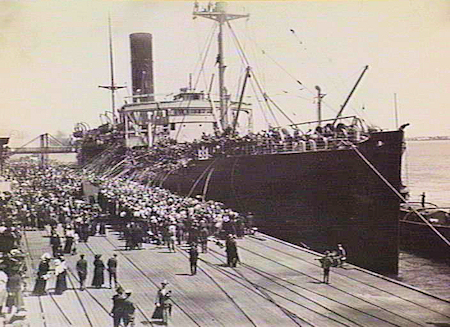
left Broadmeadows at midday, to embark on HMAT [A38] "Ulysses" lying at the Town Pier, Port
Melbourne.
At 14 499 tons and 14 knot the Ulysses, ex-China Mutual Steamship
Navigation Company, was the largest ship used as a troop carrier. She was
torpedoed and sank off Florida in 1942.
Embarkation was quietly carried out. There was no fanfare of trumpets,
and that night we slipped from the pier down the bay in company with the "Euripides," which
carried the 23rd and 24th Battalions. On our boat, 'besides ourselves, there were Brigade H.Q.
and the 22nd Battalion. Troopship life was strenuous. Like the rest of the A.I.F., we lived on
troop decks, slept in hammocks, grumbled at the food, and in between times wrote home. Parades
were held at 7a.m. for "jerks," 10 till 12, and 2 till 4 for General Instruction. The ground work
obtained during these parades in musketry and the theoretical part of soldiering enabled us to
start work in Egypt in a fairly advanced stage of training.
The sea was smooth throughout the trip. The main incidents were our visit
to Colombo, the subsequent trouble over the punishment of absentees, and finally the glorious trip
through the Suez Canal in daylight. Here we saw troops on active service for the first time, as
the "line" was then right on the Canal bank.
On arrival at Alexandria, at 2 p.m. on 8th
June, most of the troops took French leave for the evening. Next day we entrained for
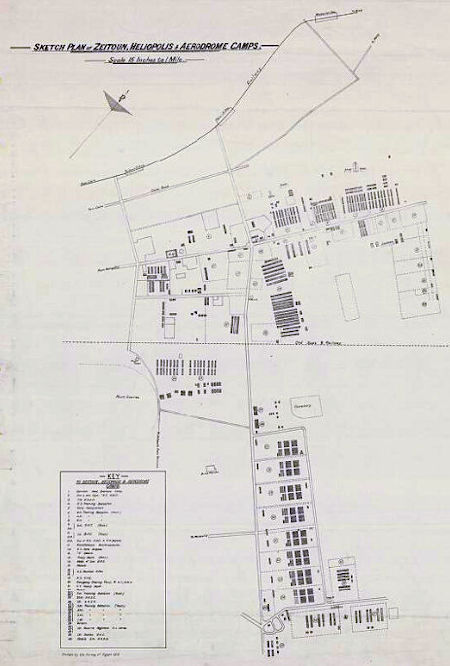
Helmieh Siding, thence we marched to the Aerodrome Camp, Heliopolis, which was our
home for the next three months.
Our first stay in Egypt is one of our happiest memories. In
spite of the heat, and the not too good tucker, we enjoyed our time off thoroughly.
Hard training in the early mornings and evenings kept us very fit. Heliopolis was
just next door to our camp, and Cairo 20 minutes by electric train, and the sights,
sounds and
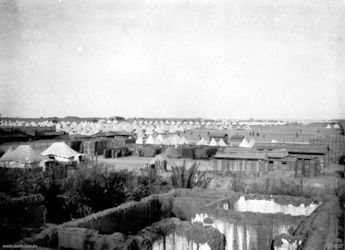
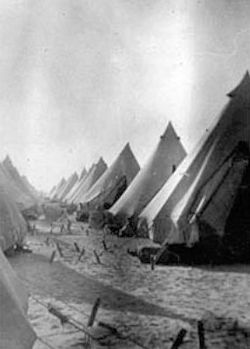
Left: Aeroplane Camp, Egypt Source:Trove
(Accessed: 01 May 2017)
1821info13b, sheet 3
smells of our new surroundings interested us. We worked through
the individual and collective stages of training rapidly, and spent most of July doing Battalion
and Brigade exercises on the desert. Junior officers and senior N.C.O's. underwent a course at the
Zeitoun School, which showed beneficial effects upon our efficiency.
In July, the 5th, 6th, and 7th Brigades were formed into the 2nd
Australian Division under Maj.-Gen. Legge, who was brought from Gallipoli to take charge.
Engineer companies and signallers were drawn from the Infantry, and trained with us. The 13th
Light Horse was detached as Divisional Cavalry, but we had no artillery, and did not get any
until after our return from the Peninsula.
From 12th to 23rd August "C" Company [Nelson] garrisoned the Cairo
Citadel, the other three companies. Kasr-el-Nil and Bab-el-Hadid Barracks in the city itself. We
were the first Australian troops to act as garrison in Cairo.
On returning to Heliopolis we absorbed our 1st and 2nd reinforcements,
which brought us to full strength, and on the night of the 29th August entrained at Helniieh
Siding once more, as a fully trained Australian unit, ready to take our place at the side of the
1st Division which had already made its name immortal on Gallipoli.
The 5th Inf. Bde. had preceded us by a week, and, even while we were
entraining, was taking part in the last effort which was made to cross the Gallipoli Peninsula,
and open the Dardanelles to our fleet.
Source: MacNeil, AR, 'The Story of the Twenty-First', The 21st Battalion
Association, Melbourne, 1920
Lieutenant-Adjutant Wellington wrote to his parents in Laurie Street Mount
Pleasant, Ballarat from Aerodrome Camp, Heliopolis, Egypt, where 21st
Battalion were under training at the Zeitoun war school.
Here he met his brother-in-law Lieutenant
Lyle Blackman, an officer of the 8th Battalion, who had
recovered from dysentery having been sent from the Gallipoli front to the base hospital. The next
day they were to meet again in Alexandria. Nelson also wrote about meeting Arthur Davis of
Ballarat, a sergeant in the 8th, Lieut. William Pearce, the son of the Mayor of
Ballarat East and Leslie Brooks of Smeaton (Bristol or Victoria?) who having arrived with the 1st Division was commissioned in the British Army.
The battalion was 'doing our field work',
which involved 'marching out through miles of sand,
sleeping there in what we walked out in and commencing hostilities at daybreak next morning. It
is wonderful what a soft, pillow a saddle makes on occasions like this. We all sleep on the
ground in our sleeping bags whilst in camp, but when out in the fields we simply throw ourselves
down and stick our heads on the saddles, and in a few minutes the starry Egyptian night listens
to our snores. The one advantage of being a mounted officer is we always have a pillow in our
saddle'. Officer training featured in Nelson's routine, undertaken by instructors who had
just returned from the front and who were right up to date'. On aggregate the 21st
was scoring very highly. Source:Trove: Letters from the
front. (1915, August 23). The Ballarat Star, p.5 (Accessed: 13 May 2017)
1821info13b, sheet 4
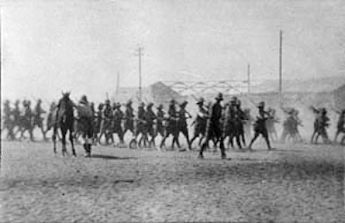
Above: 21st training at Heliopolis Camp June 1915. Note the officer
holding his horses head.
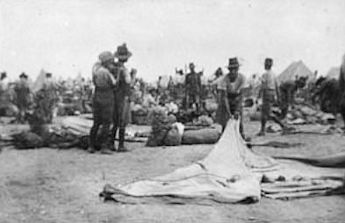
Above: Striking tents at Heliopolis Camp 27 August 1915
On 3rd September 1935
'The Victoria' Melbourne 1, hosted the First
Commemoration Dinner to remember the torpedoing of HMT B11 Southland, twenty years and
one day previous. Lieut-Col. N.F. Wellington MC VD Ship's Adjutant, one
of five members of the Commemoration Committee, supported the proposer of the toast.
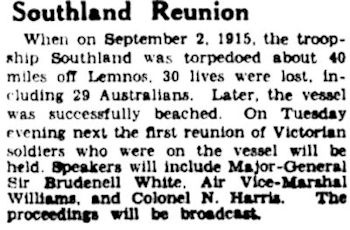
Right: The Argus, 31 August 1935
On page 10 of The Argus of Melbourne, on Saturday 7 September 1935, RCC Dunn wrote a very
comprehensive account of the Southland action, in which Nelson, as Adjutant and organiser of the
stoking party, played a prominent part.
On August 30, 1915, at 2 a.m., a four masted two-
funnelled transport named HMT B11 Southland, sailed from Alexandria for Mudros,
carrying Major General JG Legge and his staff,
Colonel R. Linton and staff of the 6th Brigade, A.I.F., the 21st, and a
company of the 23rd Battalion A.I.F., as well as details of British Yeomanry and
Artillery.
She had been a passenger liner of the
Belgian Red Star line, and was of 11,800 tons gross. On the outbreak of war she had
been taken over by the British Admiralty as a troopship and renamed.
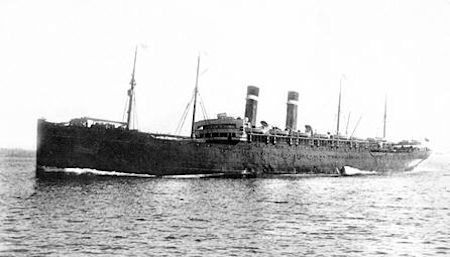
Left: HMT Southland, which took 2nd Division AIF from Egypt to Gallipoli.
1821info13b, sheet 6
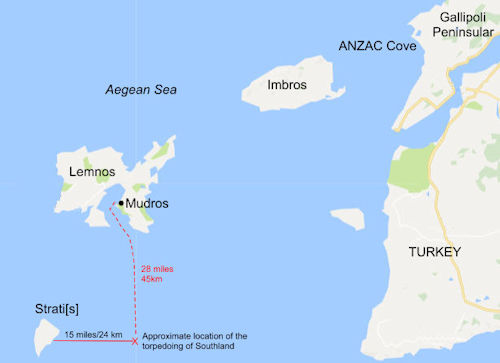
On September 2 she was steaming on her course, about 40 miles from
Lemnos. The Island of Strati[s] [modern Agios Efstratios or Saint Eustratius and colloquially Ai
Stratis] was in sight, 15 miles away on the port beam.
The sky was clear, with freshening winds. At 9.43 a.m. the wake of a
torpedo could be seen travelling towards the port bow; before the vessel could pay off under her
ported helm, the torpedo blew a hole 40ft. by 20ft. in the side, on the bulkhead between Nos. 2
and 3 holds. The torpedo came from the German submarine UB14, a vessel of only 142 tons, built in
a German shipyard, then sent in sections by rail to Pola [the Austrian Adriatic naval base], on
the Adriatic, to be reassembled there. She left Pola under the command of Kapitän Leutnant von
Keimburg for Constantinople, sinking the British troopship Royal Edward, carrying 1,366 troops,
and a crew of 260, of whom 866 troops and 132 of the crew, including the captain, were lost. This
occurred on August 13, and the submarine had previously sunk the Italian submarine Medusa.
Above: Map locating torpedoing of Southland
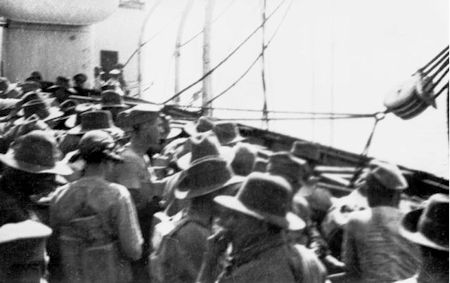
It was fortunate for the Southland that the military parade had been set
for 10 am, so that most of the troops were already on deck. The casualties were few.
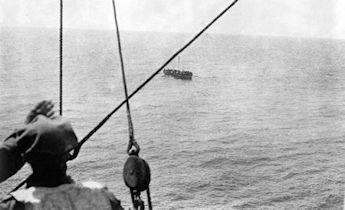
Right: Men of 11 Platoon, C Company, [Nelson's company] 21st
Battalion, AIF, moving a collapsible boat away from the torpedoed HMT Southland, 02
September 1915. Source: Australian War Memorial (AWM) A00746
1821info13b, sheet 7
A second torpedo passed harmlessly astern of the stricken ship, whose 4.7
inch gun aft, fired a round at the submarine's periscope, which then vanished, and was not seen
again. The Southland's commander, Captain J. B. Kelk, gave orders for the troops to man boat
stations. They had been instructed about these stations only the day before, but they ran without
confusion to them, and stood awaiting orders.
As the boats were being lowered, some or the firemen and stewards rushed
them as they passed down the vessel's side. The officers soon produced revolvers, and forced
the men in the boats to return to the ship to load up with troops.
The wireless operator had sent out an SOS, and several other vessels were
steaming rapidly to her assistance. Meanwhile, a boat containing the staff of the 6th Brigade, and
other troops, capsized as soon as it touched the water. Another boat collided with the capsized
boat, and turned over; a third had its forward sails cut when 20ft. above the water, dumping its
occupants into the fairly heavy sea now running. Colonel Linton was in this boat. He was picked up
after having been in the water an hour and a half, but he died in the French destroyer
Massue two hours later. All the rafts were
got over the side. Troops set to work breaking up the horse stalls, and dumping the timber
overboard, so that if the vessel sank there would be plenty of floatable material for those
unable to obtain places in the boats. Seeing one of the rafts drifting away, Private Geoff Smith
dived from the boat deck and managed to get it back alongside the ship, when it was rapidly
filled. The adjutant of the 21st Battalion, Captain N. F. Wellington (now
Lieutenant-Colonel NF Wellington, town clerk of Essendon), summoned the number of men
for each raft. Those whose turn was not yet stood there without movement, only their slightly
strained faces indicating their inner thoughts, but still they awaited their turn, knowing that
the ship, dependent on one bulkhead, might sink at any moment.
Above: Two boat loads of survivors, taken from the ship
deck Source: AWM A00738
At 10.15am, Captain Kelk, having been informed that three vessels were
coming to his assistance, asked if he could get a party of troops to stoke the boilers, the
majority of his crew having left the ship. Volunteers were called for, after the men had been told
of the dangers, that the bulkhead was bulging badly at the bottom through the great pressure
of the rising water. Six officers, [Nelson being the senior according to the Commemorative
programme], and eight men stepped forward. It is related that one of them asked the chief
engineer if it were worth while to stay, receiving the reply, "I do not give it much chance,
but I have a wife and children, and it's good enough for me", upon which the troops
immediately went below. By 10.30am, most of the troops, excepting about 400, as well as the staff
of the 2nd Australian Division and the Southland's officers, were all out of the vessel. As the
volunteers had gone below, the first of the rescuers, the hospital ship
Neuralia, arrived with her boats all swung out,
and her nurses and crew all in life-belts in case of torpedo attack.
She was soon busy picking up the occupants of rafts and boats and was
joined in a few minutes by H. M. seaplane carrier,
Ben-my-chree; the British destroyer Racoon
(Lieut-Commander Hardy formerly of Flinders Naval Depot and a grandson of Nelson's
Hardy); the French destroyer Massue and
H.M. transport Haverford also arrived.
Volunteers were called for from among Racoon's
stokers to assist in the Southland.
There was a rush of men, some coming straight up out of the destroyer's boiler rooms to clamber
into the boat. Twelve were sent away to the troopship.
1821info13b, sheet 8
The men of the 21st Battalion had raised a pressure of 200lb. in the
boilers when relieved by the naval stokers. H. M.
gunboat Hussar also arrived and sent a carpenter's mate to shore up the bulging
bulkhead, which he accomplished after tremendous efforts. As the vessel was carrying several
thousand tons of military stores as well as a large amount of bullion,(£30,000 1
equivalent to £2.206 million in May 2017) his work was invaluable.
Southland was
listing so heavily to port and down so much by the bows that her rudder had little effect.
Ballast tanks on her starboard side were flooded giving her a list to starboard but she steered
better. Ringing slow ahead on the engine-room telegraphs, Captain Kelk felt the vessel move ahead
at a speed of two knots. Racoon circled round
to ward off any further submarine attacks. The large troopship Nile with a full complement of troops on board slowed almost to a standstill
alongside until the destroyer sent an order to her to get on her way to Mudros which she did,
zigzagging as she went to foil any submarines.
Slowly Southland
steamed onwards until nearly 6pm, when she was in sight of Mudros. She was drawing 34ft. (10.363m)
forward, and only 18ft. (5.5m) aft, so that with her two propellers partly out of the water she
was yawing dangerously. She was still expected to sink at any moment, but the military and naval
volunteers with the ship's officers stuck grimly to their tasks.
Shortly before 7 p.m. the sun set, and darkness fell almost immediately.
The next difficulty now was to get the almost unmanageable vessel through the 50 yards (45.72m)
wide gate in the anti-submarine boom across the entrance to Mudros Harbour. The destroyer
signalled for the gate, which was always closed at sunset, to be left open, and the almost
impossible task of getting Southland through
was undertaken. A tug came out of the harbour, and making fast on the port side abaft the funnels,
assisted considerably in guiding the stricken vessel through the entrance. Even through the gate
troubles were not over, for there were dozens of warships, troopships, water carriers, colliers,
and numerous small craft at anchor scattered all over the waters of the harbour.
Slowly in the darkness she steamed through the lines of ships in the
upper reaches to a soft sandy beach, where she was quietly put ashore and allowed to settle down.
Racoon went alongside and made
fast for the night. The bullion room was intact with an armed sentry posted
outside its door. One officer and 31 troop had lost their lives in the capsizing
of the boats.
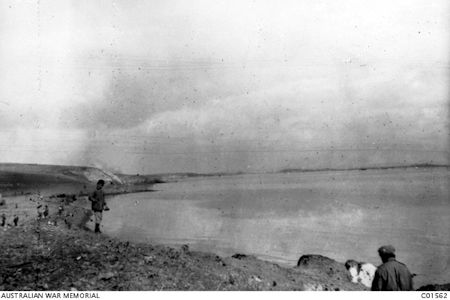
Right: A beach in Mudros harbour 1915
There were no casualties among the
Southland's personnel. Salvage operations
were immediately undertaken. The torpedo holes were covered with concrete patches until finding
these to be watertight the naval salvors pumped her out and she proceeded to Malta under her own
steam, convoyed by destroyers. She was permanently re-paired in the naval dockyard [illegible]
her services as a troopship. After [Illegible] valuable service she was fated not to see the end
of the war or resume her peace-time passenger services, for on June 4, 1917, when 140 miles north-
west half west from Tory Island, she was struck by a torpedo from a German submarine and sunk.
Four of her crew were drowned.
1821info13b, sheet 9
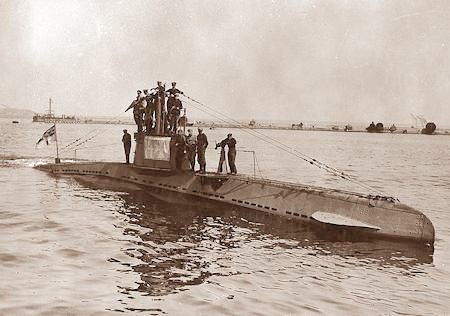
UB14 was surrendered to Britain at Sebastopol in 1918, and broken up in 1919.
Left: UB41 under the White Ensign at the end of the war
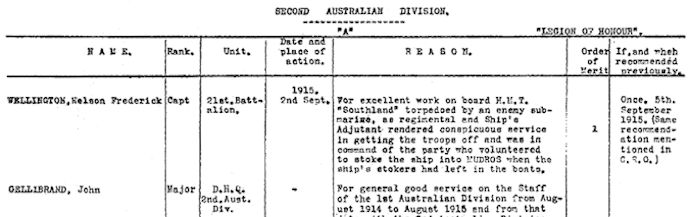
Following the Southland incident Nelson
was recommended for the Legion of Honour (Légion d'honneur à titre militaire for service
(Wiki). It was usual that countries could nominate a certain number of soldiers for this French
award. Despite Nelson being first in the order of merit, the award was never made. It is
interesting to note that Maj-Gen Sir John Gellibrand, who commanded the 3rd Division from 1918 to
1922, was second on the list and has, according to Wiki, the award.
NC Smith, Red and Black Diamond, Mostly Unsung, Melbourne, 1997 Captain Wellington
is mentioned for his skill & bravery
1821info13b, sheet 10
The Gallipoli Campaign
The Australian War Memorial records
'The 21st Battalion arrived in Egypt in June 1915. As part of the newly
raised 2nd Australian Division, it proceeded to Gallipoli in late August. It was an eventful trip,
the battalion's transport was torpedoed near the island of Lemnos and had to be abandoned. The
battalion finally landed at ANZAC Cove on 7 September. It had a relatively quiet time at
Gallipoli, as the last major Allied offensives had been defeated in August.' 1
The family record that whilst in Gallipoli, Nelson served at Quinn's Post 2 and later
was promoted to be in charge of company of men in Lone Pine trench in the last few weeks before
the evacuation.
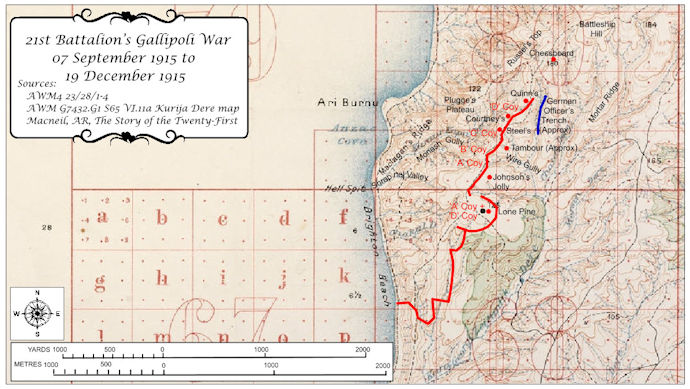
The 21st Battalions War Diaries, 2 from their landing in September 1915 to their
evacuation in December 1915, cover very few pages per month and record only the names of those
killed, Nelson was To be O.C. "A" Coy from 9/10/15.
Nelson Wellington commanded 'C' Company (hereafter Coy) on embarkation. His service record
3 notes that he was given command of 'A' Coy on 10 October 1915. Whilst company
positions appear to remain static, there is little detail of Company's being identified or their
disposition, The Story of the Twenty First (MacNeill) does show 'A' Coy defending Wire
Gully then, in December 1915, they took over the trench at Lone Pine. Nelson remains one of three
named officers in the War Diary being in command of the first evacuation group at 1900
hours on Sunday 19 December 1915.
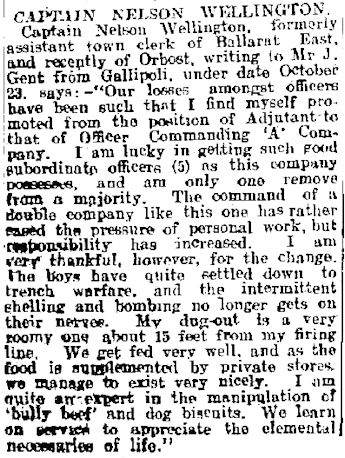
Nelson's letter published, on page one of The Ballarat Star, gives a
comprehensive description of his promotion from battalion Adjutant to the command of
a double company this is presumed to be 'A' and 'B' as they were
together at Lone Pine.
Similarly, he gives a basic description of his life in the trenches and how everyone
has got used to the routine of trench life.
Under the heading of 'Musical Notes' The Australasian of 04 December 1915 reports that
N. Wellington, of Ballarat, sends a copy of "Our
Australian Navy," a song written and composed by Captain Nelson Wellington, who is on
active service, and was one of those who helped to stoke the torpedoed transport
Southland." Source:Trove (Accessed: 05 May 2017)
Whilst anticipating his majority, it eluded him in World War 1.
Left: Ballarat Star 04 December 1915 Source: Trove
(Accessed: 05 May 2017)
1821info13b, sheet 11
After the 'Southland' incident, the 21st commenced loading on the HMT Abassieh
on the evening of 07 September 1915, 4 unloading at ANZAC at 2150 hours. The last
boat from HMT Abassieh unloaded at 0430 on the morning of 08 September. That day the
battalion bivouacked in Rest Gully.
By 1000, two platoons were taken to the firing line with the
remainder of the battalion moving up to the support trenches of Northern No.2 at
2230 by way of Monash Gully.5
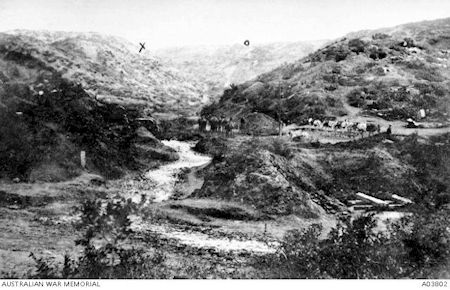
Left: The route to Quinn's (marked x) and Courtney's Post
(marked O) via Monash Valley
Source: AWM A03802
One day later, an eager battalion fired three rounds rapid fire to entice an enemy response.
Limited fire was returned from Quinn's Post, German Officer's Trench (hereafter GOT) and
Johnson's Jolly. For the duration of their stay the Battalion Headquarters was on the terraces
behind Scott's Point.
Division ordered no attacks resulting in major loss of life. That 21st Battalion had
a 'relatively quiet time' is borne out by the battalion War Diaries from September 1915 to
December 1915 6, which describe a routine life of both sides sniping 7, 8,
by day and night, both sides bombing 9, the enemy shelling, firing various coloured
flares, tunnelling and the 21st repairing the parapets and parados. On 19 October at
0800 fraternisation took place in no-man's-land, when bully beef 10 was exchanged for
cigarettes.11 Thirty minutes later a Turkish bombardment was recorded.
'A' and 'B' Coy held the line from Wire Gully on the right to where
the boundary with 22nd Battalion, 'C' Coy occupied Steel's Post and
'D' Coy Courtney's Post. On the battalion left was the 17th Battalion who manned
Quinn's Post. 12 Bean records 21st Battalion at Courtney’s in a
line facing GOT.13
The battalion settled into its 'quiet' routine of deadlock until the
evacuation. In September and October, nine days were described as
'Nothing important happened'
Above: View from Courtney's Post towards Plugge's
Plateau in 1915 Source: AWM A01208
In November there were eleven equally quiet days, with two being described as
'very quiet'. Part of the routine was to provide 100 men for the
competition to be included in the more dangerous 'beach parties' that gave a degree of freedom.
14 However on 12 September 1915, following day and night sniping, Nelson's 'C' Coy and
'D' Coy received 30 bombs, which resulted in four wounded but no damage. It wasn't until 13
November 1915 that 'Our snipers appeared to have gained superiority as
the enemy's sniping had decreased considerably along our front'.
1821info13b, sheet 12
In three and half months enemy action accounted for three soldiers killed, 22 wounded with four
slightly wounded. On eleven occasions, following an action, the War Diary report states
Nil casualties or very light.
In September 1915, a 'large percentage of the men who are suffering
from diarrhoea or dysentery'. The doctor was concerned about a correlation between this and
men with bad teeth and the 200 reinforcements, of whom 25% were on sick parade. This may have been
caused by the report of 13 September when '[t]renches [were] infected
with vermin, flees and lice. By 30 September 4 officers and 83 others [went] to hospital, despite
the most rigorous sanitary precautions. Included in this 83 are 24 wounded 13 of which were self
inflicted by accident'.
In a second letter to Mr Gent, Nelson records that Sergeant William Pryor 16,
assistant town clerk of Ballarat East, as one of these casualties. Nelson writes:
"You will be interested to learn that Pryor has been
transferred to hospital with typhoid. He has been very ill with the prevailing soldiers'
complaint, dysentery, but managed to stave off the worst stages. Yesterday, however, he had to
surrender. The R.M.G. packed him off last night to the hospital ship."
Source:Trove: The Ballarat
Star 04 December 1915 (Accessed: 05 May 2017)
At 1623 on the 10 September 1915 the enemy introduced the 21st to a baptism of shell
fire 'when German guns on MORTAR RIDGE fire 5x10 pound shells into our
trenches and at the same time 7x75[mm] were fired from TURKS HUMP five of which struck out
trenches. Parapet damage'. This resulted in the first two wounded casualties. The 21
st were kept alert by frequent but light Turkish artillery bombardments with an
assortment of pieces. The most common were the 75mm 17 (69 rounds) and 6 inch/150mm
18 (more than 28 rounds). On 08 December 1915, eight 15"/400mm shells landed on the
Tambour and Wire Gully positions. Also fired were 10 pounder/4.5kg and 12 pounder/5.5kg shells.
19 The War Diary identifies, but also uses the term 'heavy' 75mm bombardment and
includes the 75mm with an early 100-shell salvo. There is only one account, on 16 October, of an
Allied response. However, on 08 October at 2000, the Turks subjected the 21st
'to heavy rifle & machine gun fire on our lines which lasted for
about half an hour. [Thought the enemy] became "grumpy" owing
to the storm which broke at that particular time'. Two days later the 21st responded by
throwing two messages, written in Turkish, into the enemy trenches.
Above: Approximate locations of 21st Battalions in
Gallipoli Click on the map to open an A4 .pdf landscape image
Neither side chose to raid. There appears to have been only been two incidents when the
battalion stood-to. On 27 November 1915 at 0450 all four companies were on alert when
'enemy patrols were heard in WIRE GULLY & were fired on by one of
our machine guns [...] D Coy reported orders were heard in TURKISH trench - men could be seen
silhouetted over the parapet & later about 6 of the enemy were observed running towards
STEELS POST
1821info13b, sheet 13
& were fired on'. The second occasion was on 09 December
1915 when, at 2100, heavy rifle and machine gun fire was heard to the battalion's left, but the
enemy was quiet on the battalion's immediate front.
Nelson's 'A' Coy and 'B' Coy stood-to at 2037 on 03 December 1915 when the 22nd
Battalion report Turks in front of their trenches. Nothing was seen. During the three and half
months in the line, the War Diary records the 21st sending out two patrols, one of two
men, towards the enemy lines; on one occasion recovering two Turkish bodies and rifles.
Both sides indulged in 'Chinese Attacks', a term given to a faked attack upon enemy trenches
and causing the enemy to 'stand to', to test the probable reaction of the enemy to a more
seriously intended raid and to keep him jumpy. This was as simple as showing a row of bayonets or
dummies above the parapet (24 September) and cheering (16 October) or making noises in the
trenches. On 16 September 1915, tins were thrown over the parapet to simulate bombs and on the 18
October rifles were just thrust over the parapet. In response '[t]
he machine guns [...] were turned on the crest of our parapet and would have been very effective
had one man exposed themselves'.
Despite the inaccurate Turkish artillery, engineering work continued on most days. The War
Diary records only eight occasions when the parapet had to be repaired and two (22 October 1915
at 1700 and 6 December 1915) when the parapet was destroyed. This implies that the trench was also
destroyed. However, there is no mention of casualties from these salvos. It wasn't until 18
October 1915 and again on 30 November 1915 that the engineering work involved
'erect[ing] some wire entanglements (French wire interlaced with
barbed) in front of our trenches'.
In early November the battalion shortened its front by handing over Steel's and Courtney Posts
to the 18th Battalion, and taking over a short company front at Tambour from the
22nd Battalion. This enabled 200 men to dig tunnels.20 On three occasions,
the October War Diary mentions tunnelling and later tunnels 21 being prepared for
'winter quarters' and perhaps bombardment shelters. Both sides firing three
offensive mines from tunnels under
no-man's-land. 3
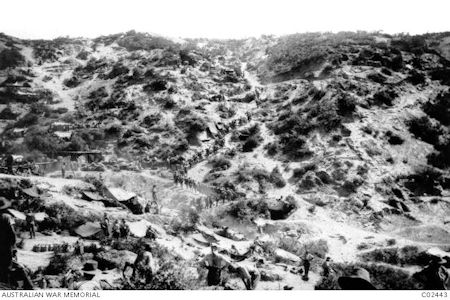
Right: 22nd Btnn in Wire Gully (at the head of Shrapnel
Gully) en route to Lone Pine in 1915
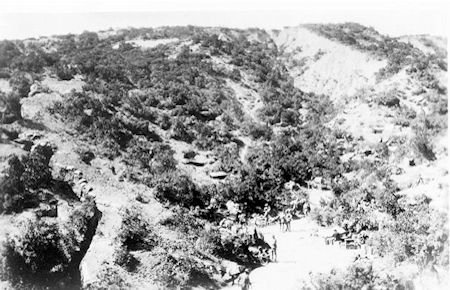
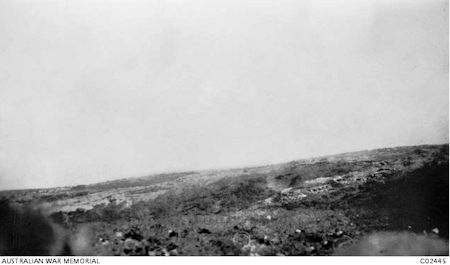
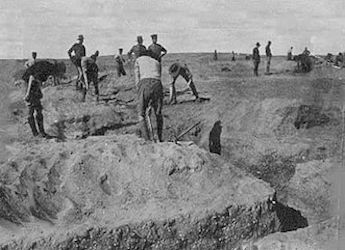
Source: AWM C02443 Below: No-man's-land at Lone Pine in 1915, held by
22nd Battalion and probably as it was for 21st Battalion Source:
C02445
Preparations for the evacuation began on 11 December 1915 with the hand
over of Tambour to 22nd Battalion.
The following day 'We handed our
own trenches to 13th ALH [Australian Light Horse] & moved to
SHRAPNEL GULLY. A&D Coys went into LONE PINE trenches taking one Coy
frontage. The other Coy in support'.
1821info13b, sheet 14
Nelson commanded 'A' Coy at Lone Pine for six days before commanding the first of 21st
Battalion to be evacuated. Because of this there is a more detailed account of Nelson's
movements. 'A' Coy withdrew from Lone Pine to Shrapnel Gully, taking over Wire Gully from 13
th Australian Light Horse (ALH). Careful preparations were made to deceive the enemy. 'Time
fused' 22 rifles were set and cook fires and incinerators left alight. Even though
there were only two 'quiet' days leading to the evacuation, there was no evidence that the Turks
knew what was happening.
Lt. Col. J Hutchinson's account of the evacuation is in the War Diary,23 but has
a date contradiction of two days.
'Definite arrangements for the evacuation were announced on the 17
th inst when all stores such as signalling gear Medical Panniers & Battn tools were
collected & sent down to the beach. On the same evening at 1800 "A" Coy were withdrawn from
LONE PINE & rejoined the battalion (less men who had taken over trenches from 13th
ALH in SHRAPNEL GULLY').
Evacuation
On the final night of the retirement, those to be withdrawn from the front
trenches will quietly withdraw and take up covering positions in silence which have been
previously arranged for. Those left in the front trenches to the last will in their turn quietly
and silently leave their trenches, passing through their comrades in covering positions and to
their places of embarkation in the same soldierly manner, in which the troops have effected their
magnificent landings on the shores of this peninsula during the last eight months. To withdraw in
the face of the enemy in good order, and with hearts full of courage and confidence for the
future, provides a test of which any soldier in the world may be justly proud, and that the 9th
and “Anzac” Corps will prove themselves second to none as soldiers of this Empire, I have not the
slightest doubt.24
Later Hutchinson writes: At 1030 [on Sunday 19th] A Coy
at LONE PINE were relieved by 24th Batn & joined the Batn in
SHRAPNEL GULLY. During the day all surplus store which could not be removed were destroyed. At
1900 our first party of 3 officers & 147 others under Captain Wellington moved off
to the rendezvous & then to the beach & embarked. [...] During the day 19th
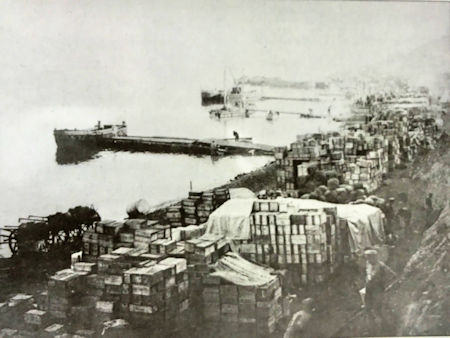
(sic) everything was quiet normal & the whole battalion 25 (except those actually
in the trenches) had embarked. [...] The unit embarked safely 26 & had no
casualties. [...] The first party landed at IMBROS at 0400 on 19th inst & remained
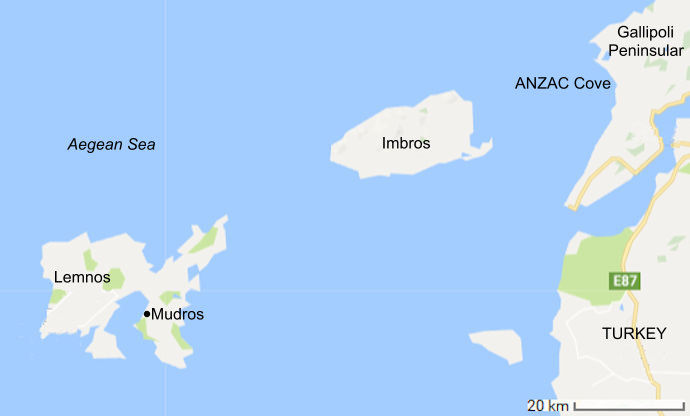
there until 1630 on 22nd when they embarked on a trawler & were taken to MUDROS.
They were transhipped to Z75 which left LEMNOS at 0700 on 23rd arriving ALEXANDRIA on
the 26th & the party arrived in camp at TEL-EL-KEBIR on the 27th Dec.
[...]
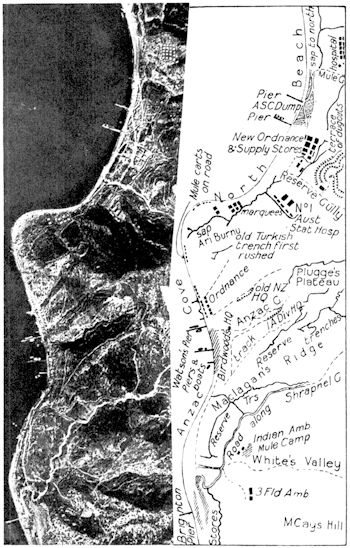
Left: Watson's Pier as mention by McNeil - see note 25 below
1821info11b, sheet 15
Above: Aegean Sea around ANZAC showing the locations
mentioned in the evacuation
Whilst in camps at MUDROS & TEL-EL-KEBIR both detachments were
occupied in platoon & Coy training, general field work & route marches. The whole
battalion was got together on 8th January 1916'.
During their stay on Gallipoli the Battalion dwindled from near 1000 to 650 strong, even with
their third reinforcements who joined on 11 October 1915. Casualties were light but constant work
in the front line, short rations and dirt causing sickness took its toll. 2
Gallipoli was finally evacuated on 9 January 1916.
1821info11b, sheet 16
Footnotes
1Australian War
Memorial (AWM) (Accessed: 01 May 2017) 2
Australian War Memorial (AWM) 21 Battalion War Diary September 1915 Click for
subsequent month (Accessed: 28 June 2024) 3National Archives of Australia (Accessed: 20 February 2019) 4 MacNeil On page 9 MacNeil record the departure 'on the evening of 06 September 1915
[and landing] at ANZAC Cove before midnight'. 5Australian War Memorial (Accessed: 20 February 2019) 6 AWM4 23/28/1, AWM4 23/28/2, AWM4 23/28/3, AWM4 23/28/4 respectively. Source unless
otherwise stated. 7 The 21st were successful in knocking out Turkish sniper posts using the Wallaby
sniping cage. These cages, with a front of 18mm steel, were used to hold a rifle in a fixed
position after aiming, so that it could be fired again at the same target without re-aiming,
principally for night firing. The concept was invented at Gallipoli by Major William Thomas
Charley of the 6th Light Horse Regiment.
Australian War Memorial (Accessed: 01 May 2017) 8 On 03 November the enemy discovered the 21st snipping post at Steel's Post, which was
temporarily vacated. 9 The Turks used 'stick' bombs and 'football' bombs. The 21st used a broomstick bomb,
an Australian version of a Turkish jerry-rigged hand grenade that was attached to a stick to
increase the throwing range. Australian War Memorial (Accessed: 01 May 2017) They also used improvised
'Jam Tin Grenades' or 'Garland' bombs in an improvised 65mm Garland trench mortar.
Australian War Memorial
(Accessed: 01 May 2017) Catapults were frequently mention as a method of
propelling bombs. Catapults had the distinct disadvantage of protruding over the parapet and
showing their position. 10 MacNeil p.9 11 Bean Chapter XXVIII p.822 THE STORY OF ANZAC [Aug.-Oct., 1915 ] During the
Mohaniniedan feast of Bairani, which lasted from the 18th to the 20th of the month. [...] the
celebration was marked in a different fashion. The Turks opposite Quinn’s and near German
Officers’, who among themselves were receiving visits and exchanging presents, ceased hostilities
and, making signs from their parapet, threw cigarettes to the men of the 17th and 21st Battalions-
who flung cigarettes and “bully beef” in return. 12 MacNeil p.9 13 Bean Chapter XXVIII p.810 THE STORY OF ANZAC [Sept., 1915 ] The Autumn. 14 MacNeil p.9 15 Sum totalled from War Diary entries. 16 Sergeant William Percival Pryor 21st Battalion, of Ballarat, Vic. enlisted on 15
March 1915. He was later commissioned as a Lieutenant and returned to Australia on 9 February 1916
as a member of the 29th Battalion. Source: Australian War Memorial (Accessed: 05 May 2017) 17 Probably a Model 1903 75 mm Field Gun contract used by the Turkish Army during the
First World War. This gun was made by Krupp, one of 558 made to Turkish specifications.
Australian War
Memorial (Accessed: 01 May 2017)
18 A Turkish 6 inch gun was made by Vickers & Sons and Maxim in 1910.
Australian War Memorial (Accessed: 01 May 2017) 19 Sum totalled from War Diary entries. 20 MacNeil p.9 21 An AWM photograph shows a Tambour Sap tunnel being used as a sniper loophole.
Australian War
Memorial (Accessed: 01 May 2017) 22 Rifles were left in trenches and set to fire by an automatic means: a dripping tin
could drop a weight when empty, which pulls the trigger by an attached string. 23 AWM4 23/28/4 pp.6-9 24 Liddell Hart Centre for Military Archives: Hamilton 7/4/39, Apecial Army order, 17
December 1915, in Farrimond p.123 25 Bean Chapter XXX p877 Dec., 19151 THE EVACUATION The Battalion gathered at
MacLaurin’s Hill with the 13th L.H. Regt. 26 Probably at Watson's Pier. MacNeil p.10 27 MacNeil p.9
1821info13b, sheet 17
An air-photograph of Anzac Cove after the August offensive. The annotated
sketch to the right shows the location of Watson's Pier.
Source: Bean,
CEW, 'Official History of the Australia in the war of 1914-1918 Volume XII,
Photographic Record of the War, Naval and Military Press reprint, undated,
plate 123
Bean, CEW, Volume II – The Story of ANZAC from 4 May, 1915, to the evacuation of the
Gallipoli Peninsula (11th edition, 1941) Chapter XXVII The Autumn Australian War Memorial (Accessed: 01 May 2017)
Bean, CEW, Volume II – The Story of ANZAC from 4 May, 1915, to the evacuation of the
Gallipoli Peninsula (11th edition, 1941) Chapter XXX The Evacuation Australian War Memorial (Accessed: 01 May 2017)
Farrimond, Richard, Birdie More than 'Soul of Anzac, Field Marshal
Lord Birdwood of Anzac and Totnes, 1865-1951, Helion, Warwick, 2023
MacNeil, AR, The Story of the Twenty-First, The 21st Battalion Association, Melbourne,
1920
During the War 538 Cpl. Ivor Alexander Williams, 21st Battalion, also a native of
Ballarat, sent home various small diaries to his cousin Rita Gadd, who typed them into a
complete diary. His son, Hugh, made the diaries available on the web. Closely matching the
official War Diary, they present the perspective from an unofficial 'other ranks' source.
I am grateful to Hugh Williams for allowing me to reproduce his father's photographs.
1821info13b, sheet 18
More information 1
The Victoria Hotel, Melbourne
The Victoria Hotel is one of the original hotels in Melbourne, established 135
years ago, opening its doors for business on 1 November, 1880, just 45 years
after Melbourne was established in 1835. This historic Melbourne hotel was known
as a luxury hotel in the 20’s and 30’s, prided itself on its guest service,
including porters being sent to meet guests arriving at Port Melbourne Docks and
Spencer Street Train Station.
At one stage, The Vic, as it became known, was advertised
as the largest hotel in the Commonwealth
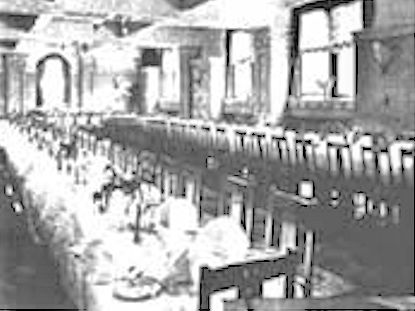
Left: The Victoria Hotel dining room, possibly where the First
Commemoration dinner was held
... Throughout May [1915] a great deal of work was devoted to developing their
strength and establishing a margin of safety in case of a major Turkish attack. As
it was impossible to create a single, continuous line, like those on either flank,
tunnels and deep communication trenches had to be carved out to link the posts.
increasingly the Turks began to rely on a steady supply of bombs, a weapon with
which the MEF had not been provided and which the Anzacs now had to learn to
improvise from jam tins, and overhead cover became a priority to reduce the drain
of casualties they caused. A mutually supporting network of enfilade fire was also
developed to overcome the difficulty of firing directly to the front. Central to
this part of the line was Quinn's Post, which probably had the most evil reputation
of all. The situation at Quinn's verged on the surrealistic, with the Anzac
front line wedged between an almost sheer drop which cascaded down into Monash Valley, a
mere five yards behind the rear of the
trench, and the Turkish front line, which lay only a matter of a few feet in front.
(cont:-)
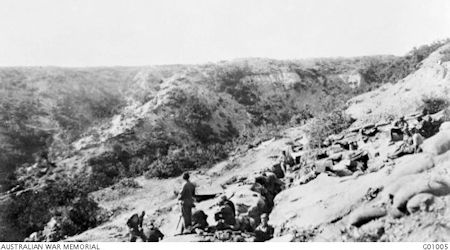
Left: Quinn's Post July 1915 looking to Russel's Top
Source: AWM G01005
1821info13b, sheet 19
More information 2 cont
Quinn's Post
Yet, likewise, Turkish fire from Dead Man's Ridge alongside Pope's Hill and German
Officer's Trench beyond Courtney's Post prevented the Anzacs from pushing their
position further inland. As the weeks went by, raids and constant bombing created
wretched conditions and the fear of death became ubiquitous. We were told that the
battalion was to go up and take over Quinn's Post. All the way up the track there
were sandbags placed to stop the bombs rolling down the hill. There were men
coming and they said to us, 'You're going to absolute hell and you'll probably
never come back!' We crawled up on this track to Quinn's Post which was a ghastly
spot - hot and barren, all sorts of holes and trenches, in one place literally
within inches of the Turkish trench. In fact there was one place where you could
put your hand round the corner and shake hands with a Turk as he put his hand
round. I was determined to see what the Turkish trenches were like, and in
daylight I popped up over the top of the trench and had a look round, and down
again. I got into trouble for this, blasted by the Colonel who said I was 'a
perfect bloody fool' and what on earth did I do that for?'31 (2nd Lieutenant
Rupert Westmacott Auckland Battalion letter dated 03 April-08 Jun 1915)
Source: Steel, Nigel and Hart, Peter, Defeat at Gallipoli, Papermac,
London, 1995, pp.171-2
In isolation Quinn's would have been indefensible. But
enfilade fire from Pope's Hill to the west and Courtney's Post to the
south prevented the Turks from overrunning it.
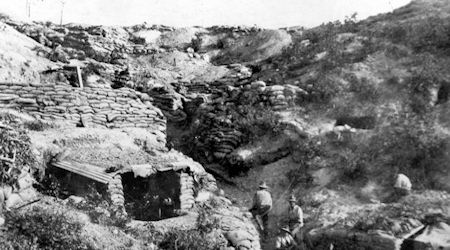
Left: Quinn's Post c. May 1915 Source: AWM A02009
1821info13b, sheet 20
More information 3
Australian tunnels on Gallipoli
Simon Jones gives a detailed account of the mining activities in 21st
Battalion's area.
Nelson Wellington's company
may have been involved in their construction.
'The strength of the defences above ground at Anzac meant that from September offensive
work moved underground and the corps commander Birdwood, ordered a comprehensive scheme
along much of the sector. The plans of Major General J.G. Legge, commanding the 2nd
Australian Division, for Lone Pine were the most ambitious, with a low-level system at
60ft commenced on 20 October and a yet deeper pair of tunnels [...] intended to enable
infantry to emerge behind the Turkish lines. By mid-November the mines along the Anzac
position were either approaching, or in many places actually beneath, the Turkish
trenches. Charles Bean speculated [...] that a general attack launched at the moment of
the explosion might have met with important success, but for the fact that reserves were
no longer to be allocated to Gallipoli.
When the decision was taken to evacuate the Anzac and Suvla positions, Birdwood, in
overall command at Gallipoli since 23 November, wished to use the mines to cover the
hazardous withdrawal operation, for which he anticipated up to 2,000 casualties. In
addition General Monro, commanding in the Mediterranean while he left the planning of the
evacuation to Birdwood, asked firstly for a system of defensive mines to be considered to
cover the withdrawal. Secondly he asked that 'an offensive attitude' should be
adopted to deceive the Turks as to the British intentions. General Godley, now commanding
Anzac, and his Chief of Staff replied that in certain carefully selected positions the
explosion of mines might assist by forcing the Turks to be cautious. However, overall
Godley strongly objected to the offensive to cover the withdrawal and had already started
on a reverse tactic of conditioning the Turks to expect periods of quiet, especially at
night, so that they would not suspect the ultimate withdrawal of troops.18 [...] Birdwood,
however, wished serious consideration to be given to offensive action before the
evacuation and the use of mines. The result was that a large number of mines were
prepared prior to the evacuation and in the event not used, and they lie today beneath
the Peninsula. At Anzac sixteen mines containing 14.5 tons of explosive were charged
ready for firing in case of emergency (see table). General Godley instructed that, with
the exception of three mines at the Nek, they were only to be fired on the order of a
senior officer if the Turks were actually to attack. Those at the Nek were to be fired on
the discretion of the Rearguard Commander at the very end of the evacuation, to prevent
the Turks from following up the retirement. This was done at 3.30am on 20 December,
completely destroying the Turkish front line, killing seventy men and forming two large
craters. It served to alert the Turks to the evacuation of Anzac, but by this time the
garrison was clear of the hills and almost entirely embarked.'



 Click on the text to return to Fred Sales page