Searching Nelson's war record suggests he was seconded from 21st Battalion AIF to act as
Brigade Major 1
(Captain GSOIII - General Staff Officer Grade III) to various Australian Divisions and
a British Brigade with two periods of three months back with the 21st Battalion.
Service record date
War Diary dates
References
23/07/16 5th Div AIF
No evidence as an arrival in War Diary for June 1916
or subsequent months
AWM4 1/50/4 part 1, July 1916 AWM4 1/50/5 part 1,
August 1915 AWM4 1/50/6 part 1
20/11/16 4th Division AIF
POMMIERS REDOUBT 1916 Nov 14 Major GF Dickinson, 15
th Bn AIF, GSO3 of the Division is appointed Brigade Major 14
th Aus Inf Bde will be succeeded by Capt NF Wellington 21st Bn.
AWM4 1/48/8 part 1 p.8
POMMIERS REDOUBT 19/11/16 4pm Capt Nelson
Frederick Wellington of the 21st Bn 6th AIBde arrived to
take over GSO3 for 4th Div
AWM4 1/48/8 part 1 p.13
POMMIERS REDOUBT 1916 Nov 29 Captain NF Wellington
21st Bn GSO(3) 4th Div, to be transferred in the same
capacity to the 5th Aus. Div, vice Boase, promoted and transferred.
AWM4 1/48/8 part 1 p.20
01/12/16 5th Division AIF
BERNAFAY WOOD 6.12.16 Captain Wellington the
new GSO3 reported for duty. Captain Boase promoted Major and transferred to Corps HQ
as lecturer in "Q" Branch. He didn't sign the Appendices. War
Diary signed weekly, probably in his immaculate hand in blue-black ink.
AWM4 1/50/10 part 1 p.4
1821info13c, sheet 2
Service record date
War Diary dates
References
16/01/17
RIBEMONT to BERNAFAY WOOD Signing
Divisional orders and Intelligence Summary
AWM 1/50/11 part 1 p.5, part 3 many
04/12/16 to 21st Bn
No evidence as an arrival in War Diary for November, December 1916
and January 1917
AWM4 23/38/16 and 24/38/16
09/02/17 5th Division AIF
BERNAFAY 9.2.17 Capt. Wellington GSO3
took over duties temporarily of Brigade Major 7th Brigade
The same hand writing continues to the end of February. Nothing in Appendices
signed by Nelson.
AWM 1/50/12 part 1 p.7
7th Inf. Brigade AIF (Temp)
10/2/17 Capt N. Wellington
GSO III 5th Aust. Div. arrived to replace Capt. Rowan Hamilton on
leave. Signed appendices documents after that date.
AWM4 23/7/18 p.2
Apl 2 [1917] SHELTER WOOD Camp Capt. ROWAN HAMILTON takes
over duties as BM. Capt. N Wellington goes to Div as GSO3 (tempy)
AWM4 23/7/20 p.2
Signed March War Diary and as Capt A/Brigade Major
AWM4 23/7/19
5th Division AIF
The March War Diary is typed. There is no mention of a GSO3. The War Diary is
in 25 parts.
AWM 1/50/13 part 1
01/04/17 2nd Aust. Div
Fricourt 6 April 1917 - Captain Wellington,
GSO3 5th Australian Division, reported for duty GSO3 (temporary) Signs an
error of typing p.36, summary of intelligence p.40-3,.50, 52
AWM4 1/44/21 part 1 April 1917 p.2
Vaulx May 16th 1917 Capt WELLINGTON
acting GSO3 left to take up appointment as Brigade major 17th Aust. Inf. Brigade in
England. Signs an error of typing
AWM4 1/44/22 part 1 May 1917 p.24,60
Signs the location of units p.18, intelligence summaries p.31, 33-4, 37, 40, 45,
operational procedures p.42, summary of wires received p.47, 50-53.This gives a
flavour of Nelson's junior role of GSO3. It is interesting to note that Nelson
visited this same area as brigade major to 16/Brigade.
AWM4 1/44/22 part 2 May 1917
14/05/17 17th Inf. Brigade AIF
17th was based in England and didn't see any action.
Seconded to Junior Staff School, Cambridge - not Sandhurst as Pat Wellington writes.
No War Diary
28/12/17 2nd Aust. Div
No evidence as an arrival in War Diary for November, December 1917
and January 1918.
29/12/17 21st Bn
No evidence as an arrival in War Diary for November, December 1917 and January
1918.
06/02/18 16th Imperial Brigade
'To be major' 1.
See below.
The 17th AIF Brigade was formed in England, on Salisbury Plain, as part of the 6th Division on
25 April 1917. The formation did not see any action and was disbanded on 26 September 1917.
(Source: Wikipedia)
1821info13c, sheet 3
Staff College
On 01 October 1917, Nelson attended the First Junior Course at the Staff School, Cambridge
in his current role of Brigade Major 17th Brigade AIF. At the end of the course
Brig. General RAM Currie assessed Nelson's performance as:
A very keen and hard working Officer. Average
ability. His work has shown a steady improvement. Not yet very experienced in Staff
work. Has a liking for General Staff work and anxious to be attached to a British
Divn. in the field. Not yet fitted for advancement.
Nelson was recommended to remain in his present appointment. On 28 December 1917 Nelson was
attached to 2nd Australian Division.
Brigade Major to 16th Brigade 02 February 1918 to 03 June 1918
The 16/Brigade, part of the 6th Division, was a Regular Army division sent to France on 09
September 1914 serving on the Western Front with III Corps. By February 1918, the Division, as
part of Byng's 3rd Army, manned the Lagnicourt Sector and was there on 22 March
when the Germans launched
Operation Michael 2 in their Spring Offensive. Although on the British left
flank, it was driven back with 3,900 of its 5,000 infantry as casualties.
6th Division moved northwards to relive 25th Division in the Lagnicourt sector
between the villages of Quéant and Pronville where, expecting an attack, the defences
had been strengthened. It was tank friendly rolling downland of broad spurs and narrow
valleys. The advantage lay, unless attacked by tanks, with the impervious British
defence. No Mans Land averaged 1320 yards (1.2km). The front line valleys were sown
with instantaneously fused 2" trench-mortar bombs to disable anything heavier
than man. The wire was broad and thick. Once complete the defences
would have been impregnable.
Brigade Major, Capt. Wellington arrived at Frémicourt, 4 miles (6.3km) south-west of
Lagnicourt, on 5 February 1918. Capt. RB LESLIE MC, returned to England for six
months of home duties on 06 February 1918. On 10
February 1918, 16/Brigade moved up to Favreuil and took over the
Left Brigade Sub-Sector of the line on the night of 12/13th
instant. 2
16/Brigade held a frontage of 1500 yards (1.37km) with battalions of just over half
strength on undulating ground defended by a series of outposts with limited fields of
fire. The Vaulx-Morchies Line, a good corps line, had been dug about a mile behind
the reserve line.
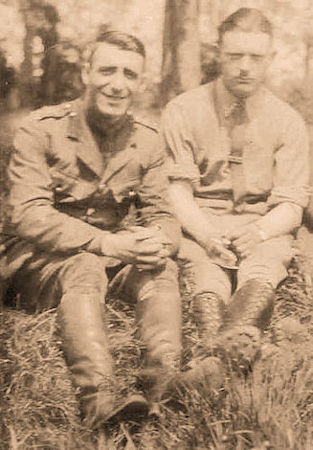
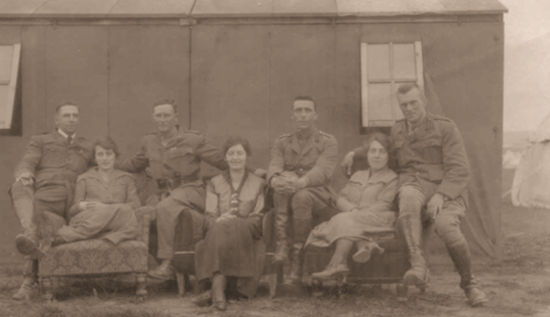
Left: Nelson in World War 1 and friend with his staff officer collar tabs
perhaps when attached to 16/Brigade Source: Wellington p.5
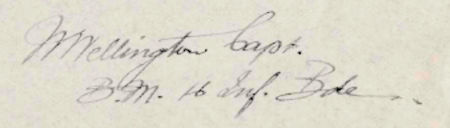
Left: Nelson Wellington's signature from the January 1918 War Diary
of 16/Brigade.
Source: TNA W 95/1607/2.1 p.5
1821info13c, sheet 4
On the night of 03-04 February 1918 16/Brigade was relieved by 17/Brigade and moved out of the
line from Beaumetz to Frémicourt, where the Battalion was engaged on working parties and training.
Its War Diary records Nelson taking over as Brigade Major on 5 February 1918. 4 On 09
February at 7.30 am Nelson issued the Brigade movement directives for 16/Brigade to take over the
front at Vaulx-Vraucourt on 13 February 1918.
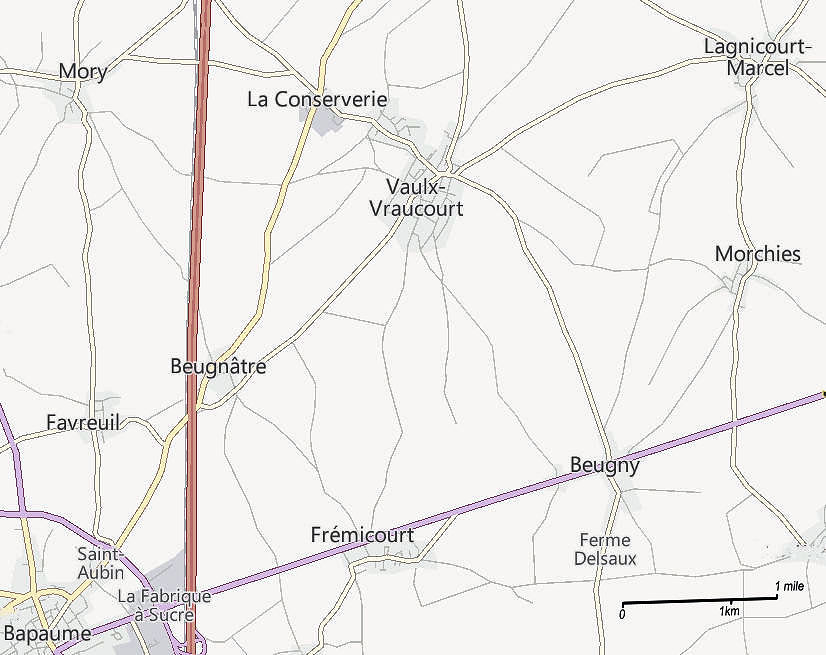
Above: A map locating places mentioned in the Battle
Narrative
In an appendices to a Brigade conference of 12 February 1918, Nelson detailed the defensive
plan for the Right Battalion with specific reference to the wiring and Lewis Gun posts in the
valley.
1821info13c, sheet 6
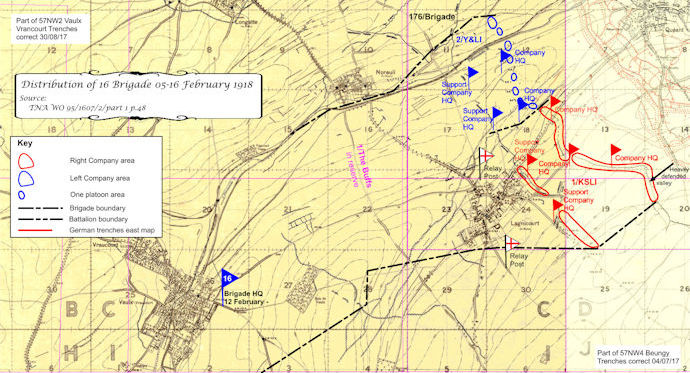
Above: Map locating 16/Brigade disposition at Lagnicourt
where Nelson was gassed Click on the map to open a 617kB A3 .pdf in a new
window
On 14 February, whilst Nelson was inspecting the Right Front in front of Lagnicourt, the
Germans fired gas shells to 16/Brigade's left. It is possible that Nelson was caught in the
gas drift causing him to be evacuated by 16/Field Ambulance. 16/Brigade War Diary records:
WAR DIARIES or
INTELLIGENT SUMMARY
Place
Date
Summary of Events and Information
FREMICOURT
Feb 5
Capt. N. WELLINGTON, Australian Imperial Force arrived to take over duties of
Brigade Major
VAULX- VRAUCOURT
14
Brigade Major reconnoitred the Right Battalion Area. Misty. At about 11pm enemy
fired Gas Projectors on to 176th Brigade Front on our left - Our forward area only
slightly affected, but a thick gas cloud drifted down the valley to back areas
16
[...] Brigade Major evacuated to CCS with poisoning contracted
on night of 14th. Staff Captain took over duties of Brigade Major.
Unsigned
Above: Composite image of 16th Brigade War Diary February 1918 Source: TNA WO
95/1607
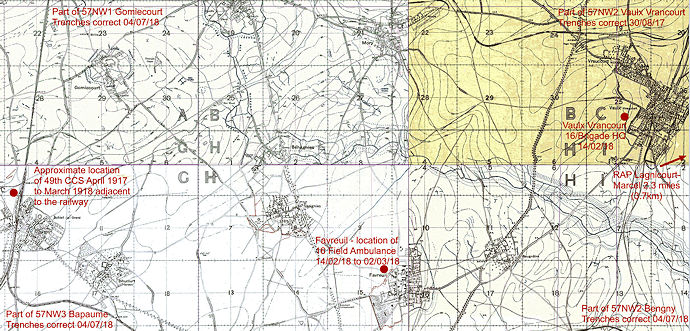
At the time when Nelson was gassed, 16/Field Ambulance, attached 16/Brigade, was based at
Favreuil, 2.5 miles (3.75km) east-north-east of Bapaume, having just decamped from Beugny. Nelson
was evacuated to 49/CCS (Casualty Clearing Station) based at Achiet-le-Grand and sited near the
railway sidings, 3.5 miles (5.5km) north-west of Bapaume, between April 1917 and March 1918.
1821info13c, sheet 6
WAR DIARIES or
INTELLIGENT SUMMARY
Place
Date
Summary of Events and Information
FAVREUIL
Feb 14
Routine [...] ADMS inspects MDS FAVREUIL Working party of 4 NCOs and 20 OR to
proceed to LAGNICOURT [Marcel] for work on the construction of a new RAP ...
Henry Moore A/Maj. RAMC A/Co 16 Field Ambulance
Above:Composite image of 16th Brigade War Diary February 1918 Source: TNA WO
95/1602/1/3
Above: A composite map of the Favreuil area showing where
Nelson operated with 16/Brigade and was evacuated by 16/Field Ambulance.
Click on the map to open a 687kB pdf map in a new window
The War Diary then records him inspecting
the line, being gassed and then being evacuated. 16/Brigade remained in line until 21 February
1918 when they were relieved to working parties and training in the Favreuil area. They returned
to Vaulx-Vraucourt on 1 March 1918 and on 06 March 'The Brigade Major
(Capt. WELLINGTON) rejoined from CCS'. 5
On 21 March 1918 'The long expected attack took place in renewed fine weather'. 6 [Author - typically British weather comment!!]
The War Diary of 2/York & Lancasters (2/Y&L) contains a vivid, hand written battle
narrative, describing the hard pressed 2/Y&L, implying the effect on 16/Brigade's other
battalions and should be read with Nelson's MC in mind.
1821info13c, sheet 7
Confidential 16th I.B. I forward the following
report on the operations of the 21st inst. [March 1918] On that date my Battalion
was disposed as follows
D Coy front line [...]
C Coy in [Reserve]
A &B Coy in sunken road [...]
Battn HQ at C.23.b.65.90
At 5am on 21st the German Barrage commenced & was put down extremely heavily on
Lagnicourt Trench & the sunken road immediately in rear &our Battn HQ and York
Support [Trench]. HE and gas shells being employed.
Only a light barrage was put on the front line and reserve line. At about 7.30am
an intense barrage was put on the [next line not copied]
The barrage killed & wounded practically the whole of the front line Coy., only 1
OR surviving amp; eventually getting back to the Reserve Line.
The barrage did not cut the wire in front of the front line or Reserve Line.
No infantry attack developed against my front line from the front.
At about 8.30am as far as I can ascertain the enemy infantry assaulted the front line
left of 71st Bde (Sherwood Foresters) & captured the front line; they spread
outwards & elements of them cross CORNHILL and advanced towards York support [...]
The remnants of the front line Coy. fought these for some time but were eventually
forced back to the Reserve Line. [...]
The next phase was the attack on the Reserve Line. The enemy advanced in considerable
numbers along POULTRY & reached the Reserve Line about 9am. Every man of both C
& D Coys whom I have questioned state that no resistance was offered & that
the garrison surrendered without fighting, being plainly visible leaving the trench
with their hands up as the enemy approached. This left my right flank exposed. The
enemy quickly got into Lagnicourt in large numbers & attacked my C Coy in flank
and right rear. [...] This Coy had suffered considerable casualties from the barrage
as they came out of their dugouts when the enemy was seen advancing on the right [...]
[A Coy, sent from Lagnicourt to support C Coy, suffered considerable casualties,] when
they saw the enemy advancing [...]. They engaged these when the enemy shorted his
barrage to the wire and killed or wounded the greater part of A Coy. I received a
message [from B Coy] to say that they had suffered considerable casualties, that
large numbers of the enemy were advancing [...] & that they were going to fight
it out. The only survivors of their Coy were a few who had been left behind in the
dugouts.
At 9 am when the barrage had lifted from Bn HQ [...] [I] saw the enemy [...] advancing
through Lagnicourt village. I manned the trenches around HQ but owing to the cover of
afforded by the houses could not stop them. They went through the village and
continued to advance [...] up the Vaulx road.
[...] Arrived at the next Sunken road I took up a position to hold on but here again
was outflanked from the north eventually retired to the Vaulx [Morchies] line where I
put in all my men to strength the garrison of that line.
I attributed the success of the enemy to
1. The extremely heavy barrage.
2. The large numbers he employed.
3. The lack of training in open warfare of our men.
4. The tactics of the enemy in breaking in on certain fronts &then spreading
outwards thus taking our defences in the flank & rear. 6
5. The lack of counter attacks from behind at the critical moments.
6. The men though game to fight were tired from the enormous amount of work they had
been called upon to do.
23/3/18 A Blunt [DSO] Lt Col 2 York &
Lancaster Reg 7
2/Y&L War Diary concludes:
The losses suffered by the Battalion during the offensive were 24
Officers & 391 OR killed wounded & missing. 8
1821info13c, sheet 8
The War Diary 16/Brigade gives a full Battle Narrative but not in the same detail. 9
However, it is evident from the narrative that within 16/Brigade, 2/Y&L and 1/Buffs took the
brunt of this attack and the casualties. Vaulx-Vauxcourt, three or four miles behind the front
line, was captured and then retaken by counter attack. Marden, in A Short History of the 6th
Division Aug 1914 - March 191910 gives a fuller account of the battle.
The Division had stood to twice before 21 March. On that day troops had
to be in their battle positions by 5am, the exact time the German barrage opened up. Fog hid the
stormtroppers and supporting infantry waves who concentrated on the three main valleys, of which
the Lagnicourt valley was the central, so avoiding the enfilade fire from the higher spurs. The
tremendous five hours bombardment, which dropped gas and HE on the back areas, was replaced at
about 7 to 8am with smoke and HE that annihilated the forward systems leaving few survivors to
reach the reserve line.
The 59th Division, on the 6th Division's left, were driven back leaving
the 16/Brigade's left in the air and unsupported. 16/Brigade were gradually squeezed out of their
lines, retiring to the corps line where, with reorganization and after darkness counter attacks,
the line was held with heavy casualties.
At 0730 on 22 March 16/Brigade repulsed an attack but with the heavy
artillery and mortars the persistent enemy renewed its attack at 0930 in the area of Vaux and
Méricourt Woods. Despite counter attacks, the division was forced back some 1000 yards (914m) to
the corps line.
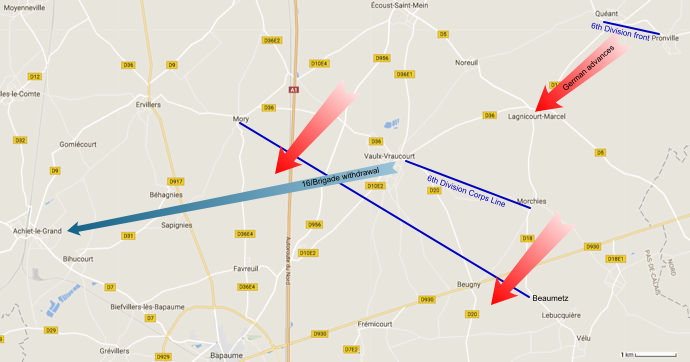
Above: 6/Division's withdrawal in the face of German
attacks and their defensive lines Click on the map to open an A4 landscape version in .pdf
Marden reports the situation at Brigade Headquarter, which may have involved Nelson twice in
its defence and in a counter attack.
The Headquarters of 16/Brigade changed hands three times. On the left
40th Division, had pushed forward to Vaux-Vraucourt, but there was a widening six mile gap between
it and 16/Brigade which 6th Division could not fill. There was a gap between Beaumetz and Mory.
The enemy's pressure on the flank of 16/Brigade caused the line to fall back, in good order, on
the new Army line which was being dug and wired.
On 24 March 1918, following the battle, 'The Brigade was with drawn
from the defensive position in rear of ACHIET-LE-GRAND (the location of 49th CCS)
and proceeded by train from PUISIEUC-AU-MONT (sic) to DOULLENS and there
commenced entraining for ROUSBRUGGE, NW of POPERINGHE.' 11 to be part of 2
nd Army.
1821info13c, sheet 9
Sir Julian Byng, GOC 3rd Army, wrote of the Division's proud resistance:
'I cannot allow the 6th Division to leave the Third Army without
expressing my appreciation of their splendid conduct during the first stages of the great battle
now in progress. By their devotion and courage they have broken up overwhelming attacks and
prevented the enemy gaining his objective, namely a decisive victory. I wish them every possible
good luck.'
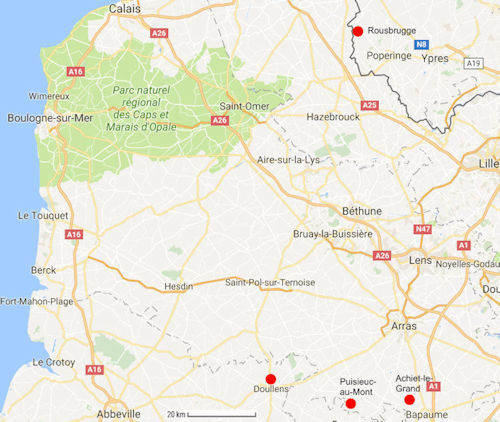
Above: Map showing route from Achiet-le-Grand to
Rousbrugge
Above: Nelson Wellington, as a staff officer but with no
MC, and friends Source: Geoffrey Hutson
1821info13c, sheet 10
Nelson's Military Cross - The battle for Lagnicourt
The War Diary for the 16th Brigade does not mention the award of Nelson's
Military Cross. It is assumed that this is because he was no longer on the
strength and was en route to the Boulogne Hospital. This account is purely
speculative and is based on the position 16/Brigade found itself between 21 and
24 March 1918. His service record notes the award on 05 June 1918. It was Gazetted,
in London, on 7 January 1919.
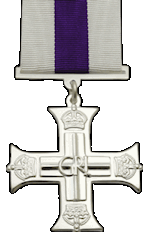
Right: An example of a Military Cross
SUPPLEMENT TO THE
LONDON GAZETTE, Published 31 December 1918
AWARDED THE MILITARY CROSS.
Capt. Nelson Frederick Wellington,
21st Bn., Aust. Infy.
Source: Composite of The Supplement to the London
Gazette, published 31 December 1918, Issue 31092, page 33
'The Military Cross is granted in recognition of an act or acts of exemplary gallantry during
active operations against the enemy on land.' 12 At this point, there is no citation
that explains Nelson's awarded of his MC. However, in the 'great battle'
13 at Lagnicourt, between 21 March and 24 March 1918, battalions of 16/Brigade
were heavily attacked and suffered serious casualties at the front and when retiring. Nelson,
having signed 16/Brigade War Diary for the month of March 1918, was present. For Nelson to be
awarded his MC in this battle he must have been directly involved in the intense fighting, as
described by 2/Y&L's battle narrative, and performed some act of exemplary gallantry. If the
date of the award is 05 June 1918, 14 then a ten-week 'delay' seems a reasonable time
for an act of gallantry in the battle at Lagnicourt to be recognised.
Footnotes: 1 Nelson Wellington's service record - National Archives of Australia B883,
VX12732 2 TNA WO 95/1607/2/1 p.37 3 Service Record 4 TNA WO 95/1607/2/1 p.27 5 ibid p.81 6 ibid p.84 7 War Diary 2/York and Lancaster Regiment TNA WO 95/1610/7 p.6-11 Battle
Narrative 8 ibid p.25 The nominal battalion strength was over 1000 but it was not unknown
for this to be 200 rifles. The nominal company strength was 227 men. This represents a casualty
rate of 41.5% of a full strength battalion and a very high officer rate. 9 TNA WO 95/1607/2/1 p.67-73 10 Marden, TO (Ed), A Short History of the 6th Division Aug. 1914-March 1919,
Hugh Rees Ltd, London, 1920 pp.44-52 (Accessed 14 June 2017)
11 TNA WO 95/1607/3 part 2 pdia 13 TNA WO 95/1607/2/1 p.84 14 Service record
The British Army was beginning to adopt a policy of lightly holding the front line during the
bombardments, allowing the enemy to pass through before engaging the attack in the British 'battle
zone' behind the front line. This tactic had not been employed by 16/Brigade on 21 March 1918
until after the attack. The Battle Narrative reports 'This was afterwards found to be very
effective'. This illustrates the slow percolation of ideas at the expense of casualties!
1821info13c, sheet 11
A chest wound at Zillebeke
My father was wounded in action in Belgium, at Ypres, receiving a bullet
in the lung and it remained there for the rest of his life. He was sent to England for
convalescence in one of the stately homes used for this purpose and was very proud of the fact
that he and other patients received a visit from Princess Mary. He later was sent to Sandhurst
Military College. [Nelson's military record shows that he was
posted to Junior Staff School,
Cambridge 3 on 1 October 1917] for further training and promotion to
Captain. At the end of the French campaign he was awarded the Military Cross on 05 June 1918, for
his services at Ypres. [Wellington op cit pp. 6/8]
A tired and decimated Division that had faced Operation Michael now held the Ypres front.
'On the 30th March, whilst resting in the neighbourhood of Steenvoorde,
the Division had the honour of a visit from His Majesty the King. Representative survivors of all
ranks from the recent fighting were drawn up in the square and were inspected by His Majesty, who
spoke most graciously to every individual, questioning all as to their experiences during the
fighting, and thanking them for and congratulating them on their services.' 1
At the beginning of April, 16/Brigade took over the front from Broodseinde to Polygon Wood.
Though reinforced up to a reasonable strength by any means available, the men lacked training in
infantry methods. Officers and men were new to each other and, with the whole Division in the
trenches; there was no chance to train together. 16/Brigade, for its Order of Battle had
three Battalions attached: the 1/Buffs (West Kent), the 1/King's Shropshire Light Infantry
(1/KSLI) and the 2/York and Lancaster (2/Y&L). Each Battalion comprised of four Companies: A
to D. Generally, each Battalion put two Companies in the front line, with the third in support a
short way behind the front in case the front was pressed, and the fourth in reserve to move
forward in two stages when the need arose.
During the Battle of the Lys (Operation Georgette 7-29 April 1918) the Germans attacked from
Zandvoorde southwards pushing the British Army off the Passchendaele ridge towards the town of
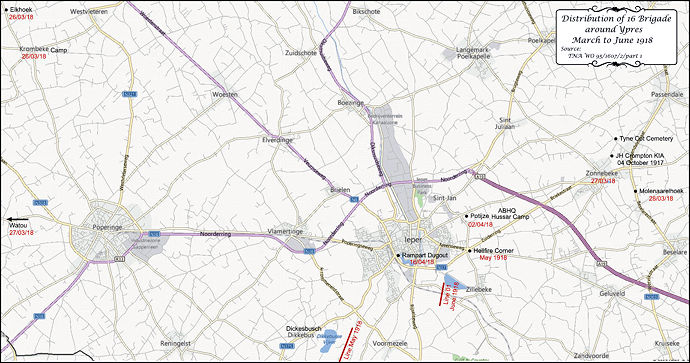
Ypres. On 29 March 1918, 16/Brigade were in the line at Molenaarelhoek (modern Molenarrelst) with
its Headquarters based at Hussar Camp, near the village of Potijze (Potaze). Four days later
the General Officer Commanding, the Brigade Major and the Intelligence
Officer visited the Advanced BHQ. 2 The Brigade were in action on 11 April 1918
against the German advance. The next day a withdrawal was considered and implemented on the 14th.
On 16 April the Division retired to the battle zone leaving outposts in pill boxes.
Above: 16/Brigade locations Ypres March to June 1918 Click on the map to open a 350kB A3 .pdf in a new window
1821info13c, sheet 12
Hoverbox Photo Gallery - Hussar Camp, Potijze - Author: October 2017
This feature does not function correctly on phones and tablets
1. The centre of Potijze village
2. The site of Hussar Camp, Potijze, opposite Potijze Chateau Grounds Cemetery
1
2
Two days later 16/Brigade's headquarters withdrew to the Rampart Dugouts, off The
Esplanade in Ypres. On the following day, the enemy pressed forward over Broodseinde Ridge
(Broodseinde translates apprpriately from the Flemish as End of the mire) with the War Diary
showing a map for the defence of Hellfire Corner, the closest the Germans got to Ypres. On 19
April 1918, Brigade Major took 30 days leave to England,
3 when he wrote his family history letter, to his father, from Bristol
. [.pdf file with additional research]
He reported back on 20 May 1918. During May, 16/Brigade were based east of Dickesbusch (Dikkebus)
holding a north-east to south-west Reserve Line until, on 24 May 1918, they relieved 18/Brigade
on the Zillebeke Lake to Ypres-Comines Canal front line. On 27 May 1918,
Brigade HQ took a number of direct hits, without damage. The next day the War Diary
records Nelson visiting the Battalions. 4
On the night of 24/25 May 1918 the 2/Y&L and the 1/KSLI moved from Reserve to take over the
Zillebeke line between Zillebeke Lake and the Ypres to Comines Canal, south of Ypres. On 01 June
1918 'B' and 'A' Companies of the 1/KSLI held the left front line of about 750 yards and 'C' and
'D' Companies of the 2/Y&L held the right. They took over a series of unconnected forward
posts with two defensive lines to the rear: the Dolls House or GHQ1 Line and the Krisstraat or
GHQ2 Line. Advanced Brigade Headquarters, where it is assumed Nelson was based, was located at
Andes Farm, 3 miles (4.8km) west of the Zillebeke Lake and front line.
The War Diaries paint an idyllic wartime scenario. Saturday 01 June 1918 was a glorious day of
brilliant sunshine, which would continue for several days. On the night of 02 June 1918, 2/Y&L
recorded a 'perfect moonlight night and no unusual enemy activity'.
5 The enemy was inactive apart from some night shelling of roads and the
reporting of many aircraft over the British lines.
Hellfire Corner in art
This well named locality was continually under observation and notorious for its danger. At night this road was crammed with traffic, limbers, guns, pack animals, motor lorries and troops. The dead bodies of horses, mules and men were often to be seen lying where the last shell had got them. The neighbourhood was piled with the wreckage of all kinds of transport. A 'sticky' spot that was always taken at the trot. Note the hessian screen to make transport 'invisible'. Unknown photographer. AWM E01889
Horse transport moving along silhouetted behind the camouflaged Menin Road, in the Ypres sector, in Belgium. Note the angled posts on the right used to hold up the poles supporting the camouflage netting. Unknown Australian photographer. AWM E01407
A scene on the Menin road beyond Ypres. Note that the soldiers are wearing shorts, and in foreground beside the damaged rail lines are two dead horses - Frank Hurley AWM E00700
The Menin Road, 1919, by Paul Nash. The Menin Road is a large oil painting that depicts a First World War battlefield. Nash was commissioned by the British War Memorials Committee to paint a battlefield scene for the proposed national Hall of Remembrance.
Near Hellfire Corner, Menin Road, Ypres. A view along a section of the Menin Road near the notorious Hell Fire Corner, the junction of the Menin Road and the Ypres-Roulers railway kept under constant observation by German artillery. There are trees on either side of the road that have been reduced to bare stumps by artillery fire. Haydn Reynolds Mackey 1918-1919
The Menin Road looking towards Hooge, c.1918, by William Lionel Wyllie,
1821info13c, sheet 14
WAR DIARIES or
INTELLIGENT SUMMARY
Place
Date
Summary of Events and Information
Sheet 28[NW4] H.22.a.2.7
1918 June 2nd
The Brigade Major, Capt. N.F. WELLINGTON, whilst going round the
line at night, was seriously wounded in the thigh by a M.G. bullet and was evacuated to
CCS.
HA Walker
Brigadier General Commanding 16th Infantry Brigade
Above: Composite image of 16th Brigade War Diary June 1918 Source: TNA WO 95/1607/3
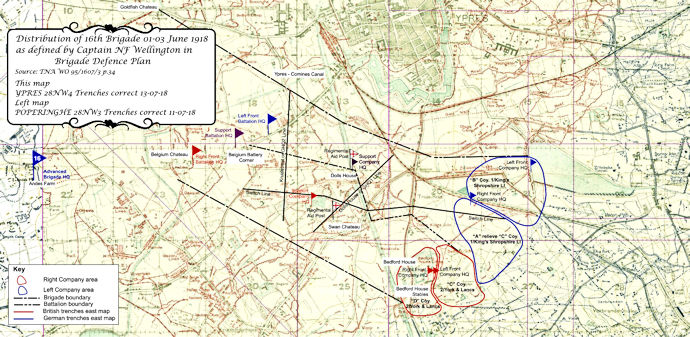
Above: Trench map showing the distribution of troops
around Zillebeke Lake June 1918 Click on the map to open a 5mB A3 pdf in a
new window
16 Brigade Major
Hoverbox Photo Gallery - 16/Bdg HQ, Andes Farm Author: 04 October 2017
This feature does not function correctly on phones and tablets
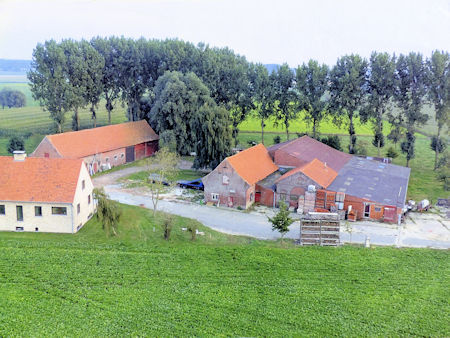
Andes Farm from the air The modern farm house is on the left built on the
site of the original building.
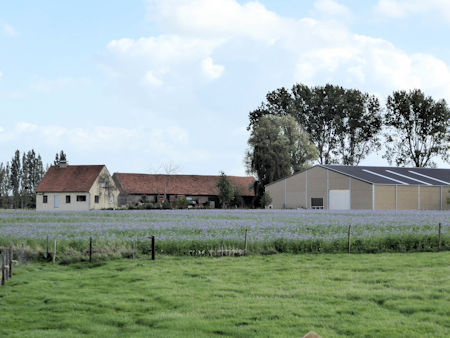
Andes Farm from the west.
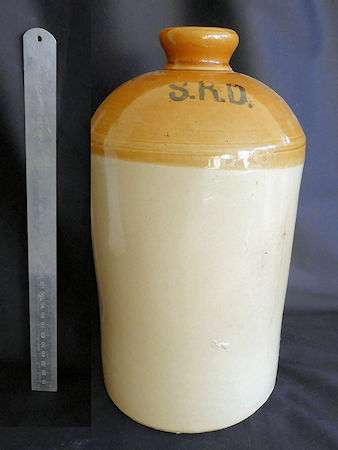
A World War 1 Service Rum Diluted (AKA Seldom Reaches Destination) jar
discovered on the farm.
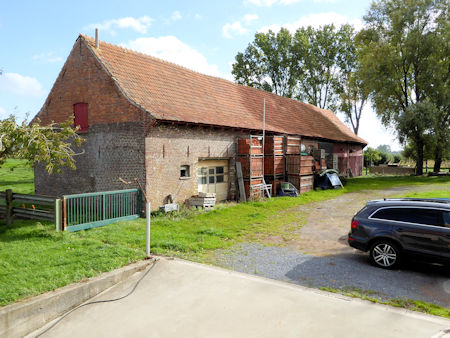
The remaining building from World War1 that Nelson would have seen.
1
2
3
4
1821info13c, sheet 15
Andes Farm, located at 28NW3 H.22.a.2.7 (50.835950 , 2.830609), was the Headquarters of
16/Brigade and Nelson 'office' whilst on the Ypres front. The present owner,
Wim Vanrobaeys
of Zorgulietstraat 61, 8908 Vlaumertinge, knows little of its history in World War 1, even
showing me the SRD flagon of World War 1 vintage. When explained, he kindly gave the flagon to
me. Perhaps it was of Nelson's vintage. As the farm is being modernised, the only surviving
building of World War 1 vintage is the barn . I suspect that it was from here that Nelson began
his final visit to the front. Wim was familiar with its history in World War 2 when his land was
part of a Luftwaffe fighter base. The runways are still visible under the grass and several '
barns' have been created as reinforced ammunition bunkers or hangers.
The 1/KSLI War Diary castes doubt on the date of Nelson's wound: 16/ Brigade
War Diary records it as 02 June 1918 and 1/KSLI recording '
3rd June 1918 [...] Brigade Major badly wounded going round our lines'.
6
Due perhaps to the chaos of war, the date is debatable.
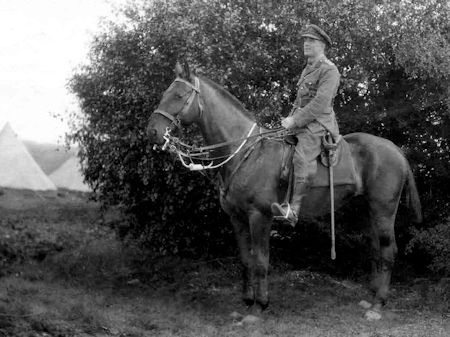
Left: Nelson on horse back, with sword, in World War 1 Source: Wellington p.5
16/Brigade's War Diary was remote from the incident and if Nelson was evacuated from the
front, the loss of the Brigade Major relied on a messaged being relayed from the front. The acting
Brigade Major may have been confused by hasty reports and the passage of time before the War Diary
was written. The 1/KSLI were on the spot. However, their War Diary was either written nightly or
in the confusion of active service when time permitted. Whatever, the handwriting suggests the
June War Diary was written at one sitting, when dates could have been confused. On 02 June 1918,
the 2/Y&L reported a 'perfect moonlight night', which would
make Nelson an easier target, but 'no unusual enemy activity'.
However, on 03 June 1918, 1/KSLI recorded 'considerable enemy harassing
MG fire all along our line', 7 and Nelson did suffer a machine gun wound.
Nelson's was wounded somewhere along the 750 yard (686m) front held by 1/KSLI.
Nelson's Service record paints a slightly different picture and states:
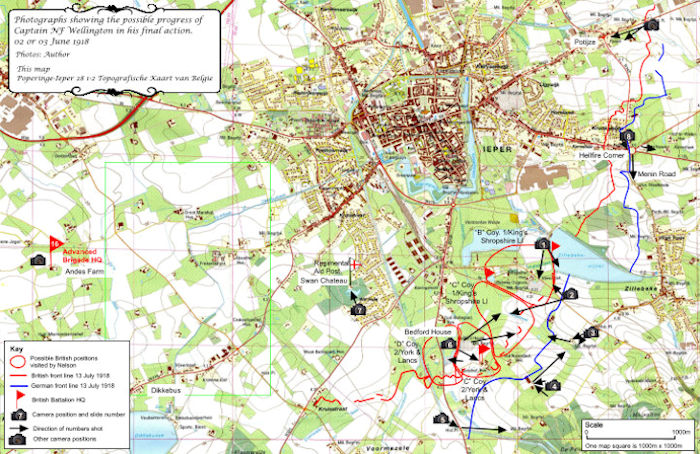
Nelson Wellington's final action - a pictorial record 04 October 2017
On 04 October 2017, I walked Nelson's last action, getting as close as possible to the
features defined in Nelson's distribution of troops around Zillebeke Lake in June 1918 - see
above. The map at the top of the previous page locates the images in the slideshow and the camera
direction. This map is better seen in the enlarged .pdf window. The locations can only be
approximate, the landscape will have changed but the topography remains dangerously flat and open.
The building featured have been rebuilt from the original farms which may have housed machine
guns. Standing, looking through a lens, it is very possible to recreate an imaginative
atmosphere. The map also locates Andes Farm, the headquarters of 16/Brigade, Hellfire Corner and
Hussar Camp at Potijze, which are to be seen in their own photo display.
1821info13c, sheet 16
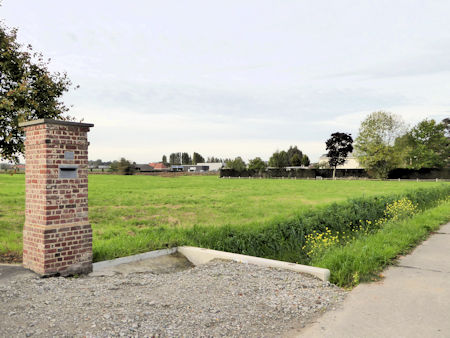
1.1 Looking across Zillebeke Lake.
1.2 Zillebeke Lake looking towards Railway Dugout Cemetery. It is possible that 'B' Coy 1/ King's Shropshire LI had its HQ in a dugout in the bank behind the photograph. If so, it is likely this would have been on Nelson's round.
2.1 Rail crossing possibly on the German front line of 13 July 1918. A defensive action took place in the field to the right behind the white sign.
2.2 From the railway crossing looking west into the area defended by 'C' Coy 1/ King's Shroshire LI. The photograph shows the flat land over which Nelson may have travelled.
3.1 The entrance to Blauwepoort Farm Cemetery with 91 casualties of whom 83 are identified from the period February 1915 to February 1916.
3.2 Modernised farm house adjacent to Blauwepoort Farm Cemetery.
3.3 Behind the modernised farm house looking towards the German lines of 13 July 1918.
4.1 Waastensestraat Farm's iron harvest. The drive bands at the flat end of all shells shows they are still 'live'.
4.2 Waastensestraat Farm looking back across the German rear towards Blauwepoort Farm Cemetery and modernised farm house just below the horizon.
4.3 Waastensestraat Farm. Perhaps a German strongpoint containing machine guns?
5.1 On the bridge of the overgrownYpres-Comines Canal with the Demarcation Stone showing the maximum extent of the German advance on Ypres. The stone is crowned by a representation of an Adrian steel helmet.
5.2 Along side the Ypres-Comines Canal looking east towards Spoilbank Cemetery behind the German lines.
6.1 Kasteel Rosendaal, known to the British Troops as Bedford House, was a moated country house set in woodlands, just behind the British lines. Though the chateau was never captured it was destroyed by shell fire. It was used by field ambulances and as brigade headquarters.
6.2 The remains of the moated Bedford House, with 'consolidation' Cemetery Enclosure 6 in the backgound.
6.3 Bedford House looking towards the rebuilt farm buildings in the direction of The Stables, which housed the Company Headquarters of 'C' and 'D' Coys 2/York and Lancashire Regiment. These too may have been on Nelson's inspection rounds.
6.4 Bedford House Cemetery looking across the open flat land held by 'C' Coy 2/Yorks & Lancs towards Railway Dugout Cemetery.
6.5 Bedford House Cemetery looking across the open flat land held by 'C' Coy 2/Yorks & Lancs more towards the east.
7.1 The entrance to Swan Chateau's overgrown grounds, which once housed the Regimental Aid Post.
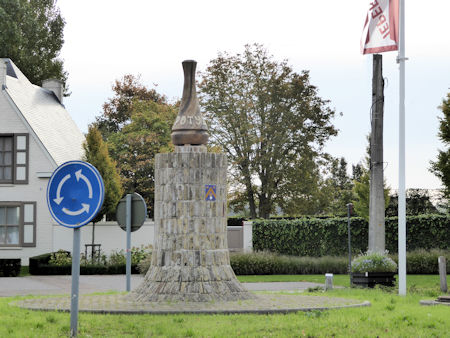
8.1 Hellfire Corner roundabout with the Demarcation Stone showing the maximum extent of German advance on Ypres. The stone is crowned by a representation of an Adrian steel helmet.
8.2 Hellfire Corner looking over the land of the German advance toward the Demarcation Stone.
8.3 Hellfire Corner roundabout looking along the modern Menin Road.
1821info13c, sheet 17
Above: Locations of photos Wellington's last action Click on the map to open a 1.16mB A3 .pdf in a new window
The AIF considering the sentiment of her fighting troops
so much decided that an officer can retain his equipment belt , sword, strap,
whistle etc. by paying 2/3rds of their original value. If fact if they are not handed
in the amount is deducted in your pay book i.e. my belt 3½ years old and only fit for
another six months can be retained by me paying £1-2-0 [...] 9
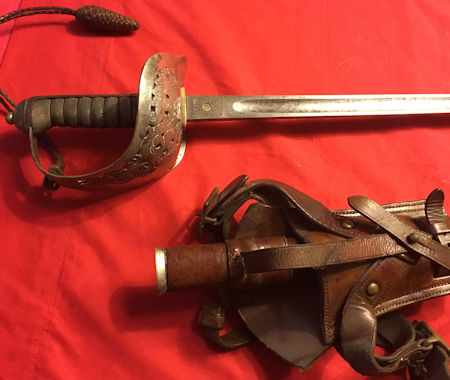
Right: A Trophy of war. Nelson Wellington's sword as seen above -
Curtsey: John Hutson
Evacuation to Blighty
In the Order of Battle for 16/Brigade, part of 6 Division, the 16/Field Ambulance was attached.
The relevant War Diary (ref: TNA WO 95/1602/1 part 3) gives very sketchy dispositions of the unit
and no information as to the CCS they fed. Unlike the evacuation flow chart of September 1917,
there are very few informative appendices. The War Diary of April, May and June 1918 paints a
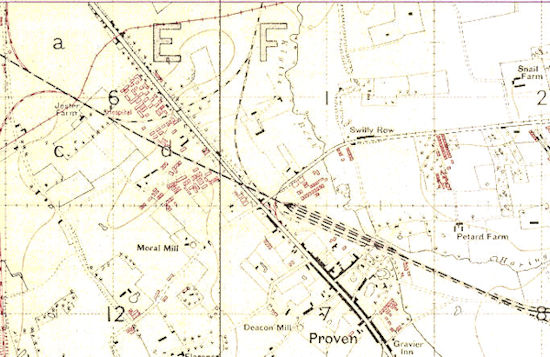
picture time the base for 16/Field Ambulance was the settlement of Proven, with an Advanced
Dressing Stations (ADS) and HQ at Vlamertinge Mill, some 5 miles (8km) from Zillebeke Lake
together with two emergency ADS in case the Mill was evacuated during the pending German attack.
Above: Details of the Proven ADS 05 July 1918. Note the
hospital buildings in square 6d and the two railway lines are from Ypres
1821info13c, sheet 18
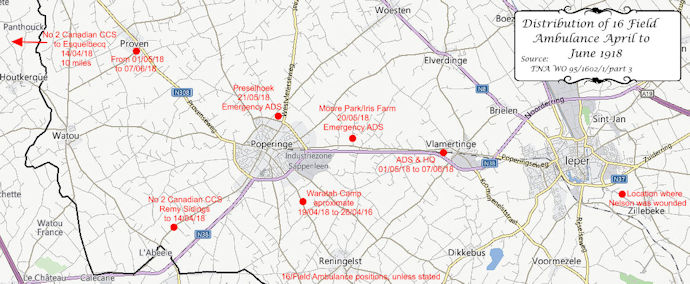
Nelson's service records him being admitted to the 2nd Canadian CCS 10 then at
Esquelbecq, an approximate distance of 25 miles (41km) from Zillebeke, having been withdrawn from
Remy Sidings at Lijsenthoek on 14 April 1918. It is possible that Nelson was carried in a bearer
relay and ambulance to the ADS first at Vlamertinge Mill and then by horse or motor ambulance to
Esquelbecq, 10 miles (16km) west of 16/Field Ambulance's HQ at Proven. The distribution of
16/Field Ambulance at the time of Nelson's wound is shown below.
Above: Distribution map of 16/Field Ambulance's posts.
Click on the map to open a 263kB pdf map in a new window Source: TNA
WO 95/1602/1 part 3
Nelson's record initially show he was evacuated on 16/06/18 Adm
LofC Hosps - an unnamed unit in the
medical evacuation Line of
Communication Hospital 4 before being admitted to a Base Hospital in
Boulogne. Here his record shows ' To RC Hospital, Boulogne G.S.W
Abdomen'. This was likely to have been No 8 BRCS known as the British Red Cross
Hospital or the Baltic & Corn Exchange Hospital of 250 beds ...
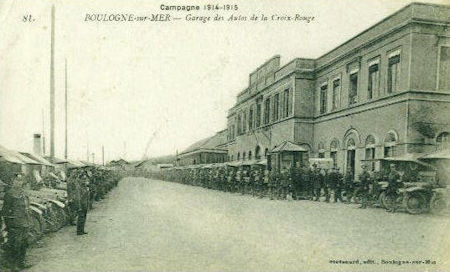
Left: Believed to be the Red Cross Hotel, Boulogne
1821info13c, sheet 19
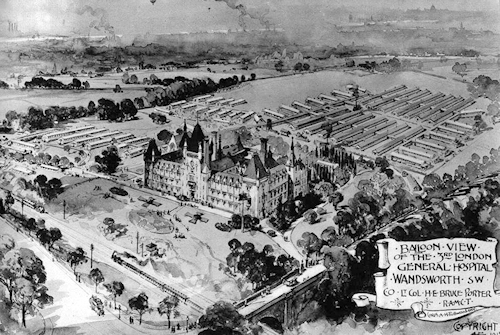
... before being transferred to England 22 July 1918 on the Hospital Ship St Andrew to
3rd London
General Hospital 5
where his record shows,
G.S.W. L. CHEST SEV[ERE] and is S.O.S. 11
Right: Hospital Ship St Andrew
On 23 November 1918 the Ballarat Star reported Nelson being
wounded in three places in the German offensive of March, and he and his batman narrowly escaped
being captured by the Germans. The paper also mentions Nelson being mentioned in Dispatches
for the Southland incident. Later, on 31 December 1918 on page one, the Star reported that
Capt. Nelson Wellington, who was dangerously wounded in France of 3
June, is now reported to be in a stationary condition.
End notes
Marden p.53
16/Brigade War Diary TNA WO 95/1607/2 part 1 p.126
ibid p.129
16/Brigade War Diary TNA WO 95/1607/3 part 1 p.2
2/York & Lancaster War Diary TNA WO 95/1607/7 p.38
1/Kings Shropshire Light Infantry War Diary TNA WO 95/1609/4 p.86
ibid p.86
Nelson Wellington's service record - National Archives of Australia B883, VX12732
Major Victor Morse DSO CO AE&M&BC, letter to his wife Finlayson 2018, p.277
Nelson Wellington's service record - National Archives of Australia B883, VX12732
ibid
Sources
16th Brigade War Diary ref: TNA WO 95/1607/2 part 2
16th Brigade War Diary ref: TNA WO 95/1607/3 part 1
1/Kings Shropshire Light Infantry War Diary TNA WO 95/1609/4
2/York & Lancaster War Diary TNA WO 95/1607/7
Finlayson, Damien, Supporting Tunnelling Operations in the Great War, Pen &
Sword Military, Barnsley, 2018, originally published as The Lightning Keeper: The AIF
Alphabet Company in the Great War, Big Sky Publishing, 2017
Nelson Wellington's service record - National Archives of Australia B883, VX12732
1821info13c, sheet 20
More information 1
The role of Brigade Major
Roger Lee describes the important role of Brigade Major as
[T]he brigade was the smallest formation to have a formal
staff structure. To assist him in the execution of his duties, the brigade
commander had two principal officers - the brigade major (or BM) and a staff
captain. The brigade major - normally a major or senior captain in rank -
fulfilled the 'G' [General Staff] functions for the brigade, his
central task being to plan the brigade's operations within the larger
context of the divisional or corps scheme. Much of his time was spent
interpreting commands from higher headquarters and converting them into
precise orders and detailed objectives for each of the brigade's
subordinate formations. He was also called upon to keep his own commander
abreast of all matters concerning the efficiency or strength of the brigade,
to advise the brigadier- general as to which local objectives could and
should be reached, and to co-ordinate whatever actions might be necessary by
smaller units in order to secure those objectives. His responsibilities would
therefore embrace liaison with neighbouring formations and the co-ordination
of the relevant artillery and trench mortar support on the brigade front. In
short, it was at his level 'that the minor tactical planning for the
battle was undertaken.' and the brigade major's ability was a crucial
factor in shaping a brigade's battle performance.
Source: Lee, Roger, The Australian
Staff: The Forgotten Men of the AIF, in Dennis and Grey (Ed), 1918: Defining
Victory', The Army History Unit,
Canberra, 1999, p.118-20 in Simpkins, Peter, Building Blocks, in Sheffield,
Gary and Todman, Dan (Eds), Command and Control
on the Western Front: The British Army's experiences in 1914-18
, Spellmont, Stroud, 2007, p.146-7
The pamphlet Preliminary Notes on the Tactical
Lessons of Recent Operations (SS119) defined the importance of the Brigade
Major by advising that the brigade commander and brigade major should not be
away from headquarters at the same time. Anthony Eden, the future British
Prime Minister (1951-1955) and The Earl of Avon, was, at 20, the youngest
Brigade Major in the Army. He later recalled how [...] how strenuous the work
was, even by the standards of trench warfare, he wrote, 'there was little
chance of sleep; by day attack, by night preparing and issuing orders for the
next advance'.
Source:
Simpkins ibid p.147
Peter Pedersen describes what Monash looked for in a staff officer. Although
Nelson was attached to a British brigade, I'm sure he had Monash's
qualities: qualities he took on to Brisbane as Australian liaison to MacArthur.
Monash held strong views on what constituted the ideal
staff officer: 'unfailing patience under the most trying conditions, unquenchable
zeal under rebuffs and tireless energy'. As well as familiarity with tactical
principles in the use of all arms, the staff officer had to understand fully the
situation and how his commander intended to react. It was essential that the
staff officer gained and kept the commander's confidence by tact and using
suggestion devoid of forcefulness. He had to be able to speak and write
fluently, telling the commander precisely what he needed to know and nothing
else. Monash was especially critical of his own officers in this regard.
When giving verbal reports, they stammered, hesitated and became confused,
using incorrect names and words. He instructed them to anticipate what they
were going to say, 'then say it crisply, without hesitation, correctly and
fluently', while in written reports, the object was 'to convey pithily only
the essentials'. Here was an outstanding reflection of his practice in civil
life.
Pedersen, PR, Monash as Military Commander, Melbourne University Press,
Carlton, Victoria, 2005 edition p.25
1821info13c, sheet 21
More information 2
Operation Michael
- The German Spring Offensive
Beginning on 21 March 1918, the German Spring Offensive was one of a series of attacks
along the Western Front, which marked the deepest advances by either side since 1914. In
order to defeat the Allies, before American soldiers and resources arrived in France, the
Germans realised there only chance of victory was to defeat the Allies in a series of
quick and powerful attacks. They had the temporary advantage in numbers as nearly 50
divisions had returned from the east after the Russian surrender.
Operation Michael was the main attack, which was intended to break through the Allied
lines, outflank and defeat the British forces which held the front from the Somme River to
the English Channel. Once achieved, it was hoped that the French would seek armistice
terms. [...]
No clear objective was established before the start of the offensives and once the
operations were underway, the targets of the attacks were constantly changed according to
the battlefield (tactical) situation. The Allies concentrated their main forces to
protect the approaches to the Channel Ports and the rail junction of Amiens. The
fast-moving stormtroopers leading the attack against 3rd Army could not carry enough food
and ammunition to sustain themselves for long and all the German offensives petered out,
in part through lack of supplies. The Germans were unable to move supplies and
reinforcements fast enough to maintain their advance.
By late April 1918, the danger of a German breakthrough had passed. The German Army had
suffered heavy casualties and now occupied ground of dubious value which would prove
impossible to hold with such depleted units. On 08 August 1918, the Allies began a
counter-offensive at the Battle of Amiens with the Australians using new techniques of
integrating infantry with artillery, tank and aircraft in new operational methods. This
Hundred Days Offensive lead to the collapse of the German army and the November
armistice. Source: Wikipedia
More information 3
Junior Staff College
[...] the Junior Staff College under Lieutenant
Colonel RAM Currie held two courses lasting six weeks for 50 officers training
for junior staff appointments. [...] the two GHQ Staff Schools were re-opened on
1 October 1917 to train SOs during the autumn and winter of 1917 Field Marshal
Lord Alanbrooke believed that the Cambridge Staff Course in March 1918 was '
the most excellent value .[This is Likely to be in one of the University
Colleges. New College, Oxford held officer training courses.
The casualty is likely to have received first medical attention at aid posts
situated in or close behind the front line position. Units in the trenches
provided such posts and generally had a Medical Officer, orderlies and men
trained as stretcher bearers who would provide this support. The Field Ambulance
would provide relays of stretcher bearers and men skilled in first aid, at a
series of 'bearer posts' along the route of evacuation from the trenches. All
involved were well within the zone where they could be under fire.
The Field Ambulance was a mobile medical unit, not a vehicle. Each British
division had three such units, as well as a specialist medical sanitary unit. The
Field Ambulances provided the bearer posts but also established Main and Advanced
(that is, forward) Dressing Stations where a casualty could receive further
treatment and be got into a condition where he could be evacuated to a Casualty
Clearing Station. Men who were ill or injured would also be sent to the Dressing
Stations and in many cases returned to their unit after first aid or some primary
care. Once treated at a Dressing Station, casualties would be moved rearward
several miles to the Casualty Clearing Station. This might be on foot; or on a
horse drawn wagon or motor ambulance or lorry; or in some cases by light railway.
The CCS was the first large, well-equipped and static medical facility that the
wounded man would visit. Its role was to retain all serious cases that were unfit
for further travel; to treat and return slight cases to their unit; and evacuate
all others to Base Hospitals. It was often a tented camp, although when possible
the accommodation would be in huts. CCSs were often grouped into clusters of two
or three in a small area, usually a few miles behind the lines and on a railway
line. A typical CCS could hold 1,000 casualties at any time, and each would admit
15-300 cases, in rotation. At peak times of battle, even the CCSs were overflowing. Serious operations such as limb amputations were carried out here.
Some CCSs were specialist units, for nervous disorders, skin diseases, infectious
diseases, certain types of wounds, etc. CCSs did not move location very often,
and the transport infrastructure of railways usually dictated their location.
Most evacuated casualties came away from the CCS by rail, although motor
ambulances and canal barges also carried casualties to Base Hospitals, or
directly to a port of embarkation if the man had been identified as a '
Blighty' case. [...] The serious nature of many wounds defied the medical
facilities and skills of a CCS, and many CCS positions are today marked by
large military cemeteries. [...] Generally there was one provided for each
Division. From the CCS, the casualty would be evacuated to a Base Hospital.
Once admitted to a Base Hospital, the soldier stood a reasonable chance of
survival. More than half were evacuated from a General or Stationary Hospital for
further treatment or convalescence in the United Kingdom. The Stationary
Hospitals, two per Division, could hold 400 casualties each. The General Hospital
could hold 1040 patients. They were located near the army's principal bases
at Boulogne, Le Havre, Rouen, Le Touquet and Etaples. The establishment of a
General Hospital included 32 Medical Officers of the RAMC, 3 Chaplains, 73 female
Nurses and 206 RAMC troops acting as orderlies, etc. The hospitals were enlarged
in 1917, to as many as 2,500 beds.
Soon after War broke out No.3 London General was mobilised at the Royal Patriotic School,
Wandsworth Common. The CO Bruce Porter agreed to take on a group of men as RAMC orderlies,
all members of the Chelsea Arts Club, who were either too old, or unfit for other military
service. Thus, he accumulated a wonderful collection of artists, sculptors, writers and
poets, and laid the foundations for a hospital journal 'The Gazette.' This
magnificent building has been restored and converted into residential and commercial
accommodation and is now known as the Royal Victoria Patriotic Building.
It is situated opposite Wandsworth Prison and was used during
World War 2 by the military intelligence sections responsible for detecting and
interrogating spies, and operating the 'Double Cross system' of double-agents.