1821 Info 13d for Caleb Crompton
Nelson Frederick Wellington - in World War 2
September 1939 to June 1945
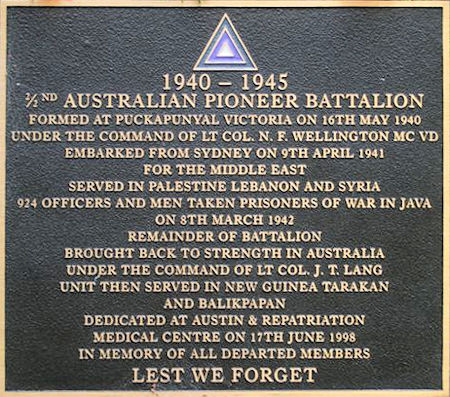
The 2/2 Pioneer Battalion (2/2 Pioneers) were formed at Puckapunyal, Victoria in May 1940
under the command of Lieutenant Colonel Nelson Wellington.
His
daughter, Pat Wellington, wrote in her book Memoirs:
Nelson, as VX12732, was given a command of the
2/2nd Pioneers in the Second AIF more than a year ago. He trained the battalion at
Puckapunyal Military Area and
Balcombe, and embarked with it in April last. 1
Right: 2/2 colour patch - The triangular shape of the colour patch
represents a Corps attached to a Division (the Pioneers were attached to 7th Division)
The white inner triangle represents Infantry, the purple middle triangle represents
Engineers and grey outer triangle represents that they fought at Tobruk or it
distinguishes them from the maliatia,
My Father, the CO of the 58th Battalion CMF
at Essendon, expected an increase in military training and even the possibility of
active service in the future if Australia became involved. He began to talk of his
"fitness" for another war. The war in Europe was escalating and spreading
and what information we had made us all very apprehensive about the future.
2
Nelson's illustrious predecessor of the 58/Bn was Col.
(later Major General) Harold 'Pompey' Elliott. The 2nd/2nd Pioneer Battalion
was formed on 1 May 1940 and my Father was given command of the unit. He was assigned
to the Puckapunyal military camp near Seymour where the unit was built up to full
establishment, equipped and trained during the next six months. He took leave of
absence from his job, with the Essendon City Council, for the duration of the war.
3
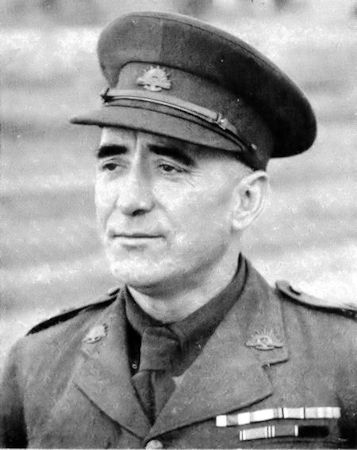
Above: Wellington at Puckapunyal
Source: Aitken
On 14 November 1931 Major NF Wellington was 'tested to his fitness for a Lieutenant
Colonel's command in the field in accordance with the prescribed Syllabus and Instructions;.
(NAA Service record) Nelson, from being the CO of the 58th Battalion of the Citizen Military
Force (CMF), raised the 2nd/2nd Pioneers in Victoria. Although the article below relates to World War 1 2,
the qualities of leadership must extend to World War 2 and it is possible to envisage Nelson.
1821info13d, sheet 2
fulfilling many of the qualities: tactically proficient in raising and training the battalion,
being tactically aware when commanding in combat against the Vichy in Syria. His profession and
experience as brigade major meant he was administratively aware and capable. At Merdjayoun,
Nelson demonstrated the ability of a commander to influence his subordinates to 'follow him
', especially following the failure of the Scots Greys and 2/25th Bn AIF, though the
Australian War Memorial questions the use.
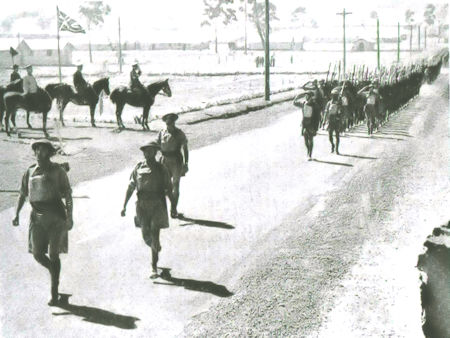
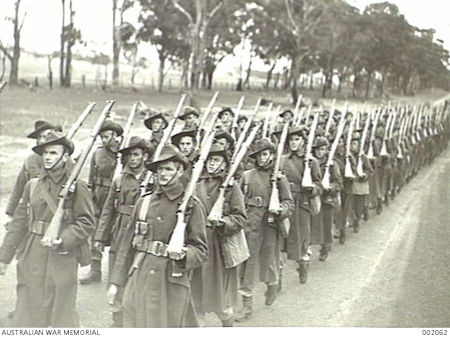
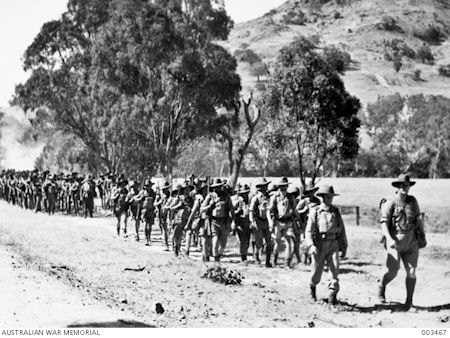
Hoverbox Photo Gallery - 2/2 Pioneers at Puckapunyal Camp4 This feature does not function correctly on phones and tablets
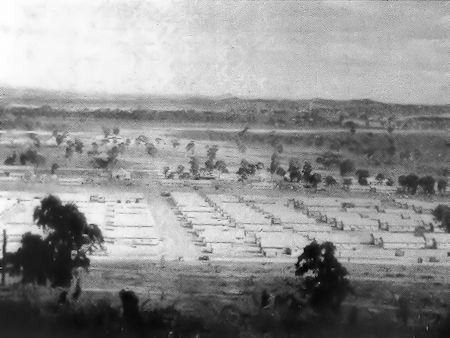
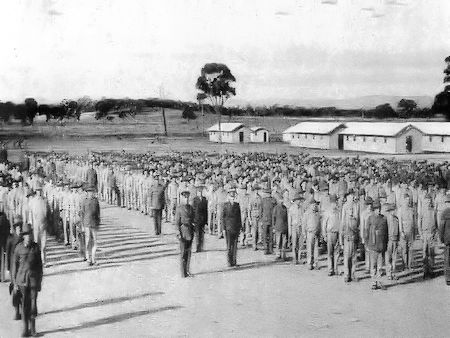
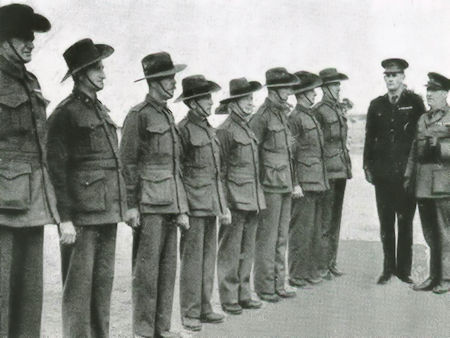
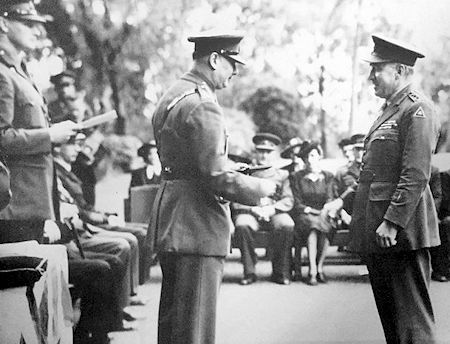
1.The camp - Aitken 2. First Battalion parade, June 1940 - Aitken 3. Nelson (right) at a medal parade - Aitken
4. Governor General Lord Gowrie at the passing-out parade -
Aitken 5. Puckapunyal 28 June 1940 AWM 002062 6. Seymour October 1940 AWM 003467
1
2
3
4
5
6
Late in March [his daughter Pat] went to Balcombe Camp at Mt Martha
with my Mother and sister. We spent the weekend at Mt Martha guest house to say farewell my
Father's unit, the 2nd/2nd Pioneers, before their departure overseas. They later left
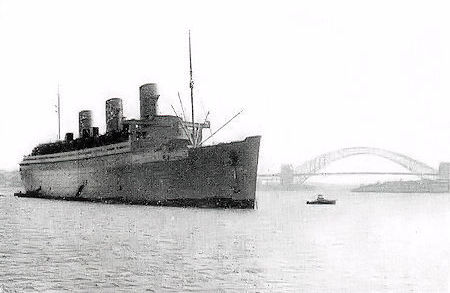
Australia from Sydney on the Queen Mary in
convoy in April 1941 bound for the Middle East and active service in the Syrian campaign. After
the unit departed my Mother decided to give up her flat in Essendon and join me for a time. She
was very involved with the Pioneer Association consisting of families, wives and friends of the
unit who organised fund raising to provide amenities for the unit. She often went off to the
country for a week or two visiting some of the Pioneer families. 5
Mrs Nelson Wellington, wife of Lt. Col. Wellington, O.C. of the 2/2nd
Pioneers, Puckapunyal, accompanied by Mrs Dalton Mitchell, of Coburg, paid a visit to this
district this week with the object of forming small sub-branches of the 2/2nd Pioneer Auxiliary.
Their object was to raise a sum of money to send abroad to the men on active service, to be spent
in the way considered to be most useful to all those concerned, at the time of receiving. This
auxiliary, however, worked on a 50-50 basis, 50% for the Pioneers and 50% as a general war effort
[...] 6
1821info13d, sheet 3
As one of four pioneer battalions in the Second AIF pioneer battalions consisted
of a headquarters and four companies, and were expected to undertake minor
engineering tasks during combat in order to free up trained engineers for more complex
tasks.
The 2/2 Pioneer Battalion sailed from Sydney for the Middle East aboard the HMT
‘NN’ – the Queen Mary - on 07 April 1941. Photo After arriving at the Suez
Canal, the Battalion re-embarked on the Ethiopiain for Kantara Camp where they
disembarking on 04 May 1941.
On 8 June 1941, at the insistence of the British government, General Wavell launched a hastily
planned invasion of Vichy-held Lebanon and Syria. Most of the troops were Australians of 7th Div,
who spearheaded two of the three columns that attacked from Palestine and Transjordan.
Although assured that the Vichy French would offer little
resistance, they soon found themselves attacking thoroughly prepared defences that
exploited the mountainous terrain; the columns were not mutually supporting, and made
variable progress. After a week of fighting the French defenders counter-attacked,
exploiting their superiority in armour; but the counter-attack soon foundered against
stubborn defence. However, it disrupted the Allied timetable by several days.
On 18 June, General Lavarack, now commanding I Australian Corps, took over the
campaign from the British General Wilson. He wisely decided to concentrate the attack
on the coastal sector, where Australians fought the decisive battle on 5-9 July at
Damour; this involved a frontal attack across the Damour river as well as fighting in
rugged country to the east of the town. Australians also did most of the fighting in
the central sector, especially around Merdjayoun and Jezzine, and contributed to the
advance in the east once the Allied forces took Damascus.
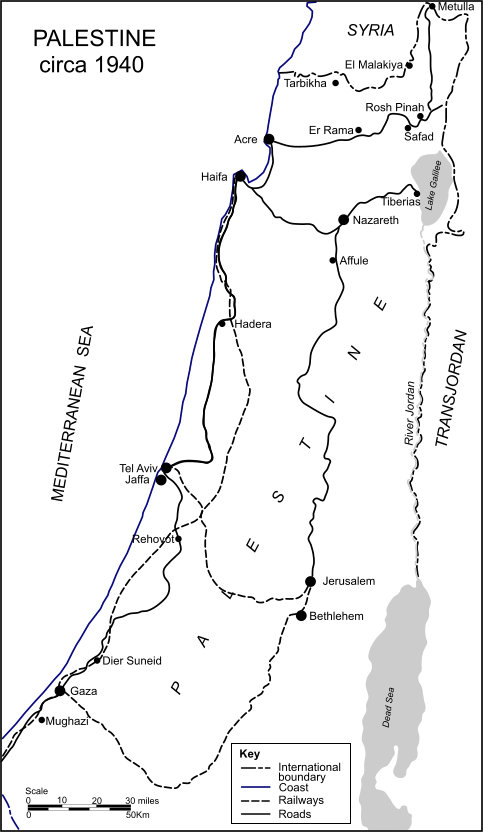
Above: Map of Palestine Source: Aitken
1821info13d, sheet 5
The 2/2 Pioneers
The Battalion was assigned to the 7th Division, fighting against the Vichy French during the
Syria–Lebanon Campaign, where they fought mainly as infantry. The battalion had not been fully
trained in this role and had not received all the equipment required, lacking mortars and
possessing only a small number of automatic weapons. They lacked some of the specialist troops
attached to established infantry battalions, including an intelligence section. Nevertheless, it
was committed to several attacks. 1
When the attacks began on 07 June 1941, ‘A’ Coy was placed under the command of the 2/16th
Infantry Battalion (2/16Bn) of 21st Brigade (21/Bde) at Er Rama and had three tasks: to breach
the frontier fence at El Malakiya, a formidable obstacle of barbed-wire and iron picket; improve
the approaches from the frontier road to the gap in the fence; and build a road across the fields
to link with the road passing through Aiteroune to allow 2/16Bn to cross the frontier. ‘B’ Coy,
attached to the 25/Bde near Rosh Pinah, had a similar task. At Metulla it prepared artillery
approaches and improved the track from Mezudal and Banias. The men also assisted engineers to
repair a crater in the road near Dan. ‘D’ Coy joined the 25th Brigade and also assisted
maintaining and repairing roads. Several days later ‘C’ Coy came forward from Er Rama and began
improving the rough track to Metulla for vehicles to pass.
But when the Vichy French counter-attacked at Merdjayoun on 15 June 1941 the 2/2 Pioneers
recalled its scattered companies to hold the Litani Bridge and prevent further enemy advance.
On 17 June 1941, the Pioneers participated in the attack on Fort Merdjayoun. (Marjayoun in the
present spelling). In a 'reckless decision' 2‘A’ and ‘B’ Coys made a frontal
attack on the fort. French machine-gun fire quickly stopped the attack and the Australians were
exposed. Casualties mounted but the companies were pinned, unable to withdraw until evening. They
suffered heavily: 27 killed, 29 captured, and 46 wounded. 3
This paper describes the part played by 2/2 Pioneers whilst under the command of Nelson
Wellington.
The campaign
On 31 May 1941, all defensive preparations were suspended. It was decided to mount an
offensive operation against Syria instead, and the Battalion was to take part in the campaign as
part of Exporter Force (7th Australian Division (7/Div) and other Australian and British units).
Individual 2/2 Pioneers companies were allocated to different brigades. The CO’s party returned
to Hill 95 (possibly Deir Suneid - War Diary) on 02 June 1941. 4
In the days that followed the Battalion was busy obtaining motor vehicles, automatic weapons
– Bren and Thompson sub-machine-guns – and, for the first time, the 1937 pattern webbing.
At 0730 hours on 06 June 1941, the Battalion less ‘C’ and ‘D’ Coys entrained at Deir Suneid
for Hadera, where Royal Army Service Corps (RASC) lorries took them to the 7/Div’s concentration
area at Er Rama with 25th Infantry Brigade (25/Bde). 25/Bde were to secure Khiam and Merdjayoun
and pass through Metulla before cutting the Damasus-Beyrouth road and occupying the aerodrome and
important railway junction at Rayak. Soon after daybreak ‘A’ Coy, attached to 2/16Bn, followed
the frontier fence of barbed wire and pickets in full view of the enemy. After breaking through
the frontier, they were to construct a road/track across the fields to join the Aiteroune road.
By 0400 hours and for a further six hours, a convoy of ladened trucks entered the settlement.
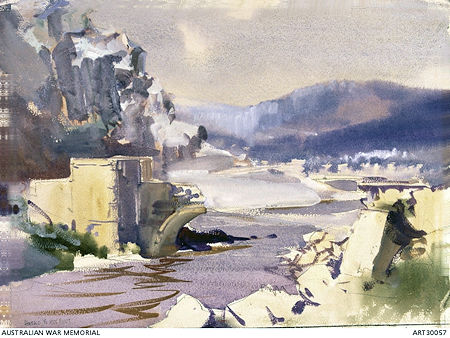
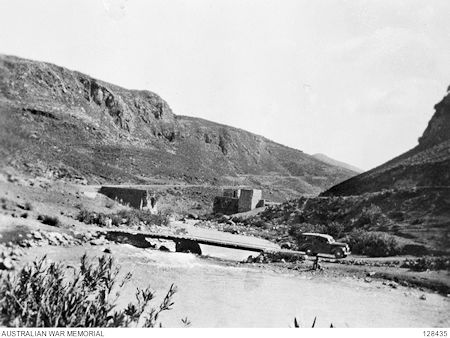
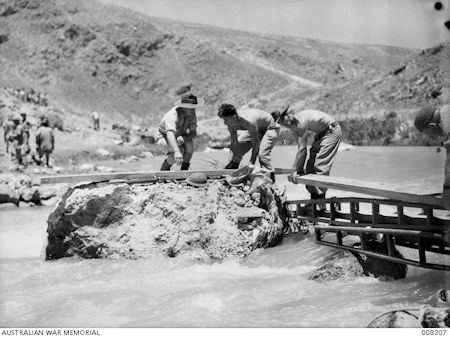
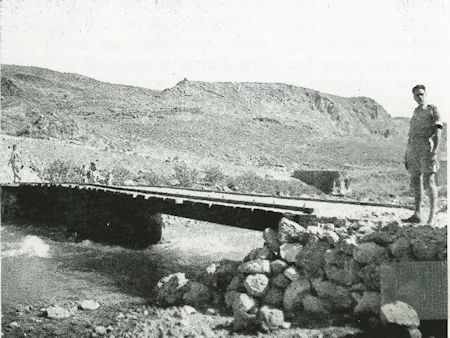
The retreating enemy had blown the bridge over the Litania River. ‘D’ Coy, under air attack,
repaired road craters and constructed approaches to the new bridge. By 13 June 1941, ‘C’ Coy had
improved the rough track to Metulla making it suitable for vehicles. This was the only route from
Palestine to Jezzine and Merdjayoun. 5
Hoverbox Photo Gallery -
Litania River bridge This feature does not function correctly on
phones and tablets
1. Litania River bridge AWM Art30057 2. Litania River bridge AWM 128435
3. Building the Litania River bridge - AWM 0082074. Litania River bridge complete Source: Aitken
1
2
3
4
1821info13d, sheet 6
The Vichy French, defending Damascus, were in a strong position
outnumbering the attackers. The Pioneers were working around Merdjayoun with orders
to protect the flank and to harass the enemy as part of the general advance. 6
On Sunday 15 June 1941, the tactical position changed. The Vichy French
subjected Merdjayoun to heavy shelling and a successful counter-attack, which altered
the plans for the advance into Syria. The 2/2 Pioneers scattered companies were
recalled to defend the Litania Bridge and to prevent any further French advance.
7 One company, which had been repairing the road near Jerme, set out on
foot at about 11pm and marched to the crossing, arriving just before dawn. The others
began marching but were picked up by trucks. All were weary next morning.8
At 2200 hours news came of French retaking Merdjayoun so the battalion began building
defences.
C’ Coy, moving forward, came into view of Fort Merdjayoun on 16 June 1941 and came
under shell fire. At 1100 hours, ‘B’ Coy, in moving up to take a defensive position,
suffered casualties. At 1800 hours orders were issued to attack Fort Merdjayoun and
Lt-Col. Nelson Wellington, commanding, moved his headquarters to the village of
Kleyat awaiting final orders.
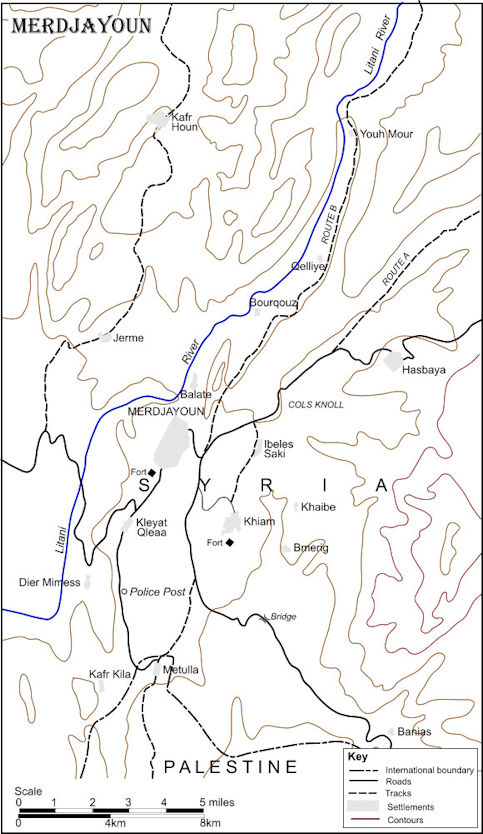
Above: A map of the environs of Merdjayoun Source: Aitken
Brigadier Berryman decided the best way to check the enemy was to attack Merdjayoun on the 17
June 1941 using the Pioneers and 2/25Bn against the stronger – though motley – French Vichy
force on the Damascus front. Berryman received his orders at Jezzine about midnight on the 15th.
… He […] left Jezzine at 1am on the 16th and at 0630 hours met Lt-Col Wellington of the 2/2
Pioneers at the Litania crossing. Although Berryman’s responsibility was confined to the west of
Litania he ordered Wellington to send one company to take up a position on the ridge between
Merdjayoun and Qleaa to support the Scots Greys, with a second company leap-frogging any success.
9
1821info13d, sheet 7
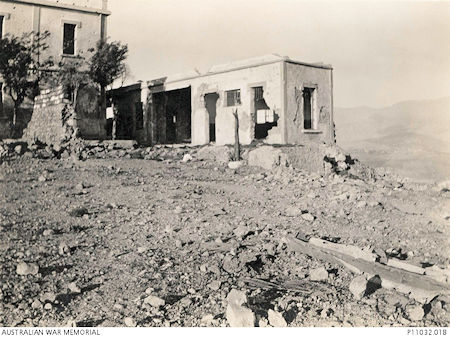
Fort Merdjayoun was a stout fortification built on commanding ground defending the Syrian and
Palestine borders. Built at the southern end of the town, twin tiers of machine-guns, in strong
points at the four corners, commanded the road to Damascus, 62 miles (100km) distant. The 15-foot
(4.5m) walls were solid concrete almost three feet thick (1m), so thick that 25-pounder (11.3kg)
shells did them little damage. It was manned by Vichy Foreign Legionnaires and Senegalese troops.
10
Hoverbox Photo Gallery - Postcards of Auburn House before 1939
This feature does not function correctly on phones and tablets
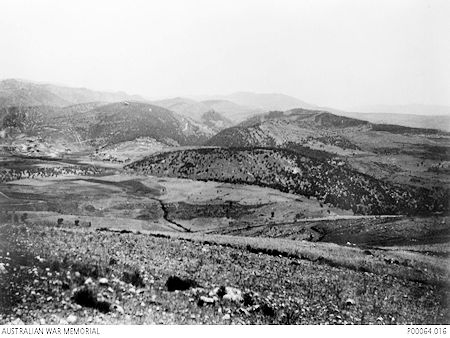
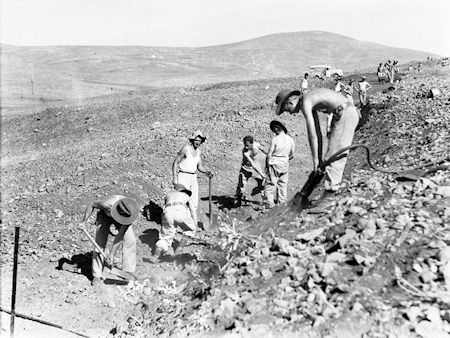
1. Merdjayoun terrain - AWM P00064016
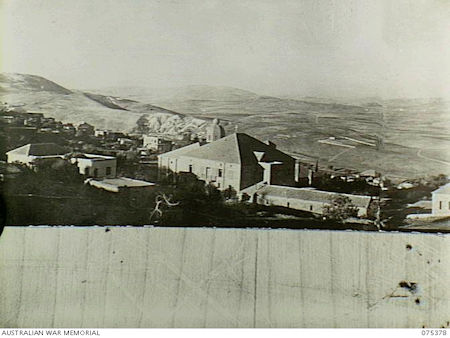
2. Merdjayoun routes - AWM 075379
3. D Coy building a defence roadway - AWM 021353
3. Merdjayoun fort - AWM P1032018
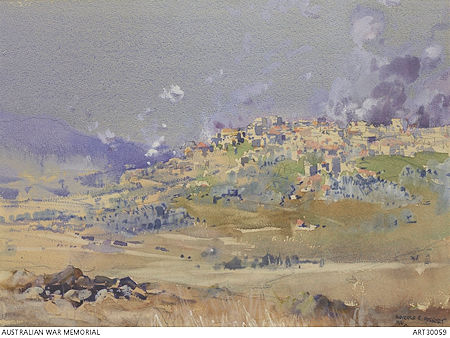
4.Merdjayoun village - AWM Art30059
1
2
3
4
5
Wellington decided to attack Merdjayoun frontally, with ‘A’ Coy moving up parallel to the road
and ‘B’ Coy moving to the right rear of ‘A’ Coy to leapfrogging through the fort to capture the
fleeing enemy. 11
At precisely 0530 hours on 17 June 1941, the artillery laid down a creeping barrage, which ‘A’
Coy followed with Company Headquarters to the rear of the forward platoons. Eighty yards (73m)
from the fort the wire and picket fence was met. As casualties mounted, No. 3 Platoon attacked
under cover of two platoons. Concentrated fire from the fort frustrated flank attacks.
12
‘B’ Coy, advancing about 50 yards (46m) behind ‘A’ Coy, with Company Headquarters and No. 5
Platoon in the centre, came under concentrated automatic fire. This made control difficult and
forward movement impossible. The slightest movement brought fire from dozens from machine-guns
leaving both companies taking advantage of the scant cover in the folds of the ground and under
small bushes. Casualties mounted and complete destruction was threatened by the unexpected
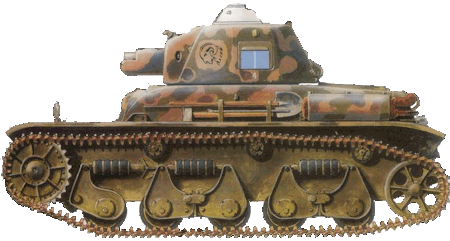
appearance of Renault Medium R35 tanks. Uncertain as to the 2/2 Pioneers’ antitank capabilities
and lacking support of troops, the R35s missed an opportunity to exploit the situation. The 2/2
Pioneers’ single Boyes anti-tank gun was out of ammunition. However, in the confusion 38 of the
Pioneer survivors were taken prisoner. 13
During the attack, ‘C’ Coy had remained defending the bridge. They were moved back
by motor transport to Metulla and then forward, towards Kleyat taking a position
across the road to Merdjayoun. Later in the morning of 18 June 1941, enemy tanks came
down the road firing on any movement. As the 2/2 Anti-Tank Regiment were unable to
engage, No. 7 Platoon withdrew to the crossroads in front of the village.14
When a battery of 25-pounders (11.3kg) fired in support of ‘C’ Coy, the tanks withdrew
and No. 7 Platoon returned to its original position.15
Right: Renault Medium R35 tank
Over the next few days, a stalemate prevailed. Battalion units were relieved, enemy mortar were
dropped and the tanks reappeared. On the 18 June 1941, patrols of the 2/25Bn had moved to the high
ground to the left of the fort capturing prisoners and machine-guns. No 10 Platoon of the 2/2
Pioneers had moved forward in support reaching a stone building to the rear of the fort. At 1900
hours, the enemy launched a counter-attack, which forced No. 10 Platoon to withdraw and the
2/25Bn’s attack to fail, as it was beyond one battalion to attack experienced Foreign Legionnaires
and Senegalese machine-gunners. 16
1821info13d, sheet 8
Brigadier Berryman then walked through the country over which the 2/25Bn had made
its abortive attack and decided a second similar attack should be made on the 19 June
1941. He divided the position south of Merdjayoun into three sections with the left,
facing Merdjayoun itself, covered by the 2/2 Pioneers, the Scots Greys, and a company
of the 2/5Bn all under Lt-Col Wellington. The Pioneers were to “demonstrate” from the
south in order to distract the enemy’s attention, and were to get in touch with the
2/25Bn on the left flank and be ready to help it exploit its gains. 17
At 0420 hours, the Australian guns opened fire on the Merdjayoun fort, to delude the
enemy, and after ten minutes were switched to the first objectives of the attacking
infantry who were awaiting the order to move. Shells from the French guns, which
quickly retaliated, bursting among the Australians causing casualties. A patrol of
the Pioneers advanced towards the fort under cover of rocks and grass until they were
only 300 yards (275m) away from the fort. They crept forward and captured a Vichy
machine-gun and crew, then moving north of the fort captured a mortar from the rear.
Using their own weapons and the captured mortar, the Pioneers ‘sniped’ the Frenchmen
in the other houses. When the French tanks appeared, the Pioneers withdrew.
18 The 2/2 Pioneers’ company on the left cleared a copse in which the
French were strongly established and advanced into the town without meeting any
resistance, breaking up into small groups to clear houses from which Frenchmen were
firing. 19
Right: A map of the Merdjayoun attack Source: Aitken
On 21 June 1941, ‘D’ Coy moved to the left flank to establishing a chain of posts around the
fort. With the 2/25Bn and 2/33Bn engaged at Merdjayoun, the Kings Own Royal Rifle Regiment took
Fort Khiam and the high ground behind Merdjayoun. With the town out flanked the French withdrew
to prepared positions three miles (4.8km) to the rear. 20
1821info13d, sheet 9
Meanwhile, on the early morning of this attack, a Pioneer patrol, which had been
on the edge of Merdjayoun, had reported much noise near the fort. When the platoon
went forward and opened fire, there was no reply. At 0830 hours on 22 June 1941,
Wellington ordered ‘C’ and ‘D’ Coys to advance on the fort under the cover of smoke.
Sections entered the fort without a shot being fired, the enemy having moved. The
town was in chaos as the artillery fire had done much damage, but the French troops
had done more. (Long 448) After ‘D’ Coy had cleared the town, the company took a
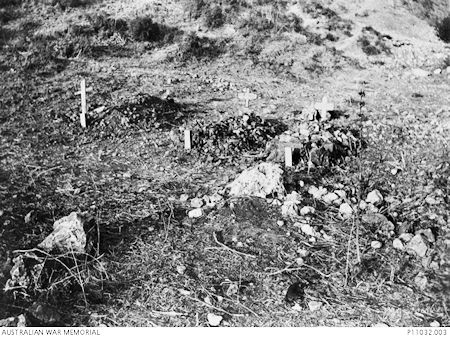
position in olive groves north of the town. 21 Many dead French troops
were lying on the ground. The Pioneers who had been killed in the attack on the 17th
were found and buried in front of the fort.
Right: 2/2 Pioneer graves at Merdjayoun Source: AWM P11032003
Now the enemy held the high ridge north of Balate to the Litani River. The 2/2 Pioneers
Headquarters issued a warning order for an attack on these positions on the morning of 27 June
1941. However, Wellington who had issued the outline plans on 25 June 1941, was not to see the
attack carried out. Whilst on a reconnaissance, early on the morning of 26 June 1941, he was
wounded in the right elbow and brought back to the Regimental Aid Post by motor cycle and
evacuated later that afternoon. Lt-Col. Monaghan took over command of the 2/2 Pioneers.
22
Above: War Diary 26 June 1941 - recording Nelson being wounded
Source: War Diary
Nelson was evacuated to 7 Australian General Hospital and was transferred to the ‘X’ list due
to gun-shot wound right elbow and arteriosclerosis. On 15 September 1941 the medical board
classified him as ‘permanently unfit for service’. On 27 September 1941 Nelson relinquished
appointment to command and was transferred to the Permanent Supernumerary List. On the 05
November 1941 his service record says that he embarked in the Middle East for return to Australia
arriving on a hospital ship on 01 December 1941to be transferred to the 115 General Hospital at
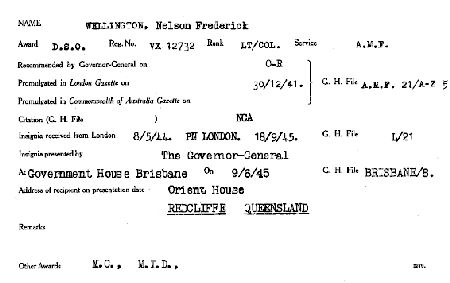
Heidelberg. On 20 December 1941/23 January 1942 he was awarded the DSO.
Later action under Monaghan
The objective of the attack, on an 850-yard (777m) frontage, was a long low ridge running
north and parallel to the Balate Ridge, which dominated the Merdjayoun-Hasbaya road, and would
remove the threat to the southern Metulla route. The steep and rocky ridge was protected by four
prominent knolls, three of which were platoon objectives. At 0100 hours on 27 June 1941, ‘D’ Coy
left Balate and filed up Balate Ridge following a creek (Long 449). At 0405 hours the artillery
began their preparatory bombardment before the attack began. At 0415 hours it dropped to form a
creeping barrage lifting 50 yards (46m) at a time leading the infantry to their objective (Long
449) over difficult boulder and rocky ground, which provided good cover. Bayonets fixed, they
advanced up the hill, apparently without being observed, until they were about 300 yards (275m)
from the first objective - the saddle north of Col’s Knoll. The advancing men met machine-gun and
mortar fire, the machine-gun fire at first passing well over their heads. Then in a final rush men
began to fall in hand-to-hand and grenade fighting. The crest of the knoll was reached and
carried. By first light the forward troops had reached all their objectives with few casualties.
However, it was realised that these were outposts and the strength of the enemy lay on the
reverse slopes. Preparations were made for a daylight counter-attack, against No. 12 Platoon, by
the main enemy force. Lacking ammunition and with 50 per cent casualties the platoon withdrew to
Balate
1821info13d, sheet 10
Ridge. Realising the attack had failed Lt.Col. Monaghan called down a protective artillery
barrage in front to the forward troops, who broke off and, with difficulty, withdrew to the start
line. 23The ridge, which was the main French position, had been held by two French
battalions which had withdrawn over the hill during the barrage, and, when it ceased, had advanced
again. Of the company which went into the attack 27 were killed, more than thirty were wounded,
and others were taken prisoner. After dark Staff-Sergeant Peeler (who had been awarded the
Victoria Cross in 1917) led out a patrol which brought in four wounded men. 24
On 28 June 1941, approximately 70 reinforcements arrived and allocated to bring the companies
to equal strength. On the 29 June 1941, two 2/2 Pioneers patrols went out to assess the present
state of wiring and field works, but returned without making contact. The enemy had withdrawn his
outposts and moved his main defences to the rear. On 01 July 1941, the Battalion was relieved by
a battalion of the Durham Light Infantry. By 0140 hours on 02 July 1941, the last company reached
the company areas in the olive groves of Dier Mimes. The next day was spent overhauling weapons
and equipment before their next assignment at Damour was posted. 25
The campaign at Merdjayoun resulted in heavy casualties with 27 killed, 46 wounded, and 29
being taken prisoner. Despite the losses the battalion remained in action for the rest of the
campaign. Further actions followed around Merdjayoun, El Mtolle and, in July, Damour before the
Vichy French defenders capitulated in July 1941. Casualties throughout the whole campaign
amounted to 14 officers and 161 other ranks killed or wounded.
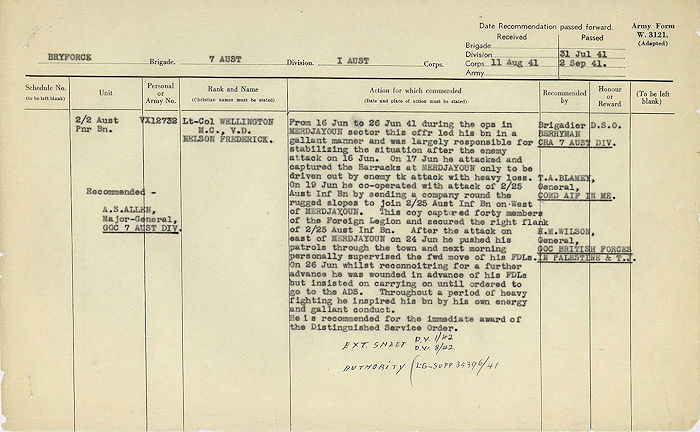
Above: Nelson Wellington's DSO recommendation from his
NAA service record Click on the map to open a scalable pdf map in a new window
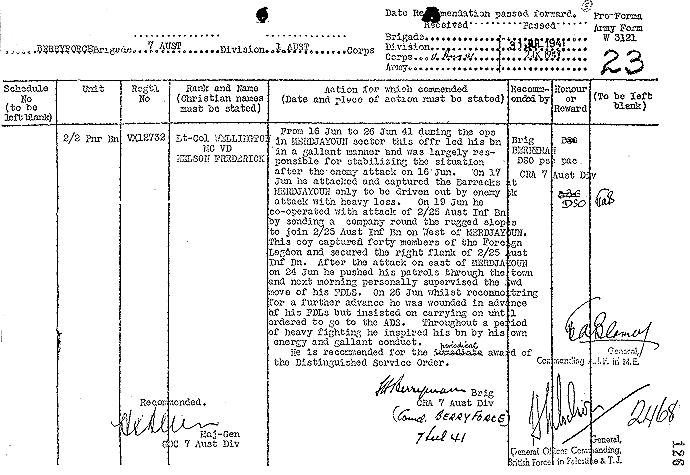
Above: Nelson Wellington's DSO recommendation
Click on the map to open a scalable pdf map in a new window
1821info13d, sheet 12
Note particularly that this recommendation is for an 'immediate award' and that this
has been changed in the recommendation below. Note also the distinguished names supporting the
award of a DSO: Major General AS Allan, Nelson's 7th Division commander, Brigadier Berryman
officially Commander Royal Artillery but who commanded the Merdjayoun attack, General TA Blaney
Commanding AIF Middle East and General KM Wilson GOC British Forces in Palestine. The meaning of
'FDL' is not known.
In the second version an 'immediate' award has been replaced by a 'periodical'
award and a military OBE was considered and discounted. The military Order of the British Empire
is awarded for gallantry as well as service but is four levels below the DSO.
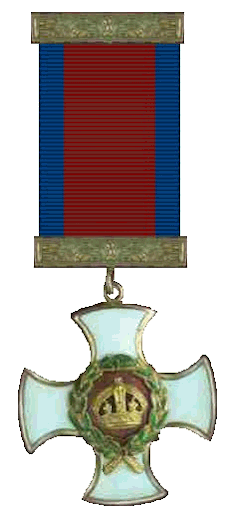
The DSO was established for rewarding individual instances of meritorious or
distinguished service in war. In World War II it was a military order, specifically
for officers only, and normally given for service under fire or under conditions
equivalent to service in actual combat with the enemy, Between 1914 and 1916 under
circumstances which could not be regarded as under fire it was offered to staff
officers, which caused resentment among front-line officers. After 1 January 1917,
commanders in the field were instructed to recommend this award only for those
serving under fire. Prior to 1943, the order could be given only to someone Mentioned
in Despatches. The order is generally given to officers in command, above the rank
of Captain. 1 Nelson was initially awarded an immediate DSO for gallantry
leading his battalion.
Nelson's service record records:
23.1.42 H[ouse] Com{mons] Office
London Awarded D.S.O
8.8.42
The King has been graciously pleased to approve the following Award on recognition
of distinguished services in the Middle East (including Egypt, East Africa, The
Western Desert, The Sudan, Crete, Syria & Tobruk during the periods February
1941 to July 1941. Award The DSO
Right: DSO correct
1821info13d, sheet 13
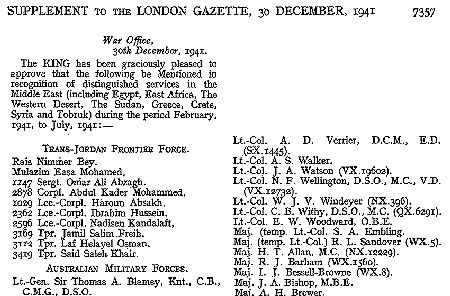
Right: Wellington DSO announcement in the London Gazette
of 30 December 1941 page 7334 Click on the image to open a scalable pdf
Conclusion
With Beirut threatened the Vichy command sought an armistice, and hostilities ceased on 12
July; the campaign had cost the Australians 1,500 killed and wounded. Australian participants felt
(justifiably) that the British and Australian authorities intentionally restricted publicity about
their efforts in this tough campaign, which was politically sensitive.
Source:
Johnson Mark, 'The Australian Army in World War II', Osprey, Oxford, 2007
During this time Pat Wellington was working at the Heidelberg Hospital in north-east Melbourne.
One of her responsibilities was to tell patients that a relative had become a casualty.
One day when I responded to such a call he suggested we sit down on a
bench nearby and he said "This one is rather difficult. It concerns you!! "I just froze
and asked "My husband or my Father?" He said "Your Father has been wounded in
action in Syria on 26 June 1941. Do you know where your Mother is?" 2
Nelson arrived Brisbane from Syria on 1 December 1941.
Nelson Wellington was the Chief Liaison Officer and Director of Training for the
Australian Army attached, during 1942 and 1943 as a substantive Lieutenant
Colonel appointed temporary/honorary full colonel on 20 July 1942 to General Douglas
MacArthur's Staff. General MacArthur as Supreme Commander, South West Asia's
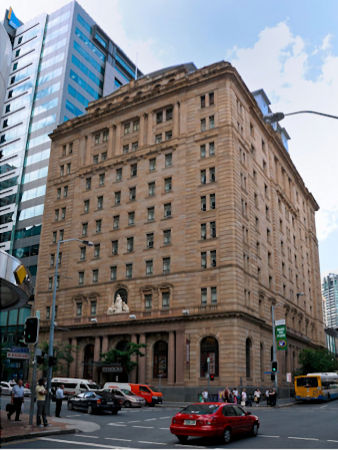
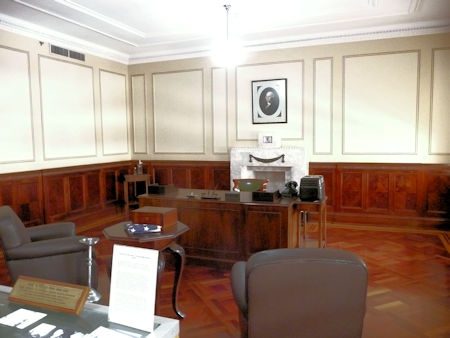
had his office is on the 8th floor of the old AMP building in Queen Street, Brisbane,
now the MacArthur Centre which is as it was in 1943. The whole Building was taken
over by the Military at this time selected because of a thick reinforced concrete
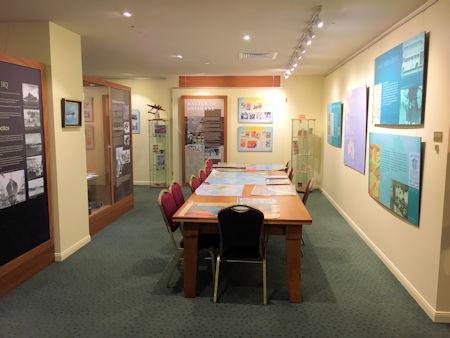
roof. The museum also has the history of Brisbane in WW2. 3
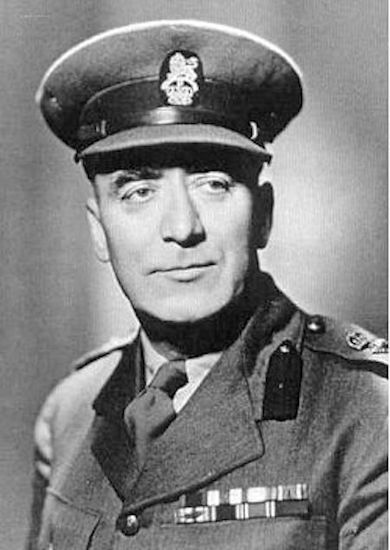
Right: Lt.Col. NF Wellington in 1943. His son Chip writes that the photo
shows the red cap band and red tabs 'my father earnestly aspired to and for which
he demonstrated his military ardour, in the Second World War'.
Note the DSO, MC but only one MiD
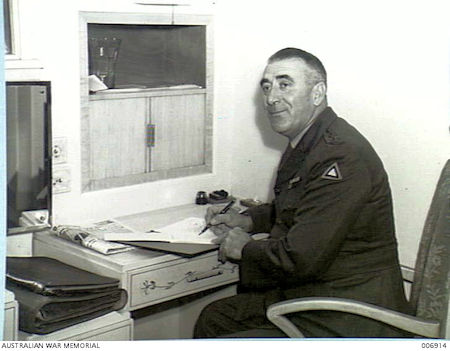
A photograph of Nelson taken, according to the AWM in Sydney. Note that he still wears
his 2/2 Pioneer colour patch.
Right: NF Wellington Sydney 28 April 1941 Source: AWM 006914
1821info13d, sheet 15
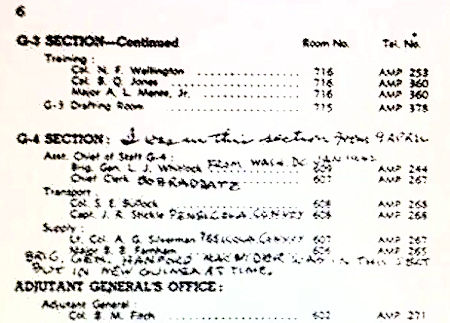
Bruce Hutson reports finding an old telephone directory list at the museum and
Nelson's office was on level 7 in room 716 Tel AMP253. As Chief liaison officer for
the Australian Army he would have been frequently at meetings with the General.
There was decoding and signals on other floors.
Right: Nelson Wellington work in Brisbane showing that
he was attached to G3 Section training before being transferred from
09 April 1945 to G4 Section Source: Bruce Hutson
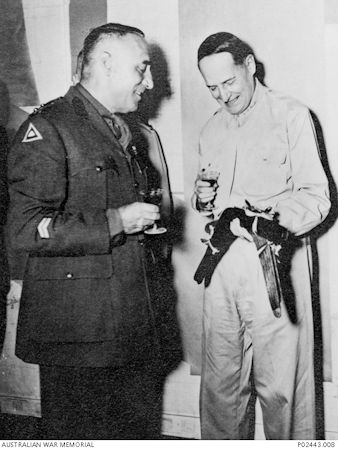
Right: Nelson with Douglas MacArthur - AWM P02443.008
Note that Nelson still wears his 2/2 Pioneer colours and supports
two wound stripes. He appears to be presenting MacArthur with autographed boomerangs
on behalf of fellow officers. The occasion was a party to celebrate Australia Day and
General MacArthur's birthday
Hoverbox Photo Gallery - MacArthur's war room - Source:
Bruce Hutson
This feature does not function correctly on phones and tablets
1. AMP Building Brisbane
2. MacArthur's war room office
3. MacArthur's war room museum
1
2
3
1821info13d, sheet 16
Finally retirement from the army
Above: The Age of 11 June 1945 recounts Nelson's award
of the DSO from Duke of Gloucester and summaries his service record
Nelson's records shows that he was discharged from the army on 16 May 1945 as medically unfit
for service.
1821info13d, sheet 17
Right: Nelson Wellington's DS0 award, which was
promulgated in the London Gazette of 31 December 1941. However, it
has been impossible to find the actual Gazette entry.
Right: Brisbane 09 June 1945 Nelson Wellington with Duke of Gloucester
on receiving his DSO and leaving the army Source: Chip
Wellington's book
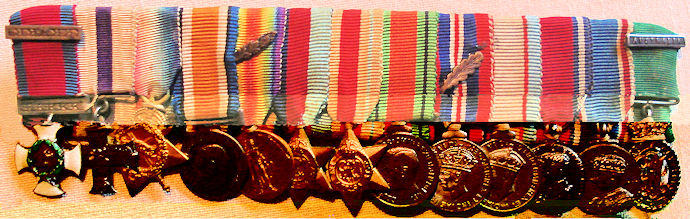
Above: Nelson Wellington's medal ribbon The medal group
consists of Distinguished Service Order, Military Cross, 1914/15 Star, British War
Medal, Victory Medal with MID, 1939/45 Star, Africa Star, Defence Medal, War Medal
with MID 26/12/41, Australian Service Medal 1939/45, 1935 George V Jubilee Medal, 1937
Coronation of George VI Medal and Colonial Auxiliary Forces Officers Decoration.
With thanks to Ian Stephens
1821info13d, sheet 18
Nelson's service record records 4 The
King has been graciously pleased to approve a Mentioned of Distinguished Services
M/E, Greece Crete & Tobruk during the period Feb 1941 to July 1941. The
MiD oak leaf is on the right.
Right: Wellington MiD citation December 1941
London Gazette 26 December 1941 ref: LG 35296
His service record also records his promotion...
Rank
2/Lieutenant
29 March 1909
Lieutenant
23 November 1911
Captain
16 June 1918
Major
09 May 1930
Lieutenant Colonel
14 November 1931
Lt.Col to command 2/2
01 May 1940
Temp Colonel
20 July 1942
Reserve list
21 June 1945
Lt.Col, Honorary Colonel
21 June 1945
His army nickname was 'Clete' Source: Heather Schoffelen, though the
family have no knowledge of this.
Puckapunyal Army Base, colloquially as "Pucka", is an Australian Army training facility in
central Victoria: the name was taken from the Aboriginal name for a large hill within the
training area.
The area was first used as a mobilisation and training area during World War I. During the
early 1920s, an ordnance store and rifle range were built on the site. It was one of
several new camps built for the concentration and training of the Second AIF because
existing military facilities were already occupied by militia units. The original site
was too small for wartime training, and an additional 5,700 hectares (14,000 acres) of
grazing land were compulsory acquired just to the west of the town of Seymour (96
kilometres north of Melbourne); Seymour had been a site for military training since the
late 1800s. In 1939, the area was formally established as Puckapunyal Camp. (AWM/Wiki)
The camp facilities at Puckapunyal were spartan at first, consisting primarily of unlined,
windowless corrugated iron hut, which were progressively improved as the war continued.
More information 2
The qualities of being a Commanding Officer
In assessing the effectiveness of Australia's
battalion commanders it is important to understand the nature and complexity of
command. [...] What we might say is that to be in command is to be in authority
over a group of people for the purpose of achieving a set task. In this context
this involves raising, training, maintaining and organising a battalion of
infantry so that they might close with the enemy, kill, capture or otherwise
incapacitate them, capture their ground and hold it against counter-attacks.
To do this, a battalion commander needed to be competent in three broad areas,
requiring different skills. First, he needed to be tactically proficient -
implementing training programs, commanding in combat and then disseminating the
lessons of battle into reports to aid the future conduct of both the battalion
and also the wider force. Second, the CO needed to be administratively aware and
capable. A battalion might be tactically proficient, but if they were ill-fed,
with dirty clothes and poor accommodation their fighting effectiveness would
suffer. Therefore the battalion commander needed to manage both his human and
physical resources well. This was accomplished by the delegation of tasks and
areas of responsibility to his key subordinates, particularly the quartermaster,
transport officer, RMO and chaplain often under the overall guidance of his 2/ic.
The CO would then oversee the battalion's administrative arrangements,
intervening only when necessary. He could also advocate on behalf of his
battalion to his superiors in matters that were outside his control, such as
leave allowances.
On Leadership Westerman writes:
Finally, the battalion commander needed to be an
effective leader. This is a far more complex topic than can possibly be addressed
here, but needs to be touched on briefly. Leadership in this specific sense
relates to the ability of a commander to influence his subordinates to follow
him. What that looks like in any given context changes dramatically, but the
basics are still the same. Military leadership has an advantage, given the
structural and authoritarian nature of the leadership dynamic, but even there the
difference between a good leader and a poor leader are evident in the way in
which the subordinates respond to the orders of the commander. Three key
indicators of how well a battalion commander was leading his men were unit
morale, administrative effectiveness and battlefield performance, all of which
were linked and were to a large degree interdependent.
1821info13d, sheet 20
More information 2 cont:
The qualities of being a Commanding Officer
[...] What made a good leader for soldiers (exerting
influence by visible demonstrations of competence, concern for welfare, effective
but not overbearing discipline and courage) was not what necessarily made a good
leader for officers, which required the development of personal working
relationships.
Source: Westerman, William, AIF Battalion Commanders in the Great War -
The 14th Australian Infantry Battalion - a Case Study, in Stand To! No. 108,
the journal of The Western Front Association, page 18