1821 Info 13a for Caleb Crompton
Nelson Frederick Wellington - his life
Ida May BLACKMAN was born on 22 November 1886, the seventh child and youngest
daughter of Frances Emily CROMPTON and William BLACKMAN, a farmer of 'Lyndon', Sulky,
north of Ballarat, Victoria.
She married Nelson Frederick WELLINGTON. Pat WELLINGTON writes of her parents.
My parents' interest in singing led to their membership
of the leading Ballarat choir of the day. My Father was the number one tenor and my
Mother was the number one contralto. They did a great deal of singing together and
the romance took off from there.
My Mother's courtship days were filled with music and teaching. She had elocution
pupils and she taught in a little country school.
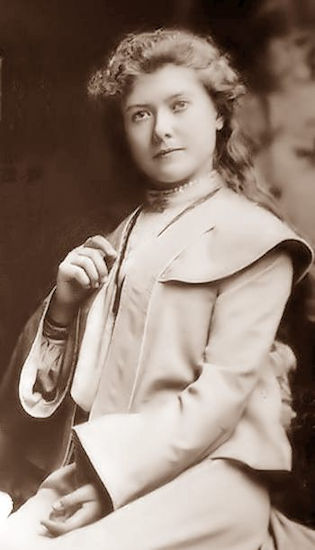
Left: Ida Blackman c.1900 taken from a photograph of all the Blackman
sisters.
Source: Heather Schoffelen
Nelson edward Wellington (Commercial Street Merbein)  John Smith
b......1866 Ballarat East, Victoria                   b.
d.30aug1936 Mildura, Victoria                         d.
|                                                     |
m......1888 (Reg no. 5271)                            m......1859
|                                                     |
Margaret (Minnie) Elizabeth Smith =================== Hephzibah Petty
b......1864 Ballarat East, Victoria                   b.
d.23dec1950 Merbein, Victoria                         d......1892
|
|============|===========|========|========|========|========|=======||
Nelson       Minnie      Allen    Daisy    Margaret Ireen    Adele
frederick                                  (Marge)  (Rene)   (Dell)
b.03mar1889  b.1891      b.1893   b.1896   b.1901   b.1904   b.1911
d.22aug1952  d.1976      d.1893   d.1975   d.1976   d.1980   d.1996
|            |             ****   |        |        |        |
m.14nov1911  m.05jul1919          m.       m.       m.       m.
|            |                    |        |        |        |
Ida may      Frank                George   William  Harry    Charles
Blackman     Beaven               Ball     Missen   Symons   Tulloch
             ******
1821info13a, sheet 2
Nelson Frederick WELLINGTON was born Ballarat on 04 April 1889. His father was in the building
trade - a plasterer and concrete expert. 1 A former pupil of Mount Pleasant,
established in Ballarat on 3 August 1874 as State School No. 1436 for 550 scholars and then the
Church of England Grammar School, Ballarat. Nelson was, in March 1937, listed in an article
from The Age, as a distinguished former pupil. 2 On completing school he joined the
Ballarat East Town Council as a junior clerk where he remained for 6 years. In that time, on 19
August 1911, he gained a Certificate of Competence from the Municipal Clerks Board.
Their first child, Pat WELLINGTON, writes of her parents:
Besides singing well my Father was a talented pianist. He
could play anything by ear as well as read music. He was much in demand socially all
his life because of this entertainment skill. Two of his sisters were also talented
musicians so there was a great deal of music in his family life. My Father was also
good at sport and played football in the Golden Point team [Now East Point Football
Club]. He also rowed well.
His days as a young man were filled with music, sport and
municipal training at Ballarat Municipal Offices. When the opportunity came to get a
shire secretary's job at Orbost [Gippsland] my Father applied and when he was
successful my parents married and went to Orbost to live. 3
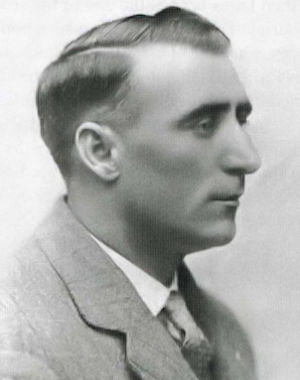
Left: NF WELLINGTON Shire Secretary, Orbost, 1911-1914
All photographs, unless otherwise stated, with permission of Pat WELLINGTON's
son, Geoffrey HUTSON
Before and after her marriage on 14 November 1911, the Electoral Roll records Ida May
BLACKMAN living at:
1908 67 Blackman, Ida May, Bald Hill, sewing-mistress,
in Learmonth sub-district of Grampian
1913 118 Blackman, Ida May, Bald Hill, sewing-mistress, in Learmonth
sub-district of Ballarat
and who also gave elocution lessons.
Nelson Frederick WELLINGTON was living with his family at:
1912 2030 Wellington, Minnie, 13 Laurie st., home duties, in Mount Pleasant sub-
district of Ballarat
1912 2031 Wellington, Nelson, 13 Laurie st., plasterer, in Mount Pleasant sub-
district of Ballarat
1912 2032 Wellington, Nelson Frederick, 13 Laurie st., assistant town
clerk, in Mount Pleasant sub-district of Ballarat
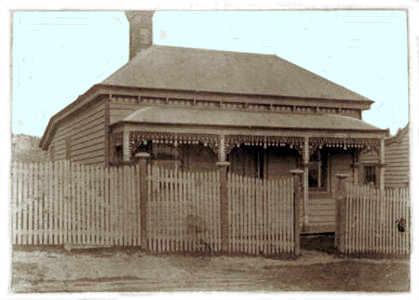
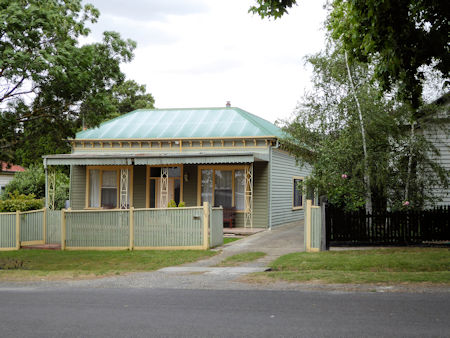
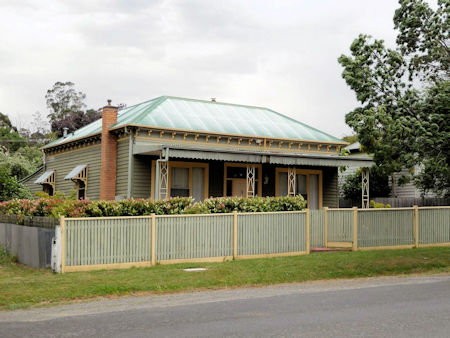
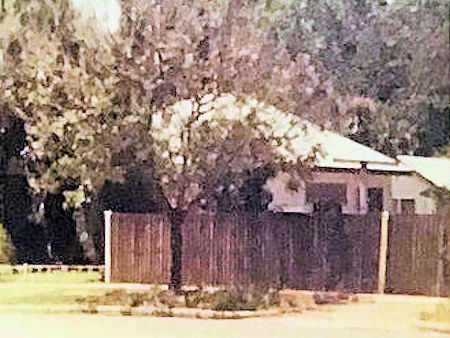
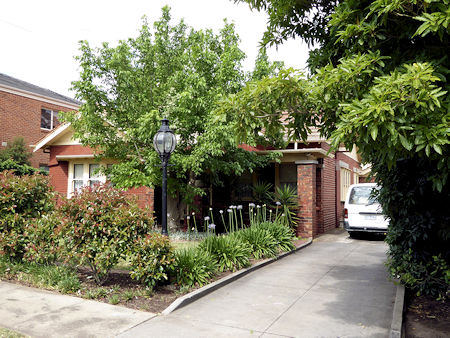
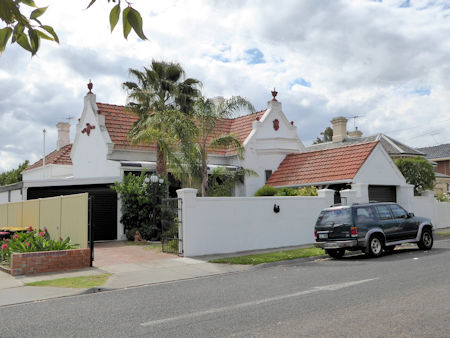
It is believed that 13 Laurie Street was renumbered 709 Laurie Street. This belief
is supported by the similar architectural style of numbers 7 and 709.
Left: 709 Laurie Street, Ballarat Author: November 2015
Right: 709 Laurie Street, Ballarat Author: November 2015
1821info 13a, sheet 4
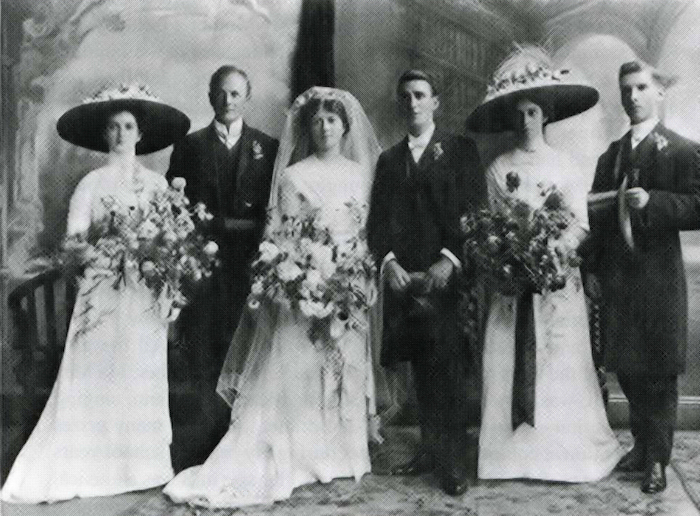
The wedding
Above: Blackman - Wellington wedding, Ballarat, 14 November
1911 4 Left to right: Mabel BLACKMAN, sister of the bride, later Mrs PEARSON,
Eric BRIND 1, best man and NFW's friend Ida May BLACKMAN, the bride, Nelson
Frederick WELLINGTON the groom, Minnie WELLINGTON, bridesmaid and sister of NFW, Thomas
BLACKMAN, brother of the bride.
The report of the Ballarat Star of 09 December 1911 gives a vivid description of the wedding
and the dresses featured in the photograph.
A very prety (sic) wedding
took place at Christ Church Cathedral on Tuesday, the 14th November, when Miss Ida
May Blackman, youngest daughter of Mr and Mrs William Blackman of "Lyndon," Sulky,
was married to Mr Nelson Wellington only son of Mr and Mrs Wellington, of Mount
Pleasant. The Rev. John Forster, sub-Warden of St. Aidan's Theological College,
was the celebrant. The bride who, in the absence of her father was given away by her
eldest brother, Mr. Harry Blackman of Albert Park, was gowned in ivory charmeues
satin. The semi-evening corsage was draped, over a chemisette of Malines lace. Heavy
lace embroideries outlined it on one side, whilst a spray of orange blossom was the
only ornament. The long rounded train, weighted with groups of blossoms and ribbons,
fell from under the embroideries of the tunic and the whole was held together at the
waist by a silken rope. Her veil was of tulle, with a coronet of orange blossom, and
a shower bouquet of white roses, the gift of the bridegroom. She was attended by two
bridesmaids, Miss Mabel Blackman (sister of bride and Miss Minnie Wellington (sister
1821info 13a, sheet 5
of bridegroom), who were
dressed alike in ivory crepe de chine. The dresses, simply
made, were very effective, the trimmings being of silk insertion and tucked net,
finished off with ivory sashes. They worelarge black hats, and carried shower Mr
Eric Brind (best man) and Mr Thomas Blackman (groomsman). Mr Garnet Eggington
presided at the organ,playing "The voice that breathed over Eden" as the bridal
party entered the church, and Mendelssohn's "Wedding march" at the conclusion of
the ceremony. The reception was held in the Parish Hall, the Rev. J. Forster
presiding. The following toast list was honored (sic): - "Bride and
Bridegroom." by Mr. S. W. H. Pearson, president of South street Society: "
Bridesmaids." proposed by bride-groom: "Parents." proposed by Rev. J.
Forster; "Officiating Clergyman," proposed by Mr Thomas Blackman. For the
entertainment of the young people a social evening was held in the
A.N.A. Hall, Camp Street 2 The following ladies and gentlemen
rendered musical and elocutionary items: Misses May Bennett, Mary Frank, Mima Scott,
Winnie Slattery. Messrs Eric Brind and Hugh Edmunds. The accompaniments were played
by Miss Mollie Laffey and Mr Garnet Eggington. Mr and Mrs Wellington left by the
evening train for Melbourne en route to the Gippsland Lakes, where the honeymoon was
spent. Many handsome presents were received from a large circle of friends, including;
Bridegroom to bride, chased buckle bracelet: to bridesmaids, dressing case and dress
ring respectively: bride to bridegroom, travelling outfit; mother of bride, house
linen and satin eider-down quilt: father of bride, pictures; mother and father of
bridegroom, cheque; officers of Town Council, silver hot water kettle and spirit
lamp, and silver rose bowl; Mayor Penhalluriack, elaborate silver butter dish in
case; Golden Point Football Club, silver cake basket; president (Mr E. Beacham)
handsome bronze figure; secretary (Mr J. Dulter), large hand painted vase; Mr
Pearson (president South street). chip carved afternoon tea table; Mr Hill
(secretary South street.), silver cocoa jug; Mr. J, T. Morris (conductor Glee Club)
silver butter cooler. Many congratulatory messages were received, including
telegrams from Vancouver, British Columbia, Kalgoorlie, and Boulder City (W.A.) and
also from a large number of Victorian friends. Mr and Mrs Wellington's future home
will be at Orbost, Lakes district, East Gippsland.
In 1911, where Nelson was the Shire Secretary. He was assistant town
clerk at Ballarat East when he was appointed as Shire Secretary to the Shire of Orbost
in December 1911 following their wedding, the couple moved to Orbost. He commenced
duties at Orbost in the first week of January 1912.
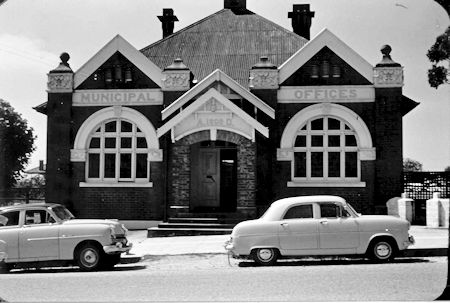
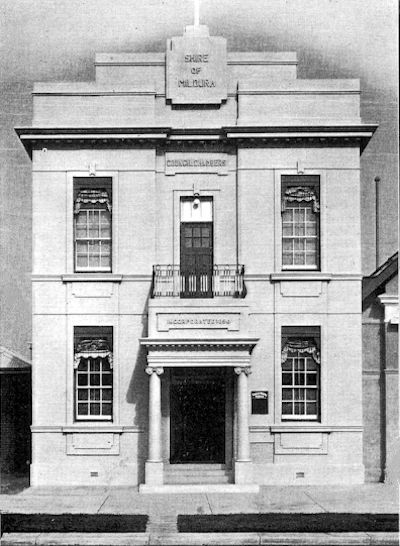
Right: Orbost Shire Offices early 1950s
Source: Geoffrey Hutson
The Australian Electoral Roll 1903-1977, available on Ancestry, records their homes and
occupations in the 1913 Roll as:
1913 1167 Wellington, Ida May, Orbost, home duties, in Orbost sub-district of
Gippsland
1913 1168 Wellington, Nelson Frederick, Orbost, shire secretary, in Orbost sub-
district of Gippsland
They lived at “Rosslyn”, Salisbury Street, Orbost, then at “Rosslyn” Gordon Street, Orbost.
Whilst Salisbury and Gordon Streets are on Google maps, “Rosslyn” is not.
1821info 13a, sheet 6
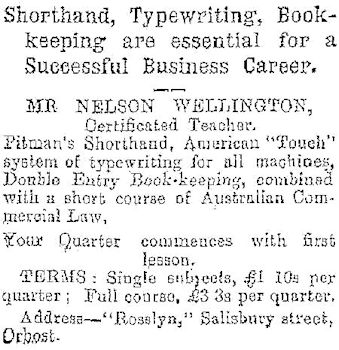
In the same year, Nelson was supplementing his salary by
teaching clerical skills at his home in 'Rosslyn', Salisbury Street,
Orbost.
Right: A composite image of Snowy River Mail of 11 November
1913
During his time at Orbost he was actively involved with local groups and activities.
At the time of his arrival, it was compulsory for all boys between the ages of 14 and 18
to register for military training. As a trained army Lieutenant, he organised a corps of
local lads to be provided with rifles and uniforms and undertake some initial training, and
later on organised a system of voluntary training in military instruction for all male
residents of the district.
He umpired local football matches between Orbost, Newmerella, Cunninghame (Lakes Entrance)
and Bruthen football clubs; he captained the Orbost cricket team and was a very competent
golfer.
He chaired local meetings and took on the position of auditor of the Orbost branch of the
People’s Party.
Both he and Mrs WELLINGTON contributed vocal and recitation items as well as musical
accompaniment for local church performances and other occasions, such as a visit by the
Governor of Victoria. He was a member of the Orbost Municipal Band. 6
The Snowy River Mail reports the Orbost Shire Hall council meeting, which said farewell to
Nelson leaving Orbost for war on 30 April 1915. The
President said he was extremely sorry Mr Wellington was leaving, as he had proved a worthy
officer. He congratulated him on the position he had attained in the forces, and expressed
confidence that he would discharge the duties with honours ...
1821info13a, sheet 7
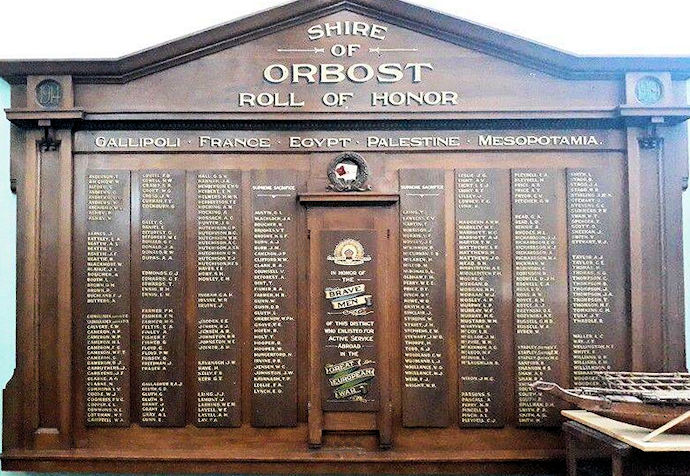
Above: Shire of Orbost honours board -
Orbost Museum
The central panel records:
In Honour Of The BRAVE MEN
Of This District Who Enlisted For Active Service Abroad In The Great
European War
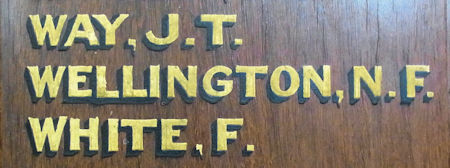
Right: Nelson's detail on the Orbost honours board
1821info13a, sheet 8
Nelson the horticulturalist as part of the Soldier Settlement Scheme
When war intervened, Nelson was still registered in Orbost. However, on board the
returning troopship, soldiers were advised not
to try and return to their old jobs, but to go to the new Soldier Settlements being
set up by the government. One was at Merbein, near Mildura, on the Murray River. New
virgin land was to cleared to extend the grape and citrus industry. 5
Here Nelson became a horticulturalist. Nelson Edward WELLINGTON decided to move
his family from Ballarat to an established citrus farm he had purchased:
a challenge for both families. 7
Nelson's eleven page application to the Discharged Soldiers Settlement Inquiry
Board is available on-line at PROV. To summarise. At the time of his application, on
15 April 1919, he requested about 20 acres of land needing irrigating in Merbein.
Nelson was living at 6 Finlay Street, Albert Park. the home of William Henry BLACKMAN
being temporarily employed as an area officer in the Defence Department. He was
ordered to appear before the Board on 17 May 1919, but failed to appear. His
declaration confirmed his position as Orbost's Shire Secretary for 3½ years, his
rank and position with 21/Bn and AIF's General Staff and that he had been wounded
in the chest that required a dry climate. He was applying for fruit growing land with
three months practical and theoretical experience at Merbein and a certificate for
irrigation orchard farming. Nelson requested a preference for the 18 acre block 67 at
£153 or the 15 acre block 72 valued at £135 'or any other' and a three roomed
house to be built for his wife and girl of 6 year and boy of 4 years.
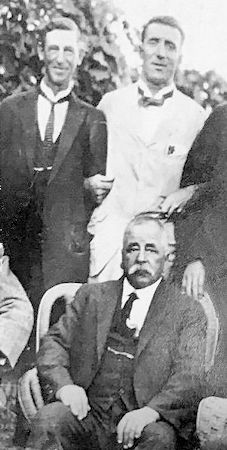
Right: Nelson Wellington, back row right, in Merbein at an
unknown date, with, its believed
Nelson Edward seated
Having £30 in London's Bank of Australia and £120 in Stakes Saving Bank and no liabilities,
he didn't require a loan. Nelson's lease was dated 02 June 1919 for a term of 39½ years at
a cost of £304 15 shillings and 3 pence (£304.76) repayable over 72 half-yearly instalments of £4
4s (£4.20), the first being paid on 2 December 1922. The lease was cancelled on 05 April 1928 for
non-compliance and confirmed on 22 August 1919.
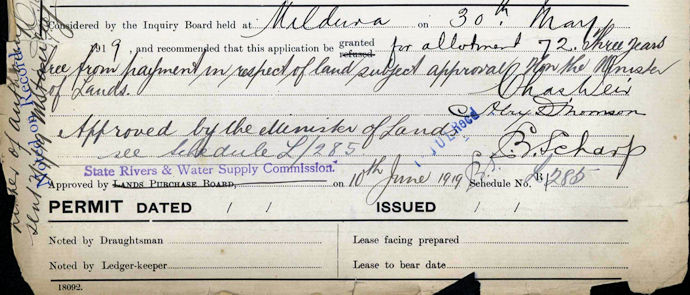
Above: the lower half of page 8 of
Nelson's Application at Discharged Soldiers Settlement Inquiry Board
showing confirmation that he was allocated allotment 72 on 10 June
1919 Victoria PROV World War I Soldier Settlement Scheme (Accessed: 27 December 2023)
1821info13a, sheet 9
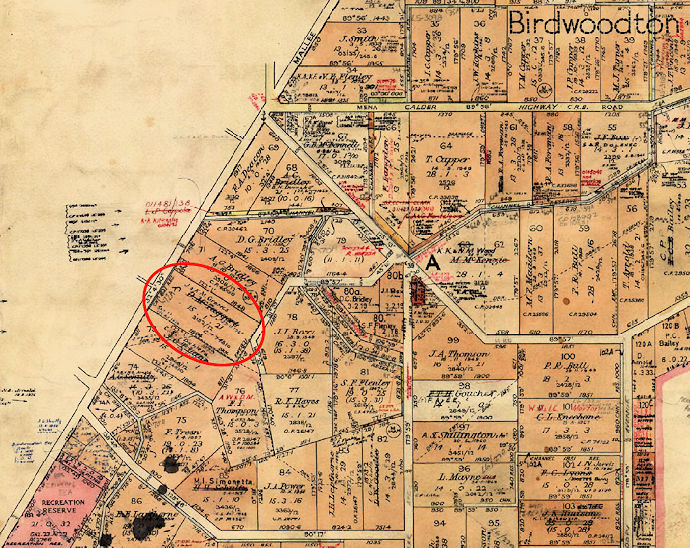
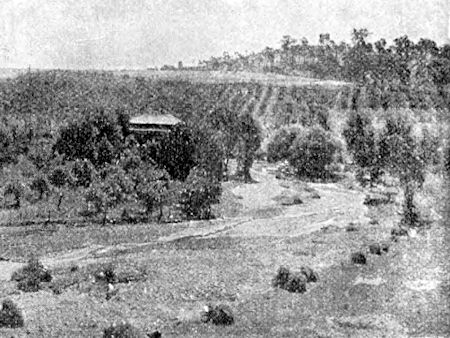
Above: A map locating Wellington's lot 72
circa 1925, circled, after the family had left for Mildura, hence the Wellington name
is not recorded Source: Mildura06 Parish Plan Imperial measure3102 VPRS
16171/P0001/7, Mildura-06(Psh)LOImp3102.pdf available at VPRO
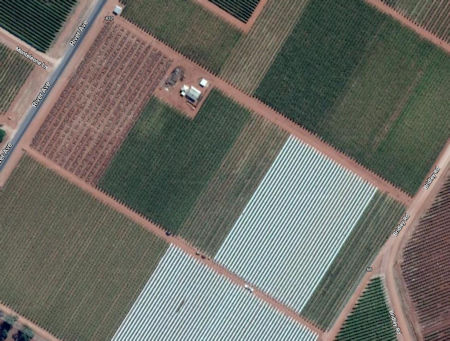
Right: Lot 72 in 2019 with the assumed location of The
Dugout - approximately 432 River Avenue, Birdwoodton
1919 5207 Wellington, Ida May, Merbein, home duties, Mildura sub-district of Wimmera
1919 5207 Wellington, Nelson Frederick, Merbein, horticulturalist, Mildura sub-district of
Wimmera
1821info13a, sheet 10
The settlement in Merbein was virgin land about three miles from Merbein
township, and had to be cleared, blocks measured and fenced, and then planted up with vines and
citrus and irrigated. [...] We had grapes back and front and an orange grove in the centre. It was
a grim life - freezing cold with frosts in the winter and blazing hot for months in the summer.
[...] The harsh life at Merbein in 1920 was very difficult to tolerate. A one roomed dwelling was
erected between the front vines and the orange on our block - bunks at one end and wood stove and
large kitchen stove at the other. [...] Eventually Grandfather Wellington helped us extend the
one-roomed cottage. Two rooms were added onto the back of it. [...] We had plenty of fruit as the
vines and citrus trees grew and flourished. 8
Hoverbox Photo Gallery - The Dugout
Source: Chip Wellington
This feature does not function correctly on phones and tablets
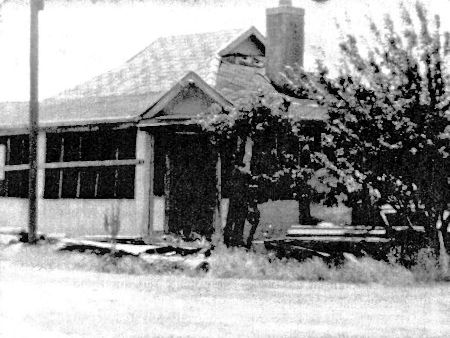
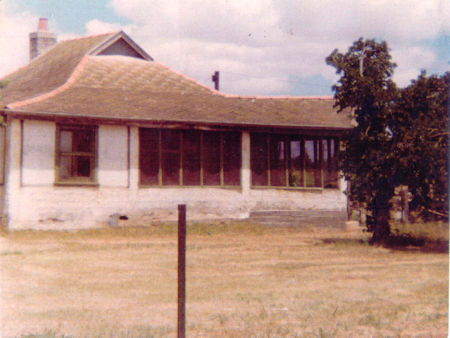
1. An early Dugout after it had been extended Source: Wellington - undated
2. The Dugout c.1920
3. The Dugout c.1980
1
2
3
Hoverbox Photo Gallery - Soldier Settlement orchard
This feature does not function correctly on phones and tablets
As time passed [Nelson] became more and more involved
with the administration of the settlement. [...] As time passed, [Nelson] began to
miss his former occupation and his enthusiasm for fruit growing was waning. Mildura
been a shire and was about to become a town. When the position for the town clerk of
Mildura became available, [Nelson] decided to apply [...] and when he was appointed
in 1923 we moved to Mildura. 10 When the arrangements for the
management of the farm proved unsatisfactory the block and house were sold.
Left: Mildura Shire Offices circa 1923 Source:
Wellington
We didn't stay long in the first floor flat. [In
1925] my parents eventually found a [three bedroomed and with bathroom] home to rent
in Tenth Street. [...] It was a large house, with grape vines all round the front
verandah and considerable garden space [...] one of the first electric stoves in
town. We also had electric light [and] a telephone. [...] The floors were covered in
linoleum and in the living room [...] rugs and some new furniture and a piano.
11
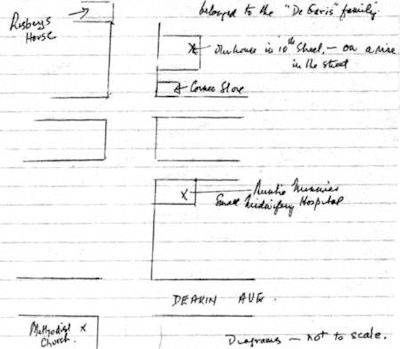
Right: Map locating the 10th Street Mildura House 12
During this time the Electoral Register shows the family still residents of Merbein, though the
family had a small flat at the back of the municipal office, right in the centre of Mildura and
close to the shops. A second flat was rented above some shops which faced the road behind Deakin
Avenue and close to Brownings Store (Brownings Lane(?)).
1821info13a, sheet 12
Nelson meets Pompey Elliott - a supposition
Given Nelson’s wartime experience, his between wars commitment to the Australian militia and
his location and position, it would be surprising if Nelson was not at one of the meetings hosted
by Victoria’s illustrious Brig-Gen. Harold ‘Pompey’ Elliott, whose original 7/Battalion was formed
on Essendon and Moonee Ponds volunteers.
"STILL A
DIGGER" General Elliott Entertained by R.S.S.I.L.A.
Brigadier-General H. E. Elliott, C.B., C.M.G., D.S.O., was entertained by the
Mildura branch of the R.S.S.I.L.A., at a well attended and enjoyable social night
held in the Memorial Hall on Saturday. A number of visitors from the Merbein and Red
Cliffs associations were present. Arrangements had been taken well in hand and the
spirit of genial good-fellowship that prevailed from the start, ensured the success
of the evening. A silent tribute was paid early in the proceedings, to the men that
made the supreme sacrifice. The chairman Dr. H. H. McWilliams proposed the toast of
"The King," which was honored to the accompaniment of the singing of the
National Anthem.
In proposing the toast, "Our Guest," Major D. Radclyffe,
president of the Morbein branch of the association, said that his task was a very
pleasant one, although difficult in view of the fact that he had not been with the
A.l.F., but with the New Zealand forces (A voice: "Nearly as good". He said
that he did have the pleasure of meeting the General and therefore would not be able
to re-count any stories associated with him. "As you know", Major Radclyffe
proceeded, "this association has no politics and no religion." Criticism
had been made in regard to entertaining their guest during an election campaign. He
considered this was unfair and felt sure that all present would disregard politics in
seizing the opportunity of making welcome so distinguished a soldier as General
Elliott (Applause). "I have had a chat with him about our troubles,"
continued the speaker, "and he is taking a big interest in soldier settlement
affairs. He is doing his upmost to help and is trying hard to solve our problems and
improve condition." The toast was honored with enthusiasm and was followed by
the singing of "For he's a jolly good fellow," and three hearty cheers.
Responding
Brigadier-General Elliott thanked the association for the opportunity they had given
him of meeting them all again and said that although since they had last met he had
become a politician, he was still a Digger and a comrade. He was glad that Major
Radclyffe had given the toast, as Australians would never forget the part played by
the New Zealand troops in the war. In Palestine particularly, the tie was very close
and the Light Horse and the New Zealanders would always harbor very warm feelings
toward each other. Proceeding, the General said that although this was his first
visit for four years, he had not lost touch with them, and he referred to the work
that he had been doing in the interests of the returned men in this and other
difficulties. He hoped to gain knowledge of their problems and lend his help to the
solution of them. Here the speaker struck a happy note and proceeded to recount a few
anecdotes relating to the life of the Digger and one against him-self was
particularly well received. Concluding, the speaker said "I thank you once more
as an ordinary Digger." (Cheers.)
The speeches were interspersed with much appreciated musical numbers,
by Messers. Wolfe, Blount and Phillips. An enjoyable feature was the singing by all "
files" of those old familiar choruses of the A.I.F., that did so much to lighten many
a weary route march in days gone by. It is a remarkable fact, that whenever re-turned
men meet, the grim tragedy of war is allowed to lie almost forgotten at the bottom of
a pool of memory whilst bubbling to the surface come those cheerful stories of the
happier experiences of active services. Between "engagements" on Saturday
night, the trend of conversation led dear to the heart of the soldier and
preliminaries such as, "do you re-hear the story of -" opened wide of the
peaceful working day were carried way on [illegible illegible illegible] that -
Saturday night [illegible], the Digger will never forget. 13
1821info13a, sheet 13
As part of Elliott’s 1925 campaign for re-election to the Federal Senate he travelled around
northern Victoria. On Thursday 15 October 1925, Elliott began a four-day stay at Mildura’ s
Grand Hotel to give his standard campaign address in Mildura, Merbein and Red Cliff.
After the third of these speeches on Saturday morning, the meeting chairman GC Green announced
he had a ‘pleasant duty to perform on behalf of ex-members of the 7th Battalion’, who were
represented amongst the local resettlement soldier settlers. Green retold the story of how Pompey
castigated one of his soldiers, whilst at Mena Camp, Egypt, for appearing on parade without a
hat. The soldier’s explanation that his hat had been stolen was scorned until soon afterwards
Elliott found his own hat to be missing. Ten years after that event, Green pulled a crumpled felt
hat from his pocket and presented it to Elliott. Whilst Elliott was reluctant to spoil a good
story, he strongly suspected it was not the real thing.
Later that Saturday, Elliott returned to Mildura as guest of honour at a memorable social of
the Returned Sailors and Soldiers Imperial League of Australia (RSSILA). The struggling soldier
settlers forgot their troubles, enjoyed a jovial evening of spirited singing and memories. They
saluted Pompey in genuine gratitude for his keen interest in their cause. 14
Wellington Pat, 'Memories 1913-1954', Clifton Press,
Kensington, Victoria, 2007, p.1
ibid p.7
ibid p.9
Phillips, John, Who’s Who in Orbost and District, Orbost Historical Society Inc.
P.O. Box 284 Orbost Vic 3888, 9 March 2020 which is full of newspaper clips
depicting
Nelson's life
In 1926 the town clerk of Essendon died and, after an interview in Melbourne, Nelson was, on 29
October 1926, offered the job at a salary of £750 per annum (equivalent to £119,000 in 2015. In
2015 Prime Minister Cameron was earning £146,000. 1 Ida, being in variable heath, was
delighted as she found the severe summers difficult to manage. In November that year a public
farewell, in Mildura, was arranged. It was a big affair in
the town hall and presentations were made. 2
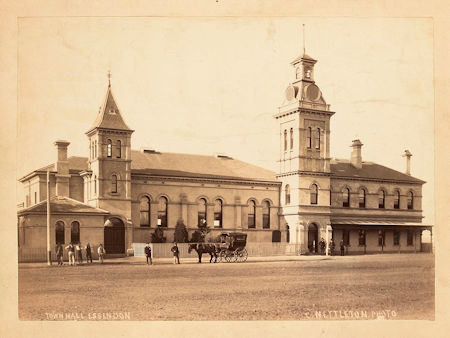
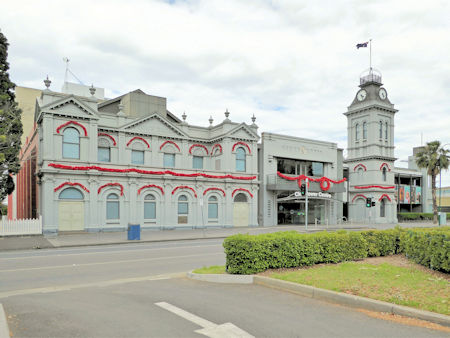
Hoverbox Photo Gallery -
Essendon Town Hall This feature does not function correctly on phones and tablets
1. Essendon Town Hall c.1882 prior
to the installation of the clock in 1930
2. Essendon town hall 2015 now
the Clock Tower Centre Author: November 2015
1
2
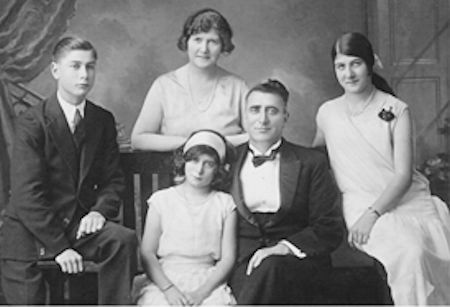
Right: The Wellington family between 1925 and 1930 Left to right: Nelson Thomas Lyle (Chip), Ida May, Lesley Joan (Mickie),
Patricia Frances
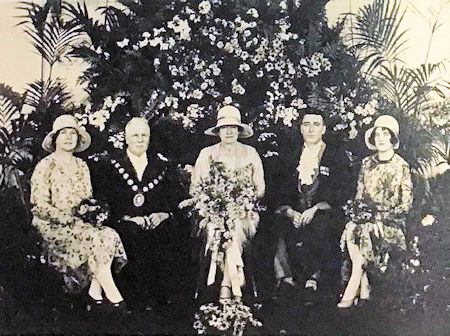
Right: Nelson Wellington with Councillor A Fenton,
Mayor of Essendon between 1929-31, with Mrs Fenton holding the
flowers
1821info13a, sheet 15
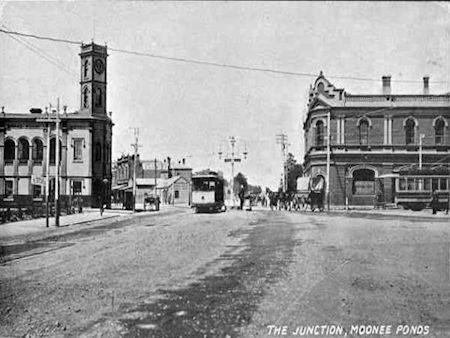
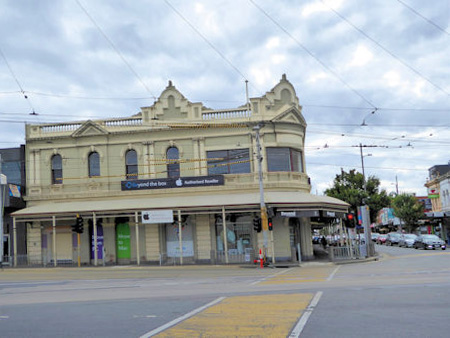
In December 1926 Nelson became Essendon's town clerk with the family living
in the Junction Hotel, Moonee Ponds, almost opposite the town hall.
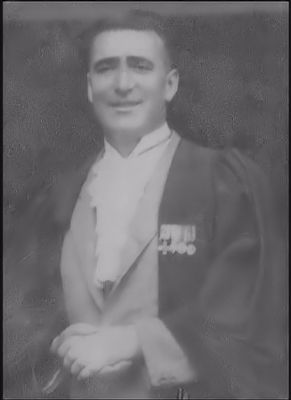
Right: Nelson Wellington as Essendon town clerk
in 1930
Hoverbox Photo Gallery - Junction Hotel, Moonee Ponds
Author: November 2015
This feature does not function correctly on phones and tablets
1. Junction Hotel Moonee Ponds 1908
2. Junction Hotel Moonee Ponds
3. Junction Hotel Moonee Ponds from Puckle Street
1
2
3
At this time Nelson was a founder member of Essendon Rotary Club and later its secretary.
3
1927 11394 Wellington, Ida May, Junction Hotel, Puckle st., home duties, in Moonee Ponds
sub-district of Maribyrnong
1927 11395 Wellington, Nelson Frederick, Junction Hotel, Puckle st., town clerk, in Moonee
Ponds sub-district of Maribyrnong
In the week of 7 April 1927 their new home was a bungalow at 57 Aberfeldie Street.
1928 11851 Wellington, Ida May, 57 Aberfeldie st., home duties, in Moonee Ponds sub-
district of Maribyrnong
1927 11395 Wellington, Nelson Frederick, 57 Aberfeldie st., town clerk, in Moonee Ponds
sub-district of Maribyrnong
1821info13a, sheet 16
During this time Ida, being the wife of the Town Clerk, had widely reported social
responsibilities at receptions as far away as Mordialloc. Whilst at Aberfeldie Road,
because of her social position or church affiliation, Ida was on the committee of the
Moonee Ponds St. Martin's and St John, the Evangelist Homes for Boys (Church of
England). This reinforces her protestant faith.
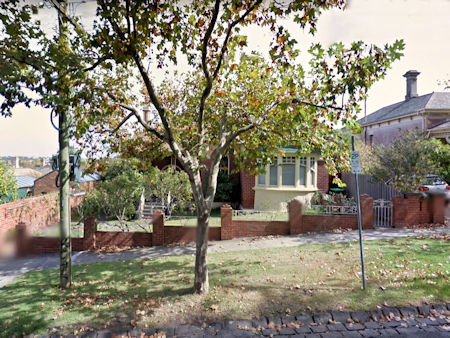
Left: 57 Aberfieldie Street, Moonee Ponds, Author: November 2015
Ida's committee undertook to provide £150 a year to the homes maintenance. In July 1928,
Ida helped organise a bridge party at Toronga, the residence of Mr and Mrs E.H. Kinnear in
Aberfeldie Road, which once stood in the now Aberfeldie Park. Card tables were set in the spacious
ballroom, drawing and dining rooms and the committee provided refreshments. 4 Two
years later, still on the committee, Ida helped to organise an informal dance held at Lowther
Hall, Essendon. 5
1931 12387 Wellington, Ida May, 23 Learmonth st., home duties, in Moonee Ponds sub-
district of Maribyrnong
1931 12388 Wellington, Nelson Frederick, 23 Learmonth st., town clerk, in Moonee Ponds
sub-district of Maribyrnong
In late 1929 the family moved to the now much modified Kiandra, built in 1887, at
23 Learmonth Street. This was recorded as the family home through out the Second World
War, when again Nelson was on active service. However, Ida endeavoured to follow
Nelson's Queensland postings and to where Mickey was preparing to be a war bride.
Left: 23 Learmonth Street, Moonee Ponds - extensively
altered since the 1930s Author: November 2015
Trove suggested that Ida has more social column inches than Nelson has civic mentions. In 1935
Ida's social duties had expanded to train Essendon's 32 debutants for the Essendon
Combined Freemasons' ball. 6 In 1938 Ida was president of the Essendon
Housewives' Association of Victoria when a craft competition was organised for adults and
children in aid of Women in Need. 7 In Ballarat Ida had been a renowned teacher of
elocution. With her Ballarat friend being the chair of Melbourne's English Speaking Union and
Ida the secretary, she was frequently mentioned in the society pages: Mrs NF Wellington is about
to leave on/has returned from her trip to .....
In 1936 the Shire Councils and Essendon in particular, were in the Arbitration Court for
letting out council contracts to tender at a reduced rate per hour and with the prospect of
unemployment for council workers. Specifically, carters, their horses and insurance were
re-employed at a reduction of 12/6 (12 shillings and 6 pence) a week. Nelson was called to give
evidence on the contracts, the need for economy and the
necessity for getting down to the rates which the council was able to pay. 8
1821info13a, sheet 17
The municipalities of Footscray, Essendon, Braybrook, Werribee and Williamstown were
in dispute with the Graziers' Association of Victoria and Southern Rlverina, the
Melbourne Stock and Station Agents' Association, the City and Country Land, Stock and
Station Agents' Association, the Master Butchers' Association, and Melbourne City
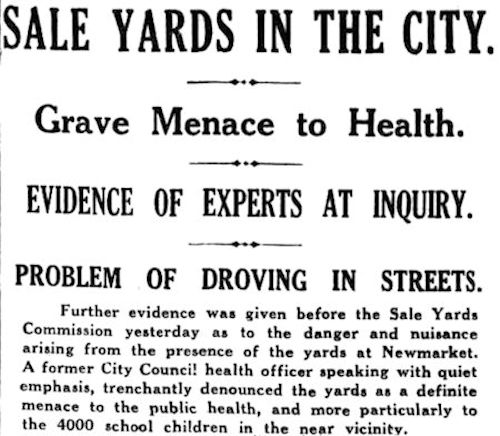
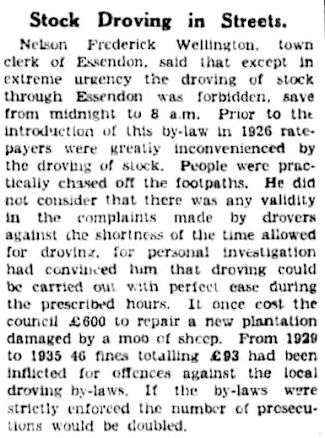
Council. The council had in 1929 passed a by-law prohibiting the droving of stock except
between midnight and 8am, but it had suspended the law owing to the complaints of those
interested in the sale yards, who declared they would not have sufficient road facilities,
and that buying for export would have to be practically abandoned.
Nelson, along with the Health Inspector was called to give evidence on behalf of Essendon
Council, who were proposing to move the stock yard to another location. 9
1821info13a, sheet 18
Nelson's military life between the wars
Through out this time Nelson maintained his military contacts, being active in the peace time
forces with the command of the 58th Battalion
(Essendon Rifles Militia) 3 for 4½ years until October 1,
1938. 10 He is recorded as a full colonel at the farewell ball given on
the retirement of Lieut. Colonel JJ McKenna, from command of the 57/60 Battalion, at the Drill
Hall, Preston. 11
He gained his air pilot's licence with the Royal Victorian Aero Club at Essendon.
12
After 12 months convalescing in Queensland, Nelson resumed his role as town clerk in Essendon
in June 1945 1, where he presided over the post-war development of Essendon, which
involved the building of good quality homes on the old racecourse and the choice of street names.
Another concern was the bottle neck between Puckle Street and Flemington Bridge, which could have
involved the widening of Mount Alexander Road at a cost of more than £1 million, or removing the
traffic to Essendon airport. 2
In 1949, for some unknown reason the family, with the children having left home, Nelson and Ida
were back in the Junction Hotel on Puckle Street.
1949 15660 Wellington, Ida May, Hotel, Puckle st., home duties, in Moonee Ponds sub-
district of Maribyrnong
1949 15661 Wellington, Nelson Frederick, Junction Hotel, Puckle st., town clerk, in Moonee
Ponds sub-district of Maribyrnong
Nelson's Second World War service sheet gives a post 1940 address as Lot 3,
Laura St. and Holmes Rd., Moonee Ponds W4 as dated by his MC, rank and service with
2/2 Pioneers. A second undated document gives the same post-war address identified by
his DSO and rank of Hon. Col 15 May 1945.
Right: 3 Laura Street, Moonee Ponds
1821info13a, sheet 19
Ida's professional elocution association over many years, with the English
Speaking Union continued after the War. There were several occasions when Ida and her
friends from Ballarat, Mrs Maie Hoban (Ida's oldest friend and a director of the
Pilgrim Theatre) and Mrs Elsie Carnegie got together for afternoon tea parties at the
Oriental Hotel. Several other familiar names seemed to be present. Ida appears to
feature in Melbourne society, being frequently reported in The Argus social columns.
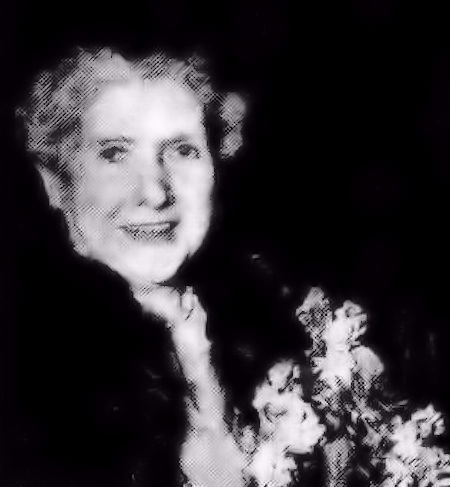
Right: Ida Wellington 20 June 1949 probably at an Essendon council event
On 5 April 1951 The Argus reported that Ida was joint guest of honour, with Nelson, at an
afternoon reception after their 15 month trip to the United States. She commented on 'the
lack of old women in America, due to the labour saving appliances that can do their work at night
if necessary [... and] they can buy what food they want at the marts'. Nelson, after his
war leave, convalescences and a fifteen month holiday in America, was still employed as town clerk
for Essendon.
That Nelson was received into the Catholic Faith by Bishop Hayes, of Rockhampton, whom Colonel
Wellington first knew as Father Romauld Hayes, of St. Columban's Mission, Essendon, was not
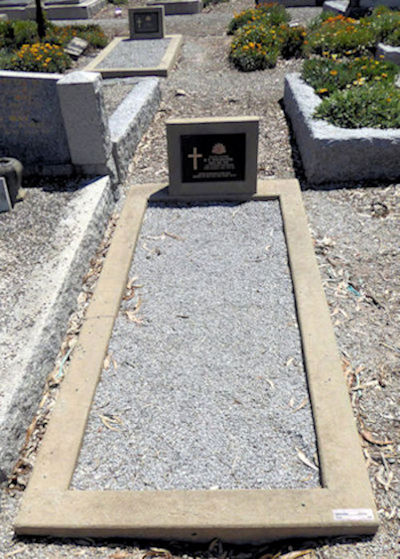
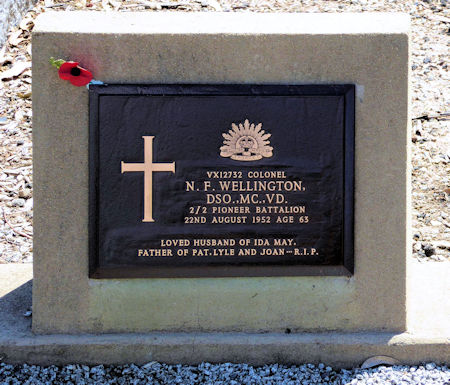
generally know by the family and by Ida in particular. Nelson was buried in the Roman Catholic
section of Fawkner Memorial Park on 26 August 1952 in a grave maintained by the Office of
Australian War Graves, who are responsible for the maintenance of all war graves. Ida, given the
choice of being buried besides Nelson or in the Protestant section, was buried on 19 October 1964
in an unmarked grave next to Nelson. However, as his grandson Geoffrey Hutson writes 'Ida
went through much anguish. She wanted to be with her husband in death, but couldn't bear the
shame of being in the Roman Catholic section. The book suggests she is buried in the space
alongside Nelson, but when we asked Fawkner they said she was in the plot with him.
1821info31a, sheet 21
Above: Wellington graves at Fawkner November 2015
with Ida's interned in the same grave Author: November 2015
Right: Nelson Wellington's Veteran's headstone at
Fawkner Author: November 2015
1821info13a, sheet 22
Nelson Wellington's memorial (Author: November 2015 or family)
Ballarat's Arch of Victory looking on to the Avenue of Honour
Nelson's name of the Arch of Victory's name boards which also indicates his tree number
Nelson's memorial
on the central reservation of Ballarat's Avenue of Honour
Nelson's memorial plaque by his tree in Queen's Park, Moonee Ponds (Family photo)
Nelson's memorial tree, Queen's Park, as a sapling with family members (Family photo)
Nelson's mature memorial tree in Queen's Park (Family photo)
Bruce Hutson in
front of Nelson's tree in Queen's Park (Family photo 2016)
Moonee Ponds War
Memorial on Kellaway Avenue (Web photo)
A picture of the late town clerk, Colonel Nelson F. Wellington. D.S.O., M.C., V.D., was
presented in late June 1953 to the Essendon City Council. The presentation, made to the Mayor
(Cr. A. S. McDonald), by the wife of the late Col. Wellington. 3
Nelson's wartime will was signed on 30 May 1940. In it everything was left to Ida ad his
solicitor in Litle Collins Street, his sole Executor. At the time of his death, Nelson was living
in Dandenong. Nelson's will is available at Victoria Public Records Office 4
His probate, date 15 January 1953, appoints Ida, Pat and Lyle as executors to allocate the sum of
£413 1 shilling and 11 pence.
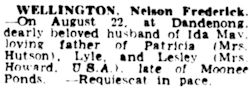
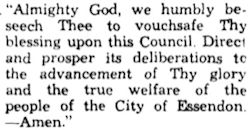
Subsequent to Nelson's death, Essendon Council voted to open its meeting with one
of two prayers: one being written by Nelson and subsequently used by several other
Councils. 5
After the death of Nelson, Ida had a flat in Essendon. Later, when her daughter Mickie and
granddaughter Libby were visiting from Kansas, they moved in with her daughter Pat at 153 Foster
Street, Dandenong.
1821info 13a, sheet 23
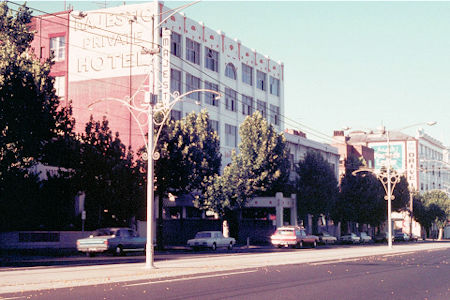
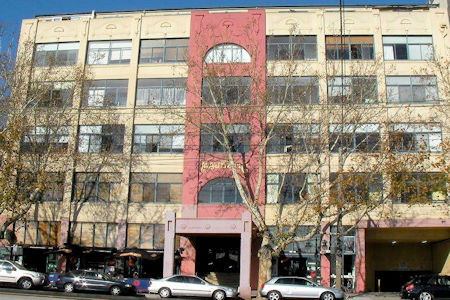
Wanting to sever connection with Essendon Ida found a solution when, in late 1952,
she inspected the Majestic Private Hotel in St. Kilda.
Right: Majestic Hotel, St Kilda in 1981
Situated at 151 Fitzroy Street, the hotel faced the grounds and lake of Albert Park.
It had become a superior guest house for genteel ladies, which Ida thought would suit her.
Left: Majestic Hotel, St Kilda
1954 4455 Wellington, Ida May, 151 Fitzroy st., home duties, St Kilda West sub-district of
Isaacs
After Mickie's departure on 29 April 1953, Ida became restless and arrived on the Foster
Street doorstep with suitcase saying she couldn't stay at the Majestic any longer and wanted
to save to visit Mickie. (Wellington p.258-9)
Ida died on 16 October 1964. Her will leaves her jewellery and clothes to Pat and Mickie and
her costume jewellery to her daughter-in-law and grand-daughters. Legacies of £100 were left to
Mickie, Pat and Dorothy Wellington. Methwyn Hutson and Elizabeth Howard received £200, Barney
£250. 6
Victoria Public Records Office reference VPRS 7591/P3 unit 572, item 621/928 and probate
VPRS 28/P4 unit 3373, item 61/928.
1821info 13a, sheet 24
Their children and grandchildren
Patricia Frances Nelson and Ida Mays first child
Nelson and Ida May's first child,married Doctor Medwyn HUTSON In later
life Patricia wrote her autobiography Memoirs 1913-1954, which was published
by her son Geoffrey.
Medwyn had been a brilliant student and not long out of Melbourne University
volunteered for a field ambulance unit in PNG. He went on to become a past president
of the Australian Medical Association.
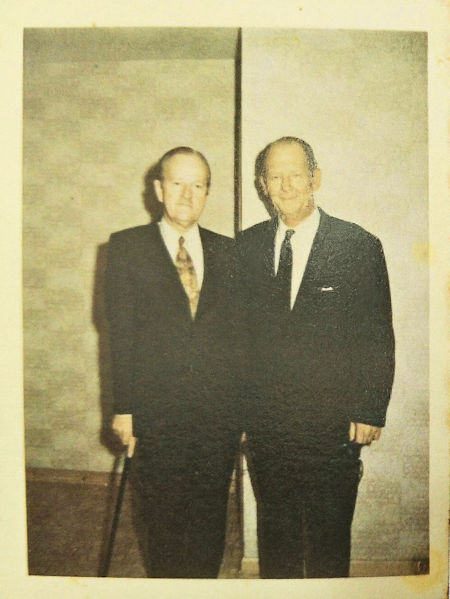
Right: Medwyn Hutson and Barney Howard in Kansas City in the 1970s Source:
Chip Wellington's book
Patricia and Medwyn second son is Dr Geoffrey HUTSON a behavioural scientist, who in
retirement, is applying his knowledge to Flemington racehorse Their third child is Professor John
HUTSON who was the Chair of Paediatric Surgery at the University of Melbourne, and one of the
Consultant Paediatric Urologists at The Royal Children's Hospital. Bruce, the couple's
eldest child, is a retired medical practitioner who spent many years as a country GP in Grafton,
NSW. In Brisbane he does voluntary work in the AMP building that was once General MacArthur's
war room for the Pacific campaign, where Nelson also had his Brisbane office on the seventh
floor.
Nelson Thomas Lyle Wellington (known as Lyle and 'Chips'), Nelson and Ida Mays
second child
Lesley Joan Wellington (known as 'Mickie'), Nelson and Ida Mays third child
Mickie was born on 03 May 1921 at "Quisisana", Dandenong Road, Windsor. 1
On 25 September 1943 Mickey married Alva Bernard HOWARD, born at RDF2 (West) Peculiar, Cass
County, Missouri on 04 May 1913/ the third child, first son of Alva and Elizabeth.. Before
joining the army, Barney was employed by Standard Oil Company of California as an apprentice
machinist and lived at 162 Santa Fe Avenue, Richmond, Contra Costa, California. 2
Barney had enlisted in the army on 01 August 1942 and was discharged on 23 September 1946. He
reenlisted, for Korea, on 01 December 1957 and was discharged on 31 May 1961. 3
Pat Wellington writes:
In spite of their initial reluctance the girls enjoyed the
party which was voted a great success. Afterwards, one of the American officers,
Captain A.B. ("Barney") Howard, started paying my sister a good deal of
attention. He was an ordnance officer from Kansas City, Missouri, and they dated a
few times and then gradually became very friendly and a romance developed. This
worried my parents. They had heard all the tales about the Americans and Australian
girls and did not want Joan (Mickie) to get involved.
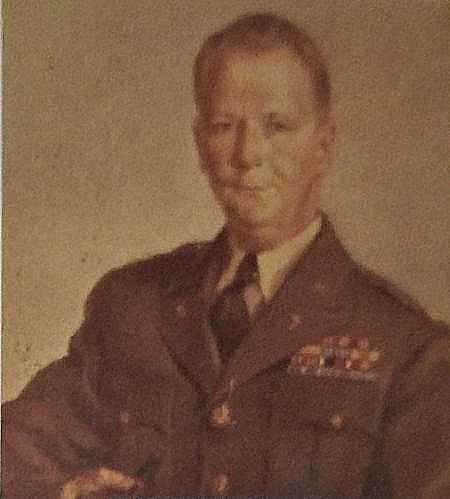
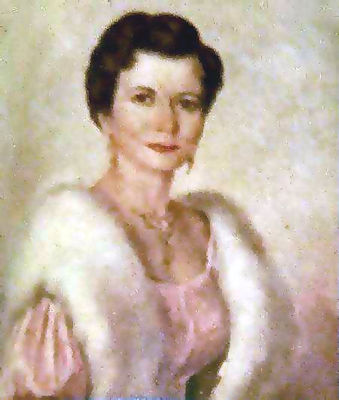
Right: Major Barney Howard from an oil painting made in Stuttgart c.1956
My Father decided to investigate Barney's family background through a
Rotary friend in America. The information obtained disclosed that Barney's family were a Methodist
family — the parents living on a prosperous farm near Kansas City. The farm was originally
purchased with money Barney's father made on the goldfields of Ballarat on his stop over in
Australia on his way to USA from England. The father still had his miner's licence. [...] Barney
was single and had not been married. It was reported that the family were highly respected in
their district. My parents then relaxed a bit but did not really want Joan to marry an American
and go to USA to live — not their precious "delicate" daughter carefully protected all
her life. However, Barney proceeded to charm them all, won over my sister and my parents and they
all went to Surfer's Paradise for the Easter holidays to celebrate the engagement. I was amazed
at this news and just hoped it was the right decision. [...] I could only wish them well and hope
for the best. 4
Joan and Barney began to think about marriage in Rockhampton if there was
no sign of his unit going overseas in the immediate future. Barney applied for leave in September
and tentative arrangements for the wedding were made. Joan invited me to be matron of honour and
there was to be one other bridesmaid. [...] My Father said he would solve that and I could go with
him to Rockhampton by army plane. He could see no difficulty as I was an air force staff officer.
[...]My sister and Barney were married in Rockhampton on 25 September 1943 [...] 5
1821info13a, sheet 26
With Nelson commuting between Melbourne and Brisbane and Barney being in North Queensland, Ida
and Mickey decided to take an apartment at Orient House in Redcliffe. Here Mickey began to
organise her eventual departure to the USA by the 'brideship' SS Marinosa that
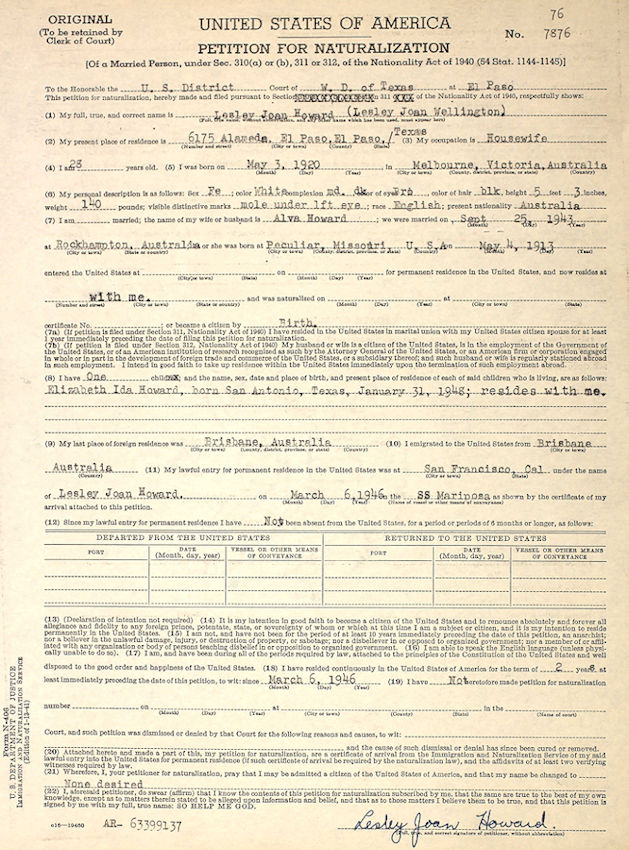
arrived San Francisco on 06 March 1946. Two years later, her naturalisation papers, recorded her
living at 6175 Alameda, El Paso, Texas as a housewife with one child.
Above: Mickie Howard's naturalisation paper Source:
Ancestry Click on the map to open a scalable pdf map in a new window
1821info13a, sheet 27
In 1948, after retiring from Essendon City Council, Nelson and Ida planned an extended visit,
sailing on the Mariposa, to see Mickey and granddaughter Libby. When Nelson died on 24
August 1952, Mickie was unable to be at the funeral but in October/November 1952, she and Libby
flew to Melbourne to visit Ida for four months, staying in the Majestic Private Hotel in St.
Kilda, where Ida then lived. Shortly after Libby became ill with whopping cough and needed
admission to the Royal Children's Hospital for several weeks. Mickie returned to Melbourne in
January 1953, from seeing friends in Sydney and relatives in Mildura, to plan to return to the
US. She sailed in the Oronsay on 29 April 1953 to London, for the Coronation, and then
sailed to America on the Queen Mary in July 1953. 6
[...]Barney refused to come to Australia with her and she did not know
when she would get the chance to come again. Barney's excuse was that he had an overdose of
travelling during the war. [...] We wondered about the marriage but when Mickie and Libby
returned to Kansas City everything seemed to continue as before. My Mother settled in to The
Majestic at first, after Mickie's departure, but gradually became restless and missed Mickie very
much. They had always been very close. It seemed a pity Mickie had chosen to marry an American
and live so far from home. After coasting for a while my Mother decided to leave The Majestic
[and] wanted us to help her save enough money to go and visit my sister. 7
In 1950 Barney, Mickie and Elizabeth were living on the Fort Bliss Military Reservation, El
Paso, Texas, where Elizabeth had been born in 1948. Barney was employed in ordnance. 8
After treatment for a breast lump, in 1954, Ida was given medical permission to fly to Germany
provided that Mickie was willing to accept responsibility for her condition.
[...] Mickie, Barney and Libby were in Stuttgart. Barney was stationed
at a US base there and they were living in army staff housing. As soon as my Mother felt well
enough to travel she was keen to join them, but needed a bit more finance to do this. My Father
had bought two blocks of land at Port Douglas when he was in Queensland and it was developing
into a tourist resort and land prices going up. My Mother was in the process of working out my
Father's legacy with her solicitor. If she sold both blocks, and with her savings, she would
have enough to go to Germany. 9
Right: Mickie Howard née Wellington circa 1956 whilst is Stuttgart
Source: Chip describes this as an idealised oil painting. Chip describes Mickie
as having a fuller face which spoke of kindness, warm-heartedness and sensitivity10
1821info13a, sheet 28
Chip records that Mickie worked with computers until her death and Barney, who retired
on an army Lieutenant Colonel's pension, found it difficult to live comfortably,
even with the American social security pension. However, the two combined pensions
were just about enough. 11
Barney remarried Thelma Marie PEEK on 09 October 1982 at Harrison, Cass County,
Missouri, where he died on 16 January 1987 aged 74.
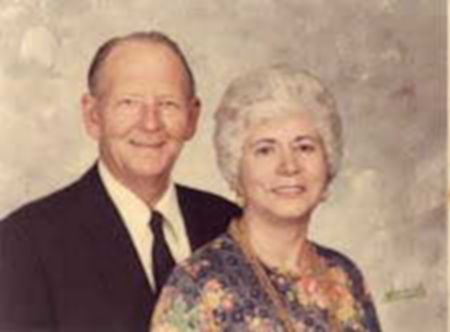
Right: Mickie and Barney Howard c.1975 12
Mickie and Barney's daughter, Elizabeth Ida, known as Libby, was born 31
January 1948. 13
According to Chip Wellington, in about 1975, Libby left the Conservatorium of Music at
the University of Missouri where she was an able flutist and music critic for the
Kansas City Star. Libby became pregnant to a man living in Kansas City whom she
refused to name. She left the family home and drove to New York City. She gave birth
to Rebecca, known as Becky, who was in the care of an Italian couple in whilst Libby
was ill in a mental institution. Mickie applied for and was granted custody. Mickie
and Barney cared for Becky in Kansas City until Mickie died of Leukaemia then Barney
took over until he died in 1987.
In the 1970s, when visited by Pat and Medwyn, Mickie and Barney were living in Kansas
City, where Mickie died. Chip records Mickie's last years as
being clouded not only by pain, discomfort and
worry [about Libby] and [her] final disease she contracted - described by her doctor
as cancer of the throat. 14
Orma, DS, Land Settlement in Victoria Useful information for
intending Soldier Settlers, Crown Lands Department, Melbourne, 1920
Wellington NTL, called Regions Caesar Never Knew, Bellingen, NSW, 1980 also
Victoria State Library
Wellington Pat, Memories 1913-1954, Clifton Press, Kensington, Victoria, 2007
1821info13a, sheet 30
More information 1
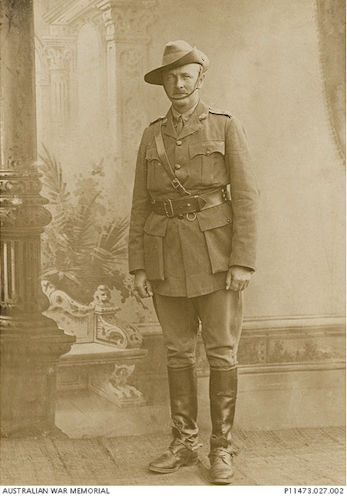
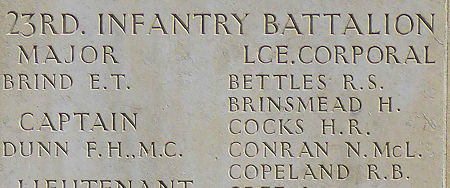
Major Eric Thomas Brind
Major Eric Thomas Brind, of the 23rd Battalion and was KiA on 28 July 1916 in
France and is commemorated on the Australian National Memorial at Villers-
Bretonneux. A 31 year old distiller prior to being appointed a Lieutenant on 24
March 1915 and promoted to Captain on 1 May 1916, he embarked with the
Headquarters Staff. After serving at Gallipoli, he went on to serve in France
where he was promoted to Major on 27 May 1916. He was Mentioned in Despatches for
conspicuous good work as Company Commander since arriving in France. Major Brind
was reported missing in action at Pozieres on 28 July 1916 and
is on the Villers-Bretonneux, Memorial, France.
Right: Major Brind's memorial at Villers-Bretonneux
Author: 23 April 2018
More information 2
Australian Native' Association
Originating in 1871, the Australian Native' Association was a mutual society for those
born first in Victoria and later Australia. The present 1924 building at 22 Camp Street,
Ballarat. The branch was one of the most active in the colony, playing a key role in
Federation. The Ballarat branch of the ANA was wound up in 1957. Source:Australian Natives' Association (Accessed: 23
August 2017)
1821info13a, sheet 31
More information 3
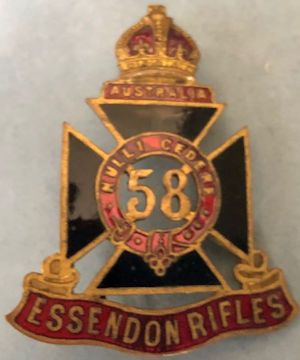
The formation of the Essendon Rifles
The advent of compulsory military training led to an overhaul of
the militia structure as well as a large increase in its numerical strength. Major Harold
[Pompey] Elliott, with other 5th Australian Infantry Regiment officers, joined a newly
created battalion, the 60th Infantry, based in North Carlton. A year later [1912], when
another batch of cadets was drafted into the militia and further formations came into
existence, he was promoted to command one of these new units, the 58th Infantry Battalion
(Essendon Rifles). The nucleus of the 58th was a single Essendon based company previously
belonging to the 60th. Henceforth all eight companies of the 58th were to obtain their
recruits from the Essendon area, including the nearby suburbs of Moonee Ponds, Ascot Vale,
and Newmarket.
Right from the outset Lieutenant-Colonel Elliott forged the closest possible links between
his battalion and the local community. He arranged for a formal ceremonial inauguration
of the unit at Essendon on 19 July, and a special church parade the following day. His
impetus led to the
formation of a citizens' committee to support the
battalion's activities, particularly in sport, military competitions, and fund-
raising. Elliott used sport wherever possible to help the local community
identify with the battalion. For the unit's colours he chose the red and black of
the popular Essendon VFL team.
Colonel Elliott outlined his views on discipline for officers and NCOs of the
58th in a lively and informative treatise full of historical allusions. In
particular, it was sprinkled with insights derived from his Boer War experiences.
[…]
Right: Pre-war Essendon Rifles badge
Before long it was evident to anyone who took an interest in the
Essendon Rifles that its inaugural commander had abundant zeal and capacity. He was a hard
taskmaster who frequently roared at his men (and sometimes at his officers), but his
demanding methods instilled effectiveness. That he quickly managed to overcome any
misgivings entertained by influential Essendon residents was demonstrated by the
remarkable success of a military fete held in March 1914 at Queen's Park, Moonee Ponds.
The fete was conceived in order to raise funds for the district's cadets and militiamen so
they could acquire various facilities such as band instruments, gymnastic equipment and
camp requisites.
Lt. Col. Nelson Frederick Wellington commanded the battalion in the inter-war
years so continuing the close connections with the city.
The Second AIF, for overseas service, attracted the keen from the peace time militia,
designed for home defence. The officers were generally drawn from the militia with the
senior commanders and most of the regimental ones being chosen from a large pool of leaders
who had served with distinction in the First AIF.
The younger officers, who resolved to prove themselves as formidable as their fathers,
had been trained by these men during their militia service. They believed that the First
AIF had been the finest force in the world in its day and that the training and experience
they had gained, in their militia service, from ‘the old-lags’ was beyond that to be
gained as a civilian conscript. The younger men had full confidence in their leaders and
particularly those who had been in battle before. The wisdom of the older citizen officers
was founded on four or more years as regimental officers in the war of 1914-18 and kept alive
by study and militia service between the wars. In commanding
1821info13a, sheet 32
The formation of the Essendon Rifles - cont:
the Essendon Rifles, Nelson Wellington fitted into this between wars picture. He had
experience of combat, of brigade administration and a medal for valour.
However, the frugal treatment of the Australian Army, between the wars, with its night
parade, its eight or ten days annual training, its uncertain future and its constantly
changing organisation, left gaps that were hard to remedy by the experienced officers of
the middle ranks.
By an intense devotion to soldiering tested in battle, Nelson had made it a second
profession during the peace years and had attained a degree of proficiency well beyond what
the militia system demanded. Nelson had come to command with a full apprenticeship. In the
lean tween war years the Australian Army was kept alive by men of Nelson’s character.
Source: Long, Gavin, Australia in the War of 1939-1945, Second World War
Official History, Chapter 8, The Battle of Bardia, pp.204/5
1821info13a, sheet 33
More information 4
Ballarat's Avenue of Honour
Trees in Ballarat's Avenue of Honour (Remembrance Drive) were planted by the ladies of
E. Lucas Clothing Factory in honour of all the men from Ballarat and district who fought
in the Great War. Source: Karen Walsh
Ballarat Councillor Glen Crompton (no relation, but one of three Crompton families in
old Ballarat), writes, with pride:
'At 22km Ballarat boast the longest First World War
commemorative avenue in the world and the Arch structure is acknowledged within
Paris’ grand Arc. The original tree plantings were undertaken between 1917 and
1919. Unfortunately, The Avenue fell to neglect over the years. Trees were lost to harsh
natural events, road building, and vehicle crashes. Many of the plaques identifying the
trees were damaged or pilfered. In a final insult, the avenue’s full length was
severed 20 years ago as a result of the construction of a freeway.'
'Ballarat's Arch of Victory and Avenue of Honour Committee has spent decades quite simply
adhering to the remembrance axiom, 'We will remember them'. By 25 April 25 2015,
the centenary of ANZAC day, the Avenue had been restored to its full complement of 3801
tree, each and every one bearing a commemorative plaque. The Arch had been fully restored
and rejuvenated. Incredibly, The Avenue was re-connected to its full length after the Road
Authority constructed a magnificent overpass for the freeway. This was not merely a
bridge, rather a spectacular engineering and landscaping feat which enhances The Avenue'.
'And so it was at dawn on the 25 April, 25,000 citizens of Ballarat, about a quarter of
the entire population, remembered them a hundred years on. The Honour Party comprised of
the descendants of the 8th Battalion 8/7 Royal Victorian Rifles.'