Cayton Info 1: Cayton By Scarborough origins
Cayton Parish Registers |
Close info window |
Cayton-by-Scarborough parish
Right: The church of St John the Baptist at Cayton by Scarborough 2010 where
the family worshipped since 1660 and were church wardens. Cayton had its church at the
time of the Norman Conquest. The Church of England describe it as a 'Medieval church
in village on southern outskirts of Scarborough.'
Below: The east end of Cayton by Scarborough church 2010 |
 |
 |
'The Church, dedicated to St. John the Baptist, is an ancient structure
consisting of chancel, nave, north aisle and square embattled tower with crocketed
pinnacles containing three bells. It was restored in 1862 when the flat roof was replaced
by an open timbered one, the gallery removed and several new windows inserted. The
chancel retains its ancient piscine and from the discovery of another at the east end of
the north aisle, we may infer the presence of a chapel (probably a chantry), there in
catholic times. The south doorway is Norman with zigzag moulding. Other parts of the
church are Early English and later styles.'
Source: Cayton Parish Council web site |
caytoninfo1, sheet 2
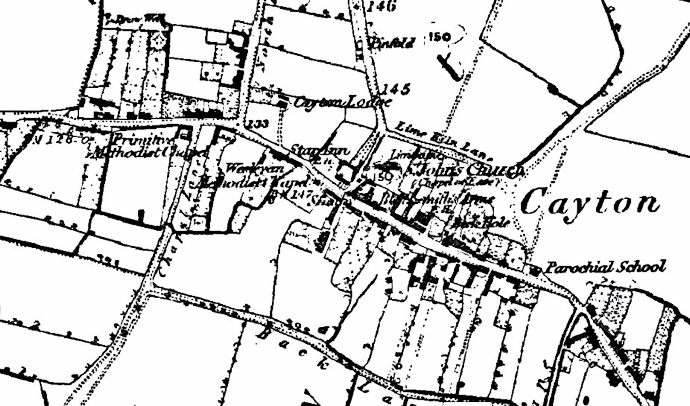 |
| Above: Cayton village in 1854 Scale 1:10560 showing the centre
of the village in which was sited Glebe Farm. A second farm appears to be located on the
south-east approach. |
Cayton at the turn of the 18th century
From the parish records it is know that the Crumpton/Cromptons were resident in Cayton by 1650.
However, the family name is not mentioned in Charles Richard?s ?A short history of Cayton?.
Contributions, in the book, give a flavour of life during the second half of the 17th century and
the first half of the 18th century.
On the early history of Cayton, Sheila McGown writes:
?The property boom which followed the dissolution of the monasteries in
the 16th and 17th centuries saw a number of Cayton farmers buy their won properties. Some of
these men flourished and provided leadership to a Cayton community with no resident gentry. ? [T]
he Hearth Tax, taken in 1674, gave 73 households. This suggests that the number of houses and
people declined only slightly in nearly 300 years. In 1642, five Cayton Yeomen were presented at
the Quarter Sessions for supporting a footway through certain lands called Bulmer?s lands between
Cayton and Osgodby, by ploughing it up. This looks like an attempt at an early enclosure, when
cattle farming was becoming more popular along the coastal strip south of Scarborough. In 1660
Cayton?s open fields were enclosed. Dairying, butchering and tanning became the most remunerative
occupation, slowly replacing the traditional mixed farming of the past, and providing a changing
future for the inhabitants of Cayton?.
Source:
Richard Charles C, ?A short history of Cayton?, Cayton Village Millennium Committee, 1999
Linking hypothesis
It is possible that the above entries, in the Cayton by Scarborough parish register, bridge the
gap between the wealth of the descendants of Thomas '
Auditor' Crompton and Thomas of Bridlington
.
Between 1232 and 1894 the parishes of England were governed by Vestry - the village parliament
equivalent to today's parish council - so called because they met, periodically, in the church
Vestry, under the chairmanship of the priest. The Vestry, responsible for the majority of
happenings within the marked parish boundary, comprised of:
caytoninfo1, sheet 3
- Parish Clerk - 1232 to
1844;
- Constable
- 1242 to 1839;
- Waywarden - 1555 to
1835 - in charge of highways;
- Overseer of the poor - 1601 to 1834; and
- Church Warden - 1533 to 1894.
All the members of the Vestry were nominated from the landed gentry. Failure to accept
the nomination for this voluntary post resulted in a fine paid to the parish chest. Only the
production of a Tyburn Ticket, a reward for bringing a felon to justice, could prevent this fine.
Research has suggested that the same names rotated around the Vestry posts.
In modern times the Church Warden is responsible for church matters. However, within the Vestry
the Church Warden could levy and apply his 'church rate' to the repairs of the church and
to his secular responsibilities. These included:
- ensuring that there was no Sunday drinking, in the pubs, between the hours of 10am and
11am;
- pest control officer, a responsibility delegated by Henry VIII;
- the supervisor of the travel 'Pass', which allowed travelling people to pass
through the village on their way to a given destination, and a possible travel subsidy of 6d.
(Because the parish was responsible for its own, vagrants were moved on. Sailors, for example,
returning to their home parish from their port of arrival required a 'Pass' so that
they could stay within a village for a maximum of 14 hours.)
It is now a possibility that Thomas Crumpton and Abraham Crumpton, the grandfather and father
of Thomas Crompton of Bridlington, were of the landed gentry and that this is how Thomas of
Bridlington amassed his wealth in order to buy property and land in Bridlington. If this is so
then, though this wealth, there is a tentative link to the wealth of the Stuart and Restoration
periods.
CAYTON BY SCARBOROUGH PARISH REGISTER
Entries are as recorded. A range of 20 to 30 years has been allowed from birth to marriage.
| Entry in the parish register for Lady Day 1702 and 1723 |
Entry in the parish register for Lady Day 1743 and 1762 |
Thomas Crumpton Chappell warden |
Abraham Crumpton Gentleman Chappell Warden |
who either entered the information or audited the books. It is possible that the entry which
followed were written in his hand, the hand of the other more literate chapel warden or the
curate.
Dates
Prior to 1 January 1752 the Julian new year began on 25 March, which is Lady Day. The new legal
year of 1752 began on 1 January. To align the calendar in use in England to that on the continent,
the Gregorian calendar was adopted: and the calendar was advanced by 11 days: Wednesday 2
September 1752 was followed by Thursday 14 September 1752. The year 1752 was thus a short year
(355 days) as well.
The majority of the dates listed from the Cayton Parish Records are recorded in the Julian
Calendar.
To make all date the same for the months of January, February and March the Julian year has been
adjusted to the Gregorian year.
The dates, spellings and people quoted on the tree relate to those transcribed from the Cayton
Parish Register.Baptisms 1686-1775
1699 Oct 29 Rich son of Thomas Crumpton and Ellice his wife Bap.
 |
Above: A composite image (date) Richard Crumpton's
baptism October 1699
Source: All photos Cayton Parish Record, Beverley Archives PE127/1 |
cayinfo1, sheet 4
1701 Feb 16 Tho son of Thomas Crumpton and Ellies his wife Bap.
 |
| Above: Thomas Crumpton's baptism February 1702 |
1702 May 23 Wm son of Thomas Crumpton and Ellice his wife Bap.
 |
| Above: William's baptism record with the day obscure.
Note also Thomas Crumpton as Church Warden and so of the Vestry and Landed Gentry |
1704 May 2 Abraham son of Tho Crumpton Bapt.
 |
| Above: Abraham father of Thomas b.1738 s baptism record
with the day obscure. |
1706 Sep  8      Roger  son of Tho Crumpton Bapt.
1709 Feb  1      Mary dau of Tho. Crumpton Bapt.
1711 Nov 11      Ann  dau of Thom Crumpton
1716 Aug 19      Ann dau Thomas Crumpton
 |
| Above: Ann Crumpton's baptism 19 August 1716 Note the
change of style as no mother is recorded. |
1733 Jun 25      Prisilay daughter of Abraham Crumpton
1735 Nov 18      Ellise  daughter of Abraham Crumpton
1736 Dec 27      Mary daughter of Wm Crumpton
cayinfo1,sheet 5
1738 Aug 20 William son of William Crumpton
 |
| Above: A composite image of William Crumpton's baptism
August 1738 |
1738 Sep 21 Thomas son of Abraham Crumpton
 |
| Above: A composite image of Thomas Crumpton's baptism
September 1738 |
1741 Mar  6      Mathew son of William Crumpton
1742 Mar 16      Anne Dau of Abraham and Isabell Crumpton
1744 Feb 27      Richard son of Abraham and Isabell Crumpton
1745 Mar 30      Ann J daughter of Will and Mary Crumpton
1748 Apr 14      Elizabeth Dr of Abraham & Esbel Crumpton
1748 Sep 19      Jonathan son of Will and Mary Crumpton
1768 Oct 30      Thomas Crumpton son of Thomas Crumpton & Jane
Marriages 1684-1754
1698 Apr 11      Tho. Crumpton & Eliz Wobow? (Elice Walker) was married
1701/2/16        are impossible to read.
1732             Abraham Crumpton & Isabell Brown
In 1753 Marriages were then transferred to new book and official format.
Deaths 1684-1774
1700 Apr  2      Richard  Crumpton was buried
1701 Feb  6      Tho. Crumpton Buried  [Possible day transcription error.]
1731 Feb 15      Thomas Richardson a youth
1736 Feb 15      Tho Crumpton Blacksmith (1735 Feb 23 Julian)
 |
| Above: The burial of an unattached Thomas Crumpton
blacksmith February 1736 |
1738 Feb 15      Elizabeth Crumpton
1741 Oct 27      Thomas Crumpton son of Willm Crumpton
caytoninfo1, sheet 6
1745 Feb 23 Aleas Crumpton A widdow woman (1746 Feb 23 Julian)
 |
| Above: (Aleas) Alice Crumpton's burial February 1746
(1745 Julian) |
1745 Sep 29      Jane Daughter of William and Mary Crumpton
1746 Jul 29      Richard Son of Abraham & Esabel Crumpton
 |
| Above: The burial of Richard Crumpton son of Abraham,
May 1746 |
1746 Dec 21      Tho. the Childe of Will & Mary Crumpton
1748 Apr 20      Elizebeth Dr of Abraham & Ebe Crumpton
1748 Oct 11      Jonathan A Childe of Will & Mary Crumpton
1769 Jan 09      Thomas son of Thomas & Jane Crumpton
Source: For Cayton by Scarborough Parish Records PE 127/1- East Riding Archives,
Beverley, East Yorkshire