 |
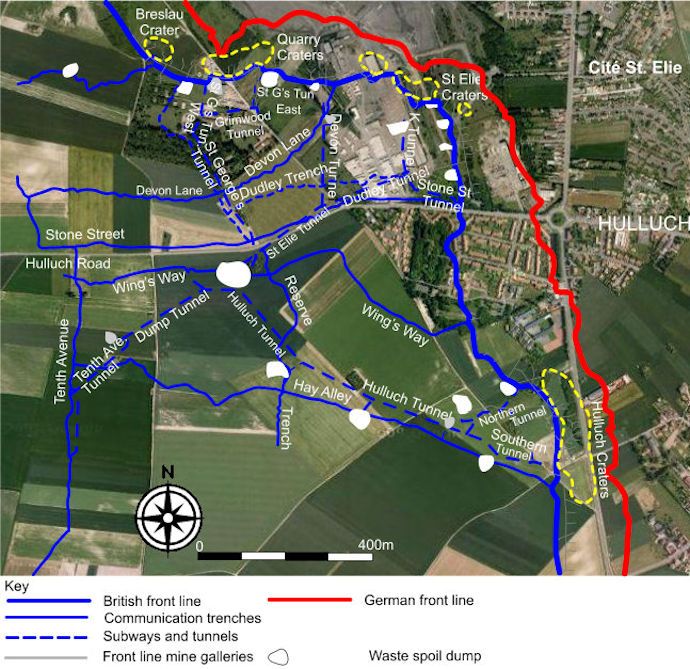
| Above: Hulluch trench system September 1917 to September 1918 - after Finlayson page 283 |
| 1821 Info 9d_2 for Caleb Crompton The descendants of Elizabeth and Thomas Forsyth Leslie Milo Forsyth, MM - at war Part 2 Hulluch |
Working in the Hulluch Sectors 1
The British thought that the Hulluch area was a suitable 'road' for a German counter attack. Though this never happened, it remained heavily defended.
To the north of Lenwent through the workings with Sanderson (Major Alexander Sanderson, DSO, MC and Bar, MiD commanding 3/ATC) the whole defence of the front appears to be underground. The infantry garrison lived underground. Trench mortars and their crews and their embrasures are underground. The machineguns are underground. The men’s living rooms are underground, and for a mile behind the front line the communication trenches are all 35 feet underground. The light railway brings the stores to an underground dump which is distributed in lighter tramways right up to the trench mortar positions.' 1
|
| Above: Hulluch trench system September 1917 to September 1918 - after Finlayson page 283 |
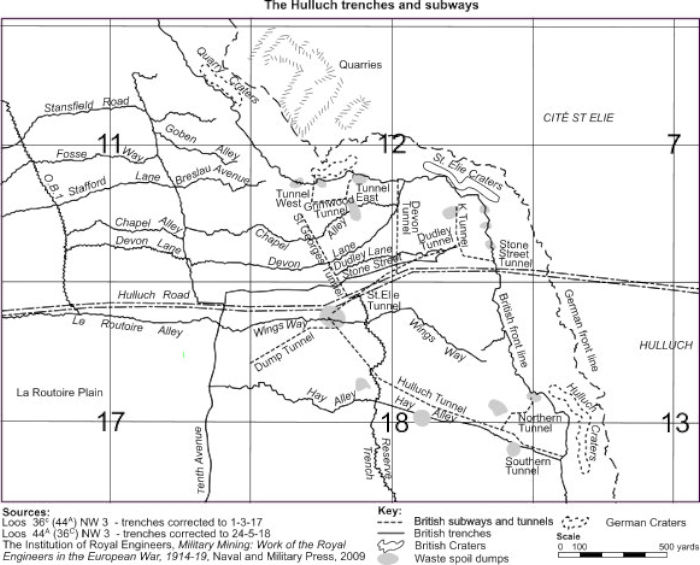 |
| Above: Hulluch trenches and tunnels
Click on the map to open a scalable pdf map in a new window |
On the 25 September 1915, the British were in front of Vermelles on La Rutoire Plain. The army faced The Quarries and the villages of Cité St. Elie and Hulluch, both behind the German's second line. The right flank's objective was to seize Hulluch. The left flank reached the area of The Quarries and dug in. These and subsequent attacks failed and the trenches became static. (See map above.) With the removal of the German mining threat at Hill 70, 3/ATC moved to the vast and elaborate Hulluch-St. Elie (Hulluch) mining system originally dug by 235 Coy RE between November 1916 and February 1917. First recorded in the War Diaries of July 1917, 3/ATC were responsible for strengthening the system. In mid-September the Company's front was extended north to the Hairpin-Border Redoubt mining sector towards Givenchy. Expanding and improving these massive tunnelling systems was the bread and butter of 3/ATC.2
'The unusual length of stability in this Sector, allowed the tunnellers the luxury of constructing a labyrinth of connected infantry subways and galleries below the entire front [...] of complexity and sheer size. [...] The front lines [...] were approached from below ground via a series of long tunnels which divided and multiplied, spreading like fingers as they neared the front. They could be entered from multiple locations via shafts that connected with the surface communication trenches below which they passed. [...]
The tunnels were fitted with dugouts of all descriptions necessary for enabling men to live and move underground. [...] Expanding and improving these massive and intricate tunnel systems was the bread and butter of the Third Australian Tunnelling Company.' 3
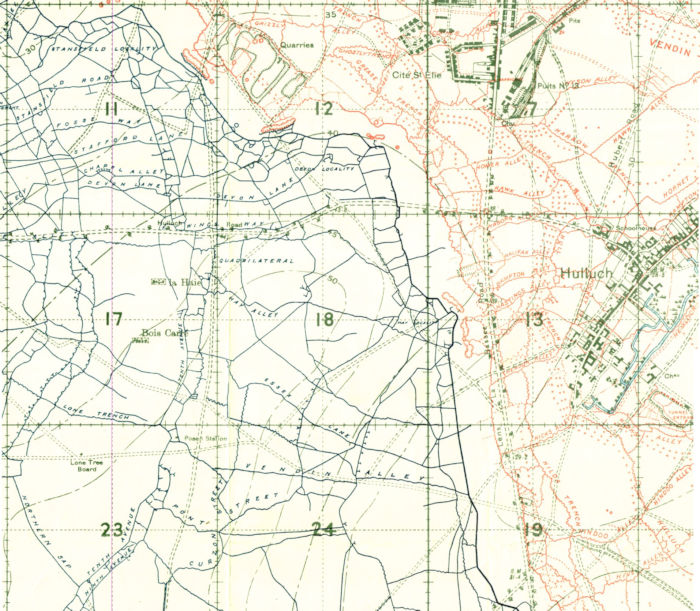 |
| Above: Hulluch trench map
Trenches correct 04 May 1917 Click on the map to open a scalable pdf map in a new window |
CEW Bean visited the Hulluch workings and recorded:
Between 17 and 23 February 1918 two Sections of 3 ATC cut out 544 feet of chalk, tunnelling four ?et wide, and averaging 500 feet per week for the past four weeks. To the north of Lens, near Hulluch, where I went through the workings with Sanderson, the whole defence of the front appears to he underground. The infantry garrison lives underground, trench mortars and their crews and their embrasures are underground. The machine guns are underground. The men living rooms are underground, and for a mile behind the front line the communication trenches are all 35 feet underground The light railway brings the stores to an underground dump [which are then] distributed in lighter tramways right up to the trench mortar. The entrances to the tunnels from the trenches are defended, so that on the last occasion when the Germans raided, the sentry who was outnumbered on the top, carried his Lewis gun into a shaft and fired up the shaft at the first two Germans whom he saw. These men were about to place an explosive charge inside the shaft, but they were hit and lost their charge, and the other raiders cleared back to their own trenches. Two raids on these trenches have been defeated. No .3 Tunnelling Company originally contained a number of the Revolutionary Unionists of the Broken Hill type from Western Australia and Queensland. They showed their spirit from the first, and in the early days of the Company, there were a good number of strong battles of wills between the officers and men. But before the company had been long established, these fiery trade unionists were amongst the very finest soldiers, and the most willing, energetic, hardened workers that the Company possessed. There was a spirit among them which was of great value. Sanderson tells me that he wished the men whom he was getting nowadays were of these same old fiery soldiers. 4
| Hoverbox Photo Gallery - The Hulluch front 1918 This feature does not function correctly on phones and tablets |
|
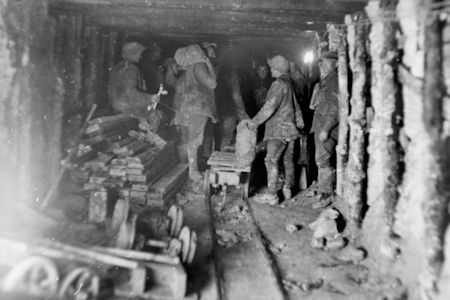
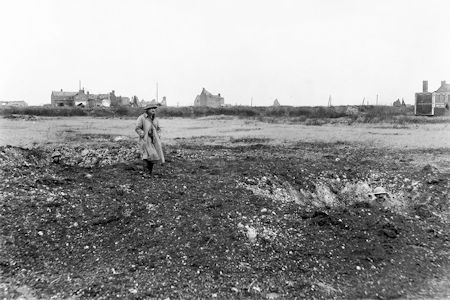
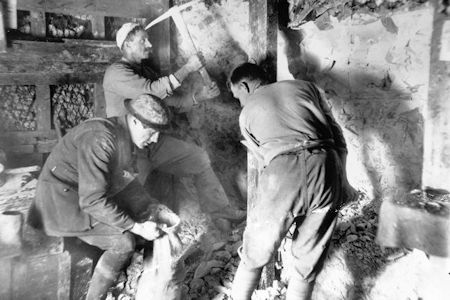
1. 3/ATC under the Hulluch front 30 January 1918 Source: AWM E04563 2. 3/ATC constructing tank trap 07 February 1918 - see text Source: AWM E01711 3. 3/ATC under the Hulluch front 30 January 1918 Source: AWM E04563 |
| 1 | 2 | 3 |
|---|
|
|
|
| Hoverbox Photo Gallery - the Hulluch tunnel - Author: 23 September 2018 |
|
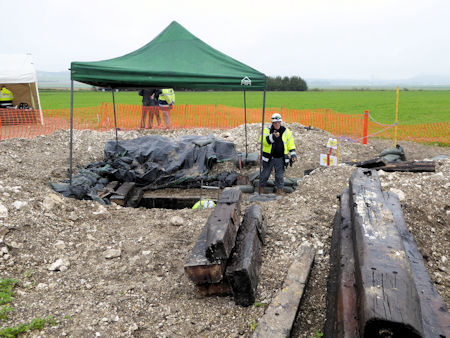
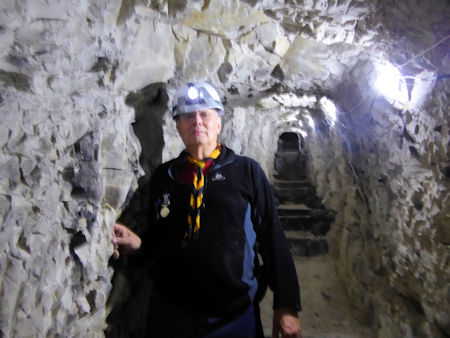
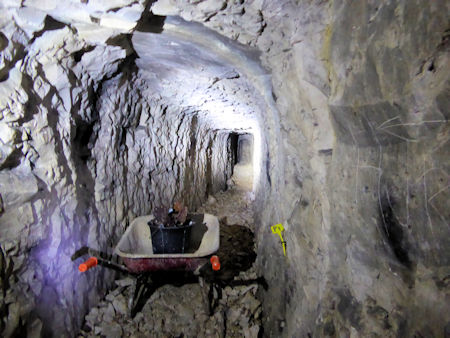
1. The Durand Group's excavated entrance on Wing's Way 2. The author at the foot of the entrance step supporting a facsimile of Les' MM 3. A closed lateral off the main subway |
| 1 | 2 | 3 |
|---|
|
|
|
|
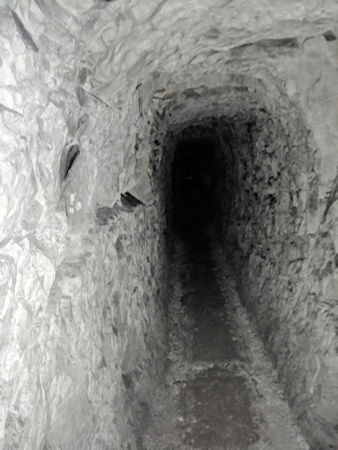
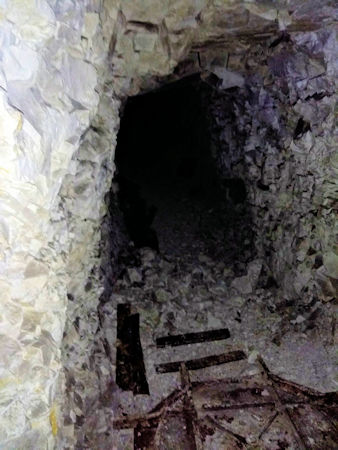
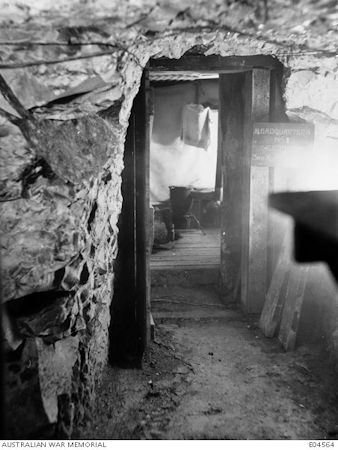
4. Deep lateral with rail sleeper marks and well worn base 5. Deep lateral with rail sleepers and points 6. No. 4 Section 3/ATC's undiscovered HQ where Les was based AWM E04564 |
| 4 | 5 | 6 |
|---|
|
|
|
|
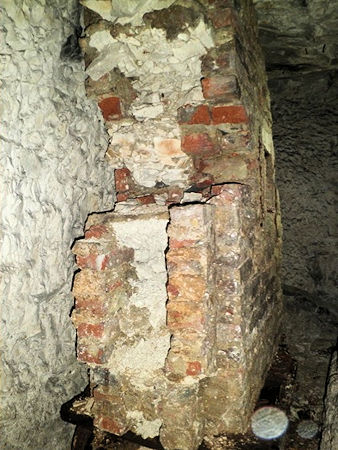
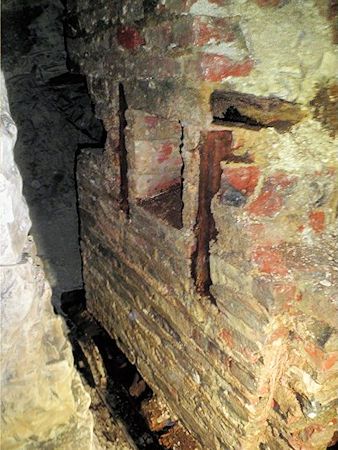
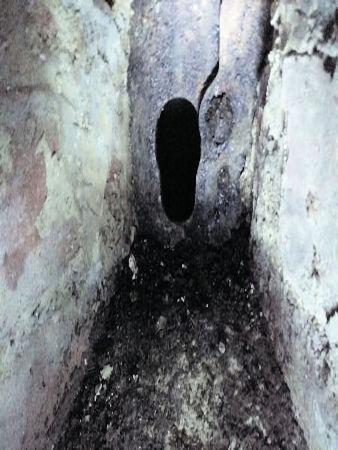
7. Sanderson's brick and concrete stop door 8. Stop door with embrasure gun port 9. Lee Enfield shaped sniper port with blacksmith's hinge |
| 7 | 8 | 9 |
|
|
|
|
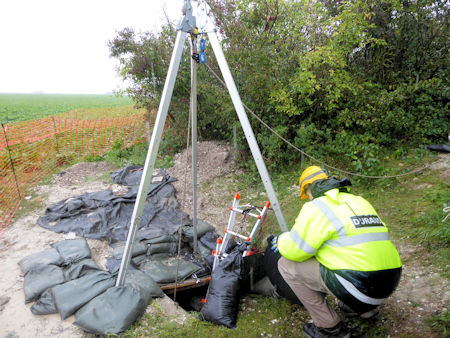
10. Durand Group's triple ladder exit on Wing's Way 11. Camouflaged Wing's Way entrance 1918 and to AEMMBC's generator Source: AWM |
| 10 | 11 |
|---|
|
|
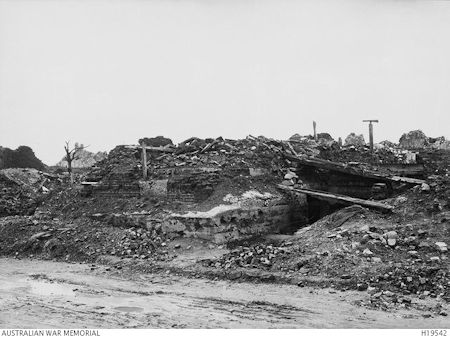
In August 1917, two Sections worked in the Hulluch system manning permanent Listening Posts in the forward areas, creating heavy trench mortar emplacements and observation posts. The line was strengthened by integrating the underground lateral tunnels and creating 'keeps' [redoubts] in preparation for 'raids' and an enemy withdrawal. Demolition charges were placed in important tunnels, some of which were blown as defensive posts and three rows of 150 mines created an anti-tank ditch. In the subways, battalion headquarters and Regimental Aid Posts were improved and garrison accommodation, with cook houses, were dug-out. Subways were maintained in a sanitary and safe condition by special teams of six Tunnel Wardens and improved gas doors covered entrances. Light railways and engines for water supplies, electrical lighting and sirocco fans, to ventilate the gas were installed. In total 2.9km (1.8miles) of tunnels were created to a deepest depth of 13.7m (45 feet). Major Alex Sanderson designed and had constructed a thick brick recessed 'block door' designed to be pulled across the subway to prevent the Germans from penetrating all the British lines should they penetrate Wings Way. A sniper port, in the manner of an embrasure, was incorporated with a sold metal shield and hole for a rifle. It is possible that Les, as a blacksmith constructed this and the blacksmith's rivet. It was completed on 12 April 1918 - see War Diary below.
On 16 March 1918 one officer and Les, completed Lewis Gun Course at I Corps Schools. Les had a good general knowledge of the subject, a very good ability to command and a good ability to instruct. He was keen and set a very good personal example and turn-out. Finally, he 'Made good progress. Should develop into efficient instructor'.
Entering by Dump Tunnel, we went through to the Hulluch Tunnel, examining the loophole traverse protection of entrances, the gas doors, and the demolition arrangements. A point of special interest was the concrete doors, of which one exists in Hulluch, St Elie and St George’s tunnels to cut off any one system from the rest. The door is 3 feet thick, [and] is of wood filled with concrete. It runs on rails and can be run into position by hand spike and pulled clear again by a block and tackle arrangement. 5
The block was manned by by a picket of two NCOs and six men in case of attack. In 2018 this door was brick faced.
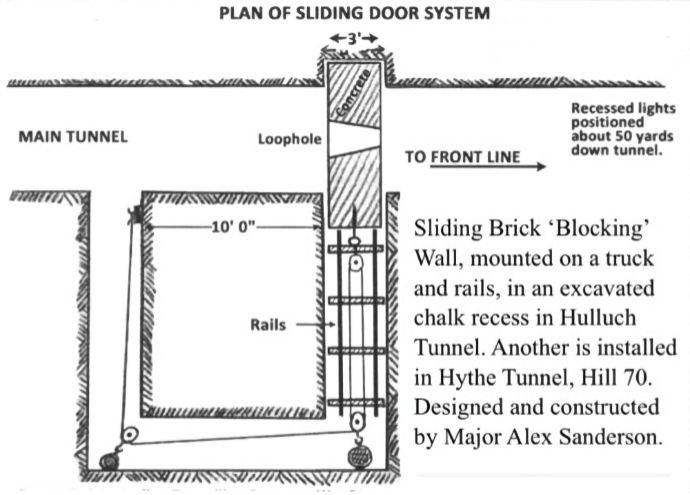 |
| Above: Hulluch Tunnel's 'Blocking Wall' Source: 3/ATC's War Diary Plan redrawn by Lt-Col P Robinson RE (Rt'd) |
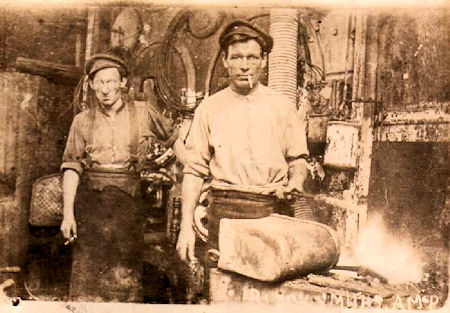
| Right: From the Morse Collection, showings the AEMMBC's smiths at
work.
Given that Les was a blacksmith by training in the Mt Lyell mines and the War Diary personnel lists that there were only one blacksmith per company, it remains possible Les made the sniper port in Sanderson's stop door. Sanderson had many innovations to protect enemy egress into the whole tunnel system, for once in the enemy could penetrate the British rear lines. One idea involved and armoured truck, requiring much metal work, involving a blacksmith. |
 |
For clearing the long straight tunnels, a double ended armoured truck, with hinged steel plates opening inwards, loophole each end and carrying a ?xed machine gun might be of good service... the trucks should be manned by two machine gunners with supply of ammunition and bombs. Two ORs would be required to push each truck. The short lengths of straight tunnel would be captured by the attacking party in rushes, from one bend to the next. 6
Sergeant Forsyth and four sappers had run 'Mine Charge Leads' from the locked chambers (at the end of the charge cables buried in the Hulluch, St Elie and St. Georges tunnels) along to the Mine Rescue Station. 7
On 12 April 1918, the same day the 'block door' was completed, Les was gassed on Le Rutoire Plain, which had been a collection area in the attack of 25 September 1915 and the farm the headquarters of many battalions active on the Hulluch front. Finlayson reports:
Mustard gas was fired into the vast plain east of Vermelles and Philosphe almost without intermission [...] and the whole time the plain behind us was full of gas. [...] The Australian tunnellers in the Bethune coalfield salient south of the La Bassee Canal did not escape the onslaught. Over the course of 8 and 9 April [1918], the opening two days of the St George offensive. [...] On the 12 April 1918 the War Diary records, Sergeant 1005 Leslie FORSYTH and eight sappers from No. 4 Section were evacuated from the nearby La Rutoire Plain sector, also victims of [mustard] gas. 8
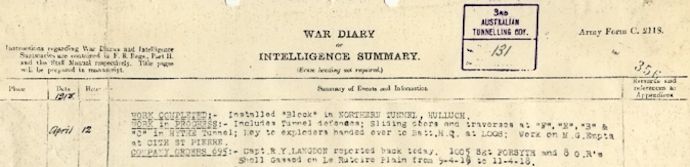 |
| Above: The War Diary of 12 April 1918 records Sgt Forsyth being shell gassed |
Sanderson asked Captain Hillman for a report on the circumstances of the gassing. In a hand written reply, he recorded:
'The outgoing & incoming relief on the morning of 9th April were caught in a very heavy gas bombardment on Le Rutoire Plain & Philosophe. I turned back those of the outgoing relief who I could find at Philosophe while Segt Freeman i/c of relief brought back all all the others with the exception of Sapper Mytton. This sapper got through the tunnels but became a gas casualty & was evacuated. Several other are under observation but
so far they have not been evacuated. Thus both reliefs came through unscathed. Sergts Forsyth & Freeman in my opinion handled their reliefs very creditably. AJ Hillman, Capt, OC No 4 Section 10-4-18 9
 |
|
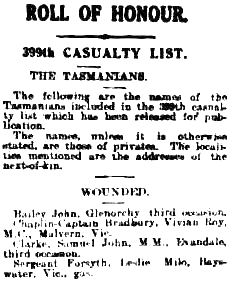 |
Left: An Abstract from the 399th casualty list Hobart Mercury 11 May 1918,
page 7, recording Les' gassing. The list of wounded is preceded by the names of those
'Killed in action', Died of wounds', and the 'Missing'
After treatment at a Casualty Clearing Station (CCS), Les was transferred to Hospital Transport 27 on 12 April and then admitted to the 1st Canadian General Hospital at Etaples on 13 April. On 19 April he was transferred to the 6th Convalescent Depot at Boulogne and on 24 April to the 5th Convalescent Depot at Cayeaux. In May he was transferred to the 17th Convalescent Depot, also at Cayeaux, and from there to the 19th Convalescent Depot at Harve on 7 May. He remained at Harve until 6 July when he was returned to the Australian General Base Depot (A.G.B.D.) at Rouelles, re-joining his unit on 23 August 1918 after an absence of 123 days. |
Throughout a quiet summer the Company were stretched from Lens to Givenchy. No.2 and No.4 Sections were involved in constructing dugouts in the extensive Hulluch system. By June 1918 only one Section remained at Hulluch constructing H[eavy] T[renc] M[ortar] E[mplacements], manning the Listening Pots, connecting a series of concrete pill boxes erected by the Royal Engineers and creating dugouts.
Despite this continued work and increasing casualties, morale was raised, in December 1917, by purchasing a cinema from Regimental Funds for the amusements of the Company and the attached BEF Units. A sports meeting was held on 16 June 1918. Shooting competitions at the Bracquement rifle range sharpened up defensive skills.
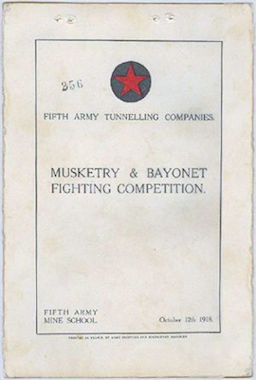
| On 12 October 1918, a Musketry and Bayonet Fighting competition between Tunnelling Companies in the 5th Army took place at the 5th Army Mine School at Linghem. Two teams were chosen from 3/ATC to compete on that day, and on 01 October the teams were taken in hand by Lieut J.B. Shaw MC who supervised the musketry practice and | |
| the training in bayonet fighting exercises was
carried out by Sgt L.M. Forsyth.
On the day of the contest our teams acquitted themselves well. There were four events and our teams won two first, one second and one fourth position, and also gained first prize in the aggregate. A great deal of the credit for the success of the 3rd Aust. Tnlg. Coy's teams in these competitions was due to Sgt. Forsyth for the energetic interest he took in training the men in Bayonet exercises. The Cup will probably find a resting place in the Australian War Museum. Right: The front page of the shooting competition programme 10 |
 |
Towards the end of August and through September a marked change occurred in the work routine, owing to the enemies withdrawal from the Loos front on 25 September 1918 and the continued success of the Allied armies. The Hulluch system was abandoned to Tunnel Wardens for maintenance. The tunnellers became engineers. All hands were put on the construction, repair and maintenance of roads, the repair of bridges and causeways and making the captured German dugouts safe for occupation. Company Sections were re-organised into special trained fighting units and were renamed from 1-4 to A, B, C, and D, plus HQ. Each Section, of about 160 men, were sub-divided into four Reliefs and each Relief into four Squads. 11 In October 1918 Les was promoted to Company Quarter Master Sergeant (CQMS) of C Section. At the same time each Section's Investigation Parties (IP) were put through a week's instruction on finding and handling booby traps and mines 5 .
| On 29 September General Birdwood inspected the headquarters, billets and the Hulluch tunnel systems. As the ANZAC Corps leader at Gallipoli, and General of II ANZAC Corps and the Australian Corps, his compliment to 3/ATC would be seen as a special honour. | 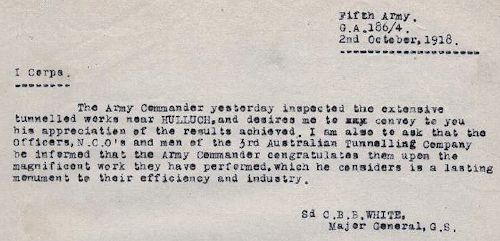 |
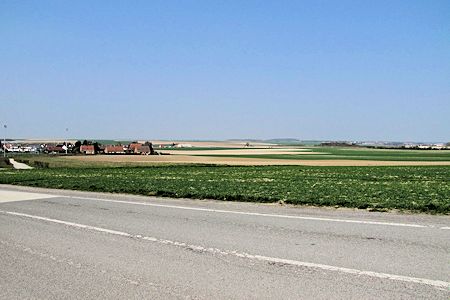 |
Above: 12 Right: Looking north. British lines cross La Rutoire Plain towards Hulluch from Chemin des Croisettes Author: 28 March 2011 |
End notes
Investigation parties
On 08 ]uly 1917 the Controller of Mines circulated instructions to parties of of?cers and O.R.s of 3 A.T.C., 170th and 172nd T.C. who were detailed as special investigation detachments to seek booby traps or delay action mines left in enemy dugouts, under buildings, at cross roads or in embankments and to give immediate warnings of any dangers discovered.
Classi?ed SECRET: Officers will Wear upon both sleeves a strip of red cloth, 1 inch wide, from shoulder to cuff for ready identification. Each dugout or cellar passed by a ?rst examination as free of traps, numbered and logged (though not necessarily free of delay action mines, requiring a longer search) will be marked with a full green circle, 4 inches in diameter, under the word: EXAMINED. A Red Circle must be shown and a red warning written: MINED—DANGEROUS where a trap is found and not removed, or if delay—action mine, not actually discovered, is suspected. If, after a thorough examination, there is no reason to suspect a delay—action mine, the sign will read: CONSIDERED SAFE in green chalk or sign boards. 1
IEDs in the Advance to Victory - October 1918 to May 1919
In early October the infantry divisions of I Corps were reorganised to facilitate rapid pursuit of the enemy. Infantry brigades were divided into an advanced guard and a main body. Each brigade commander was allotted an all-arms mobile body (one section of cavalry, one section RE, one 18-pdr battery, one section each of 4.5-in howitzers and medium trench mortars, one company of machine gunners, part of a Field Ambulance, and an 'Investigation Party' of men from a Tunnelling Company). This reorganisation 'proved very suitable to the circumstances. 2
With the expectation that the Germans would soon withdraw along the corps front, the company prepared for a new and final phase of work. Six parties, each comprising one officer, three non-commissioned officers and eighteen sappers, were selected from the four company sections [of Australian Tunnelling Companies]. Each party was assigned a letter, 'A' to 'F', and sent on a week's course of instruction in conducting investigations as well as specialist training in locating and removing booby traps from road junctions, railway embankments, cellars, dugouts, bridges, tunnels and along main roads. The parties were then assigned to a parent infantry brigade. [...] 'D', 'E' and 'F' parties eventually moved forward with the 16th (Irish) Division.
Each investigation party was further divided into three squads comprising a non-commissioned officer and six sappers. The squads were assigned to battalions in their respective brigades: a squad in each of the two forward advancing battalions and the third to a reserve battalion. The men in the investigation parties wore a red stripe down the arms of their tunics which distinguished them in the eyes of the British infantry as booby trap specialists, to be summoned if they stumbled across anything that looked remotely suspicious. Each of the infantry battalions was required to supply a platoon section of eight men to assist the Australians in their investigations. Around twenty per cent of the men from the 3rd Australian Tunnelling Company were thus assigned the task of advancing with the British infantry during the German withdrawal on the I Corps front. [...]
On 25 September, the real first signs of the general German withdrawal along the I Corps (Fifth Army) front became evident to the men in the line. [...] The following day, the 3rd Australian Tunnelling Company [...] investigation parties began their movement eastwards with the British infantry on the heels of the retreating Germans. [...] The withdrawal of the Germans along the I Corps front during the first two weeks of October began slowly but gathered pace in the latter half of the month. The Germans took great care to make their pursuers' task as difficult as possible. As well as the usual booby trapping of the roads and key buildings in the path of the advancing British, they destroyed every bridge across the waterways that meandered through north-eastern France and western Belgium.
As a consequence, the first obstacle faced by I Corps in its advance was the Haute Deule Canal, a man-made waterway connecting the Scarpe River at Douai in the south with the Lys River to the north of the city of Lille. The canal lay directly across the I Corps path five kilometres to the east of the old front line. The villages of Hulluch and Wingles lay between the canal and the former front. 3
On 04 October 1918 President Wilson's Fourteen Points for peace were under consideration by the Allies and the severely pressed Germany, both on the field and at home. The German's response to the delay in peace discussions was to retreat with a scorched earth policy to be faced by 3/ATC. Pitt writes:
'... the retirement of the German armies immediately after the dispatch of the appeal for peace, was accompanied by havoc and destruction of property far exceeding anything that military expediency could warrant. Houses were wrecked, villages mined, even gardens despoiled and fruit trees ringed; and as, slowly, the Allied armies began to creep forward again, the anger and hatred which had been swamped by feelings of relief when first news of the peace move had been circulated, renewed themselves at such useless and wanton destruction, and rose indeed to greater heights. In the centre, the British First, Third and Fourth Armies gathered their strength, picked up their arms and began again to drive forward with a grim determination ....' 4
There were enough of them now, however, and what they lacked in physical height, breadth of shoulder or depth of chest, they made up for in cunning, whilst nerves stretched beyond recovery by years of danger received at least a temporary revival from anger and a fierce resolve to finish for ever with an opponent capable of such brutal vandalism.' 5
One quarter of the 28 Officers and over 600 OR (Company strength until demobilization began to take effect) of 3/ATC found themselves following the rapid advance of I Corps and coping with the wanton destruction.
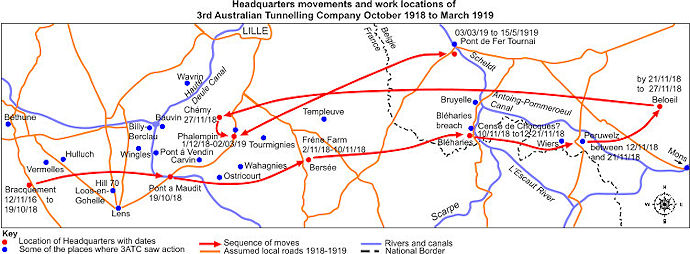 |
| Above: Map locating 3/ATC's HQ movements and actions from
October 1918 to April 1919 when they were involved in reconstructing bridges on the
Scheldt and Pommeroeul Canals. Click on the map to open an A3 landscape image in a new window |
In the state of open warfare, 3/ATC, now Australian Engineers, kept up with the advancing I Corps, moving their Headquarters accordingly: from a two year static base at Bracquement, headquarters moved to near Le Pont Maudit on the Haut Duele Canal.
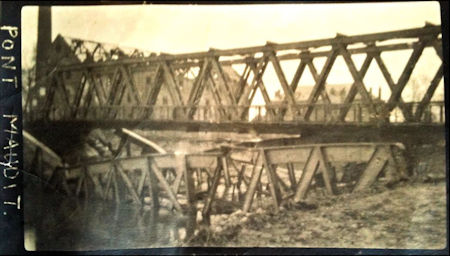
| On 19 October 1918, 220 3/ATC of B', 'C' and 'D' clearing the
demolished bridge under heavy shell fire. Construction of a Hopkins tank bridge began,
which was launched over the canal on 23 October 1918 and opened by General Holland,
GOV 1st Corps, 5th Army.
Right: Alexander Sanderson's photo of Le Pont du Mordit bridge 1918 Source: Robin Sanderson, with permission |
 |
In his introduction to Grieve and Newman's 1936 classic on tunnelling Major-General RN Harvey CB CMG DSO described the adaptive multi-tasking roll of tunnellers in the Advance to Victory.
...Even when the mining had ceased and our miners took to other work, they were constantly exposed to dangers in searching for booby traps, concealed charges, delay action mines etc. left behind by the Germans in their retreat. The amount of explosive thus collected amounted to no less than two and a half million pounds. In addition to this second main branch of work, the Tunnelling Companies proved their general usefulness by taking on every form of engineering work as it came to hand; construction of deep dugouts, repairs to roads, bridge building, water supply, drainage, and in times of stress they fought in the line with rifles, fully proving the claim of their originators that the Tunnelling Companies as organised for the Great War were the most valuable engineering units in France, and the most highly prized by the Commander of any formation who managed to get possession of even one Company of them.
In their retreat the Germans had destroyed both road and railways. There was scarcely a bridge left over a stream or canal or crossroad that hadn't been cratered, destroying the supply lines threatening the delivery of food to the front and liberated civilians. Delayed action ' bombs' and 'duds' littered the roads and rail.
The Company moved to eight other locations in the I Corps designated area with the rapidly advancing Infantry. 3/ATC was divided into five sections - 'A', 'B, 'C', 'D' and 'HQ'. Sections who, with the exception of HQ, sent men to the Investigation Parties (IP) to deal with German mines, delayed action mines and booby traps in a wide radius of the current HQ, in the area of I Corps. In his Attestation papers for his World War 2 commission, Les entered his training in 'Delayed Action Mines and Traps' and was with 3/ATC's 'C' Section's IP. Always on the move they dealt with:
It is suggested that Les' being a sergeant/CQMS of one of the IPs spent the last 100 days dealing with traps and mines, rather than the engineering rebuild of France and Belgium, as detailed in Sanderson's War Dairies.
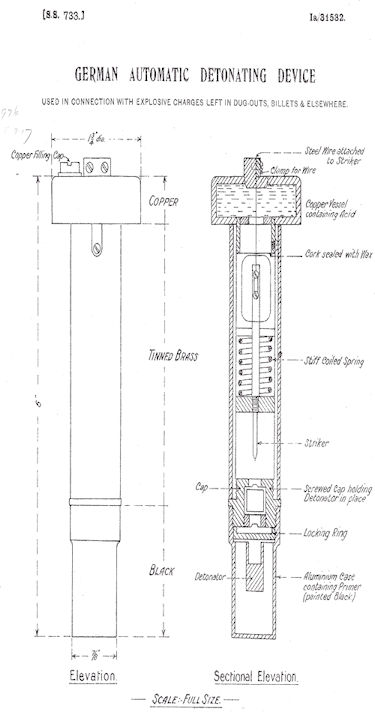
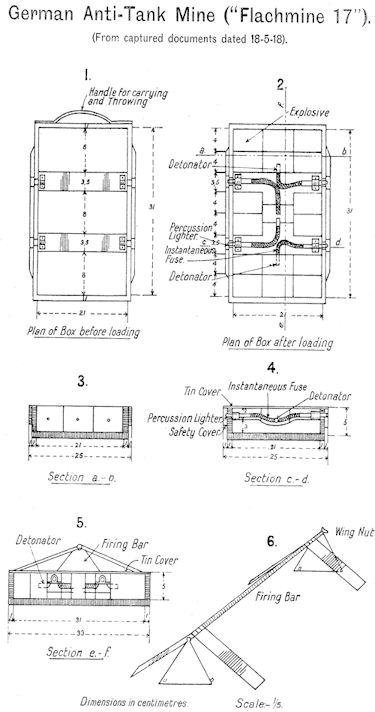
| Hoverbox Photo Gallery - Examples from the 1918
traps and mines training manual from 3/ATC War Diary
6 This feature does not function correctly on phones and tablets |
|
| 1 | 2 | 3 | 4 |
|---|
|
|
|
|
After the Armistice the British advance to the Rhine was hindered ...
'... by the necessity for locating and neutralizing mines and demolition charges which had been buried beneath the permanent way by the Germans before the Armistice. Location maps of these were provided under the Armistice agreements, but although these were accurate and detailed, it took many days for each stretch of the approaches to the Rhine to be cleared ...' 7
3/ATC's October and November 1918 War Diary gives no specific action or location for the IP parties. However, the War Diary entry for August 1917, in preparation for the Canadian attack on Hill 70, describes their formative brief.
| SECRET. INSTRUCTIONS FOR INVESTIGATION PARTY FROM 3rd AUSTRALIAN TUNNELLING COMPANY A.I.F. BY MAJOR A. SANDERSON M.C. COMMANDING OFFICER |
| [...]
DUTY
It will be the duty of the Investigation Party to search for, remove and destroy any traps or mines left in enemy dugouts, under buildings, roads, railways, bridges, embankments etc., and to give immediate warning to the Brigades concerned. Also to generally investigate the question of forward dugout accommodation for troops. NOTICES On discovery of an enemy mine or trap, sentries will be posted and a notice board marked "MINED-DANGEROUS" will be erected in a conspicuous position. If on the other hand a dugout, building or other structure has been examined without finding any trap or mine a notice board marked "CONSIDERED SAFE" will be fixed. REMOVAL Of CHARGES It will generally be advisable to move or render harmless at the earliest possible moment any mines or traps found as the longer they are in action the more dangerous they become. INFORMATION RE ENEMY RUSES Particular attention is drawn to the information collected in reports on "booby traps" and mines left by the enemy in their retreat before Third and Fourth Armies. The Officer i/c Investigation Party will see that all Officers, N.C.O. & men are conversant with the information referred to. [...] 30/7/1917 A. Sanderson
Major, |
An entry for October 1918 shows the work done during the month.
The CIB [Corps Investigation Battalion] Parties did good and continuous work in advanced positions of the 1st Corps area, keeping in touch with the advancing Infantry. Hundreds of road and anti-tank mines were unearthed and destroyed. Houses, cellars, billets, aerodromes and cross roads were checked for mines and booby traps. Many were discovered and rendered ineffective. Several delayed action acid traps of a dangerous nature were found and destroyed. Shell and Mine Crater, where they blocked the roads of ammunition, were filled in by the tunnellers as occasion demanded. 9
Sapper James Halliman 3/ATC described that:
Prior to the Armistice, things were getting’ quiet. The powers-that—be knew the war was gettin’ to its end because the Germans, with their ‘supposed-to-be’ infallible or impregnable Hindenburg line, was gettin’ blown to smithereens. Instead of marching on, and making progress to Paris, they were falling back onto the Hindenburg line for protection/They were also falling back up from where we were towards the Rhine to get back home. For us, as far as the underground work was concerned, it was ?nished. When the war was on, some of us was picked to go to a gas training school and others to train in a booby—trapping school. I was selected to learn the tricks of the trade of booby—trapping. We were all sent to the tailor shop and had a red ribbon (sewn) down both arms. On our collars some had ‘C.I.B.’ Commonwealth Investigation Branch, or Corps Investigation Battalion. The ?nal stages then was that a team of us was picked out, after the Lens bridge job, to go booby—trappin’. Well, we had to go into houses and shops, buildings
and all, to make them safe before the civilian people could come back into their homes, farms and shops. These booby traps were set by the Germans and likely to go off any time. We lost a couple of friends near Lille through carelessness when they came to a place and opened a door. As they were going down the stairs, they put their weight on the stairs where was a booby trap. Of course, the result was: up went the stairs and these fellows! They were blown down below. The booby—trapping lasted about three or four months.‘ 10
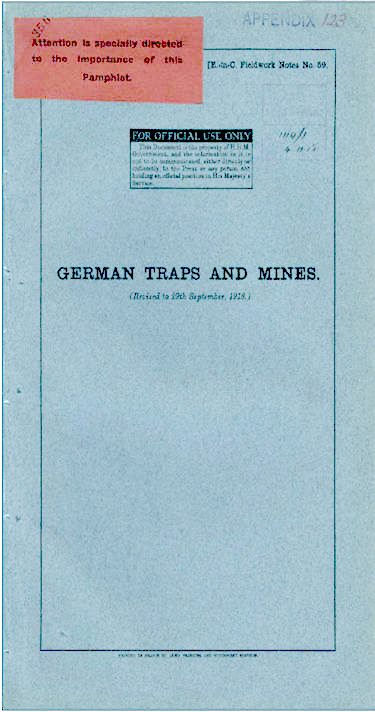
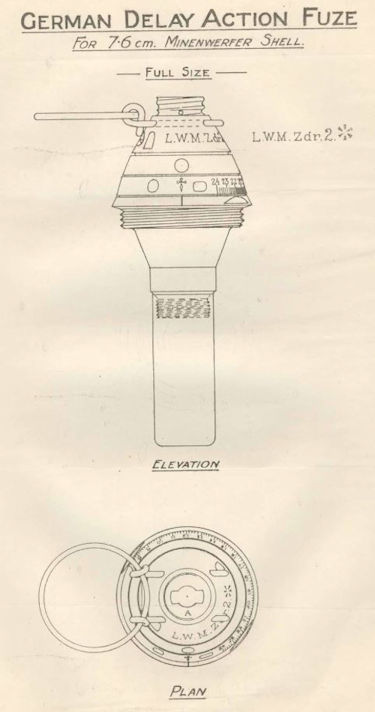
The War Diary summary for November 1918 (Part2) (Accessed: 15 April 2016) records what was taught and shows the published training document ' German Traps and Mines' revised bloth September 1918, page 73-88:
During this month occurred the great event of cessation of hostilities and the signing of the armistice by the enemy on 11/11/18. The complete and sudden collapse of the enemy gave victory to the Allies after over four years of hard struggling. Much work was done in the construction of steel and wooden bridges to span the canals and waterways. Work carried out by the Investigation Parties was an arduous nature, besides being dangerous in a very real sense. The Advanced parties moved with the Infantry Brigades examining roads for mines, billets for booby traps, and all villages for explosives. Delayed action mines, in many cases overdue to go up, were removed at great risk. Ammunition dumps were rendered harmless by the removal of electrical fuses. Thousand of anti-tank mines & road mines were unearthed besides very many delayed action acid devises for detonating mines. The ammunition recovered or rendered harmless for mines, aggregated hundreds of tons.
The War Diary for 09 December 1918 lists, for the Controller of Mines, 24 pages of the number, type and location by map area of mines and trap dealt with between 7 September 1918 and the Armistice. This is equivalent to 22 London double-decker buses.
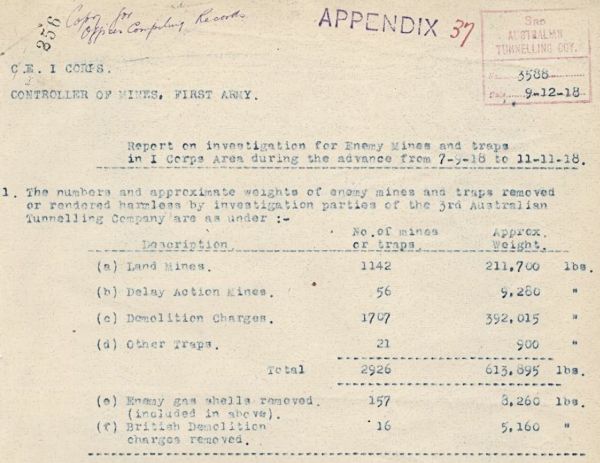 |
| Above: 3/ATC mine tally, which shows why Haig sent the letter of appreciation - below 11 |
The appreciation of the work undertaken by the tunnelling companies is recorded in the War Diaries. The day after the Armistice General WR Birdwood, who had commanded the Australian Corps before Monash, and now commanded Fifth Army, circulated the following letter of appreciation to the tunnelling companies.
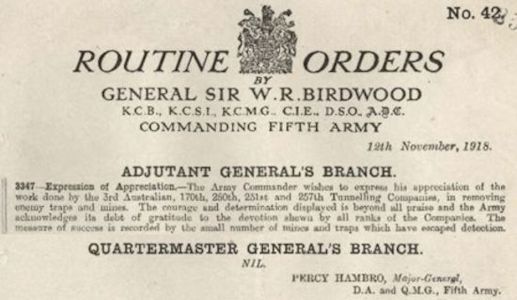 |
Left: Birdwood's letter of 12 November 1918 to 3/ATC, written in appreciation of the removal of enemy traps and mines 12 |
Promotion
| On 1 October 1918 Sergeant FORSYTH was promoted to Company Quarter Master Sergeant (CQMS) of 'C' Section, being one of the four CQMS in the reorganised 3/ATC Section A-D. On page 46 of the War Diary of May 1917 (below), Major Alexander Sanderson defines the job description for CQMS, giving testament to Les' qualities. On his homeward voyage Les became to Acting Regimental Quartermaster Sergeant (RQMS). |  |
| Above: Left - RQMS. Right: CQMS |
| The A.A.G., A.I.F re Establishment I like (sic) to draw your attention to the amount of work and technical knowledge and experience required for a Tunnelling C.S.M., & C.Q.M.S. For the past 18 months, the period that this Company has served in the line, its strength (A.I.F. personnel with permanently & temporarily attached infantry) has varied between 700 & 1400. The maintenance of discipline and the considerable technical knowledge and experience necessary as well as military knowledge difficult matter to obtain a suitable man for the position of C.S.M., when (sic) such a man is found, I think it is desirable that he should have the rank of "Warrant Office Class 1" I should like to point out that an Infantry Battalion has an R.S.M. and four C.S.M's. (sic) The above facts are also applicable to the C.Q.M.S., as far as technical knowledge and experience go. The stores for this Company are many and varied, and the arrangements in case of advance of 3 mobile sections and one stationary with their respective stores makes the matter more complicated and responsibility greater; I, therefore would ask that the C.Q.M.S. be granted the rank of "W.O.II". [...] 11/5/1917 |
| Major, O.C. 3rd Australian Tunnelling Company. |
CQMS Penleigh Boyd, of the Australian Electrical and Mechanical, Mining and Boring Company (the Alphabet Company), 'job description' gives a flavour of Les' experiences:
My job is sort of is QMS machinery. I've got to keep all the books about the machinery and keep ordering stock for the stores whenever I think anything would be needed. There is a tremendous lot of stuff always coming in and going out ... 13
End notes
The possible circumstances leading to FORSYTH's Military Medal and CORKERY's death 3
By 16 October 1918, I Corps of Fifth Army 4 had crossed the Haute-Deule Canal. It was evident that German Sixth Army could not delay its withdrawal. Fifth Army believed that no serious stand could be made until reaching the River Scheldt, a distance of 25 miles (40km). Plans were made to harass the retreat with advanced guards and to proceed by bounds. Volume 5 of The British Official History notes, for 18 October 1918, that each division sent forward one or two strong columns on the roads, which covered their advance by patrols, which had with them a section of Tunnellers RE to deal with delay-action charges and booby traps [...]. 1 On 25 October 1918, the War Diary of 49/Infantry Brigade of I Corps, records 34/London Regt in support with 1 Coy. St Maur, 1 Coy. Longue Sault, 2 Coys. Taintignies. 2 Amongst the attached troops was 3rd Australian Tunnelling Section. 3 and not Tunnellers RE, firmly placing 3/ATC with 49/Brigade near the time of the CORKERY incident of 2 November 1918 and in the area of Saint-Maur, 4km south of Tournai, Belgium.
49/Brigade's War Diary continues Saint-Maur very heavy shelling from 2000 29th to 0500 30th with HE and YELLOW CROSS GAS about 3000 shells. At 0445 enemy about 20 under cover of an Artillery Bombardment and MG fire raided the post at U.18.b.9.0 (see map) from the rear. Two of our men missing and two men wounded. Considerable aerial activity. Enemy artillery fairly quiet during the day. Enemy artillery very active during the night on U.22.23 with HE and gas Blue and Yellow Cross [gas] 4.
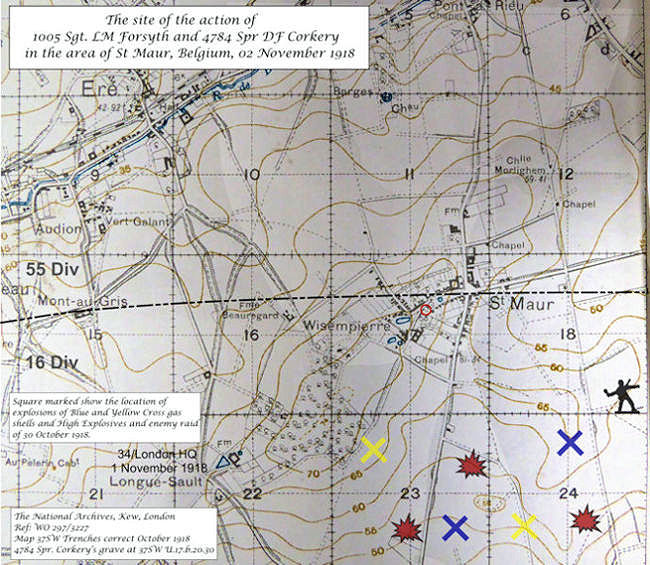 |
| Above: Map of the location and activities around Saint-Maur 30 October 1918.Blue Cross gas was tear gas. |
The German's often fired Blue Cross gas, otherwise known as tear gas into areas where troops were concentrating causing choking, sneezing and coughing. After the Blue Cross had been deployed the area was deluged with a more deadly gas, many men finding impossible to keep their gas masks on because of coughing and sneezing. The Yellow Cross used was Mustard Gas.
On or around 24 October 49/Brigade's dash to the River Scheldt halted in the vicinity of Saint-Maur. The town was heavily shelled and gassed 2 on 30 October, enemy patrols were active and Belgium refugees reported that churches and high places were being mined. On 01 November 1918, the night before Corkery's death 34/London relieved 18/Gloucesters in the outpost line before BRUYELLES. HQ was established at LONGUE SAULT. A & B Coys. formed the left right front Corps respectively with 'D' Coy in support & 'C' Coy in reserve 5. On 02 November, Several enemy patrols seen during the night. 6
From the two War Diaries we know that 3/ATC's Investigational Parties were operating in the area at work removing mines. At Brigade level, on the night of 01 November 34/London were, in relieving 18/Gloucesters, new to the line. This relief and because 3/ATC was operating at Brigade level, may account for the lack of the infantry support 1005 Sgt Les FORSYTH and 4748 Sapper Daniel CORKERY were expecting. It is possible 34/Londons did not know they were in the area. It appears that this support was needed because, if enemy patrols were active on the night of 02 November and raids were still taking place, they may have been active in the day. Perhaps one of these patrols found Les and Corkery.
Local civilians and refugees had told 49/Brigade that the Germans were mining church towers and high places, so Saint-Maur Church was a candidate to be defused, despite its damaged state. This was a scenario for IP to defuse traps and mines in close proximity to the enemy with 3/ATC's War Diary records that Les and CORKERY were teamed together and a reason for them to be near the town. When CORKERY was mortally wounded, sniped in the stomach near Saint-Maur. Les stayed with CORKERY until persuaded to withdraw under fire. It is assumed they were on IP work dealing with traps and mines but lacked the infantry support.
At this moment there is no know location for this incident. At this time Headquarters had move up to Fréne Farm near Bersé in France and didn't become active in Belgium until between 12 and 21 November when HQ moved first to Peruwelz then on to Beléil.
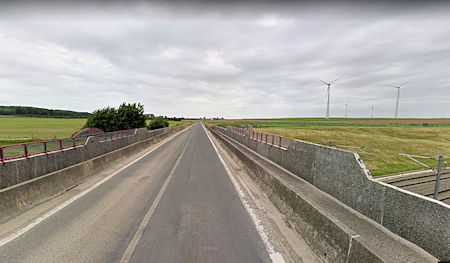
|
Left: rue du Colonel Dettetmer looking north towards Saint- Maur church. From the map above the action could have been close to the crossing the Jurbise to Ath railway. This bridge may have been the target for German traps and mines. |
Later in the month the War Diary records '4748 Sapper Corkery DF, previously reported missing, reported "killed in action"'.
However, Finlayson 7 suggested an alternative death quoting George Oxman's diary: “During one such souvenir expedition on 2 November, Sapper 4748 Daniel CORKERY was spotted by a German sniper and killed. This Oxman state's Corkery was souveniring whilst on 'gas guard'. Whilst this confirms the presence of Yellow Cross and Blue Cross gas, it is not known whether this ' guard' was a night detail or when Les was defusing a trap or mine. See map above.
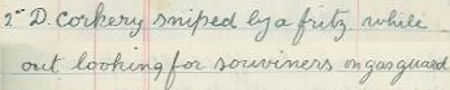 |
Left: A composite image of George Oxman's diary AWM PR00712 |
It is possible that Les and Dan were out looking for booby trapped 'souvenirs' that may have caught unsuspecting and scavenging troops.
3/ATC's End of War Report records the death of CORKERY and the possible reason for Les' Military Medal:
On 2/11/18, 4748 Spr. CORKERY D.F. was wounded and missing and afterwards reported killed in action. This regrettable incident removed a young energetic and high spirited sapper from the ranks of the Tunnellers. He, with Sgt. FORSYTH, was engaged in investigation work in forward areas, believed to be protected by advanced infantry patrols. They were fired on at close range and a sniper’s bullet found Sapper Corkery. He fell shot through the stomach, and insisted on Sgt. Forsyth leaving him knowing he was beyond assistance. Sgt. FORSYTH when quite convinced there was no hope sought shelter followed by snipers fire. 8
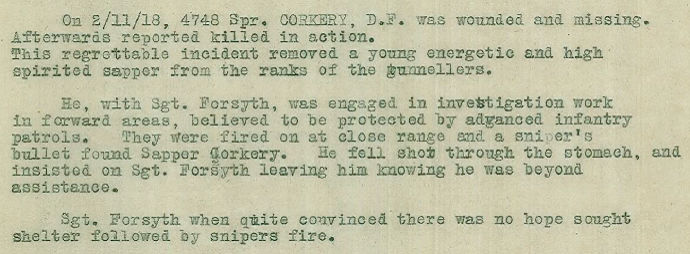 |
| Above: Leslie Milo FORSYTH's at St Maur and Daniel CORKERY's death |
 |
| Above: Map locating Saint-Maur in relationship to Oxman's activities, Saint-Maur churchyard and the suggested location for CORKERY's death |
Bruyelle, mentioned by Oxman, is a modern 3.7km by road from Saint-Maur and on the same railway line crossed by the rue du Colonel Dettetmer, perhaps reinforcing the suggested location for the sniping. Bruyelle appears to have a modern out of town cemetery suggesting a reason for Saint-Maur churchyard.
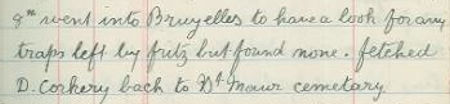 |
On 08 December 1918 George Oxman collected CORKERY's body and buried it in
Saint-Maur churchyard. Spr. CORKERY is the only Commonwealth War Grave in the
graveyard of Saint-Maur.
Left: George Oxman's diary for 08 December 1918 AWM PR00712 |
Investigation work continued after the Armistice. On 24 November 1918 No 4 (sic) Section with Lt Wallman and Sgt Forsyth plus 10 3/ATC men and 40 infantry became a mobile Investigation Section searching with the Left Brigade of I Corps' Right Division area for mines and traps left during the retreat.
End notes
The award of the Military Medal
In the months of peace Major Sanderson was able to write and file letters on congratulation to those awarded MC, MM and MiD. The general phrase he used, when acknowledging a Military Medal, was 'conspicuous Gallantry and Devotion to Duty during the October advance'. The Military Medal tended to be in recognition of a period of sustained gallant performance rather than a single act, and many went to those men who were not in a position to carry out spectacular acts - the unsung men of the transport, artillery, medical and veterinary services, ordnance and engineering. This was Major Sanderon's last award and last letter of acknowledgement.
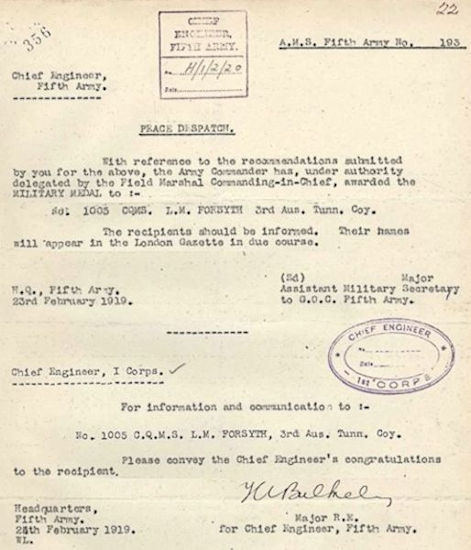 |
Left: A composite letter from Chief Engineer, Fifth Army to 3/ATC's CO Major Alexander Sanderson DSO, MC and Bar, announcing Les' MM - War Diary of February 1919 p.29 (Accessed: 23 April 2016)) |
 |
| Above: Announcement of his MM in the War Diary of March 1919 p.5 - effective 23/2/19 |
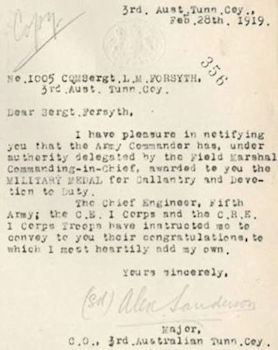 |
Left: Letter from CO Major Sanderson announcing Les' MM for
Gallantry and Devotion to Duty -
War Diary of February 1919 page 27 (Accessed: 23
April 2016). Attached is a 1919 'Post It' expressing the congratulations of the
Chief Engineer 1st Corps.
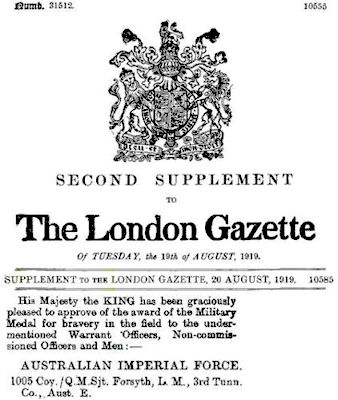
Below: A composite image of Les' Military Medal award in the London Gazette Supplement 31512, page 10585 |
 |
 |
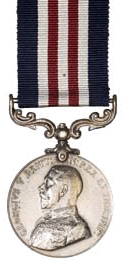
| Above: The Military Medal, awarded to Other Ranks, which although equal to the Military Cross (MC,) it was ranked below an MC and the Distinguished Conduct Medal (DCM) in order of precedence. |
The award was posted in the Australian Gazette of 11 December 1919. His record shows he received his British War Medal (35183) on 12 October 1921 and his Victory Medal (34925) on 8 November 1922. His documents were sent to the Repatriation Department, St Kilda, Victoria in July 1926.
Sources:
Postscript - 3/ATC reunion Oxford, UK, 08 March 2016
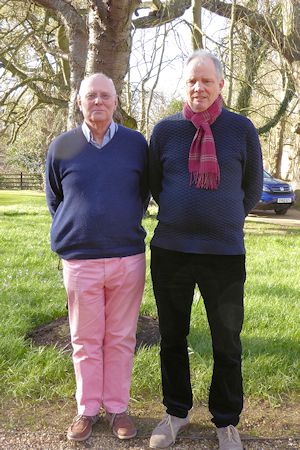
| On 08 March 2016 Robin Sanderson (right), grandson of Major Alexander Sanderson, met
Richard Crompton (left) second cousin twice removed to CQMS Leslie Milo Forsyth, in
Oxford. We live about 11 miles (18km) apart.
Particularly at the end of the war, Major Sanderson would have known his CQMS, (I think he was that sort of person), especially when writing up Les' recommendation for the units final MM of the war. It is strange to think that our respective relatives saluted each other and perhaps met over a table to discuss stores. Robin, as Myles Sanderson has written his grandfather's biography "Tunnelling Commander on the Western Front" published by Frontline Books, 2024. In reading the War Diary's, Alex Sanderson is a man to be admired. And the war was only four years of his life. It is some story. |
 |
| More information 1 |
 |
A journalist visits the Hulluch System
I went into a world the other day where no shells bursting high or low, can have any effect upon our men who live there. No German barrage can ‘put the wind up’, because in this world there is no wind. Visibility may be good or bad, but the enemy has no observation here, though he is on top all the time. I went into No Man’s Land beyond our lines, and was as safe as in the Strand at home, though only a few yards away from the enemy’s outposts. For this world was deep underground. It is a place of long galleries, 60 feet below the outside earth, in which I walked for hours and hours and did not come to the end of them. My guide, who knows these tunnels blindfold, pointed to the entrance of another gallery and said: ‘That leads to another part of the front, and would take another day to explore.’ My guide is one of the officers of the Australian Tunnelling Company, which during the past two years, has done a great part of the work in boring this subterranean system below some section of our battle line. They are mostly miners from the gold fields of Western Australia: hard, tough fellows with a special code of their own as regards their ways of discipline and work, but experts at their job, and with all their pride in it, and a courage which would frighten the devils of hell if they happened to meet them in the dark. When they first came over with their plant, the Germans were mining actively under our lines and blowing up our infantry in the trenches. It was the worst terror of war, before poison gas came, and I used to pity our poor officers and men who knew, and hated to know, that the enemy was sapping his way under them, and that, at any moment, they might be buried in a crater or hurled sky—high. The enemy were beaten out of the field by British, Australian, Canadian and New Zealand miners, who fought the Germans back underground from gallery to gallery, blowing them up again and again, whenever they drew near, and racing them for the possession of the leads, whenever they tried to regain part of their destroyed systems. But the Australian tunnellers drove in at three times his speed of working, blew in the ends of one of his galleries and then broke through his timber into the tunnel. The Australian tunnellers dashed them with rifles and revolvers. The enemy had escaped, 'but their system was destroyed, before they could set off their mines. The Germans know now that they are beaten underground. It is an honour of which this Australian Company is proud that, apart from their own casualties, not a single infantry soldier of ours has lost his life by hostile mining. In each side of the galleries were rooms carved out of the chalk. They were furnished with wooden tables and benches, and the miners were playing cards. Through holes in the chalk walls I looked into caverns where men lay asleep in bunks... In a big vault was a power—house with three electric engines, providing the light of the galleries. Not far away was. .. a kitchen with big stoves and ovens, where meals were being cooked by sweltering men, within a few yards of the front—line trenches. In a little while, a big electric fan will blow a draught through the kitchen and take away the heat. In other rooms were field dressing stations, and we came to a subway with trolley lines, down which the wounded are brought from the battlefield up above. The roofs of the tunnels were richly coloured with a reddish fungus which hangs down like stalactites. We went deeper down and further forward. In one room men were listening to the sounds of German life in other tunnels like these, the sounds of men walking and talking and filling sandbags and moving timber. The listeners are so expert that they can tell by the nature of the sounds exactly what the enemy is doing through a chalk wall 70 feet thick. Presently we went into a fighting point driven out beyond the lateral galleries and my guide said, ‘Here we will be quiet, because we don’t want the enemy to get suspicious. We are now out in No Man’s Land.’ The war seemed a world away. The Australian tunnellers live below ground for most of their life. Some of them have the pale look of men who have been out of the light. In their spare times down below, they play cards and yarn of old days in the goldfields, and carve faces in the chalk. One man had carved the face of Shakespeare: ‘Old Bill’ he called him. These men, by their toil and courage with picks and explosives and listening instruments, have saved the lives of many hundreds of British soldiers, and long after the war is finished this underground world of ours will remain as a memorial of their splendid labour. I had seen the working of the tunnellers up by Hill 70 and elsewhere. I had listened through a microphone, by which I heard the scuffle of German feet in German galleries a thousand yards away, the dropping of a pick or shovel, the knocking out of German pipes against charcoal stoves. It was by that listening instrument, more perfect than the enemy’s, that we had beaten him, and by the grim determination of those underground men of ours, whose skin was the colour of the chalk in which they worked, who coughed in the dampness of the caves, and who packed high explosives at the shaft-heads — hundreds of tons of it — for the moment when a button should be touched far away, and an electric current would pass down a wire, and the enemy and his works would be blown to dust. Source: Sanderson pp.188-190 |
| More information 2 |
|
German gas ammunition
Odourless but yellow in colour, Yellow Cross gas was the blistering agent known as mustard gas, first used in 1917. It was intended to harass and incapacitate. There was no initial choking, so the first sign the victims saw was blurred vision and blistering of exposed skin, with external and internal bleeding. When mixed with high explosives it was difficult to detect that there was a gas attack. The area became contaminated along with the equipment in the area. Victims were evacuated so over whelming the medical services. Blue Cross ammunition, first used in 1915, contained chloropicrin or diphenlychloroarsine or diphenylcyanoarsine, a non-persistent non-lethal arsenic based a lachrymatory gas as a fine dust. It caused vomiting agent causing fits of sneezing and vomiting, temporary blindness, inflamed noses and throats and caused great pain. It was later found to be carcinogenic. Now known as tear gas. Green cross ammunition contained phosgene or diphosgene, a non-persistent, lethal choking agent. Non-persistent agents were used to induced temporary panic amongst front-line defenders but timed to have dispersed when the attacking German infantry reached the defender’s line. They had the advantage of incapacitating defenders without massive destruction of the ground. Source: Bromford, Michele, The Battle of Mont Quentin-Peronne, Australian Army Campaign Series - 11, Canberra, 2012, Lloyd, Nick, The Western Front, Viking, 2021, p.395 |
| More information 3 |
|
Sapper 4748 Daniel CORKERY: his life and his death has been transferred to its own section, Click here to open it in its own window. |
| More information 4: |
|
Order of Battle 5th Army. I Corps. Lt. Gen. Sir Arthur Holland October 1918 to
11 November 1918
I Corps, with 15/Division, 16/Division and 58/Division joined Fifth Army on 25 September 1918. On 3 October, progress continued along the whole army front, with little opposition until I Corps met machine guns along the Haute-Deule Canal and was brought to a halt. Considerable damage had been done to the roads and canal sides, and by implication Pont au Maudit, which was rebuilt by 3/ATC in mid October 1918, but not the railways. By 16 October, it was evident that German Sixth Army, opposite the British Fifth Army, could not delay its withdrawal. Fifth Army believed that no serious stand could be made until reaching the River Scheldt. Plans were made to harass the retreat with advanced guards and to proceed by bounds. At 11pm on the 16th, I Corps notified its Divisions that they should push forward at dawn to the objectives, if they had not already been achieved. Then, patrols should be pushed forward for two miles (3.25km). This second objective saw the capture of the Thumeries-Phalempin ridge. 47/Brigade captured Phalempin, where 3/ATC would make its Headquarters in December 1918 and March 1919 and, after slight opposition during the morning, the railway to the north was captured. In the evening, it established outposts 3000 yards (914m) to the east. The 16/Division, after being shelled at night, proceeded to take its objective by 11am on the 19th. Shortly after, it was reduced to a two-battalion frontage. The next day 47/Brigade encountered slight opposition when entering Rumes, but they were still some way west of the River Scheldt. |
| More information 4 cont:- |
|
The Scheldt, at 40 yards (36m) wide and 18 feet (5.5m) deep, was a formidable obstacle. The wide and flat valley had low hills extended along its western edge to almost the river at Antoing. Refugees told of poor defences and that churches and bridges were prepared for demolition. These would be suitable for 3/ATC's IP groups. Against considerable opposition, 16/Div took highland overlooking Tournai on the 21st but could go no further due to active German artillery. Patrols found Bruyelle still contained many Germans, who had, according to civilians, mined churches and cathedrals. In the first week of November, the German Sixth Army lined the eastern bank of the Scheldt, with bridgeheads at Antoing and Tournai. No serious effort was made to dislodge them. Both sides carried out daily harassing fire and intermittent bombardments. Active British patrols were unsuccessful in crossing the river. The Germans made several small raids, which apart from one were unsuccessful - see 34/London War Diary. On 9th November, 16/Div stood fast allowing 15/Div to take its frontage to follow up on the retreating enemy. Source: Edmonds, Sir James, Military Operations France and Belgium 1918 Volume 5,Imperial War Museum/Battery Press, 1993 edition
|
| More information 5 |
|
Booby traps
The advancing Allies were now learning about yet more novelties of war: booby-traps. This displayed distressing ingenuity: explosive charges, carefully concealed, attached to tempting items of booty or souvenirs, time bombs in dugouts or houses, some of them blowing up buildings and their occupants many days after the Germans had gone - these were daily occurrences, and did nothing for the tempers of the Allied troops. One and all, however, turned to their engineers to deal with these objectionable things, thus adding to their already ample burdens. 'A delightful job,' remarked one Royal Engineers officer, 'feeling around a deep German dugout to see if it is going to blow up!' The Germans also displayed considerable skill at road demolitions. Bridges, of course, were natural targets for destruction, but, says the same officer. They have one or two other ideas, such as: (a) Tunnelling into the side of a, road embankment and blowing a great breach in it. (b) Dropping an overhead bridge onto a road passing underneath it. This not only cuts the railway, but also blocks the road with hundreds of tons of twisted steel girders, very difficult to remove quickly. We front-line engineers have no equipment to do this kind of thing. We can only make earth diversions, or build wooden trestles or pontoon bridges. (c) Mining the crossroads in the middle of a village. Either the crater has to be ?lled in, or deviations made by knocking down the houses. Either job takes time and being at a cross-roads, the obstacle creates a maximum of delay. Reaching the end of a day soaked to the skin and with a horrible backache, he quietly remarked: 'This moving warfare is very interesting but a bit strenuous.' Glubb, Lieut-Gen Sir John, Into Battle: A soldier's diary of the Great War, Cassel, 1978, pp.210, 217 quoted in Terraine, John, To win a war, Cassel, 1978 |
|
 |
|||||||
| This page was created by Richard Crompton and maintained by Chris Glass |
 |
Version C7br> Updated 04 July 2026 | ||||||


