 |
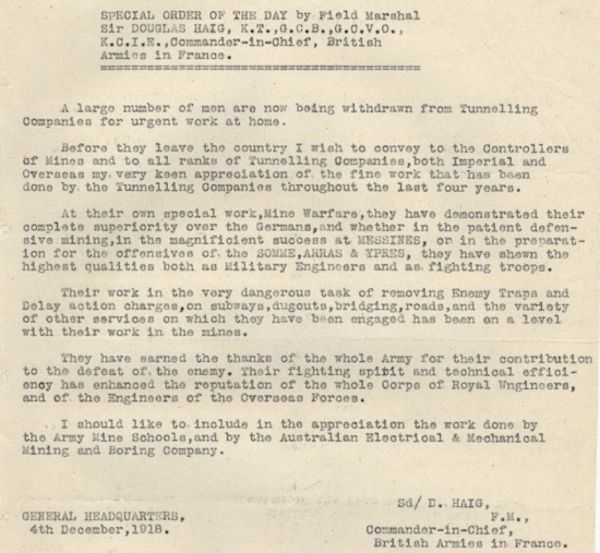
| Above: Field Marshal Haig's letter of appreciation 04/12/18 emphasising the work undertaken by tunnelling companies 4 |
| 1821 Info 9d_3 for Caleb
Crompton The descendants of Elizabeth and Thomas Forsyth Leslie Milo Forsyth, MM - at war Part 3 |
After the Armistice
On 13 November 1918 the Company entered Belgium and set to on the repairs Sanderson had identified. Whilst the booby-trap work continued, five days later orders were issued aimed at keeping order and discipline with definite tasks allocated: tasks that were not so great as to unduly fatigue the men.
After the Armistice, and between 30 November and 7 December 1918, Les enjoyed some leave in Paris. He returned to disarming of mines and booby-traps left behind by the Germans before another period of leave between 28 February and 7 March 1919. 1
The process of a structured demobilisation began after the Armistice gradually reducing the strength of 3/ATC. The company War Diary of April 1919 records:
The strength of the unit was 8 officers and 175 OR. The work on the Escaut River at Beléries, in pile driving and filing the west bank was continued up to 22/4/19 when the men were withdrawn for demobilization. The remaining personnel were engaged in routine matters and in educational work. Major Sanderson struck off strength from 2/4/19.2
Of the 118 ORs 'demobilized' in the month of May, Les went to Non-Military Employment in Middlesbrough - see below. In May 1919 the War Diary reported Company comprised of 3 Officers and 20 OR. On 26/5/19 the 3rd Aust. Tunnelling Company ceased to exist. 3
Final recognition of the tunnellers work was issued in a Special Order of the Day by Field Marshall Douglas Haig.
|
| Above: Field Marshal Haig's letter of appreciation 04/12/18 emphasising the work undertaken by tunnelling companies 4 |
NME - Blacksmithing to gain experience in Steel Rolling’ in Middlesbrough
| Les was granted leave for non-military employment (NME) 1 from 5 April to 5 July 1919 with full military pay and 6/- (30p) per day subsistence to attending Dorman, Long & Co Ltd, Britannia Works, Middlesbrough. | |
 |
The reason stated for the NME was ‘blacksmithing - to gain
experience in Steel Rolling’. He was issued with a suit to the value of £2 5
shillings 6 pence (£2.275); overalls valued at 14 shillings 11
pence (75p) and a cap at 3/- (15p), and was given rail warrants to and from Middlesbrough
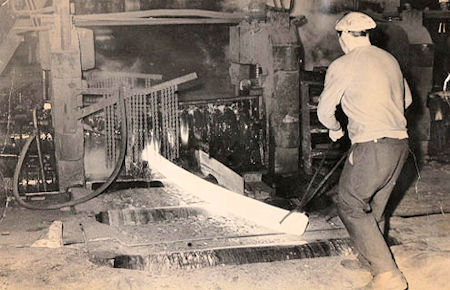
to the value of £1 6 shillings and 6 pence (£1.325). Left: Steel rolling in Britannia Works 1977 |
| The NME scheme was set up in England as part of the repatriation process to provide
soldiers with civilian skills that they could use on their return to Australia.
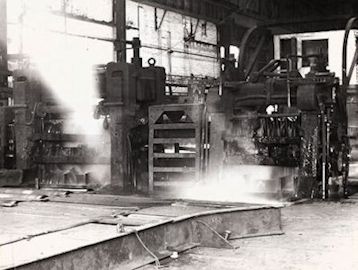
Right: A steel rolling mill at the Dorman Long's Ormesby rolling mill circa 1954. This illustrates the machinery that Les may have trained on. |
 |
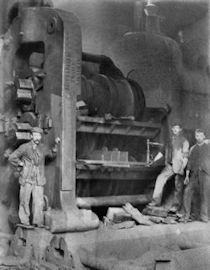 |
Left: An undated photograph of the Dorman Long Rolling Mill
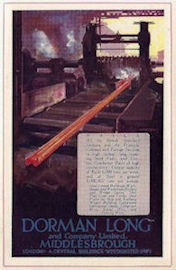
Right: A Dorman Long advertisement, showing hot rolling, from 1925 |
 |
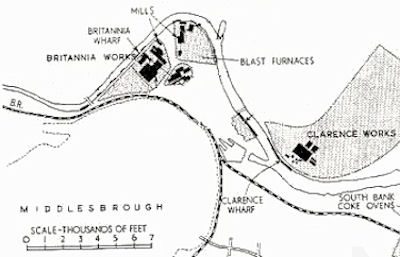 |
Left: A map locating Britannia Works in 1959. This was only a part of the Dorman Long complex which extended along the banks of the River Tees to the sea. Apart for the Test House, this site has been demolished to be replaced by modern lighter industry. The Riverside Stadium, home of Middlesbrough Football Club, is now situated within the Britannia meander loop. |
| Dorman Long, established in 1875, was based in Middlesbrough in the north-east
England. It was a major steel producer, which diversified into bridge building, including
the Sydney Harbour Bridge in 1924. Now it manufacturers steel components and construction
equipment for bridges and other structures.
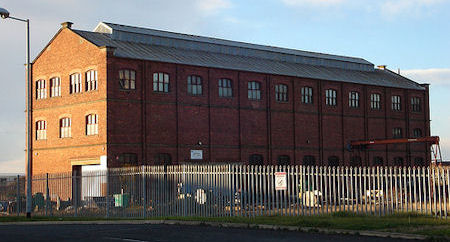
Right: The Dorman Long Test House tested the steel used in the Sydney Harbour Bridge. |
 |
Even though his future wife lived in Stockton-on-Tees, close to the Dorman Long works in Middlesbrough, there is no evidence that he met Beatrice Moore at Dorman Long. 2
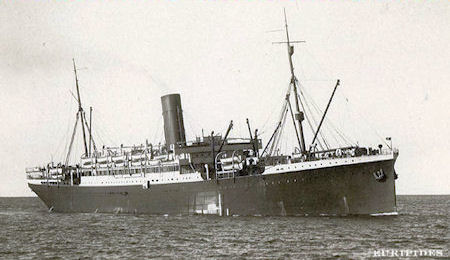 |
On 03 September 1919, following an extended embarkation leave from 11
July 1919 to 21 July 1919, Les embarked in London for return to Australia on board
Euripides as Acting RQMS at Warrant Officer Class 2 rank as the ship's
quartermaster for the voyage. He disembarked at Melbourne, Victoria on 02 October 1919
and was discharged in the 3rd Military District on 12 December 1919. It is recorded, he
returned to Queenstown, Tasmania, but it is assumed this is his pre-war address.
Left: HMAT A14 Euripides |
| DIVISION OF DARWIN (1919) | SUBDIVISION OF QUEENSTOWN (1919) |
| 611 | Forsyth, Leslie Milo, | Allan's lane., Queenstown | blacksmith | M |
Source: Australian Electoral Roll
On enlistment, Les had made an allotment from his military pay of 7/- per diem to Miss Lucy Agnes TONKS 3, Post Office, Queenstown, Tasmania. In November 1919, Miss TONKS wrote to the Military Pay Master seeking the amount she had drawn as she wished to return it to Les. The allotment had been drawn for a period of 439 days and Miss TONKS was advised the total amount drawn was £153.13.0 (£153.65)
End notes
Sources:
Postscript - 3ATC reunion Oxford, UK, 08 March 2016
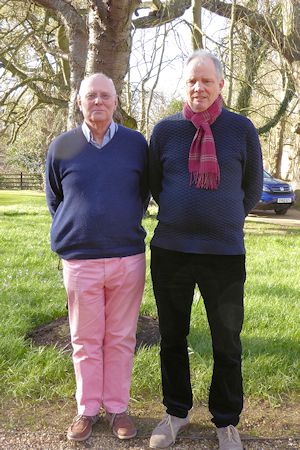
| On 08 March 2016 Robin (Myles) Sanderson (right), grandson of Major Alexander
Sanderson, met Richard Crompton (left) second cousin twice removed to CQMS Leslie Milo
Forsyth, in Oxford. We live about 11 miles (18km) apart.
Particularly at the end of the war, Major Sanderson would have known his CQMS, (I think he was that sort of person), especially when writing up Les' recommendation for the units final MM of the war. It is strange to think that our respective relatives saluted each other and perhaps met over a table to discuss stores. Robin Sanderson has written his grandfather's biography "Tunnelling Commander" published by Pen and Sword 2024. In reading the War Diary's, Alex Sanderson is a man to be admired. And that was only four years of his life. It is some story. |
 |
| More information 1 |
 |
Non-Military Employment (NME)
General Sir Brudenell White, the AIF Chief of Staff, who presided over the Demobilisation and Repatriation Branch, admired Canada's education programme for soldiers long before the armistice. White recruited George Merrick Long, the Anglican Bishop of Bathurst, to run the AIF's education programme. Since May 1918, Long had been reviewing other armies' education schemes, researching the future Australian labour market and talking to troops about what type of training they wanted. Together with an academic staff, he formulated a wide-ranging programme offering the men educational and work experience options in the UK, other parts of Europe and America. There were three main strands of training: professional, for those seeking university degrees and a professional career; technical, for those wishing to learn a trade; and general, for improving basic literacy and numeracy skills. To do this, he needed the co-operation of the British education system, trade unions, leaders of industry and the people of Britain. Such help was not always forthcoming. In any case, only one in three men took up the offer of education and training. Many had never had a job, had little idea about preparing themselves for one and believed that they should wait until they were home and had a sense of the career options available in Australia before they underwent training. Source: Davies, Will, In the footsteps of Private Lynch, Bantam, London 2010 p.282 |
| More information 2 |
|
Dorman Long employment records checked. Source:
Teesside Archives: Dorman Long Collection (Accessed 27 August 2016)
|
| More information 3 |
|
It is believed this is Lucy Agnes TONKS, born 07 July 1895 at Oatlands,
Tasmania to Richard TONKS and Martha Jane PARNELL, who married in 1875 at Oatlands,
Tasmania - (Ref: Colonial Tasmania Family Links). In 1917, Lucy Agnes TONKS
married William Corbett DAVIS (Ref page no 0992, Ancestry marriage index), who was
born at Ballarat East in 1891 (Ref: 8849), in Tasmania. Perhaps, Lucy found a new
love whilst Les was at war or she may just have been Les' 'good friend'.
The Australian Electoral Roll 1903-1977, available on Ancestry, records their homes and occupations as:
The distance from Oatlands, where Lucy TONKS was born and Claremont Camp, Ross, where Les did his initial training, is 23 miles (37km) |
|
 |
|||||||
| This page was created by Richard Crompton and maintained by Chris Glass |
 |
Version a1 Updated 08 January 2025 |
||||||


