1821 info 9d_corkery: Leslie Milo Forsyth
Daniel Corkery - his colleague
Sapper 4748 Daniel CORKERY: his life and his death
Edmonds in The British Official History, Vol.5 notes, for 18 October 1918,
that each division sent ' forward one
or two strong columns on the roads, which covered their advance by patrols. In a
footnote, he describes the composition of these advanced patrols, which had with
them a section of Tunnellers RE to deal with delay-action charges and booby traps
[...].' (Edmonds p.412)
From 01 October 1918 until the Armistice, 3ATC were attached to 1 Corps to deal
with 'traps and mines' left by the retreating German Army. Specifically, 3ATC
were attached to 49 Infantry Brigade, whose Headquarters were at Chateau
Taintignies. On 25 October 1918, the War Diary of 49/Brigade records
34/London Regt in support with 1 Coy. St Maur, 1 Coy.
Longue Sault, 2 Coys. Taintignies. Amongst the attached troops was
3rd Australian Tunnelling Section.
(p.60) The War Diary of 34/London is more explicit. It records:
B Coy into support LONGUE SOULT C Coy moved into
support ST MAUR. Saint-Maur, 4km south of Tournai and where Corkery is
buried, features but there is no mention of 3ATC.
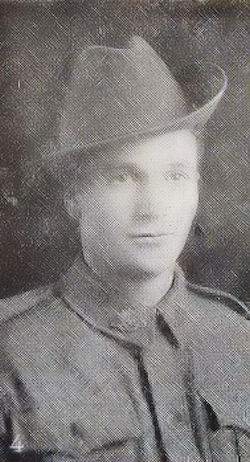
Left: Dan Corkery on enlistment Source: Weekly Courier,
Tasmania 09 November 1916
Towards the end of October, the rapid forward movement of 16 Division appears to have stalled
towards the River Scheldt defences. The War Diaries record an enemy who was generally
very quiet during the day. However, on 30 October, Brigade
recorded: Saint-Maur very heavy shelling from 2000 29th to 0500 30th with
HE and YELLOW CROSS GAS about 3000 shells. At 0445 enemy about 20 under cover of an Artillery
Bombardment and MG fire raided the post at [map reference]
U.18.b.9.0 (see map)
from the rear. Two of our men missing and two men wounded. Considerable
aerial activity. Enemy artillery fairly quiet during the day. Enemy artillery very active during
the night on U.22.23 with HE and gas Blue and Yellow Cross. The 34/London's
D Coy relieved C Coy who returned to TAINTIGNIES.
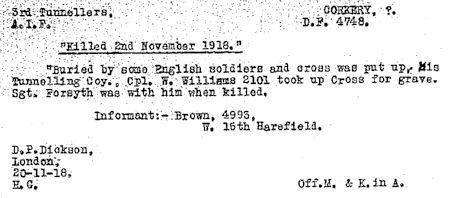
1005 Sgt Les Forsyth and 4748 Sapper Daniel Corkery were teamed together when Corkery was
mortally wounded, sniped in the stomach near Saint-Maur.
1821info9d_corkery, sheet 2
Les stayed with Corkery until persuaded to withdraw under fire, an act that may have
won him his Military Medal. It is assumed they were on IP work dealing with traps and
mines but lacked infantry support.
Left: Daniel Corkery's Red Cross paper, which acknowledges Les' presence.
It is not possible to determine precisely where the two were working. Being that 49/Brigade was
at Taintignies, which is a modern 10 minutes by car or a direct 5km overland to Saint-Maur,
Saint-Maur is a possible location. On 30 October 49/Brigade recorded.
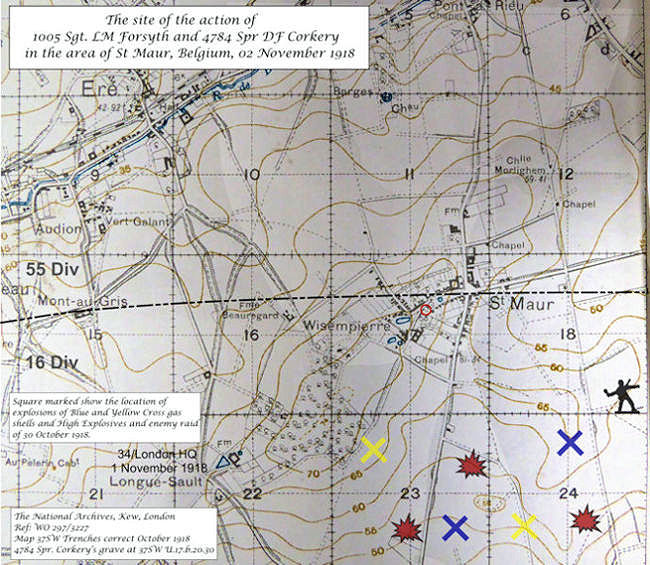
Above: Map showing the location and activities around
Saint-Maur 30 October 1918
1821info9d_corkery, sheet 3
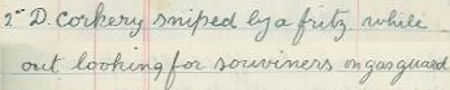
Finlayson [op.cit.] - Chapter 12/Note 34 (referencing note 35 in the book) suggested an
alternative death: “During one such souvenir expedition
on 2 November, Sapper 4748 Daniel CORKERY was spotted by a German sniper and killed
”, quoting George Oxman's diary. This state's Corkery was on 'gas
guard', but there is no mention of Les being there.
'Gas guard' 1 confirms the presence of Yellow Cross
and Blue Cross gas. See map above.
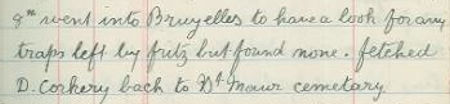
Left: A composite image of George Oxman's diary AWM PR00712
Saint-Maur very heavy shelling from 2000 29th to 0500 30th with HE and
YELLOW CROSS GAS about 3000 shells. At 0445 enemy about 20 under cover of an Artillery
Bombardment and MG fire raided the post at U.18.b.9.0 (see map) from the rear. Two of our men
missing and two men wounded. Considerable aerial activity. Enemy artillery fairly quiet during
the day. Enemy artillery very active during the night on U.22.23 with HE and gas Blue and Yellow
Cross [gas]. Local civilians and refugees had told 49/Brigade that the Germans were mining
church towers and high places, so Saint-Maur was a candidate to be defused, despite its damaged
state.
On 01 November 1918, the night before Corkery's death 34/London
relieved 18/Gloucesters in front line before BRUYELLES. HQ was established at LONGUE SAULT. A
& B Coys. formed the left right front Corps respectively with 'D' Coy in support & 'C'
Coy in reserve. On 02 November, Several enemy patrols seen during
the night.
From the two War Diaries we know that 3ATC were operating in the area, but at Brigade November
34/London were, in relieving 18/Gloucesters, new to the line. This, because 3ATC was operating at
Brigade level, may account for the lack of the infantry support Les and Corkery were expecting. It
appears that this support was needed because, if enemy patrols were active on the night of 02
November and raids were still taking place, they may have been active in the day. Perhaps one of
these patrols found Forsyth and Corkery.
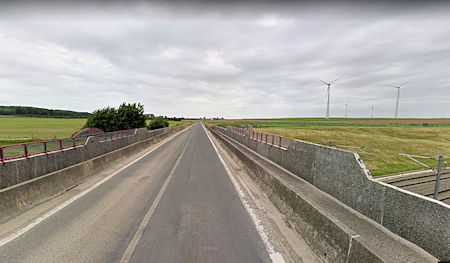
Left: rue du Colonel Dettetmer looking north towards Saint-Maur church
crossing the Jurbise to Ath railway. This bridge may have been the target for German
traps and mines.
Left: George Oxman's diary for 08 December 1918 AWM PR00712
1821info9d_corkery, sheet 4
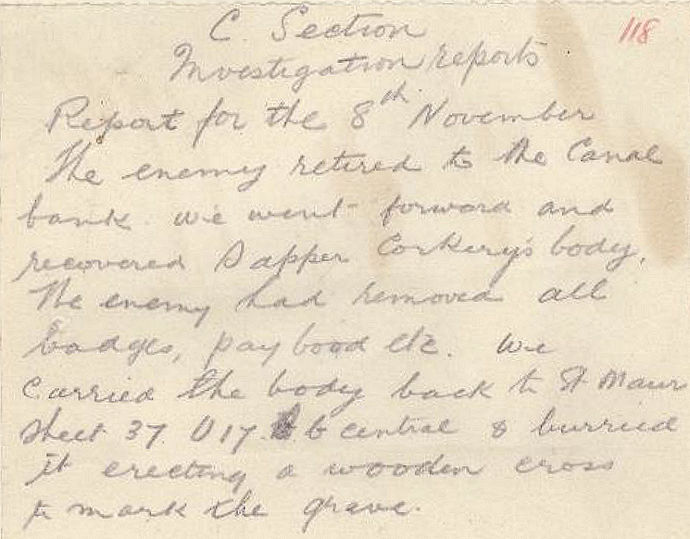
Above: Corkery's reburial at Saint-Maur Source: War Diary November 1918 Part 2, page 68 AWM4 16/4/34
Above: Daniel Corkery's burial location from his Attestation
file
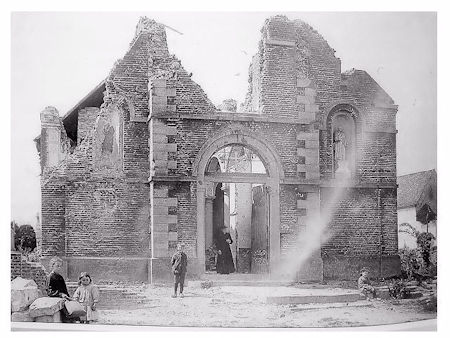
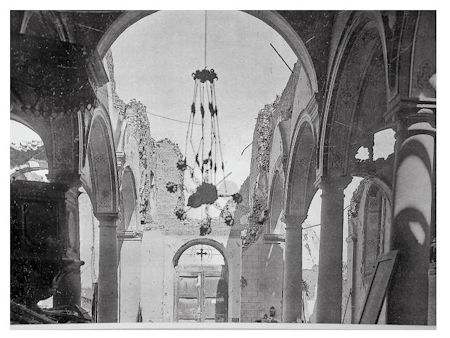
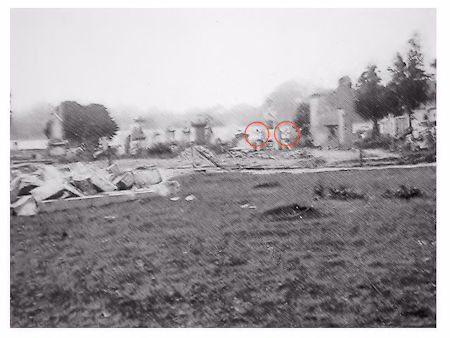
Hoverbox Photo Gallery - Saint-Maur Church post war
This feature does not function correctly on phones and tablets
1. Exterior and priest 1919
2. Interior 1919
3. Levelled in 1920. Two original wooden wartime grave are circled beyond the
remains of the church. It is thought that Dan Cockery's grave is one the right.
Source: With thanks to Alain Tripnaux of Tournai
1
2
3
1821info9d_corkery, sheet 5
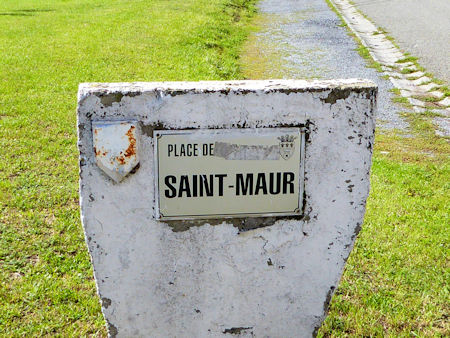
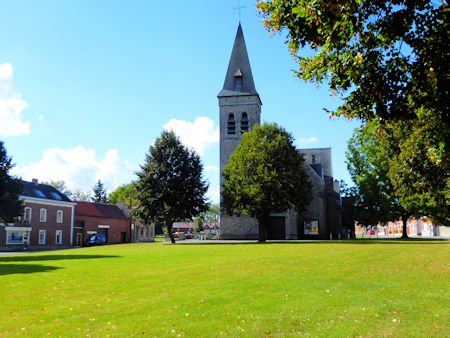
Hoverbox Photo Gallery - Saint-Maur Church - Author: 28 September 2018
This feature does not function correctly on phones and tablets
1. Place de Saint-Maur street marker by the church
2. The church from the Grand Place
3. Commonwealth War Graves entrance Source:
Author
1
2
3
Despite the fact that Infantry support was missing from the 3ATC activities it
was, according to the Australian Red Cross file, English soldiers who buried him as
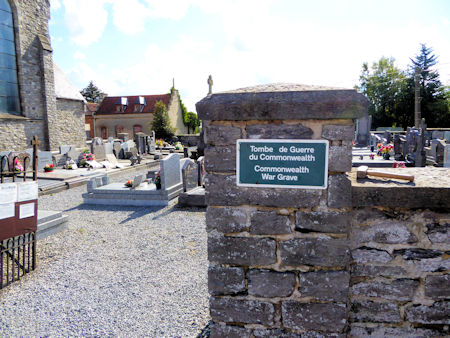
the only Commonwealth War Grave in Saint-Maur churchyard.
His service record locates his grave at Sheet 37.U.17.B.central. Saint-Maur churchyard
falls in this reference.
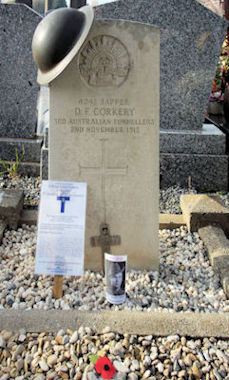
Left: Daniel Corkery's headstone in Saint-Maur graveyard on the one
hundredth anniversary of his death
Photo: kindly supplied by Alain Tripnaux of
Tournai, a Belgium who visits Dan's grave and several others in the area every year
The report of Dan Corkery's death soon reached Tasmania.
Press reports of his youth and his service report confirm the end of war assessment of being
a young energetic and high spirited sapper.
LYELL LOST IN THE BUSH.
On Sunday, at about mid-day, a
party consisting of Jack Venn and two boys named, Corkery left with the intention of
visiting Lake Beatrice. Their non-return by 10 o'clock that same evening caused some
anxiety to the parents.
Later on Messrs Venn, Chapman, and Corkery went out to see what they could do, but were
forced to return, as the night was dark. The boys, however, turned up at their homes at
about 9 o'clock on Monday morning. They had evidently become 'bushed,' and had spent the
night by the side of a warm fire.
Page 3
1821info9d_corkery, sheet 6
FOR VALOR. ROYAL HUMANE
SOCIETY AWARDS. TASMANIAN RECIPIENTS.
HOBART, Wednesday— Royal Humane
Society awards were presented by the Governor to the following recipients to-day: —
Bronze Medal. — John Henry Venn, Linda, Tasmania, miner, aged 17, who risked his life in
attempting to rescue John William Harding, aged 18, and Henry Lodge, aged 17, and in
rescuing Daniel Corkery, aged 19, from drowning in the King River, Gormanston, Tasmania,
on February 27, 1910. Several young men had been bathing, when Harding and Lodge got into
difficulties, and while struggling with one another sank. Venn dived in and separated
them, but as Harding attempted to swim away Lodge caught him by the legs, and the three
sank together. Venn came up alone, but at once dived again, and brought both the other
boys to the surface. Once more he separated them, and Harding disappeared.
Another lad, D. Corkery, had joined in the rescue, and was seized by Lodge, and they both
sank. Venn dived again, and brought them both to the surface, and succeeded in getting
Corkery to the bank, but Lodge sank, and was drowned. As soon as Venn reached the bank he
fell exhausted, but subsequently re-entered the water, and endeavored unsuccessfully to
recover Harding’s body.
Page 3
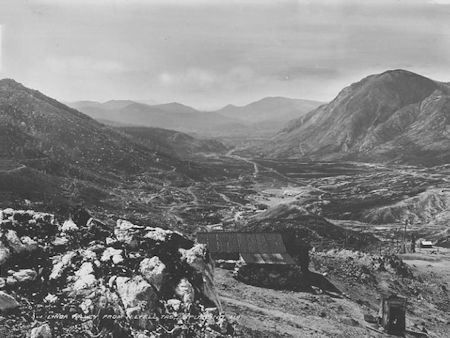
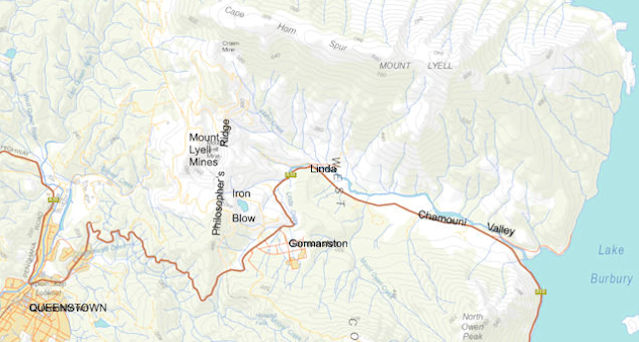
The Corkery's were a long established Linda family. (Linda is 7.5km from Queenstown,
Tasmania, where Les was based.) The Australian Electoral Roll for 1914 records
181 Corkery, Daniel, Linda, miner - his father and from newspaper reports a regular after
hours drinker in the North Lyell Hotel
182 Corkery, William John, Linda, miner - his brother
Hoverbox Photo Gallery - Gormanston and Linda
This feature does not function correctly on phones and tablets
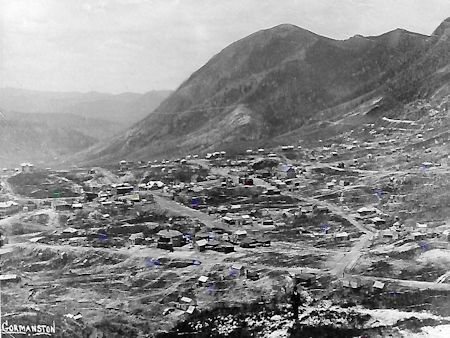
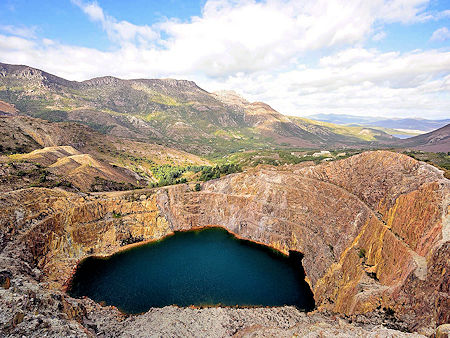
1. Gormanston with Mount Owen
2. Iron Blow open cast pit
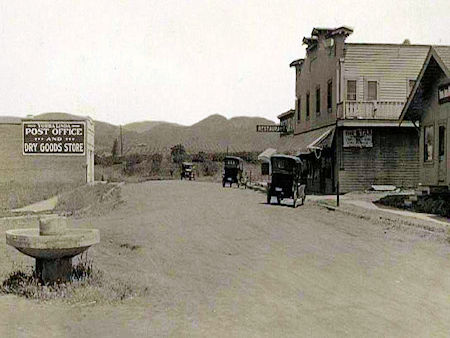
3. Linda Post Office
1
2
3
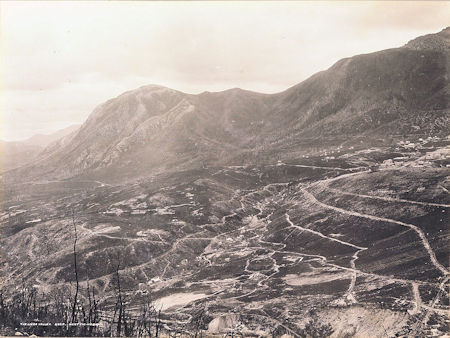
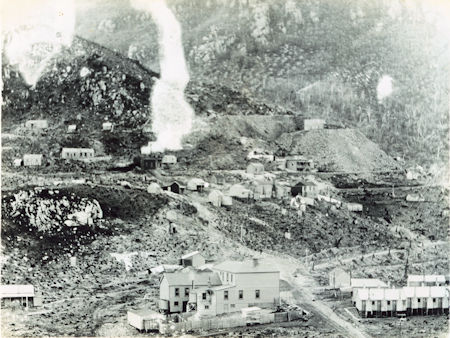
4. Linda valley settlements circa 1905 NS2389/1/38
5. A Linda Valley hotel and 'bachelor shacks' c.1903 NS3245/1/63
6. Linda Valley from Mount Lyell NS241/1/37
Source: Libraries Tasmania (Accessed 01 December 2018)
4
5
6
Though not the North Lyell Hotel, the photograph illustrates a contemporary hotel in the Linda
Valley. Note also the terrace of narrow dwellings, possibly for bachelor miners.
1821info9d_corkery, sheet 7
Above: A map locating Linda in the Queenstown area
Sources:
49 Brigade War Diary (The National Archives (TNA) ref: WO 95/1976/6 Part II pp.59-67)
contained the diary pages and signals. There were no operational orders or reports of
activities.
34/London's War Diaries (TNA WO 95/1979/3 pp 20-22) contain diary pages only.
Blainey, Geoffrey, The Peaks of Lyell, Melbourne University Press, Second
Edition, 1959
Odourless but yellow in colour,
Yellow cross gas was the blistering agent known as mustard gas, first used in 1917. It was intended to harass
and incapacitate. There was no initial choking, so the first sign the victims saw was
blurred vision and blistering of exposed skin, with external and internal bleeding. When
mixed with high explosives it was difficult to detect that there was a gas attack. The area became contaminated along with
the equipment in the area. Victims were evacuated so over whelming the medical services.
Blue cross ammunition, first used in 1915, contained diphenylcyanoarsine, , a non-persistent non-lethal arsenic based
a lachrymatory gas. It caused vomiting agent causing temporary blindness, inflamed noses and
throats and caused great pain. It was later found to be carcinogenic.
Green cross ammunition contained phosgene or diphosgene, a non-persistent, lethal choking
agent.
Non-persistent agents were used to induced temporary panic amongst front-line defenders
but timed to have dispersed when the attacking German infantry reached the defender’s
line. They had the advantage of incapacitating defenders without massive destruction of
the ground.
This page was created by Richard Crompton
and maintained by Chris Glass