 |
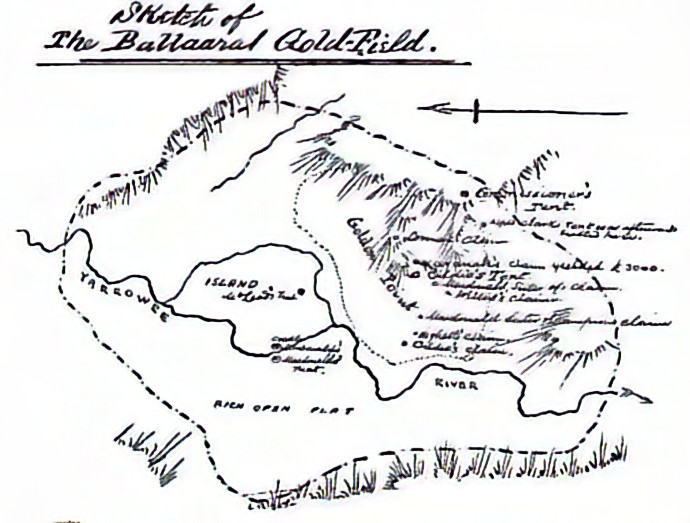
| Above: An 1851 map of the Ballarat goldfields Source: eurekapedia |
1821 Info 1h: Caleb Crompton |
There was no gold at Miners Rest but it was where the Miners stopped off, on their way to the north-eastern goldfields. Though times were tough, there were undoubted opportunities, in both Ballarat and its surrounding areas, for settlers to the newly open lands. Caleb saw his ‘fortune’ as a ‘publican’, in partnership with Alexander Sangster.
In the beginning
In late August 1851, possibly 24th or 25th, near Yuille's Black Hill outstation, James Regan was returning from the Clues gold workings to Buninyong when he explored the higher land, flanking Buninyong Creek, above his tent. He dug and washed a spade of surface soil, in the nearby creek and before long he was staring at several sizeable pieces of gold. He and his partner John Dunlop returned the next day and in the first few spadefuls they discovered as much gold as five hours hard labour at Buninyong. They had stumbled on the surface deposits of Ballarat's Golden Point (Sovereign Hill Historical Park): one of the richest alluvial goldfields in world history.
|
| Above: An 1851 map of the Ballarat goldfields Source: eurekapedia |
By early September the Connor and Merrick's parties were camped at Golden Point with tents, horses and cradles that couldn't be missed. What had been seen as barren land with grass and water for sheep, now had gold in the quartz boulders so close to the surface that it was tangled in the roots of the vegetation. In earlier days, when water had flowed across the flat and fertile farm land, it robbed the gold reef of its treasure and as the river torrents changed course the gold was deposited in the quartz gravel. One such point was the Golden Point meander where the half mile by 200 yard quartz reef terminated above Golden Point and did not appear again until the Black Hills. Through the gap the river ran over flat fertile land that buried a river bed that had once carried a torrent of water that had robbed the reefs of their gold leaving it deposited on on terraces. One such hidden treasure was the Golden Point terrace; half a mile long and 200 yards wide.
The 'plunder' began slowly around Regan and Dunlop's eastern site, later called Poverty Point (off Clayton Street, Ballarat), with others at the western end. Many groups were inept, just scratching the surface. On Sunday 31 August a nugget weighing almost ¾ ounce (oz) (21.26 grams) attracted most of the miners from Buninyong and new prospectors from Geelong went straight to the new field. By 3 September 1851 there were 26 tents and about 100 diggers. Late on Saturday afternoon 23oz (652g) of gold were dug before dark with one piece weighing over 4.65 grams (0.164oz). Small though they were by later standards they were exciting finds. A good average of ¼ and ½oz (7-14 grams) per man per day began Victoria's first gold rush. The digger's life took over and swallowed the erstwhile loafers, labourers, shopkeepers, mechanics and the feared ex-convicts.
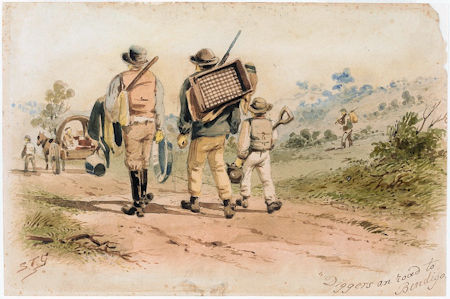 |
The road from Geelong brought bullock and horse drays, donkey, dog and goat
carts, wheel barrows and swag-carrying would be miners.
Left: Diggers on the road to Bendigo Source: William Howett State Library of Victoria |
A gold digger must be a Jack-o-all trades; he must be able to strip bark, fall a tree, and saw it, dig sods, make embankments, put up a hut, mend your clothes, draw firewood after chopping it, bake, boil and roast, use a pick and spade, delve, dig, and quarry, load, and unload, draw a sledge, and drive a barrow, cut paths, make roadways, puddle in mud, and splash ankle deep in water, with occasional slushings from head to foot, bear sleet and rain without flinching during the day, and sleep in damp blankets during the night, thankful that they are not entirely saturated - if ye can do all this, and have spirit enough to attempt it, and endurance enough to carry it on for three months, why there is gold and rheumatism in store for you. 1
 |
The Melbourne Dailey News described the labour needed to wheel barrow the
earth of the old river bend back to water. Newcomers faced a long carry to water. One
such was Brownbill who went upstream and found Brownbill's, later corrupted to
Brown Hill. This was the beginning of the Little Bendigo field. By 20 September 1851
there were 150 men at Brownbill's, compared with 300 to 400 at Golden Point and
250 up the Buninyong Gully.
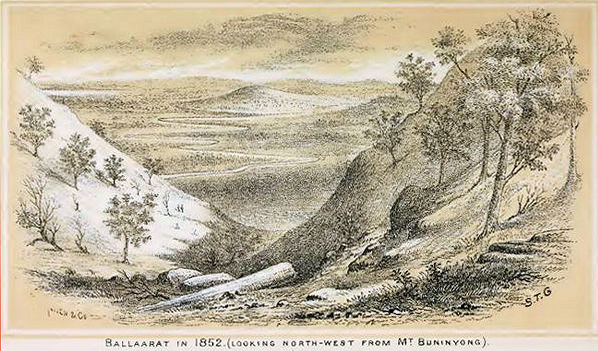
Left: Ballarat in 1852 looking from Mount Buninyong |
The drawing looks out across Ballarat Flat, on which there are a number of tents and huts, to the line of the creek and beyond to Mount Warrenheip. Diggers are thick on the ground, especially along the creek, where Tullock shows 'thousands' absorbed in washing. Tubs and cradles are in almost equal supply. Moving down to the water are wheelbarrows and miners with sacks slung on their backs. One woman stands by the doorway to a hut. There are two Aboriginal's.
For three weeks frontier democracy prevailed with decisions made at a convenient stump. Ground close to the creek was the most prized. At a public meeting the ' early birds' soon allocated all of allotments 50 feet (15.24m) deep with a frontage of 10 feet (3m).
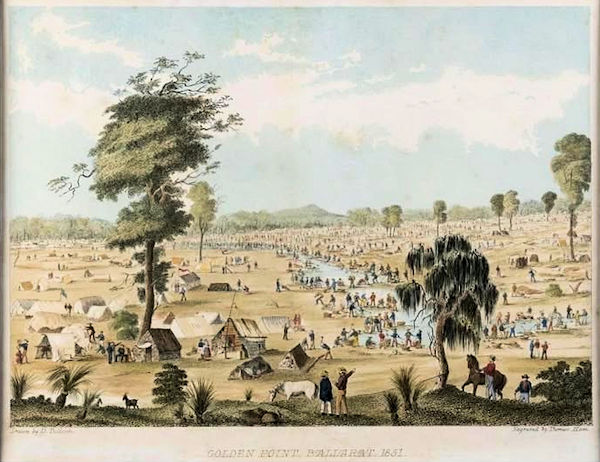 |
| Above: Golden Point prospecting 1851 by David Tulloch later engraved by Thomas Ham Source: Leski Auctions |
| Attracted by stories of huge nuggets every able bodied man was soon on the move.
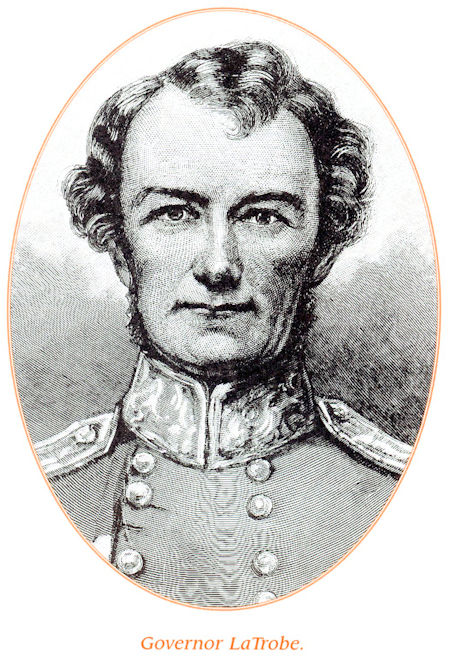
The Lieutenant Governor of the Colony, Charles La Trobe watched society disintegrate.
As a single claim could produce a fortune, men slept with loaded pistols. Locally an
ounce of gold was valued at £3 (a relative value of £443/A$455 at 2024 prices) and in
London £4 (a relative value of £590.70/A$606.80 at 2024 prices). In two days the
Cavanaghs were worth £3800 (a relative value of £561,200/A$576,400 at 2024 prices).
As it was feared that diggers would clash with squatters, La Trobe called a team of irregular mounted rifles to Ballarat. They arrived with pistols and carbines and when in town were close to La Trobe. Their powers were wide: they issued licences, settle boundary disputes, dealt with Aboriginal outbreaks and licensed and set prices for s bush pubs - Caleb's Newmarket hotel. The arrival of Commissioner Doveton, together with Captain Dana and half a dozen native police, led to confrontation. The law lay with the Commissioner as the diggers were trespassing on crown lands. It was proposed to collect a tax of 30 shillings (a relative value of £221.50/ A$227.60 at 2024 prices) per man per month, paid in advance. This was a ludicrous figure in terms of the gold recovered at this date. The tax was more to discourage diggers. Right: Lieutenant Governor Charles La Trobe Source: Coupe p.16 |
 |
The Cavanagh brother, the Colonies most experienced miners, arrived 10 September 1851 and crossed the 15 foot (4.6m) right of way and sank amongst the trees near Oddies tent and in two days had extracted 60lbs (27.22kg) at a depth of six feet (1.8m) in the shallow blue gold bearing clay. From their Californian experience and because the all the frontage claims had been taken, they were higher up the hill where the blue clay was closer to the surface. This was the breakthrough.
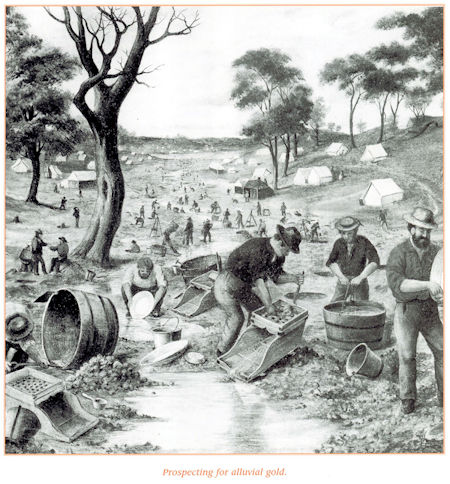 |
By 13 September 1851, 50 washing cradles were at work, each operated by two men; a
shoveller and a washer. Already the rhythm of intense manual labour was apparent. Out
of round or oval holes of from five to ten feet deep the washdirt was thrown. It was
then carted in sacks slung over the shoulder, or trundled with difficulty in barrows
across rough ground to the increasingly broken-down banks of the creek. It was dumped
there, until it could be washed by stages in puddling-tub, cradle and dish. There were
about a hundred cradles at this time, but the era of the tub was just beginning in
the wake of Cavanagh’s discovery of gold in the glutinous clay. Already the rhythm of
intense manual labour was apparent. Out of round or oval holes of from five to ten
feet deep the washdirt was thrown. It was then carted in sacks slung over the
shoulder, or trundled with difficulty in barrows across rough ground to the
increasingly broken-down banks of the creek. It was dumped there, until it could be
washed by stages in puddling-tub, cradle and dish.
Left: Prospecting for alluvial gold at Golden Point. Note the cradles, pans and tubs. Source: Coupe p.27 |
There were about a hundred cradles at this time, but the era of the tub was just beginning in the wake of Cavanagh’s discovery of gold in the glutinous clay.
On Saturday morning, 21 September 1851, the commissioner announced that he untended to issue licences and to restrict claims to eight square feet (0.75squ m.). The miners gathered, at the 'stump' in protest and agreed strongly against paying. Despite this diggers were seen to enter the tent and emerge with the first licences and probably the right to a double claim at a cost of 15 shillings (a relative value of £110.80/A$113.78 at 2024 prices) for half the month. Such was the commissioners strength with men who feared to lose their claim, or were eager to get them, that by 2pm he had run out of all 88 printed licences. Troopers who could write issued 1300 handwritten licences
The Melbourne Argus spoke with alarm of the threat to free people, who failed to get an official licence. The spirit of the middle class, in rough working clothes, was mobilized against the authorities who were fearful of anarchy and rebellion if men were allowed to do as they pleased. There were no proposals for the diggers to take part in their government. This was seen to be the first confrontation that led to the Eureka Stockade, three years later.
The population of a sizeable town moved into the country side in October 1851. However, the richness of the ground and pastoral interests of the governor could not be brought together to foster the diggers civil rights. Perhaps, through the NSW experiences of large claims, where newcomers had to move on and to accommodate the increasing numbers Commissioner Doveton, in his ignorance and paternalism, decided that individual claims should be a fairer eight feet by eight feet (2.5mx2.5m). There was a rush to peg claims to the new dimensions, which hindered the efficiency of mining for years to come.
Gradually the government camp took shape on the quartz hill, later known as Post Office Hill over looking the diggings. A large Union flag flew over neat rows of military tents in a cleared area.
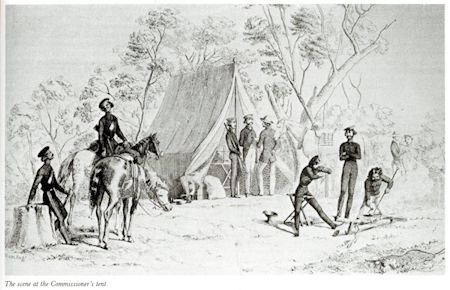 |
The Commissioner's tent was the focal point. (Later researched identified this as
being area near the intersection of Barkly, Grant and Young Streets, Golden Point).
Regular questions were direct towards this tent. The police office was a separate tent
but with similar questions. Captain Dana aware of the 'turbulent ruffians' requested
at least twenty fully armed troops to supplement to predominant Aboriginal law
officers. However, the Aborigines were out of place policing white men whose language
they barely understood. And partly because of their weakness the diggers took their
own measures.
Left: Scene at the Ballarat Commissioner's tent Source: William Strutt 1854: National Library of Australia (NLA) |
'Men of the worst character were arriving from Van Diemen's Land to join the refuse of Victoria society in preying on an enterprise which demanded sever labour than they were prepared for.' 2
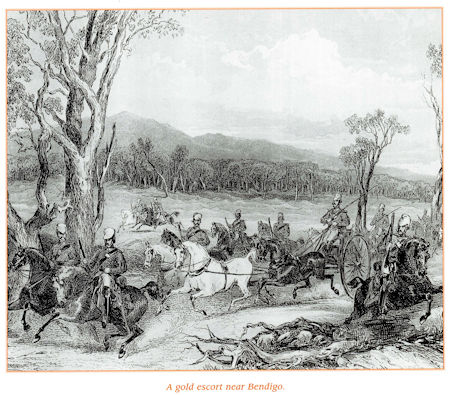 |
Security of the gold was a constant headache. Because Dana had only an open tent
to store the treasure, he felt the need to send two escorted gold trains to Melbourne:
the second amounted to 912oz (25.855grams). A cart arrived at Buninyong from
Melbourne each Saturday night, went to Ballarat on Monday afternoon to pick up gold,
stayed overnight at Buninyong before departing to Melbourne at 6am. A charge of 1%
was levied. Despite this Bates believed the majority stayed on the field or was
transported privately. Bates estimated that, for the week ending 6 October 1851,
18,000oz (510.291kg) would have been excavated against the 1200oz (34kg) escorted. By
22 October 1821, it was estimated that 25,000oz/708.74kg of gold worth £80,000 (a
relative value of £11,810,000/ A$12,136,000 at 2024 prices) was being concealed.
Left: A gold escort near Bendigo Source: Coupe p.45 |
When the population of Victoria State was 77,000, Bates records the increasing goldfield population as:
| Golden Point | 21 September 1851 | 800 |
| 6 October 1851 | 2500-3000 | |
| 13 October 1851 | 4500-5000 | |
| 20 October 1851 | 5000-6000 | |
| Brownhill's | 20 October 1851 | 1500 |
In the Melbourne Daily News of 25 October 1851 Golden Point was described as a citadel thrown to the ground. Thousands of men were running around like rabbits between burrows. Every thing appeared a 'deep yellow earth - yellow clothes - yellow hands - yellow faces - yellow every-thing'. And no wonder 'Not a spadeful of this earth but possessed some amount of gold.' 3
Before then end of October, gold was found in the gravel of Black Hills Flat, which began the famous high yield Gravel Pits lead. One day five miners took 236oz (6.69kg) and 120oz (3.4kg) the next, from a single hole, about £180 a man (a relative value of £26,580/A$27,300 at 2024 prices) Howe and Herring took 37lbs (pounds) (16.78kg) from their hole. The largest nugget weighing 7oz (198g). La Trobe, saw 8lbs (3.629kg) washed from two dishes of earth. One party washed 16lbs (7.257kg) before breakfast and 31lbs (14.061kg) in the day. By 13 October the nugget bearing blue clay was almost worked out and beginning the decline of Golden Point. In early November 1851, the rich surface deposits of Mount Alexander/Castlemaine, 67km north-east of Ballarat, denuded Ballarat's population.
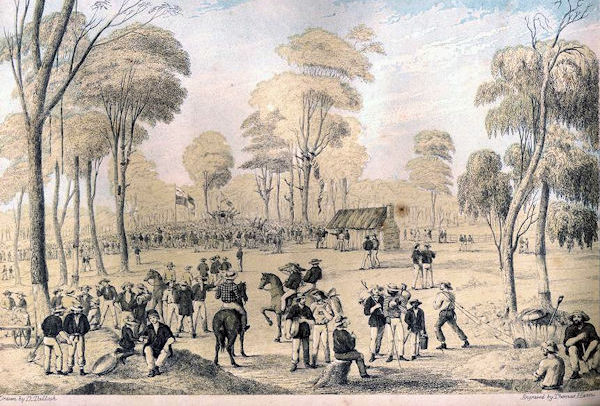 |
| Above: Great Meeting of Gold Diggers at Castlemaine 15
December 1851 drawn by David Tulloch Source: Victoria Collections |
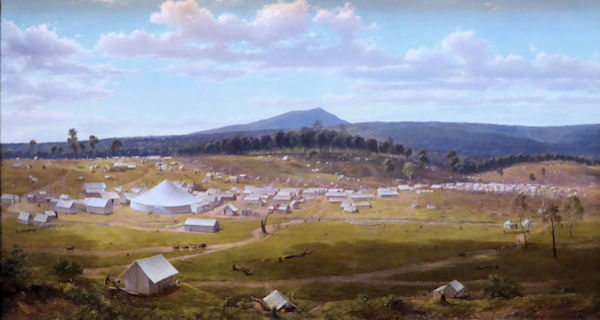 |
| Above: Old Ballarat in 1853 by Eugene von Guerard Source: Art Gallery of Ballarat Collection |
Into this cradle of attitude and experience came all manner of men, including many who later spent their lives in Ballarat. Their urban origins should be stressed, for that helps to explain the advent of doctors, storekeepers, blacksmiths, butchers, bakers and other tradesmen. ... Families were left behind, thus subjecting the urbanites to a male-dominated frontier experience. 4
In 1852 Caleb and his family arrived.
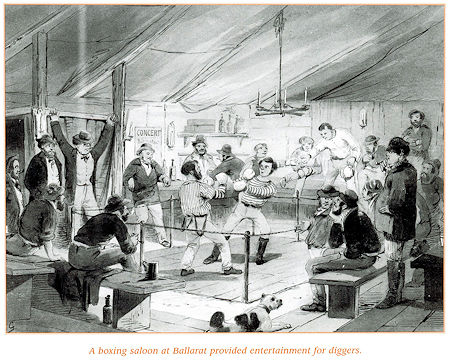 |
Sunday's were a day of worship and relaxation.
finding it's pleasure in
devoting the day to gin, and there after settling its disputes in the matter
of the prize ring. On the Sunday the 'churches' had barely dispersed when a
prize fighting celebrity from Gelong - Ned Bolton - and some of his mates had
a set to. [...] An indication of the large numbers involved in Sunday sport
is given in a prize-fight which drew three thousand spectators on 26 October.
5
Left: A boxing saloon providing entertainment Source: Coupe p.63 |
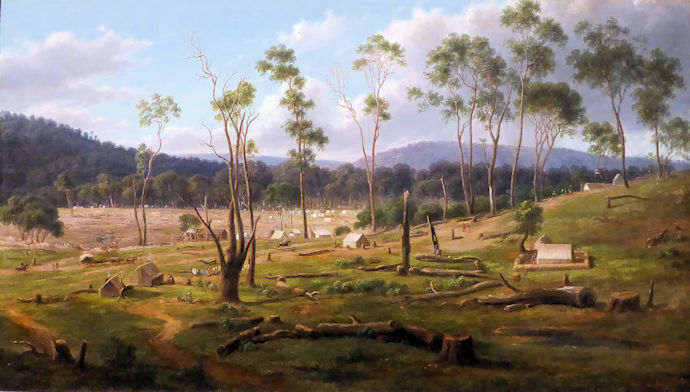 |
| Above: Golden Point in 1853 by Eugene von Guerard Source: Art Gallery of Ballarat Collection |
In that Caleb 'invested' in the Newmarket Hotel, it is possible that the large tent was that first 'hotel'.
Ballarat at the time of the riots
The Ballarat Riots led to the Eureka Stockade Rebellion of 3 December 1854. The obituary of Maralena MacDonald, Caleb's eldest child, says the family arrived in 1852 when Ballarat was only a village, and was in business here at the time of the riots.
 |
La Trobe's successor as lieutenant-governor, was Sir Charles Hotham (1806-1855
pronounce Huthum) took up his commission in Victoria on 22 June 1854.
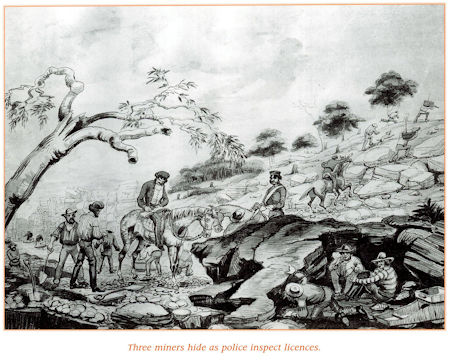
The Hotham faced protests against his draconian liquor laws and the prohibitive miners licence fees of 30 shillings a month (a relative value of £221.50/A$227.60 at 2024 prices). He instructed Police Commissioner Robert Rede to introduce strict weekly licence hunts, which he hoped would stop the flow to the gold fields. He was warned that unless there were reforms a slumbering unrest would be aroused which would not be quelled by law. By not taking this advice, Hotham widened the gap between the self-reliant miners, the Goldfield Commission and his autocratic stance to raise money to reduce the Colonies enormous financial crisis, draining the British exchequer. Rede explained that his under strength force had difficulty collecting fees from a population containing many who were not miners. With the passing of the Goldfields Act at the end of 1853, licences could be taken out on any day of the month for periods of one, three, six or twelve months, making the collection of fees more complex. I Left: Sir Charles Hotham Source: Coupe p.51 |
| Even before the troubled days of September 1854, Rede had requested
reinforcements of numbers and quality. The unarmed police not only assaulted
civilians and fought amongst themselves but they hard pressed the diggers and
storekeepers. In September 1854, Hotham, lacking an understanding of the situation,
stepped-up the collection for licence fees by ordering a twice-weekly fee sweep,
inspecting and annoying those who generally held a three-month licence. At a time of
economic depression, this made the licence fee more objectionable as it hindered
production and, it was believed, the taxes were used to maintain the forces against
the miners.
Right: Three miners hide as police inspect licences Source: Coupe p.52 |
 |
A spark to the riots was the burning of the elaborate Bentley's Eureka Hotel valued at (£2.954million/A$3.034million converted to RPI 2024 figures) and the murder of James Scobie on 7 October 1854, who it was believed was killed by James Bentley. Ten days later, a large crowd of miners gathered to protest against the acquittal of James Bentley.
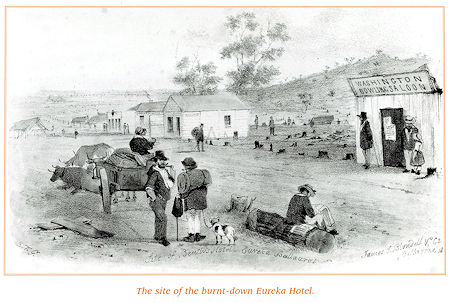 |
On 15 September 1854, the crowd was threatening but not very active. Whilst there
was tension, there was no cause for alarm at this stage and the Riot Act was not
read. The crowd moved behind the mounted police towards the hotel where it began to
fling stones. However, reading the Riot Act may have prevented further acts. Then
there was a rush of spades, stick and stones, which destroyed the windows and the
police horses rushed into the mass of miners. Even though Rede tried to stop the
rioters, the hotel was burnt, encouraged by a gale. The military, in Melbourne, was
sent for.
Left: Site of Bentley's Hotel - Eureka Ballaarat (sic) ST Gill Source: Coupe p.51 |
The day began with a specific grievance but brought forward a wider issue, which the excuse of burning of the hotel could not justify. Rede then had two options: do nothing or arrest everyone. The miners had already shown they would resist when a large crowd gathered to threaten for the release of the three men committed for trial in Geelong. Rede waited for troop reinforcements before making his next move. He allowed those who took part in mass gatherings to create some turbulence, which discredited the whole opposition to Hotham's law. On Sunday 22 October 1854, after mass in the Catholic Church, it was decided that a deputation of miners would meet with the Commissioner. However, at about two o'clock there was a general move towards Bakery Hill, where a platform had been built in full view of the Government Camp.
The Bentley affair stimulated a great deal of tension so that on the 22 October the Camp was threatened and barricaded by the miners, stimulated by the Irish diggers, so that at night the soldiers stood to their post. At this stage, the people were united and the authorities confused. Whilst Police Commissioner MacMahon ordered the arrest of those of the mob on whom charges would stick, he had full knowledge they could be 'rescued'. MacMahon called on Hotham to end the licensing laws and agreed with the people that the police were tyrants who were imposing military law. This latter act swayed the moderates in favour of the protestors; the deep-seated unrest and Australian independence.
On 25 October, the protests, encouraged by the Irish, were at their height: miners demanded their rights to form The Ballarat Reform League: their own regulations with proposals for juries of miners resolving claims disputes. Henry Seekamp, editor of the Ballarat Times, wrote of injustice, corruption, bribery, personal animosity, private interest and brutality and suggested, unless their demands were met, the forming of local armed mercenaries of miners to enforce the demands. The moderates were bringing together the strands of opposition, though a crowd of moderates could easily be roused.
On 1 November 1854, The Ballarat Reform League of miners was formed to challenge the licence hunting, Carey's grog convictions, the case of Smyth's servant and Bentley's trial. They added flagrant cruelty, injustice, bribery and perjury found in the Camp, which imposed God's people.
The Eureka Stockade
Rather than hear the Ballarat Reform League's grievance, Rede took the Irish agitation seriously and requested reinforcements from Melbourne. Eighty infantry from Melbourne's 40th (2nd Somerset) Regiment and 200 cavalry from Geelong, a total force of nine officers and 297 other ranks, were to arrive by Wednesday 29 November 1854. There was great confusion when they were attacked along the road from Eureka: either by ambush or they went off track into the claims. With one drummer-boy killed the miners lost the sympathy of the military. However, there is debate whether this was a deliberate attack to bring the conflict into the open.
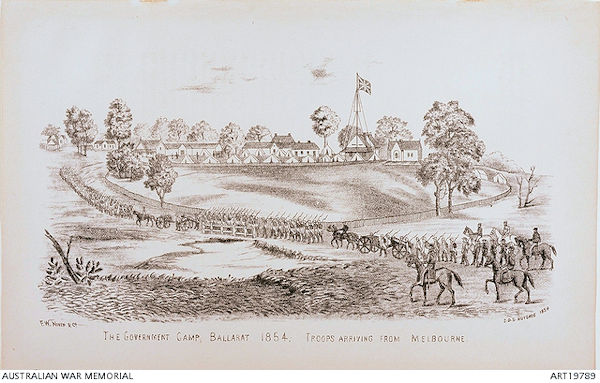 |
| Above: Melbourne troops arriving at the Government Camp, Ballarat 1854 Source: AWM ART 19789 Samuel Douglas Smith 1854 |
Held under the newly sewn Southern Cross flag, which signified resistance to British oppression, the Reformers, calling a meeting on 29 November 1854 to test the strength of the feeling between constitutionalism and force. Though a relative quiet meeting, the time for appeasement seemed to have passed. Between twenty and 100 licences were burnt and resistance to the arrest of unlicensed miners grew. Agitation had already been raised to a new level when, on 30 November, the much disliked Inspector/Assistant Commissioner Johnstone lead a raid against the Gravel Pits. The party and their reinforcements were pelted with stones.
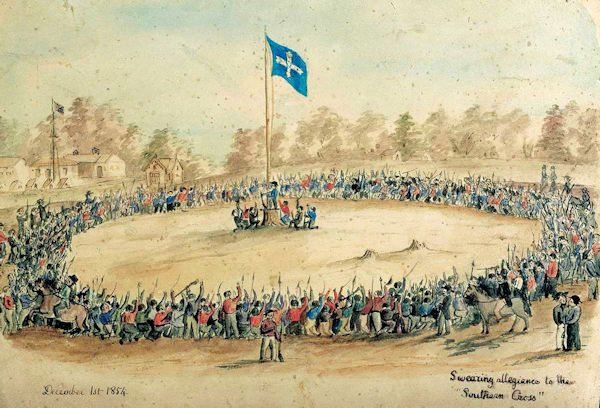 |
| Above: Swearing allegiance to the Southern Cross Source: Charles A Doudiet 1 December 1854 Art Gallery of Ballarat Collection |
Rede read the Riot Act and called out the troops, who advanced in skirmish order, flanked by cavalry, to maintain the law and collect eight prisoners. Opposition was not serious and casualties were light. However, the crisis developed when Rede, rather winning over the loyal element of the crowd, organised an aggressive licence hunt. It was clear Rede had misjudged public opinion. In Rede's eyes, as he stood for British law, the whole population was against the Crown.
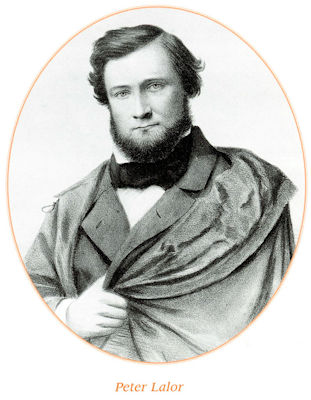 |
When the mass crowds met on Bakery Hill, under arms, Rede called for martial law,
reinforcements and artillery to stamp out disobedience. This divided the alliance of
the moral-force and the exponents of direct force. When the League's leaders
failed to appear, the Irish digger Peter Lalor called for the armed men to form
companies and to swear, under the Southern Cross, to defend their rights and liberty.
A thousand men marched under the Southern Cross to Eureka with the feeling of being
trapped and misunderstood. With the rise of emotion, rather than a tactical plan,
the Reform League disintegrated.
Left: Peter Lalor Source: Coupe p.51 |
The rebels met at 4am Friday 1 December on Bakery Hill, were confronted by troops who were impotent because they had large crowd at their back. When The Riot Act was read the moderates withdrew and Rede saw his chance to crush the 500 largely Irish agitators and to restore peace and prosperity to the goldfields.
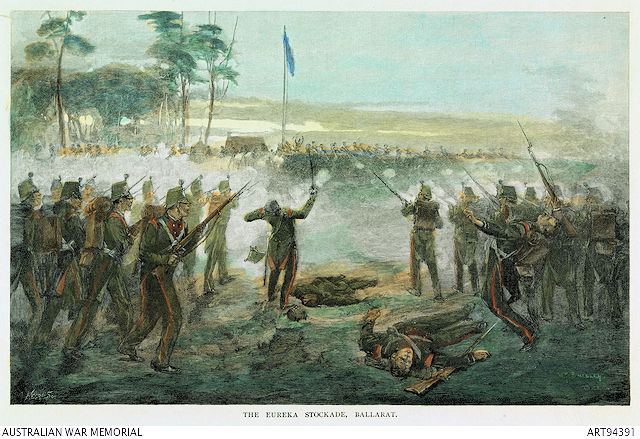 |
| Above: Eureka Stockade barricade and opening action by WT Smedley 1886 |
Instead, on Saturday determined agitators began to construct their badly sited palisade, around a weapons producing smithy. It had become the last ditch symbol of protest rather than rebellion. At 2.30am on Sunday 3 December, 176 infantry and 100 cavalry assembled before moving off to cross the creek towards Black Hill.
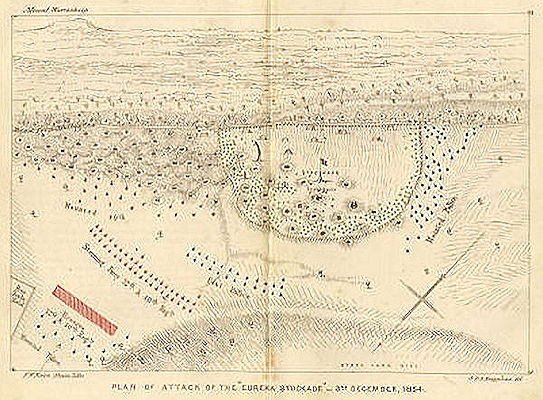 |
| Above: Huyghue's Plan of attack of the Eureka Stockade
map Source: Ballarat Heritage Service/eurekapedia |
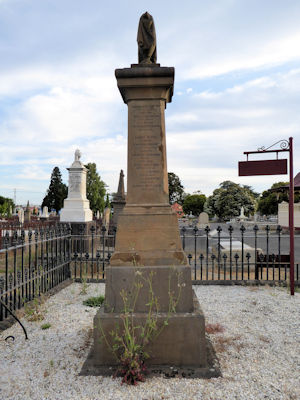 |
The engagement was brief. Five attackers died and twelve fell seriously wounded.
Thirty diggers died of whom about half were bayoneted after the fortifications had
been over run. A shock wave of opinion in the Victoria press shattered government
complacency. Ballarat was angry but not cowed. On Monday, under armed garrison escort,
the coffins moved along the Creswick Road to the Old Ballarat Cemetery.
Left: The Eureka Soldier's Memorial Author: November 2015 |
Notes:
Albert James CROMPTON (1876-1929), the author's great uncle, was chauffeur to John Hotham (1836-1907) the 5th Baron Hotham of Dalton Hall, South Dalton, East Yorkshire. Sir Charles Hotham (1806-1855), then Lieutenant Governor of Victoria, was born in Dennington Suffolk. Whilst there is no direct link between the two families, it is suggested they must be related based on the fifth Baron dying childless. He was succeeded by his first cousin once removed Frederick William Hotham (1863-1923)
Source:
|
 |
|||||||
| This page was created by Richard Crompton and maintained by Chris Glass |
 |
Version A1 Updated 22 September 2025 |
||||||


