 |
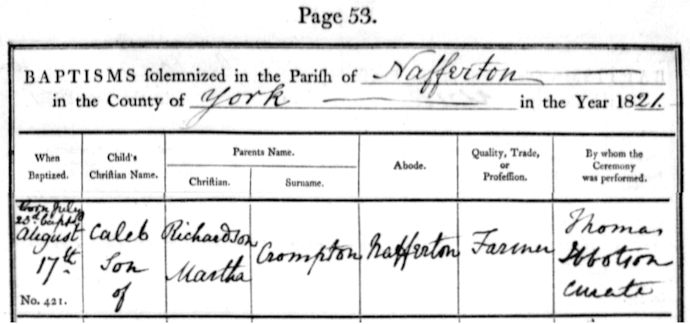
| Above: A composite image of Caleb Crompton's baptism record for 17 August 1821 which also records his birth on 23 July 1821. His father is recorded by his second forename |
1821 Info 1b: Caleb Crompton |
Caleb's birth
Source: Nafferton church records
Caleb Crompton
b.23jul1821
c.17aug1821 Nafferton
by Martha and Richardson Crompton farmer, Nafferton
Curate Thomas Ibbotson

Source: IGI film 919202
Caleb CROMPTON (M)            C: 17 Aug 1821                 Ba: C106381
Father: Richardson CROMPTON   Nafferton, Yorkshire, England  So: 919202
Mother: Martha
|
| Above: A composite image of Caleb Crompton's baptism record for 17 August 1821 which also records his birth on 23 July 1821. His father is recorded by his second forename |
Caleb in 1841
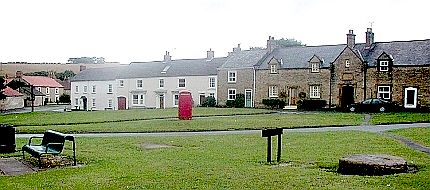
The 1841 census of 06 June shows that of Thomas Richardson and Martha's children James 1807, William 1808, Elizabeth 1811, Jane 1819 CROMPTON/PEARS and Caleb 1821 lived in North Newbald. Caleb was recorded as a 'farmer' living with his sister Jane Pears.
| The enumerator marked this "house" before Eastgate, suggesting Caleb lived
in the left hand white house around The Green, with his sister Jane.
However, it is known that Caleb was in Australia at the time of the census and this may account for Caleb being included as the very last family member, below a farm servant. But Jane's reason remains a mystery. Right: The Green in North Newbald. |
 |
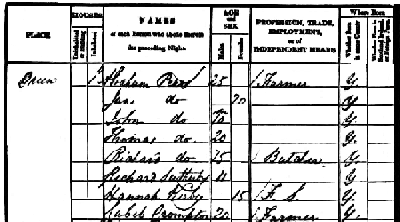 |
1841 Census Son/Mon 6/7 June 1841
    Source: FHL Film PRO Ref HO107
    Piece 1219 Folio 8 Page 7
    Dwelling: Green
    Place:    North Newbald, Yorks
Name              Age  Occupation
Abraham Pears     25   Farmer
Jane Pears        20
John Pears        10m
Richard Pears     15   Butcher
Richard Sutherby  11
Hannah Kirby      15   F S
Caleb Crompton 20 Farmer |
|---|---|
| Above: A composite image of the 1841 census showing Caleb living in North Newbald | |
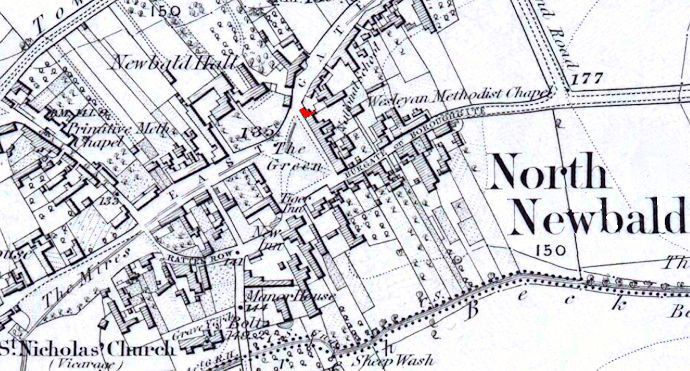 |
| Above: North Newbald in 1855 showing Caleb's believed home in red |
Caleb arrives in Launceston, Van Diemen's Land
The initial Van Diemen's Land land-grants, to the European settlers, by the Government of George IV, favoured the influential and wealthy, who used convict labour to their own advantage. They constructed houses of locally made bricks and sandstone, and established farms on their three hundred and fifty acre grant, comprising much of the best land in the far north west of Tasmania. This land, however, proved unsuitable for sheep as planned, and the Van Diemen‘s Land Company failed. Source: Celebrating 100 years of the Federation of Australia
An impression of the land first settled by the British is given in by the author Richard Flannigan.
'When the English first arrived [in Van Diemen's Land] ... the land was fat and full of trees and game. ... When the English first saw plains so thickly speckled with emu and wallaby dung that it looked as though the heavens must have hailed sleek black turds upon this land ... Through the last of the farmland, the boggy marshy, marginal paddocks of the soldier settler whose hopes sagged even more than their post-and-rail fence. The meadows gave way to button-grass plains and scrub, then, ... the world of pencil pine ... forests, wide and open, interspersed with lawns of undamaged moss, the occasional deciduous beech copse.' Source: Flannigan R, 1994, Death of a River Guide, Grove Press, New York
Caleb sailed to Van Diemen's Land on the 372 tons barque "Branken Moor" 1 (used throughout unless in a quote), which was also recorded as "Brankenmoor". In general the " Branken Moor" took about four months to sail from London Gravesend to Port Adelaide with upwards of 150 emigrants. On this basis Caleb sailed from London in mid November 1842 to arrive in Launceston on 04 April 1843. Source: The Ships List Various voyages (Accessed 10 August 2015) This would enable Caleb to be on the 1841 UK census.
As the Branken Moor approached Launceston along the River Tamar she would have carefully negotiated the many mud shoals that lined the 70km estuary. This map shows the present day Dilston meander, some 8.15 miles (13.1km) from Cimitiere Street, Launceston.
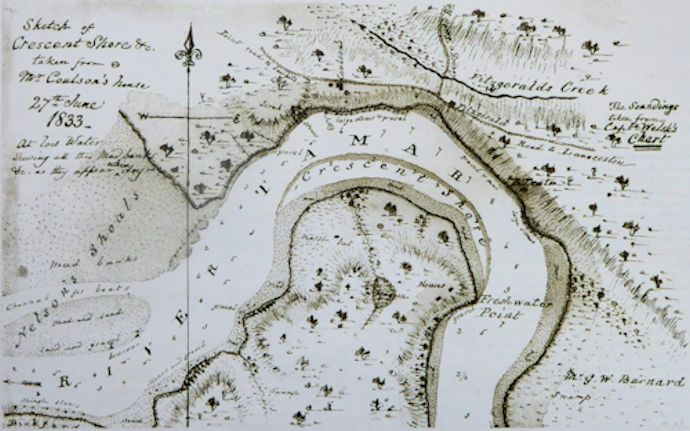 |
| Above: Thomas Scott's map of 27 June 1833 of the River
Tamar, Launceston
Source: Richardson Peter (Ed), 'On the tide stories of the Tamar', Launceston Library, 2001 |
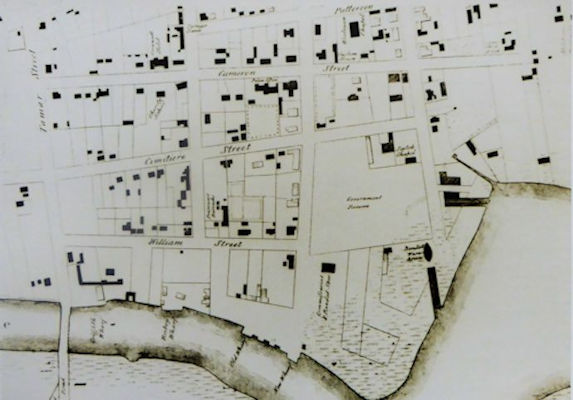 |
| Above: Smythe's 1835 plan of Launceston quay side
Source: Richardson Peter (Ed), 'On the tide stories of the Tamar', Launceston Library, 2001 |
Smythe's 1835 plan of Launceston showing Cimitiere Street to the north and the wharves where the Branken Moor would have tied up and where Caleb would have first stepped ashore. Launceston was already the thriving second city of Van Diemen's Land
'The Free Arrivals Index' shows:
Immigrants arrived on Board the Ship: Brankenmoor from |
It is interesting to note that Caleb's given occupation is different from that of
'farmer' in the 1841 UK census. Farmer implies land owner or tenant, similar to
his brother William at Bullen's Farm. On this immigration document Caleb's
occupation is more inline with his brother James. Source: Launceston Archives Office, LINC Tasmania Ref: CS08/1/164 P150 |
"Known passengers who [went] to South Australia under the free emigrants scheme from all the listed vessels [can be located] through their embarkation number." Source: Button Pat, A Free Passage to Paradise?, 1992 SAGHS or GRG 56/68/45. However, Caleb does not appear to be listed in the assisted passengers list so perhaps he paid the £19 steerage fare for a single male, with full provisions. (Accessed 05 November 2020)
It was originally thought possible that Caleb may have taken over one of the original 255 acre grant of the failed Van Diemen‘s Land Company. The area is currently regarded as prime Tasmanian farmland and it seems that Caleb, according to his letter, turned the sheep grazing land grant into a "successful" 255 acre mixed farm.
| More information 1 |
 |
Branken Moor
Neither the Australian Maritime Museum nor The National Maritime Museum, at Greenwich, has a likeness of the "Branken Moor". The National Archives, at Kew, does not hold passenger lists before 1860. The barque Branken Moor is also recorded as bringing 152 migrants from Cork to Port Phillip Colony, Melbourne, New South Wales on 3 December 1841, under Captain David Smith with the medical supervision of Doctor Large. The bounty for the voyage was £2532 at £48/6/0 for a family ticket, £19 for a single male or female ticket. Ref: Branken Moor passenger list 1841 (Accessed 27 May 2017) The Branken Moor also berthed in Australia in 1845 with Captain Carr as Master and Griffiths, Borradaile "&" Co as agent. |
|
 |
|||||||
| This page was created by Richard Crompton and maintained by Chris Glass |
 |
Version B25 Updated 10 October 2024 |
||||||


