1805 Info 8j: John Henry Crompton aka Jack Crompton
|
Back to John henry's content page |
Introduction
On 24 August 2010 an email was received from Diane Carl in Alberta intriguingly entitled ‘ John H Crompton’. She had found this website and was …
looking for a John H Crompton who is commemorated on the Royal Canadian Legion memorial in Wainwright, Alberta trying to find out when and where he died as the Legion is publishing some Memorial books and I have taken it upon myself to submit info regarding World War 1 veterans who lived in or near our community and who have no one I know of to speak for them. I have a certain feeling that the John H Crompton I am looking for, and who died in World War 1 is the same John H you have written up.
John homesteaded in Alberta circa 1907 and seems to have left the area circa 1914. In fact he filed for a homestead that was later purchased by my father. John was known to have been in South Africa prior to coming to Canada.
Diane continued …
I am interested in John because he was a local pioneer whose name appears on the commemorative war plaque in Wainwright, Alberta. Within the pioneer community, John was always referred to as Jack. My grandfather [Alexander Miller Postans] knew Jack, as he bought the quarter [section of land equivalent to 160 acres (65ha)] just south of Jack's homestead. [Jack] once homesteaded a quarter of land subsequently owned by my father and his homestead abuts my own quarter of land near Wainwright. My father and grandfather mentioned him numerous times.
![]() |
| Above: The settlement of Wainwright in 1911 |
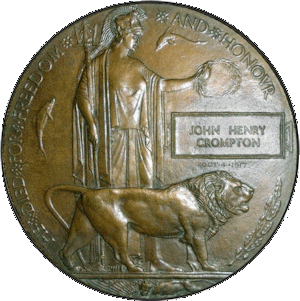
This chapter reveals that part of John henry's story hinted at in the family letter of 1939 sent by Thomas Crompton to Eileen Crompton, his daughter-in-law, from UK to Kenya. ‘Dear Harry & Eileen, ... Harvey Crompton [John henry] farmed in S. Africa for a time, then in Canada. He was killed in France in Australian Army’.
Note: Throughout this chapter of John henry’s life he will be referred to as Jack, unless a specific name is mentioned in an official document.
Perhaps Jack’s story begins with …him seeing copies of the flyers posted to attract settlers to the Canadian West.
![]() |
| Above: Contemporary Canadian immigration posters Source: Library and Archives Canada, CN Railways |
| With no opportunity of inheriting the family tenancy or, it appears, wanting to follow brother Charles in taking a tenancy and after his failure in South Africa, Jack sailed on the RMS Tunisian, departing Liverpool on 31 May 1906 bound for Montreal. The ship boasted good heating and ventilation, hot, fresh cold and salt water on tap and four-berth emigrant cabins with spring mattresses. Jack was one of the 1735 passengers on the pursers manifest. The RMS Tunisian docked 9 June 1906. | ![]() |
|---|---|
| Right: RMS Tunisian |
![]() |
Name | John H Crompton |
| Date of Departure | 31 May 1906 | |
| Port of Departure | Liverpool | |
| Passenger destination port | Montreal, Canada | |
| Passenger destination | Montreal, Canada | |
| Age | 30 | |
| Marital status | Single | |
| Sex | Male | |
| Occupation | - | |
|
Above: John H Crompton's embarkation for Canada in 1906 on the RMS
Tunisian passenger list
Source: TNA BT 27/495 It should be noted that the passenger list shows no obvious occupation against John H Crompton's name. Whilst the first occupation has two ditto marks beneath it the second 'Lab' doesn't. |
Passenger record on page | 2 of 27 |
| Ship | Tunisian | |
| Official number | 0 | |
| Master's name | AG Braes | |
|
Right: Transcription of the passenger record for John H Crompton's emigration to
Canada
Source: The National Archives (TNA), Kew, London, BT 27 |
Steamship line | Allan Line |
| Square feet | 29213 | |
| Registered tonnage | 6802 | |
| Passengers on voyage | 1443 |
Searching the Canadian Passenger Lists, 1865-1922, Ref: RG75 Microfilm T-487 page 24, confirmed John H Crompton's arrival, in Montreal on 9 June 1906, on RMS Tunisian, as a second class cabin passenger/farmer bound for Calgary, Alberta.
![]() |
| Click on the image to open a 229Kb jpg of the full entry page. |
Arriving in Edmonton
Fifteen days later after declaring to Canadian Immigration that he was bound for Calgary, Jack is next recorded in Edmonton, Alberta in the Census of the Northwest Provinces, the Prairies Census of 24 June 1906. This records: Crompton JH, male, single, aged 30 and born in England. He had emigrated to Canada in 1906 and was recorded as living in Edmonton. The registration sub-district is described simply as: ‘Edmonton, being that part of the electoral district of Edmonton which lies within the province of Alberta.’
![]() |
| Above: A composite image of John henry's entry in the 1906
Prairie census
Click on the image to open an A4 image showing every column. |
| Source:
1906 Census of Population and Agriculture - Northwest Provinces of Manitoba, Saskatchewan
and Alberta
Reference: Alberta / Edmonton / District 20 / Sub-district 27C, page 10, line39 The census headings and questions asked are listed in Appendix 1. |
Many people settled in Edmonton permanently and by 1904 Edmonton had 9,000 residents. It became incorporated as a city and a year later was declared the provincial capital.
Although Alberta became a Province in 1905 much of the best land had already been settled but there were still settlers streaming in from the United Kingdom, Eastern Canada and the USA. Although Jack may have gone to Calgary it is likely he found that there was little, if any, homestead land available as it was largely settled by then. The same applied to land around Edmonton and central Alberta. In fact, homestead land in east central Alberta, where Jack finally got a homestead, was getting pretty scarce by 1906 and almost gone by the time Diane’s family got there in 1908. This may have accounted for his change of plans.
Right: 1906 map of the Edmonton electoral district, showing the eastern township grids |
![]() |
| Distance travel was by rail. The Canadian Northern Railway main line
reached Edmonton late in 1905 as part of Canada’s second continental railway intended
to attract settlers and to tap areas of potentially high income generating traffic. It is
possible that Jack used this direct route from the east or, if he first went to Calgary as
suggested by his immigration papers, the Canadian Pacific and the Calgary & Edmonton
Railway.
Source: Atlas of Alberta Railways |
![]() |
| Right: A Canadian Northern locomotive photographed in 1913
Source: City of Edmonton Archives |
![]() |
| Above: Canadian Northern Railways route to Edmonton via Wainwright, and the Calgary & Edmonton Railway |
Homesteading in Western Canada
![]() |
Dominion Land Survey
of 1871 1 established, quarter sections of 160 acres (65ha), commonly
referred to as a homestead. It was adapted from the United States system, establishing a
series of astronomically determined initial meridians and base lines. To the prime meridian
(97° 27' 28.4") just west of Winnipeg were added initial meridians, generally four degrees
of longitude apart starting with the second. A network of six miles square Townships was
established, comprising of 36 sections. Each section was subdivided into quarters with
sides of a linear ½ mile (805m).
Source: Atlas of Alberta Railways Left: Plan of a Township of 36 square miles Even numbers - homestead Odd numbers - railways School land - section 11 and 29 Hudson Bay Co. land - section 8 and ¾ section 28 |
| Jack’s homestead was located between the modern village of Edgerton, Alberta and the town of Wainwright, Alberta; four miles north off the present day east-west Highway 14. At the time Jack settled in the area neither Wainwright nor Edgerton existed. Greenshields was the small old community of people located about 12 miles south-west of Jack’s farm. A relative of Diane had a small store there at the same time Jack was living in the vicinity and this may be where Jack went to get groceries or the mail. | ![]() |
| Above: A map locating Wainwright, Alberta in relationship to Jack's homestead |
| Footnote 1 |
| Right: Main Street Wainwright about 1910 at the beginning of
the railway town
Source: Glenbow Museum, Calgary |
![]() |
![]() |
Jack was already homesteading when Diane’s grandfather, Alexander
miller Postans, began homesteading in 1909. Alex Postans homestead was the south-west
quarter of Section 20, Township 45, Range 4, west of the 4th Meridian 2
(SW20-45-4-4). Jack's homestead was the north-west quarter of Section 20, Township 45, Range 4, west of the 4th Meridian, was known as NW20-45-4-4 3. In other words they were next door neighbours in adjacent homestead. At the time of settlement homestead quarters were known by their land grant code rather than property names. The old settlers, in this part of the country, would have laughed someone out of the community had they presumed to give their property some "fancy" name and would have viewed this as "giving oneself airs". Left: Map detailing Township 45, showing the positions of NW20-45-4-4 and SW20-45-4-4 and the location of Gooseberry Lake |
| Footnote 2 |
| Footnote 3 |
Using Google Earth the coordinates for the south-west corner of Jack’s homestead are:
| The homesteads are 4 miles north of Highway 14 on Range Road 45. Along this road, on
the right hand side, is a large lake. This is Gooseberry Lake, an alkali lake just south-
east of Jack’s land. To the left of this are two small
sloughs5
across the road from each other and on either side of the road. Diane’s quarter of
land begins here on the right hand side of the road. The next quarter, which could easily
be spotted if each quarter is under cultivation, was Jack's quarter.
Right: An aerial view of NW20-45-4-4 in 2010 |
![]() |
| Footnote 4 |
| Footnote 5 |
Staking a claim
Canada did not have a Homestead Act. It used the Dominion Lands Act of 1872 to distribute and deal with homestead lands. A homestead was free apart from a $10 (£2.27) 6 administration/registration fee if you met the qualifications. You had to be a male of at least 21 years old to make an application and had to answer a lot of questions. In order to prevent speculators from gaining control of the land the homesteader had to agree to occupy the land for at least three years in order to "prove up" and cultivate at least 40 acres (16.25 ha) and build a permanent dwelling. After this, applicants could apply for title to their homestead. The application for homestead lands was handled by the Federal Government and the issuance of land titles by the Province. Jack's application for a homestead and any pertinent papers are in the Ottawa archives and his land title (Patent) in the homestead records in Edmonton.
The claim had to be register with the Provincial Records Office in Edmonton. The online index Western Land Grants Database at Archives Canada, confirms that a John H. Crompton took out a homestead on NW20-45-4-4. However, the date of this application is not stated though a 1904 district map is part of this file.
The Canadian Census, enumerated 30 June 1911, records that a …
… John Crompton was a farmer: a single male and head of family who was aged 32, and who was born in April 1879 in England. He is recorded as entering Canada 1905. Though his nationality is given as Canadian, his ethnic background was English ...
... and confirms that Jack's friends and neighbours included Joe Flint, Arthur Fox (q.v.) and Alex Postans. Diane recalls that in the 1950's she knew folks listed on this census and listened to their pioneering stories.
![]() |
| Above: A composite image of the 1911 Strathcona Census showing Jack on line
30, Arthur Fox on line 29 and Alexander and Agnes Postans on lines 14 and 15 respectively.
Click on the image to open a full 786kB A4 image
The 1911 Census of Canada - Schedule no. 1 - Population questions is to be found in Appendix 2 Census source: Item #25: Province: Alberta; District name: Strathcona; District #6; Sub district #4 Twp45. line 30. Reference #RG31 Stats Can Mfilm# 20331 at Library and Archives Canada |
Apart from the slightly ambiguous name John, errors were noted: the year of birth was not 1875 and the year of entry to Canada was not 1905. To eliminate any other John Cromptons born in 1879 The National Archives’ Board of Trade outwards passenger lists from1890 to 1960 (TNA BT27) was searched for a single male Crompton born1879, ±2 years, sailing to Canada between 1900 and 1909. Three possible names, containing the initial J were found:
A search of Ancestry UK’s 1901 census for a JW Crompton, born 1879 ±2 years, found four single men: When the same query was entered into the 1911 census one of these could be identified as still living in the UK. Two other JW Crompton’s born 1880 and 1881 could not be found, but these were discounted a being too young. John William Crompton, born Burnley in 1879, could not be found.
The Homestead Patent papers, photographic and hearsay evidence suggests these were an enumerator’s error or Jack simply ‘lost’ a year or two, which does happen in genealogical records.
| Footnote 6 |
| It has not been possible to find the exact exchange rate. However, since Canada and the UK were tied to the Gold Standard the exchange rate was stable at around C$4.40 to the pound Stirling. |
Jack, the homesteader
According to Jack’s application for a Homestead Patent, dated 6 June 1910, his first attempt at homesteading was located at NE16-44-1-4, located near Chauvin Alberta, about 20 miles southeast of Jacks final homestead. That it was ‘abandoned’ may account for some of the missing time between the Prairie Census of 24 June 1906 and his taking NW20-45-4-4 on 30 May 1907. The 1904 map shows that no homesteads were allocated to that Township. However, the Western Land Grants Database records that, at an unspecified date, this quarter became the property of William Swan.
In 1976, Edgerton and District published a local history book entitled "The Winds of Change". In this, Richard Postans wrote several articles about the early pioneers as he knew all the stories and most of the people in the area. One of the stories was about Jack Crompton with a picture of Jack, Joe Flint, Jack’s barn and his team of oxen. Richard Postans wrote …
![]() |
| Above: Jack Crompton's homestead, Wainwright circa 1908, showing Jack Crompton, on the left, in front of his homestead with his team of oxen Source: Richard Postans, "The Winds of Change" Edgerton and District History |
"Jack Crompton was a well educated man and had travelled extensively. He was a correspondent 7 and photographer for a London newspaper in the South African War (The Second Boer War - 11 October 1899 until 31 May 1902). After the war he and a brother (Richard cecil) farmed in South Africa until a disease - sleeping sickness, killed off their cattle. He came to Canada and homesteaded NW20-45-W-4. Jack Crompton was liked by all who knew him."
The article, entitled ‘Jack Crompton N.W. 20-45-4-W4’, continues:
"After Jack had built his house he gathered up a quantity of logs to build a barn, a group of neighbours came to help erect the building. About the middle of the morning one of these men stopped work and listened. “I hear geese,” he said, and running over to the house he grabbed his gun and took off. He was not seen again during the barn-raising. No one else heard the geese. In this part of the country whenever a hard job had to be done it was not uncommon to hear the expression “I hear geese”."
“Jack Crompton’s house was on a knoll overlooking a fairly large slough ringed with willow. During the summer he could observe the various families of ducks who became quite tame. In the fall he was away from home often hauling grain, etc. and then suddenly noticed the ducks had become timid and hiding whenever he appeared. He was puzzled by the ducks’ attitude until one afternoon when he was coming home early and he could hear a rifle going off at regular intervals. On arriving home he saw a neighbour calmly sitting in a chair with his gun barrel on the window sill, shooting at every duck that appeared in sight.”
| Footnote 7 |
Diane adds: ‘Although the article is not clear, my Dad told me that the guy who took off after the geese was Jack himself. The neighbour who was using Jack’s house as a hunting blind was Arthur Fox, his next door neighbour and best friend (whom I knew). The old slough with the ducks, mentioned in the article is still there and still has ducks on it in spring and summer.’
| According to Richard Postans’ article Jack built himself a house, which was long gone by the 1950s, though Diane’s mother knows its position. Diane recalls that ‘Mom [said] Dad (Stan) showed her once exactly where Jack's | |
| "bachelor shack" and barn had been located on the property. Apparently the
remains were still evident when Dad bought the farm circa 1946. [It stood on] what is now
an open space on a slight hill above the creek that ran through the property … half
a mile across the field.’
On the aerial view of NW20 quarter, Jack’s shack and barn were located more toward the centre area of the quarter, west of the coulee and fairly near the Range Road 45. The faint, but much larger outline just to the right of the coulee, is where William Reynolds, the third owner of the property, built his house and outbuildings. Though the outline is still visible, the house, barn and outbuildings that were once here are now all gone. The present house is the one built by Stan Postans in the 1960's. Right: An aerial view of NW20-45-4-4 showing the underlying archaeology |
![]() |
In the Homestead Patent papers Jack records that his ‘home’ was18 foot by 14 foot (5.5 metres by 4.27 metres). He had built a granary and fenced two sides of his property. His four oxen were probably worth about $50 to $75 each (£11.50 to £17).
![]() |
Heritage homesteads suggest the average bachelor would probably have built
a one room, uninsulated clapboard "bachelor shack" residence about the size of a granary or
about 12 foot wide and 16 foot long (3m x 4m) with a board floor, one or two glassed windows,
a doorway and a chimney for the stove. They were furnished with a stove, single cot, table,
chairs, cooking utensils and perhaps a small kitchen storage cupboard. Sometimes the
interior walls were insulated with old newspapers.
|
| Above: A contemporary photograph of a bachelor shack circa 1910 Source: Peel Prairie Provinces | |
| This photo is of someone's old bachelor shack probably from the 1910 era, which appears
to have been turned into a granary. This one appears to have had an upper story. Most shacks
like this had a lean-to woodshed attached to the house, and a partial dugout cellar under
the interior floor for food storage/cold storage so stuff would not freeze in winter and
would stay cold in summer. One can only imagine how cold such uninsulated shacks were at
minus 40 degrees in January. Note the old grain binder beside the house.
Right: A bachelor shack circa 1910 Source: Diane Carl, 14 April 2010 |
![]() |
![]() |
Barns were usually constructed out of local trees hence the name "pole
barns". Since Jack's homestead was located at the northernmost part of the prairie parkland
region, poplar trees were the most predominant species of tree. However, these trees were
never that big and if utilized as building material, were not particularly durable.
Harnesses, a wagon, a saddle horse with equipment, a scythe and pitchforks were needed. To
‘prove’ the land a one or two furrowed steel tipped walking plough, directed by
the ploughman holding onto handles on either side of the plough to break the virgin
grassland was essential.
Left: Agriculture in Edmonton 1907 Source: City of Edmonton Archives |
Above: Dark brown chernozem soil profile Right: Breaking the Prairie at Wainwright with a sit-on plough and four oxen - 1920 Source: Peel Prairie Provinces |
The land was good pasture land but in the days before regular fertilizer application, crops could be sparse. The topsoil is in the dark brown Chernozemic soil, which is not as productive as the highly fertile black soil. In these dark brown zones there can be underlying sand deposits, which drains any precipitation. Planting was done in late May with harvesting in September/October, but in a harsh country it is not unusual for it to snow in June and freeze in early September, making farming a difficult proposition, particularly in the old days. This is one possible explanation for Jack ‘proving’ only 27 of the required 40 acres in four years. |
![]() |
![]() |
A second reason was that virgin prairie has grass roots up to 30 feet (10m) deep and is so tightly packed that it is almost impossible to break through.8 This doubles the time it takes to plough a UK acre.9 Hypothetically, this would be four days per acre for Jack the novice ploughman. However, oxen harnessed across their neck do not have the pulling power of a Shire horse. A team of four cheaper oxen would be required to break virgin Prairie and probably at a slower pace. It therefore seems reasonable to suggest it taking six back-breaking days to plough one acre. |
| Above: Considered a heavy load for two oxen. Reginald Pennock breaking land at Wainwright 1909 Source: Glenbow Museum, Calgary |
![]() |
Left: The road in the picture is Range Road 45
running past what was once Jack's land, leads to the Battle River Valley, which is two miles
(3.2km) to the north
Source: Diane Carl 15 July 2008 |
| Footnote 8 |
| Footnote 9 |
| Right: Jack's and Diane’s land share a common
coulee 10
that has always had a stream running through it, until lately when a
colony of beavers has moved in and now there are five ponds between
Jack's old quarter and Diane’s.
Source: Diane Carl |
![]() |
| This was originally buffalo country. Diane writes that when she “was
a child there were still buffalo wallows on the sunny side of some hills out in some pasture
and in the spring you could lay in them and soak up the sun. In the spring the wallows were
usually ringed with wild crocus and ‘buffalo beans’ a sort of wild yellow pea
plant”.
Right: Wainwright's original buffalo and calf 04 July 1905 Source: Peel Prairie Provinces |
![]() |
| Footnote 10 |
| A coulee is a deep ravine or gulch, usually dry, which has been formed by running water. |
![]() |
Left: Battle River valley showing stands of Poplar tree used
in the construction of 'pole barns'
Source: Diane Carl 05 May 2010 |
![]() |
| In the 1790's David Thompson (above right), passed along the Battle River Valley
naming one of the deep coulees near the property Grizzly Bear Creek.
Largely forgotten until recently, Thompson was arguably the greatest explorer and map-maker of his time. Not only had he navigated the entire length of the Columbia River in 1811, following it from its source at Athabasca Pass in the Rockies through southeast British Columbia, western Montana, Idaho and Washington, he mapped 3.9 million square kilometres of wilderness, or one-fifth of the continent, in his lifetime. Fellow explorer Alexander Mackenzie once remarked that Thompson had accomplished more in 10 months than he did in two years of exploring Western Canada. Source: In the tracks of David Thompson |
An analysis of Jack's Homestead Patent - see also Appendix 2
It should be remembered that Jack was required, under the terms of the Dominion Lands Act of 1872, to 'prove' 40 acres and build a permanent dwelling in three years. His Patent papers show that he clearly failed to complete the cultivation requirements.
The Homestead Patent papers suggest that Jack did not seem to have exerted himself in the development of his homestead. However, without the comparative evidence of other Homestead Patents it is difficult to assess how much Jack really achieved. In four years he had broken only 27 of his 40 ‘proving’ acres. In his first four years he had harvested 32 acres of income, the first being in 1908. He had however, built his home, a log barn with the help of the community, a stable, and constructed one mile of fencing to the total value of C$220. It seems that the need for additional income necessitated 47% of his time being spent as a labourer on the Fabyan trestle bridge (q.v.).
![]() |
Jack worked on his homestead from 24 June 1907 to 18 December 1907, from 21 March 1908 to 04 May 1908, from 28 September 1908 to 08 April 1909 and finally from 16 October 1909 to 6 June 1910, the date of his Patent application.
If planting was done in late May and harvesting in September/October a very loose critical path analysis for Jack’s work, with little allowance for the seasonal weather, could suggest:
![]() |
| Above: Critical path analysis for Jack's work showing the amounts of time available for working on the homestead and the possible tasks undertaken. Alternative tasks are spread over two rows. |
The weather dependant critical path analysis suggests Jack:
The danger of fire presented the other extreme. In 1908 or 1909 a huge prairie fire that swept through the surrounding area and the community where Jack lived. Jack would have been one of those who survived this not uncommon prairie disaster. This is recorded in a Wainwright local history book.
Five hundred dollars (£112) would have been enough to set up a homestead. There were no Provincial grants and if you didn't have title to your land or any other assets the banks would not give out loans.
No one ever referred to Jack as a "remittance man" of whom some were Diane’s neighbours. She remembers 'these were 'always Englishmen who received payments (remittances) from their families to stay away from England. Usually they were second or third sons with no chance of inheritance, n'er do wells or those who had caused their families embarrassment or had run into trouble at home. Many remained local ‘characters’ to the end of their days, perhaps caused by living alone on the Prairie too long.'
| Right: Jack Crompton (lower right) hunting circa 1908
Source: Source: Richard Postans, "The Winds of Change" (qv) There are no family records to explain how Jack financed his homestead. It could have been from money saved from his days as a clerk 11 or war correspondent, but equally this money could have been lost when the South Africa cattle died of sleeping sickness. There could have been support from his affluent tenant farming family at home. This hunting photograph shows a man more fashionable than his contemporaries: someone appearing to wear a duffle jacket over breeches and long socks, with a boot rather |
![]() |
| than Arthur Fox’s utilitarian footwear. He appears to be sporting a Winchester Model 1894 (also known as Winchester .30-30 rifle), one of the most famous and most popular hunting rifles, perhaps used to shoot the mule deer. The photograph, and limited progress on the land, gives the appearance of what in the west would have been called "a gentleman farmer", more given perhaps to hunting and socializing with the neighbours than in hard manual labour on his farm. | |
| Footnote 11 |
| In 1905 the average weekly wage for a UK agricultural worker was 15/- (fifteen shillings or 75p, an estimated equivalent of C$3.30) and a non-government clerk £287 a year (an estimated equivalent of C$1263). Source: Relative Value of Sums of Money |
Jack the labourer
On his Homestead Patent papers, in Appendix 2, Jack declares that he had both worked and lived at the Grand Trunk Pacific Railroad (GPR) construction of the Fabyan Trestle for 47% of his time in Greenshields.
The GPR built a new railway line westward towards Edmonton as its final destination, which it reached in 13 August 1909. When the GPR got to Wainwright they had to overcome the big problem of the Battle River Valley.
| Right: Fabyan Trestle over the Battle River 2009
West of Wainwright the railway met a deep challenge, a glorious valley that was home to the Battle River. Today the Battle River is quite a small stream in most places but the valley is very wide and in many places, very deep. In the vicinity of Wainwright, the valley’s meander sweep around the north, south and west sides of the area. This meant that the railroad had to cross the valley at some point. The GPR had to build a railway bridge and the best place to do so was a few miles west of Wainwright, near the hamlet of Fabyan. 'In 1907, the concrete footings of the bridge that would span the valley were poured. Farmers and other |
![]() |
![]() |
contractors hauled supplies to the site by wagon from Hardisty. When the
railway crept to the eastern side of the valley, supplies could be brought in by rail. The
construction site became a tiny community all its own with a store, cafe and hospital.'
Source:
Municipal District of Wainwright No.61
The construction of the bridge and the westward expansion of the GPR caused its failure. It declared bankruptcy in 1919 and became part of Canadian National Railway (CNR) in 1923. The tracks through Wainwright became CNR's mainline. On 21 July, 1908 Wainwright became a railroad town when the GPR arrived. The bridge, completed on 10 December 1908, is still in use and is the second longest steel trestle bridge in Canada at 2775 feet (845.82 m) long and 195 feet (59.44m) high. |
| Above: The Fabyan Trestle in 1910 Source: Glenbow Museum, Calgary |
| In his application for his Homestead Patent, Jack declared that he had been
away from his homestead labouring on the Battle River Bridge between 19 December 1907 and
20 March 1908, 5 May 1908 and 27 September 1908 and finally, between 7 April 1909 and 15
October 1909: 431 of the 920 days recorded on the Homestead Patent. It is possible that, for
this final date, Jack was working on the track improvement, which, though having reached
Edmonton, had been built quickly and to a secondary line specification.
Right: GPR track laying near Wainwright 1908, where Jack may have been employed Source: Glenbow Museum, Calgary |
![]() |
![]() |
Right: GPR tented construction camp 12 in May 1908, at a time when Jack was
working on the line. His friend, homestead-mate and neighbour
Arthur Fox 12
also worked on the CPR and they probably met in a similar camp. Source: Glenbow Museum, Calgary |
| Footnote 12 |
Jack’s departure
Diane story continued,
“Uncle Richard provides an amusing story about Jack and other information but nothing to say when Jack left or what happened to him after he left. .... I remember being told that Jack had sold out and gone to England or Australia.”
The Dominion Lands Act allowed the farmers to buy a neighbouring lot for the same C$10 registration fee. This allowed most farms to quickly double in size. Diane thinks the next owner was his friend and referee Joe Flint in either 1912 or 1913. Joe Flint sold the quarter to William Reynolds in early 1915 who then sold it to Stan Postans, Diane’s father. However, according to the Alberta Farm Facts 1910, which was based old Statscan data, the average cost of farmland in Alberta was C$24.00 per acre which would translate into approximately C$3000.00 per quarter. If Jack held the Patent for NW20-45-4-4 and was able to sell at these prices, he returned to England with a sum of money.
![]() |
There is no obvious record of Jack returning to Britain in the incoming
passenger lists (TNA BT26). There is a Mr Crompton, one of the 230 first class passengers
who arrived in Liverpool on the 14892 tons White Star RMS Laurentic, on the 30 June 1912.
His intended residence was classified as ‘British Protectorate’. Being a First
Class passenger the Purser chose not to include Mr Crompton’s first name or his
profession. Perhaps this is how he spent his 'wealth'.
Left: RMS Laurentic Below: A composite image of Mr Crompton's immigration 30 June 1912 Source: TNA BT26 1472 |
![]() |
Jack was a bachelor, so there was no one to put pressure on him to "get with it" or to assist him. Given the literature and notions of the day, perhaps the idea of homesteading in the Canadian Wild West was far more romantically appealing than the actual labour required to develop the property for long term purposes. This may have been the reason why he kept moving on. Perhaps the adventure was more important than the reality. Perhaps this is why he enlisted at the age of 40 years.
Jack's memorials - Wainwright’s Memorial Clock Tower
Jack's name is recorded on the Wainwright Memorial Clock Tower, built by public subscription and hard labour in 1925.
![]() |
On 13 September 1925 the people of Wainwright and district gathered around the newly built clock and dedicated it, and its plaque engraved with 33 names, to the memory of those from the area who gave their lives in the First World War. Since that day and on each |
| Above: Jack's name on the Wainwright Memorial Clock | |
| Remembrance Sunday the citizens of Wainwright have gathered in the centre square of Main Street and Second Avenue to be reminded of the fallen. | |
The story began four years earlier. On 19 September 1921 the Walter Musson Chapter of the Imperial Order of the Daughters of the Empire 13 (IODE) approached the town council asking for permission to erect some kind of memorial, suitable to the soldiers of the town who fell in the Great War. In Erika Foley’s article Edwin Harris wrote that ‘They wanted to build a war memorial - it had to be a project everyone could take part in - something from the land the men had left - something useful, that future generations could look up to’.
Ms. Foley quotes Gordon Kenny’s recollections of 1981. ‘The Clock Tower idea for a memorial was selected because it was felt that it would be a most fitting memorial in that it would stand in the centre of the main square of the town, would serve a useful purpose, and would hopefully remind us day to day and year after year of the sacrifices made by our young men and women who served our country, and those who were killed and wounded in the “War to end War. ” It was to be a dignified, beautiful and entirely unique memorial that was to be Wainwright’s alone. It was intended not to be the usual cenotaph erected but rather a more personal memorial in that everyone could have a part in its erection and use.’
| During 1923 the IODE dedicated their income from the well supported annual ball to the War Memorial Clock Tower Fund, as well as the proceeds of a concert, a two act play and an open air dance. The local paper ‘The Star’ advertised a “ Stone Bee” to be held 7 and 8 July 1923, when farmers were to bring in loads of stones and deposit them besides the restroom. The Clock Tower was to be built ‘ entirely of local stone so that it would truly represent our whole area as everyone could bring in a stone or stones. The school children were each asked to participate in the gathering of the stones and thus all of us in the whole area could make it our memorial. ’ (Kenny 1981) | |
![]() |
Ron Morrison recalled visiting Greenshields, near where Jack had homesteaded, to collect
a load of stones which were amongst the first dumped ‘in the centre of the block
back of where the Legion hut was set up, near the derelict tractor that was used by the
farmers as a hitching post.’ By 9 July 1924 The Star reported that 20 tons,
nearly half of that required, had been delivered. The ladies supplied coffee and sandwiches
for all those who brought loads of stones.
For a grand total of C$3500 (£780) Frank Bailey, carpenter and architect, and William Bailey, stone mason, built the uncluttered monument as it ‘exemplifies and incorporates the strength, and the solidity of the West and Westerners while also having and retaining the line, the balance and the beauty of good architectural design. In part this was achieved by the carefully calculated height and proportions and these are completely unique.’ (Kenny 1981) ‘The clock itself was purchased from Gillett & Johnston, Croydon, England through [Edwin Harris’] Dad, at cost. [who] installed … and maintained it for many years as his contribution to the memorial. … The bronze tablet, set in the masonry, was designed by Major Norburg, of Edmonton.’ (Edwin Harris) Left: Wainwright Memorial Clock Tower 13 September 1925 one hour after the unveiling |
| Footnote 13 |
![]() |
On Sunday 13 September 1925, Major Gen. W. Griesbach of Edmonton, supported by the
children of Wainwright and the local Alberta Dragoons, unveiled the bronze memorial tablet
set into the masonry of the Clock Tower. On the tablet was written ‘These went and
came not again In memory of those from this community who gave their lives in the Great War’.
Left: Wainwright Memorial Clock plaque Source: Diane Carl |
![]() |
![]() |
| Above: Wainwright Memorial Clock 13 September 1923
Right: Wainwright Memorial Clock plaque Source: Diane Carl |
Source: Foley Erika, ‘The Memorial Clock Tower: Through 75 Years and Beyond’
The Royal Canadian Legion Memorial, Wainwright
![]() |
In preparation for her article Diane phoned the Wainwright Branch of the Royal Canadian Legion to ask why J Crompton was listed on their World War 1 cenotaph when there was no record of him being killed in action |
| Above: Jack's name on the Wainwright Legion memorial | |
| with the Canadian forces in World War 1 or in any of the Canadian service records files. | |
| Diane contacted a 92 year old ex-neighbour; an officer in the
Wainwright Legion whose family homesteaded was just north of Jack’s quarter. He knew
the name of the World War 1 soldier listed as J. Crompton as John Crompton although ‘
the neighbours knew him as Jack’. He said that if Jack was not listed in the National
Book of Remembrance in Ottawa, Jack must have served with another Commonwealth country,
probably Britain or Australia. He had heard that Jack had taken up homesteading in Australia.
His name was on the Wainwright memorial because he lived in the community at one time and
had died during World War 1 ‘It wouldn't have made any difference which country he had
served.’
Since the construction of the Wainwright memorial plaque Jack’s name, along with all the names of those from District who were killed in action, have been read from the ‘ Honor Roll’ at the Wainwright Remembrance Day Parades. As each name is called, Sea Cadets place a poppy on the large white cross for each soldier. In appreciation to: Major (retired) Jack F. Mahon, CD President, Royal Canadian Legion, Worthington Branch #29 Wainwright, Alberta, Canada Right: Wainwright Royal Canadian Legion memorial |
![]() |
How did the Wainwright Legion know about Jack's death?
If Jack left Wainwright between 1912 and 1913, there are two possible ways the town and the Legion learnt about his death.
Diane suggests: ‘The Wainwright Memorial Clock Tower was built in 1925 and the memorial plaque including Jack's name was placed on it at that time. The Legion now is unable to determine how or who advised them of which names should appear on the plaque, as the old Legion meeting house, and the downtown area of Wainwright, was destroyed in a fire in 1929. Unfortunately, the local newspaper established in 1910 also lost whatever papers they had.’
She writes ‘I and the old soldier think that back in 1925 when the Legion members were determining whose names should appear on the memorial, they were all quite well aware of who in their community had served in the Great War. When Jack sold out to Joe Flint and left Canada he kept in touch, via mail, with his best friends, Joe and Arthur Fox. In fact Arthur lived with Jack until he got a place of his own. As you know, folks were pretty prolific letter writers in those days The last two continued to live out the rest of their lives in the community; Arthur on his homestead and Joe in the town of Wainwright. No doubt Jack left instructions with his mother or one of his brothers who to notify if anything should happen to him during the war. I would suggest that someone in Jack's family wrote to Joe or Arthur and told them the news. …. [T]he news probably spread among community neighbours via moccasin-telegraph; carried on foot and transmitted face-to-face. This scenario was not uncommon at all in those days. For instance my Dad found out about a neighbour's son this way even though the neighbour had moved back to England 30 years before. Then Dad advised other old neighbours who would have known this family. In an era devoted to letter writing and mail service, news often got around faster than it does today, despite all the instantaneous tweets and twits.’
![]() |
Between 1927 and 1933 Jack’s youngest brother
Arthur was a travelling salesman
for the paint company Sherwin-Williams Co. based in Winnipeg, Manitoba. His area of
responsibility included ‘special work from West Ontario thro (sic) all Manitoba,
Saskatchewan & Alberta, district of 1600 x 400 miles’. The GPR, then the
Canadian National main line, stopped at Wainwright on its way to Edmonton. If a letter was
not sent from the family in Yorkshire to Jack’s Albertan neighbours, then Arthur,
in the course of his work and travels, could have made a pilgrimage to his brother’s
homestead.
Left: Arthur Crompton in 1918 |
Postscript
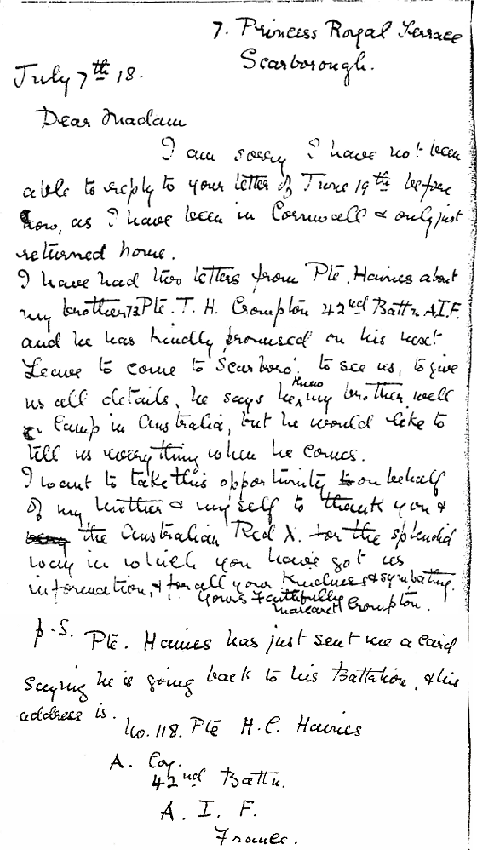
![]() |
|
| Click on the icon for a full transcription of the script in Word2003 format | |
Acknowledgements
My sincere thanks to Diane Carl whose heart is at NW20-45-4-4 and in her Prairies. Without her web search for John henry Crompton this missing chapter would never have been revealed in such detail. I am indebted to her encyclopaedic knowledge of the Wainwright area, her many emails and her patience, as a child, when listening to the tales of 'the old timers', some of whom knew Jack. Her roasted beaver tail, unchewable and tasting like rancid fat, would defeat Ray Mears. Another pilgrimage beckons.
Appendix 1 - 1906 Census of the Northwest Provinces - Manitoba, Saskatchewan and Alberta - Schedule no. 1 - Population and Livestock
The census asked for information on the following questions:
| Population 1.No. of family in order of visitation 2.Names of Each Person in Family 3.Relation to Head of Family 4.Sex 5.Married, Single, Widowed or Divorced 6.Age 7.Country or Place of Birth |
8.Year of Immigration to Canada 9.Post Office Address Location 10.Section 11.Township 12.Range 13.Meridian |
Live Stock 14.Horses, All Ages 15.Milk cows 16.Other horned or neat cattle, all ages 17.Sheep and lambs, all ages 18.Hogs and pigs, all ages |
| Source: Library and Archive of Canada - Canadian Genealogy Centre | ||
Appendix 2 - 1911 Census of Canada - Schedule No. 1 - Population
The census asked for information on the following questions:
| Numbered in the order of visitation 1. Dwelling House 2. Family, Household, or Institution Residence & personal description 3. Name of Each Person in Family, Household, or Institution 4. Place of Habitation 5. Sex 6. Relationship to Head of Family or Household 7. Single, Married, Widowed, Divorced or Legally Separated 8. Month of Birth 9. Year of Birth 10. Age at Last Birthday Citizenship, Nationality and Religion 11. Country or Place of Birth 12. Year of Immigration to Canada, if an Immigrant 13.Year of Naturalization, if Formerly an Alien 14. Racial or Tribal Origin 15. Nationality 16. Religion |
Principal Profession or Trade 17. Chief Occupation or Trade 18. Living on own means 19. Employer 20. Employee 21. Working on Own Account Wage Earner 22. State Where Person Is Employed, as "on Farm," "in Woollen Mill," "at Foundry Shop," "in Drug Store," etc. 23. Weeks Employed in 1910 at Chief Occupation or Trade 24. Weeks Employed in 1910 at Other Than Chief Occupation or Trade, if Any 25. Hours of Working Time per Week at Chief Occupation 26. Hours of Working Time per Week at Other Occupation, if Any 27. Total Earnings in 1910 from Chief Occupation or Trade 28. Total Earnings in 1910 from Other Than Chief Occupation or Trade, if Any 29. Rate of Earnings per Hour When Employed by the Hour-Cents |
Insurance Held at Date
30. Upon Life $ 31. Against Accident or Sickness $ 32. Cost of Insurance in Census Year $ Education and Language of Each Person Five Years of Age and Over 33. Months at School in 1910 34. Can Read 35. Can Write 36. Language Commonly Spoken 37. Cost of Education in 1910 for Persons Over 16 Years of Age at College, Convent or University Infirmities (specify age when infirmity appeared) 38. Blind 39. Deaf and Dumb 40. Crazy or Lunatic 41. Idiotic or Silly |
| Source: Library and Archive of Canada - Canadian Genealogy Centre | ||
Appendix 3 - Jack's Homestead Patent
| Sworn Statement of | ![]() |
|
| In support of his application for Homestead Patent for NW of Sec. 20 Thp. 45 Reg. 4 of 4 Meridian | ||
| 1. What is your name in full, age, occupation and Post Office address? |
John Henry Crompton age 34 farmer Greenshields Alb |
| 2. (i) Are you a British subject at the present and if so (ii) have you always been one? (iii) Are you a British subject by Birth, Naturalisation or Repatriation? | (i) Yes
(ii) Yes British by birth |
| 3. (a) When did you obtain entry for this homestead? (b) When did you build your house thereon? And (c) when did you begin actual residence thereon? | (a) May 30/07 (b) June/07 (c) |
| 4. What portion of each year since that date have you resided thereon, giving actual dates? |
June 24/07 to Dec 18/07 Mar 21/08 to May 4/08 Sep 28/08 to Apr 8/09 Oct 16/09 to Dec 18/09 |
| 5. When absent from your homestead, where have you resided and what has been your occupation. | Battle River Bridge and Lodge Labouring |
| 6. Of whom do your family consist; when did they first commence residence upon the homestead, and for what portion of each year since that date have they resided upon it? | Not married |
|
7. If residence has been performed on the land owned by yourself or duly authorised relative,
describe such land: a) When (1) and how (2) was such land acquired. b) By whom (1) was the land acquired, and who (2) is the present owner thereof? c) What buildings are on each land, and what is the general value thereof? d) State each month or part of month you have resided on your land. e) State each month or part of month you and your Father, mother, son, daughter, sister, brother have resided on the latter’s land. |
![]() |
| 8. How much breaking have you done upon your homestead in each year since you obtained entry, and how many acres have you cultivated each year? |
Year 1 907
Broke 8 acres, cropped 0 acres Year 1 908 Broke 0 " " 8 " Year 1 909 Broke 8 " " Year 1 910 Broke 11 " " 16 " Year 1 Broke " " " Year 1 Broke " " " |
| 9. What stock of which you are the owner have you had on your homestead each year since date of obtaining entry? | No stock |
| 10. What is the size of your house, of what material, and what is its present value? | 18 x 14 log val. 70 00 |
| 11. What other buildings have you erected on your homestead? What other improvements have you made thereon, and what is the cash value of the same? |
stable log “ 60 00 granary “ 40 00 |
| 12. What extent of fencing have you made on your homestead, and what is the present cash value thereof? | 2 sides fenced “ 50 00 |
| 13. Are there any indications of minerals or quarries on your homestead? If so, state nature of same and whether the land is more valuable for agricultural than any other purpose. | None suitable for agriculture |
| 14. Have you had any other homestead entry? If so, describe it and say what became of it. | Yes NE 16-44-1-4W abandoned |
| 15. Have you mortgaged, assigned, or transferred, or agreed to mortgage, assign or transfer your present homestead or any part thereof? If so, when and to whom? | No |
| To wit: I John Henry Crompton do solemnly swear that the answers to the foregoing questions are true and correct in every particular. That I claim a Patent for this Homestead under provisions of the “ Dominion Lands Act”. That I obtained and entry, and obtained a Patent for the same for my own benefit, and not in the interest or the benefit of any other person or persons, whomsoever. SO HELP ME GOD. |
||
| Sworn before me at
Wainwright } this 6th day of June A.D. 1910 } Having first read over and explained to the said applicant |
![]() |
|
| N Culp Sub Agent for the Dominion Lands or |
|
|
| I recommend the following application for Patent, believing that the homestead requirement of the “Dominion Land Act”, in this case have been complied with. | ||
| Dated at
Edmonton July 4th A.D. 1910 } Cleared in Timber?????ch. Date July 5th 1910 } |
KW MacKayce Local Agent for Dominion Lands for Edmonton |
|
| Ottawa - JUL-22 1910 19 Accepted as sufficient ?? Roy Dixon Commissioner |
||
| Source: Library and Archive of Canada - Canadian Genealogy Centre | ||
This application was supported by sworn statements of his referees:
| Back to TOP
Back to John Henry Crompton's content page Close info window |
|
| This page was created by Richard Crompton
and maintained by Chris Glass |

Version A4
Updated 16 March 2011 |