1805 Info 8i: John Henry Crompton
'He is not missing; he is here'
'But who shall record the glorious deeds of the soldier whose lot is
numbered with the thousands in the ranks who live and die and fight in obscurity' , Quoted in Liddell Hart, B. (ed), The letters of Private Wheeler, Michael Joseph,
London, 1951 - a Napoleonic soldier
The Commonwealth War Graves Commission:
In Memory of
Private JOHN HENRY CROMPTON
73, 42nd Bn., Australian Infantry, A.I.F
who died age 42
on Thursday, 4th October 1917.
Son of Mrs. M.E. Williams, of 7 Princess Royal Terrace, Scarborough, England. Remembered
with honour
'He is not missing; he is here' Field Marshal Lord Plumber at the inauguration of the Menin Gate,
24 July 1927.
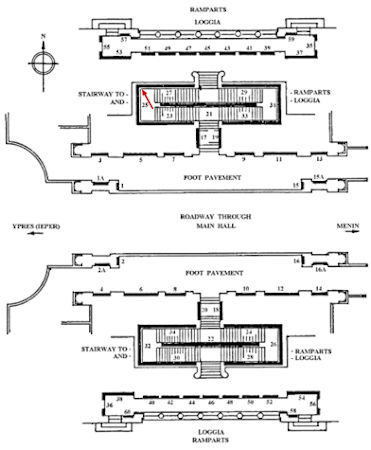
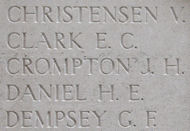
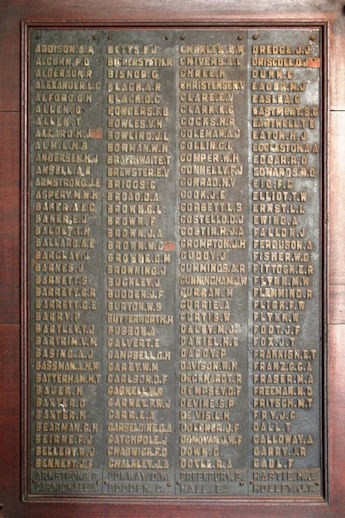
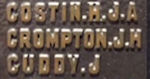
Above: The panel showing John Henry's name on the Menin Gate, marked
with a red arrow on the plan
Left: The Commonwealth War Graves Commission plan of the Menin
Gate shows John Henry's name to be in section 25 adjacent to panel 27
Situated on the site of Vauban's old fortified gate, through which many
British soldiers passed on their way to the front, the Menin Gate lists the names of 54,
900 names of those who were killed and had no known grave in The Salient between 4 August
1914 and prior to 16 August 1917 - the date of the Battle of Langemarck. The remaining 34,
888 names are inscribed to the rear of Tyne Cot Cemetery.
1805info8i, sheet 2
It was intended that the missing from all overseas armies would be
represented on the walls. However, had the date rules applied there would be virtually no
Australians named on the Gate.
Right: Menin Gate from the Menin Road side 2007
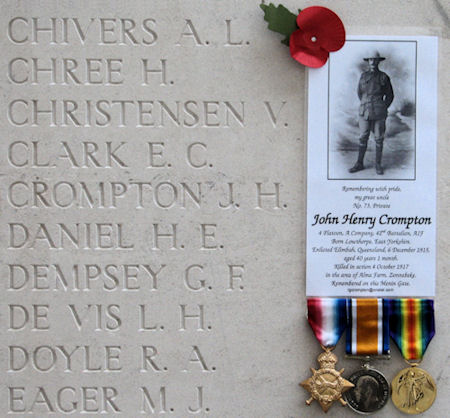
Left: John Henry's medals at the Menin Gate panel 04 October 2007, the
90th anniversary of the battle
1805info8i, sheet 3
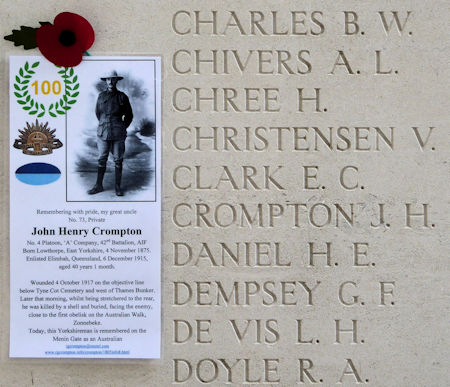
Left: John Henry's memorial card at the Menin Gate panel 04 October
2017, the 100th anniversary of the battle
At Zonnebeke, Belgium
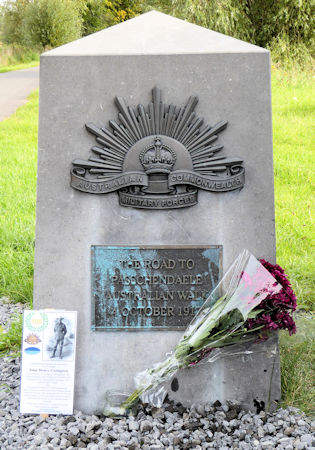
Left: The first obelisk on the Australian Walk, Zonnebeke 04 October 2017 at
0915, one hundred years and fifteen minutes after John Henry's reported death.
In the top left corner is the tarmac surface of the old Ypres to Roulers railway,
followed by the Australian on 04 October 1917. The commune and Museum of Passchendaele
1917 have made the track into a pedestrian and cycle way to Tyne Cot Cemetery. An
obelisk, provided by the Australian government marks the beginning and end of the
Australian's progress.
The photo shows the first obelisk, placed at the start of the 3km trail. Across the
trail is the field where John Henry's body was believed to have been killed and
subsequently buried. In 1919, in a first sweep of the battlefield the Graves
Registration Commission found 42 bodies in the 500 square yard map grid adjacent to
the obelisk. Perhaps John Henry was one of those!
1809info8g, sheet 4
At Lowthorpe, East Yorkshire
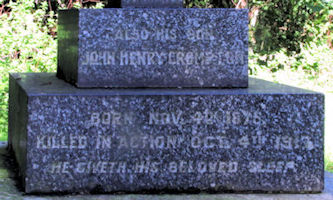
Left: John Henry's Lowthorpe memorial
In October 2010 I visited St. Martin's Lowthorpe and left flowers and a card on John
Henry's memorial headstone. John Wresdell, St. Martin's church warden of many
years, contacted me to say that my card had resolved a puzzle. Whilst he has seen John
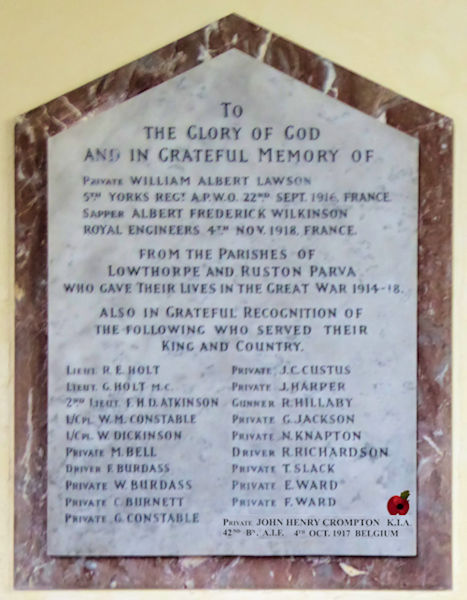
Henry's memorial he knew no more. He kindly sent me a photograph of the village war
memorial, situated inside the church.
John Wresdell did not know why John Henry's name was missing from the tablet, but,
unfortunately, it does not seem possible to add his name. In June 2016 the family added
his name. John Wresdell confirmed that John Henry's name is included in the Armistice
Day service and that the Church commemorated the centenary of his death.
Left: Lowthorpe war memorial
1805info8i, sheet 5
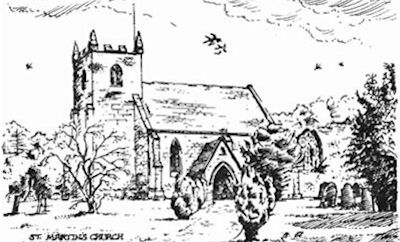
St Martin's Church stands behind high conifers, which have grown tall over the years
giving it a dark and gloomy appearance as you walk up the path towards it. It is believed
to have been built in 1333. The original chancel is now is open to the skies but the
church remains supported and used today on an occasional basis.
Right: Pencil drawing by unknown artist of St. Martin's Church, Lowthorpe.
John Henry's memorial is through the trees by the tower.
1805info8i, sheet 6
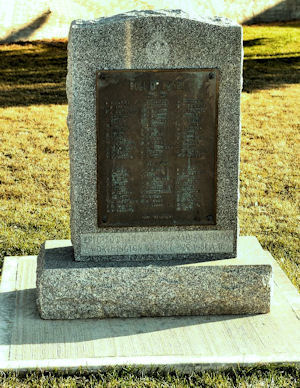
Royal Canadian Legion Memorial in Wainwright, Alberta, Canada
On 24 August 2010 Diane Carl, from Alberta, sent an intriguing email entitled 'John H
Crompton'. The Legion was publishing a Memorial and Diane had taken upon herself to research
World War 1 veteran who have no one I know of to speak for them. She had found this website and was:
looking for a John H Crompton who is commemorated on the Royal Canadian Legion memorial in
Wainwright, Alberta [as she was] trying to find out when and where he died.
John Henry, known as Jack, homesteaded near Wainwright between circa 1907 and circa 1914 on
land that was to be purchased, in later years, by Diane's father. Diane writes that although
'his name appears on the Commemorative War Plaques in Wainwright, as being
killed in World War 1, the Canadian Virtual War Memorial and Books of Remembrance do not list him
as being in the Canadian Expeditionary Forces in World War 1.
Chester Zaijic, a 92 year old officer in the Wainwright Legion knew the
name of the soldier listed as J. Crompton as John Crompton although 'the neighbours
knew him as Jack' and he had heard that Jack had taken up homesteading in Australia.
His name was on the Wainwright memorial because he lived in the community at one time and
had died during World War 1 'It wouldn't have made any difference which country he
had served.'
Since the construction of the Wainwright memorial plaque Jack's name, along with all the
names of those from District who were killed in action, have been read from the 'Honor
Roll' at the Wainwright Remembrance Day Parades. As each name is called, Sea Cadets place
a poppy on the large white cross for each soldier.
Above: Jack's name on the Wainwright Legion memorial
Right: Wainwright Royal Canadian Legion memorial
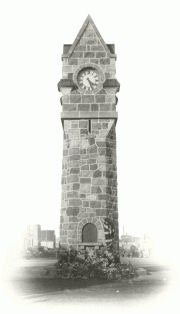
Wainwright's Memorial Clock Tower
Jack's name is also recorded on the Wainwright Memorial Clock Tower, built by public
subscription and hard labour in 1925.
On 13 September 1925 the people of Wainwright and district gathered around
the newly built clock and dedicated it, and its plaque engraved with 33 names, to the
memory of those from the area who gave their lives in the First World War. Since that day
and on each
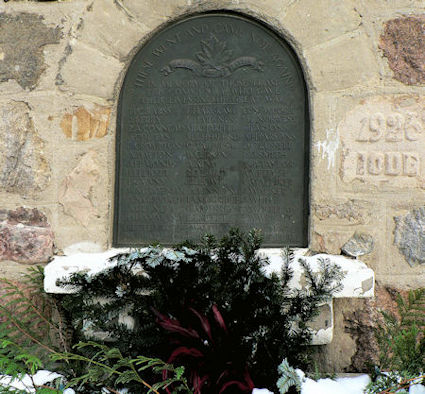
Above: Jack's name on the Wainwright Memorial Clock
Remembrance Sunday the citizens of Wainwright have gathered in the centre
square of Main Street and Second Avenue to be reminded of the fallen.
1805info8i, sheet 7
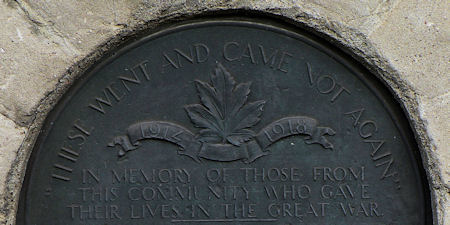
Major Gen. W. Griesbach of Edmonton, supported by the children of
Wainwright and the local Alberta Dragoons, unveiled the bronze memorial tablet set into
the masonry of the Clock Tower. On the tablet was written 'These went and came not again'
In memory of those from this community who gave their lives in the Great War'.
Left: Wainwright Memorial Clock plaque Source: Diane Carl
Above: Wainwright Memorial Clock 13 September 1923
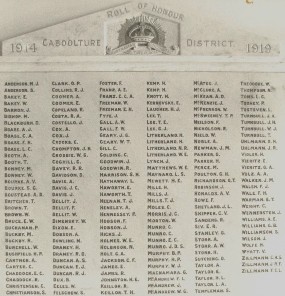
His memorial in Caboolture Returned Serviceman's League (RSL),
Queensland
Caboolture is, perhaps, the closest town to Elimbah. It is large enough to support a
branch of the Return Services League (RSL) in which is the Caboolture District Roll of
Honour 1914-1919. This records the name of CROMPTON J.H.
1805info8i, sheet 8
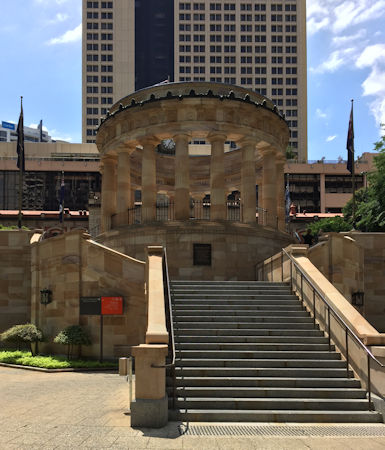
In Brisbane, where it all started
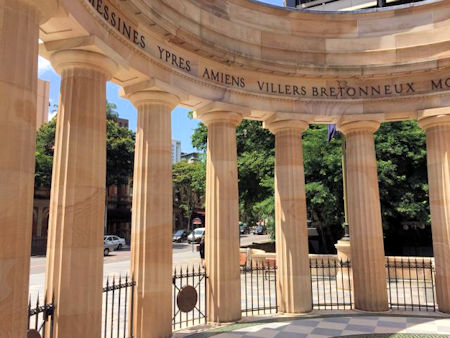
ANZAC Square War Memorial and Parkland in Adelaide Street, was opened on Armistice
Day, 1930. It is dedicated to Queenland's military heritage, features the Shrine
of Remembrance with Eternal Flame.
All photos: Bruce Hutson
Anzac Square commemorates all Queenslanders who participated in war, not just
Brisbane residents. It remains as the focus of armed services commemorations,
particularly on Anzac Day.
Beneath the Shrine is a large crypt containing the Shrine of Memories, and several other
memorials dedicated to various Queensland contingents of the armed forces.
1805info8i, sheet 9
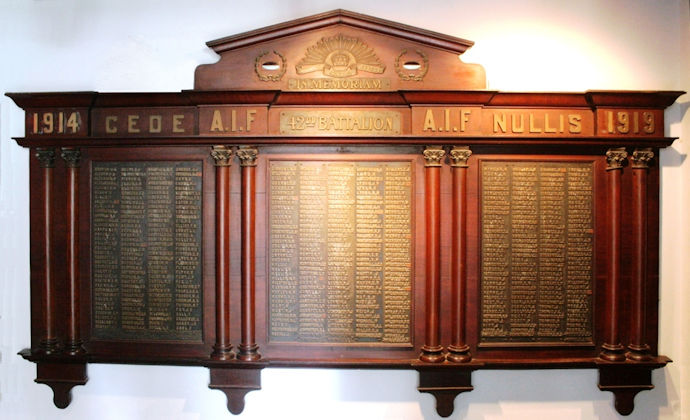
Located in the Shrine of Memories crypt, this large ornate timber
Honour Board, is dedicated to the men of the 42nd Battalion who served during the
First World War. The board displays two enamelled Unit badges and the Rising Sun
badge of the Australian Forces. Beneath exists three panels containing names of the
42nd Battalion men who fell in combat and these are divided by eight column facades.
1805info8i, sheet 10
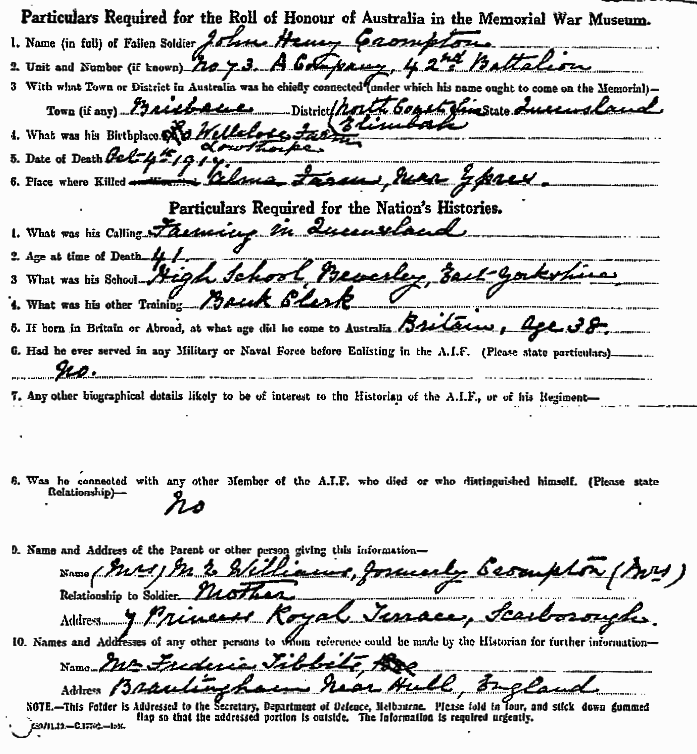
Australian War Memorial First World War Nominal Roll of Honour
Particulars Required for the Roll of Honour of Australia in the Memorial
War Museum
Name of fallen soldier
John Henry Crompton
Unit and number
No 73 A Company 42nd Battalion
Town
Brisbane, North Coast Line, Elimbah, Queensland
Birthplace
Well Close Farm, Lowthorpe, [Driffield] East Yorkshire
Date of Death
Oct 4th 1917
Place where Killed
Alma Farm, Near Ypres
What was his calling
Farming in Queensland
Age at time of death
41
What was his school
High School, Beverley, East Yorkshire
What was his other training
Bank Clerk
If he was born abroad at what age did he come to
Australia
Britain, aged 38
Name and address of parent or other
person giving information
Mrs ME Williams, formerly Crompton
Relation to soldier
Mother
Address
7 Princess Royal Terrace, Scarborough
Name and address of parents or other
person to whom reference could be made
Mr Fredric Tibbets Brantingham, Near Hull, England
Frederic Tibbits was John Henry's brother-in-law.
Click on the icon to open the image.
The Australian War Memorial Roll of Honour records John Henry being killed at Alma Farm.
This is located 750 yards (686m) due north of Zonnebeke church, 1 250 yards (1150m)
south east of Tyne Cot Cemetery, and 3 200 yards (3km) south west of Passchendaele, the
ultimate target.
Source: The National Archives, Kew WO297/718 Trench map October 1917. Reference
28NE1 D22a 2.4)
1805info8i, sheet 11
Australian War Memorial Roll of Honour - John Henry Crompton
Service number:
73
Rank:
Private
Unit
42nd Battalion (Infantry)
Service:
Army
Conflict:
1914-1918
Date of Death:
4 October 1917
Memorial details:
29 Ypres (The Menin Gate) Belgium
Place of enlistment:
Brisbane, Qld, 6 December 1915
War Graves Registration Notes:
CROMPTON, Pte. John Henry, 73. 42nd Bn. 4th Oct., 1917. Age 42. Son of
Mrs. M. E. Williams, of 7, Princess Royal Terrace, Scarborough, England.