1805 Info 8d: John Henry Crompton
His enlistment, embarkation and service record
Origins of the 42nd Battalion, AIF
On 2 February 1916, the Australian government formed a Third Division in Queensland
commencing March 1916. It moved to England to train in July 1916 commanded, for most of its war
service, by Major General John Monash.
John Henry CROMPTON's 42nd Battalion formed, together with the 41st, 43rd and 44th Battalions,
the 11th Infantry Brigade. With the 9th and 10th Brigades, its Engineers, Pioneer, Salvage,
Ammunition Column, Medical Services, Sanitary Section and four Field Artillery Brigades it
was part of the Australian 3rd Division, II Anzac Corp.
In December 1916 it was the last Australian division to move to France, taking over part of the
'nursery' sector near Armentieres. In June 1917 it participated in the battles of 3rd Ypres
including the Battles of Messines, Pilckem and Broodseinde Ridge where the 3rd Division lost, in
total, 4,122 men.
Enlisting
John Henry's service record, placed on the web by the
Australian War Memorial, (AWM) gives insight into 22 months of
illness, a short time at the front and an understandable confusion over his death. These
can be seen from links on the last page.
On the 6 December 1915 John Henry enlisted at Thompson Park, Enoggera Barracks situated
6km north-west of Brisbane. He therefore qualified, by 25 days, for the 1914/15 Star. It
is possible that he travelled there with Ronald Reeve Davey, a fellow farmer and close
friend from Elimbah, who witnessed John Henry's will.
Right: A family photograph taken at his embarkation and published in the
Queensland Pictorial of 03 June 1916. Here he is wrongly identified as being a member of
the 34th Battalion reinforcement draft. Source:State Library of Queensland - Queensland Pictorial (Accessed: 14 March 2015)
Above: A modern map locating Enoggera Barracks, Brisbane.
The 1915 barrack area is coloured green, to the west of the red circle.
1805info8d, sheet 2
'The Enoggera Army Camp, renamed Gallipoli Barracks in 1990, was responsible for the training
of thousands of Queenslanders for service in both World Wars. The broader defence area at Enoggera
has a considerable history of association with military activities, dating back to 1855. It is
believed that British Imperial troops, based at Bulimba on the southern bank of the river, used
the area for training exercises from as early as 1855. Rifle and training ranges, including the
old Toowong Rifle Range, were established there and subsequently used by civilian groups such as
the Queensland Rifle Association and the Queensland defence forces, including volunteer militia.
Many Queensland troops sent to the Boer War in South Africa in the 1890s also trained here.
After Federation in 1901 the Commonwealth became responsible for defence matters. … Once
Commonwealth military units began to be established in earnest, the government began to acquire
property on a large-scale to facilitate training and accommodation of its forces. The land at
Enoggera was acquired by the Commonwealth as part of this process in 1908. The acquisition
amalgamated four separate properties: Thompson`s Paddock, Rifle Paddock, Fraser`s Paddock and Bell
Paddock, comprising a total of 1235 acres. The first major improvement made by the Commonwealth
was the development of a new rifle range, with mounds targets and shelter sheds.
… The School of Musketry, Small Arms Magazine Store and two Cordite Magazines were
erected in 1910 as part of a functional complex associated with the rifle range. These were
followed by the explosives laboratory and the expense magazine in 1912. A cavalry remount section
barracks was built in 1913, including a general barracks block, infirmary and farriery. Four more
explosives magazines were built in 1913, and an additional magazine in 1915. The 1917-1920s
period saw a number of hospital buildings and mobilisation stores also established.'
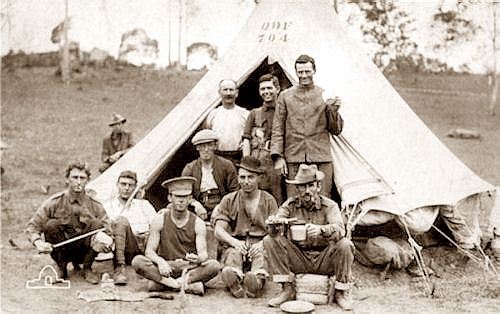
Right: Typical recruits at Enoggera Barracks c.1915
Source: With permission Australian War Memorial ref: H02156
Photographs of the camp can be seen at the Australian War Memorial, [Click on <
Collection search>,
enter <Enoggera> and choose <First World War>]
Enoggera became the main reception camp for Queensland AIF volunteers. It was set in what
appears to be low rolling parkland. It was also the location of an Army Clearing Hospital, No.13
Australian General Hospital, with at least 15 wards, the Army Medical Corps, the Dental Corps and
facilities for the Light Horse cavalry.
Photographic evidence suggests several camps whose accommodation of regimented rows of whitish
bell tents supplemented the original rows of low wooden barrack blocks. Some officers were
accommodated in white Niger tents with the luxury of a fly sheet. Open-air washing benches were
provided and dining areas, comprising of several trestle tables with two six-seater benches, were
under thatch-shaded pergolas. Each camp appeared to have its own parade ground, surrounded by low
wooden buildings with small windows high in the shaded veranda. Perhaps these were the
administrative blocks.
There are several photographs of White City Camp: more solid, white wooden clapboard buildings,
several having brick chimneys. Here was also recreation facilities: a gym, open-air boxing ring,
refreshment booths run by The Salvation Army and YMCA, and a bench-seated amphitheatre backing
onto an open-air wooden theatre set between two impressive brick towers.
1805info8d, sheet 3
His medical
At Enoggera's Army Clearing Hospital John Henry, declaring 'never to have been unfit',
was passed fit for active service. His medical officer, HD Stafford, recorded:
Height
5 feet 7 inches
Weight
130lbs
Chest fully expanded
35 inches
Range of expansion
2 inches
Vaccination marks
3 on left arm
When vaccinated
Vision
D6/D6
Complexion
Dark
Hair
Black
Religious Denomination
C of E
Marks
Scar back of neck, above right knee
His Army Form B103 creates a picture of the 40 years and one month man who enlisted
in the newly formed 42nd Battalion. The papers show he had no previous military
experience, no previous convictions and to be unmarried, His mother Margaret Elizabeth
CROMPTON, then of 55 Westborough Road, Scarborough, was nominated as next of kin.
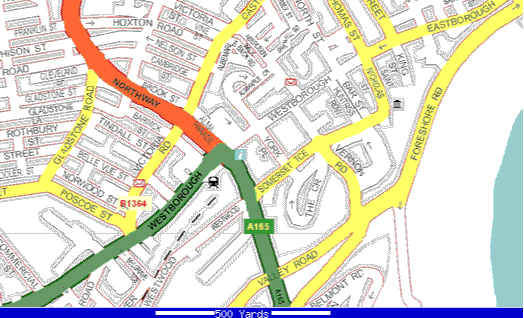
Right: A map locating Westborough, Scarborough
1805info8d, sheet 4
His Will
John Henry's will in favoured
Walter Ernest CROMPTON, his youngest brother, of 55 Westborough,
Scarborough in East Yorkshire. Walter was then serving as a Royal Engineers motor cycle
despatch rider on the Signals Company, Headquarters' Staff in France.
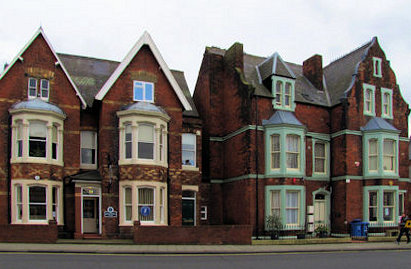
The green door of number 55 is situated by the base of the W on the green road on the map
above.
THIS IS THE LAST WILL AND TESTAMENT of me
JOHN HENRY
CROMPTON of ELIMBAH in the state of Queensland FARMER
at present however a PRIVATE in the 42nd BATTALION of
His Majesty's Australian Imperial Force.
1. I REVOKE all former Wills AND I APPOINT THE
PUBLIC CURATOR of Queensland to be my sole Executor and
Trustee of this my Will.
2. I GIVE DEVISE AND BEQUEATH the whole of my
estate both real and personal of whatever nature and
whatever situate (including therein the proceeds of
all policies of assurance on my life) unto my brother WALTER ERNEST CROMPTON of 55 Westborough, Scarborough,
England, or, in the event of his predeceasing me, to his
executors or administrators as part of his estate
AS WITNESSED my hand this day 14th day of APRIL 1916.
SIGNED by the said JOHN HENRY )
CROMPTON the testator, as and )
for his last Will and testament )
in the presence of us together )
present at the same time who in )
his presence at his request and )
in the presence of each other )
have hereunto subscribed our names )
as witness
)
Witness Ronald R.Davey
Occupation Farmer
Address
ELIMBAH
Witness W.H.F. Cowdry
Occupation Public
Servant
Address
BRISBANE
CERTIFIED TO BE A CORRECT COPY
1805info8d, sheet 5
Embarkation
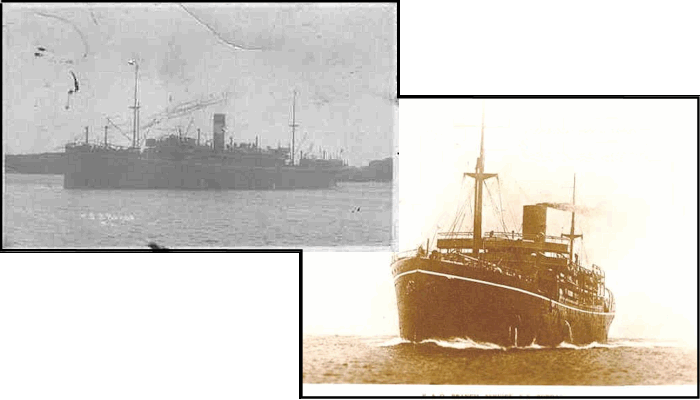
John Henry embarked from Sydney on 5 June 1916 on the 'A30 HMAT Borda', disembarking in
Southampton on 22 July 1916.
AUSTRALIAN
IMPERIAL FORCE- NOMINAL ROLL - continued
Reg No
Name (in full)
Rank
Age
Trade or calling
Married or
Single
Address at time of enlistment
Next of kin and
address
Religion
Date of
joining
42nd INFANTRY
BATTALION. "A" COMPANY - continued
73
Crompton, John Henry
Private
40
Farmer
S
Elimbah, North Coast Line,
Queensland
Mother, Mrs Margaret Elizabeth
Crompton, 55 West Borough road, Scarborough, England
C of E
6.12.15
Below: His Majesty's Australian Transport A30 Borda of 11,136 tons and
14 knots. Requisitioned as a troopship from P & O SN Co London. Commonwealth
control ended 10 September 1917.
Source:Diggers History - Troopships
En route
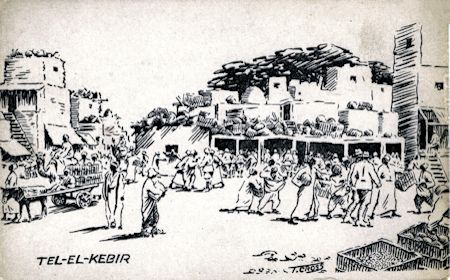
Suez was reached on July 6th, and the next day we arrived at Tel-el-Kebir
in Egypt, where we remained for a few days and thus gave the doctor an opportunity to diligently
exploit his prowess with "The Needle", and so, the 42nd was once more
inoculated.'
Source: Brahms, Vivian. 'The Spirit of the Forty-Second', Naval and Military reprint,
page 13
Hoverbox Photo Gallery - Tel-el-Kebir 1916 This feature does not function correctly on phones and tablets
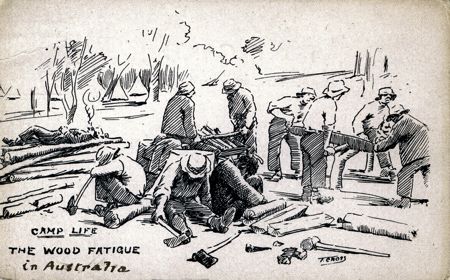
1. Camp life. The wood fatigue [in Australia]
2. Tel-el-Kebir town
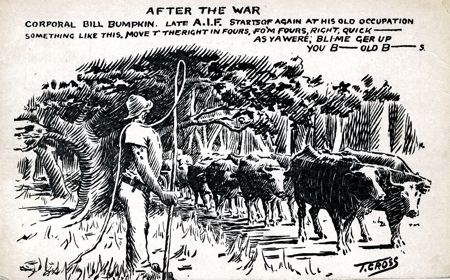
3. After the war
1
2
3
Source: Alex Postans' letters from John Henry
The voyage continued on the "Borda", on which we re-embarked at Alexandria,
for the passage through the Mediterranean. ... The menace of enemy submarines was very great, but
we reached Marseilles, in Southern France, without mishap on July the 19th. We proceeded through
France by train to Le Havre. It was here that we first saw a Red Cross train. Painted all white
with large crosses of red, occupied by wounded men and nurses, it was the means of making us
realise how near we were getting to the battlefield, and how grim was the job we had on hand.
(Brahms)
1805info8d, sheet 6
This letter to Alex POSTANS in Heath, Alberta, was written whilst on home leave, with his
mother in Scarborough, some eight days after landing in Southampton and before his full Larkhill
training began. However, the leave was so short that John Henry didn't envisage seeing any other
of his relatives.
The Canadians were stationed in this camp on Salisbury
Plains & got a sickener of mud & wet but we have been favoured so far with
drought & heat quite Australian. Only the early mornings are raw & cold &
misery to me.
The journey was good enough for troops & the rail trip through France simply lovely,
it is a gem of a country & very pleasant people. My folk are urging me to visit them
but leave is so scarce & I shall have little time to spare with them.
I often think of you all & wonder how all are doing the War prices must have been a
big help. Your lasses must be very useful to you now & I expect the boy is quite a
chuck of a fellow. Will you remember me to the Monaghans futh[….] & all the
folk I shall be glad to have the news via the above address when you can spare the time
Page 2
I expect Joe [FLINT] will be around still and Mr & Mrs Reynolds. Hope you are
having a good harvest & able to take a trip east now & them, How is Furnett
getting on & your brother & the Morrisons.
I did nothing very great in Australia, just quit when we were beginning to show a little
progress. All the same it is a good place for a man with energy & some capital a few
thousand dollars [Canadian]. Good land in a fairly safe district is getting high priced $
200 [Canadian] an acre is only usual for a good dairy farm in the coastal rain belt &
fruit land (planted) runs much higher while good virgin scrub forest land is worth $100
[Canadian] per acre as it stands. Inland leases can be got in dry areas on a large scale
for 3 cents an acre. How are prices moving with you?
1805info8d, sheet 7
End Notes:
The MORRISONS were Alex POSTANS relatives who lived at Greenshield a couple of miles from
Wainwright. Wainwright was 16 miles from the homestead.
Lumby was Ted “Goodnight” LUMBY (he prefaced most sentences with the word
'goodnight'), a neighbour.
Joe is Joe FLINT John Henry's friend, neighbour and homestead referee. Joe bought Jack's
Albertan homestead.
Monaghan
British sovereign was valued at Can$4.8666 on the 1914 gold standard.
John Henry Crompton's service record
John Henry's army record shows him to be a sick man, constantly plagued by bowel trouble. It
appears that he was killed in his only action.
On 3 October 1916 John Henry was transferred to hospital, for the first
time, before proceeding overseas with the 42nd Battalion on the 25 November 1916. During
December 1916, whilst 'in the field', dysentery or diarrohea [sic] sent him to hospital
for nine days. He returned to his unit on 13 December 1916 and back on duty three days
later.
He was again sent to hospital, first on 11 January 1917, then on the 17
January to the 3rd Canadian General Hospital in Boulogne before being transferred to the
2nd Advanced Casualty Clearing Station (ACCS) on 23 January with enteritis. The next day,
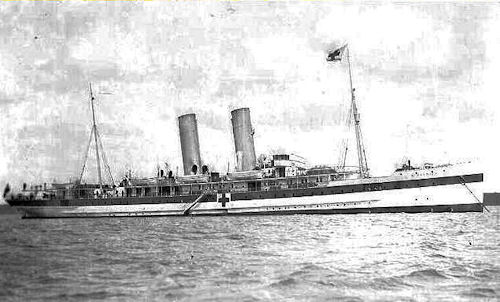
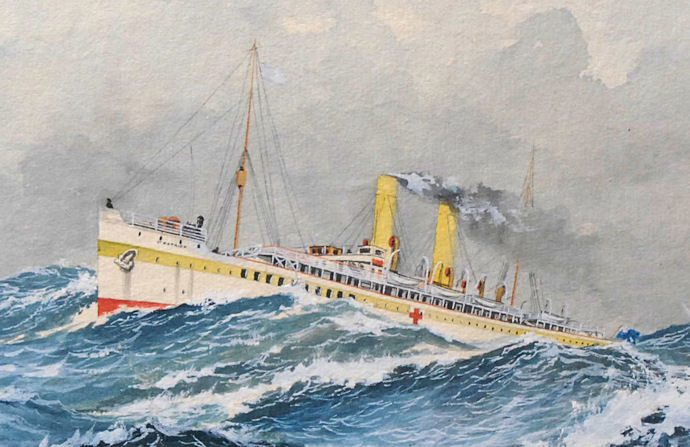
this necessitated repatriation to England on His Majesty's Hospital Ship St Patrick,
where an 'ulcerated bowell' [sic] was diagnosed.
Above: HMHS St Patrick extracted from a painting by
Will Jeneway in 1916.
With thanks to Chris Rushworth
1805info8d, sheet 8
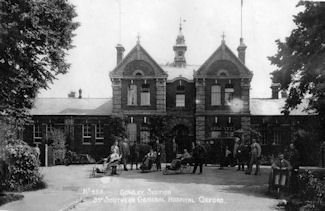
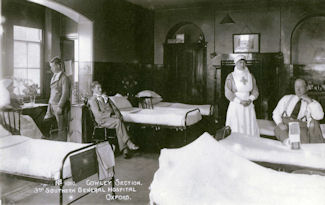
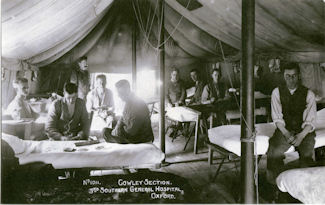
Enteritis enforced a 32 day stay in a hospital in Cowley Road, Oxford.
During the World War 1 this was designated as the Cowley Section of the Third Southern
General Hospital (whose headquarters were at the Oxford University Examination School) and
provided orthopaedic, surgical and rehabilitation care for wounded servicemen.
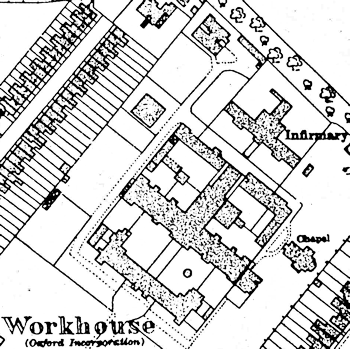
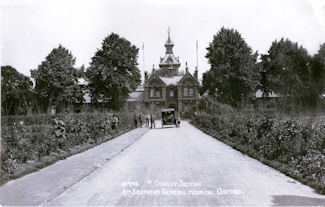
The photographs below show the Third Southern General Hospital, based in The Union
Workhouse, Cowley Road, Oxford. The Oxford Poor Law Board constructed a workhouse for 330
inmates between 1863 and 1865, on an 11 acre site, in red and white brick and dressed
with Bath stone. Later, in1929, it took the guise of a Public Assistance Institution as
an innovative hospital for geriatric patients. Finally as the Cowley Road Hospital, part
of the United Oxford Hospital, it was closed and subsequently demolition in 1981.
Right: 1901 Ordnance Survey map of Oxford workhouse situated at the corner of
Cowley Road and Divinity Road. Double click on the image for an A4 image.
Above: The entrance drive from Cowley Road. The central 30m
spire housed the workhouse Master and Matron
Above: The original workhouse infirmary at the rear of the
buildings
Above: An internal ward
Above: An additional tent ward in the grounds
Source: Oxfordshire County Council Photographic
Archives: 1990/3/2 1990/3/3 1990/3/6 1990/3/14 - acknowledged
1805info8d, sheet 9
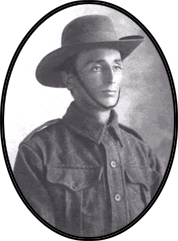
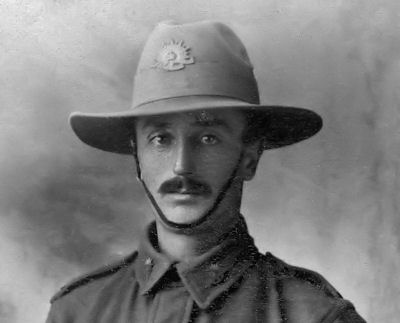
After discharge John Henry was granted a 16 day furlough
beginning on 20 March 1917. It is possible that, whilst in Scarborough, he had his
photograph taken (Right) in uniform and wearing the slouched hat of Major General
Monash's 3rd Division, worn after training in Egypt.
There is no photographer's address on the art-board surround, but the reverse records his
name and Scarborough address.
On 3 April 1917 John Henry reported to No.2. Australian Command Depot (C.D.) Weymouth. Here,
although he had put on weight, he was recorded as being thin but with normal bowel movements. He
was now deaf in his left ear. During May 1917 John Henry's fitness was graded B3 on three occasions.
Despite this grading John Henry proceeded overseas on 14 June 1917, first reporting to CO 3rd
ADBU (Australian Divisional Base Unit) in Rouelles, France before returning to 42nd Battalion on
13 July 1917. He was again sent to hospital on 24 July and did not rejoin his unit until 23
August. It was during this hospital stay that he missed the 42nd Battalion's opening action of
3rd Ypres at Warneton, on the Messines front, on 31 July 1917. On 13 August 1917 he was 'Adm.
wounded L.hand (AVC)' and didn't return from hospital until 24 August 1917.
Click on the Adobe Acrobat link to open a transcription of John Henry's B103 Casualty
Form Active Service, which describes his many illnesses.
Note:
On occasions the content and dates of the hand written and typed versions vary. The hand
written documents downloads are not clear enough to transcribe with 100% accuracy. In
general evidence is taken from the typed version, which may itself be second hand.
Click on the icons below to open files of John Henry's
service record from the Australian War Memorial.
These files do not include duplicated pages.
Click on the Adobe Acrobat link to open a 27.8Mb .pdf file
Click on the link to open a 3Mb Word2003 file
Click on the link to open the directory of .jpg images