|
| 1 | 2 | 3 | 4 | 5 |
|---|

|

|

|

|

|
1805 Info 8e: John Henry Crompton
|
The camp's origins
Whilst always associated with the School of Instruction for Royal Horse and Field Artillery (Larkhill), after war was declared, the position changed dramatically By 1914, Larkhill 1 had been chosen as the site for one of the new large hutted camps being built in different parts of the country and permanent buildings were introduced. Larkhill Camp began on 12 August 1914 and completed in early 1915, The site grew: the RAF Practice Camp became Durrington Camp; Lark Hill Camp was established both sides of The Packway and Pond Farm Camp was built to the north of West Down North Camp near The Bustard inn. Further west Fargo Down Camp was constructed; the original Rollestone Camp was north of Rollestone Bake Farm; whilst opposite The Bustard, on both sides of the road, was Bustard . After 1914, these camps increased in size and Hamilton Camp was built.
Thirty-four camps were completed in 1915 and were occupied by ‘units of practically every arm of the British Army’, each camp being designed to accommodate and infantry battalion. They were distributed as follows: numbers 1-14 lay to the east of a line from the RA Mess southwards through the site of the old Down Barn destructor to Fargo Road. Numbers 15-30 were located to the west of that line with numbers 15-19 to the north of The Packway and the remainder to the south. Numbers 31-34 formed a detached group about 500m east of Rollestone cross roads.
The typical wooden and tin-hutted buildings, some standing on two to three feet brick pillars, were suitable for all year use and for the continual coming and goings of a large number of troops. After the war, an observer described the camp as a collection of 'tin huts – even the Church and the cinema were corrugated iron'.
Hoverbox Photo Gallery - Old Larkhill Camp
This feature does not function correctly on phones and tablets
|
| 1 | 2 | 3 | 4 | 5 |
|---|
|
|
|
|
|
|
The new roads, constructed by the Royal Engineers from the natural chalk of Salisbury Plain, extending from the camp to the training grounds, proved sticky when wet and covered in clouds of white dust when dry.
| A Military Light
Railway 2 connected Larkhill to the London and Southwestern
Railway spur, at Amesbury Station, crossing the Packway and terminated at Rolleston
Camp, with a spur to the site of the original Fargo ammunition dump. The course of
the light railway's permanent way, though pulled up in 1935, can be traced by a
line of hedge row apple trees that, it is said, have grown from the seeds of apples
thrown out by troops on passing trains.
Right: Larkhill Military Railway 0-4-0 tank 'Queen Mary' used to pull troop trains from Amesbury to Larkhill Camp Source: NDG James Gunners at Larkhill |
 title="Larkhill military railway loco" title="Larkhill military railway loco" |
As well as the open spaces of Salisbury Plain, suitable for large-scale
manoeuvres, The School of Musketry had the following rifle ranges:
Source: James, Plain Soldiering p.129 |
 |
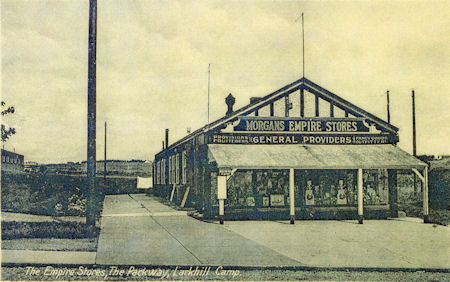
During the War welfare buildings on the camp included: the YMCA provided five huts in the Larkhill area as well as three huts at Rollestone. The Salvation Army had two huts, Larkhill I at Larkhill and Larkhill II at Durrington but there is no record of their location. However, after the War the Salvation Army established a Soldier’s Home on the north side of The Packway near Alanbrooke Road. In addition there were:
|
 |
| Thirty-four individual infantry training camps, of a size suitable for a battalion at
war strength, were added, and experienced by 'units of practically every arm of the
British Army'.
The verse, entitled 'Larkhill Camp', emphases the importance of infantry training: There's an isolated desolate spot I'd like to mention |
 |
| Above: Larkhill camp showing the 42nd
Battalion's Camp 11, the church, The Packway and the light railway. Source:
James, Plain Soldiering, p.126 Click on the image to see a larger landscape map of the whole camp. |
|
 |
| Above: Camp 11 Larkhill from the 1923 Ordnance Survey 6" map, show Camp 11 and the facilities around it. Click on the map to show a fuller 1923 map of all the Larkhill camps, including Rollestone, as a pdf |
The origins and early growth of the AIF's 3rd Division
In the post Gallipoli experience and the move of the AIF to France, there was a need to raise more Australian divisions. The 1st and 2nd Divisions were split to form the 4th and 5th Divisions. The 3rd Division was to be newly formed with Monash as its divisional commander. Battalion, Brigade and Divisional War Diaries begin in November 1916 and are very scant on detail.
The arrival of the 3rd Division in England, at the rate of three thousand men per week, in July and August 1916 facilitated the formation of companies, battalions and brigades at Larkhill. Salisbury Plain was not only more suitable for training, but it did not have the temptations which had so bedevilled the camps in Egypt. The men were virtually untrained and there was an acute shortage of weapons and equipment. However, Monash relished forging the raw material, who he saw as mostly averaging about 25 years, were mature, independent, hard and active with the outstanding characteristic being intelligence. The behaviour of the men was exemplary. The quiet determination, characteristic of the 3rd Division, was encouraged by Monash’s nature and methods of training relevant battlefield skills gained from Monash’s training of the 4th Brigade in his twenty months of war.
Monash's principles were: discipline—loyalty—esprit/obedience of orders—no dodging; cohesion of units—helpful spirit and making the best of all situations'. Training was divided between British Army schools, to train instructors in musketry, machine-gunnery, trench and gas warfare, who when qualified formed the divisional school. Each brigade built its own bombing course and each battalion its own bayonet course. All units down to platoons were rotated through the same exercises, ensuring tactical uniformity as well. The Inspector of Infantry, Major-General Sir Francis Howard, was impressed as ‘Everything I saw was being run on sound and sensible lines. Keenness and anxiety to learn are evident throughout and from eight to ten hours put in daily'. 2
42nd Battalion arrive at Larkhill Camp
In 1916, the AIF decided to form Australian training battalions in England from which reinforcements could be posted to Australian Divisions in France. Camps were established at Larkhill, Rolleston, Perham Downs, Parkhouse and Tidworth. 3
At Rollestone, Camps 31 to 34 were taken over by No. 2 Group, comprising 4th, 5th, 6th, 7th, 12th and 13th Training Battalions which were to provide reinforcements for the 2nd and 4th Divisions. No. 5 Group consisting of the 8th, 14th and 15th Training Battalions which supplied the 5th Division, together with the Australian Artillery Depot, were stationed at Larkhill. During July 1916, units of the 3rd Division began to arrive in this country from Australia and assembled at Larkhill where they remained until the Division moved to France at the end of that year. 4
During July 1916, units of the newly formed 3rd Division began to arrive from Australia and assembled at Larkhill, where they remained, in training, until the Division moved to France at the end of the year. And so on 23 July 1916 the 42nd arrived, all the way from sunny Queensland, by way of Egypt, at Amesbury Station.
| We crossed the English Channel on the night of July the 22nd, and disembarked next
morning at Southampton, travelling thence to Amesbury by train. We eventually reached our
new home on July the 23rd. Our address for the next three months was Number 11 Camp,
Larkhill, Salisbury Plain. We spent this time steadily acquiring the arts of war and
assiduously training both body and mind for that great day when we should meet the enemy
face to face. (Brahms)
On September the 27th, the Third Australian Division, of which we were a unit, was reviewed by His Majesty King George the Fifth. Including New Zealand troops there was a parade of 38,500 men. It was a most inspiring sight. (Brahms) The largest number of troops that we had ever seen on a route march was on the occasion when the entire Third Division, consisting of 18,000 men, with vehicles, animals, and mechanical transport passed along the roads stretching many miles around Salisbury Plain. The display was spectacular and impressive. This took place on November 13th, twelve days prior to our embarkation for France. (Brahms) |
 |
|---|
| They marched through Amesbury town on their way to their billets in Camp
11, in huts behind the then corrugated iron Garrison Church.
Right: A contemporary postcard of Amesbury High Street, which once saw the passing of many troops |
 |
However, Larkhill seems to have been unpopular with the Australian. On 3rd September 1916, WJ Sinney wrote, in an unpublished letter:
'It has been raining like fun here and things about Larkhill are pretty sloppy. It's a rotten place when it rains and a jolly sight worse if it keeps fine for any length of time. The dust is that fine that it will get in anywhere; do what you will you can't get away from it.' 5
Hoverbox Photo Gallery - The location of Camp 11
- Author: Spring 2000
This feature does not function correctly on phones and tablets
| 1. The field where Camp 11 once stood | 2. The modern Garrison Church |
| 1 | 2 |
|---|

|

|
 |
Left: Australians at Larkhill YMCA
Source: Alex POSTANS' papers. A post card sent by John Henry to Alberta, shortly before leaving for France in November 1916 |
This syndicated article, describing the relationship between Australian troop and the Young Men's Christian Association (YMCA), gives several insights into the lives of the Australians. It notes the number of troops and describes their accommodation throughout Larkhill Camp in 1916.
 |
| AUSTRALIANS AT
LARKHILL
Y.M.C.A. AMONG THE TROOPS.
That Australian soldiers abroad are faithful to the brands of commodities which they had been accustomed to use in their homeland is stated in a description of a visit to the "huts" of the Young Men's Christian Association' on Salisbury Plains, in England. "On Salisbury Plains", says the report, "There are three large camps of Australian troops and two New Zealand camps. At each of the camps the Y.M.C.A. has established huts, which have been paid for out of funds provided by the Australian and New Zealand branches of the association. The camps vary great deal in size. At Larkhill, where the' bulk of the Australians are to be found, there are 40,000 troops, and there the Y.M.C.A. has built five huts. The camps consist of long rows of substantial- looking buildings, the |
standard size being adapted for housing thirty men. These building are also called huts by
the military authorities. Most of them are built of wood, but some of them have wall of
corrugated iron painted a dull creem (sic). The accumulation or several hungreds (sic) of
these buildings in successive damps (sic) in the undulating plains of Salisbury gives some
idea of the determined spirit in which the Empire his settled down to the task of
inflicting a decisive defeat on Germany.
The association is endeavouring to see that each one of the 1500 huts will be supported, as a loss in working them would soon result in very serious financial embarrassment. But the standard of self support is not reached in all cases, in spite of the fact that so many of the Y.M.C.A. workers at the huts give their services voluntarily. The explanation is to be found in the fact that the prices charged for refreshments and for the |
miscellaneous articles sold at the canteen, which are the only sources of revenue, are low, and they are certainly lower than the price of the London shops. A cup of tea or coffee costs ld., cakes and tarts cost 1d. each, and for 2d. a good-sized pie can be obtained. These are prices with which the London tea shops cannot compete. With some articles the Australians and New Zealanders remain obstinately faithful to the brands with which they are familiar in their own country, and the same thing put up by the same maker under a different name for the English trade does not appeal to them. Needless to say, they are faith of all the brands of tobacco and cigarettes that they hare smoked under southern skies. The brands which provide the British Tommy with his favourite smoke has comparatively no sale among Australian troops. |
Note: 1d (pence) is equivalent to £0.20 or AU$0.35 (08/2014)
Source:
The Southern Argus Thursday December 21, 1916: Trove Digitised Newspapers
page 3 (Accessed 28 August 2014)
Training at Larkhill
Being a new division and under Monash’s tuition, the 3rd received more systematic training than the other Australian divisions who had been thrown into Gallipoli to be divided and rebuilt in Egypt. Issuing his own training circulars, Monash made use of the army’s manuals, schools of instructors, the experiences of officers and senior NCOs in France and his experience at Bois Grenier. These easily were digestible, concentrating on the basics: the use of bayonets and being an effective platoon commander.
Between August and September 1916, the Third were responsible for the construction of ‘The Bustard’ brigade trench system six miles from Lark Hill (see map) to familiarise the troops with trench conditions and live firing. The system 'replete in every detail with bomb stores, observer stations, sniper's positions [and] complete wiring'. Brigades lived in the trenches for five days, during which the two battalions in the front line were relieved by the two in support according to the Trench Standing Orders. Bustard was used for the punishing routines of simulated attacks, sham fights, bayonet charges and consolidation of a captured trench, despite any weather situation. In the weeks before embarkation the division experienced a whole ‘stunt’ (raid) involving the detonation of a mine, infantry consolidation, support by RFC planes and a creeping barrage. Patrols reconnoitred the 'enemy' trenches, which were then raided by each battalion. 6
As a result of the heavy casualties experiences at Fromelles and the Somme, the four Australian divisions required reinforcements; numbers needed that exceeded the capacity of the training depots. On 11 August 1916, the War Office made an innocuous enquired of Monash the level of training reached at Lark Hill; an enquiry that foreshadowed the breaking up of 3rd Division to supply the needed reinforcements. Four days later, Monash sent 2800 men to the Tidworth Training Centre in preparation for an early departure to France to reinforce other divisions. If shortages had existed beyond September, another 5000 reinforcements were expected to be sent to France, but the number of reinforcements enroute from Australia and the returning convalescents meant this wasn’t necessary.
However, Army regulations specified all troops must receive fourteen weeks training before posting to France, despite soldiers being ready for service after only eight weeks training in the harsher climate of Egypt. Monash attempted to have the division fit for service by October 1916 were compromised by a lack of equipment. The 3rd Division had to wait in turn for their equipment until 9 October 1916, until the expanding British army of conscripts had been equipped.
Monash was keen to show off his division whenever an opportunity arose. At the Royal Review at Bulford Field on 27 September 1916, 26 700 troops paraded, forming a line 2200 yards long, which took nearly two hours to march past George V. 7
To France
Then 'Saturday, November 25th 1916 witnessed the departure from Salisbury Plain of the 42nd Battalion. After chafing for months under the routine of drill and exercise, the Battalion at last emerged as a smart, well equipped, highly trained fighting unit, with every man fit and eager to get to grips with the enemy. Its strength was 33 officers and 994 other ranks. Reveille was sounded at 4.30am. It was a cold bleak morning on which we partook of our last breakfast at Number 11 Camp, Larkhill. After the meal, a period of tremendous hustle and bustle ensued. There were strapping and unstrapping of equipment, the packing of packs, to say nothing of the unceasing struggles to get all personal possessions, gear, ammunition, rations, blankets and utensils securely buckled to our body. These weighed approximately 100lbs, exclusive of rifles.
At length we fell in for final inspection, then off we went on the
four-mile journey to Amesbury railway station, gaily marching to the strains of the '
Colonel Bogie March' played by the Battalion Band.
|
 |
The following day their ship departed for Le Havre at 8pm with the troops disembarking at midday before proceeding to a rest camp. At 9am on 27 November 1916 the battalion entrained again, bound for Bailleul in the Armentieres sector where they arrived at 3pm on 28 November 1916. A two-hour route march brought the battalion to their billets at Outtersten, where training further began. 8
Training continued through December until the battalion moved into the left sector of Armentieres. 9
| Today Larkhill Camp is a School of Artillery for the British army. The coloured
photographs, of the modern camp, were taken the day before Gulf War II was declared and
when the Corporal of the Guard politely said 'Today isn't a good day for taking
photographs, Sir'.
Along the A345 is Durrington Cemetery, part of which contains the Commonwealth War Graves and commemorative an Australian obelisk to those killed in training. There are several 42nd Battalion graves. Right: A modern road sign locating Larkhill Camp Author |
 |
End Notes:
Source:
| More information 1 |
 |
More history of Larkhill Camp
During the latter half of the 19th century the need for permanent artillery ranges of adequate size, was apparent. There were three main reasons for this: there were new designs of guns, cordite was used instead of black powder and changes in the tactical use of artillery, which required practice in fire and movement. To facilitate this, The Plain was purchased in 1897 and became an artillery firing range in August 1899 marked by the boundaries shown on the 1903 Ordnance Survey map and over printed with Larkhill Artillery Range. This show the western boundary following the old Rollestone cross road to Redhorn Hill where it turned south to meet The Packway at its junction with Tombs Road and so back along The Packway to Rollestone. The second range was Rollestone Artillery Range now known as West Down range. Apart from Territorial units, Aldershot Brigades, who arrived after a forty-six mile two day march, used Larkhill. The first four tented sites, shown on the 1903 map were at the RAF Practice Camp, Larkhill, West Down North Camp and West Down South Camp. During the course of years the licence for The Bustard had lapsed, but in 1910, with the arrival of troops, this was renewed. In 1912 the School of Gunnery, moved from Oakhampton to Larkhill for both the Royal Horse and Field Artillery. In September 1914 we moved to Larkhill to carry out practice and at that time it consisted of a hut for the Gunnery Instructor on Knighton Down, all personnel being accommodated under canvas. From that single hut on Knighton Down has developed the great establishment which is now in existence there. 1There was also a School of Musketry at Larkhill with rifle ranges at Rollestone and Durrington. The first rifle ranges to be laid out near Larkhill shown on the 1903 Ordnance map of the area, were at Honey Down Barn, Rushall Down, Shrewton Folly and Wilsford Down. It is unlikely that the ranges north-east of Rollestone Camp, as shown on the Ordnance Survey map, were in operation in the First War. East of Rollestone crossroads was the original ammunition dump at Fargo, served by a branch of the Larkhill Military Railway. In the middle of October 1914, the first Canadian and Newfoundland troops to camps on or near West Down, with their headquarters at The Bustard. Further troops marched to Pond Farm on 21 October 1914. This coincided with a prolonged period of heavy rain, which lasted until February 1915, when 24 inches of rain fell or about one inch every five days. The camp turned into a sea of mud. It was not only extremely wet but cold high winds penetrated unheated tents. This prompted the construction of huts, with Jackson’s labourers supplemented by experienced Canadian and Newfoundland troops. In 1918 and 1919, for the first months after the War, Larkhill was used as a Commonwealth repatriation centre, with troops: dismantling many of the wartime camps […], although some of the huts were retained. The first camps to be dealt with were those located to the south of the Packway (except Nos. 29 and 30), that is, Nos. 1—9 and 20—28 and also Nos. 31—34 at Rollestone. The effect on the surroundings must have been rather depressing with many buildings in various stages of being broken up, rubble and rubbish scattered over a large area and weeds taking possession of disused roadways and old parade grounds. 2 During the late 1950s, it was decided to replace the old wood and corrugated iron huts, many dating from World War One, with modern buildings. End notes:
|
| More information 2 |
|
Larkhill Military Railway
Larkhill was one of the centres selected for the training of Kitchener’s New Army and troops from overseas. The order for the construction of hutted camps was issued on 12 August 1914 and by 14 August a complete working drawings of a typically hutted camps of a battalion of infantry at war strength had been made. Larkhill was constructed, at cost, by Sir John Jackson MP's company, which was one of the largest contractors of public works. Completion by early 1915 was largely due to Sir John’s organisation and efficiency. Clearly, with motor transport in its infancy, horse and cart and steam haulage, could not cope with the volume of traffic need to build the new camp. Since railways were the main form of transport, A light railway was to connect Larkhill to the Bulford Light Railway, which in turn connected to a standard gauge branch line from Amesbury Junction on the Waterloo-Salisbury line. Again, Sir John Jackson’s experienced railway building company was contracted to build a 4½ mile light railway. During the First World War, Amesbury, where troops changed from standard gauge to light railway transport was probably one of the busiest stations in the country. The Larkhill light railway branched at Ratfyn, some 640 metre north of Amesbury Station (GR 162424), crossed the Packway at GR 113445, terminated at GR 103449 and at GR 103446, the original Fargo ammunition dump. Construction of the 7.31 mile (11.750km) line began in 1914 and was completed the following year. From there it was extended through Fargo Plantation to Druid's Lodge on the Salisbury-Devizes A360 road with a branch to Stonehenge Aerodrome and another to Rollestone Camp. Today, the line of the railway can be traced by following curving hedgerows east of Ratfyn crossing the Countess Road at Countess Crossing, before winding north-west towards the Garrison Church on The Packway and beyond into the camp. Cutting and embankments are still well preserved. Brigadier DF Ryan, in ‘Larkhill, the early days’, referred to the apple trees growing along the side of the track, which are said to have grown from apple cores thrown out by troops from passing trains between Countess Crossing and Fargo Road. Whether true or not the apple trees are scattered rather than showing indications of being planted. |
|
 |
|||||||
| This page was created by Richard Crompton and maintained by Chris Glass |
 |
Version A13 Updated 12 September 2026 |
||||||


