 |
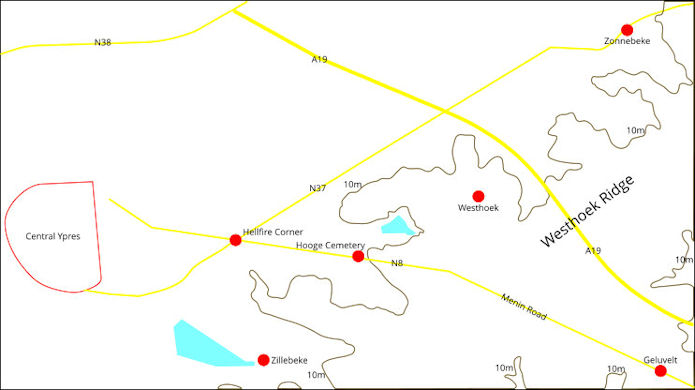
| Above: Map locating Westhoek above the Gheluvelt Plateau 10m contour Click on the map to open a scalable pdf map in a new window |
1805 Info 3g-3 for John Crompton |
Wounded in Action at Westhoek 16 August 1917
Strategic background
At the time of the Westhoek attack, 1/3 London Regiment, the Royal Fusiliers, were part of 167th Infantry Brigade 1 of the 56th Division, part of II Corps and Gough’s Fifth Army.
Westhoek was a Belgium village on the slopes of the Gheluvelt Plateau, 3km or nine minutes by road from Ypres. It lies north of the Ypres-Menin road and south-west of Polygon Wood. The Gheluvelt Plateau is part of a low ridge, shaped like a sickle with the Messines-Wytschaete Ridge as the handle with the south eastern part of a ridge forming a horn around the heavily defended city of Ypres. Some 35m higher it provided points of observation and enfilade fire. It was a critical objective for Gough’s and later Plumer’s attack and Haig’s grand strategic plan for Passchendaele and the Belgium coast
Operations on the Gheluvelt Plateau took place between 31 July and 27 August 1917 as part of the Third Battle of Ypres and specifically the battle of Pilckem Ridge. Strategically, the Plateau was the southern flank of any attack on Passchendaele. If still held by the Germans, they could see any advances and direct counter attacks and enfilading artillery fire into the right flank of the advancing British. Gheluvelt had to be cleared, preferably by regrouping shortly after the successful Messines attack. The initial plan was for Plumer’s Second Army to coordinate the clearing of the Plateau with Gough’s Fifth Army attacking in the direction of Zonnebeke and St. Julian.
|
|
| Above: Map locating Westhoek above the Gheluvelt Plateau 10m contour Click on the map to open a scalable pdf map in a new window |
However, lacking sufficient artillery in the right place, Plumer’s heavies had to reposition delaying the attack. Haig changed his commander but ‘thruster’ Gough, using the same corps as Plumer, recognised the same problems and instigated another delay. He believed that those Germans on the flank and not involved in the main defence would defeat any attack. Haig relented and the Gheluvelt attack was postponed until the end of July 1917. It would be launched six weeks later than intended, in conjunction with the main attack.
In the planning and execution phase, II Corps argued that the challenge of the Gheluvelt Plateau required a significantly more resources but only received an additional division and some artillery.
The preparatory barrage of Third Battle of Ypres, known as Passchendaele, began on 17 July. The British fired 4,283,550 rounds of artillery into the German defences, including over 100,000 shells containing chloropicrin gas before the infantry assault at 3.50 am (sunrise) on 31 July. The weather was misty, with low cloud and a westerly wind limiting the use of contact aircraft used to monitor the progress of the infantry. Rain, which had been falling steadily prior to zero hour, cleared as the day progressed, only to return that evening and continue unabated for the next four days saturating the top soil.
The artillery barrage was effective and the German defensive barrage, by comparison, was late in reacting to the attack and did not commence until 10 minutes after the assault had begun. It was described as weak and erratic, except that against II Corps on the Gheluvelt Plateau. With the exception of the Gheluvelt Plateau, the first objectives were secured by 4.40 am. This still represented a significant problem for tanks and even infantry with the attack hindered by the broken terrain and a slow, carefully staged approach.
In Haig’s view the Germans retaining a hold on the bulk of the Gheluvelt Plateau, was their only tactical success.
Even with fresh reserves, II Corps prospects for the resumed attack of 10 August were as poor as that of 31 July. Despite II Corp capturing Westhoek village, the massive concentration of German artillery continued to harass them. The lack of effective British counter-battery sites, restricted by the boggy conditions of the Hanebeek (also Hannebeek), had dire consequences. This, in turn, affected the whole attack until any planned attack were abandoned with the Germans still possessing most of the significantly tactical ground.
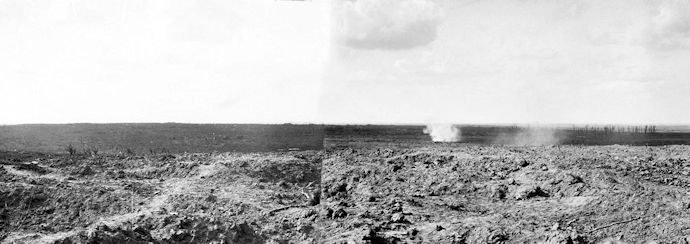 |
| Above: Taken from Westhoek Ridge, this is the ground around Hanebeek. However, it doesn't show the boggy landscape Source: Composite of AWM E00915A&B |
The terrain
Running from or parallel to the central ridge are several minor spurs including Westhoek Ridge. This produces a number of low valleys that, considering Belgium’s notoriously wet climate, channelled surface water into a large number of small streams including Hanebeek. Most of these streams run north or south from the east-west plateau. When combined with manmade land drains, these channels efficiently dealt with the surface run off above the vast sheets of impervious Y presian clay. By 1917, however, many of the land drains had been destroyed by artillery and with the natural streams blocked by debris, the natural drainage failed. Saturation turned the top soil into mud, the streams into marshes and the shell holes and trenches into pools and streams. In warmer weather, a skin covered the still saturated ground. 2
The eight square kilometres had a significant concentration of small woods and copses, many of which had been smashed by artillery. The stumps and fallen logs made concealed defensive locations to add to the difficult and broken terrain. Westhoek, as a village, and the Menin Road had been obliterated.
Glencorse Wood was found to be very marshy especially down the slopes on the Northern side where passage was almost impossible even to troops moving in file. The ground was entirely covered in shell-holes and fallen trees. The soil consisted of slimy black mud, which was very adhesive. The ground became even more swampy as far as the sunken road running through grid reference J.8.d.1.0 from when it improved as the ground sloped up. On both sides of this road there were concrete dugouts entirely undamaged. There were at least four encountered each capable of containing 25 men. These offered very little resistance during the advance though filled with men. No wire or trenches
were encountered anywhere except those that had been completely demolished. 3 Glencorse Wood had no undergrowth to speak of. Fallen trees helped the passage over the wet ground if anything.
 |
| Above: A view of the countryside near Glencorse Wood and Inverness Copse Source: AWM E00916P |
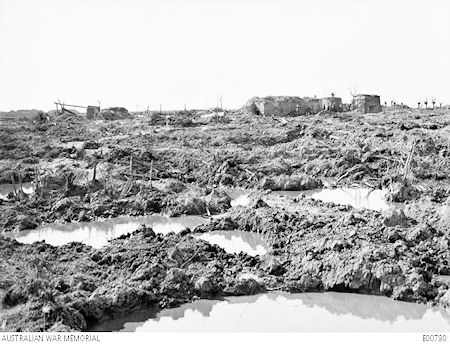
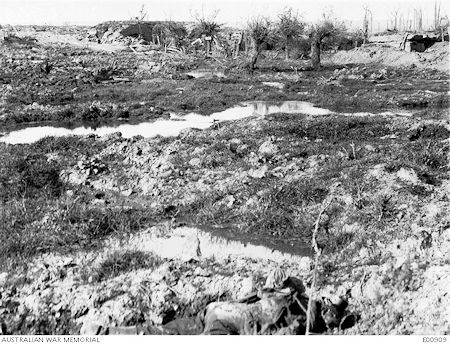
Nonne Bosschen though very marshy was passable for troops in extended order. The ground to the east of Nonne Bosschen rose gradually and was fairy dry but very churned up with shell holes. The soil here was sandy making rapid consolidation almost impossible. Nonne Bosschen and the Polygon hardly differed at all from the surrounding country as regards trees or undergrowth.
| Hoverbox Photo Gallery - Nonne Bosschen - Source:
AWM 20 September 1917 This feature does not function correctly on phones and tablets |
| 1. Nonne Bosschen swamp and concrete shelters after several weeks of dry weather AWM E00780 | 2. The boggy ground between Hanebeek and Nonne Bosschen AWM E00909
3. A typical Nonne Bosschen landscape |
| 1 | 2 | 3 |
|---|
|
|

|
The ground on the Western end of Polygonveld (sic) was dry but sandy. The whole ground in the valley to the north of the Battalion area was noticed to be exceedingly marshy. 4
14 August 1917 - the preparation
With a slipping timetable, the next phase was to begin on 14 August, but heavy rain caused a two day delay. By 14 August, the 56th (1/1st London) Division of Major-General F. A. Dudgeon relieved 25th Division.
At 4.30am, the enemy put down a heavy barrage on WESTHOEK RIDGE and the trenches east of it. This was in preparation for a successful attack on JABBER RESERVE and JABBER SUPPORT trenches, which took place 15 minutes later. The 1/3 Londons were ordered to regain the trenches at dusk. At 7pm after a successful attack, 1/3 London were relieved by dawn with the exception of 1/3 London’s left front company. 5
15 August 1917 – further preparation
Representation was put forward to postpone the attack for one day because of the impassable conditions of the ground and the considerable number of 1/3 London’s casualties and who had been on the move for three successive nights. Owing to the continuous shelling, it was difficult for the attacking battalions to familiarise themselves with the boggy ground or to lay communication cables. Despite continuous enemy shelling on the back areas, the relief was completed before dawn, including the left company of 1/3 London. 6
The battle narrative appears in the 1/3 London’s War Diary. 7 Having held the whole front line, on the night of 14/15 August 1917 the 1/3 Londons were relieved by 1/1 Londons and 8/Middlesex and moved back into support.
16 August 1917 - the battle
At 4.45am on 16 August, the barrage opened and II Corps crossed the start-line.
The 167th Brigade (167/Bde) Instructions No.1, 8 dated 11 August 1917 and subject to alteration, sets out the detail of the battle plan for an offensive operation against the Gheluvelt Plateau between 12 and 17 August 1917. The front line taken over ran approximately along JABBER RESERVE trench from its junction with the Westhoek to Zonnebeke road to about map reference J.8.a.8.2, then to the road at J.8.c.4.7 excluding the houses ending at J.8.c.8.5. (see map though these coordinated do not correspond with the markings on the printed map). However, the front jump-off line needed straightening by completing the capture of JABBER RESERVE trench as far J.8.c.9.9 and to make the gun pits and house at J.8.d.1.4 ‘good’. On 15 August JABBER SUPPORT trench had become the front line. The outpost line was withdrawn 1½ hours before ZERO as the barrage started on J.8.a.50.55. 9 10
167/Bde were the right brigade of 56 Division (56/Div) with 25/Bde on its left. Both brigades were tasked with capturing and consolidation the GREEN LINE approximately along the line J.14.a.7.5 – J.9.c.9.4 – J.9.c.9.8 – J.9.a.9.4 – J.3.c.4.8. 11 Additionally a line of Posts was to be established to support the front of the GREEN LINE against counter-attack approximately along the same line. 167/Bde start line was JABBER SUPPORT TRENCH 13 and were specifically tasked with constructing Strong Points at J.9.b.6.7 and J.3.c.20.25. 14
In the initial planning 7/Middlesex were to attack on the right and the 1/3 London’s on the left. 1/1/Londons were in reserve and to mop-up German strong points not neutralised by the leading battalions. They were also to provide one company to reinforce each battalion. The attacking battalion were to capture the objective GREEN LINE as there were no battalions to ‘leap-frog’ through to gain more ground. However, by 167/Bde Instructions No.2, dated 14 August 1917, 1/3 Londons had become the reserve battalion with 1/1 Londons taking part in the attack. There is no obvious reason for this exchange. Consequently, the details of Instruction No. 1 have been amended to reflect this change
The dividing line between the assaulting battalions was the end of JABBER RESERVE at J.8.c.9.9 to the end of NONNE BOSSCHEN at J.8.b.4.2. It then went to the south face of ALBERT REDOUBT and JEREMY SWITCH at the J.3.d.3.3 track junction then northeast to the GREEN LINE. Capture and consolidation of the GREEN LINE. Additional to the consolidation of the GREEN LINE by the Centre and Left Brigades.(See map).
Each battalion was to undertake a two-company attack on a front of two platoons, usually 40 men at full strength. One platoon formed the second wave with one platoon in reserve. The supporting companies formed the third wave some 500 yards to the rear. 15
1/3 London in support, who has assembled in the open on the west slopes of WESTHOEK RIDGE, were to provide the mopping up companies starting in a line from J.9.a.35.05 to J.2.d.9.2 with the second company mopping up to the west of this. Their critical part in the operation was emphasised so that the enemy didn’t appear behind the attacking force. When this task was completed, they were to form Strong Point 15 at J.3.c.20.25 to fend off counter attacks with the assistance of four units from the167/Machine Gun Company. The remainder of 1/3 London assembled in the open west of JABBER TRENCH and then occupied the trench when vacated, pushing forward one platoon to JABBER SUPPORT and JABBER RESERVE to garrison the trench and become the reserve company. 16
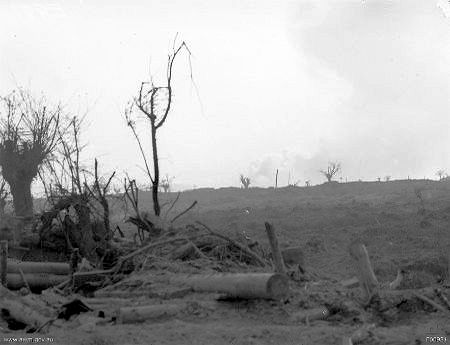
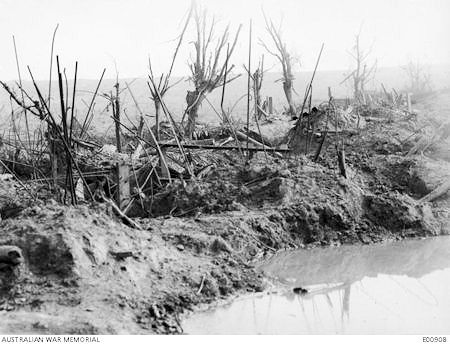
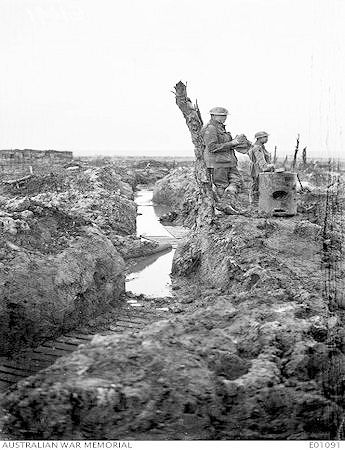
Hoverbox Photo Gallery - Westhoek Ridge showing the desolation and water logged ground -
Source: AWM September/October 1917
This feature does not function correctly on phones and tablets
|
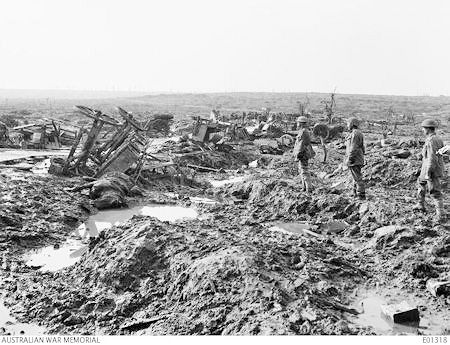
1. Westhoek Ridge showing debris and shell damaged tree AWM E00981 2. A damaged German strongpoint and water filled crater AWM E00908 |
3. Westhoek Ridge Communication trench AWM E01091 4. Corduroy track from Westhoek Ridge to Bellevarde Ridge AWM E01318 |
| 1 | 2 | 3 | 4 |
|---|
|
|
|
|
At dusk on the 15 August as the battalions massed for attack, ‘B’ Coy. became the ‘Mopper ups’ for 8/Middlesex and ‘D’ Coy. for 1/1 Londons. ‘A’ and ‘C’ Coys. became the reserves in preparation for taking over JABBER RESERVE. The nature of the ground and the mixing of units in the darkness complicated the assembly.
The barrage and attack began at 4:45 am, and the infantry advanced as the barrage began its creep forward. German SOS flares rose into the sky but their artillery reply began too late and missed most of the attacking waves, except in the 56th Division area on the right. 17 Due to the slowness of the creeping barrage, all waves and mopper-ups mingled into one thick line, consequently small bodies of the enemy were overlooked. The first enemy 4.9 and 77mm shelled the 1/1 Londons front and support lines, before they had gone 300 yards. By 5.15am, impassable swampy ground, in J.8.b & d west and northwest of NONNE BOSSCHEN and defended by snipers and machine guns, check the advance. By 5.30am, the left mopping up party had established a strong point at J.8.b.0.8 and had taken five prisoners.
|
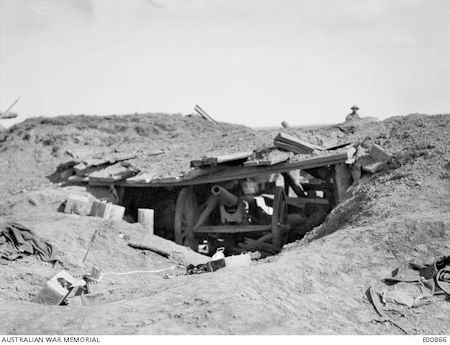
Right: Concealed artillery between Westhoek and Nonne Bosschen Source: AWM E00866 |
 |
At about 12.30am Lt.Col. FO Samuel DSO, commanding 1/3 London had moved to the dugout occupied by the CO 8/Middlesex:
was hit by a high explosive shell and the entrance was blown in and a good deal of damage done. Lt.Col. Ingpen then established his HQ in JABBER TRENCH. […] At about 4pm it was reported that enemy were counter attacking but in view of the obstacle formed by the wet ground, it is probable that they were reoccupying the position from which they had retired. At about this time I had the news that Lt.Col. Ingpen had be hit and also my Adjutant. 18
which accounts for Jack's wound. It is possible that Jack was in this forward position as a liaison officer.
From 6pm, enemy’s fire slackened and, for the rest of the night, everything became quiet and consolidation was possible on a line in front of JABBER RESERVE trench with mixed parties of 8/Middlesex and 1/3 Londons though they were relieved that night by 7/Middlesex. 19 By this time, Jack would have been at HALF WAY HOUSE, the location of 167/Bde’s headquarters at I.17.c. 20
167/Bde’s reflections on the action took place at a conference on 19 August 1917. It was agreed that the opening stages of the assault was very successful though the pace was slow causing the rear waves to mingle with the first wave. The barrage was considered exceedingly good, halting at the proper time and in the proper place. The barrage was however too slow when once the marshy ground had been cleared, ie on approaching NONNE BOSSCHEN. 21
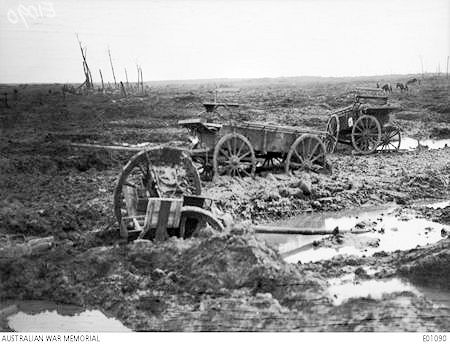
| The assault was hindered by a belt of mud 30 yards wide and 4 to 5 feet deep with
standing water to a depth of six inches to one foot deep. It was so bad, that none of
the tanks in support got into action. 22 Even the General Servive wagons
and mules found the going difficult. This forced the attacking units to migrate to
the left mingling with troops from 169/Bde, who were migrating right.
Right: Westhoek mud and transport 09 October 1917 AWM E01090 |
 |
This allowed troops from Infantry Regiment 145 penetrating gaps. 23 When 8/Middlesex reached the northern end of NONNE BOSSCHEN WOOD they had lost touched with each other and lost the protective artillery barrage. After several attempts to advance and unable to traverse the machine gun defended bog, the brigade consolidated to repel counterattacks, which the boggy ground and the strong posts, established by 1/3 London mopper ups, prevented. In the meantime, 169/Bde, on their right moved the GLENCORSE WOOD, though the brigades were not in touch. 24
At 10am, owing to their flanks being exposed, 8/Middlesex withdrew to about J.8.b.3.3, making contact with 1/London and 1/3 Londons. Two companies of reinforcements were sent forward. Between noon and 5pm, little changed.
Casualties
Whilst the 1/3 London’s does not identify the casualties for the action at Westhoek, Jack, being an officer, is mentioned in the total figures for August 1917.
1/3 London Regiment Casualties for August 1917 25
| Officers | OR | ||
| Killed | 2 | 26 | |
| Died of Wounds | 0 | 4 | |
| Wounded | 3 | 195 | including Lieut J, Crompton |
| Missing | 2 | 53 | |
| Total | 7 | 278 |
The attack at Westhoek - In conclusion
No resistance encountered up to the Sunken Road and none within NONNE BOSSCHEN. The principle difficulty experienced was that of efficient ‘mopping up’. This was especially so in the case of strong points. Many Germans remained hidden in shell-holes and re-opened fire when the withdrawal took place. These usually had machine guns covered with earth pretending to be dead. 26
The II Corps operations on the Gheluvelt Plateau from 31 July to 31 August were conducted by seven divisions including the 56/Div from 25 June – 31 August. The II Corps artillery fired 2,766,824 shells, amounting to 86,766 tons. All of the II Corps divisions suffered many casualties and the torrential rains created exhausting conditions for the infantry. Edmonds, (the British Official Historian) wrote in 1948, that the costly failure to capture the plateau in August, depressed British morale lower than ever before.
On 25 August, Haig transferred responsibility for Passchendaele attacks to General Plumer and Second Army, recognising that the capture of the Gheluvelt Plateau was more suited to carefully planned attacks for which he would concentrate maximum resources to support the attempt. The initial activities of the Passchendaele campaign were over at a cost of 10,000 killed and 50,000 wounded. So opened the next phase, the battle of the Menin Road.
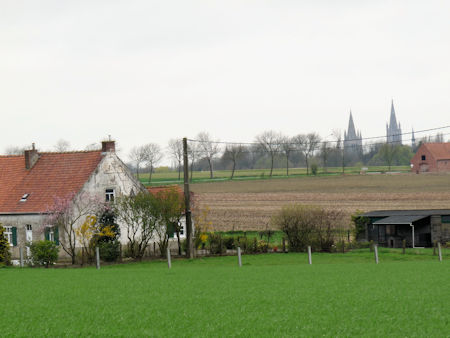
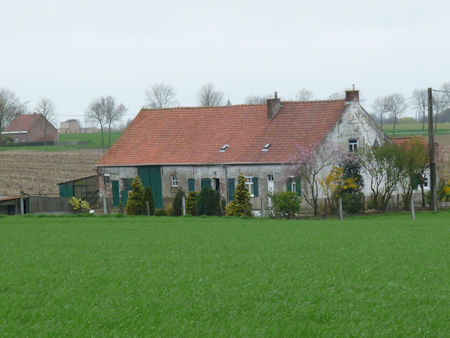
Westhoek in October 2008
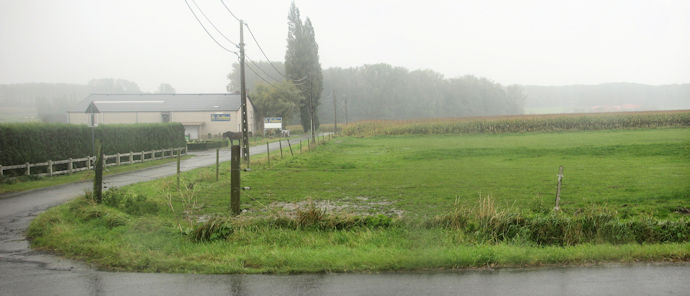 |
| Above: Believed to be the left-right position of Jabber Trench, where it is thought Jack was wounded, looking towards Bellewarde Ridge - Author: April 2009 |
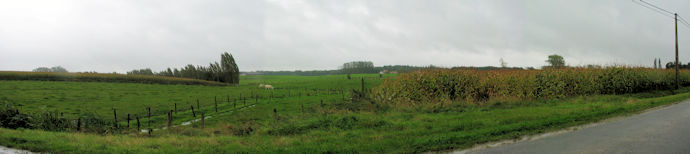 |
| Above: The left flank of 167/Bde's line of attack looking down Grote Molestraat towards Westhoek Author: April 2009 |
| Right: Believed to be the location of Jabber Reserve Trench from Grote Molestraaten, Westhoek looking towards the Gheluvelt Plateau. Water can be seen standing on the plough land Author: April 2009 | 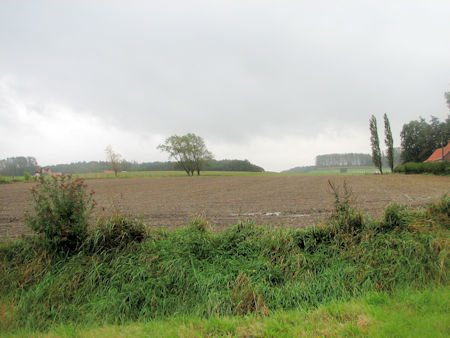 |
End notes
Sources
From Half Way House ...
Halfway House is at the end of the track that runs to the south of Perth (China Wall) Cemetery, some 500 yards from the main Ypres to Menin road. At the time of the 1/3 London’s action, it was the headquarters for 167/Bde and probably an Advanced Dressing Station. 1
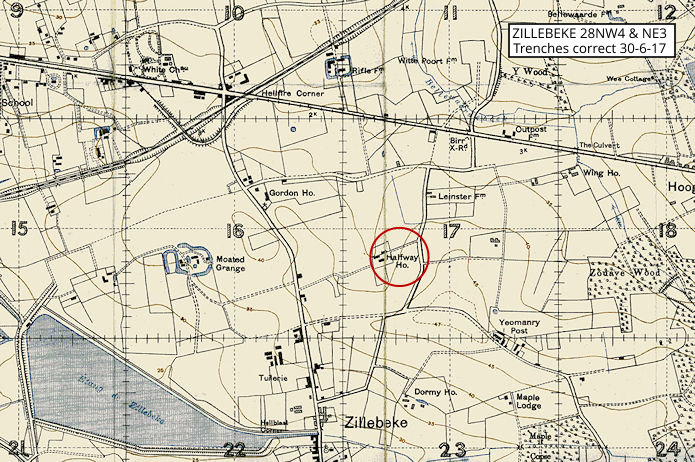 |
| Above: Trench map locating Halfway House 2miles/3km from Westhoek |
Between 6pm and 7pm, this was the place where the wounded Jack reported. 2 It also appeared to have been an assembly area for troops gathering before an attack or held there in reserve and could be kept under cover.
 |
| Above: A composite image of 167/Bde War Diary for 16 August 1917 recording Adjt 3rd London came in wounded ... Click on the map to open a scalable pdf map in a new window |
The Halfway House dugout, located at the intersection of Ritz and Oxford Street communication trenches between Hellfire Corner and Birr Cross Road, was 500 metres south of the Menin Road. It was once the location of a large German fortification before being by the 171st Tunnelling Company. On 7 September 1917, the 1st Australian Tunnelling Company replaced the 171st Tunnelling Company, assuming responsibility for maintaining and extending the system. The ground was so water logged that it was impossible to dig good dugouts unless they were properly engineered, timbered and drained. Being down at the foot of the slopes on the side of the Menin Road, water poured through the entrance via the trenches at the top of the steps, flooding the tunnels to a depth of 600mm. It was damp and evil-smelling, and constant pumping was necessary to keep them habitable. 4, 5
The Halfway House dugout was extensive and, during the Battle of Menin Road, housed an advanced dressing station, brigade and battalion headquarters and accommodation for tunnellers, signallers and around 1000 infantrymen: from the British 8th Division in the days leading up to the start of the battle.
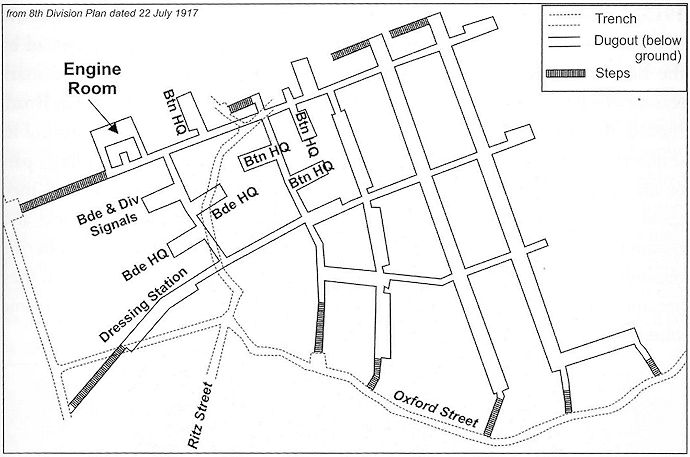 |
| Above: Halfway House tunnels on 22 July 1917 showing the Dressing Station where Jack was probably treated 3 |
| Generators from the Australian Electrical and Mechanical Mining and Boring Company
(The Alphabet Company) supplied the electricity for this system.
Right: Halfway House generator Source: AWM H12777 |
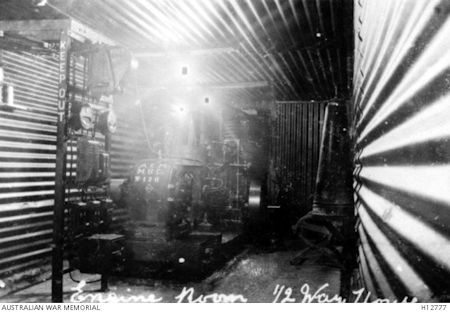 |
In the German offensives of Spring 1918, the British were pushed back to Hell Fire Corner, mid-way along the Zillebeke Lake reservoir. On 19 June 1918, 350 men of 1/4 Duke of Wellingtons Regiment raided in strength towards Half Way House. ‘A’ Company crossed the Calvary Road where they made contact with the Germans, who quickly withdrew after an exchange of bombs. At 12.45 ‘A’ Company were ready to continue their advance to Half Way House. The withdrawal began at 1.30.
| It was also the location of a French cemetery adopted by the 2/Scottish Rifles
when it was known as Perth Cemetery after their town of origin. It was also known
as China Wall Cemetery, after the main communication trench from the Menin Road to
the front to the south of the Menin Road, and Halfway House Cemetery after the farm
of that name which is to the east of the cemetery. It became the CWGC post-war
consolidation cemetery known as Perth Cemetery. 6
Right: China Wall Cemetery at an unknown date |
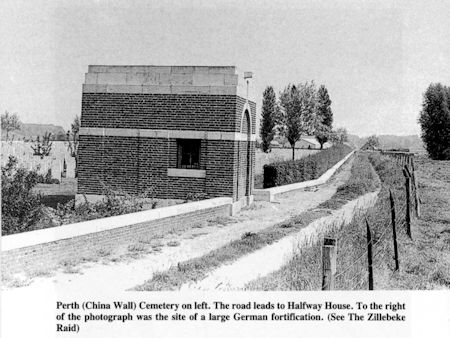 |
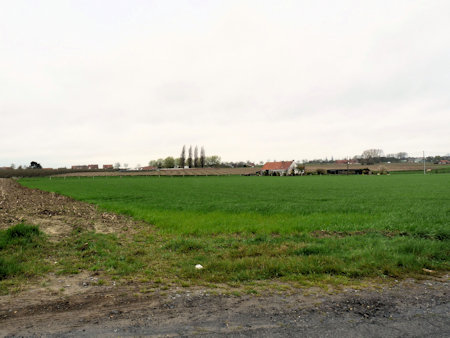
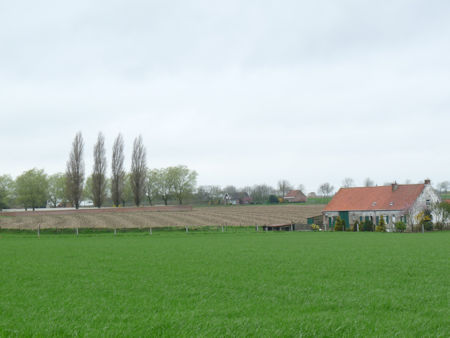
Hoverbox Photo Gallery - Halfway House - Author: April 2009
This feature does not function correctly on phones and tablets
|
1. Halfway House from China Road 2. Halfway House and the fields where the deep dugout may be sited |
3. Halfway House looking toward Ypres churches 4. The modern Halfway House |
| 1 | 2 | 3 | 4 |
|---|
|
|
|
|
End notes
Sources
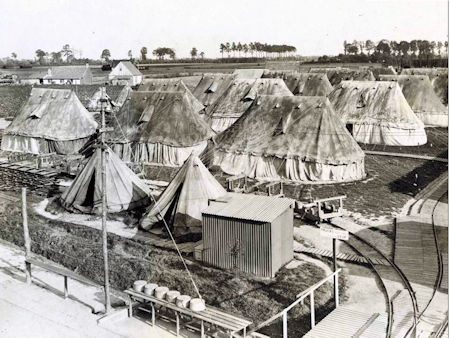
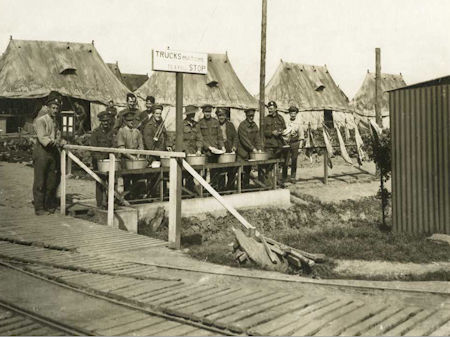
Shortly after being wounded, Jack had one third of his right Olecranon removed in an operation at the 2nd Canadian Casualty Clearing Station (2/CCCS)1 at Remy Sidings 2, Lijssenthoek, Belgium. This was the site of the largest hospital complex in the Ypres Salient, comprising of a three casualty clearing station complex 2 miles/3km south-west of Poperinge. In 1917, 30,000 patients were treated. 1 It was adjacent to the site of the present Commonwealth War Graves Commission's Lijssenthoek Military Cemetery, where there are 9,901 burial, related to the CCSs except for 41 concentration graves. 2 The French built the original hospital on 'Ferme Remi', named after the farmer, one Remi Quaglebeurs. 3 The sidings were the name given to the ambulance train spur off the railway linking to the Poperinge railhead.
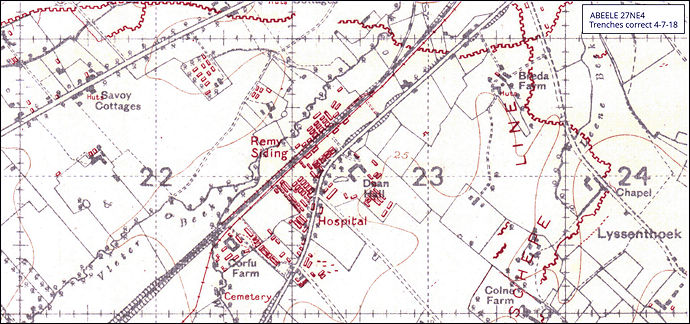 |
| Above: Remy Siding Trench Map Abeele, with defensive
trenches correct 04 July 1918
Click on the map to open a scalable pdf map in a new window |
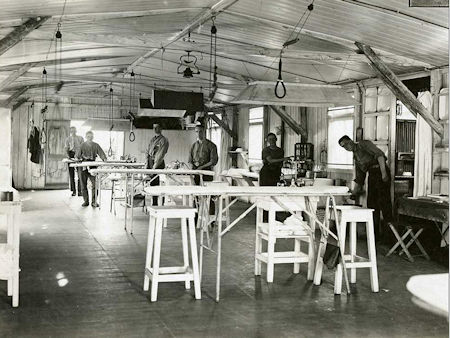
A soldier injured in the field was first treated at a Regimental Aid Post (RAP), in the trenches by the Battalion Medical Officer or his orderlies and stretcher bearers. This would only be crude superficial medical care in the manner of first aid. The walking wounded made their way to an Advanced Dressing Station (ADS) manned by the Field Ambulance of the Royal Army Medical Corps (RAMC) close to the front line: in Jack's case at Halfway House. Here wounds could be dressed and some emergency operations carried out. If further treatment was needed the casualty was evacuated by horse or motor ambulance, buses or light railway to a highly mobile Casualty Clearing Station (CCS). This was a tented camp behind the front line and beyond artillery range, which was not for the long term care of the sick. Triage assessment repaired the hastily dressed wounds or performed specialist emergency treatment, such as amputations, before evacuation to a base hospital by ambulance train. It was unusual for a patient to spend no more than a day at a CCS before being evacuated. 4
| In Jack's case, he was evacuated to The First Northern General Hospital in
Newcastle where there was a specialist orthopaedic centre.
As walking wounded it is not known how Jack got from the Regimental Aid Post at Halfway House to 2/CCCS or how long it took. A possible route if the railway track (see below) that extends from Poperinge eastwards to Ypres Asylum and then south-east towards Zillebeke. However, many light railways criss-crossed the area. Right: Remy Siding-Lijssenthoek station Source: Bulletin November 2014 p.37, a Journal of the Western Front Association |
 |
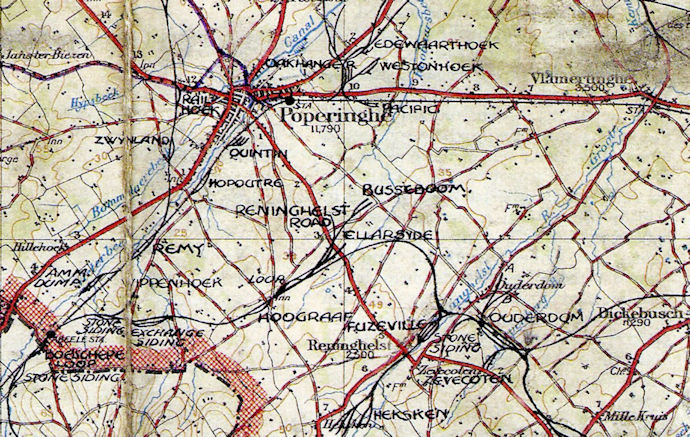 |
| Above: Major Barrington-Ward's railway map locating
Remy Siding and Poperinge Source: Bulletin November 2014 p.37, a Journal of the Western Front Association |
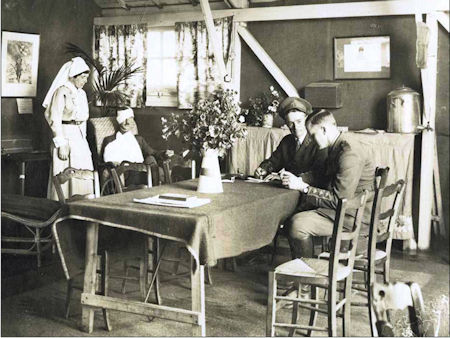
Hoverbox Photo Gallery - Remy Siding 2/CCCS 5 Source: Archives of Canada Ontario
This feature does not function correctly on phones and tablets
|
1. Camouflaged tents Source: I0050302 2. Patients and tents Source: I0052165 |
3. Operating theatre Source: I0050301 4. Officer's mess Source: I0052166 |
| 1 | 2 | 3 | 4 |
|---|
|
|
|
|
The War Diary of 2/CCCS records the events of 17 and 18 August 1917 and gives an indication of the pressure felt by the hospital. The salient points have been transcribed for the 18 August, when I think Jack fwould have been admitted, given the time of his wound and the time taken to evacuate him. On 16 August 1917, casualties from the expected attack began to arrive at 1am. During the next twenty hours, 367 lying and 833 sitting cases were admitted; a total of 1200 new cases at a rate of one a minute. In the same period, 944 cases were evacuated. JE Davey, the author of the War Diary, ends the day by writing ‘Our work has gone very smoothly today. Evacuation trains have been always on hand. No 10 CCS took cases from the “shuttle trains”.’
|
Remy Siding |
17 | 1am | Evac 175 |
| 4am 5.30am |
Began admitting Evac 152 |
||
| 8.30 9.30 |
Evac 110 Completed admitting (63 lying + 183 sitting = 246) |
||
| pm 2.50 |
Began admitting Evac 36 |
||
| 6.20 | Completed admitting (55 lying +
190 sitting = 245) Visited by Sir Anthony Bowlby who reported that the fight had been a success. We had been held up on our right but fresh Divisions were completing our objectives. He further informed us of the splendid success of the Canadians at Lens. Sister Graham received message her brother had been wounded at Lens. Visited by DMS |
||
| From 10am (16th)
to 10am (17th we admitted 1202 casualties of whom 1096 were wounded. We operated on 162 of these. There have been 6 deaths. |
|||
| pm 9.30 | Enemy aeroplanes
droped (sic) 4 to 6 bombs over our area. Two fell on No.7 CCS close by causing 60
casualties, 14 OR personnel and 10 German wounded prisoners were killed. 27 OR personnel and 9 Germans wounded |
||
| 11.45 | Evac 91. Wrote DMS
asking for a splinter shelter for the Nursing Sisters. Fine cloudy intervals |
||
| 18 | AM 2.30 | Evac 265 | |
| AM 12.55 | Began Admitting | ||
| 3.30 | Evac 78 | ||
| 6.30 | Completed admitting (60 lying & 188 sitting - 248) | ||
| 9.30 | Another enemy air raid. Bombs dropped towards Godewaersevelt & Hazebrouck. There seems to be a special purpose in the enemy aeroplane raids recently. [...] (At Remy (Nos 10, 17 and 2 & 3 Canadian CCS) there were 60 casualties. I examined the craters at No 17 CCS today. They were 12 to 14 feet in diameter and 5 to 6 ft deep. One was within 20 yards of the officers huts and tents which were riddled with splinters. The officers were in the mess tent. |
 |
| Above: 2/CCCS War Diary 17 August 1917 6 |
End notes
Post war records
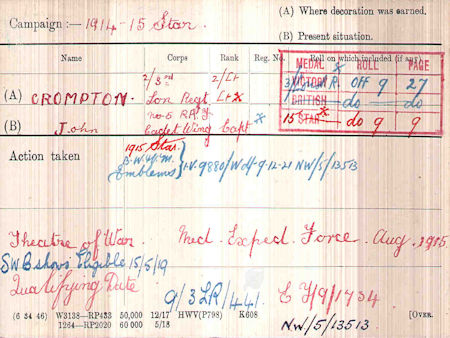
| Hoverbox Photo Gallery - Jack Crompton's
medal records - Source - Ancestry This feature does not function correctly on phones and tablets |
|
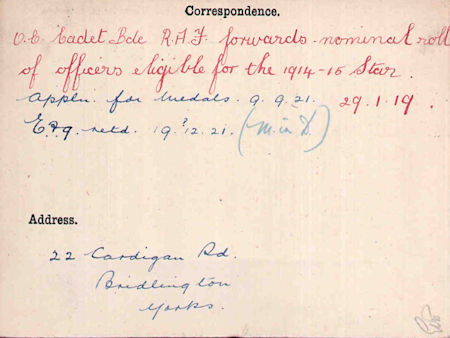
1. Medal roll card obverse 2. Medal roll card reverse |
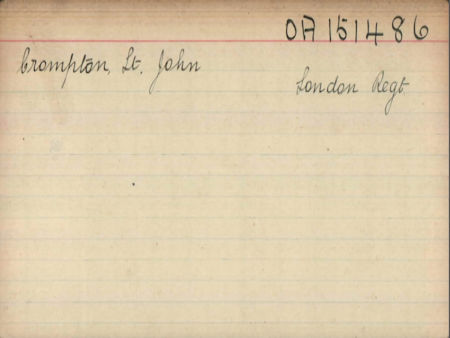
3. Pension card |
| 1 | 2 | 3 |
|---|
|
|
|
Card one is the most informative document. It shows that Jack entered a theatre of war in August 1915 as part of the Mediterranean Expedition Force. This entitled him to the 1914-19 Star, issued o officers and men of British and Imperial forces who served in any theatre of the War between 5 August 1914 and 31 December 1915. in addition to the Victory Medal and British War Medal - Pip, Squeak and Wilfred. It confirms he was initially with 2/3 London Regiment as a Second Lieutenant, with a promotion to Lieutenant. It also confirms his promotion to captain with No5.RAF Cadet Wing.
| Card two repeats this information but adds that Jack applies for his medals on
09 September 1921 and that they were sent to 22 Cardigan Road, Bridlington. I
suspect that it was decided he qualified for the 1914-195 Star on 29 January 1919.
The card suggests Jack was retired on 19 December 1921. 1
Right: From left to right - The 1914-1915 Star, British War Medal with Oak Leaf and Victory Medal, known as Pip, Squeak, Wilfred |
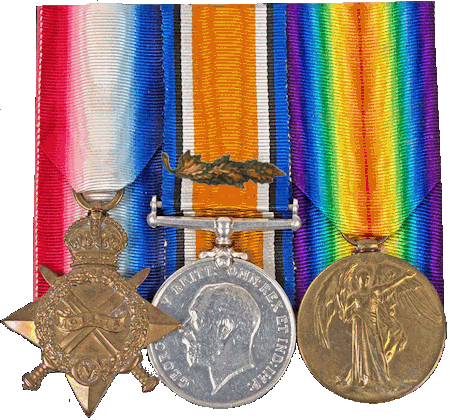 |
Card two records an intriguing (M in D). If Jack was Mentioned in Dispatches, I have yet to find a report. If correct he would be entitled to an oak leaf in bronze on his Victory Medal. This signifies Jack's name appeared in an official report written by a superior officer and sent to the high command, in which his gallant or meritorious action in the face of the enemy was described.
Jack's Pension record card three is blank suggesting either he had no pension for his TB or that he died before an award was made. 2
End notes
| More information 1 |
 |
2/Canadian Casualty Clearing Station
In July 1916, the War Diary locates No.2 CCCS at Aire, which could have been 3 miles (5km) from Bethune or at Aire-sur-Lys. At 10.30pm on 07 August 1916, the unit was notified by telephone that movement orders were on their way and asked when they would be ready to move. The next day the advanced party arrived at Remy Sidings to look over the ground and buildings with the French sergeant in charge. The handover was immediate. The new location was described as having five well built French huts, three being 27 feet (8m) by 97 feet (30m) and two 27 feet (8m) x 95 feet (29m), with earth floors and leaky roofs. Attached to the farm buildings, on a well drained plot of land, were five wooden lean-tos. Close by were a typical unsanitary farm house, barns and cess ponds. The railhead touched the northern boundary and a metalled road crossed the front and ran through the grounds. At the southeast corner was a cemetery with 3000 graves. No 10 and No 17 British and No. 3 Canadian CCS were close by. The commanding officer made immediate plans to improve the situation. The huts were to be floored and reroofed with tarpaper. Additional huts were needed for:
Additional land was required for the extra tentage needed and building materials were required for:
2/CCCS remained at Remy Siding until 15 April 1918 when it moved to Esquelbecq (?). |
| More information 2 |
|
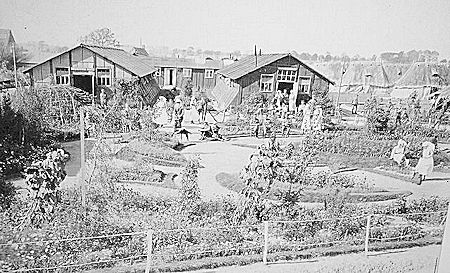
Remy Sidings
As Remy Sidings expanded into a village, wooden passageways between the tents and barracks and the gravel driveways were given street names. Trees and bushes were planted, a generator provided power, and there was a water purification plant and an incinerator. The staffing level grew and there were 50 staff tents. In 1917, vegetable gardens were developed with competitions for the most productive garden; the most amazing statistic available is that of a pumpkin weighing 11 kilos! The staff and patients were often treated to concerts and battalion bands to raise morale. Despite being behind the lines, the Casualty Clearing Stations at Remy Sidings were not always safe havens and occasionally it was attacked. On the evening of 17 August 1917, the day after Jack's wound, enemy planes flew over and dropped bombs. This raid left 24 dead, including 10 German prisoners of war, and 42 injured.
|
|
 |
|||||||
| This page was created by Richard Crompton and maintained by Chris Glass |
 |
Version A4 Updated 03 June 2023 |
||||||