1805 Info 3g_4 for John Crompton
Captain John Crompton (Jack) - post war and death - page 4 of 4
First Northern General Hospital
Jack’s wound was serious enough for him to be evacuated to three UK hospitals and convalescent
hospitals for wounded officers.
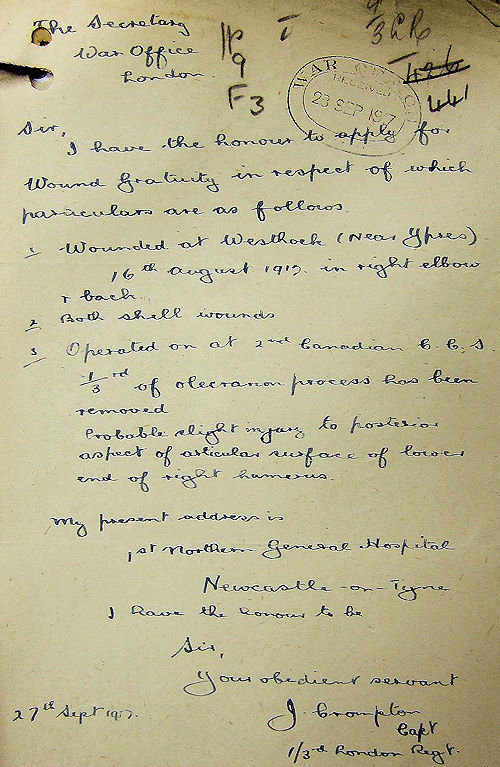
On 27 September 1917, from
The First Northern General Hospital 1, Jack wrote to the
Secretary of War applying for a Wound Gratuity. This letter confirms and describes
his wounds and the treatment at the 2nd Canadian Casualty Clearing Station (CCS).
It also confirms the date of the action and his rank of captain, though temporary, at
the time of his wound.
The First Northern, in association with the Royal Victoria Hospital had specialised to
become a military orthopaedic hospital, presumably suitable for Jacks elbow wound.
Left: Jack Crompton's letter of 27 September 1917 to the War Office
Source: The National Archived (TNA) WO 374/16721
Furness Auxiliary Hospital
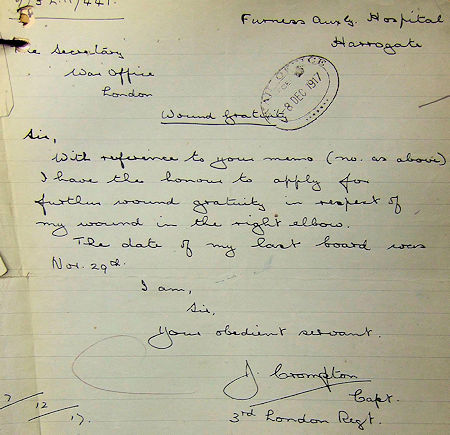
On 7 December 1917, Jack followed up his first letter with a second
showing he was convalescing in Furness Auxiliary Hospital in Harrogate. It makes
reference to his last [Medical] Board being on 29 November 1917.
Right: Jack Crompton's letter of 07 December 1917 applying for a wound
gratuity.
Source: TNA WO 374/16721
1805info3g_4, sheet 2
On 18 December 1917, a Confidential Medical Board Report On A Disabled Officer (Army Form A.45)
1 was completed at Furness Auxiliary Hospital, Harrogate. It records that Captain
J Crompton of the 1/3 London Regt. had a disability of 1) GSW (Gun Shot Wound) Rt. Elbow Joint and
2) GSW Back sustained on 16 August 1917 (sic) at Ypres, from HE (High Explosive) shell. His
present condition was described as:
a posterior healed scar just above the point of the R elbow posteriorly.
A sharp spicule (small or minute, sharp-pointed body part) of bone is seen from behind under the
skin of the point of the elbow. The specialist recommended & the board agree that a further
operation for removal of this spicule of bone should be give performed at a General Hospital.
Condition of A.C.T. 13155,13,55, 1917 have been complied with a ----- regarding were [pending
average] made for his fracture
He had a non-permanent disability of 70% requiring a further examination in one month in an
officer’s hospital. Jack was declared unfit for general service for four months, all garrison or
overseas duties or home service for two months, and sedentary employment for one month. Whilst
Jack was not suffering from neurasthenia (shell shock) it was the opinion of the board that he was
permanently unfit for further military service. This appears to have been ratified on 20 December
1917. 2
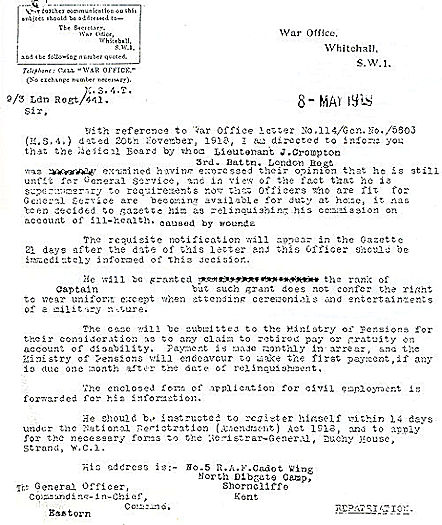
This letter informs Jack that the Medical Board still considers him unfit for General
Service and is no longer required for duty at home and therefore he will be gazetted
as relinquishing his commission on the grounds of wounds.
The letter is addressed to Lieutenant J Crompton but also announces his promotion to
the rank of captain, which being Gazetted, possibly on 01 June 1918, the rank is
substantive and will qualify for a pension.
Note: The London Gazette has been searched from May 1919 to December 1923 for
this promotion.
Right: Jack Crompton's letter of 08 May 1918 from the War Office ending
his commission
Source: TNA WO 374/16721
Despite the prediction of the Furness Board that Jack would likely be
fit for active service in April 1918 and the letter relinquishing his commission and
giving his address as Shorncliffe, Jack was still in hospital in June 1918 and
applying for a further 'wound gratuity'.
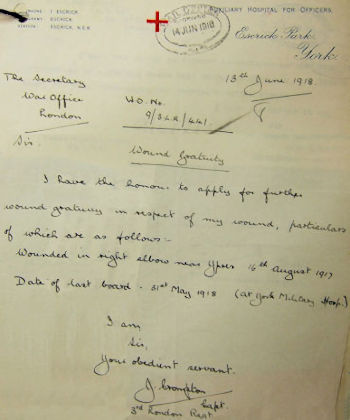
Following a Board at York Military Hospital, on 31 May 1918, Jack made a third
application for a Wound Gratuity, on 13 June 1918, from the Auxiliary Hospital for
Officers, Escrick Park, York. A period of leave between 20 June 1918 and 21 August
1918 followed.
Left: Jack Crompton's letter of 13 June 1918 applying for a further wound
gratuity.
Source: TNA WO 374/16721
1805info3g_4, sheet 3
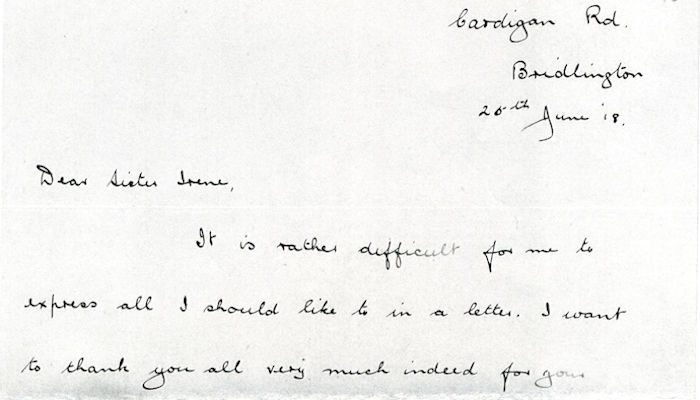
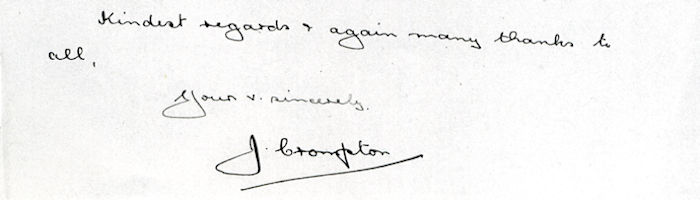
A letter, written during his leave on 25 June 1918 from Cardigan Road, from Jack to Sister
Irene exists in Hull History Centre. 3
kindness to me during my time with you. I cannot see how
you could do more to make fellows comfortable & happy above all to make them
forget there is a war on, which, to me, seems to be the great object in running a
convalescent hospital. One feels that one can do so little in return. I am afraid I
have often said things that sounded critical & may have annoyed you. If so I
apologies & make no excuse except that it is an unfortunate habit of mine to say
more than I really mean - why, I don't quite know. If you have a cricket match in
the near future & will let me come over I shall only be too glad to do so. I have
sent some of the films to have more prints taken off & will send you some as soon
as they are done. An also thinking of having one or two enlarged, of which you might
like copies.
Please excuse the writing materials, we seem to be in a state of chaos at home so far
as note paper is concerned.
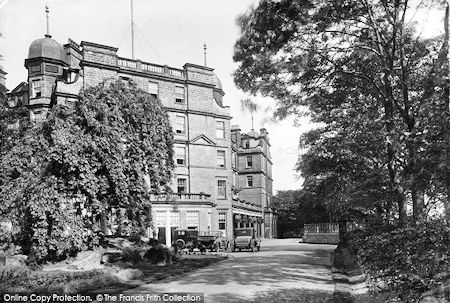
Furness Auxiliary Hospital was a convalescent hospital for officers, based in the
former Grand Hotel, Montepellier, Harrogate, not far from the baths. My maternal
grandfather and JRR Tolkien were also a patients.
Still in the army and having never returned to active service, a further Board convened on 8
January 1919 at the Military Hospital, Shorncliffe, Kent where the disability described was the
GSW rt. elbow, which had not improved since the last Board, and also broncho pneumonia, which had
developed after contracting influenza as a patient in the 1st Northern General Hospital at
Newcastle-on-Tyne.
1805info3g_4, sheet 4
The report gives specific details of the damage to the right elbow.
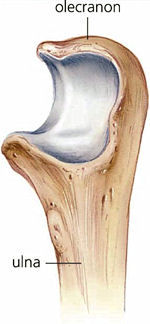
There is a scar over rt. elbow on extension aspect. Tip of
Olecranon is missing and anaesthesia. Flexion of Forearm is good. Grip fair
circulation in forearm deficient. Diminuation of R.M. and V.F. & function sounds
present over Base. Has been informed that he has been placed in Cat.CI. ans [sic]
instructed to join 5th R.A.F. Cadet Wing Shornecliffe. [sic]
Left: A sketch of the olecranon, which features in Jack's wound and
Boards.
The third Proceedings of a Medical Board were recorded at the Military Hospital, York on 29
July 1919. This adds the details that the GSW was a compound fracture of the Olecranon and that
influenza was contracted on 15 February 1918, whilst at Newcastle. At this time:
The wound had healed soundly allowing the elbow joint to flex but not to
extend. [Jack’s] hand and forearm were unimpaired. The breath sounds are somewhat fainter over
right base due to thickened pleura. There are no adventitious sounds. {OED: Coming from outside
or from an external source]
Whilst Jack died of TB, it is not possible to diagnose TB or pneumonia, without some
investigations, like x-rays and sputum tests. They can look very similar, with coughing, weakness,
and fever. Pneumonia usually happens when the immune system is weak and the bacteria in the
respiratory system start to breed. I speculate that Jack's influenza may have weakened his system.
Tuberculosis, on the other hand,shows symptoms slowly over time, which makes the wet trench in
Salonika a possibility.
A commission in the Indian Army
On 31 July 1917, whilst a lieutenant and adjutant of the 1/3rd
London Regiment (TF) and a month before he was wounded at Westhoek, Jack completed an
‘Army Form W.8418 Application for permanent commission in the Indian Army’
4 There is no indication for his reasons for requesting a commission in the
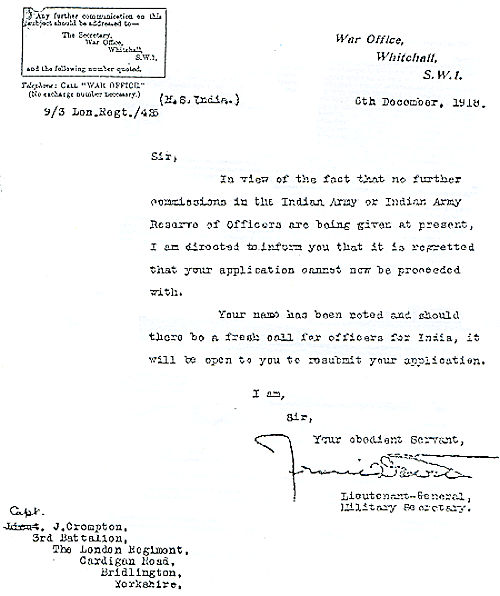
Indian Army. On 6th December 1918 the War Office replied to 22 Cardigan Road:
Note: The London Gazette has been searched from May 1919 to December
1923 for this promotion.
Right: Letter to Jack Crompton
from War Office, on 06 December 1918, refusing his application for a commission in the
Indian Army.
Source: TNA WO 374/16721
5th RAF Cadet Wing Shorncliff
Having failed to transfer to the Indian Army, it seems that Jack enjoyed service life as he
was 'instructed to join the 5th RAF Cadet Wing at Shornecliffe'
(sic).
Two further Medical Boards are recorded. On 08 January 1919, whilst at Shorncliffe, Jack was
recorded as having 4 5/12 total service with three years in 'Theatre' and recognises him
as Captain. His G[un].S[hot].W[ound]. rt elbow was dated 18.8.17 and his Broncho pneumonia was
dated about 15.2.18 in Newcastle. He states that his wound has not
improved since the last Board and that his pneumonia has improved since the last Board. The
History given by the patient is that whilst a patient in 1st Northern Gen. Hosp. Newcastle-on-
Tyne he contracted Influenza and developed Pneumonia. The report continued There is a scar over rt.elbow on extension aspect. Tip of Olecranon missing and
anasthesia. Flexion of Forearm and arm good. Grip fair circulation in forearm deficient.
Diminution of R.M. & V.F. & function sounds present over Base. Has been informed that he
has been placed Cat.CI ans (sic) instructed to join the 5th R.A.F. Cadet Wing Shornecliffe. (sic)
5
1805info3g_4, sheet 5
The last available Medical Board report is dated 29 July 1919 from the Military Hospital, York
suggests Jack's service ended 29 May 1919 as his address was 22 Cardigan Road, Bridlington.
Both the wound and pneumonia were progressing satisfactorily. He is able
to fully flex but cannot fully extend the elbow. The hand and forearm are unimpaired. His breath
sounds are somewhat fainter over right base due to old thickened pleura. There are no adventitious
sounds. [OED: coming from an external source] 6
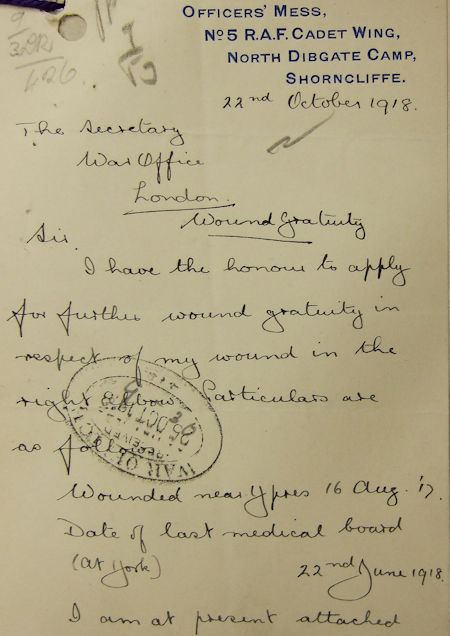
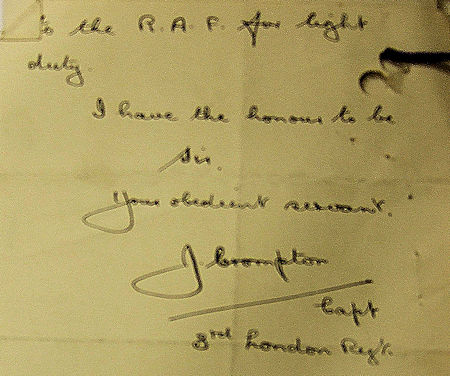
On release from hospital, Jack was transferred to light duties: to
instruct at No. 5 R.A.F Cadet Wing at North Dibgate Camp, Shorncliffe, Folkestone,
Kent, despite being unfit for General Service. On 22 October 1918 another application
for a Wound Gratuity was made from Shorncliffe.
Right: Jack Crompton's letter, confirming his Shorncliffe posting, asking
for another wound gratuity.
Right: Jack Crompton's letter, confirming his Shorncliffe posting,
asking for another wound gratuity page 2
Shorncliffe is still a large army camp near Cheriton in Kent. Established in 1794, it later
served as a staging post for troops destined for the Western Front during the First World War. No
5 Cadet Wing, a Ground Training Unit, moved to Dibgate Camp, Shorncliffe by 31 December 1918,
where it was disbanded on 24 January 1919. It was located south of the M20 junction to what is
now the UK Eurotunnel terminal.
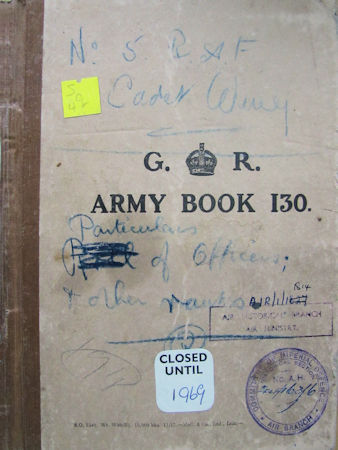
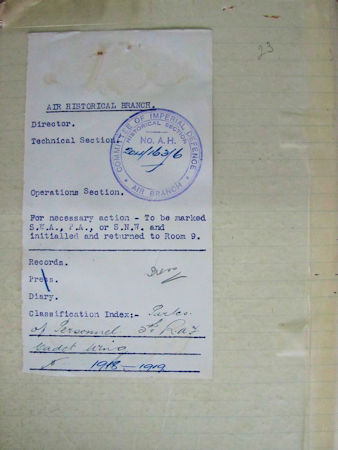
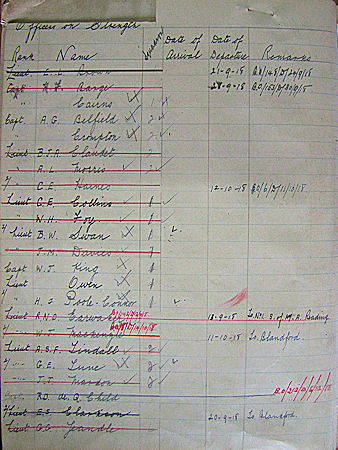
Hoverbox Photo Gallery - Jack Crompton at Shorncliffe -
Ref:TNA AIR 1/1814/163/6
This feature does not function correctly on phones and tablets
1. Shorncliffe register of officers cover
2. Shorncliffe register of officers inside cover
3. Shorncliffe register of officers page with Jack on line 5 and no
further details
1
2
3
1805info3g_4, sheet 6
His death
Jack died on 26 March 1922, without issue, it is alleged as a result of active service in
Salonika, but his cause of death is not clear.
On 8th September 1922, during the process of administering Jack’s estate, Thos
Holtby, Solicitors of Great Driffield, wrote to the War Office. Their letter to the War Office
provides a summary of Jack's war .
Sir,
Capt. John Crompton deceased.
Ref. M.S. 4T. 9/3 Ldn. Regt./441
I am acting for the father of the above deceased and
am about to apply for Administration of his estate.
The deceased was granted a commission in October 1914 and in May 1919 was
gazetted out of the 3rd London Regiment whilst at No. 5 R.A.F. Cadet Wing,
Shorncliffe, as relinquishing his commission "on account of ill health caused by
wounds" and granted Temporary Retired Pay.
He afterwards carried on the occupation of corn dealer but in August 1921 he
was admitted to the East Anglian Sanatorium at Nayland under an arrangement made by
the Ministry of Pensions and steps were shortly
He died in the Sanatorium on the 26th March last, leaving estate of the value
of under £5000.
I shall be pleased to hear that under these circumstances the War Office is
prepared to recommend that he should be considered as "killed in the War"
for the purpose of remission of Death Duties.
I am, Sir,
Your obedient Servant.
The Secretary. War Office.
LONDON. S.W. 1
Source: The National Archives, Kew (TNA) WO 374/16721
On 14 September 1922, the War Office requested Thomas Holtby to forward a copy of the actual
death certificate, which stated that tuberculosis (TB) as the cause of death.
Registration District Sudbury
1922 DEATH in Sub-District of Bures in the County of West
Suffolk
No.
When and Where Died
Name and Surname
Sex
Age
Rank or Profession
Cause of Death
Informant
When Registered
Signature of Registrar
346
26th March 1922 East Anglian Sanatorium Nayland with
Wissington R.D.
John Crompton
Male
26 years
A Corn Merchant of 22 Cardogan Road Bridlington late of
3rd London Regiment
(1) Pulmonary Tuberculosis Certified by G.Eleanor Soltau,
L.R.C.P.
H.B.Poole Secretary East Anglian Sanatorium Nayland with
Wissington
Seventh April 1922
W.T. Tomkins Registrar
CERTIFIED to be a true Copy of an Entry in the Certified
Copy of a Register of Death in the District above mentioned.
Given at the GENERAL REGISTER OFFICE, SOMERSET HOUSE, LONDON under the Seal of the said
Office, the 18th day of September, 1922
Source: The National Archives, Kew (TNA) WO 374/16721
Note: John Crompton's address should have been 22 Cardigan Road, the home
of his father.
Six days later, Thomas Holtby, in a continued effort to remove death duties, replied
attributing the TB to Jack's service in Salonika. The replied was typed onto the two part
Effects - Form 8.
It will be observed that the cause of death is given as
Pulmonary Tuberculosis. The deceased had shown no symptoms whatsoever of this disease
prior to his entering the Army. He was one of the unfortunate party who were caught by
a flood in Salonika and had to remain for several days in waterlogged positions.
Source: TNA WO 374/16721
At this point it has not been able to prove the flooded trench in Salonika.
1805info3g_4, sheet 7
East Anglian Sanatorium for consumptives
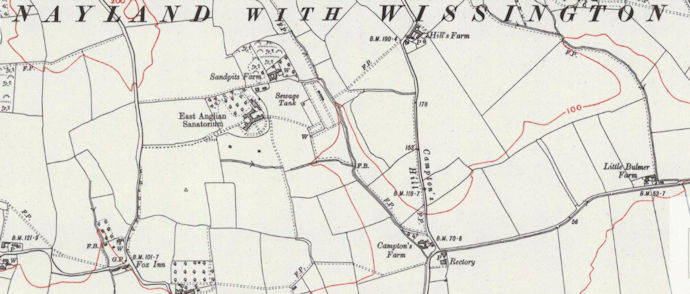
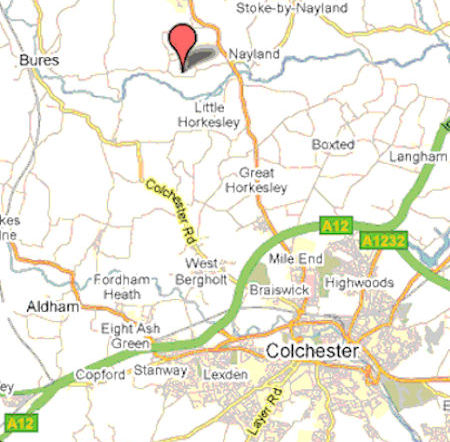
Jack entered the East Anglian Sanatorium, Nayland with Wissington, Suffolk in August 1921, and
died there in 1922. 7
Above: A 1925 OS map locating East Anglian Sanatorium
Left: Map locating Nayland in Suffolk
In 1899, to meet the need for places to treat TB, Dr Jane Walker (1859-1938), the medical
superintendant for the East Anglian Sanatorium Company, extended her first centre, in Downham
Market, by buying Maltings and Sand Pits Farms in Nayland and Wissington. The East Anglian
Sanatorium opened on 22 January 1901. During and immediately after the First World War the male
patients at Maltings Farm were almost all ex-servicemen; other ranks from 1916 and officers from
1919. Generally, the treatment was to expose patients to plenty of fresh air and provide good
nutrition. Dr Jane, as she was known, examined every patient, perhaps at her 122 Harley Street,
London consulting rooms.
Above: A modern aerial view of Nayland showing the main
building and the redeveloped land
1805info3g_4, sheet 8
Dr Jane Walker was one of the first women medical pioneers and a strong supporter of the early
feminist movement. She had been to a Black Forest sanatorium where she studied the new treatment
for tuberculosis, which consisted of rest, good food, plenty of cold fresh air, followed by
carefully graded exercise. To treat TB, her specially dedicated sanatoriums was constructed. A
south-facing situation, preferably on a sandy soil where pine trees would grow, was considered
important, so she purchased Maltings, Sandpits and Rushbanks Farms to found the sanatorium. The
upper building, now Jane Walker Park, was a paying sanatorium, and she used this to support
Maltings Farm Sanatorium, founded in 1904, and the children's sanatorium, founded in 1912 where
the patients were treated for minimal charges.
The spot chosen for the first building was on the slope of a hill with an extensive view of the
Stour Valley. The valley's sunny and dry climate recommended it for people with TB at a time
when their were no antibiotics. Set in 90 private and recreational acres, the building was a
butterfly plan facing south-east with wards at front and axial passages behind in the wings. To
implement the fresh-air therapy, the central building had several tall casement windows under
a covered porches to a room. Patients occupied single and double rooms facing south on two floors
with staffrooms above. There were fireplaces and central heating throughout. The centre of the
front was originally open and with staircase behind opening to balconies through spacious
entrances wide enough for bed and deckchairs; the main entrance was in gable end of west wing. A
cross ventilated passage separates the bedrooms from the sanitary block. The central, two storey
and attic, rear wing contains entrance and offices with the kitchen wing on right and hall on
left branching from it. Attached to this was the chapel. 8 Every point for the then
essential open-air treatment of TB had been considered.
Instead of confining patients to stuffy room as was the English custom, the prevailing German
treatment of open air for resting and sleeping, was applied. The usual régime at the sanatorium,
and Jack's day, began with rising at 7.15 with a visit from the resident physician to all
patients before breakfast which was served at eight o'clock. Between breakfast and midday
patients, except those excused for medical reasons, took their prescribed amount of exercise.
There was an hours rest at the one o'clock dinner time. After dinner there was more regulated
exercise. Tea was served at four o'clock, followed more rest before supper at seven o'
clock and lights out at nine o'clock. Temperatures and pulses were taken three times a day;
and patients were regularly seen by the physician before dinner and supper and again at bedtime
if necessary. The patients were weighed weekly and it would seem that there was an average gain
of 28 pounds (12.7kg). There was no alcohol unless prescribed, no food between meals, no card
playing until after tea, no gambling ever and no expectorating anywhere unless into a mug or
flask. Visitors were discouraged but permitted on the second and fourth Sunday of the month.
9
East Anglian Sanatorium main building in 1904
East Anglian Sanatorium main building - undated
The drive to East Anglian Sanatorium main building in 1906
East Anglian Sanatorium main building - undated
East Anglian Sanatorium looking across the sanatorium's gardens and drive - undated
East Anglian Sanatorium
post card dated 1921, when Jack was a resident
East Anglian Sanatorium ward in 1905 showing beds outside rooms and deckchairs in the garden
The
men's ward at Maltings Farm part of East Anglian Sanatorium - undated
The dining room in East Anglian Sanatorium main building in 1915
Photos: Nayland with Wissington Conservation Society David May
Collection III
The duration of the treatment was between three and six months. After three months patients
were warned that though they may appeared 'cured' 'complete stability was
unlikely', and that at least six months was required for a cure [My italics]. Dr Jane
Walker declared that treatment was directed 'not only to the arrest of the disease, but to
the permanent raising of the standard of the patient's health in order that the recurrent
attacks may be warded off.' ... 'No two cases [could] be treated on exactly the same
lines; [she] considered not only the individual sicknesses, but the sick individuals'.
10
Although a cure for TB was not found until antibiotics arrived at the end of the Second War,
the open air treatment could put this disease into remission and many patients were able to return
to normal lives although it was always liable to return. Therefore many patients chose to remain
near the sanatoriums, often working as nursing assistants, gardeners and domestic workers. There
was a high death rate as Dr Walker did not select her patients because, as they were likely to be
cured, she did her best for all. The laboratories, 'equipped with electric lights to
facilitate throat examination', the outcomes of the treatment were difficult to assess. In
1901, at the time the article was written, a large majority of those in the 'first stage'
of TB recovered; there was a lower proportion of those in the 'second stage'; with the
'third stage' being much lower than the second. In 1901 Dr Jane Walker quantified her
success rate. Of the 177 patients: 45 recovered, 54 were improving, 13 were going back, she had
lost sight of 9, there were 29 still under treatment and 27 died. Jack would have fallen into
this last category, presumably being in 'stage three' TB. 11
1805info3g_4, sheet 9
In memoriam
THE
AND GENERAL ADVERTISER APRIL
8, 1922
NAFFERTON
The funeral took place at
Nafferton on Thursday, of Mr. J Crompton, eldest son of Mr T. Crompton, of Bridlington,
and late of Nafferton who died on March 26th, at the East Anglian Sanatorium, Nayland,
Suffolk. He received wounds in the lung during the war from which he has since suffered.
The Rev. J.F. Wilkinson (vicar) took the service and gave a feeling address in the
Church. The mourners consisted of Mr. T. Crompton (father), Mr H. Crompton, Mr C.
Crompton, (brothers), Mr & Mrs Chas. Crompton (Wakefield), Mr Crompton (Newcastle),
Mr F. Tibbits, Mr T.C. Wilson, Missess Jefferson, Mr W.T. Elgey, Mr J.W. Elgey, Mr H.
Pickering (Bridlington), Mr F. Duggleby, Mr H. Duggleby, Mr Wm. Robinson, Dr. Thornley,
Mr. Goulding, (County Hall, Beverley), and others. The coffin was covered with the Union
Jack. A number of beautiful floral tributes were placed on the coffin.
Source: British Library Newspaper Archives, Colindale, Driffield Time, 1922, shelf
56
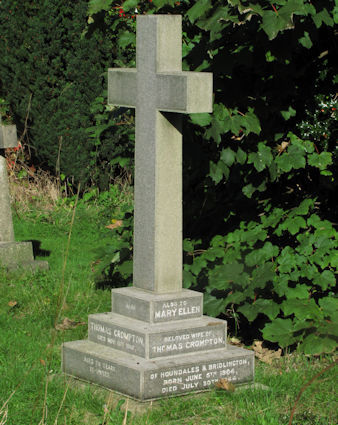
Left: Thomas Crompton's family headstone in Nafferton new church yard.
Jack's inscription is on the face opposite the adjacent headstone.
As part of the family monument, his memorial stone in Nafferton new churchyard reads
also to their
beloved eldest son
JOHN Captain 3rd London Regt.
who died March 26th 1922
aged 28 years
RIP
John died as a result of Tuberculosis, possibly contracted in the Salonika campaigns of
1915-1916.
1805info3g_4, sheet 10
Cardigan Road, Bridlington
Cardigan Road, Bridlington was a favourite address for the Crompton
family. In 1915 Thomas retired to 91 Cardigan Road. Harry is recorded as living at the
same address.
Jack's address, recorded on his death certificate was 22 Cardigan Road, Bridlington. A
letter, written by Jack during his leave on 25 June 1918 to a Sister Irene, was from
Cardigan Road,
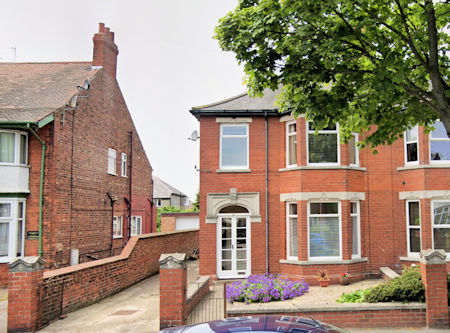
Right: 22 Cardigan Road, Bridlington
The final puzzle
On returning to the UK, Jack returned to his profession of corn merchant. The 1921 census shows
Jack to be resident in Settle, in the old West Riding, and creates an intriguing puzzle and with
no known solution. There is no known reason why Jack should be boarding in The Golden Lion Hotel, a
hundred miles from his home and family. Why was he a corn merchant in the predominantly hill seep
farming area, unless he sold animal feed? The census records Jack as a 'Border'
which suggests more permanence than 'Visitor'.
1921 Census:      Sun 19th June 1921
Source:   RG15;  Piece: 20996;
          RegDist number: 484; SubDist: 2; ED 8; Sched: 139 page 2;
          Reg District: Settle;  Parish: Settle
Dwelling: Hotel, Duke Street, [Golden Lion]
Place:    Settle, Yorkshire West Riding
Children under sixteen: none
BL=Both parents alive; FD=father dead; MD=mother dead
Whole time school

Name                   Rel    Age  Mar  Occupation       Employer          Work place              Birthplace
                            Yrs Mn
Edwin Marson         Head   48 10   M   Hotel Proprietor Employer          Duke Street Settle      Yorks, Hull
Elizabeth Marson     Wife   46  0   M   Homes Duties                                               Yorks, Rotherham
James Marson          Son    9 10   BL  Whole time                                                 Yorks, Leeds
Ella Mardson          Dau   12  0   BL  Whole time                                                 Yorks, Leeds
Sidney Marson         Son   17  6   S   Assisting father in hotel          At home, Settle         Yorks, Leeds
....
Page 2
Frances Maud Tulham   Vis   25  3   S   Private nursing  Leeds Married     Golden Lion, Settle     Lancs, Widnes
                                                         Nurses Institute
David Goodwin Hindle  Vis   46  8   M   Manufacture      Employer          Mount Spring Waterfoot  Lancs, Newchurch Rossendale
                                        b??fact????                        355 Burnley Road
                                                                           Waterfoot [Rossendale]
Mary Alice Hindle     Vis   44  8   M   Home Duties                                                Lancs, Newchurch Rossendale
Donald Hindle         Vis   15  2   S   Whole time school                                          Lancs, Newchurch Rossendale
Elizabeth Stirling    Vis   45  8   M   Married woman                                              Lancs, Ulveston
John Crompton       Board   28  1   S   Corn Merchant     Employer         Town Hall Buildings     Yorks, Nafferton
                                                                           Settle
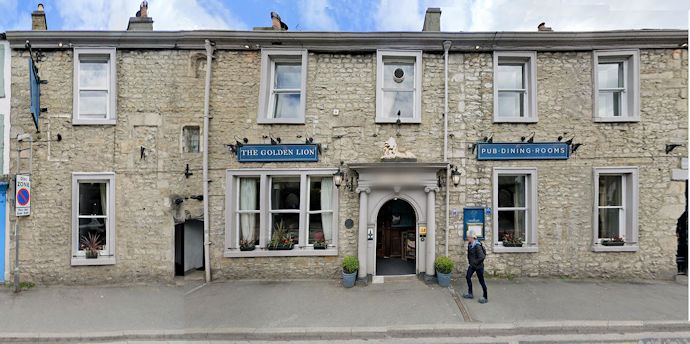
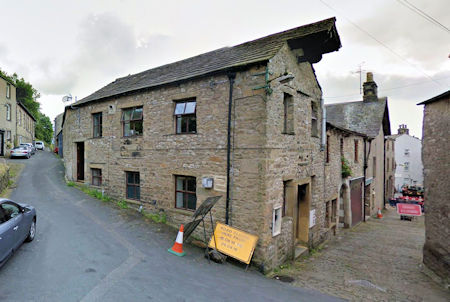
Above: Golden Lion Hotel, Duke Street, Settle
1805info3g_4, sheet 11
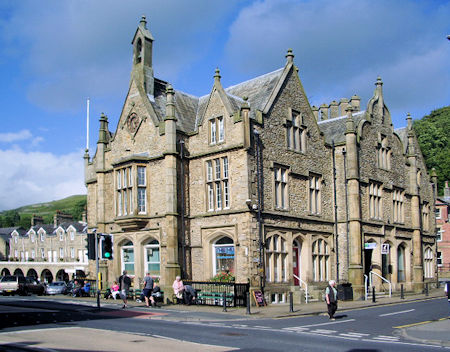
According to the 1921 census Jack's place of work was Settle Town Hall. This
Gothic Revival building of 1832 has ground floor 'shops' with the rural
district council chamber, court room, assembly room and at one time the library on
the upper floor. The ground floor has six 'bays' on the north and south face
and two on the west and east faces. In the 2020s these were used as shops, tourist
information and a solicitors office. The author recalls in the 1950s to mid 1960s the
north-east corner being Billy Jackman's hairdressers and the south-west
corner being an unsavoury gentleman's urinal. The wooden slatted seats, facing the
road, were the domain of pensioners 'taking the air'.
Right: Settle Town Hall with Jack's possible place of work being on the
lower floor
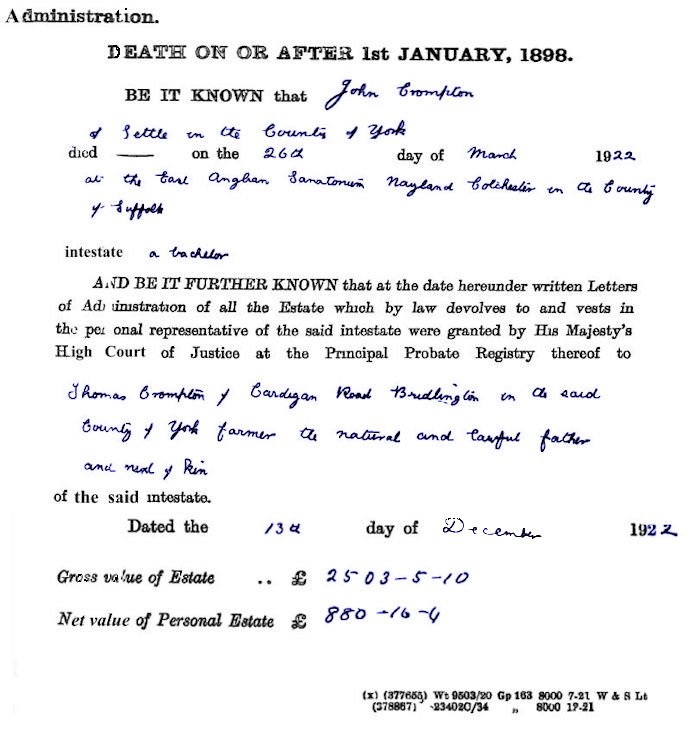
Jack's probate adds to this puzzle. Rather than stating Bridlington as his home, his
probate confirms Settle was his home town on death.
Above: John Crompton's probate
Above: A composite image of John Crompton's probate Source: https://probatesearch.service.gov.uk/#wills
Note again he is "of Settle in the County of York".
All the facts confirm this is our Jack Crompton, except that the probate
record declares him to be of Settle, Yorkshire, instead of Cardigan Road,
Bridlington as per his death certificate. The probate sum equates to £154,000 in
2022 by the RPI calculator. (Measuring Worth). However his net value of worth
was £880 16shillings and 4pence, equivalent to £54,350 in 2022 by the RPI
calculator. (Measuring Worth). Speculation is that there were sanatorium bills
to pay.
The author was born in Settle and raised in the parish of Giggleswick, just across the River
Ribble. It was always thought that the author's father, Geoff Crompton born 1913, having been
posted there in November 1945 was the first Crompton to live in Settle.
1805info3g_4, sheet 12
Given that Jack's profession was a corn merchant it is entirely possible that
he was connected with the more modern Thornton's corn merchant once of Castle Hill, Settle. The
author remembers their old building its wooden floor and hessian sacks, when lived on
Castle Hill in 1958 and when he
went to collect hen food, as an errand boy, for Jack Atkinson of Albert Hill, Settle.
Left: The original location of Thornton Corn Merchants of Settle, at the
junction of Castle Hill and Castlebergh Lane. Now a private residence, the bag hoist
can still be seen above the 'front' door.
Postscript
Jack’s niece Sheila Mellstrom née Crompton offered a comment suggesting family hearsay said the
Jack’s TB resulted from the shell fragment wound to the olecranon. Dr James Crompton, though not a
respiratory specialist, thought that, since TB is a respiratory disease it was unlikely to
originate in the elbow, though he has known TB in the abdomen. He suspected the elbow wound may
have been complicated by clostridium, defined as ‘several rod-shaped, spore-forming, anaerobic
bacteria of the genus Clostridium, found in soil and in the intestinal tract of humans’. An X-Ray,
had it been taken, would have resolved whether TB was in his lungs. The Mantoux skin test has been
available since 1908 to show TB. He opined that if the disease had been contracted in Salonika,
six years was a long incubation period. He didn’t think it was likely that Jack contracted TB in
1916, recovered whilst on active service, only to relapse and die in 1922. There is no real
illness called TB per se. Pneumonia is the illness; mycobacterium tuberculosis is one infective
agent that might cause a respiratory inflammation. Haemophilus influenza is another. Consequently,
Jack died of a pneumonia caused by TB.
End Notes:
TNA WO374/16721
ibid
Hull History Centre DDFA 3/6/45/90
TNA WO374/16721
ibid
ibid
Bury St Edmonds Branch, of Suffolk Record Office, hold the patients' register for
Maltings Farm, Ref: ID 507/6/4 1913 - 30 Nov. 1938. However, there is no public
access until 2038, when further details, of Jack's treatment will be released.
Architectural details from Historic England. The original ‘arts and crafts’ Sanatorium ,
designed by Smith and Brewer, became a listed building and was converted into eight houses,
while the rest was knocked down and replaced by housing.
The Hospital, 14 December 1901
ibid
ibid
Sources:
Captain John Crompton Short Service Attestation Paper - TNA WO 374/16721 (Printed copy
November 2008)
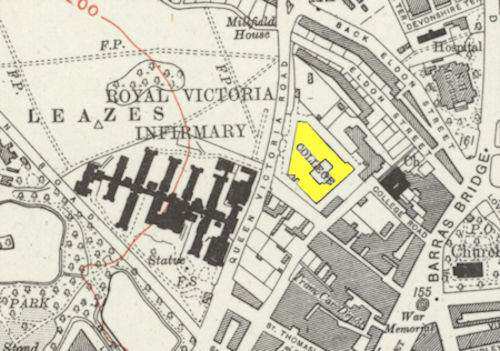
On 06 August 1914, two days after war broke out the 1st Northern General Hospital was
mobilised with the rest of the Territorial General Hospitals: a military hospital
installed in an existing buildings based at Armstrong College, part of Durham
University in Newcastle (now part of Newcastle University). Before the college could
occupy the new building, it was requisitioned by the government. Throughout the war, the
hospital worked very closely with the adjacent Royal Victoria Infirmary (RVI), which had
only recently opened. Many of the RVI’s medical staff received honorary commissions and
spent periods of up to a year caring for troops.
Left: 1914 Map locating Armstrong College the original site of 1st
Northern General Hospital
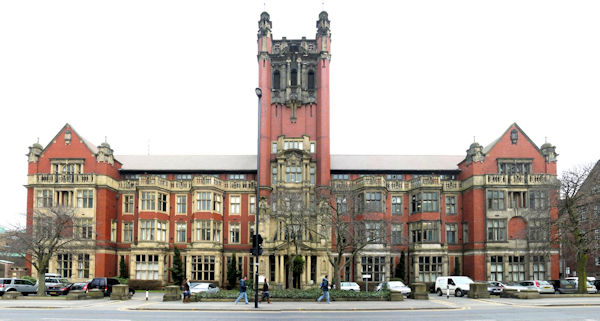
Above: The Armstrong Building, Newcastle, where Jack
was hospitalised
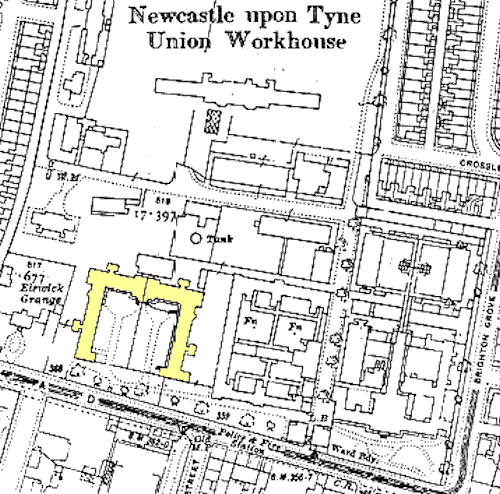
Right: 1913 map locating Newcastle Union, an extension of 1st
Northern General Hospital
1805info3g_4, sheet 14
More information 1 cont:-
In September 1914, the unit's strength was given as 32 Officers and 109 Other Ranks with
the original provision for 540 beds. By 1st January 1917, the strength had risen to 338,
including 42 Officers. By taking over a private house, the Hatton Gallery in Kings Row
and the Newcastle Workhouse Infirmary on Westgate Road (now Newcastle General Hospital –
Acute Services) to serve as hospital accommodation, this had risen to 2166.
The RVI and the military hospital also worked closely on the creation of a military
orthopaedic hospital, following a model already established in Leeds. The intention was
to provide specialist rehabilitation facilities for soldiers who had lost or damaged
limbs. An initial meeting was held on 25 September 1917 to discuss plans for a facility
with up to 1500 beds, to be built on the RVI site. This may be why Jack was sent to
Newcastle.
This page was created by Richard Crompton
and maintained by Chris Glass