| Right: A composite image of the London Gazette dated 20 Jul 1915 promoting Jack to a temporary Lieutenant in the 3/London Regiment |  |
1805 Info 3g-2 for John Crompton |
Recruitment and promotions
On the 15 September 1914, at Scarborough, Jack signed his Attestation on Army Form B.2065, Short Service [Commission] (Three years with the Colours) and was initially posted to the Old Public Schools and University Corps (Mens Force) with a Regimental Number 4039. This was more properly known as the 21st (Service) Battalion (4th Public Schools) Royal Fusiliers [RF], which was formed at Epsom, on 11 September 1914. In his own hand, he declares spending ‘five weeks with 4th Public Schools Battn. (R.F.) Sept. & Oct. 1914’. 1
On 21 October 1914 Jack was commissioned as a substantive 2nd Lieutenant. 2 On 27 October 1914, ‘[H]aving received a Commission in 3rd Reserve Battn R.F.’, the posting to the Old Public Schools and University Corps became ‘non-effective’ and three corrections were made to his Attestation papers to show ‘Royal Fusiliers’. It is possible this Commission was on the strength of his academic qualifications. 3
The Army Lists, shown below, show Jack's official progress through the army, published in quarterly lists.
| Army Lists 4 | ||||||||
| Month | Column | Batt. | Name | Rank | Adjt. | Substant. | Acting | Imperial Service |
| Jan. 1915 | 1574 | 3 | Crompton J | 2nd Lt | 21-Oct-14 | X | ||
| March 1915 | 1574 | 3 | Crompton J | 2nd Lt | 21-Oct-14 | |||
| April 1915 | 1574 | 2/3 | Crompton J | 2nd Lt | 21-Oct-14 | X | ||
| July. 1915 | 1574 | 2/3 | Crompton J | 2nd Lt | 21-Oct-14 | X | ||
| Feb. 1916 | 1574 | 2/3 | Crompton J | 2nd Lt | 21-Oct-14 | X | ||
| Crompton J | Lt | 21-Jul-15 | ||||||
| April 1916 | 1574 | 2/3 | Crompton J | 2nd Lt | 21-Oct-14 | |||
| Crompton J | Lt | 21-Jul-15 | ||||||
| July 1916 | 1574 | 2/3 | Crompton J | 2nd Lt | 21-Oct-14 | |||
| Crompton J | Lt | Adjt. | 21-Jul-15 | |||||
| Sept. 1916 | 1574b | 2/3 | Crompton J | 2nd Lt | 21-Oct-14 | |||
| 1574 | Crompton J | Capt. | Adjt. | 29-Nov-15 | ||||
| Oct. 1916 | 1588a | 1/3 | Crompton J | Capt | Adjt. | 29-Nov-15 | ||
| 1587g | Crompton J | 2nd Lt | 21-Oct-14 | |||||
| Crompton J | Capt. | Adjt. | 29-Nov-15 | |||||
| Nov. 1916 | 1587g | 1/3 | Crompton J | 2nd Lt | 21-Oct-14 | |||
| Crompton J | Capt. | Adjt. | 29-Nov-15 | |||||
| Jan.1917 | 1587g | 1/3 | Crompton J | 2ndLt | Adjt. | 21-Oct-14 | ||
| 1588a | Crompton J | Capt. | Adjt. | 29-Nov-15 | ||||
| July 1917 | 1587g | 1/3 | Crompton J | Lt. | Adjt. | 01-Jun-16 | ||
| 1588a | Crompton J | Capt. | Adjt. | 29-Nov-15 | ||||
Names in the Lists are referenced by the column of entry. On certain occasions Jack has two entries: one for his role as Adjutant. Each entry gives his permanent and substantive rank with date it was authorised. In Jack's case there is usually a date when he was appointed to an acting rank. The table records these in a separate row.
| Right: A composite image of the London Gazette dated 20 Jul 1915 promoting Jack to a temporary Lieutenant in the 3/London Regiment | |
| From the Lists it can be seen that Jack was promoted to a substantive Lieutenant
on 01 June 1916, whilst still a temporary Captain.
Right: A composite image of the London Gazette dated 16 March 1917 |
 |
| Right: A composite image of the London Gazette dated 28 January 1918 confirming Jacks promotion to Lieutenant acting Captain but with pay and allowances as a Lieutenant whilst acting as Adjutant. |  |
All of Jack's entries are registered with the 3rd London Regiment. In most cases a superscript number proceeds his name. This is taken to be his attachment to either the 2/3 London's or the 1/3 London. The Lists suggest he had transferred to 1/3 Londons by October 1916. The early 1915 Lists only have him posted to the 3/Londons. It can be seen that Jack acted as Adjutant for a year.
3 Battalion Royal Fusiliers (City of London Regiment)
At some point the 3 Battalion was designated 1/3 Battalion when it recruited two more battalions: the 2/3 and the 3/3. In June 1916, whilst at Rouen and after a decimating attack at 2nd Ypres, the 2/3 London Regiment was amalgamated with the 1/3 London Regiment. The 3/3 London Regiment was then designated 2/3 London Regiment.
The Third Battalion was a regular army battalion. In August 1914, it was in Lucknow, India, returning to UK in December 1914. Initially, 1/3 Londons were part of 85/Brigade, which was with 28/Division. The 28th was formed at Hursley, Pitt Hill and Magdalen Hill Camp near Winchester between December 1914 and January 1915 and was rushed as a much-needed reinforcement to France. It embarked at Southampton, landed at Le Havre on 16-19 January 1915, and then moved to concentrate in the area between Bailleul and Hazebrouck. During 1915, the Division fought in the Second Battle of Ypres and the Battle of Loos. On 19 October 1915 the Division was ordered to prepare to sail. The first units left Marseilles for Alexandria (Egypt) five days later and most units were there by 22 November. The Division was then ordered on to Salonika and completed its disembarkation on 4 January 1916. 5
End notes
Salonika
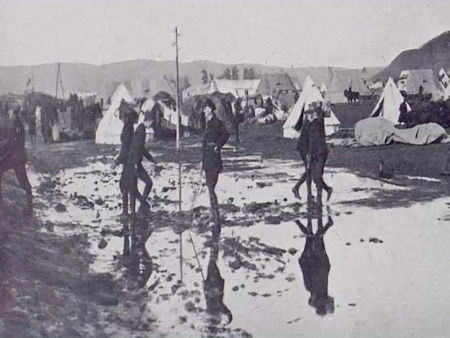
On 25 October 1915 3/Londons embarked for Alexandria, where they remained for about a month. On 22 November the Battalion marched to Quay 75 in Alexandria to embark on HMT Cardiganshire and HMT Anchises arriving in Salonika harbour at about 10.30am on 26 November. In very cold weather and snow, they proceeded to Lembet Camp a distance of 3½ miles from the town. 1
| Hoverbox Photo Gallery - Salonika in 1915 -
Source: Imperial War Museum This feature does not function correctly on phones and tablets |
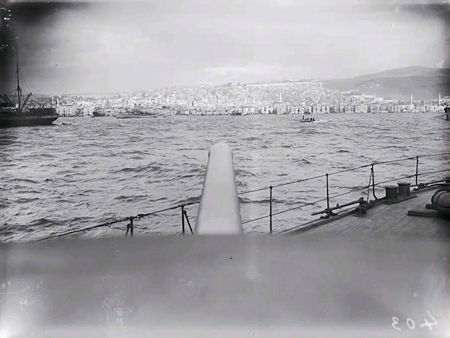
| 1. Salonika harbour 1915 from a British warship IWM Q13626 | 2. Bell tents at Lembet Camp in October 1915 IWM Q55113 3. A Salonika camp in autumn 1915 |
| 1 | 2 | 3 |
|---|
|

|
|
Apart from digging artillery bays and constructing roads, the Battalion found little to do for six months. The Lembet Plain over looked the bay with a view of Mount Olympus some 80km distant. 2
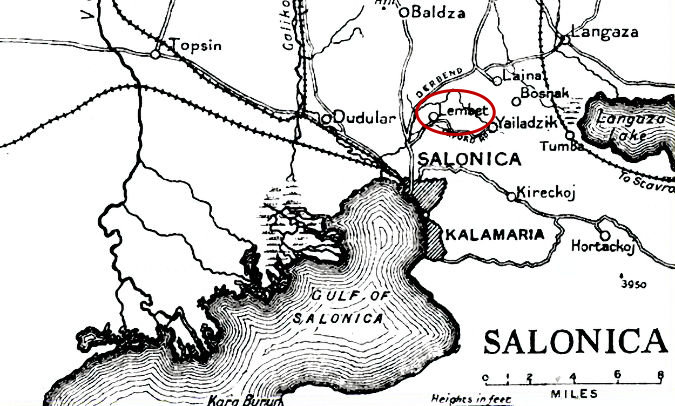 |
| Above: Map locating Lembet north of Salonika then modern Thessaloniki 2 |
Reasons for the Salonika campaign
In October 1915 a combined Anglo-French force of some two large brigades landed at Salonika (today called Thessaloniki) at the request of the Greek Prime Minister. The objective was to help the Serbs in their fight against the aggression of the Germany and Austro-Hungary allies, Bulgarian . However, with the expedition arrived too late and the Serbs having been beaten before they landed, the Anglo-French were forced to withdraw to Salonika. With the outcome of the Gallipoli campaign in the balance, most shipping went there leaving the British Salonika Force (BSF) under resourced. It was decided to keep the force in place for future operations, even against Greek opposition. The Greek Chief of the General Staff had told them "You will be driven into the sea, and you will not have time even to cry for mercy". Despite some Greek factions, including King Constantine, being pro-German, the British hoped to induce Romania to side with the Allies. In December 1915, after withdrawing from Serbia, the British element fought a battle at Kosturino, north of Lake Doiran.
During the first four months of 1916, the BSF had enough spadework to last it for the rest of its life. Large amounts of barbed wire were used and a bastion about eight miles north of the city was created connecting with the Vardar marshes to the west, and the lake defences of Langaza and Beshik to the east, and so to the Gulf of Orfano and the Aegean Sea. This area was known as the 'Birdcage' on account of the quantity of wire used. At he same time Bulgarians and Austrians also fortified the heights of the hills surrounding Salonika, which had dire consequences later on. The original two Brigades were eventually reinforced by the British 22nd, 26th, 27th and 28th Divisions who were deployed in a fortify advanced defensive line. Had the Bulgarians descended from their Doiran and Struma heights, it would have been very difficult to 'push [the Allies] into the sea'.
The soldiers faced each other for three years across challenging terrain, through harsh winters and the summers rife with malaria. Accommodation for the front line soldier usually comprised little more than a bivouac tent or dugout. The BSF dug-in until the summer of 1916, by which time the Anglo-French force had been reinforced by Serbian, Russian and Italian units. The Bulgarian attempt to invade Greece in July was repulsed near Lake Doiran. At the beginning of October 1916 the British, in co-operation with her allies on other parts of the front, began operations on the River Struma towards Seres. The campaign succeeded to capture of the Rupell Pass and advances to within a few miles of Seres, 35km south of the Bulgarian border. 4 After this, there was little action on the static lines except for occasional air-raids on Salonika, until the successful campaign of September 1918.
 |
| Above: Salonika defences, battles and Seres Road Source: Alan Wakefield, WFA webinar |
The 3/Londons in Salonika
Jack's time in Salonika is illustrated by the unit War Diaries 3 and by a chapter in O'Neill's book. 4 It is possible to piece together the campaign, but not Jack's part in it or why and when he was transferred to the Western Front. Similarly, it is not possible to identify the specific time when Jack may have contracted TB from a wet trench. It would have been easier to account for recurring bouts of malaria. The following account is the best possible picture of what 3/London's experienced.
On arrival, the Battalion was based at Lembet Camp usually either digging trenches or wiring for the defences of the Salonika area. At 2pm on 13 December 1915, orders were received for the Brigade to move camp to the vicinity of Dautbali on 14th or 15th. At 4.45pm, this order was cancelled by a new order stating the Brigade will move on 14th to the area of the Seres 5 road. At 7.10pm, this order was modified to moving on 15 December. At 10am on 15 December, the Battalion marched out of Lembet Camp along the Balja track to Muddy Lane Camp No.4 acting as the columns rear guard. They were to take part in the 28 Division’s general line of defence from Tumba 6 to Aivalti to Balja to one mile north of Balja.7 The men were impressed to work with vigour owing to the rapid advance of the Bulgarians.
In very cold and wet weather, the Battalion were employed constructing defences until the end of the year. On Christmas Day the Battalion suffered its first fatal casualty when Sgt. Smith McKenna was killed in a fall. Digging was interrupted on 30 December when a single enemy plane dropping a bomb that destroyed a hut, but cause no casualties, before flying on Salonika where again no real damage was done. A second air raid, by five planes, was logged at midday on 7 January 1916, but this was chiefly on Lembet Camp.
At the end of the year, the strength of the Battalion was 24 officers and 933 other ranks (OR), which remained constant.
During January and February, the Battalion was employed in the construction of the defences of Salonika. On 19 January 1916, in severe weather and heavy snowfall, the Battalion practiced occupying the trenches they had dug. Later, on 22 February, the Battalion practiced attacking trenches constructed by A&E Royal Fusiliers.
By 8.15pm on 11 March 1916 the Battalion handed over their trenches to the relieving 2/East Yorkshire Regiment of 84/Brigade. This suggest the Londons were manning the section of trenches around the Salonika perimeter that they had constructed.
From 12 March to the end of the month, the Battalion was employed on construction of roads, observation posts and gun positions. This was punctuated by a dozen hostile aircraft raiding Salonika and adjacent camps, destroying, in the process a French RE dump of several tons of ammonal. The French brought down four enemy aircraft.
Brigade exercises took place between 01 and 08 April in the mountain area of Kamara-Rahmanli- Jenikoj. The day after the exercise the GOC 85th Infantry Brigade sent the following order "The Brigadier wishes to place on record his appreciation of the good work performed by all units during the Brigade march. He was much pleased with the [eag]erness and energy displayed by all ranks." On 13 April 1916, the British 85/Brigade performed a ceremonial parade when General Sarrail, commanding the allied forces in Macedonia, was invested with the Grand Cross of St Michael and St George. The location of this ceremony was not given.
The Battalion marched off at 8.15, on 4 May 1916, for an eight day Divisional training exercise, which developed into a small campaign against the Bulgarians. That night, the Battalion bivouacked about two miles east of Gvezne on the Lanbaza Chai. 8 The next day, the Division marched to Likouvam 9 in columns with 85/Brigade on the east of the Seres road, 10 83/Brigade on the Seres road and 84/Brigade to the west. The Division bivouacked south-east of the Osmanli ridge. Reports on 5 May 1916 said the enemy were holding a line one mile east of Lupikouvan Dere 11 and astride the main Seres road. That night, 85th Brigade bivouacked two kilometre south-east of Karadzatepe. On 6 May it was reported that the enemy had been driven off Likouvan ridge, by an unnamed unit, in disorder. The GOC decided change point and marched on Berovo 12 to secure high ground. The Brigade then bivouacked three kilometres due east of Janik. 13 and rested the next day. At 6pm on 7 May 1916, the Battalion came on duty and formed outposts. That evening, at 6.30pm, the enemy were reported holding portion of 1059 14 with its left flank rests on ridges west of Suho. At 8am the next day, the GOC ordered the occupation of the high ground about 1059. However, on the 9 May an aeroplane reports enemy has been reinforced from Nigrita and the GOC decided to withdraw his forces toward Langaza. The Brigade bivouacked east of Sariar before marching back to camp on 10 May.
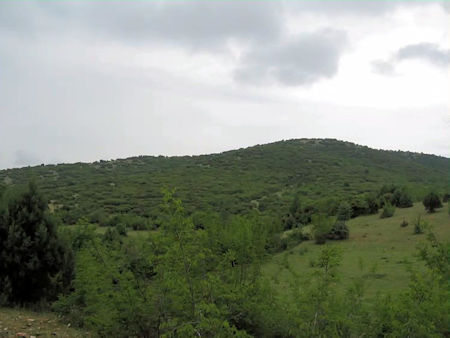
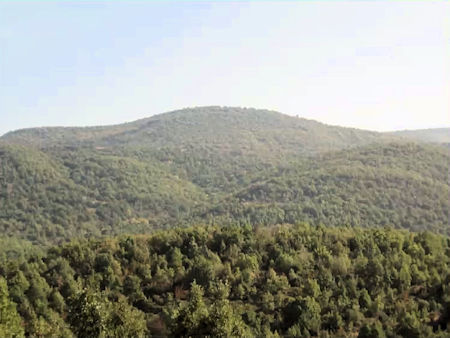
| Hoverbox Photo Gallery - Salonika terrain and vegetation - Source: Alan Wakefield WFA webinar This feature does not function correctly on phones and tablets |
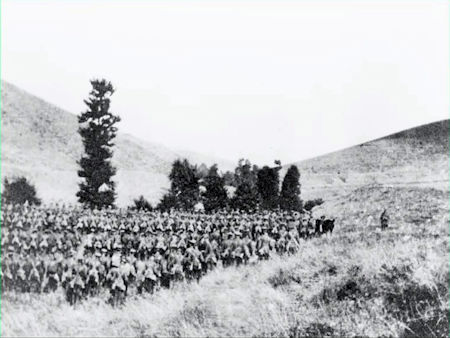
| 1. Salonika route march October 1915 IWM Q55116 | 2. Crete Simonet 3. Kosturino Ridge |
| 1 | 2 | 3 |
|---|
|
|
|
Alan Wakefield, in his webinar showed the terrain that 10th (Irish) Division fought in at the battle of Kosturino in December 1915. He commented that his photographs of the terrain and vegetation were typical of Salonika and by implication the land either side of the Seres Road.
On return and until the end of the month the Battalion continued with the defences of Salonika. 15
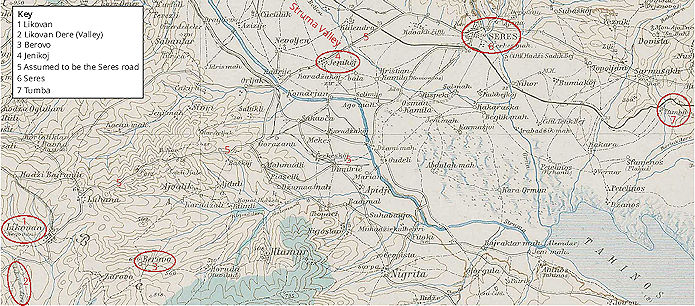 |
| Above: Map locating some of 3/London's action's identified on a contemporary map. It remains difficult to transcribe War Diary location names to a contemporary map in Latin script and modern two names in Cyrillic. It is suspected that some settlements no longer exist. Click on the map to open a scalable pdf map in a new window 16 |
O'Neill continues the story in Chapter XIV on Salonika, which details 3/Londons from Loos to their return to Segueux (sic), north-west of Beauvais, on 3 July 1918.
In June 1916, 85/Brigade moved north to reinforce 22/Division in the Vardar Valley. The march, protected by aeroplanes, could only take place between the flying hours of 8am and 4pm. On reaching Sarigeul, on the Salonika-Seres-Constantinople railway, they were ordered to return to the Struma Hills. The Whit Monday march of 11 June 1916, in the mid-day heat, was memorable for the number of cases of heat exhaustion. In this heat, the arduous task of road construction was hindered by the increasing cases of malaria, which particularly affected the replacements fresh from UK or France. To reduce the effect of the mosquito, the Battalion moved to Petkovo via Paprat on the southern crest of the Krusha Balkans. Here the Battalion prepared five miles of defences to the right of the French.
In early August 1916, a minor operation took place to encourage Rumania to enter the war on the Allied side. 17 However, on 17 August 1917, the Bulgarian army moved south through the Rupel Pass and approached the Struma valley. Here, in the many minor exchanges that took place until the end of the Salonika campaign, the Battalion was invariably in support.
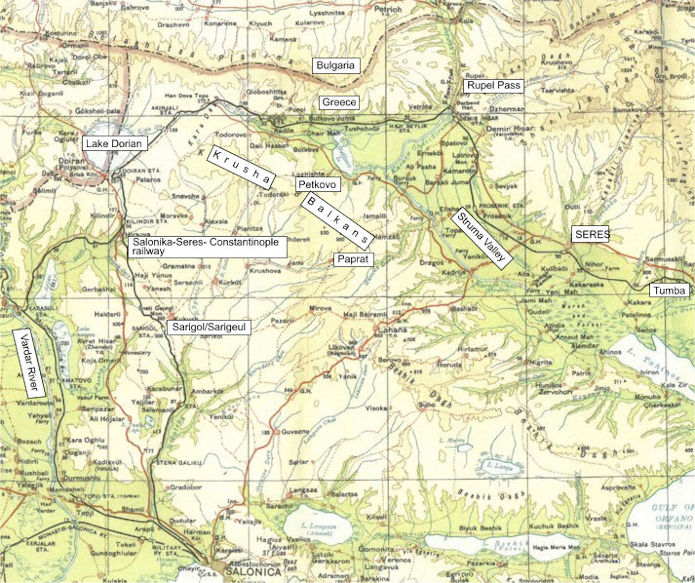 |
| Above: 3/London action as described by O'Neill. The Struma Hills have not been found. The action described in the Vardar Valley seems detached from the course of the Vardar River. Click on the map to open a scalable pdf map in a new window 18 |
Jack was in France at the time of the action at Butkova Crossing, as describe by O'Neill. There is no indication in the War Diaries available of when Jack leaving Salonika or why. The Battalion appeared to see more time on constructing defences than in actual fighting. The War Diaries give no indication of casualties sustained. However, the cold and wet weather is mentioned, along with 3/Londons manning the trenches constructed. If Jack contracted TB from a wet trench then it was likely to have been in the winter of January and February 1916.
End notes:
Transfer to the Western Front
At this time War Diaries for Salonika, beyond May 1916, are unavailable for download (January 2021). Consequently, Jack's transfer to France and the reason for transfer can not be precisely dated.
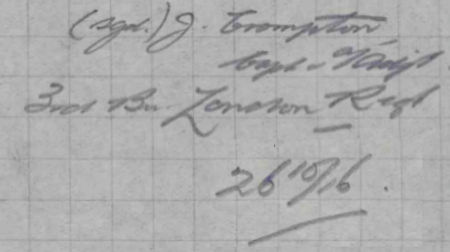
| Jack makes his first named appearance in the War Diaries of 1/3 London Regiment on
26 October 1916 when he wrote and signs a movement Operation Order as captain and Adjt
(Adjutant). 1
This corresponds to the Army Lists. Right: Jack's first signature in 3/London War Diary of 26 October 1917 |
 |
Working back through 1/3 Londons War Diaries, the daily record shows that whilst training at Airaines, on 20 October 1916 the battalion received reinforcements of one unnamed officer and 29 OR. This is the only reference to an officer reinforcement in October. Prior to this date FC Davies was signing as Lieut. and Adjt. The Battalion, newly arrived in the town situated south of the Somme river half-way between Amiens and Albert, were involved in parades and inspections.
 |
| Above: 3/London War Diary entry October 1917 showing 1 officer reinforcement 2 |
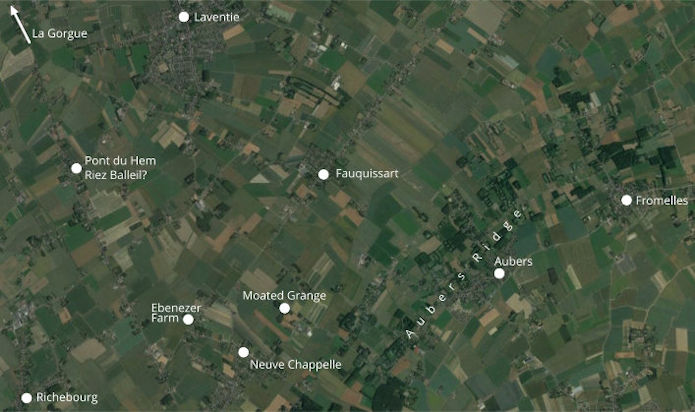 |
| Above: A map locating the places mentioned in the War Diaries related to the Moated Grange location. Click on the map to open a scalable pdf map in a new window |
Jack's first duty, as Adjutant, was to draft movement orders for the 24 October 1916, which took the battalion 117km towards to Reiz Balleil near La Gorgue. 3 and the trenches associated with the Moated Grange near Neuve-Chappel (sic) and Laventie, which they entered on 28 October 1916. These were associated with the ill fated attack on Aubers Ridge 1 and the villages of Aubers and Fromelles. In October 1916, this appeared to be a quiet sector; one usually associated with a new battalion in training or one that had suffered heavy casualties,.
During their time in the La Gorgue/Moat Grange sector, the Battalion moved in and out of the front line on a cycle of relieving the front line battalion and returning to the rear for a 'rest'. Usually the Battalion was out of the line at Riez Balleil near La Gorgue for either six or seven days when they were involved in either training or workings parties. On one occasion they were at Pont de Hem. There were two longer sessions. One of twelve days when the Battalion moved to Divisional Reserve for training at Riez Balleil. The second was for a period of eighteen days at Robermetz when the Battalion was involved in cleaning and training.
The war diary records that the time in the trenches, generally at the Moated Grange but also at Fauquissart, the troops were involved in patrolling and raiding empty trenches. During their periods at the Moated Grange their headquarters were located at Ebenezer Farm (Grid reference 36SW1 Aubers M.34.b.55.95) and this is probably where Jack, as Adjutant, was based. Apart from one occasion, the War Diary doesn’t indicate when the Battalion was in line, in support or in reserve. 4
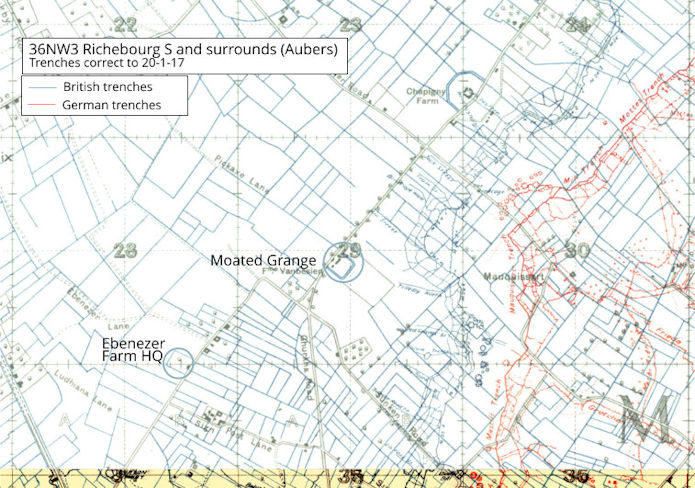 |
| Above: Trench map locating Moated Farm sector, which would be the blue trenches in front of Moated Farm. Click on the map to open a scalable pdf map in a new window |
On 06 March 1917, the Battalion left the Aubers line and began their move, by various means, to the Wancourt front south-east of Arras. On the way fourteen days were spent training at Sus St. Léger and seven days at Monchiet, with Jack signing Training Programme No.116 as Captain and Adjt. on 21 March 1917, 5 before entering the trenches at Arras on 28 April 1917 and then, two days later, to Divisional Support at Tilloy [-les-Moffaines].
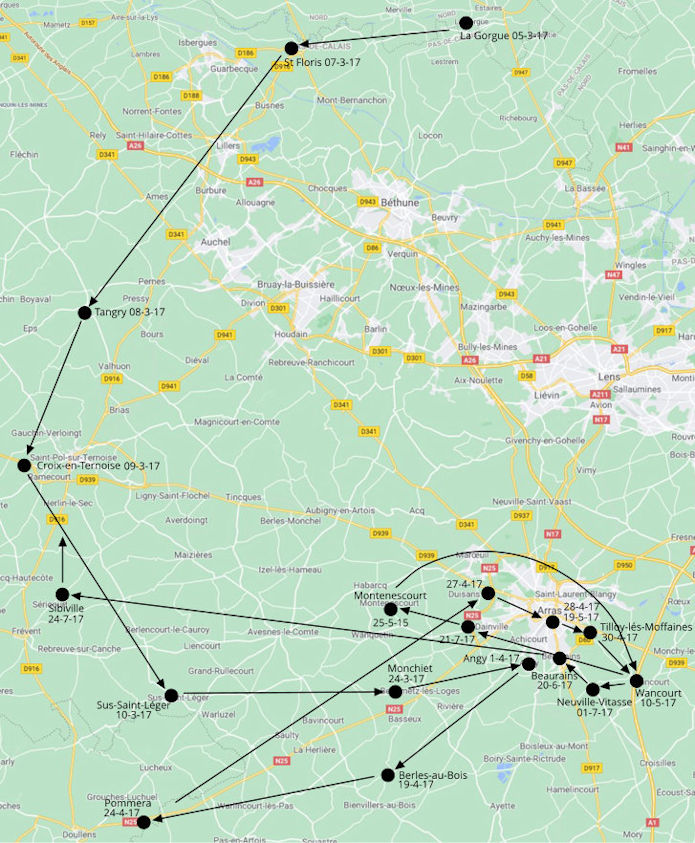 |
| Above: 1/3 Londons journey to the Wancourt front 6 |
1/3 London Regiment's time at Wancourt followed the same pattern as Moated Grange: days in the trenches followed by a period in support and reserve, though the periods in the trenches were not as strict a rotation. Eleven days in Trenches Farm, Calvary, Rake [O.7.d.1.3 b d], Gordon Support [O.13.b.d in the Guemappe area] with the headquarters in gun pits at 51BSW2 N.18.a.0.2 appears to be the longest spell. This was followed by a period of 22 day training at Montenescourt, nine days in the line and then ten days training at Beaurains, four days at Neuville Vitasse Camp and 19 days at Ivergny.
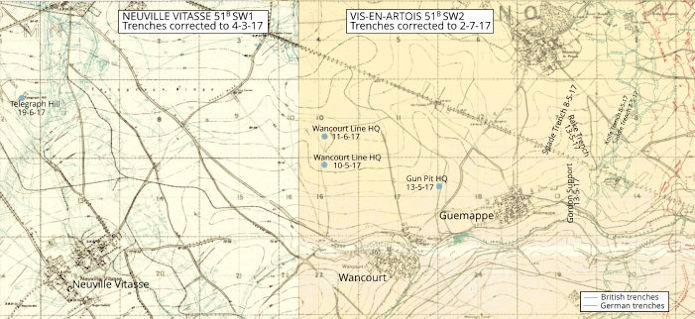 |
| Above: Map locating Wancourt Front and showing the headquarters and trenches of 1/2 Londons. Click on the map to open a scalable pdf map in a new window 12 |
When the Invergny training was completed the Battalion began its move north the Westhoek by way of Sibiville[s], Serques for a further twelve days training, Dickesbusch and finally Chateau Segard both neaar Zillebeke Lake.
End notes:
| More information 1 |
 |
Battle of Aubers
The Battle of Aubers (Battle of Aubers Ridge) was a British offensive on the Western Front on 9 May 1915. The battle was part of the British contribution to the Second Battle of Artois, a Franco-British offensive intended to exploit the German diversion of troops to the Eastern Front. Intelligence about the work to improve German positions was not available or given insufficient attention where known. No surprise was achieved because the British bombardment was insufficient to break the German wire and breastwork defences or knock out the German front-line machine-guns. German artillery and free movement of reserves were also insufficiently suppressed. Trench layout, traffic flows and organisation behind the British front line did not allow for easy movement of reinforcements and casualties. British artillery and ammunition were in poor condition: the first through over-use, the second through faulty manufacture. It soon became impossible to tell where British troops were and accurate artillery fire was impossible. This precipitated a political scandal known as the Shell Crisis of 1915. The battle was an unmitigated disaster for the First Army. No ground was won and no tactical advantage gained. It is doubted if it had the slightest positive effect on assisting the main French attack 15 miles (24 km) to the south. The battle was renewed slightly to the south, from 15 May as the Battle of Festubert. The British Official Historian, James Edmonds recorded 11,619 men British casualties. The German Infantry Regiment 55 had 602 casualties and Infantry Regiment 57 lost 300 casualties. Source Wikipedia (Accessed: 12 January 2021) |
|
 |
|||||||
| This page was created by Richard Crompton and maintained by Chris Glass |
 |
Version A3 Updated 03 June 2023 |
||||||


