Court of Common Pleas - 'Common Plees otherwise called the fine office'
The Court of Pleas dealt with legal proceedings on matters over which the Crown claimed an
exclusive jurisdiction; later, actions at law brought by one subject against another, identified
with civil actions.
Source: Shorter Oxford Dictionary
In Thomas' time it was an active court for minor civil cases. By the early 15th century
small estates were conveyed in the court by fine, in the same mode as in the Court of Common
Pleas. In the early 17th century some pleas of trespass concerned small parcels of land and were
settled after two or more suitors were appointed to 'view' the land and report to the
court. Fines were still levied in 1782 but the practice was said in 1832 to be long discontinued.
Chirographer - 'cirographers office'
The officer appointed to engross fines (chirographs), in the Court of Common Pleas. A term with
origins in Medieval English.
Source: Shorter Oxford Dictionary
The Great Seal of England - 'anie of them by lettres patientes under the grate
Seale of England'
| The Great Seal of England was (and is) simply the monarch's seal,
first used by Edward the Confessor and used ever since to sanction all royal decisions;
including such things as appointments to office and foreign treaties as well as public
acts of legislation. Normally kept in the custody of the Lord Chancellor, each monarch
would have their own seal (and sometimes more than one depending on the length of their
reign). William I adopted a double-sided seal featuring himself crowned and enthroned on
one side and mounted on the other; a practice followed by all monarchs that succeeded him
as the design embodied the two supposed facets of kingship: on the one hand as a
dispenser of justice and on the other as a military leader leading the nation into
battle. (The one exception to this would be the Great Seal adopted in 1649. As England
was then formally a Commonwealth, the seal features a representation of the House of
Commons itself.) |
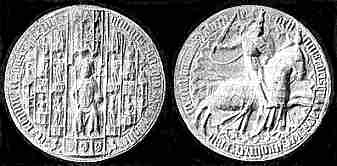 |
Above: The Great Seal of England - Henry VI |
Throughout English history government was traditionally 'by the three seals' - the
Great Seal of England (held by the Lord Chancellor), the Privy Seal and the Signet. Under Henry
VII and his successor Henry VIII this tradition continued; but under Edward VI, Mary I and (most
especially) Elizabeth I, the tradition declined. Elizabethan England saw the development of
government by ministers as a replacement for the medieval government by seals.
1601will Info2 sheet 2
Letters Patent - 'lettres patientes'
Letters patent are a type of legal document which is an open letter issued by a monarch or
government granting a right, monopoly, title, or status to someone or some entity such as a
corporation. The opposite of letters patent (from Lat. litterae patentes) is letters close (Lat.
litterae clausae) which are personal in nature and sealed so that only the recipient can read the
contents of the letter. Letters patent often start with a salutation such as "To all to whom
these presents shall come Greeting" or "To all to whom these Presents shall come or
whom the same may in any way concern, GREETING:". Letters patent can be used for the
granting of coats of arms, for the creation of corporations, or by a monarch to create an office.
They are also common in printed diplomas and academic degrees from educational institutions. The
term patent now most often refers to such a document that grants exclusive rights in an
invention.
Court of Exchequer - 'by patent under the seal of the Courte of Exchequer'
The Exchequer of Pleas or Exchequer was one of the three common-law courts of Medieval and
Early Modern England. The term Exchequer is used where there is no possibility of confusion with
the government department of the Exchequer of which the Exchequer of Pleas formed a part.
By 1190 the Exchequer exercised a judicial role, with judges, known as Barons. At first the
business consisted of two parts: actions by the Crown itself, in respect of monies owed to it; and
actions by private citizens who had the right to sue in the Exchequer.
It seems that the judicial business of the Exchequer grew until, by 1290, it had become a
regular common law court on a par with the courts of the King's Bench and the Common Pleas. A
reaction set in whereby Magna Carta was interpreted as preventing common pleas being heard other
than in the Court of the Common Pleas.
As a result most private business could only be brought in the Exchequer by use of a legal
fiction. At first parties claimed to be servants of Exchequer officials, but eventually the Writ
of Quominus became the normal way of bringing an action in the Exchequer. Quominus operating in a
similar manner to the Bill of Middlesex in the King's Bench.
By the late seventeenth century the Exchequer had become the third court for hearing Common
Pleas, after the Common Pleas and King's Bench.
The court was absorbed into the new High Court by the Judicature Act 1873 and became the
Exchequer Division, which in turn was abolished on 16th December 1880, becoming part of the
Queen's Bench Division.