 |
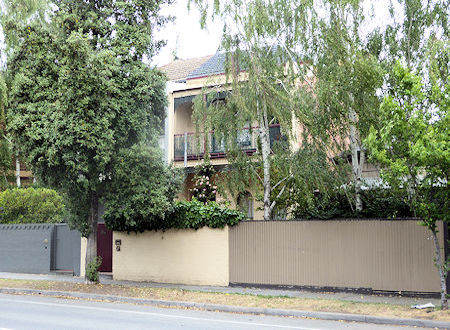
Left: 94 Wellington Street, St Kilda East Author: November 2015 |
1821 Info14c for Caleb Crompton |
His life, legacy and death after the war
In 1922, Frederick John Crompton SALES married Irene JAMES, born in the third quarter of 1898 in Liphook, England (GRO ref: Petersfield 2c 163). The Australian Electoral Roll, started 1903, give the family home and occupation for 1924 as:
|
Left: 94 Wellington Street, St Kilda East Author: November 2015 |
In 1924/5 the couple moved
| Right: 290 New Street, Brighton Author: November 2015 | 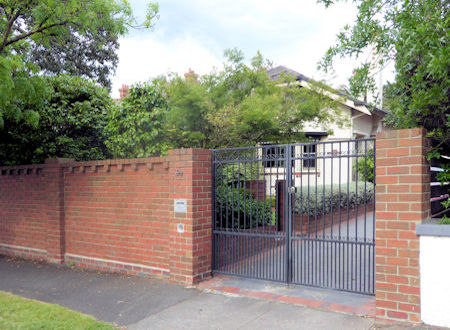 |
and again in 1928
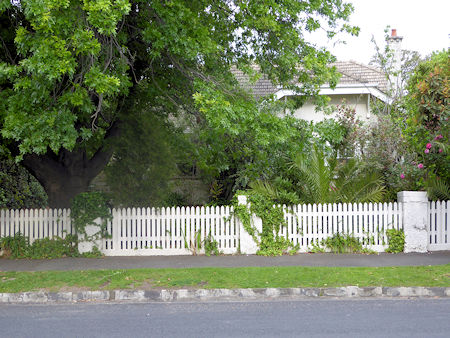 |
Left: 11 Newbay Crescent, Brighton Author: November 2015 |
and 1937, where he was probably recorded in the care of his brother-in-law, Dr George Edward Payne PHILPOTS, a dentist
where the couple lived until his death on 28 July 1937 when Irene first moved, in 1942 to:
| Right: The redeveloped site of 2a Middle Crescent Author: November 2015 | 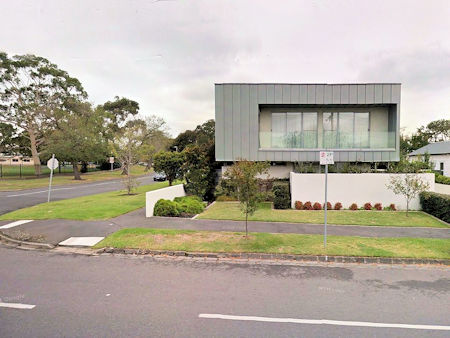 |
Between 1954 and 1963 Irene moved. In 1963 she was recorded at:
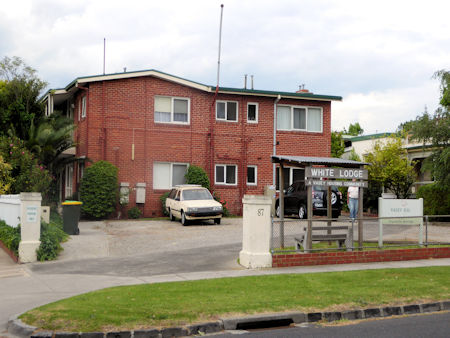 |
Left: 8/87 Seymore Road, White Lodge sheltered accommodation in November 2015 - author |
where she died in 1983 in sheltered accommodation. Irene was cremated at Springfield Botanical Cemetery on 15 June 1983 and her ashes were scattered.
SALE the architect
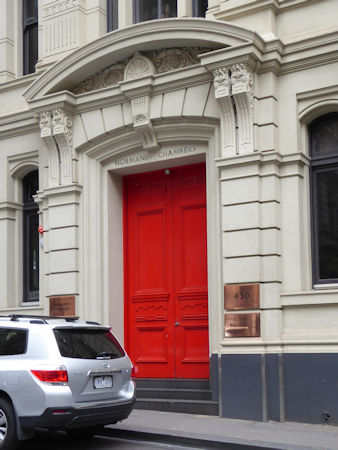
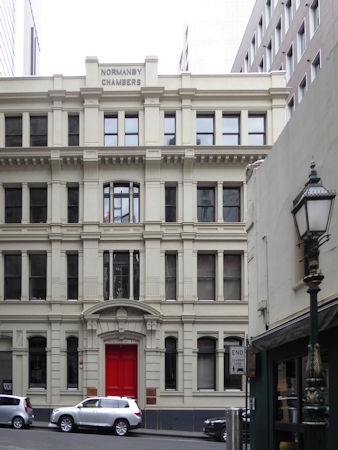
In 1920, after returning from London where he completed his architectural training, Frederick SALE formed a partnership with J Samuel KEAGE in offices at 430 Little Collins Street. As a narrow one way lane Little Collins Street takes on the name of the wider main street, which is the financial heart of Melbourne and the home to banks and insurance companies. In March 1935, the firm of Sale and Keage trained one of Melbourne's unsung architects. Norman Brendel entered the office of Sale & Keage in March 1935, where he held a probationary position for twelve months. His employers were equally glowing in their assessment of the young man, and wrote in 1936 that "he has shown considerable ability and aptitude... he is diligent, punctual and his integrity is unquestionable". From there, Brendel entered the practice of architect Arthur W Plaisted.
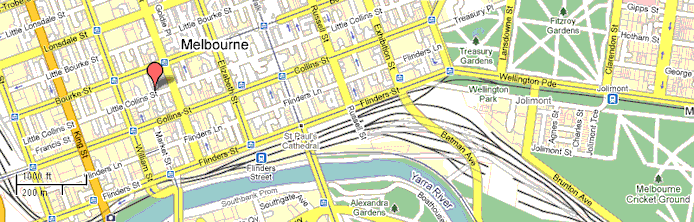 |
| Above: Sale and Keage's offices were at 430 Little Collins Street, Melbourne, located at the red dot |
|
| 1 | 2 | 3 | 4 |
|---|
|
|
|
|
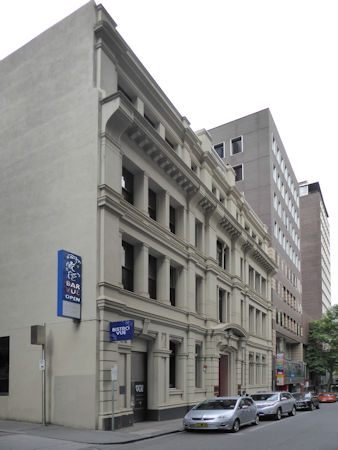
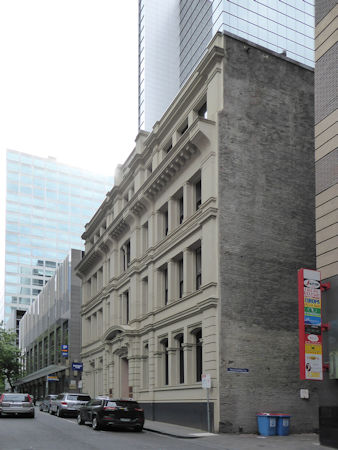
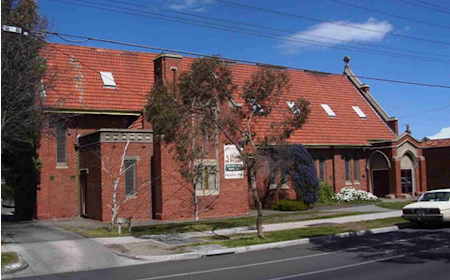
Three of their buildings are identified on the World Wide Web.
| Right: 59-61 Mason Street NEWPORT, Hobsons Bay City
The present brick church was constructed in 1926-27. Designed by architects Sale & Keage, the foundation stone was laid by the Archbishop of Melbourne, the Most Reverend Harrington Clare Lees DD, on 4 December 1926. Source: Victorian Heritage Database In 2006 Hobsons Bay Heritage Study describe it as 'austere red brick modern Gothic style building' ... ' is of local historic, social and aesthetic significance to the City of Hobsons Bay. |
 |
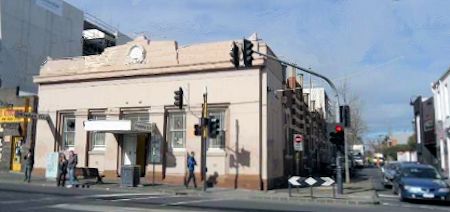 |
The building was constructed in 1911 and then modernised with the construction of an
extension on the street front, giving the building a new classical revival facade. It was
designed by the architectural firm Sale and Keage in the first half of the 1920s.
Left: Praham Tadesmens Club, 258-262 High Street Windsor front view |
| Right: Praham Tadesmens Club side view | 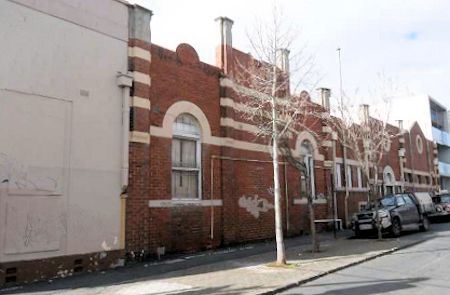 |
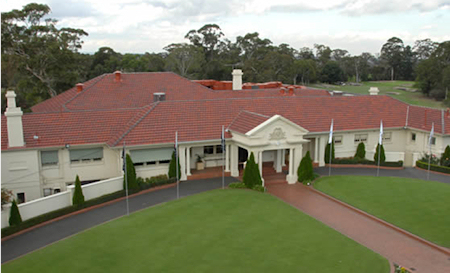 |
Left: 1928-29 Commonwealth Club, Glennie Road, Oakleigh; architect L. (sic) Sale (Sale and Keage), builder H.P. Brady, cost approx $13,000-$14,000. |
 |
|
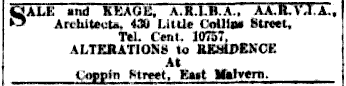 |
An advertisement from page 4 of The Argus showing, perhaps Fred SALE's London ARIBA qualification. |
On 7 November 1924 this fruitful partnership came to a sudden end with the death of Samuel Keage, aged 35 of Union Street, Kew, in a motor accident which involved Fred SALE's ' double-seater Dodge motor-car'.
Samuel Keage was driving along the wide and safe Royal Parade. At the railway bridge the road 'bottle-knecked' to a 'notoriously dangerous' bend.' By driving straight on, instead of turning right Mr. Keage struck a picket fence ... and crashed down a steep embankment to the railway line, a drop of about 40 feet. [The car] turned somersault and landed on the railway line with its wheels in the air. ... Mr Keage was apparently dead. His head was resting on the electric horn.'
Police reports suggest that Samuel Keage was driving at about 30mph and had made 'desperate efforts' to negotiate the bend. The motor car was damaged beyond repair. 1 The inquest recorded:
 |
|
MOTORING TRAGEDIES. Car Falls Down Embankment. CITY ARCHITECT KILLED. SYDNEY-ROAD DEATH TRAP. A viaduct spanning the railway line at Royal-Parade, Parkville, which has proved a dangerous trap for motorists during the past few months was the scene of a shocking motor fatality at l.55 a.m. yesterday. A double-seater Dodge motor car driven by Mr. John Samuel Keage, of Union-street, Kew, was travelling from the city towards Brunswick at a speed of about 33 miles an hour. The driver who was the sole occupant of the car, failed to notice the white picket fence running along the side of the railway line, and crashing into it with terrific force his car hurtled down the embankment and struck the rails a distance of 40 feet below. The machine fell on the hood, with the four wheels spinning in the air, and the un-fortunate motorist was pinned beneath the wreckage. His death must have been instantaneous. Mr. Keage's head was pressed by the heavy weight of the hood against the electric motor horn, with the result that the tooting disturbed the early- morning quiet ness of the neighborhood. (sic) Mrs. John Edward Lyons, wife of music warehouse-man of Bourke-street, who lives on the other side of the railway line, heard the crash of the impact between the car and the fence, and also the loud noise of the horn. Realising that a serious motor accident had occurred she awakened her husband, and they both proceeded to the railway bridge. Peering over the rails they discerned in the darkness the faint outline of a wrecked car lying on the railway line. The horn was creating an incessant din. Mr. Lyons thought that the motorist was buried beneath the wreckage, and was pressing, the horn in order to bring some of the residents to the scene of the accident. |
Sliding down the steep, embankment in his pyjamas. and cutting himself against the jagged stones, he reached the railway line, and saw that the motorist was beyond all human aid. His neck had been broken, and he had also received other shocking injuries to the body. In the meantime Mrs. Lyons had run back to the house and telegraphed the Royal Park police and the ambulance depot. An ambulance quickly arrived on the scene, and the motorist was taken to Melbourne Hospital. Constable M'lntosh of Brunswick, and Constable Malone, of Royal Park, together with Senior Constable Cornish, of the night patrol car, were summoned, and they communicated with the railway authorities. A wreckage train equipped with a crane, and several men arrived and after some little difficulty removed the car, which was splintered to match-wood. It was taken to the Royal Park | railway station pending removal to Russell street. Constable Malone is preparing a report of the fatality for the Coroner (Mr. D. Berriman). Senior Constable outline of a wrecked car lying on the railway line. The horn was creating an incessant din. Mr. Lyons thought that the motorist was buried beneath the wreckage, and was pressing, the horn in order to bring some of the residents to the scene of the accident. Sliding down the steep, embankment in his pyjamas and cutting himself against the jagged stones, he reached the railway line, and saw that the motorist was beyond all human aid. His neck had been broken, and he had also received other shocking injuries to the body. In the meantime Mrs. Lyons had run back to the house and telegraphed the Royal Park police and the ambulance depot. An ambulance quickly arrived on the scene, and the motorist was taken to Melbourne Hospital. Constable M'lntosh of Brunswick, and Constable |
Malone, of Royal Park, together with Senior Constable Cornish, of the night patrol car, were summoned, and they communicated with the railway authorities. A wreckage train equipped with a crane, and several men arrived and after some little difficulty removed the car, which was splintered to match-wood. It was taken to the Royal Park railway station pending removal to Russell street. Constable Malone is preparing a report of the fatality for the Coroner (Mr. D. Berriman). Senior Constable Cornish, of the night patrol car, were summoned, and they communicated with the railway authorities. A wreckage train equipped with a crane, and several men arrived and after some little difficulty removed the car, which was splintered to match-wood. It was taken to the Royal Park railway station pending removal to Russell street. Constable Malone is preparing a report of the fatality for the Coroner (Mr. D. Berriman). Senior Constable Cornish made inquiries, and ascertained that deceased was a single man, aged 35, and was a member of the firm of Keage and Sale. architects of 430 Little Collins street city. Mr. Sale was communicated with, and he said that he had loaned the car to his partner for the night. As Mr. Keage lived in Union street, Kew, he was a loss to understand why he had been travelling along Sydney Road at such an early hour in the morning. Five minutes before the accident a constable attached to the Royal Park railway station saw a motor car which he identified as that driven by Mr. Keage travelling in the direction of the viaduct at a speed approaching 35 miles an hour. Tyre marks near the bridge indicate that the motorist saw his fatal mistake late, and attempted to swerve his machine clear from the embankment onto the main track. |
| Constable Malone, in describing the scene of the accident said;- The motor road
at this point leads directly to the fence, and to cross the railway bridge it is
necessary to make a very sharp turn to the right around a rockery, and then to the
left over the bridge It is a particularly d dangerous spot The nearest light on the
south side 130 yards, from the bridge.
On 11 November 1924 the Geelong Advertiser reported the 'Coroner's forcible remarks: "The attention of the authorities concerned should be drawn to the need for better lighting facilities, also to the need for extension of the railway bridge to the full width of the motor road where this accident happened." These remarks were made by tbe City Coroner (Mr. D. Berrman) to-day at the conclusion of the inquest into the death of John Samuel Keage. Alexander Burnett Keage, father of the deceased, gave evidence to the inquest that his son was considered to be a very cautious driver, and was of a temperate habits. A finding of accidental death was recorded. Right: Samuel Keage |
 |
Hoverbox Photo Gallery -
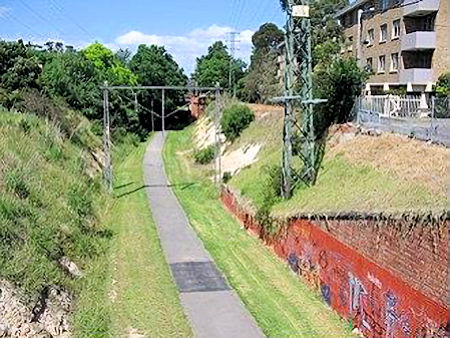
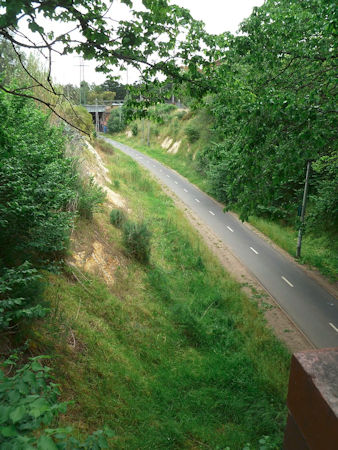
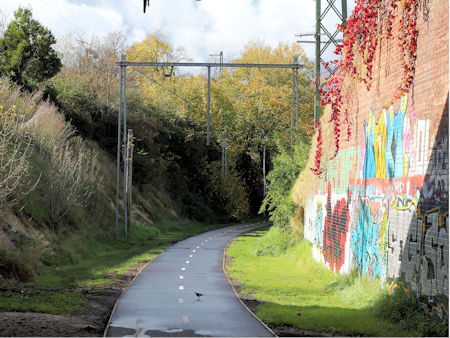
The possible scene of the accident (now 527 Royal Parade)
showing the disused Inner Circle railway track now the Inner Circle Rail Trail
This feature does not function correctly on phones and tablets
|
1. The cutting looking west from Royal Parade 2. Inner Circle Rail Trail |
3. Showing the steep sides were almost a vertical drop |
| 1 | 2 | 3 |
|---|
|
|
|
| Right: The possible car involved in Keage's death: a 3½ litre 1923 Dodge, which suggests Sale bought the car from new. It is a right-hand drive, for the Australian market, is a 'double-seater' having seats and space for back-seat passengers and a soft top 'hood'/canopy - using the English/Australian use of the word rather than the American term for bonnet. The purchase price is unknown. In 1925 the top of the range four seater tourer cost £385 in the UK. | 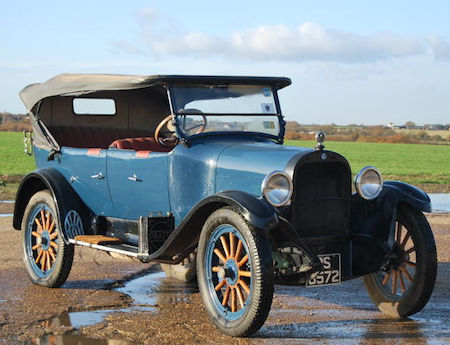 |
With thanks to Chris Glass for his research.
Other works
The name of Sale and Keage continued. SALE then practiced in partnership with TEAGUE until SALE'S death at age 45 in 1937 (Argus, 31/07/1937). The short-lived partnership of Sale and Teague won a competition in 1923 to design the RACV building at 94-98 Queen Street, Melbourne (demolished in 1989), as well as a new portico for the St Kilda Town Hall (1925). They also designed churches, factories and homes (RVIA Journal, November 1924, 165-66).
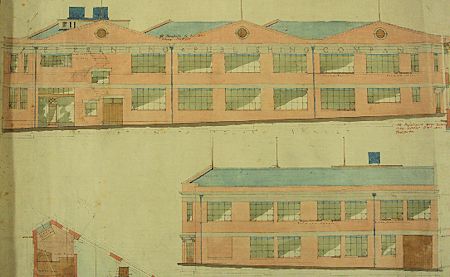
| Right: 1924 drawings for EP Printing and Publishing Company, 221 Pelham
Street, Carlton
is described as 'a double storey building with load bearing red brick walls and concrete slab floor supported internally by concrete columns. A note on the drawings reads 'Concrete columns and beams to be designed for two future additional stories'. Both floors were designed to be single open plan spaces apart from stairwells at the western and eastern ends of the Pelham Street frontage and a first floor lavatory adjacent to the east stairwell.' |
 |
The [EP Printing and Publishing Companies] 'building, while a representative example of a interwar industrial architecture, is an altered and unremarkable example of a building type that is already well represented by a number of more intact and more architecturally distinguished examples protected as individual heritage overlay sites or forming part of precincts under the Melbourne Planning Scheme'. - Conclusions to a heritage overlay scheme in the Melbourne Planning Scheme April 2014. (Accessed: 07 October 2015)
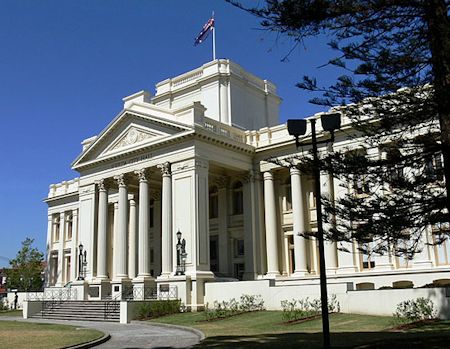 |
Left: The new portico for St Kilda Town Hall, Brighton Road (1925) is described as 'an uncommon and important feature, whilst the associated foyer is of note' (City of Port Phillip Heritage Review - Citation 68 |
An email from Dr Katti Williams (08 March 2024) a Research Fellow at the Faculty of Architecture, in The University of Melbourne suggests that Fred Sale entered the competition to design Melbourne's Shrine of Remembrance. His entry is to be featured in the 2024 exhibition.
| The Shrine is Melbourne's war memorial, located on St Kilda Road. It
was built to honour the men and women of Victoria who served in World War I. The
Shrine went through a prolonged process of development, which began in 1918. Two
committees were formed, the second of which ran a competition for the memorial's design.
The winner, architects Phillip Hudson and
James Wardrop, was announced in 1922. The foundation stone was laid on 11 November
1927 and work was finally completed in September 1934.
Right: Melbourne's Shrine of Remembrance |
 |
Frederick John Crompton SALE died on 28 July 1937.
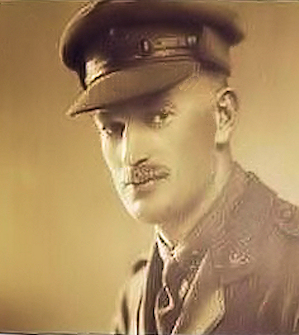
'My lovely Dad was gassed twice during the war so developed TB. This does not show on his war record as he was busy seeing that his men reported in sick, but didn't report in himself. My mother told me this. She was English, born at Liphook, and they met after the war when he was finishing his degree in Architecture in London. Her name was Irene James, and she came to Australia to marry Dad when he had established his own practice and could afford her fare. His cough was apparent by this time, and when he died it was difficult to prove that war was the cause of his illness, but some well known and respected friends of his convinced the authorities that it was so, and my Mum was able to get the pension. This was 1937 during the depression, so getting the pension was vital as Dad had been bedridden for a long time, unable to keep his practice going.'Source: Claire TIMLOCK, his daughter, August 2009 Right: Captain Frederick John Crompton SALE, after the war |
 |
| Right: Frederick SALE's medal cluster: Military Cross with Bar, Military Cross with Bar, 1914-15 Star, British War Medal, Victory Medal | 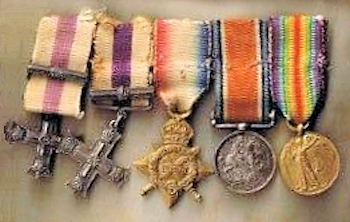 |
 |
|
 |
For several months, during Fred's final illness, the mateship of the trenches
prevailed. Jim Dafter (recorded as Daften in the unit history 'The Red and Black
Diamond') looked after him and the family by shaving the sick man and doing odd-jobs
around the house.
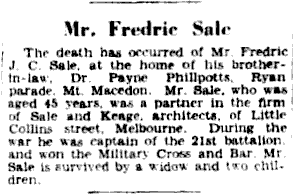
Fred's death was announced in The Argus on Saturday 31 July 1937 at Mount Macedon to the northwest of Melbourne (Through Gisborne, on the M79 highway. Ryan Parade is a tree sheltered cul-de-sac.) A private cremation followed. |
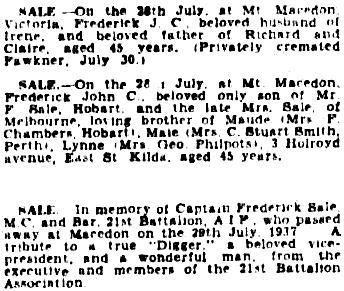 |
Source: The Argus, 31 July 1937, page 7 |
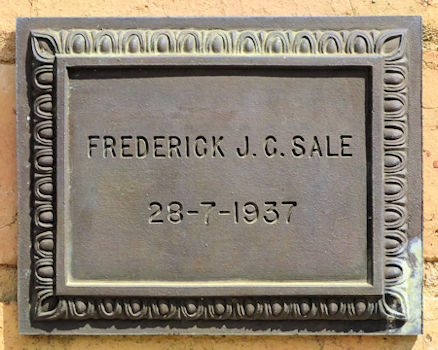 |
Victoria BMD 16367/1937
Left: Frederick Sale's memorial in Fawkner Garden of Remembrance. Author: November 2015 |
Other points of interest
End notes:
|
 |
|||||||
| This page was created by Richard Crompton and maintained by Chris Glass |
 |
Version A6 Updated 08 March 2024 |
||||||


