1821 Info14a for Caleb Crompton
|
Close info window |
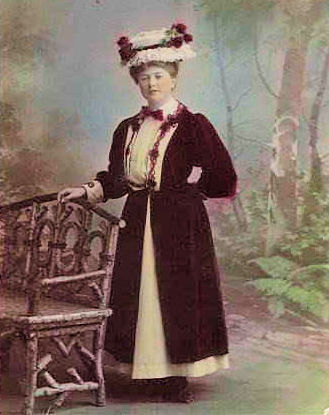
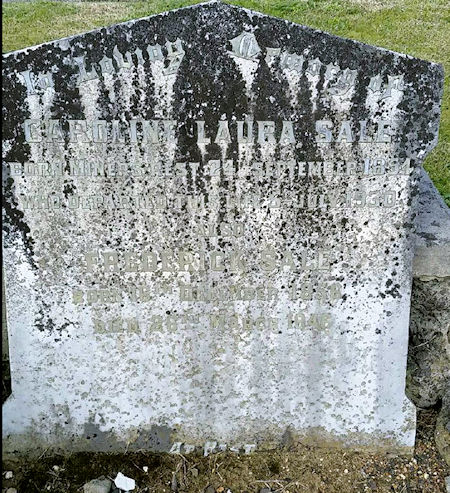
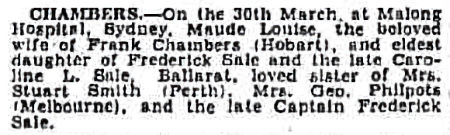
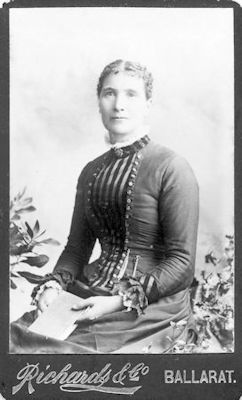
Caroline laura Crompton
b.1854 [Miners Rest?] d.1930 Cauldfield, Victoria
Caroline married Frederick Sale (1857-1946) in 1879.
Frederick john crompton Sale
Their son was Captain Frederick john crompton Sale, an architectural draftsman of Melbourne, born in Ascot Vale on 16 June 1892. He was one of seven 21st Battalion officers to be awarded a Bar to his Military Cross: the MC in 1916, and a Bar, in 1917.
The attack on Mouquet Farm, north west of Pozieres, 26 August 1916
After the carnage of Pozieres, ‘the rapid advance of the 4th Division towards Mouquet Farm, carried out with comparatively light forces, gave confidence in the method; and, although the defences near the farm were obviously stronger than those encountered during the advance, their strength was as yet uncertain, and they were still attacked with formations very much thinner than those which stormed Pozieres and the Pozieres Heights.’ …
… ‘The 2nd Australian Division, which returned to the line after a fortnight's rest, had already lost over 6,200 of its infantry in the two attacks upon Pozieres Heights. The 6th Brigade under Gellibrand had suffered least: and was therefore chosen for the next stroke of the battering ram against the farm. Upon Gellibrand pointing out that only one of his battalions, the 21st, was strong enough for fighting of this nature, it was decided to limit the attempt to an advance on one side of the farm.’
| General White, held the principle that it was useless to renew a defeated attack without
changing the method. The position already gained on the high ground (ie east of the farm)
must be consolidated. At the same time every opportunity had to be taken to consolidate
the high ground and to advance towards the Fabeck Graben (known as ‘High Trench’), east of
the farm, even if only by bombing. The main attack was ... from the west.
Brig. General Gellibrand allotted the main thrust east of the farm to the 21st, with the 24th on its left, the 23rd holding the long eastern flank, and the 22nd acting as a carrying party. |
![]() |
‘… unfortunately [Gellibrand] had placed his only fit battalion - the 21st - on the wrong side of the farm; to employ the 24th after its sufferings in the barrage of July 27th and August 22nd was out of the question. It only remained for the two battalions to change places in the line; and on the afternoon of August 24th, by an elaborate series of moves resembling the shunting of trucks in a congested railway yard, this remarkable transposition was carried through practically without loss. |
|
|
The main attack was to be delivered by the 21st in two waves against Points 54, 77, 27, and 12.
On the right the 24th would endeavour to secure … the dugouts of the farm and Point 31, while patrols
pushed up all northward-leading trenches. … The flank of the 21st must be protected. … [It] would
be guarded by a company of the 22nd, which was to follow closely upon the left of the 21st and
drop its platoons successively to form flanking posts in the shell-holes.’ ‘Gellibrand chose to attack at dawn, his object being partly to achieve surprise, since all previous attacks by the Australians on this battlefield had been made at night or late in the afternoon.’ |
![]() |
|---|
‘It would also be an advantage that the troops, after assembling under cover of dark, would advance when there was just light enough for them to see the lie of the country without themselves being clearly seen. By careful observation during the dawn of August 25th, Gellibrand and Major Plant, his brigade-major, determined that the light was suitable about 4.30. In consultation with divisional headquarters, therefore, the attack was fixed for 4.45 a.m. on August 26th. As a guide to the direction of the objectives, wires were run forward from both flanks of the 21st. Divisional orders were to watch the barrage "closely, and to keep as close as possible to it up to the objective."’
‘… The objective trench, the Grosser Riegel (‘Zigzag Trench’), lay just beyond, barely traceable; and, except on the left, the line [of men], hurrying after the barrage, crossed it without any notion of halting there and swung unconsciously eastwards in the direction of flares which were rising from the farm or beyond. As the troops topped the shoulder on which lay the farm, a machine-gun somewhere to the left opened in enfilade, killing a number of men and causing the left centre to split and hesitate. The greater part, however, went on, disappearing from view.’
|
‘The commander of the left company, Captain Sale, himself wounded at this stage, felt certain that the
objective lay on the near side of the shoulder, and that the advance was proceeding too far. He succeeded
in stopping a few men and, after a chase, in bringing back some others; but orders could not be heard in
the din, and it was a mere handful that he succeeded in placing in two or three craters approximately in
their proper position - Point 77 in the Zigzag Trench. The sound of machine-guns beyond the rise showed
that the rest of the line had run into heavy fire somewhere near the back of the farm. ‘To summarise. On the right, the bombing parties of the 24th had been repelled; in the centre, the main part of the 21st had followed the barrage far beyond the objective, but others had seized the trench west of the farm; on the left centre a small party held the objective near Point 77.’ |
![]() |
|---|
|
‘Most of the 21st’s left company, which was to have seized a frontage from Point 54 to Point 77, had,
like the centre, swung far to the right. Part of one platoon, however, under Lieutenant Jones
...had advanced in almost the true direction and reached and manned some
craters near the Zigzag Trench. ”Enemy fire was coming from only one point, 130 yards to the left. Jones
at once recognised that this was Point 54, which his company should have captured. He called for the two
special parties which were to barricade enemy trenches leading beyond the objective. Only one party was
there. “Well,” said Jones, “we’ll go and take Point 54.”’ ‘They reached it, still in the half-light, and found that its nearest face consisted of a trench parallel to and just short of the road cutting, from which it was divided by a high wide bank on which was Point 54, therefore, uncaptured. Crowded along its parapet, the Germans with two machine-guns poured a stream of fire upon |
![]() |
|---|
|
Australians visible to them near Mouquet Farm. This attracted the attention of
Captain Sale, holding the crater-post near Point 77. In crawling
along Zigzag Trench, vainly searching for the other companies, he had found a Lewis-gun team with
1,500 rounds of ammunition. These gunners, reinforcing his post, now swept the parapet of Point 54
and shot down the German gun-crews, though other Germans eventually managed to remove both guns from
the parapet. Both Sale and Jones, seeing that their posts had not been fully located by the enemy,
kept most of their men hidden, waiting for the expected counter-attack.’ At about 7.20 signs of this counter-attack appeared in the shape of a file of the enemy approaching along the Zigzag Trench from the direction of Thiepval. Sale sent information of this by three messengers; the first two were never again heard of; the third, and Sale himself, who followed, got through, to find that the movement had already been observed at The Quarry ... a Stokes [was] mortar directed on to the oncoming Germans. ... |
![]() |
|---|---|
| Above: Point 54 and 77 viewed from near Mouquet Farm. The bayonet duel took place at 'X'. Men of the 22nd were seen at 'Z'. Jones was about 'Y'. |
| Lt Mahony, of the 24th, to the east of Mouquet Farm was sent to reinforce Sale, but seeing
the 21st streaming away from and beyond their objective, he managed to collect several of them
before taking news of Sale's and Jones's post to Lieut.-Col. F. W. D. Forbes, the commander
of the 21st.
‘But after Mahony's return, no word came back of the main advance. In the trench through which Mahony had reached the forward troops, German bombers had reappeared and barred communication. Sale, who succeeded in returning from The Quarry to his post in spite of machine-gun fire from the farm, sent a patrol to his right along Zigzag Trench; but, after passing only |
![]() |
| Previous page: The Quarry, Sale's objective, photographed in December 1916
Source: AWM, E00565 |
|
| wounded men, it was suddenly met and fired on by Germans. Later in the morning more firing and bombing were heard beyond the crest. German machine-gunners at Point 54 tried to join in, but were finally silenced by Sale's Lewis gunner. It was reported that the Germans were attacking from the farm and north of it. The isolated Victorians being evidently in a desperate position, the artillery barrage was called down north of the farm, and at 10.20 a.m. Gellibrand ordered the 24th to suppress the enemy in the farm by two bombing attacks from south and south-east.… This perilous duty was accepted by Lieutenant Smythe and parties were organised; but, as the artillery could not be employed for fear of hitting the isolated troops, and the available trench-mortars were in positions from which the objective could not be hit, the order was at the last moment cancelled. A renewal of the attack on Point 54, ordered for noon after renewed bombardment by heavy artillery, also remained unattempted, apparently because the artillery had overshot their target. | ![]() |
|---|
![]() |
| Above: Annotated trench map of Mouquet Farm showing 21st Battalion's
positions in dark blue, Sale's action in solid and large dashed turquoise and the German
positions in red.
Click on the map to open a full A4 landscape map. Source: Pozieres 57D SE1, WO297/1512, The National Archives (TNA), Kew, London |
The abandonment of these projects was fortunate: it is unbelievable that such efforts, made in daylight against an alert enemy strongly occupying positions of great strength, had any chance of success. Early in the afternoon a somewhat similar attempt was made by the Germans, who had been massing east of the farm in the Fabeck Graben to bomb southwards against the advanced sapheads of the 24th. They were easily beaten back at these points by a Stokes mortar and Lewis guns, but they held the farm and Point 27 strongly, and, where the advanced body of the 21st had been fighting, there was now silence.
| The front of the 21st Battalion, which had been gradually reinforced by the 22nd
during the day, was taken over after dark by the incoming 14th (Victoria) Battalion of the 4th
Brigade (4th Division), which relieved the 6th Brigade.
When on the night of August 26th the 14th Battalion relieved the 21st, it was rumoured that some advanced post was still far out in front of The Quarry, though no one knew quite where. About 2 a.m., therefore, Captain Hansen of the 14th sent Sergeant Stewart with fifteen men to advance in skirmishing order in search of it. Passing the tree-stumps of the Courcelette road in pitch dark, they came upon them reduced to about ten men of the 21st under Sergeant McAlpine. This was the post of the 21st at Point 77. Stewart and his men relieved the garrison, and a trench to the post was at once begun from The Quarry end. |
![]() |
| Above: Mouquet Farm in 2008 |
| The legend against this photograph on page 812 of Bean Volume III records:
'The ruins of
Mouquet Farm as seen from Point 55. The photograph (which looks northeastward toward Thiepval)
was taken on 27th November 1916, some weeks after the capture of the farm. The German dugout
at Point 47 lay behind the 'road' near the tree. The officer in the darker uniform is Captain
F. Sale, 21st Battalion. AWM No. E566'.
This same photograph, on the Australian War Memorial (AWM) website, identifies the other officer as Captain CEW Bean, but fails to mention Fred Sale. Source: AWM E00566 |
![]() |
The meeting of these two officers would account for Bean's detailed description of Sale's action, cited above.
Source: Bean, CEW, ‘The Official History of Australia in the Great War, Vol. III, The Australian Imperial Forces in France 1916’, Angus and Robertson, Sydney, 1941 page 812-823
The Battalion's War Diary records Captain Sale's action as Officer Commanding 'B' Company ...
|
Vol I Sheet 6 |
WAR DIARIES |
Lt.Col JWD Forbes Commanding 21st Battalion AIF |
|---|
| Date | Place | Time | Summary of Events or Information |
|---|---|---|---|
| 26th | QUARRY | 1am | "B" Company moved from SAUSAGE VALLEY TO QUARRY "A" Company moved from TOM'S CUT to QUARRY |
| 4.45am | Enemy position 54, 77, 27 attacked with "A" & "B" Companies plus 2
Platoons "C" and "D" together with carrying parties left flank being
patrolled by one Company 90 strong 22nd Battalion Attack was successful at point 77. Points 27 and 54 however proved to very strong in men and machine guns. Reinforcements dispatched to both points and fresh efforts made to carry them by bombing but without success. Some of/\ The Company operating on right flank appeared to go beyond their objective and in falling back suffered heavily. A further attempt on Point 54 was made at 12.15pm after heavy artillery had operated. Owing to artillery not successfully finding the range this attempt was again frustrated by enemy machine gun fire. An enemy trench mortar was captured & destroyed. On relief of this Unit during the night of 26/27 position at point 77 and to the eastward handed over to 14th Battalion. |
||
| Casualties during period 22nd/26thAugust Killed Wounded Missing Officers Capt RG Smith Lt JW Pearce Capt AS Robertson Lt CAW Clanborough Capt AR Macneil 2/Lt A Bratty 2/Lt EJ Clark Lt CN Bartels 2/Lt GH Richmond Lt CR Longdon Capt F Sale 2/Lt H Buttercross 2/Lt D Black Other ranks 34 213 131 |
|||
J Forbes |
|||
Source: 21st Battalion War Diary August 1916 - Australian War Memorial
|
W6378/M755 500m 9/16 G S M.369 Army Form W.3121. |
|||||
|---|---|---|---|---|---|
| Unit | Reg. No | Rank and name | Action for which commended | Recommended by | Honour or Reward |
| 21st Bn | Lieut (Capt) FREDERICK SALE | For excellent work at Pozieres and plucky endurance under heavy fire. He has distinguished himself by an untiring devotion to duty and his gallant bearing in action. | J Gellibrand Brig Gen Commd 6 Inf Bd | MC | |
|
W6378/M755 500m 9/16 G S M.369 Army Form W.3121. |
|||||
|---|---|---|---|---|---|
| Unit | Reg. No | Rank and name | Action for which commended | Recommended by | Honour or Reward |
| 21st. Battalion A.I.F. | Captain Frederick SALE | This officer commanded the left
flank of the attack on the MOUQUET FARM trenches on the 26th August 1916,
and displayed high soldierly qualities in organising and consolidating the
defence of the captured position about [Point] 77, under very heavy shell fire.
Though wounded he remained on duty and, though his runners had become casualties in attempting to cross the open ground to our lines in rear, he reported to Battalion Headquarters and then returned to his post until relieved. |
G.O.C. 6th. Aust. Infantry Brigade. | Military Cross. | |
The Bar to his MC - 4 October1917
CEW Bean’s official account of the Battle of Broodseinde, part of the 3rd Ypres campaign which aimed to capture Passchendaele, appears to describe Brigade actions, rather than those at Battalion level. As a result, one can only conjecture about the part played by Frederick Sale in the action of the 21st Battalion. By applying parts of the citation to his MC Bar to the broad picture painted by Bean it is possible to give a general account of his bravery.
The campaign had opened on 26 September. By 4 October, the I ANZAC AND II ANZAC lined up from the west of Zonnebeke to the south east of Broodseinde villages. The objective was the last open ground before ascending the slopes to the Passchendaele ridge that dominated the Ypres salient: 21st Battalion was to take Broodseinde village and beyond.
Whilst massing in the ‘jump off tape’ (JOT), ready to go ‘over the top’, Battalions were subjected to what was initially thought to be server German counter-battery shelling. The German account, quoted by Bean, states that
‘The German bombardment began at 5.25, and ten minutes later all the mimwzuerfer and the artillery of the 4th Guard Division concentrated on the front to be attacked, while the artillery of the neighbouring divisions, to divert attention, barraged other sectors to right and left. Under this bombardment the three attack-battalions, which had assembled at midnight on the eastern slope of Broodseinde Ridge and had since been guided to the front line, were to push forward as close as possible to their barrage.
These were the fireworks noted by Australian observers.
At 6 the German bombardment lifted to allow the waves of infantry to attack. In order that they might work up very close, the last shells before the lift were fused so as to burst deep in the earth and scatter few splinters. The barrage was then to move 200 yards beyond the British line, and thence later to the back area.’
Both armies had planned a simultaneous attack. Bean’s casualty figures illustrate the severity of this bombardment on the Australians.
‘Some twenty officers are known to have been killed by the bombardment, and about a seventh of the attacking force of I Anzac appears to have been killed or wounded. Most officers felt certain that the [Australian] assembly had been detected, but at the last moment the 29th, waiting on the edge of Zonnebeke, suspected another cause. Since 11 o’clock Germans had been seen continually passing across its front, and, although for some hours this was interpreted as a normal relief, its continuance and the weight of the subsequent bombardment convinced those on the spot that the Germans were about to attack.
Most of those who were “missing” after this attack were killed in this barrage. Among the officers who, according to the records then lost their lives were Captains RNC Kirsch and JR Davidson, and Lieut. LGP Errey of the 21st Bn.’It was within this maelstrom that Captain Sale showed ‘dash and gallantry … considerable coolness and initiative’.
|
The Final stage
At a dug-out 300 yards down the slope three German officers fired with rifles until they were killed. Through similar resistance in front of the next brigade (the 6th, of the 2nd Division) a well-known leader, Captain Pearce (21st Battalion), was killed as he launched the attack. The brigade moved down the gradual slope, the right battalion (24th) making eagerly towards a hedge that, from the intelligence maps, it knew to shelter a German headquarters. The Australian shrapnel was bursting much too high to prevent it from being effective and, in the 21st, Lieutenant Rigbyen and many NCO’s and stretcher-bearers were sniped. Again, the casualty figures illustrate the severity of the fighting and therefore the gallantry and coolness shown by Frederick Sale. |
![]() |
|---|
‘On October 7th, on being ordered to the line, the 6th Brigade arranged to send back to the reinforcement camp at Caestre 100 of the most exhausted men of each battalion, and bring up 100 fresh men in their place.
Lieutenant-Colonel Beiers of the 19th found the relieving battalion so weak that he at first refused to allow it to take over the front line. The 21st Battalion, which was to have been held in reserve, was accordingly ordered to take over half the front of the 23rd and to attack beside it.’
The strength of the 21st, with its reinforcement, was 8 officers and 220 men, from a full strength of about 1000 rifles. Thirteen officers and 332 Other Ranks had been killed in action. By 9 October, the 6th Brigade was down to 600 available men, from the full strength of about 4000 rifles.
Sources:|
Vol XV |
WAR DIARIES |
Lt.Col BOC Duggan Commanding 21st Battalion |
|---|
| Date | Place | Time | Summary of Events or Information |
|---|---|---|---|
| 04.10.17 | BRICK KILN D27.0.9.0 |
8.20pm | .Message received from Officer Commanding 'B' Company [Sale] requesting water, SAA [Small Arm Ammunition] and a Stokes Mortar Gun. The two former were sent and arrangements were made with the 24th Battalion to send up a Stokes Mortar Gun Section. |
| 04.10.17 | 11.30pm | Message received from line "1 Officer killed and 2 wounded leaving 3 Officers only in the line." | |
| 05.10.17 | 1am | In touch with 24th Battalion and was informed that their Stokes Mortar Section could not be found. | |
| 5.50am | ... leaving 3 officers in the line viz Capt F Sale MC, Capt HCH Sandford & Lt NR Holt ... Capt F Sale OC 'B' Company reports everything satisfactory. | ||
| 07.10.17 | KIT KAT Westhoek Ridge | 8am | Capt F Sale evacuated sick [haemorrhoids] |
| 14.10.17 | STEENVOODE | Capt F Sale returned from hospital | |
4.10.17 5-10-17 6-10-17 8-10-17 9-10-17 10-10-17 |
Summary of Casualties for Operations 4-10-17 to 10-10-17 (inc) Killed 7 Officers ... Killed 38 Other Ranks Wounded 7 Officers ... Wounded 208 Other Ranks Missing 15 Other Ranks Killed 1 Other Ranks Wounded 2 Other Ranks Wounded 5 Other Ranks Wounded 2 Other Ranks Killed 2 Officers Killed 14 Other Ranks Wounded 5 Officers Missing 23 Other Ranks Wounded 2 Other Ranks |
||
B Duggan Lieut Colonel Commanding 21st Battalion |
|||
|
W6378/M755 500m 9/16 G S M.369 Army Form W.3121. |
|||||
|---|---|---|---|---|---|
| Unit | Reg. No | Rank and name | Action for which commended | Recommended by | Honour or Reward |
| 21st Bn. | Capt. Frederick SALE, M.C. | For most conspicuous gallantry in action. During the
attack on 4th Oct. at BROODSEINDE this officer led his company with the greatest dash and
gallantry showing considerable coolness and initiative throughout but particularly during the
half hour preceding the attack when the Battalion was heavily shelled on the J.O.T. [Jump Off
Tape] Throughout the attack his courage was a continual source of inspiration to his men. On
the final objective he practically superintended the whole of the consolidation, and owing to his
keen grasp of the situation, sent back most valuable and complete reports.
Passed to Division 14.10.17 |
Brig-General Commanding 6th Aust. Infantry Brigade | Bar to M.C. | |
His life, legacy and death after the war
After returning from London, where he completed his architectural training, Fred Sale went into partnership with Samuel Keage in offices at 430 Little Collins Street. As a narrow one way lane Little Collins Street takes on the name of the wider main street, which is the financial heart of Melbourne and the home to banks and insurance companies.
![]() |
| Above: Sale and Keage's offices were at 430 Little Collins Street, Melbourne, located at the red dot |
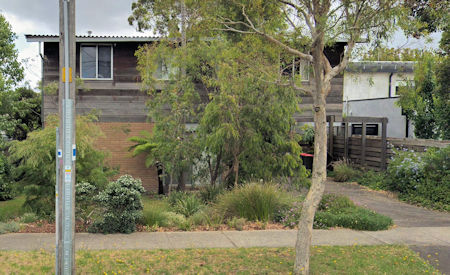
| Two of their buildings are identified on the World Wide Web.
Right: 59-61 Mason Street NEWPORT, Hobsons Bay City
|
![]() |
![]() |
Left: 1928-29 Commonwealth Club, Glennie Road, Oakleigh; architect L. (sic) Sale (Sale and Keage), builder H.P. Brady, cost approx £13,000-£14,000. |
![]() |
|
![]() |
An advertisement from page 4 of The Argus showing, perhaps Fred Sale's London ARIBA qualification. |
On 7 November 1924 this fruitful partnership came to a sudden end with the death of Samuel Keage, aged 35 of Union Street, Kew, in a motor accident which involved Fred Sale's 'double-seater Dodge motor-car'.
Samuel Keage was driving along the wide and safe Royal Parade. At the railway bridge the road 'bottle-knecked' to a 'notoriously dangerous' bend. 'By driving straight on, instead of turning right Mr. Keage struck a picket fence ... and crashed down a steep embankment to the railway line, a drop of about 40 feet. [The car] turned somersault and landed on the railway line with its wheels in the air. ... Mr Keage was apparently dead. His head was resting on the button of the electric horn.'
Police reports suggest that Samuel Keage was driving at about 30mph and had made 'desperate efforts' to negotiate the bend. The motor car was damaged beyond repair.
The name of Sale and Keage continued.
Source: The Argus, Saturday 8 November 1924, page 31
Frederick john crompton Sale died on 28 July 1937.
'My lovely Dad was gassed twice during the war so developed TB. This does not show on his war record as he was busy seeing that his men reported in sick, but didn't report in himself. My mother told me this. She was English, born at Liphook, and they met after the war when he was finishing his degree in Architecture in London Her name was Irene James, and she came to Australia to marry Dad when he had established his own practice and could afford her fare. His cough was apparent by this time, and when he died it was difficult to prove that war was the cause of his illness, but some well known and respected friends of his convinced the authorities that it was so, and my Mum was able to get the pension. This was 1937 during the depression, so getting the pension was vital as Dad had been bedridden for a long time, unable to keep his practice going.'Source: Claire Timlock, his daughter, August 2009 Right: Captain Frederick john crompton Sale, after the war |
![]() |
![]() |
|
![]() |
His death was announced in The Argus on Saturday July 31 1937. Mount Macedon is to the northwest of Melbourne, through Gisborne on the M79 highway, and Ryan Parade is a tree sheltered cul-de-sac. |
| Right: Frederick Sale's medal cluster: Military Cross with Bar, Military Cross with Bar, 1914-15 Star, British War Medal, Victory Medal | ![]() |
| Back to TOP
Close info Window |
![]() |
|
This page was created by Richard Crompton and maintained by Chris Glass |

Version A.3 Updated 10 October 2009 |