1821 Info 11f2 for Walter John Thomas Blackman
(Tom)
At War - Gallipoli
Remembering with Pride
50 Private Walter John Thomas (Tom) BLACKMAN who enlisted in to 2nd Field
Ambulance on 19 August 1914.
Commissioned into the 55th Battalion on 31 August 1917, he was declared "insane"; as a result of the Battle of Polygon Wood on 26 September 1917.
Tom died in Bundoora Repatriation House, Melbourne on 28 November 1967.
Above: The shoulder patch of 2nd Field Ambulance
Charles Bean, the Australian official historian, wrote a romantic portrayal of the men of the
first Australian Imperial Force as all of a kind.
He favoured a country lad, lean and sinewy, tough but big-hearted,
equally good with a horse or a cricket bat but always modest. The lad looked better again if he
had been a school teacher or the son of a clergyman. - Carlyon p.115
On 1 November 1914, the day Turkey entered the war, Tom sailed as part of 1/Division in a
convoy of 33 ships guarded by three cruisers including the Japanese Ibuki and HAMS
Sydney. Leaving from King George Sound, Albany, WA, Tom was one of 30,000 men and 7,800
horse. After Sydney's defeat of Emden, the convoy reached the Red Sea where the
troops were told they would disembark in Egypt for further training. Doctors had warned 'it
would be criminal' to put men in winter tents on Salisbury Plain. In Egypt they formed the
ANZACs, a word very close to the Turkish anjac sometime used to mean 'almost' or 'but'. Carlyon p.121
Gallipoli
25/04/15 Landed ANZAC with 2nd Australian Field Ambulance
6-8/051915 Second Battle of Krithia
1821info11f2, sheet 2
2/AFA, part of 2/Brigade AIF of 1st Australian Division, consisted of Headquarters, Transport
and Sections A, B and C. Each section was divided into two sub-divisions – a Tent Subdivision of
doctors and nursing orderlies and a Bearer Subdivision of doctors and 112 Stretcher Bearers (SB).
The Tent Subdivision was capable of setting up three small dressing stations and treating 50 sick
or wounded men. They could combine together to form an Advanced Dressing Station (ADS). The Field
Ambulance bearer sections were to collect the wounded from the Regimental Aid Post (RAP), where
they were treated by the Regimental Medical Officer, and carry them to the Casualty Clearing
Station (CCS). Two SBs were needed for a hand carry or 4-6 men for a shoulder carry.
The Gallipoli War Diary is very spartan, containing casualties, awards and movements
of the Tent division. This suggests that the Headquarters’ staff remained on board the temporary
'black' hospital ship HMAT A47 Mashobra. It is assumed t2/AFA’s Tent Section
manned the ships hospital.
The landing
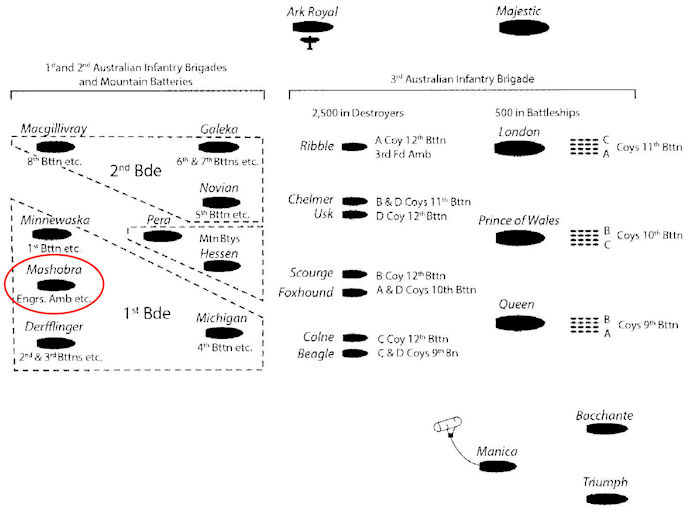
2/AFA, along with the engineers, arrived off Gaba Tepe as part of the main body of 1/Australian
Division, on Mashobra one of eight transports, which planned to approach the shore at 5.00
am. The battleship’s tow pinnaces met the first four transport, whilst the second group, including
Mashobra, waited at the rendezvous until the seven destroyers had disembarked their first
and second wave of troops closer to the shore. It was planned that 1/Brigade would be ashore by
0900 with the support detachments being landed quickly after that. It took about 40 minutes to
load the boats with their heavily laden cargo of three officers and 113 other ranks from the
Bearer Subdivision before they made progress towards the shore. 1
Above: Distribution of Anzac landing ships 25 April 1915
showing Mashobra Adapted from Bean Official History, Volume 1
1821info11f2, sheet 3
Hoverbox Photo Gallery - Anzac landing 25 April 1915
This feature does not function correctly on phones and tablets
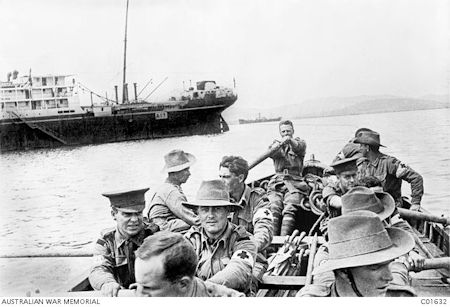
1 - 2nd Australian Field Ambulance practising boat drill in Lemnos
harbour in preparation for the landing at Anzac Cove. April 1915. AWM C01632
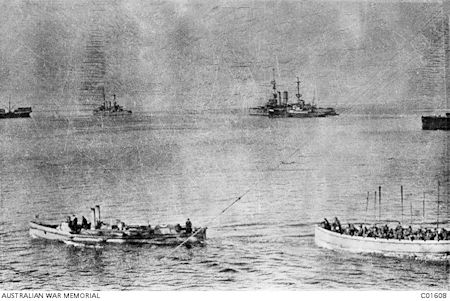
2 - 2nd Field Ambulance going ashore in a ship's boat (right) at
Anzac Cove. The boat is being towed by a steam launch (left). AWM C01608
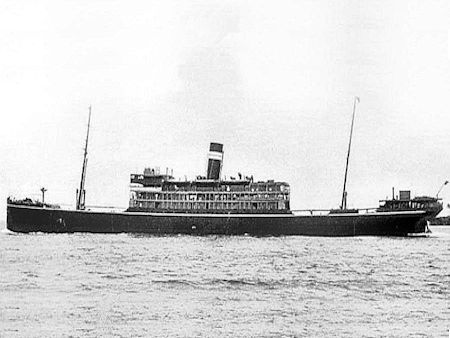
3 - 2/AFA's transport HMAT A47 Mashobra later a 'black' hospital ship
1
2
3
Sunrise was due at 5.15am but the first streak of dawn were at 4.05am, which gave approximately
an hour of complete darkness from the time the moon set. 2 Military Operations in
Gallipoli describe the scene as:
During the hour of inky darkness that preceded the dawn the faint night
breeze died suddenly, and the surface of the Aegean grew smooth and still as glass. In face of the
coming drama, the very elements appeared to hold their breath. 3
Issued with hard rations, full water bottles and 36 stretchers, the SBs scrambled down nets
into life boats. When these came within 500 yards of the shore they transferred into the
waiting boats to be towed by pinnace for 400 yards before sailors rowed them to the shore.
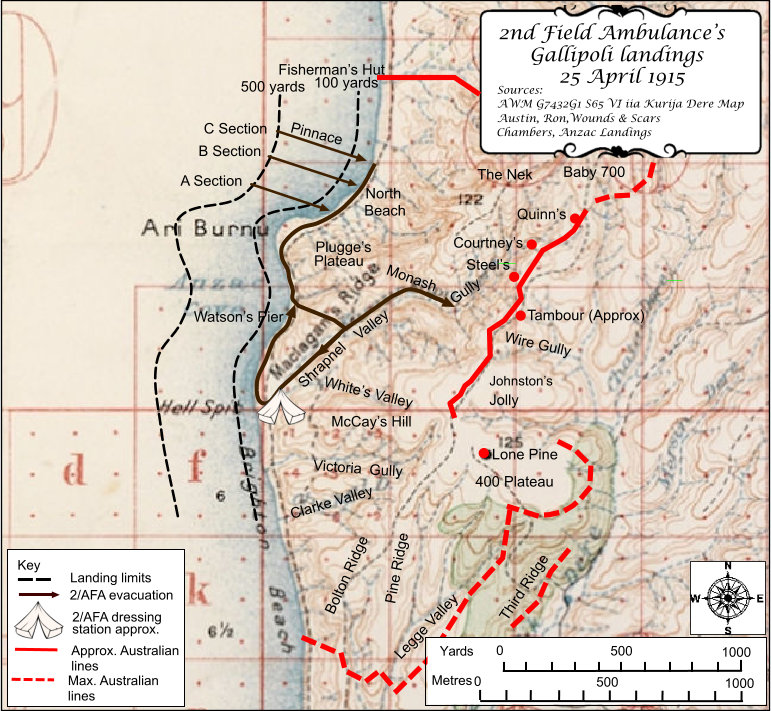
Unfortunately, the three sections were dispersed: C Section opposite North Beach, B Section 100
yards further south and A Section closer to Ari Burnu. Once assembled, the SBs moved past
Ari Burnu to the narrow beaches of Anzac Cove. They climbed over MacLagen’s Ridge and into
Shrapnel Gully and along Monash Valley from where the squads began to evacuate the wounded down
Shrapnel Gully and around Hell’s Spit to the dressing stations at Anzac Cove. Here, despite 20 to
40 patients accommodated in the tented hospital for two to three days before being dispatched on a
hospital ship, chaos was the order of the day.
George Fish, in his diary, recorded the landing:
The bullets were whistling around and the shrapnel bursting overhead, but
no one paid heed to this... The order was given by the Officer in charge to collect the wounded,
so off we started to climb the first hill. As we advanced the bullets started to come from all
directions... dived for the nearest cover, which happened to be a Turkish trench not long
evacuated. [..] All this time we had been dressing wounded and directing those who could walk back
to the beach where they were placed on barges and sent to the Hospital Ships... 4
Events of 25 April
The bearers ran short of stretchers by early afternoon as badly wounded men remained on the
stretcher when they were transferred to the hospital ships. The navy responded by making rough
rigid stretchers very suitable for lowering casualties down gullies. Puttees and handkerchiefs
replaced bandages, which had been quickly used from medical haversacks. Sticks, bayonets,
entrenching tool handles and rifles were soon being used as splints.
Chambers' gives a vivid account of their toils during the first days of the landings,
recording several accounts of the stretcher-bearer’s impossible task.
[O]ften facing enemy fire and under the constant risk of shrapnel they
not only had problems retrieving the casualties, but then they had to get them by stretcher or by
hand through the treacherous scrub-filled gullies and steep ravines back to the aid posts and
beach. 5
The diary of Fred Symonds, 5/AIF, describes the stretcher-bearers dilemma:
1821info11f2, sheet 4
The stretcher-bearers are absolutely unable to cope with the casualties;
some of the wounded have been lying out for 24 hours, and may be here for another 24 hours by the
look of things. If they would only get some more men up here a few of us could help the wounded
till dark, which would be a great help. […] It was frightful work getting the poor fellows down
those hills; it took five men in some cases to get one wounded man out, and a lot of the bearers
are being shot; we have lost 10 out of 40 already. 6
Colonel Fred Waite described the dangerous work carried out by the stretcher-bearers who were:
magnificent. […] A man without a load can dash from cover to cover, but
the stretcher-bearers, with their limp and white-faced burdens, must walk steadily on, ignoring
sniper and hostile gunner. From the front line it took about two and a half hours to get a patient
to the hospital on the beach. Hour after hour the work went on, until after twenty hours'
stretcher-bearing these unheeded heroes fell in their tracks from sheer exhaustion. Volunteers
took up the work, but after a few hours rest, the gallant souls were out again — medical officers,
stretcher-bearers and hospital orderlies literally working themselves to death in an endeavour to
mitigate the awful anguish of the wounded men of Anzac. […] "a twelve-stone weight on the
stretcher, a dark night, a little drizzling rain, groping our way down a steep incline through
prickly scrub, our wounded man crying with pain and begging for a drink every few yards, incessant
rifle fire, and bullets whizzing all round us." Except those who lay so very quietly up in
the scrub or on the shell-swept beach, no one rested that night. 7
Private Fred Symonds continued his account by describing what he saw when approaching
the line on 400 Plateau:
When we got to the ridge we retired there, and could see wounded men
coming down helping each other over the steep ground, which was very nearly perpendicular in
places. Some had stretchers, but it was almost impossible to use them. How the poor fellows got
back to the dressing station I don't know; it must have cost some of them hours of agony.
8
No one expected such overwhelming numbers needing to be evacuated on the first day. By 2.00 pm
on the 25th, Chambers records some 500 wounded men on the beach by the clearing station, lying
there under almost constant shrapnel fire. By 3.00 pm a pier had been constructed for the
re-embarkation of the wounded. However, by 5.00 pm the beach was still congested with overwhelming
and unexpected number of wounded caused by the failure to advance. The limited number of boats
made evacuation a slow process until 5.30 pm when returning tows speeded up the process. When
night fell, the backlog of wounded grew. 9
Private Fred Symonds' diary illustrates the dangers and fatigue faced by the stretcher-bearers:
There are a lot of snipers behind our lines. We caught several today, but
there must be lots more. Want food badly; half a biscuit and water, if you are lucky, for a meal,
and a little salt meat once a day. They are gradually getting reinforcements up, and our firing
line is getting stronger, but the men are getting weaker. […] By now wounded men by the score were
being brought back and laid along the track, all sorts of wounds. The stretcher-bearers couldn't
cope with the number and soon there were no stretchers. 10
Danger was ever present, as Private Ellis Silas of 16/AIF, describes:
The stretcher-bearers have been doing splendid work, poor chaps, along
this precipitous ridge where it is difficult to gain a foothold and under incessant fire from
snipers, for at this the Turks spared nobody, they shot at anything that moved. 11
1821info11f2, sheet 5
Later days at Anzac
Over the next few nights the bearers continued to evacuate the wounded from 400 Plateau,
Johnson’s Jolly, Lone Pine and Victoria Gully - see map below - before being relieved by 4/AFA on
the morning of 27 April. The bearer squads were reorganised in Victoria Gully with McCay’s Hill
immediately to the rear. Now squads no longer needed to use Shrapnel Gully so avoiding snipers and
machine guns on Hell’s Spit. Casualties were light but on 28 April No 232 Private Tom Webster,
from the Dental Corps, died of wounds, becoming the Unit’s first fatality.
On board Mashobra every space had been converted to hospital wards to take as many
wounded as possible, with ‘amazing’ life saving operations taking place over the first two nights.
Fifteen patients were buried at sea. Mashobra arrived in Alexandria at midday 3 May, when
the transport was unloaded as the terrain on Gallipoli was unsuitable for ambulances: the Tran
sport Division using their ambulances from the Alexandria docks to hospitals. On 4 May the
ship sailed for Anzac with four officers and 59 Other Ranks (OR) of the Tent Subdivision on
board. Because of the lack of hospital ships 2/AFA had had to convert Mashobra rather than
establish their dressing station at Anzac.
At Anzac the lack of blankets for the cold nights, clean clothes, washing facilities and
adequate rations were causing problems. Water bore holes and supplies of bully beef helped. In
response to a request, bearer squads were sent to Russell’s Top where they collected plenty of
wounded New Zealanders through the night of 2/3 May.
Above: Map showing the Gallipoli landings and evacuation
routes of 2/AFA
1821info11f2, sheet 6
After the failure of the poorly planned and executed First Battle of Krithia, on
28 April 1915, Major-General Hunter-Weston requested 5000 'effective'
12 reinforcements of 2nd Australian Brigade and the New Zealanders. On 5
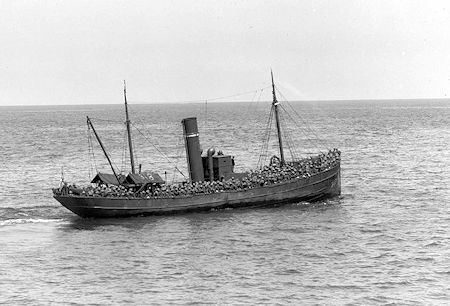
May, 2/AFA with two days hard rations, collected 30 stretchers from the beach. At 1am
on 6 May, the Bearer Subdivision moved to the beach to board HMS
Folkestone, a deep sea trawler converted to a minesweeper. At 5am after a two
hour trip Folkestone berthed alongside River Clyde at V Beach disgorging its
troops.
Right: Trawler Lancashire Fusiliers, similar to Folkestone,
with troops - 26 May 1915 Source: IWM Q13221
Second Krithia13
Eight days after the first battle, Hunter-Weston was prepared to have a second strike to
capture the strategic Krithia, the second town of the peninsula, and the dominating Achi Baba
hill. Depleted by the first battle, the British attack of 6 May made little progress against the
reinforced Turks. The next morning, Hunter-Weston resumed an equally unsuccessful attack. In all
three attacks Hunter-Weston lacked imagination and ignored the advice of his commanders on the
spot, who argued for a night attack. The first two attacks commenced at 1000 hours, with the
third New Zealand battalion's attack on 08 May 1915, 15 minutes later . The Australians were
in reserve. All three attacks lacked adequate artillery, high explosive shells, detailed orders,
preparation time, adequate maps, knowledge of the terrain and the position of unknown devastating
enfilading machine guns hidden in Fir Wood. Sir Ian Hamilton did not overrule Hunter-Weston.
Hoverbox Photo Gallery - Krithia Nullah This feature does not function correctly on phones and tablets
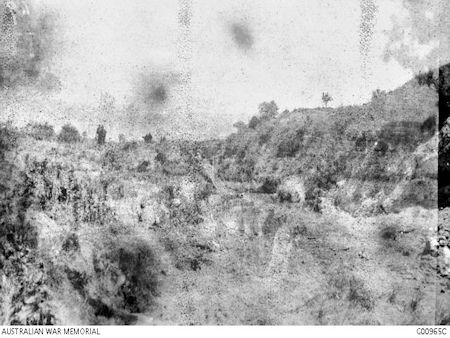
Attack was by way of the right bank. Wounded returning by Nullah. 09 May 1915
AWM G00965C
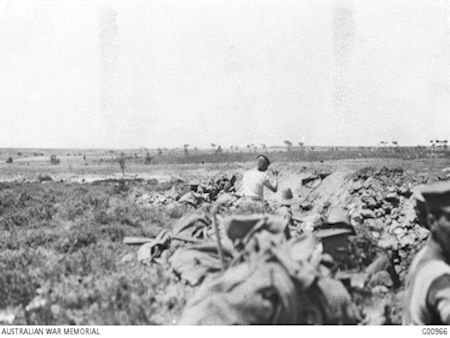
Trench dug on the night of 08 May 1915. Nullah on left. AWM G00966
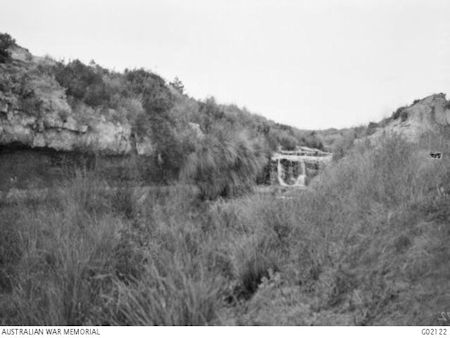
Waterfall in the Nullah. CEW Bean March 1919 AWM G02122
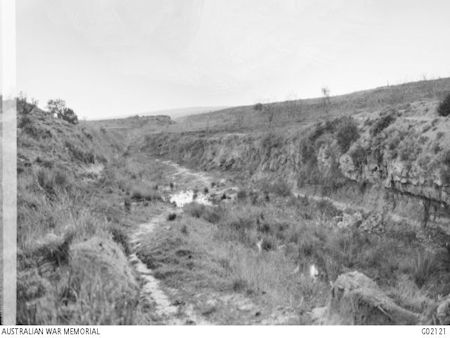
Near Tommies' Trench. CEW Bean March 1919 AWM G02121
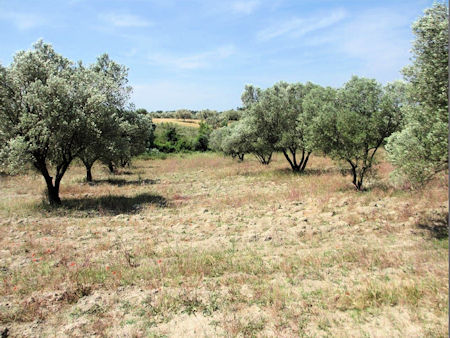
Krithia Nullah looking south 2018
1
2
3
4
5
1821info11f2, sheet 7
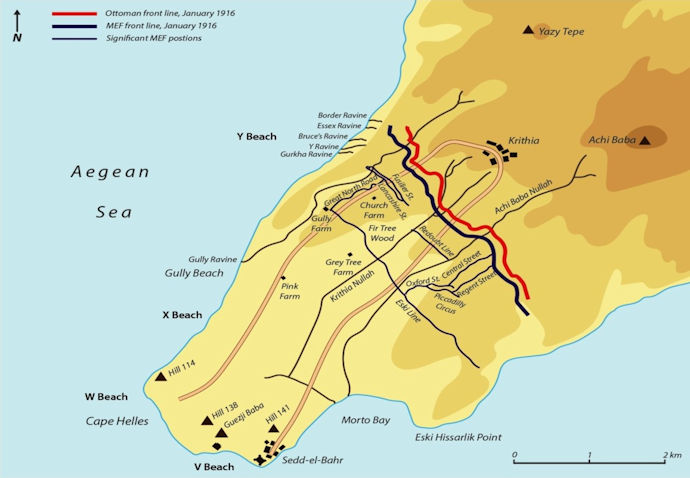
Above: Helles Peninsular Source: Bean
In late afternoon of 8 May 2/AFA moved from the beach to the left slope of a dry creek bed
known as Krithia Nullah, along the powdered white cart-tracks through gentle slopes of olive
groves to a wide undulating depression facing Achi Baba. Their Advanced Dressing Station (ADS) was
established, close to 8th Battalion. The other battalions were to the east of the dry river bed.
Rupert Laidlaw commented: This is a lovely country, quite
different to that which we had left. The country has been cultivated and wild flowers are growing
everywhere, where we are camping out is at present an orchard 14 of olive groves
in a wide undulating depression facing Achi Baba, in a meadows knee-deep in poppies, purple lupin,
white daisies and yellow flowers.
1821info11f2, sheet 8
Left: Location of Krithia
Key
Dere - stream
Nullah = dry stream bed
ADS and CCS positions are approximate
At 5.30pm, 70 minutes after the order to advance was dispatched, the Australians advancing in
open country, up the central spur, were vaguely aware of the Turkish trenches protecting Krithia.
The 6th Battalion was on the left and the 7th Battalion on the right, with 5th and 8th Battalion
in reserve in the rear. During the advance, soldiers from the 6th and 7th, fell thick and fast
over almost completely bare, rough, open ground before Tommies’ Trench and then as they crossed
the open moorland, coming within 200 yards of the Turkish trenches. In advancing the line some
500-600 yards, the Victorians took 1,056 casualties, from 2,900, in one hour before they dug in
200 yards from the Turkish trenches. At 7 o'clock Hamilton order the Australians to push
on until dark and then dig in. This effectively ended the battle. Albert Tepper described it as
2nd Brigade in action again, & have been cut to pieces.
They went along like race horses in a shower of shrapnel. 15
1821info11f2, sheet 9
Above: Annotated Krithia trench map Click on
the map to open a scalable pdf map in a new window
1821info11f2, sheet 10
John Stubbs wrote that: After this charge our work began
, 16 and Corporal Wm Siddley. 17
A dug out was made to shield the wounded and ourselves. The wounds we
attended were awful. Arms and legs blown off, hands and feet blown off... How many wounded were
treated God only knows and how many dead we had God only knows. When the wounded slackened Capt.
Mathison 18 and self made for the firing line to attend to the wounded who had been
missed by stretcher bearers... The cries for stretcher bearers were awful and very few stretchers
were to be had so the majority were carried down from the firing line to a place of safety on
water proof sheets some men were asking to be shot but I had not the heart to do such a thing and
so gave them morphia or opium to ease the pain and some very bad cases I gave an overdose and
their sufferings were relieved in a few minutes for even the firing was hell, bullets and shells
landing all around us and on several occasions the wounded whilst being treated were again hit. We
were in the valley of death and on fully ¾ of a mile stretch of ground lay dead and on several
occasions I would stack 3 or more bodies so as to make a shelter whilst I was attending to the
wounded. The wounded cried for water mine was drunk and the only water to be had was pretty nigh
green, stagnant and unfit for animals.
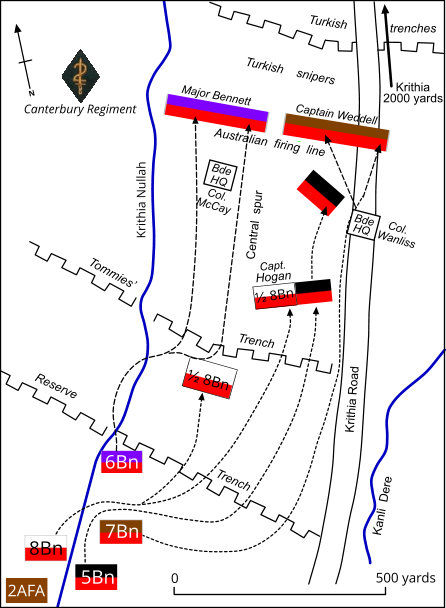
The map shows the close proximity between the disposition of Australian Field
Ambulance and his brother Lyle's 8/Bn .
Left: Second Krithia - sketch of disposition of 2nd Brigade troops
along the central spur 08 May 1915
Adapted from Austin, The White Gurkhas
The wounded began to appear at 0600. It was the practice that each battalion SBs
collected the wounded from the field carrying them back to the battalion RAP
(Regimental Aid Post), where they were collected by 2/AFA, a mile from the firing
line, to be carried from their ADS, first to their Tent Section and then back to the
CCS. One RAP was established by Captain E Gutteridge, the Regimental Medical Officer
of 7th Battalion who wrote:
1821info11f2, sheet 11
Our Medical supplies were quite unable to cope with the rush of wounded.
There were wounds of many sorts, abdominal wounds were very plentiful also shell and shrapnel
wounds. […] we were working continually for over 20 hours. Numbers of us were nearly falling
asleep carrying the stretchers, we had to carry them for a distance of over three miles at a time.
19 I can't understand why the ambulance wagons haven't come ashore, they would save us
a great deal of time. 20
As the wounded came in, squads were detailed to carry them to a CCS or
Stationary Hospital on V Beach (sic), a distance of 2½ miles. It was now dark, and owing to the
density of the scrub, and the broken ground, the majority of the squads went astray, and spent
valuable time in trying to find their way. Meanwhile the wounded were pouring in faster than they
could be cleared, and lay in such numbers that the embankment [of the nullah] was insufficient
protection for them, so that several were wounded again by MG fire and shrapnel. Just before
daylight all available squads were sent forward to clear the various RAPs, which being under
observation could not be cleared by day. 21
Severely stretched by the number of wounded and the carry distance to the CCS, Captain Chambers
persuaded the Royal Naval Division (the formation on the right flank of the 2nd Brigade) to
provide 50 volunteer stretcher bearers and also obtained the use of an ambulance wagon from a
British Field Ambulance. 22 Throughout the night of 8 May, the plaintive cries of
"Have you forgotten me, Cobbers” and "water" spurred the bearers on to continue
their hazardous and tiring work. With so many wounded being carried to the rear on stretchers,
there was a scarcity of stretchers as they frequently went from the front line back as far as the
hospital ships. 23
As darkness fell, the battlefield for half-a-mile behind the foremost
line was filled with the cries of the wounded [...] From every part of went up the thin wavering
call of the wounded for stretcher bearers A large proportion had been hit in the stomach or
intestine [... particularly] for 500 yards in front of [Tommies Trench] the wounded were laying
far more thickly. [...] [M]ost of the wounded were brought into the shelter before dawn, when work
in the open was impossible. [...] Before long the wounded lying on the grassy space were so
numerous that the lanterns of the doctors and orderlies barely reached the white faces on the
outskirts. 24
John Stubbs described the carnage facing the 2/AFA at their
ADS in more detail:
Hundreds of wounded remained unattended during the long night of 8/9 May.
Their agonising wounds made the night very long. Throughout that first night, the next day and the
second hellish night, there were plaintive calls for ‘water’. 25
Among the scores of wounded who had sustained bullet wounds to the stomach, very few would
survive the long wait and the painful carry back to the ADS and thence to the CCS. Even when the
wounded reached 2/ADA’s ADS the situation may be described as chaotic.
In addition, the Field Ambulance bearers had a carry of
close to six thousand yards to remove casualties from the ADS back to the British CCS at W
26 Beach. 27
John Stubbs described the carnage facing the 2/AFA at their ADS in more detail:
I saw as many as 200 wounded lying in a paddock where our dressing
station was, some groaning with their great pain, others died before the morning, others, again,
were not suffering so much from their wounds, but they felt the cold. The night was bitter and
the dew was falling like rain. Although we had very little time to feel the cold. As soon as the
sun did rise, the work was much easier. […] The wounded were being brought down right up till
Sunday night (9 May). 28
Fortunately the Australians had advanced wearing their packs, and Captain Gutteridge suggested
that the warmth of their greatcoats and waterproof groundsheets helped keep many of the wounded
alive over the long hours following the advance. 29 The stretcher bearers from the
2/AFA worked throughout the night. Gutteridge records his admiration for their efforts:
1821info11f2, sheet 12
A continuous carrying of cases over rough country for distances of up to
3000 yards with only two men to a stretcher for twenty hours without a spell was their record.
30
The carries were frequently under fire and casualties occurred:
(Cecil) Rennie was helping me to carry a stretcher when he was shot down
with a bullet in the chest, I think he will have a bad time of it. 31 It was terrible
work in carrying them we have no waggons & had to carry them 3 or 4 miles. 32
On the following morning, Sunday 9th May, Chaplain Creighton returned to the British Casualty
Clearing Station.
There was a mass of wounded everywhere. The bad cases had started coming
in during the night. They came in all day. Terrible stomach wounds and head wounds. The
Australians, who were the vast majority, were wonderfully plucky. I saw the Brigade Major (Cass)
lying on a stretcher in the open. 'My it was grand to see the boys charge!' People who saw it said
it was a great charge, but utterly reckless. They don't seem to understand fear . . . But what a
terrible waste it all seemed of such magnificent men! 33
On a more pragmatic note, the poor medical arrangements provided by the British staff were
severely criticised by Bean who wrote on 8th May:
Once the wounded leave our hands there seems to be the same general
muddle which is the one thing that impresses you with almost everything this British staff has
done as far as we have seen it. Everything is late — nothing up to time — no evidence of brains
that I have seen ... As for the (British) Medical Staff — the arrangements are a sheer scandal.
They have foreseen nothing. 34
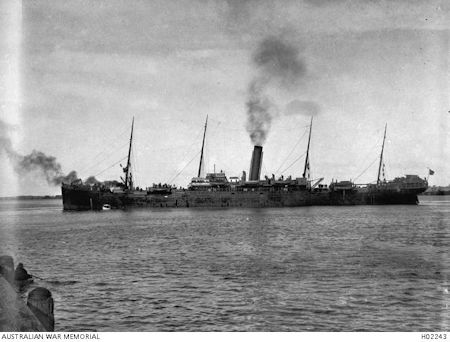
The Mashobra returned the unit to Anzac on 11 May. On the following afternoon the Tent
subdivision transferred to the Seang Choon bound for Lemnos.
Left: HMAT Seang Choon A49 (AWM H02243)
The War Diary continues to be written from the Alexandria headquarters, with the same lack of detail.
On 19 May 1915, 2/AFA became involved in the battle at Courtney’s Post and suffered one
fatality and one seriously wounded when the Turks launched their mass attack.
1821info11f2, sheet 13
In preparation for the Battle of Lone Pine, 35 between 6-10 August 1915, SBs from A
and C Sections moved up to the dressing station opposite Johnston’s Jolly, to work alternate 24
hour shifts. B Section remained at Brighton Beach with the Tent Section establishing a minor
wounds collection point.
Although the attack started at 1730, it wasn’t until 2100 that 'B' Section was sent to Lone
Pine, where, two relays were set up: one from Artillery Road to Victoria Gully and one to the foot
of Victoria Gully. Rupert Laidlaw, of A Section, described that night:
We commenced collecting the wounded at once, and it was awful, we were
under a withering shell fire all the time and one of our squads got the full force of a shell,
with the result one man was killed and the other three wounded, one very seriously as the shell
got him in the abdomen. We had to advance right into the trenches to get our men and some of the
wounds were awful. Most of them were shell wounds and a large number were caused through machine
gun fire. Head injuries were very numerous... we worked through the night and when daylight broke
the next day. We continued our work through the day until 4 pm we were then relieved for some
time. 36
The wounded were coming in in such numbers as to congest the dressing
station - the bearers working hard relieved them to some extent but it was not until the next
morning that the last of the wounded had been sent down to the beach. At the Beach the Dressing
and Clearing Stations were working at full pressure. Doctors and orderlies were going day and
night through amputating and dressing the wounded. 37
It was around midnight when six squads of C Section bearers were relieved and sent back to camp
for a short-lived rest. At 0230, a relief party of 30 SBs went to No3 Pier to load wounded into
small evacuation boats and to tend to wounded British soldiers from the current Sari Bair attack.
On 9 August a similar evacuations took place at Walker’s Pier meaning that the wounded had been
left under the hot sun for a whole day or two. During that time, bearers scrounged through packs
to source hot tea and food for the wounded. At 1730, 2/AFA were able to re-join their parent unit
at Brighton Beach. This small party had filled a serious gap
and had worked for fifty-four hours without relief. 38
By mid-August sickness was taking its toll. As well as two OR killed and 9 wounded, 52 were
evacuated due to illness, including enteric fever. 39
When the newly formed 2nd Australian Division arrived, the physically and mentally exhausted
2/AFA had a chance of a well-earned rest. Les Hall noted:
Had a rotten fortnight. Lived on eggs, chlorodyne and boiled water. Can't sleep and feel rather
weak and unsteady on my pins. Sick parades are very large, especially from the 2nd Division.
On 5 September, Vic Worland's diary entry revealed the condition of the exhausted troops:
On duty between 7 am and 7 pm. Lots of sick and wounded. Men
of 1st Infantry Brigade fainting while waiting to be examined. Many men scarcely able to walk.
40
On 9 September, 2/AFA handed over the dressing station at Bridge's Road to the newly arrived
6/AFA and began the evacuation to Mudros by No. 6 Pier and New Pier. The next day at 11.30am, an
hour after landing, the troops started a gruelling four mile march to Sarpi Camp at Mudros West.
Lacking the opportunity to exercise on Gallipoli, many men carrying heavy packs suffered from
exhaustion and foot blisters and had to be transported by motor ambulances. The strain of poor
diet, sickness and lack of exercise had taken a heavy toll during the four or so months spent on
Gallipoli. Over the coming weeks the troops dined on fresh bread, steak, eggs, coffee, sardines,
grapes, and a daily bottle of beer purchased for one shilling. Apart from occasional drill,
training and parades the men were free to attend concerts, play cricket and visit the nearby Greek
villages.
On 16 November orders were received regarding an imminent return to Anzac, the troops already
having been issued with winter underclothes. On the next day the officers and men of the 2nd
Field Ambulance marched to the harbour and embarked from North Pier on the Abbassieh.
However, after some hours the battalion were disembarked and marched in the face of a dusty gale,
to the camp site previously occupied by the 6th Battalion, but found that the tents had blown down
and been taken away. After some effort the 10-tent convalescent hospital was reopened to cope with
any sick patients who could not be accommodated in the General or Stationary Hospitals.
The unit eventually sailed from Lemnos on 31 December 1915 on HMAT Tunisian en-route for
Alexandria, arriving 02 January 1916 where they en-trained for an overnight journey to Tel-el-
Kebir arriving at 3am the next day.
1821info11f2, sheet 14
Conclusion
During this battle Tom would have been under fire when at the front and by the ADS. He would
have seen many of the horrendous sights quoted above. The question has to be asked as to how this
affected his mental stability: was this the cause of his repatriation to Australia under the guise
of enteric fever?
Notes:
Chambers pp.25,30,32 Mashobra returning to Imbros at 1300 and Port Mudros at
noon on the 28th. At 4am on the 29th the Mashrobra, as a ‘black’ non-registered
temporary hospital ship, returned to ANZAC and took on board 404 casualties and sailed for
Alexandria arriving there at noon on 3 May under the care of 2/AFA's Tent Sub-division.
ibid p.32
Aspinall-Oglander, p.173
Wounds & Scars p.35
Chambers pp.135-6
ibid pp.135-136
ibid p.135
ibid p.136
ibid p.141
ibid pp.151 and 157
ibid p.160
Bean p.4
Tom's cousin, John Neely, was involved in this battle with 7th Battalion.
Austin - Wounds & Scars p.42
Albert Tepper - provided by Peter Laidlaw, quoted in Wounds & Scars p.45
John Letters of John Stubbs held in the Imperial War Museum, quoted in Wounds & Scars
p.44
Corporal Wm Siddley medical orderly 5th Battalion Museum of Victoria’s collections
quoted in Wounds & Scars pp. 44-5
Originally in charge of 2/AFA transport. Died of wounds 10 May 1915
Distances vary according to the reports of individuals
Rupert Laidlaw, quoted from papers owned by his granddaughter, quoted in Wounds & Scars
p.45
Goode R and Green G, 2nd Australian Field Ambulance: Short History 1914-16
Catalogued in the AWM but wasn’t found by librarian in November 1915, quoted in Wounds &
Scars p.45
2/AFA’s transport had been left in Alexandria
White Gurkhas p.119
Bean pp.39, 40
White Gurkhas p.118
A (the 11th) casualty clearing station, situated on the cliffs at Cape Helles, in the base
area known as Lancashire Landing, was the chief hospital … ‘ Taylor, Frederick, Personal
experiences on the Gallipoli Peninsular …, An occasional lecture to The Royal Society of
Medicine, 08 March 1916 - Lancashire Landing was W Beach and not V Beach – see dichotomy above
https://journals.sagepub.com/doi/pdf/10.1177/003591571600900503dhd (Accessed 10
October 2019)
White Gurkhas p.119
Stubbs op cit quoted in Wounds & Scars p.45
White Gurkhas p.120
7Bn War Diary quoted in White Gurkhas p.120
He was hospitalised in Egypt and survived
Provided by Peter Laidlaw, quoted in Wounds & Scars p.45
Creighton, D, With the Twenty Ninth Division in Gallipoli, p.82-85 quoted in White
Gurkhas p.121
Bean’s diary quoted in White Gurkhas p.122
John Neely, of 7th Battalion, was Killed in Action on the night of 8-9 August 1915
Rupert Laidlaw opt cit Wounds & Scars p.54
George Fisher in Wounds & Scars p.55
1821info11f2, sheet 15
38. Butler AG, Official History of the Australian Army Medical Services, vol.1 p.315
39. Enteric fever: a fever affecting the intestines; specifically paratyphoid
fever 'A' or 'B' or typhoid - OED These diseases had been discovered before
the war, but little was known about them, and the vaccine employed failed to protect the
troops against them. Though they did not possess the extreme deadlines of typhoid, they
placed large numbers of troops temporarily out of action. [...] [T]he campaign against
[enteric] could only be waged by the medical officers by two main methods - first, sanitation;
second, the sending away of sick to prevent contagion. By keeping the troops on the
Peninsular, the cases of enteric increased. Bean Sickness pp. 367, 369, 375 'A component of
Gallipoli was paratyphoid or enteric fever. This was spread by an existing sufferer from the
disease, because the infecting organism could still be present in his excreta up to a year
after he had had the illness. From there it was a short step with the flies to the food and
water of others, and so the infection spread until there were about 5,700 cases at Gallipoli
in all. The symptoms included headaches, stomach pains, diarrhoea, a bronchial cough, large
irregular spots and a high temperature with the associated sweating. Although not often fatal
it was a debilitating condition. Prevention once the disease was established proved
impossible, as mild cases were not often correctly diagnosed and thus continued to spread the
infection. Inoculation was partially effective but offered its own perils. Steel p.318
40. Wounds & Scars p.59
Sources:
Aspinall-Oglander, Brigadier General CF, History of the Great War, Military Operations
Gallipoli, Vol. 1, (1929)
Austin, Ron, The White Gurkhas – The Australians at the Second Battle of Krithia,
Gallipoli, RJ Austin, McCrae, 1989
Austin, Ron, Wounds & Scars – from Gallipoli to France, the history of the 2nd
Australian Field Ambulance, 1914-1919, Slouched Hat, McCrae, 2012
Symonds, Fred, Unpublished diary 5/AIF, (Private collection) quoted in Chambers
Waite, Fred, The New Zealanders at Gallipoli, Whitecombe and Tombs, Christchurch,
1919, quoted in Chambers
1821info11f2, sheet 16
Evacuation to Egypt and repatriation
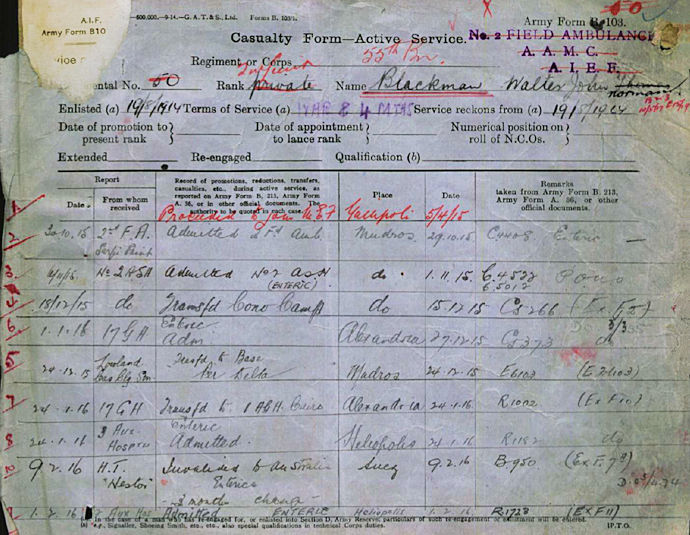
The October War Diary notes that five men left the unit, which included Tom, who was admitted
to 2/AFA’s hospital at Sarpi Point, Mudros. This began a thirteen week hospitalisation with what
was diagnosed as enteric fever. Tom's service record shows his three month hospitalisation and his
dated progression through several hospitals before being repatriated to Australia. The details are
transcribed, in date order, in the time line below.
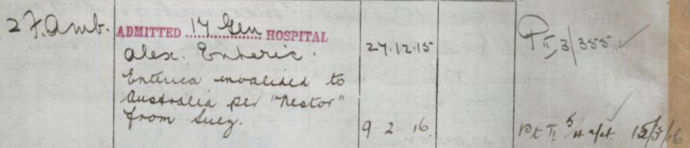
Above: Tom Blackman's medical record 1915-1916
29/10/15 Admitted to 2nd FA Sarpi Point - Enteric - Mudros
01/11/15 Admitted to 2nd A[ustralian]S[tationary]H[ospital] Mudros - Enteric 43 days -
Mudros West
24/12/15 Transferred to Base ex Lowland Casualty Clearing Station per Hospital Ship "
Delta" - Mudros
Of special significance is the annotated medical record from Tom's Repatriation file, which
declares a typed P.O.U.O. - Pyrexia of Unknown Origin, usually PUO. 1
Above: The first report of P.O.U.O. underlined in red
1821info11f2, sheet 17
27/12/15 Admitted 17 General Hospital - Enteric Fever slight 29 days - Alexandria
24/12/15 HMHS Delta from Mudros to Alexandria
24/01/16 Admitted to 3rd Aux[iliary] Hospital - Enteric - Heliopolis
24/01/16 Transferred to 1st A[ustralian]G[eneral]H[ospital] - Cairo, ex 17th
General Hospital - Alexandria
27/01/16 Medical Board - contracted on active service, totally incapacitated for a full
livelihood
01/02/16 Admitted to 2nd Auxiliary Hospital - Enteric - Heliopolis
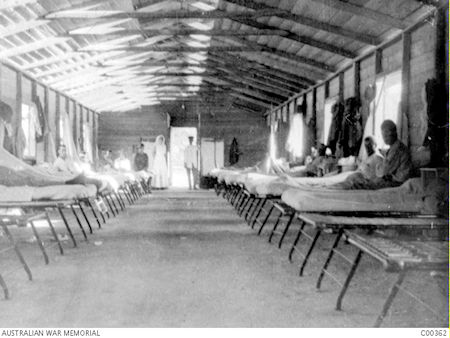
Hoverbox Photo Gallery - To hospital in Alexandria
This feature does not function correctly on phones and tablets
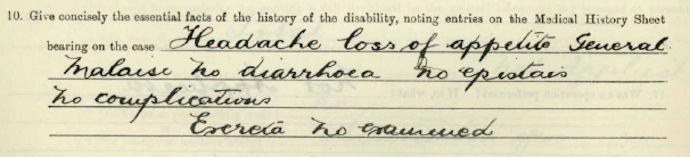
On 26 January 1916, three members of 3rd Auxiliary Hospital medical board recorded on Form
C.M: Headaches, loss of appetite, general malaise, no diarrhoea, no epistais (sic -
epistasis scum on standing urine), no complications. Excreta no (sic) examined. This and urine
was examined in Melbourne on 13 March 1916 and proved negative [for Enteritis].
Above: Tom's diagnosis from 3rd Auxiliary
Hospital on 26 January 1916
As a result of the medical assessment, question 28 gave the board two alternatives: discharge
or repatriation. The latter was recommended under the 'six month policy' of returning to
Australia those men whom it was judged would not be fit within six months. 2 It would
be interesting to know how long recovery from 'enteric' was expected to take? Or was
something more serious diagnosed - shell-shock?
1821info11f2, sheet 18
Above: Tom's repatriation to Australia
13/03/16 Arrived No 5 Australian General Hospital Ward 12 Melbourne.
Bacteriological specimen to lab suspected Enteritis with negative result
The original mention of POUO, the Alexandria diagnosis in question 10, the Melbourne test
results and the Board's recommendation suggests something other than 'enteric'. Was
this the first undiagnosed manifestation of 'shell shock' caused by Tom's Gallipoli
experiences? However, if Tom was trembling he may have had an unknown fever.
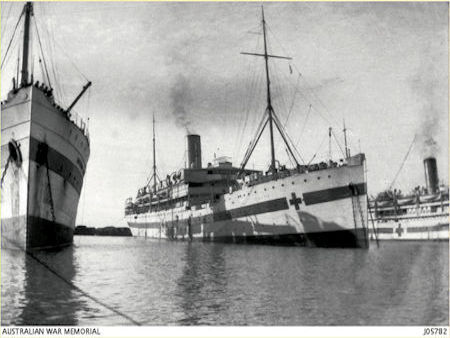
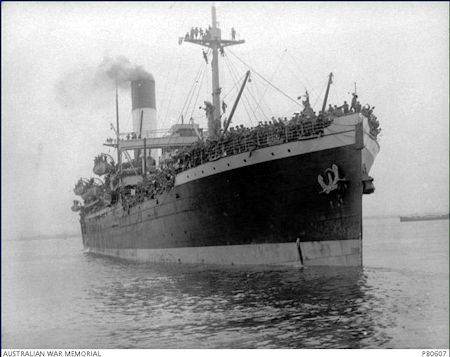
09/02/16 Invalided to Australia per HMAT A71 "Nestor" - also recorded as
Nestor from Suez 09/02/16 to Australia (Melbourne) 13/03/16
Tom was hospitalised in Mudros and Alexandria for 73 days before being
repatriated to Australia. After two weeks in Australia, he was returned to duty, but
it was another five weeks before he sailed for the Western Front.
Right: HMAT A71 Nestor with troops Source: AWM PB 0607
End notes
PUO: Pyrexia [fever] of Unknown Origin is described as:
• 'fever of unknown origin', which wasn't diagnosed after inpatient investigation;
• a name when the cause of the problem has not been found and before diagnosis has been
established.
Beckett, Roger, Keeping up the strength The Australian Imperial Force in 1918, Stand
To!, the Journal of the Western Front Association, number 118, June 2020
1821info11f2, sheet 19
Reflecting on Gallipoli
The 1922 Government Report of the War Office Committee of Enquiry into "Shell-shock"
made several recommendations relevant to Tom's time in Gallipoli and his enteric/Shell-shock
ailment:
the best possible training;
a gradual introduction to the front be fostered;
adequate rest and sleep between short shifts in the line;
organised recreation behind the lines to counter monotony countered and exhaustion;
home leave.
Steel and Hart offer a commentary on aspects of the recommendations.
Was the desert training the best possible training for the rugged scrub covered terrain of
the Peninsular?
With the landings being the first site of Anzac Cove, its beaches and hinterland, there
was no introduction similar the nursery trenches of Armentiéres.
There were no rest camps and 2/AFA were in the line for eighteen continuous weeks when they
took 20% of their wartime casualties. Gallipoli was unique in that there was no safe area in the
rear – whether at the front the rest camp dugout or swimming there was always the chance of
shrapnel or rifle fire. When the troops were out of the line they were based in rest camps
nearer the beaches. ‘I’ve been puzzling why it's called a rest camp. The only solution I can
think of is that some bullets hit the trenches and the rest come over to us'. The dugouts the troops used there were of a simple nature: a grave-like hole about six
feet long, two feet wide and as deep as the ground would allow. Sometimes four feet down with
a waterproof sheet over the top and secured by corner stones, as protection from the sun, was
quite nice. In these simple rest camps the troops tried to protect themselves from the
shrapnel, which could rain down without warning at any time of the day or night. Periods in
the rest camps were not even necessarily times of relaxation but endless working parties
constructing roads, wells, ammunition dumps as ‘The White Slaves of Gallipoli'. As a
result of overwork, tempers went from bad to worse.
Gallipoli offered the chance for daytime sea bathing under fire with hiding naked in the
gorse vegetation. Additional dangers included strong life threatening off-shore currents and
a heavily polluted shallows. p.334
Home leave to Australia was impossible. Letters from home were keenly awaited.
Unfortunately distance, submarines, pilfering and inefficiency meant letters were few and far
between, six weeks after posting and in batches and months out of date. On the Peninsula
pencil, ink, paper and envelopes were scarce.
Clearly, the recommendations of the 1922 Committee were impossible at Anzac and therefore the
avenues for Shell-shock and enteric were wide open.