Arthur WATTS was Jane's youngest brother and was always known as Brother Arthur. He married
Bessie BOTTERILL and carried on the haulage business as Watts Bros.
John WATTS had brought both his sons into the business, the younger,
Arthur, riding the spare trace horse out to meet the heavily laden Beverley-bound cart as early
as the age of eight. Arthur had gone over to France in the army during the First World War and
hadn't really wanted to come back home to Beverley but, learning how his father wasn't in the
best of health, he and elder brother William literally took over the reins of the Watts carrying
business in 1919.
Source: Walker ibid in Times New Roman
After retirement John WATTS continued to live at the Lairgate address.
Certified Copy of an Entry Pursuant to the Births and Deaths Registration
Act 1836 to 1874
Registration District Beverley
1925 DEATH in Sub-District of Beverley in the County of York
No.
When and where died
Name and surname
Sex
Age
Occupation
Cause of Death
Informant
When registered
Signature of registrar
325
Tenth April 1926 49 Liargate Beverley
John Watts
Male
77 years
Retired General Carrier
1. Carcinoma of sigmoid colon no p.m.
Arthur Watts son present at death 15 Westwood Road Beverley
Eleventh April 1926
WL Jackson Deputy Registrar
The taste of travel abroad had obviously opened Arthur's eyes to other
ways of life beyond the confines of the Beverley-Hull carrying route Whilst brother William was
gifted in being able to make and produce with his hands, Arthur was the one with vision and the
drive to improve their lot. That sole mechanised Selden apart, little had changed in the business
of J. Watts, Carrier, for over 40 years, so they adopted a new title of Watts Bros and set out to
make their mark.
Little could be done overnight to
transform affairs but with first another Selden and then a De Dion three tonner coming a couple of
years later, the haulage side of the business was slowly expanded. Getting jobs for both the
horses and the motorised vehicles, Arthur took the unusual step of going out on his push bike to
tout for work. It was on one of these forays that he learnt of plans to develop the roads in the
East Riding and how the authorities were looking for teams of workmen to undertake the contracts.
1807info3c, sheet 2
This construction programme was to be quite
extensive. Not only were the cart tracks going to be upgraded to withstand the heavier
motor cars, but what substantial roads had been laid were to be widened so that vehicles
travelling in opposite directions could pass each other in comfort. [...]
Although it was a type of job of which they had no experience whatsoever, Arthur got quite
excited about the proposed development and his enthusiasm was to win Watts Bros some hefty
work, although whether they would be able to do it or not was going to be another matter.
Whilst movement of materials was to be from a series of railheads, limiting the road
transport to something like a three mile radius, it was to be in the speed of this
movement and in reducing handling time that Watts were to excel. Whilst horses, carts and
manpower were cheap, in plentiful supply and the normal tools for this type of job.
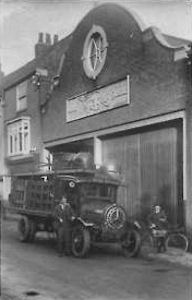
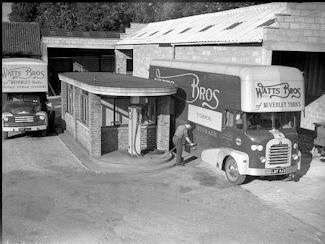
Right A Watts Bros De Dion truck outside 49 Lairgate, with a push-bike
collector and his 'shop bike'
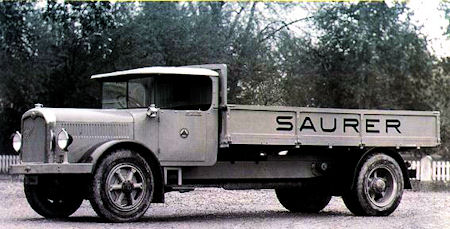
The brothers invested £2,000 cash to buy their first
Saurer three-way tipper. The vehicle could handle six tons of road stone, a weight that
was totally impossible by traditional methods. The added bonus was that the vehicle could
tip its contents mechanically either to the rear or the side so unloading
time was just a slice of the normal hand balling method.
Right: An early Saurer type B circa 1928-1934. It is not known whether this is a
three-way tipper version
The Watts road men became the talk of the region and, when income
allowed, a further four Saurer tippers were bought for the same work. As the road programme
stretched away from their Beverley base so, to ensure efficiency, Watts built traditional living
vans that were hooked up behind the Saurers. Parked up at the site of operations, they became
home for the travelling Watts staff and their families.
By 1928, records show that a big
transformation had taken place since the brothers had taken control. Watts Bros then had
27 employees on the payroll with nine heavy motor vehicles altogether in the business.
Headquarters were still at Lairgate but with foresight, the brothers had converted the
original house and courtyard. By roofing it over, they not only created a garage but also
the first loading stands for warehousing or transhipping between vehicles. Arthur WATTS
had equipped the place with electric light in 1923 and there was also underground storage
for 1,500 gallons of petrol.
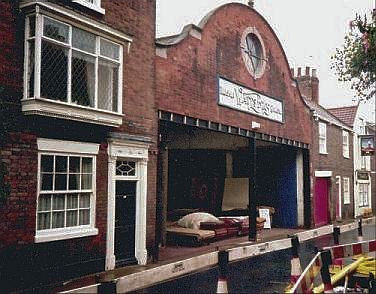
Right: 49 Lairgate garage in 2001, then used as a carpet warehouse, still
carries the 1919 Watts Bros logo above the door. This has now been demolished, though the
house remains.
1807info3c, sheet 3
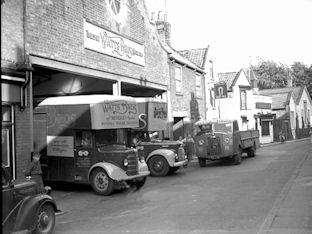
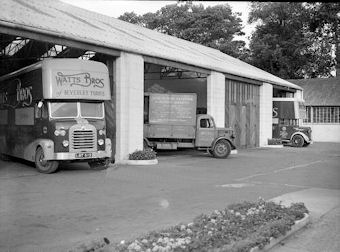
Left: Compare this scene of Lairgate, dated by the range of
vehicles used, with the more modern photograph.
John WATTS had died in 1926 but his sons went on
developing his earlier business through controlled expansion. Household removals became
more prevalent and by 1932 the first custom built removals van still based onthe favoured
Saurer chassis was brought into use. Even by 1932 there was only the A-type chassis (1919)
or the B-type chassis (1926).] This vehicle could also be used for a multitude of other
roles, and that, in essence, was the Watts Bros formula for answering the transport needs
of the area round Hull and Beverley.
In 1939, eldest brother William decided to retire but the trading name of
Watts Bros was retained, albeit with the words 'Proprietor: Arthur WATTS' added underneath in
small print. William's son George was to join the company, rising from the post of cycle delivery
lad to Manager and Director responsible for the day-to-day running of the fleet as Arthur found
his time taken up in a number of different ways.
(See Arthur Watts' public service below)
THE DAILY MAIL, THURSDAY OCTOBER 12, 1939. PUBLIC NOTICE
NOTICE IS HEREBY GIVEN that the partnership hereto subsisting between us the undersigned
carrying on businesses and Haulage Contractors and Carriers of Beverley in the County of
York under the style or firm of Watts Bros is hereby DISSOLVED by mutual agreement from
the 31st day of July 1939 so far as the said William Watts who retires from the said Firm.
All Debts due to and owing by the said late firm will be received and paid respectively
by the said Arthur Watts who will continue to carry on the said Business under the style
or firm of "Watts Bros".
Dated this 10th day of October 1939.
WILLIAM WATTS
ARTHUR WATTS
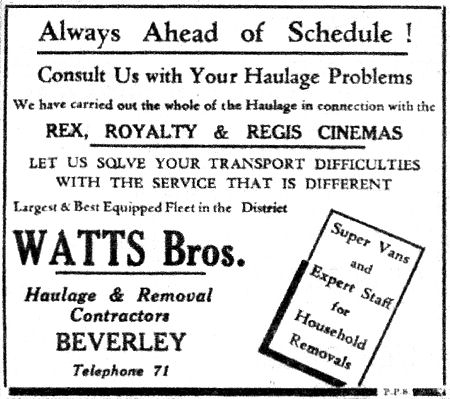
Right: Watts Bros advert from the 02 August 1935 edition of the Hull Daily Mail
1807info3c, sheet 4
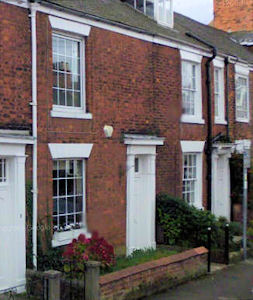
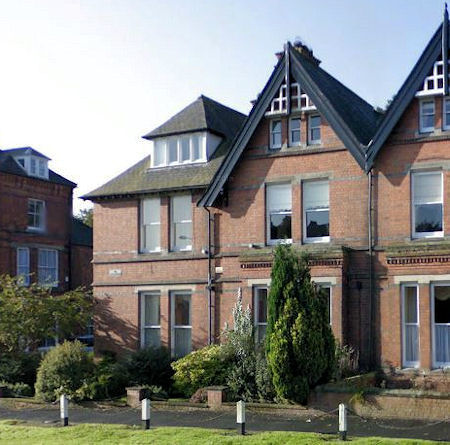
Right: 15 Westwood Road, Beverley, Arthur Watt's home in 1925 before moving to
The Chestnuts, New Walk. It is thought his grandson Chris Watson lived here at a later
date.
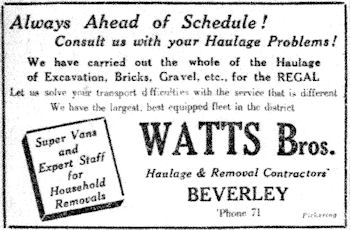
Above: Advert from the Hull Daily Mail dated 25 January 1934
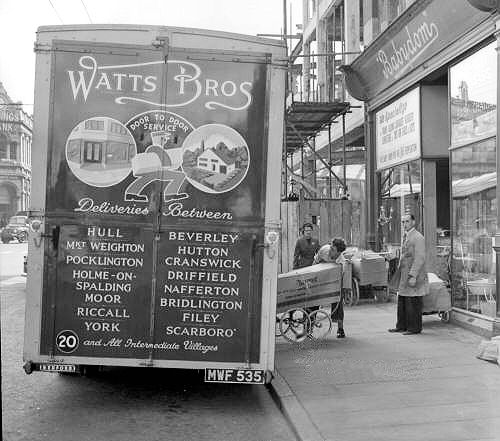
Right: The early livery of a Watts Bros removal van, the painting of which
was always completed with pride. In later years this logo was replaced with a map of the
East Riding of Yorkshire centred on Beverley.
Source:Chris Hodge Photos
Watts had strong views about not paying to advertise his
Company's services: he always said that he preferred to let his vehicles speak for the
firm.[Five adverts were found in editions of The Hull Daily Mail between 1922 and 1950.]
Doing so much multi drop work in all the major settlements between Hull, Scarborough and
York, the vehicles were a regular sight to many people. They were to become a positive
tourist attraction when the vans' livery was changed to incorporate
a huge [hand painted maps of the East Riding of Yorkshire] listing all
the places they visited on a regular basis. The result of this ploy was that very few people
would ever forget looking at a Watts vehicle. In fact, tales are told of some other wagon drivers
receiving instructions on how to reach a particular place, the directions having been given from
the map on the back of a Watts.
1807info3c, sheet 5
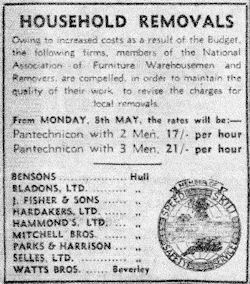
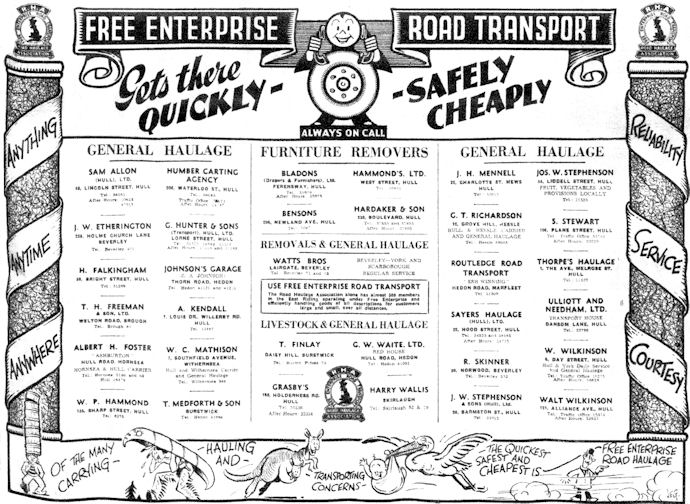
Left: A combined advertisement for the local members of the National
Association of Furniture Warehousemen and Removers from the Hull Daily Mail, 04 May 1950
The advertisement suggests that in order
to combat the 1948 nationalisation of road freight 1,
local road hauliers combined into a cartel to combat the 35 mile (56km) operating radius
placed on their independence.
One lasting effect BRS [the nationalised British Road
Services] did have on the Watts business was to convince Arthur to change his livery. He
had long favoured a pleasing red colour scheme but the Road Haulage Executive had
virtually monopolised that sort of paintwork as their own and Watts decided that he
didn't want his fleet confused with the one run by the Government. In opting for an
entirely different maroon and grey, he selected a livery, which was still in use 40 years
on.
The Hull Daily Mail reported the 70th anniversary dinner of Watts Brothers. A rully is dialect
for the carrier's cart.
LEISURELY DAYS Recalled at Dinner
The days
when Hull newspapers had to be carried to every hamlet between Hull and Beverley, by
horse-rully and when villagers depended on the carriers' cart to give a lift into towns to
sells their butter and eggs was recalled at a dinner given at Beverley by Mr Arthur Watts
to celebrate the 70th anniversary of the founding of Watts Brothers, haulage contractors.
Toasting the firm Mr Harry Wray recalled the days when the
only means of
locomotion between Hull and Beverley was the railway and the road service was a small
rully belonging to Mr Backhouse. He remembered the transfer of this business to the late
Mr John Watts.
Mr Arthur Watts, he added, had given many years of service to the public [...]
wartime Mayor of Beverley and he had been made an honorary freeman of the borough.
Some long-distance work was being done by
1957 when Watts Bros went Limited, the directors being Arthur, his wife and nephew George.
For his fleet flagships, Arthur ignored the current trend and stuck to the type of vehicle
he preferred. Although there was nothing unusual about a predominance of Bedford and
Commer four-wheelers for the lightweight multi drop traffic, the heavyweight range saw
Thomycroft eight-wheelers specified right up to the time of their disappearance into the
AEC empire.
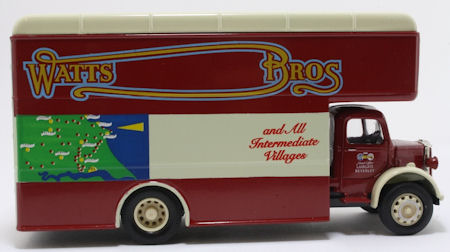
Left: A Corgi model, no.4078 off 5,500, of a Watts Bros Bedford removal lorry in
maroon livery
1807info3c, sheet 6
By the early 1960s, Watts Bros had firmly established its working
pattern. Although the fleet was not more than 30 in number, all vehicles were kept extremely busy,
especially in multi drop distribution. Whilst the tipper work had been wound down, the removals
side of the business had taken off. Storage depositories had become more important with more than
163,000 square feet of warehousing being brought into use. By now, Lairgate had long been outgrown
and the thriving operations were now based at Manor Park. When John Watts had bought the farm on
the outskirts of Beverley it had simply been a place where his horses could be grazed. Little did
he realise how important this huge chunk of land would be to his descendants.
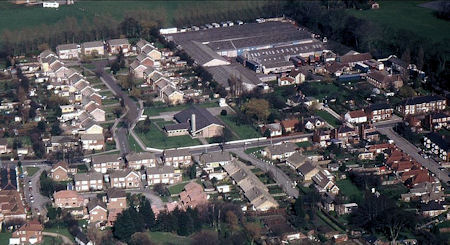
Right: The Manor Road depot
Above: The Manor Road depot
His great grandson, Chris Watson, the son of […] Arthur's [eldest
of three daughter, Joyce by her first marriage], had come into the business in 1959. But the very
complexity of the Watts family tree meant the company wasn't really amenable to being passed on.
With such a high profile in the area, Watts Bros had received many enquiries about possible
takeovers. In the end, it was Bill Revell whose approach convinced Arthur to sell up. In 1973,
Revell was the Area Manager of a company called British Fuels Ltd, a relatively new concern having
as its two shareholders The National Coal Board and Amalgamated Anthracite Holdings Ltd. The main
aim for British Fuels was to buy up other well established, ongoing operations to allow its
shareholders to diversify away from their main fuel interests. These newly acquired businesses
would retain their individual autonomy and it was this directive that attracted Arthur Watts. The
fact that the jobs of his staff would be safeguarded was perhaps the biggest wish of the 82-year-
old and with that endorsed, the assets and goodwill of Watts Bros Ltd were signed over.
1807info3c, sheet 7
With George Watts [born 30 December 1911 GRO ref: Beverley 9d 177]
retiring at the age of 65 in 1976, Eric Bilton came to Watts to take over as General Manager.
Coming from the Grimsby Express Packet Co another constituent company of British Fuels he brought
a knowledge of dock work that was soon taken on board by the Watts fleet. Bilton retired in 1990
and he was succeeded by Chris Watson, promoted from his post of Assistant General Manager. Watson
was now at the helm of a fleet of about 50 vehicles, which is split fairly evenly between
distribution and general haulage. [By now Arthur's important distribution map, once on the side
of the vehicle, had moved to the tail gate.] A change in its parent's structuring about 1986 saw
Watts Bros Ltd hived off with other non-fuel concerns under the umbrella of AAH Ltd. [to Baylis
Distribution of Goole]. This move had little effect on the Warts business, but another
development heralds the biggest transformation in the company's century-plus of history.
The modern distributor sees goods move through his hands in high volume.
Although some material may sit in the warehouse for many months, a rapid turnaround is more usual
and Watts Bros, like many, specialise in receiving bulk shipments and breaking them down into
small orders. Within days, the goods are off again in smaller vehicles for their final delivery
to places like supermarkets. It had long been realised that as a hub for this sort of operation.
Beverley is not ideally located. Protracted and methodical planning is due to come to fruition,
when Watts Bros will move their base of operations some 25 miles south-westwards to Goole.
The history of Watts Bros concludes ...
... Arthur found his time taken up in a number of different ways. He had
entered the local council in 1934 and for five consecutive years [between 1938 and 1943] filled
the role of Mayor, with his wife as Mayoress. Such service to the community was recognised in
[January] 1947 when the town conferred the Freedom of the Borough upon them both. [He was also a
long serving church warden of St Mary's, Beverley.]
Arthur Watts died, aged 97, on 19 December
1988, leaving £206,618, having spent his last days in his bungalow home in the centre of what had
been his lifelong business. Though technically he no longer had any say in the company's policy,
the impending move must have seemed an enormous upheaval to him: but he was realistic enough to
know that, if Watts Bros were to survive and prosper, the move out to Goole, alongside the
motorway network, was long overdue, and to see it as a sign of hope for the future. It's a hope
that all followers of classic road hauliers will share.
1939 England and Wales Register 29 September 1939
ED Area code:     JBA
ED District code: A
Sched no: 297
Dwelling: 9 New Walk [The Chestnuts]
Borough: Beverley, East Yorkshire

Names            Sex  D of B  Status  Personal Occupation        Others
Watts, Arthur     M   21feb91    M    Motor transport contractor
Watts, Bessie     F   14feb91    M    Unpaid domestic duties
Redacted
Redacted
Watts, Winifred   F   09nov27    S    At school
Winifred married a Barrett
Names are redacted because of the 100 years rule.
By 1939, Arthur moved the
'The Chestnuts' 2 at 9 New Walk. It is possible that
the house was named after the chestnut trees planted along New Walk.
'The Chestnuts', was built in 1889 by John Stephenson in Beverley's fashionable new
development in the style of a group of 'French Classical' grey brick villas with mansard
roofs to the design of local architect William Hawe.
9 New Walk, Beverley, HU17 7AE is now the home of Chestnut
Publishing. In 1996 number 9 exchanged for £315,000. In 2013 number 10 was sold for
£795,000. In 2014 its estimated value was £921,000.
Right: The Chestnuts, 9 New Walk, Beverley in 2009, with the name plate
showing - see map above
1807info3c, sheet 9
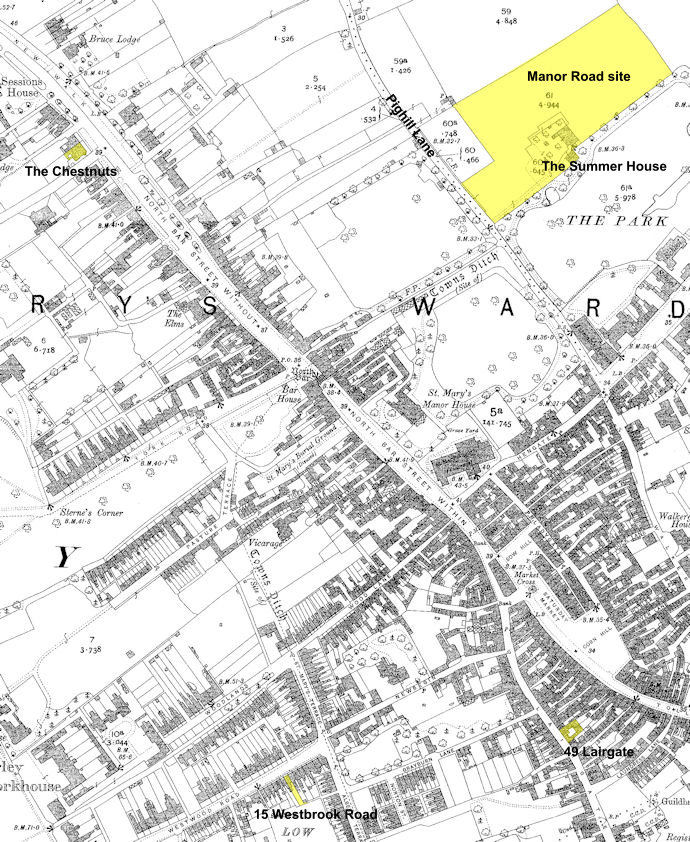
Above: 1910 map of Beverley locating Arthur Watts' property
The Manor Road plot of land was the location of 'The Summer House': the families retreat. Jane
recalled access being along Pighill Lane, now Manor Road..
1807info3c, sheet 10
Arthur Watts' public service
Arthur Watts, of The Chestnuts, New-walk, a haulage contractor, represented the St. Mary's Ward
from [...] until at least 1946. There is no indication of his political persuasion, though the
family thought him to be Conservative.
Beverley Ceremony
Beverley's
ancient Guildhall was packed today for the annual Mayor-choosing ceremony. Councillor
Arthur Watts and Mrs Watts were elected Mayor and Mayoress of the borough for the coming
year and Councillor CH Burden, retiring Mayor, who has held the position for the past two
years, was appointed Deputy Mayor.
Returning thanks, the Mayor reviewed the work of the council in the past few
years, and referred to the large expenditure
facing them.
Rates were now 13s[hillings] (65p) in the pound compared with [...] ten years ago, and it
was hoped that their schemes in connection with roads, education, housing and sewage
disposal would not mean much increase.
He moved thanks to the retiring Mayor who he said had accepted the advice of
his doctors and was taking a change and a rest. He was leaving office 'a very tired man'.
[...]
Despite Councillor Burden's exhaustion, Arthur Watts was to continue in the roll for five
years. Two months after war was declared Arthur Watts began his second term in office on a busy
schedule.
BEVERLEY SERVICES
The Mayor
(Councillor Arthur Watts) and members of the Beverley Corporation attended St. Mary's
Church, Beverley, yesterday morning for the annual Mayor's Sunday service. and in the
afternoon they attended a special Service of Remembrance at Beverley Minster. [...]
[Rev TH] Tandrow spoke of the significance of the Mayor commencing his year of
office in the presence of God, and
surrounded by
his friends who were helping him.
The civic party me after the service in the Mayor Parlour, where toasts were
honoured.
Representatives of other public bodies in the town joined with the Mayor and
Corporation of Beverley at Beverley Minster in the afternoon where the service was
conducted by the vicar (Rev. LJ Baggott MA).
1807info3c, sheet 11
Mayor of Beverley's Christmas Tour
The Mayor
and Mayoress of Beverley, (Councillor and Mrs Arthur Watts) together with their youngest
daughter [Winifred] spent a busy time on Christmas Eve visiting the hospitals, children's
homes and almshouses at Beverley.
Shortly after 9am the Mayor and Mayoress were welcomed at the Cottage Hospital
in Morton-lane by the Matron. There were only a few patients in and after shaking hands
with each of them the Mayor wished them the compliments of the season and a speedy
recovery to normal health.
From the hospital the party went to the newly built Maisons du Dieu, also in
Morton-lane - two-roomed cottages in which lived a
number
of old people. Considerable time was spent in recalling incident of long years ago.
At the Base Hospital in Woodlands, [...] each
ward had its own Christmas tree, laden with coloured lights and the usual decorations.
Paper chains and evergreens had been hung by the nurses. [...]
At Warton's Hospital in Minstermoorgate, the Mayor and Mayoress were able to
combine Christmas greetings with birthday greetings in the case of Mr Sam Jones, a former
printer, who celebrated his 84th birthday on Christmas day.
On 09 November 1940, seven spoke in favour of re-electing him for the third time. The Hull
Daily Mail recorded that 'The usual ceremony of distributing apples and pennies to the children
of the town was carried out, and the Mayor and Mayoress then entertained their guests' including
his sisters Jane and Eva, two nieces and grandson Chris Watson. Arthur's good works were
appreciated when he was elected for the fourth time.
BEVERLEY'S POPULAR MAYOR
With customary
ceremony and in the presence of a large number of townspeople the election of the Mayor
took place in the Guildhall, Beverley, yesterday.
For the fourth time in succession the Council's choice
was Councillor
Arthur Watts of the firm Watts Brothers haulage contractors, Beverley, and the esteem in
which he was held was evident when his nomination was unanimously supported.
SPITFIRE WEEK AT BEVERLEY
Enterprise Supported by Hull's Civic Heads
The opening of
Beverley's Spitfire Week was carried out on Saturday afternoon at the Market Cross.
The Mayor and Mayoress of Beverley (Councillor and Mrs Arthur Watts) were
supported by the Lord Mayor of Hull [...]
The Mayor revealed that it was only a fortnight ago that the
town raised
?282,000 for War Weapons Week, and he was sure inhabitants had enjoyed every day of that
week. The civic heads of Hull, he said had a tremendous task to overcome and as a
thanks-offering Beverley should give as generously as possible to supply our gallant
heroes with fighter planes.
1807info3c, sheet 12
WARSHIP WEEKS
BEVERLEY BID TO RAISE ?120,000
Lord
Sempill on Our Greatest Shortage
Beverley's
Warship Week opened on Saturday with the object of raising ?120,000 for the purchase
of the corvette Azalea 3. The total for the day raised was ?37,
500.
The official ceremony was performed by Lord Sempill at the
Regal Cinema, but prior to that a model corvette was launched by the
Mayoress (Mrs Arthur Watts) at the ancient Market Cross.
However, on the fifth occasion of re-election ...
BEVERLEY MAYOR-MAKING
Allegation of Lobbying and Wire-Pulling
ALD. G.H. WHITEHEAD'S
STATEMENT
For the fifth
year in succession Councillor Arthur Watts was appointed Mayor of Beverley at the ancient
Guildhall yesterday. There was a large attendance of spectators.
At the outset Councillor CH Burdon said that he had been a member of the
council for 21 years and the member with the longest period of unbroken service: on only
one occasion had he been absent. On this occasion a meeting of the council had been held
and in his opinion he had been unfairly kept from attending. Any injustice which might
have happened to him was nothing compared to the injustice to the person concerned with
the result of that meeting. He wanted it made public that he had no hand in that meeting.
Councillor GE Hawkins was the proposer of the resolution that Councillor Watts
should be mayor for another year, and the seconder was Councillor A. Graham.
"UNPRECEDENTED"
Alderman GH Whitehead spoken on the resolution. He said that he recognised the
capabilities of Councillor Watts as Mayor but peculiarly and unprecedented had led to the
presentation of the resolution now being debated: and he intended to give his reasons for
voting against it.
The gentleman's agreement concerning the secrecy of the secrecy of the
proceedings of council had been broken by the appearance of letters from members published
in the press: therefore he claimed and Englishman's privilege of freedom of speech. His
criticism was directed against the vacillation and
inconsistency of certain sections of the council. There had been an increasing opinion
amongst the members of the local authority that the office of Mayor should go round, and
that no one however brilliant, should occupy the position for more than two years.
[Councillor Whitehead went on to describe a ballot, which after exhaustive;
elimination his name had been given to the press as Mayor-elect.]
... but after the meeting a campaign of lobbying and "wire-pulling"
and eight weeks afterwards another meeting was held when his name was substituted by the
name of Councillor Watts, whose name had been considered at the first meeting and in the
voting had not been in the top three.
[...]
Councillor DB Simpson rose to propose Alderman Whitehead as mayor for the
coming year.
"A STIGMA"
Councillor HW Kirby, in support, said Alderman Whitehead had given 16 loyal
years to the borough. Today, by petition of the council he stood discredited in the eyes
of his fellow townsmen [...]
"Gentlemen," asked Councillor Kirby, "is that stigma to remain?
You alone can expunge it."
On a vote taken 13 voted for the re-election of Councillor Watts as mayor and
three in favour of Alderman Whitehead.
Alderman Whitehead was elected Mayor in November 1943 but served only six months.
1807info3c, sheet 13
A search of the Hull Daily Mail, between 1941 and 1943 gives an indication as to the wartime
roll, of the Mayor and lady Mayoress of Beverley, including many charitable and fund raising
events.
13 February 1941 - Fund raising for a St John's ambulance.
14 June 1941 - War weapons week aimed to raise ?100,000, with ?57,000 raised by 10am
on the first day
21 July 1941 - Chair of Midwives Institute
27 November 1941 - Attended Beverley Grammar School's speech day
17 July 1942 - Attended the Red Cross garden party
29 August 1942 - Swearing in of police women
13 November 1942 - Chair of Beverley Savings Committee
JP, Magistrate and Chairman of the Bench
22 January 1943 - Chairman distributing the Turner Charity
30 April 1943 - Chairman of the Royal Society of the Prevention of Accidents
16 August 1943 - Attended the Cadets Services sports and taking the salute a various
wartime parades
04 September 1943 - Attended Hull's 'Day of Prayer'
30 September 1943 - Chairman of Beverley's Saving campaign.
BEVERLEY HONOURS COUN. AND MRS WATTS
Tributes to
the services rendered to the town by Coun. and Mrs Arthur Watts were paid at a gathering
representing the whole of Beverley, when they received the freedom of the borough.
The proceedings opened with the Town Clerk (Mr. Robert Preston) calling the
roll of the surviving honorary freemen of the borough of who five [...] all veterans of
the South Africa war were present.
Resolutions confirming the honour on Coun. and Mrs Watts passed by the council
at a special meeting on Wednesday night were then read by the Town Clerk.
UNITED IN PURPOSE
Before presenting the illuminated scrolls and silver salver to Coun. and Mrs
Watts and admitting them to honorary freemanship the Mayor (Ald. HS Nicholson) said that
looking back on their many and varied activities one characteristic had always been
apparent - they reached their goals because they were always united in a common purpose
to serve the community and in this spirit they achieved great heights in public service.
Ald. Nicholson spoke of the many charitable works they had engaged in and
the boundless enthusiasm and energy Coun. Watts had shown in organising funds in response
to local and national appeals.
In 1941 he was appointed district chief warden in the Civil Defence Service
and, his leadership was an inspiration to all engaged in that service.
SPITFIRE EFFORT
In all his undertakings he had been ably supported by Mrs Watts who had
endeared herself to the towns people by the
gracious and charming manner with which she had fulfilled her many duties. Mrs Watts gave
much of her time a help to the running of a forces canteen, but would be best remembered
for the part she played in raising ?5,000 for the purchase of a Spitfire.
For many years she had been a member of the committee of the
Linnaeus-at-Home for Girls 4 in Hull. She was a member of the
Beverley Guardians Committee, and Chairman of the Beverley branch of the Ladies' Lifeboat
Guild.
Coun. Bloomfield referred to Coun. Watts' work with the Beverley Cottage
Hospital and revealed that at the time when his finances were low he guaranteed to raise
?1,500 to purchase some badly needed modern equipment.
Coun. JA Smedley and Coun. HR Godbold also added tributes and a bouquet from
the Beverley and District branch of NALGO was handed to Mrs Watts by Ann Preston.
Replying Coun. Watts expressed thanks for the honour and said that it had
been the greatest possible pleasure in his life to serve the town of his birth. Coun.
Watts named many men in the town, and officials of the Corporation who he said had always
responded to any call he had made upon them.
It had only been possible to do what had been done because he had the public
behind him.
The whole of the proceeds of the dinner dance to be held that night were to
be given to him to donate to any charity he desired, and he and he suggested that they
should form the commencement of the Beverley War Memorial Fund. He thought they should aim
at a sum of £5,000.
Mrs Watts also expressed thanks.
1807info3c, sheet 14
On the previous day, 16 January 1947, The Mail had reported the Mayor, Ald. HS Nicholson,
proposing a resolution to the council conferring the honour of freeman on Mr. Councillor and Mrs
Arthur Watts for their 'eminent service to the borough'
. The Mayor added that Coun. Watts had always been '
to the forefront in anything that would benefit the town'. For five years from 1938 to 1943 he
was Mayor, a record which has been surpassed only once in the past 64 years. Coun. Watts had been
ably assisted by Mrs Watts, who apart from her civic duties had done much valuable work that was
known only to her more intimate friends.' A Chippendale pattern, 28" in diameter
silver salver weighing 147oz was presented. Engarved on the base was the town crest and the words
'Presented with the Honorary Freedom of THE BOROUGH OF BEVERLEY to ARTHUR AND BESSIE WATTS 1
6th January 1947.
To Mr. and Mrs. ARTHUR WATTS
At the conclusion of the second world war
the Beverley Town Council decided that in addition to paying homage to the ex-Service
men and women of this ancient Borough they should pay tribute to a civilian man and
woman who had, during the long years of war, shared to a very large degree with their
fellows on active service the heavy burdens imposed by total war. It was therefore
necessary to select a man and woman who truly represented the citizens of Beverley on
the home front, in the civil defence services and in the ancillary services, including
the housewives, and it is not surprising that the choice fell upon Mr. Councillor and
Mrs. Arthur Watts. Both are natives of Beverley and both have records of service which
would be difficult to excel. Arthur Watts has for many years taken an active and whole-
hearted part in the affairs of his town, and on the 9th November, 1938, this fact was
publicly recognised by the Beverley Town Council when they unanimously elected him
Mayor of the Borough. During that year, as is well known, the threat of war which had
been hanging over the country for so long became a reality and in Beverley Arthur
Watts as civic head of its public immediately recognised the needs of the moment and
threw himself into the multifarious duties with an enthusiasm and optimism which was
an inspiration to all. He continued in office as Mayor until November, 1943, and
during that time he took the lead in raising the sum of £13,000 in local appeals for
various war charities. In 1941 he was appointed District Chief Warden of the Borough
Civil Defence Services and once again his personality and drive enabled him to carry
out the many onerous duties in connection therewith with complete satisfaction. As
chairman of the National Savings Movement he was closely associated with War Weapons
Week (£282,378); Warships Week (£802,710); and Wings for Victory Week (£383,965). In
1944 he launched an appeal for funds to purchase an ambulance for use in the Borough
and surrounding rural area, and in August, 1945, the ambulance was in use. Under his
chairmanship the Committee have equipped and organised a first-rate ambulance service
which is available to every inhabitant of Beverley, free of charge. It is true to say
that no voluntary organisation has ever called upon Arthur Watts in vain.
During the whole time he has been ably supported by his wife, and during the years of
war she gave her services, both as Mayoress and otherwise, unstintedly. In August,
1940, she launched a shilling Fund with the object of raising £5,000 for a
“Spitfire," and in October, 1942, it was achieved. Mrs. Watts spent a great amount of
time caring for the comfort of Service men and women at the St. Mary's Canteen in the
Tiger Lane Rooms. She also interested herself in the first aid training of the Civil
Defence Services, and has always been among the first to volunteer to assist in any
service which is for the benefit of the community as a whole.
1807info3c, sheet 15
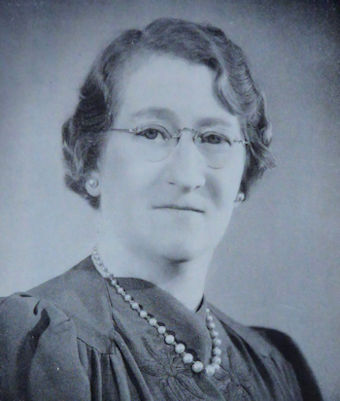
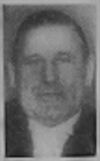
Above: Arthur Watts in 1947
Above: Bessie Watts in 1947
Source: Family photos
FIVE TIMES
MAYOR
COUN. A. WATTS RESIGNS
Beverley Town
Council last night received a letter from Coun. Arthur Watts tendering his resignation
from the Council because of ill-health. On the proposition of the Mayor, Coun. J.A.
Smedley, it was resolved to place on record the Council's deep appreciation of the
services Mr and Mrs Watts had rendered to the borough.
Coun. Smedley recalled that Coun. Watts had been a member for 14 years and
throughout that time had put his heart and soul into the work. During the war he was on
the ARP Committee and was Mayor for five years. He was chairman of the Beck
and Highways
Committee for 10 years and the Housing Committee. Seconding, Coun. C.H. Burden said that a
very considerable cause of Coun. Watts' ill-health had been his enthusiasm and energy he
had displayed in connection with his Council work. He had "burnt himself up."
1807info3c, sheet 16
The extended family has no recollection of Arthur's ill-health, though it corresponded with the
nationalisation of road transport.
With the Manor Road site sold for housing development Arthur's retirement
bungalow was built on a corner plot of the brown-field development. I recall him sitting
in this wing armed chair placed on deep piled carpets. In the early 1980's he was still
alert, interested and interesting.
Arthur WATTS died on 19 December 1988 (Probate/ GRO ref: Beverley 7 33), leaving
£260618.
No will or obituary has been found.
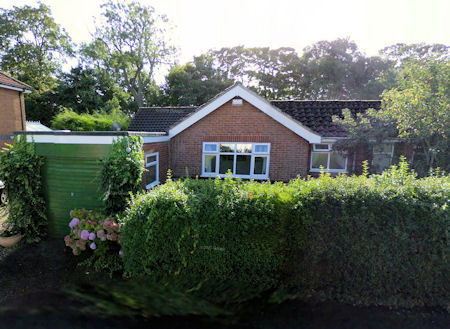
Right: 22 Manor Park Road, Beverley in 2009
1807info3c, sheet 17
More information 1
Independent road transport
A further advert from the Hull Daily Mail, dated 20 September 1950 showing how the
independent road hauler, including Watts Bros, had combined against the nationalised BRS.
Watts Bros, still at Lairgate, though with telephone lines numbered 71 and 73 advertised
regular services between Beverley, York and Scarborough.
1807info3c, sheet 18
More information 2
The Chestnuts, New Walk, Beverley
In the 13th and 14th centuries leprosy was so feared that lepers were not allowed
inside town and were provided with leper squints so that the alter could be seen
from the outside of a church. ‘Hospitals’, outside the walled defended
area, were built for their care.
Beverley’s second leper house had been established by the late 14th century
outside North Bar on the Molescroft road on a plot of land occupied by numbers 15-
21 New Walk and its adjacent areas. It was thought that number 11 and number 9
New Walk might have been the hospital's burial ground. However, an investigation
revealed no medieval remains.
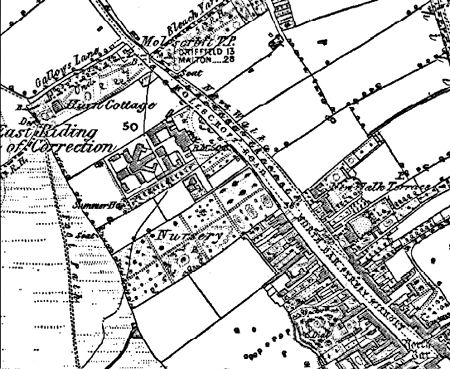
Right: An 1855 Ordnance Survey 6" map showing New Walk, Beverley,
before 'The Chestnuts' was built on the Nursery
Originally called Queen Street, it was neither part of North Bar Without or
Molescroft Road. Pevsner (Yorkshire: York and the East Riding, Pevsner & Neave,
Yale University Press, 1995, page 322) describes New Walk as a tree lined
promenade along the east side of the Molescroft Road, laid out by the Town
Corporation in the 1780s. However, houses were not built along it until the late
19th century.
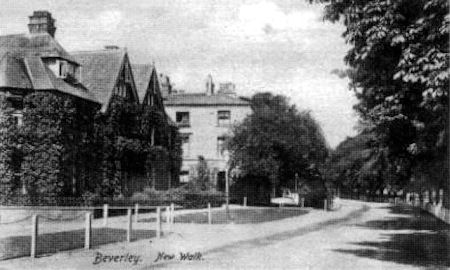
Left: The Chestnuts, ivy clad, and New Walk circa 1900 - Christopher
Ketchell collection
1807info3c, sheet 19
More information 3
HMS Azalea
Azalea was laid down by Cook, Welton & Gemmell of Beverley on 15 November 1939;
launched on 8 July 1940; and commissioned on 27 January 1941.
HMS Azalea was the sole allied warship present during the German
raid on allied landing craft during Exercise Tiger [in preparation for the D-D
landings] off Slapton Sands, in the early morning of 28 April 1944. Although
Azalea received word via radio of the presence of German torpedo boats from naval
headquarters ashore, because of a typographical error in orders, the escorted
LST's [Landing Ships Tanks] did not. Azalea did not relay the notice. In the
attack, three LST's were hit by torpedoes, two were sunk. 749 US servicemen were
killed.
Above: Flower-class corvette HMS Azalea
More information 4
Linnaeus-at-Home for Girls
The Hull Guardians' Children's Scattered Home was established at Nos.16,
18 and 92 Linneaus Street in 1915; it had taken in No 23 by 929. By 1936 it was listed
as the Hull Corporation Children's Scattered Home and was still extant in 1939.
There were six houses which provided accommodation for up to 10 pauper children in its
care each. There was also a Receiving Home at 16-18 Linnaeus Street for new children
coming into the homes system.
In 1915, the York Diocesan Maternity Home was established at No.14; the character of its
work was to help unmarried mothers under the age of 25, “of previous good character,
and for first cases only”. It was a Church of England home, but girls of any
denomination were taken. The following information is taken from “Institutions &
Charitable Agencies of the City of Hull”, compiled for The Hull Rotary Club in
1928: -
“The girls are admitted before the confinement, and pay seven shillings and six
pence per week during their stay. They remain for six months, and if their babies stay on
as boarders after then they pay six shillings a week for the maintenance of the baby. If
however an affiliation order is obtained, sums varying from six shillings to ten
shillings are paid. The girls, at the end of the six months, if they cannot go back to
their old employment, are found suitable work whenever it is possible, and are encouraged
to spend their spare time at the Home, so keeping in touch with their babies. [...]
”.