1805 info 3h_3 for John Crompton
Harry Crompton - his post war life
Life at Bempton Cliff Farm
Harry's daughter Sheila writes:
'From 1919, Dad farmed the Bempton Cliff Farm, now the
Royal Society for the Protection of Birds (RSPB) Puffin Sanctuary, to 1926 when he had a
fire in the stables and lost a number of horses.'
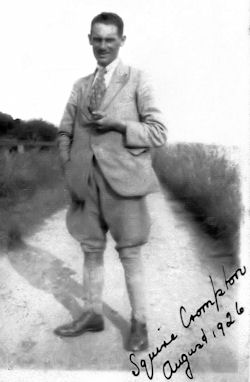
Right: Harry CROMPTON at Bempton in 1926 - a leaving photograph?
Courtesy: Sheila Mellstrom
Thomas bought Bempton Farm, near Bridlington, of 130 acres [53 hectares] for his son Harry.
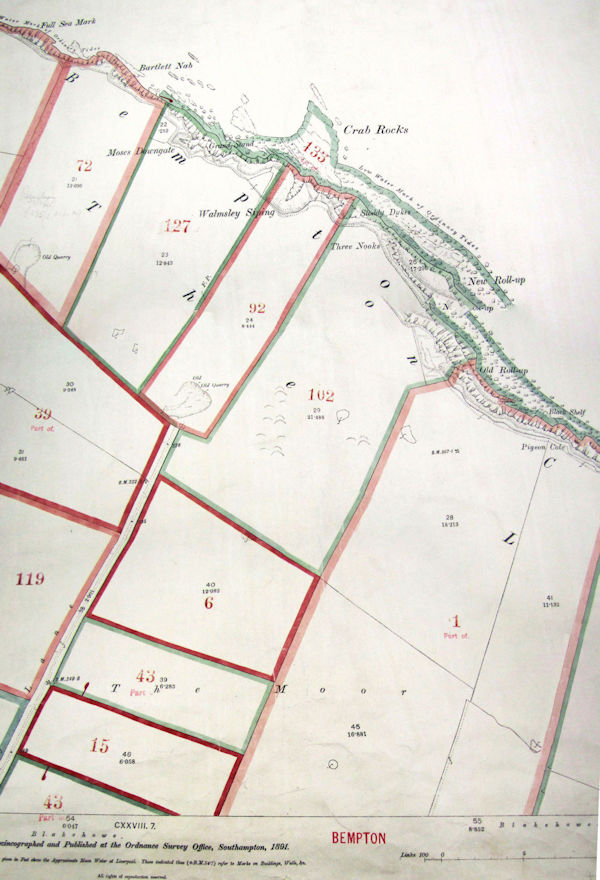
There is no specific information concerning the fields. However, using the Valuation Office Survey 1 of
1910-1911, it has been possible to identify six fields whose a size totals 125¾ acres. A
synopsis of the valuation field book records the following details related to the plan field number:
Situation: Bempton
Field
Description
Acres
Occupier
Owner
Interest
Rent £
Tythe £
Gross Value £
Rateable value £
Building
Land
Building
Land
6
Arable
12
Leeson
Wilkinson
Freehold
15
2/10/-
-
8
-
9/10/-
92
Arable
8
Coultas
Wyse
Freehold
8
-
-
8
-
7/10/-
102
Grass
21½
Appleby
Nilsthorpe
Freehold
29
1/1/-
-
27
-
25/10/-
127
Grass
14
Freehold
119
Arable
19¼
Wilkinson
Wilkinson
Freehold
20
12/-
-
20
-
19/10/-
39
See below
51
Wright
Ogle
Freehold
45
-
38
35
-
Note
The value 19/10/- represents 19 pounds, 10 shillings and no pence.
1805info3h_3, sheet 2
Above: Valuation map 1911 of Bempton Cliffs showing all
the fields along Cliff Lane
1805info3h_3, sheet 3
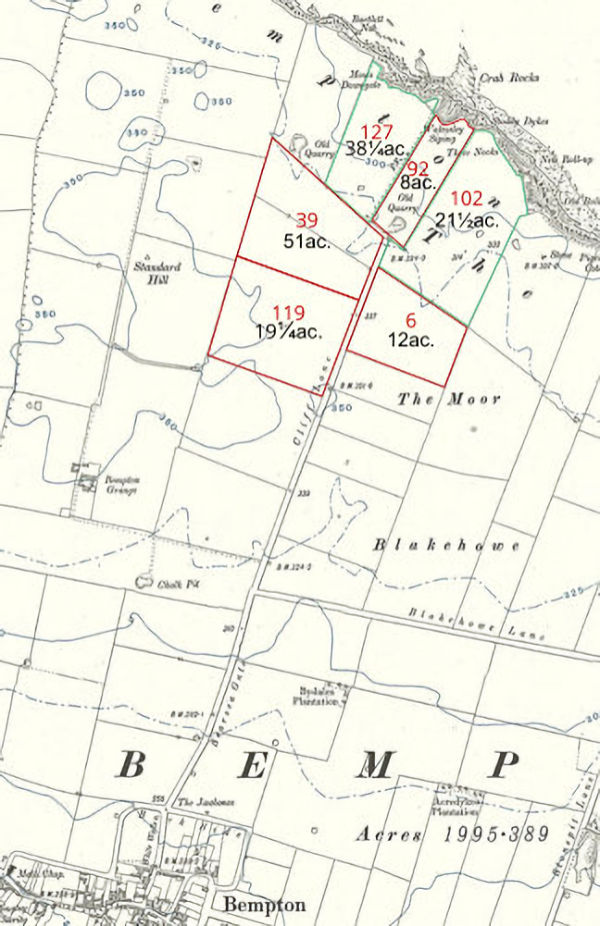
Above: 1929 1:10560 Map locating Bempton Cliff fields.
The site of the farm is thought to be at the end of the straight road. RSPB Bempton is
located at the end of Cliff Lane.
1805info3h_3, sheet 4
The location of the farm house and building is uncertain. There are no buildings for a farm
house and other buildings on this land: the buildings destroyed by the 1926 fire. However, the
valuation book details buildings related to entry 39, which were located in the village, with
the particulars detailing parcels of land at other locations. The significance of these are not
known.
Particulars: Farm house buildings and land on south side of High Street
and east of Bolan Lane. Corner field of Bolam Lane and High Street. Top of Cliff Lane on west side
between Boc- Ride and top of Poor Peoples’ Lane, north side of Flamborough Road to Danes Dyke on
south. Side of Bempton Lane near Buckton Mill.
YORKSHIRE POST
Saturday
6th June 1922, page 6
DANGER OF
SMOULDERING SOOT
A destructive fire occurred in early hours yesterday morning at Bempton Grange Farm,
near Flamborough. The Farm is situated between the village and the cliff. Wednesday
morning the chimney of the house was found a fire, and after water was poured onto it
the outbreak was to have been extinguished. The tenant of the farm, Mr. Harry
Crompton and the [...] late as 11:30 on Wednesday night, found everything
apparently in order. Mr Crompton who is unmarried, had rooms in the house, which was
also occupied by Mr. Smith and his wife and family. About 1:30am yesterday morning
Mrs Smith found her room full of smoke, and gave the alarm. The Bridlington Fire
Brigade soon reached the scene, but found there was small hope of saving the Farm
House. Mr. and Mrs Smith and family had hardly got out of the bedrooms before flames
burst from the windows. Gales seemed to have fanned the smouldering roof into flames,
which spreading though the building destroyed the entire house, only little furniture
being saved.
Happily the wind was blowing from the direction of the farm
buildings and stackyard, and these were not damaged, No one was injured and the
damage is estimated at over £1,600 is covered by insurance. The farmer is Mr. T
Crompton of Bridlington, father of the Tenant.
Driffield Times
Friday
6th June 1922, page 6
FARM FIRE at BEMPTON,
Bridlington
The Fire Brigade was called out three o'clock on Thursday morning to a fire at Bempton
Grange tenanted by Mr. Harry Crompton . The Farm House was burnt to the ground and
only a little furniture was saved. A domestic servant named Mary had a narrow escape.
The damage is estimated at £2,000
1805info3h_3, sheet 5
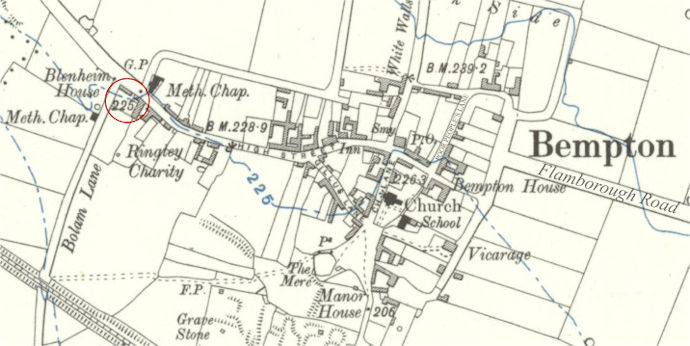
Above: Map of Bempton village 1912 locating Harry's
assumed properties Click on the map to open a scalable pdf map in a new window
Building
Detail
Build
Condition
House
2 storey, 2 sitting rooms, 2 kitchen, dairy
Brick & tile
Fairly good
Wash house & cow house
4 cows
Stone & tile
Fairly poor
Chaff house
Stone & tile
Fairly poor
Shed
3 cows
Stone, brick, wood support and corrugated
Fairly good
Store house
Dog house, stable (4), Loose box, Cow house (4). Piggery, Store
Stone, brick, brick front and side & tile
Fair
Shed
Stone & tile
Poor
Shed
2 way shed
Brick & tile
Good
Water
From pump
Land
Medium
In 1924, Harry played cricket for Bempton against Rudston, Burton Agnes,
Nafferton, Bridlington 2nds and Flamborough in the Bridlington and District
League. Harry batted up the order and appeared to bowl too. On 11 June 1924 the
paper reported Harry as being the first person to score a century in a local
league game that season. In the same year, he played tennis successfully in the
mixed doubles with Miss Hamilton and football with Bridlington Town. The
Bridlington Free Press also records Harry sending cows and poultry to market and
winning a rosette for an agricultural mare with foal at the local show.
Sources:
1910 Valuation Office Field Book Bempton 1-100 The National Archives (TNA) IR 58/73690
1910 Valuation Office Field Book Bempton 101-139 The National Archives (TNA) IR 58/73691
Hoverbox Photo Gallery -
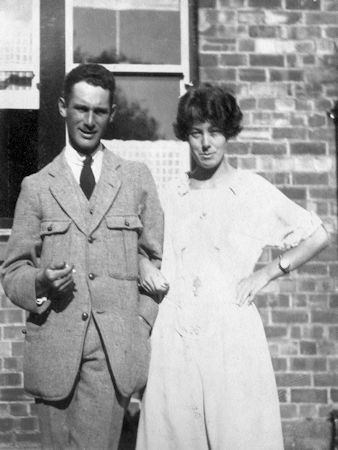
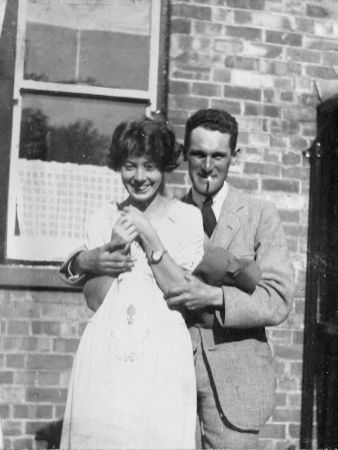
Frances Eileen RICHARDSON in 1924 - Courtesy: Sheila Mellstrom
This feature does not function correctly on phones and tablets
1 Frances and Harry probably at Bempton
2 Frances and Harry probably at Bempton
1
2
It is interesting to note that, by 1924, Harry has lost his war-weary look.
Frances was born on 12 September 1902 (GRO ref: Sculcoates 9d 182).
1911 Census:      Sun/Mon 2nd April/3rd April 1911
Source:   TNA Ref:        RG14 PN
          Reg. Gen. Ref:  RG78 PN  ; En.Dist: ; Sched:
          RegDist:  SubDist:
Dwelling: Seacroft, Trafalgar Crescent
Place:    Bridlington, Yorkshire East Riding
Rooms in dwelling, other than scullery, landing, lobby, closet, bathroom: 8
Years married: 10
Children:      Alive 2, dead none

Name                       Rel  Mar  Age  Occupation            Status    Birthplace
John Robert Richardson    Head   M   34   Timber merchant       Employer  Yorks, Hull
Louise Ellen Richardson   Wife   M   34                                   Yorks, Wakefield
Frances Eileen Richardson  Dau        8                                   Yorks, Hull
Cynthia Caton Richardson   Dau        6                                   Yorks, Hull
Theresa Emily Adams       Serv  Wid  40   Cook (Domestic)       Worker    Lancs, Liverpool
Kate Spindley             Serv   S   17   Housemaid (Domestic)  Worker    Yorks, Hull
Sheila Mellstrom writes about her father and mother:
When Frances was 14 her father died and her mother insisted she leave
school and look after her and her two younger sisters, Cynthia and Jane. The family then moved
to Devon but Frances and Kitty (Harry's sister) always kept in touch. My Grandmother never
allowed Frances to go to school again even though she was very clever and should have gone to
university. I think occasionally Frances was allowed to go up to stay with the Crompton family
thus the 1924.
When Dad went to Kenya in 1927, Granny Crompton asked a number of people
to write to him as he was very lonely and homesick and that must have been how the romance
blossomed, as eventually he asked her to marry him and she threw everything up and went out on a
boat to Kenya all on her own.
1805info3h_3, sheet 7
Emigration to Kenya
Driffield Times
Saturday
26th March 1927, page 2
FARMING STOCK
Thursday April 6th Bempton Grange Farm, the whole of the valuable Farm stock Viz;
9 horses 28 cattle 119 fat and store Hoggs 30 pigs 80 head poultry Farm carriages
implements Gearing and effects, By instruction from Mr. Harry Crompton.
'It was also the year of the slump and so Dad joined the
Soldiers Settlement Scheme and went to Kenya as a farm manager.'
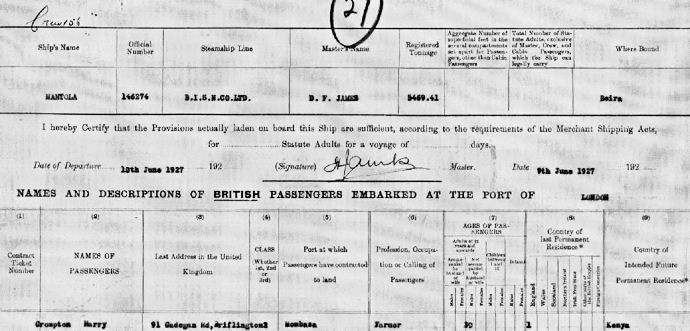
Above: An abstract from the Mantola's passenger list showing passenger
Harry CROMPTON, a farmer of 91 Cardigan Road, Bridlington embarked at London on 09 June
1927 bound for Mombasa. Harry was the only farmer on this page. Also listed was his
friend Ralf BANCROFT, who was to become godfather to his daughter Sheila. Source: The National Archives (TNA) BT 27/1167/16/1
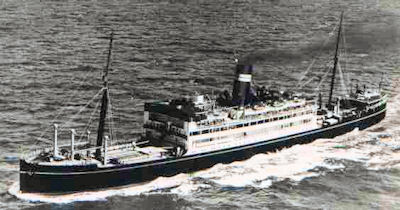
The British India Steam Navigation Company Limited (BISNCo) built the Mantola in 1921
in the Glasgow yard of Barclay, Curle Co. Ltd. Despite the company name their ships
sailed on the East Africa route to Beira in Mozambique.
At 5496 tons she carried 96 passengers in 1927. On Harry's voyage DF James was Master.
The Mantola was scrapped in 1953.
Right: B.I.S.N.Co Mantola
1805info3h_3, sheet 8
Soldier Settlement Scheme
Apart from CJ Duder's PhD thesis (1973 Aberdeen University) little appears to be written
about the UK's Soldier Settlement Scheme to Kenya.
The Soldier Settlement Scheme of 1919 saw the allocation of land in the
colony (then known as British East Africa) in an official attempt to increase the white
population. This is put down to an attempt to bring economic development to the area whilst also
seeking to address African unrest during World War 1. The Scheme applied to a small cross-section
of the population who had to be of 'pure European origin' and have served in an
officially recognised Imperial service unit in World War I. The requirement to have significant
financial reserves thinned out the majority of applicants and insured that this remained very
much a 'public schoolboy colony par excellence'. The result was that the vast majority of
participants were officers, with those of the rank of major and above disproportionate to their
numbers in the army as a whole.
The article goes on to break down by unit affiliations and also
identifies aristocratic members as well as the predominance of those from a variety of British
Public Schools (31 settlers came from Eton). In seeking to determine why the settlement occurred,
the author concludes that World War I was pivotal in weakening the position of the middle class,
with inflation and the decline of a servant population eroding their privileged position.
But it also goes on to analyse the rise of the 'unemployed ex-
officer'. The enormous expansion in the number of officers in World War I brought with it
problems after the war when 173,955 of them had to be demobilised. As their commission
automatically now made them a 'gentleman' in British society, this presented something of
a challenge.
The flood of ex-officers back into civilian life proved problematic and
by April 1919, the appointments branch had found work for only 4,415 out of 88,687 demobilised
officers. Similarly by June 1920, 17,000 ex-officers were on the unemployment rolls. For those
lucky enough to have financial security, agriculture in the Empire was a way out, with
professional officers seeing an end to rapid promotion and also those disabled by the conflict.
The description in a public school year-book of 'Farmer in British East Africa' pressed
all the right buttons in a class-conscious society.
1914-18 had also the careers of a whole generation, with many soldier
settlers going straight from school or university into the Forces and then finding themselves at
something of a loss afterwards. And for those used to military adventure, settlement in Africa
helped reduce the adjustment to peace-time again and a return to every-day lives.
It concludes by highlighting that the number one attraction to the
settlers was a chance to retain an officer status that they had become used to. The life of an ex-
officer in Kenya was a comfortable one, with status protected by the fact that its main pre-
requisite: white skin, was still something of a rarity.
For most of the ex-officers, 'migration to Kenya was but a change of
location for the exercise of elite status'.
Source: Adapted from a review of Duder, C.J., 'Men of the 'Officer
Class': The participation in the 1919 Soldier Settlement Scheme in Kenya', African
Affairs (1993) quoted in Great War Forum (No loner available)
The Scheme gained notoriety in the White Highlands and through the film 'White
Mischief', but these settlers were a small minority who gave the remaining and majority of ex-
soldiers a bad name. Harry qualified for the scheme by being an ex-officer, educated at
Bridlington Grammar School. However, rather than being landed gentry, Harry's background was
in 'hands-on' farming, which must have helped gain him the position as a farm manager.
Later, when he took on his own farm, Cottam was carved out of virgin bush, as were the majority
of farms in Trans Nzoia District. Far from the image portrayed by the White Highland, Harry would
be described as a benevolent settler and the Trans Nzoia atypical of Duder's research.
1805info3h_3, sheet 9
Farming in Kenya
Harry's daughter Sheila writes:
Dad worked on a farm between Lumbwa and Rumaruti for three
years during which time he met Frank LeBreton whose family owned big Hampshire estates
called 'Loders'. He also owned Kitale and New Loders Farms in the Trans Nzoia
District and needed a manager.
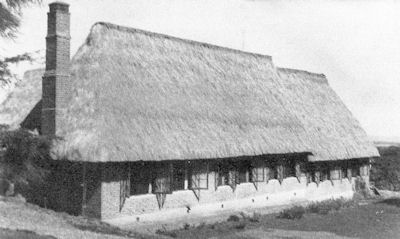
Right: Harry's first house in Kenya 1927-1930 Courtesy: Sheila
Mellstrom
Above: A map locating Kitale and Saboti in Kenya's Trans
Nzoia District, which was near Mount Elgon and very close to the Uganda border. One of
Harry's post war farms was at Saboti. Cottam was five miles from Saboti towards Mount
Elgon; perhaps on the edge of the National Park. Click on the map to open a map showing Kitale in its wider context.
Trans-Nzoia District is an administrative district of Rift Valley Province. It is located
between the Nzoia River and Mount Elgon and its centre is the town of Kitale. Historically the
area has been inhabited by the Kalenjin people.
The British East Africa colony, founded in 1905, encouraged British immigration to Kenya.
Kitale was founded in 1908 by white settlers in what to be known as the White Highlands. This term
described an area in the central uplands of Kenya, so-called because, during the period of British
Colonialism, white immigrants settled there in considerable numbers. By the time the Kenya Colony
came into being in 1920, about 10,000 British had settled in the area. Settlers got 999 year
leases over about 25% of the good land in Kenya. A branch line of the Uganda Railway from Eldoret
reached Kitale in 1926 which promoted growth of the town. The main motivation was to take
advantage of the good soils and growing conditions, as well as the cool climate, despite being
some 60 miles (100km) north of the equator.
1805info3h_3, sheet 10
After independence many of the farms vacated by white settlers were bought by individuals from
other ethnic groups in Kenya. Today Trans Nzoia District is part of Kenya's 'Grain
Basket' and the 'Big-7' grain producing districts. It produced three times the Kenya
national yield for corn as an exportable cash crop. In 2010 farmers of small holding were
diversifying because of the steady rise of input costs and the change of weather patterns.
Source:
Rift Valley Cereals (Accessed 24 June 2010 No loner available) and
USDA - 2008
(Accessed 20 October 2010 No loner available)
Frances Eileen RICHARDSON joins Harry
'During this time he had been corresponding with my mother, Frances
Eileen RICHARDSON, who was Kitty CROMPTON's [Harry's younger sister Catherine] best friend
from school. She agreed to marry him and to come you to Kenya by boat.'
[Frances had looked after and push her wheel chair bound mother between
1914 and 1928 and had asked her sister to take her turn.] Frances Eileen was always known as Jill.
To Harry 'Frances was a man's name and Eileen was difficult to say', so throughout
Kenya, Frances Eileen was know as Jill CROMPTON.
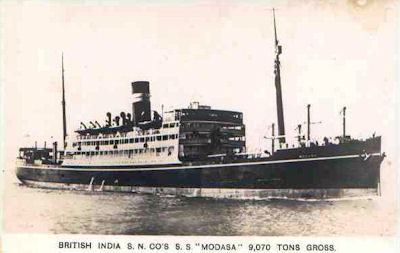
Above: An abstract from the Modasa's passenger list showing passenger
Miss Frances RICHARDSON of White Cottage, Chelston, Torquay who embarked in London on 20
December 1929 bound for Mombasa.
Source: TNA BT 27/1248
The BISNCo built the Modasa in 1921 in the Newcastle yard of Swan Hunter and
Wigham Richardson for the East African route to Beira in Mozambique.
At 5636 tons, she carried 350 passengers in 1929. On Frances's voyage ,JW Gilbert was
Master.
The Modasa was scrapped in 1954.
Right: BISNCo Modasa
1805info3h_3, sheet 11
She met a couple on the boat who said, "My Dear, if you find he has
a red nose when you meet him, don’t marry him but come and stay with us as it will mean he is
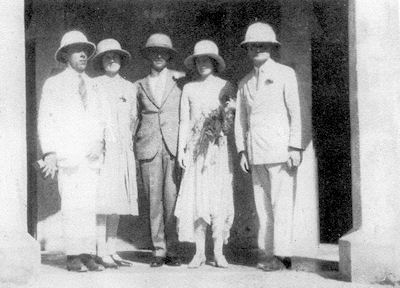
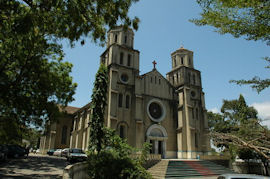
drinking!!!" However Mum and Dad were married on 17 January 1930 in Mombasa Cathedral the day
she landed with the couple off the boat and a friend of Dad’s as witnesses and were very happy!
Granny Richardson wouldn’t speak to Mum for about two years as she felt Mum had deserted her.
Above: Mombasa Cathedral ~2009
Above: Harry CROMPTON and Frances RICHARDSON's (centre) wedding on 17
January 1930 at Mombasa Cathedral Courtesy: Sheila Mellstrom
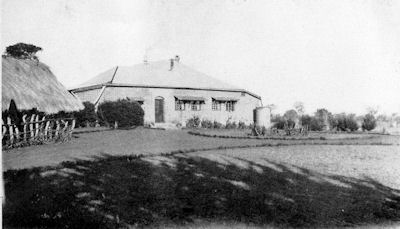
Left: Kitale Farm 1930 Courtesy: Sheila Mellstrom
They lived at Kitale Farm, where I was born in 1937, until
1942 during
which time Dad met Rodney Meyler who offered him a half share...
'... in a virgin farm on the edge of Mount Elgon if
Dad would run the farm when he (Rodney) was away in Burma in the army. So when I was four
we moved to what was now called Cottam Farm. During the War Dad ran a number of farms for
the soldiers who were away. In 1948 he bought Meyler out when he returned to England and
also purchased a farm of his own, called Saboti, five miles away. '
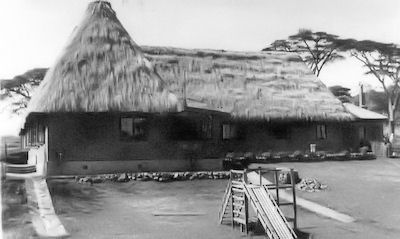
Right: The front view Cottam Farm just after it was built in 1942 Courtesy:
Sheila Mellstrom
1805info3h_3, sheet 12
In 1943 my parents adopted Heather and she came to live with us in April.
Her story is below.
'On these two farms Dad was growing maize, flax, sisal,
latex, coffee and tea. he also had cattle for beef; native cattle which he crossed with
Red Poll cattle imported from England.' [The red, preferably deep red, and
naturally hornless Red Polls is a dual purpose breed of cattle developed in England in
the latter half of the 19th century. Red Poll cattle are mainly used a beef suckler cows
known for easy calving and successfully rearing a high proportion of their calves. They
do well on poor soils.]
The early 1950's were prosperous times for Kenyan farmers, but then
the Mau Mau made life very dangerous, although it was not so bad in Trans Nzoia District. We had
very few Kikuyu there. However, Dad sat with a gun on a chair behind him at dinner. 1
My Grandmother had told Mum she had heart trouble but, in 1951 when we
came to England for the first time , she decided to come back to Kenya with us to live and had to
have a medical test before she could go on the ‘plane. The test proved she had never had anything
wrong with her heart!! A very sad story.
The Independence came and Dad decided that as he was approaching 70 it
was time to sell and return to England. It took him four years to sell, and eventually in 1966 he
sold the 900 acre farm to a syndicate of 50 Africa farmers for £15000; a pittance of what it was
actually worth. He came back to live with us in East Horsley and died of lung cancer in 1973.
'Dad and Mum did a huge amount for the
African. Dad built them proper houses - rondabels. My Mother started a Woman's Club
where she taught the women how to sew, knit and cook more nutritious food. Dad was a
member of the local African Chiefs' Council. Kenya was poorer for their
departure.'
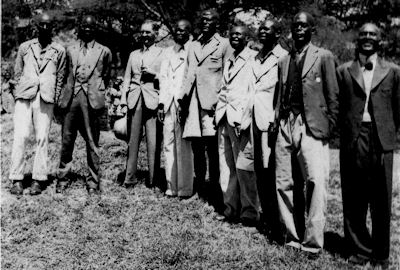
Right: Harry CROMPTON, third from left, with the Chiefs' Council
Courtesy: Sheila Mellstrom
Harry and Frances returned from Kenya in 1966 to live with their daughter Sheila at North East
Horsley, Surrey, whose house was named Cottam after the the farms in East Yorkshire and Kitale.
Both Harry and Frances died there: Harry on 27 March 1973 (GRO ref: Surrey South-Western 5g
1484) and Frances Eileen on 01 January 1996 (GRO ref: Surrey South-Western A5A 7612A 212).
They are both buried in Oakham churchyard. In his will Harry left £17,651 estimated to be
£215,000 at the 2019 RPI rate.
1805info3h_3, sheet 13
Heather CROMPTON - Harry and Frances' adopted daughter
Heather was born in Mombasa, Kenya on 27 November 1942 to a Greek mother, probably living in
Mombasa, and a British father who was in the Royal Air Force. He was possibly in a South Africa
reconnaissance squadron, who must have been in Kenya for more than nine months, although it is
believed that Heather was premature. Sheila's research, at TNA, suggests he may have been one of
seven pilots in a squadron photograph who was killed shortly after in a flying accident.
Heather was given up for adoption and must have been taken to a Nairobi orphanage. Harry and
Frances went to Nairobi when Heather was about three months old and chose her from between six and
seven babies. She was named Heather CROMPTON. Her second name, Caton, was added when she was
christened at the age of 11 years.
Heather was due to go to live at Cottam in January 1943 but Frances was unwell and so this date
had to be postponed. Meanwhile the Yugoslavian Royal Family, who had escaped from the Gestapo to
East Africa and who were seeking asylum in South America, were resident in Nairobi. Prince Paul
and his wife Queen Olga (the former Princess Olga of Greece and Denmark) had been placed under
house arrest by the British leaving Princess Elizabeth (born 7 April 1936) with an English nanny,
called Miss Ede. Miss Ede decided the Princess needed someone to share her attention, so she went
to the orphanage and asked if she could look after a baby for a few months until it went to its
new family. Heather was the baby selected and so she lived with Miss Ede and the Princess. In
April 1943 Miss Ede and Princess Elizabeth brought Heather up to Kitale, on the train, to live
with Harry, Frances and Sheila. The Princess and Miss Ede stayed for about a week.
Heather would like to trace her mother and airman father, since her birth and adoption records
were destroyed in a Nairobi flood. Unfortunately there are no known names.
Heather Crompton is trying to trace her birth family. Email Heather via
End notes
The Mau Mau Uprising was a military conflict that took place in Kenya (then called British
East Africa), from 1952 to 1960, between a Kikuyu-dominated anti-colonial-group called Mau
Mau and the British settlers protected by the Army. The conflict set the stage for Kenyan
independence.
Kitale today
The present day Kitale is a market town for the local agricultural area in western Kenya
situated between Mount Elgon and the Cherengani Hills at an elevation of around 7000 feet
(2134m). Its urban population is estimated at 220,000 in 2007. It is the administrative centre of
the of Rift Valley Province and the the agricultural hub of Kenya. The main cash crops grown in
the area are tea, Pyrethrum, seed and seed. Kitale is among the most diverse towns in the
country.
'Kitale...is a place where the modern world sits side by side with the ancient
world. Kitale is a busy little "town"... but, the "suburbs" ...
spread out and encompass many densely populated slum areas ... .
Suffice it to say that Kitale is a bustling little town. During the day and into the
evening hours; the streets are full of people selling vegetables piled on a piece of
fabric by the roadside, walking to the shops, stopping to greet a friend every few feet,
hailing a boda-boda (bicycle "taxi") or, in the case of the street kids,
begging each passer-by for a few shillings or some "bread and milk".
Hoverbox Photo Gallery - Kitale today This feature does not function correctly on phones and tablets
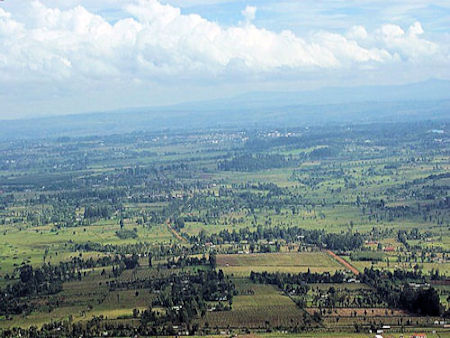
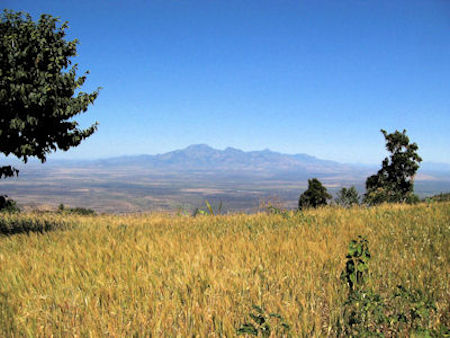
1. Modern farming in Kitale, perhaps lands that Harry saw 2. Looking toward Mount Elgon, where Cottam Farm was located
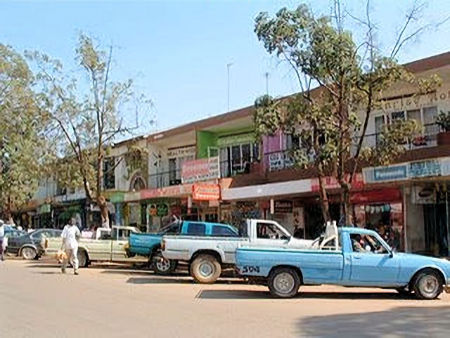
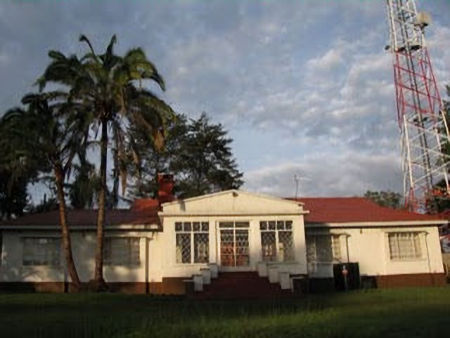
3. Shopping in Kitale 4. An old Colonial bungalow? and radio mast
1
2
3
4
1805info3h_3, sheet 14
'Businessmen in suits and ties and smartly dressed women walk side-by-side with people in more
traditional clothing. The barefoot, raggedly dressed street kids mingle with them all. But, the
modern world has crept in too. "Supermarkets" like Transmattress, Blue House and the Gigamart are
the Kenyan equivalents to Walmart selling food, clothing, electronics (including flat screen
televisions!) furniture, bicycles and hardware.' Source: An oasis of hope in Kitale, Kenya
(Accessed 13 February 2020)
Sheila Margaret CROMPTON
- Harry and Frances' eldest child
Sheila married Nicholas J MELLSTROM in the third quarter of 1959; (GRO ref: Surrey Northern
5g 907), who was born in the second quarter of 1935 (GRO ref: Surrey NE 2a 73 -
his mother's maiden name was Garnham).
Above: Sheila Mellstrom's family circa 2010 Standing from left to right: Peter Bradshaw, Harry Bradshaw, Jacqueline Fish,
Michael Mellstrom, Sheila Mellstrom, Nicholas Mellstrom, Jo Mellstrom, Karen Bradshaw,
Andrew Fish
Seated left to right: George Fish, Tom Mellstrom, Dan Bradshaw, Sam Mellstrom, Lily
Bradshaw, Jack Mellstrom, Arthur Fish Courtesy: Sheila Mellstrom
With special thanks to Sheila Mellstrom who gave me access to her wealth of photographs
and intimate family knowledge.
1805info3h_3, sheet 15
More information 1
Valuation Office Survey 1910-1915
The Valuation Office and the survey gives information about the value, use, extent or
ownership of a property or piece of land in England or Wales around the beginning of the
20th century.
The survey took place as a result of the 1909-1910 Finance Act which provided for the
levy and collection of a duty on land in the United Kingdom based on any increased value
of the land as a result of public money spent on communal infrastructure – a so-called
‘increment value duty’.
The Valuation Office, set up by the Inland Revenue in 1910 for England and Wales
established 118 valuation districts. The survey was in the charge of a district valuer
and each comprised a number of income tax divisions. The survey was organised and carried
out by these districts.
The two main types of Valuation Office Survey records are marked-up Ordnance Survey maps,
always referred to as ‘plans’, and the accompanying ‘field books’. The plans act as an
index to the field books. The field books provide the bulk of the information collected
about properties during the survey. Generally, you need to consult the plans for a place
first before you can find the respective field book.
The plans are printed Ordnance Survey map sheets, annotated by the Valuation Office
surveyors, and act as an index to the field books. The plot numbers, marked by the
surveyors, refers to the assessment numbers.
The final record of the Valuation Office Survey, compiled after the survey was completed,
was written in small bound volumes called field books. The amount of information entered
in the field books varies considerably. Field books usually include:
the names of owner and occupier;
the owner’s interest (freehold, copyhold, etc.);
details of tenancy (term and rent);
the area covered by the property;
figures entered for the purpose of valuation (i.e. market value);
They sometimes include:
the date of erection of buildings;
number of rooms;
state of repair;
liability for rates, insurance and repairs;
date(s) of previous sale(s);
a sketch-plan of the property.
Valuation books (also known as ‘Domesday books’) were the first major record created by
the Valuation Office at the start of the survey. They are distinct from the field books,
which were the final record compiled after the survey was completed, and which usually
contain more information.
In the course of the survey a number of forms were used to collect information. Some of
them were sent to land and property owners for completion.
The Valuation Office Survey was initiated by the Finance (1909-1910) Act (10 Edw. VII,
c.8 section 26(1)) which provided for the levy and collection of a duty on the increment
value of all land in the United Kingdom.
The main object of the Act was to tax that part of the capital appreciation of real
property which was attributable to the site itself, i.e. excluding that arising from
crops, buildings and improvements paid for by the owners. In this way, private owners
were required to surrender to the State part of the increase in the site value of their
land, which resulted from the expenditure of public money on communal developments such
as roads or public services. Increment value duty, as this levy was called, was based on
the difference between the amount of two valuations. The site value as at 30 April 1909
constituted the ‘datum line’ for the purposes of increment value duty. A second site
value was to be taken on the occasion of any subsequent sale or grant of a lease, or
transfer or interest in a piece of land, or the subsequent death of a land owner, to
determine any potential payment of increment value duty. The assessment of the site
value on subsequent occasions was a recurring operation, which formed part of the role of
the Valuation Office until increment value duty was repealed by the 1920 Finance Act (10
and 11 Geo. V, c.18). Although the 1910 land value tax was abolished following the 1920
Finance Act, the Valuation Office remained. Its modern-day successor is the Valuation
Office Agency.