1805 info 3h_2 for John Crompton
Harry Crompton - third child of Thomas and Mary Ellen Crompton - at war
The National Archives (TNA) holds no obvious service record from the officer (WO 339
and WO 374) or other ranks records. An officer’s file originally had three parts but two
of these were destroyed by enemy action in September 1940. What remains was heavily
weeded prior to 1940 and in many cases this means that nothing remains for many officers.
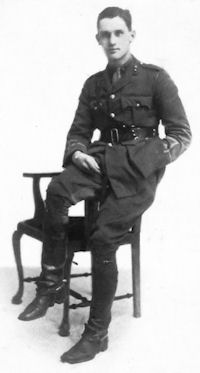
Left: Harry CROMPTON in the uniform of a second lieutenant of the Royal
Artillery taken after 10 March 1915 Courtesy: Sheila Mellstrom
Army Lists1
Month
Col.
Batt.
Name
Rank
Substant.
Acting
Effective
June 1915
725
2/East Riding Battery
Crompton H
2nd Lt
10-Mar-15
July 1916
726a
2/Northumberland Ammunition Column
Crompton H
2nd Lt
10-Mar-15
Captain
17-Nov-15
June 1917
724
Royal Field Artillery
Crompton H
2nd Lt
10-Mar-15
Captain
June 1918
724
Royal Field Artillery
Crompton H
Lt
01-Jun-16
Captain
Oct. 1918
724
Royal Field Artillery
Crompton H
Lt
01-Jun-16
Captain
Dec.1918
724
Royal Field Artillery
Crompton H
Lt
01-Jun-16
Captain
June 1919
Crompton H
Lt
01-Jun-16
Captain
Dec. 1919
Crompton H
Lt
01-Jun-16
Captain
June 1920
Crompton H
Lt
01-Jun-16
Captain
The Army Lists plot Harry's time in the army. In June 1915, he was based at Wenlock
Barracks, Anlaby Road, Hull. A year later, in July 1916, the Army Lists record Harry still in
Hull but was gaining experience with the 2/Northumberland Ammunition Column.
1805info3h_2, sheet 2
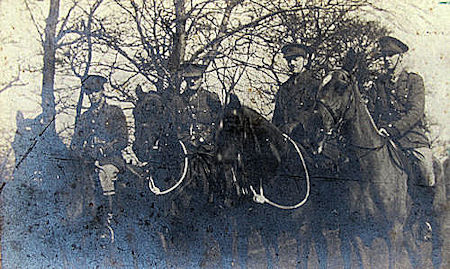
Right: Harry Crompton, Doncaster 1915 with three of his 2/Northumberland
Ammunition Column comrades, possibly England, Watson and Filby
Courtesy: Sheila Mellstrom
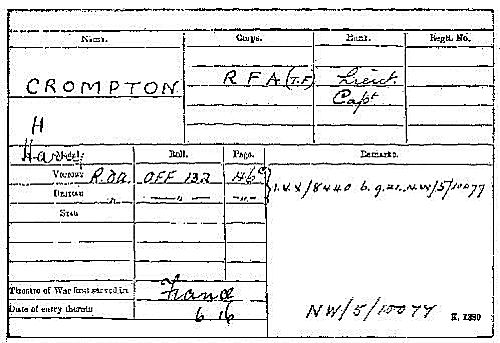
Harry's medal index card gives some basic information concerning his service.
Page one confirms his known name; that he served in the R[oyal]F[ield]A[rtillery]
part of the T[erritorial]F[orce]; with the rank of Lieutenant and Captain. It does
not distinguish between substantive and temporary rank. It confirms that Harry was
entitled to the Victory and British [War Medal] together with the access reference in
the medal book. Harry was not entitled to the 1914 Star or the 1914-15 Star because
he entered the French theatre of war in June 1916.
Source: TNA WO 372-5-9580 (Accessed 04 September 2010)
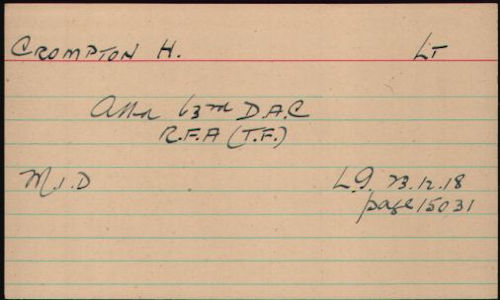
This second card
confirms Harry's attachment to the 63rd D[ivisional] A[mmunition] C[olumn] of the
Royal Field Artillery (RFA) (Territorial Force). It also mentions that he was
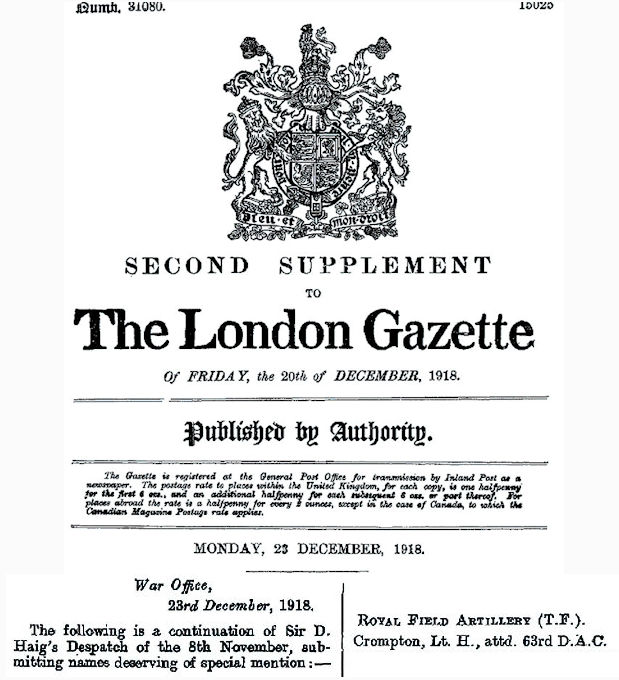
M[entioned] I[n] D[ispatches] with the post dated 23 December 1918. It is suspect
that this is in the units end of war report and was awarded for cumulative good work.
Source: Ancestry (Accessed 25 March 2021)
1805info3h_2, sheet 3
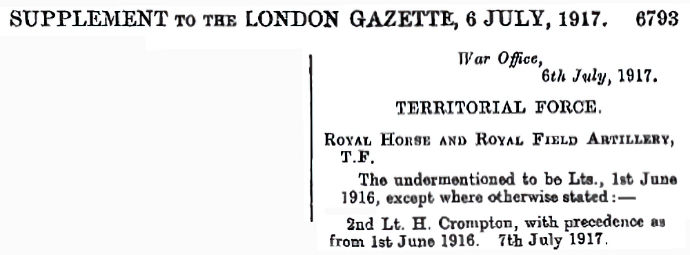
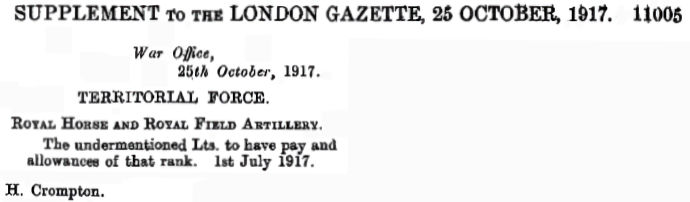
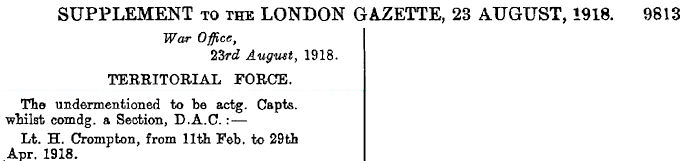
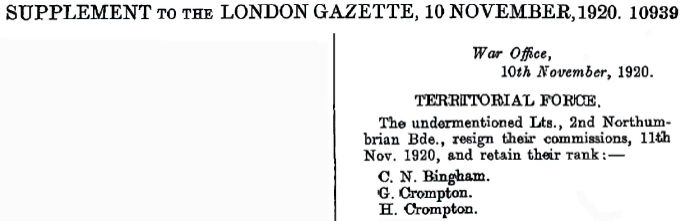
These chronological composite images of The London Gazette records Harry's promotions.
Above: Harry's official resignation dated two years
after the end of the war on 10 November 1920, interestingly from his original
battalion
1805info3h_2, sheet 4
To France
The first page of the War Diary of the Headquarters 63rd (R[oyal] N[aval]) Division Ammunition
Column (DAC), for 01 July 1916, records his arrival with the Division in Heytesbury, Wiltshire.
This coincides with the first day of the Somme battle.
Above: 63/DAC War Diary 01 July 1916 showing Harry's
transfer from 318th Bde RFA
Above: 63/DAC War Diary 03-04 July 1916 showing
Harry's departure from Codford for Southampton on 03 July 1916 and his arrival at
Le Havre the next day
The War Diaries, apart from dates and locations, contain little information other than the
movement of men and animals.
63/Divisional Ammunition Column
The Divisional Ammunition Column (DAC) was a unit in its own right. Its efficiency supplying
ammunition throughout the division. It efficiency would have been affected if it was used simply
as a replacement pool of men. All ammunition columns were officered and manned by the RFA. They
are not reserved exclusively to their own brigades, or divisions but were called upon to supply
ammunition to any unit requiring it during an action. Based some miles to the rear the divisional
and corps troops, they, on the one hand replenish the empty wagons of the columns in front, and on
the other drew fresh supplies from the depots on the line of communication. Teams, wagons and
materiel needed to move the ammunition were generally provided by liaising with the Army Service
Corps (ASC). The ASC provided the skills, abilities and transport and were the foundation of
support for the RFA. 2
The official war establishment for a New Armies Divisional Ammunition Column in 1915 lists a
total of 12 officers, one Warrant Officer, ten Sergeants, 32 artificers and 473 Other Ranks (OR)
making a total establishment of 528: with a Base detachment of 49. When the DACs absorbed the
separate RFA brigade ammunition columns in May 1916, the establishment increased to 16 officers
and about 800 men. In January 1917, when divisional artilleries were reduced to two brigades, the
numbers in the DAC were reduced to 15 officers and about 700 OR, and later in 1917 to 15 officers
and about 600 OR. By August 1918, they were further reduced to 15 officers and 569 OR.
As part of the 63rd (Royal Naval) DAC, Harry would be one of the fifteen or sixteen officers.
Some of the Royal Field Artillery units attached to 63/DAC and supplied by 63/DAC included 223
Brigade, 315 Brigade, 316 Brigade and 317 Brigade, all of which were attached to the Royal Naval
Division.
1805info3h_2, sheet 5
Somewhere in France 1916
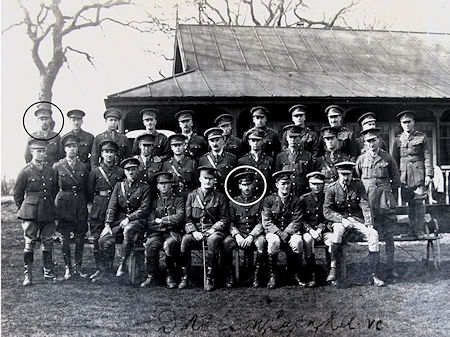
At some point in 1916, Captain David Nelson VC of L Battery RFA, the hero of
Néry 1, circled white, visited 63/DAC. Harry is circled black.
Right: Harry Crompton with officers of 63/DAC and Nelson VC. The legend
reads D Nelson Capt RA VC
Courtesy: Sheila Mellstrom
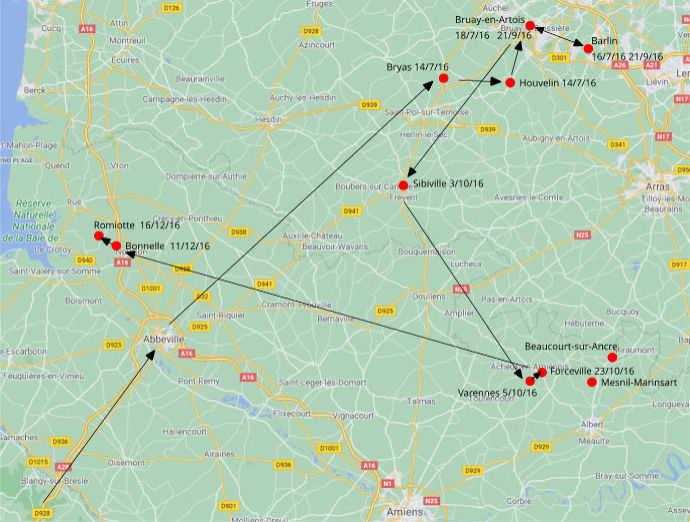
63/DAC's journeys in 1916 and on the Somme
Above: The journey of Harry and 63/DAC in 1916 from Le
Havre to the Somme Click on the map to open a scalable pdf map in a new window
1805info3h_2, sheet 6
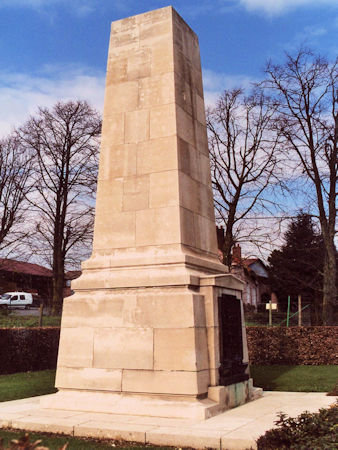
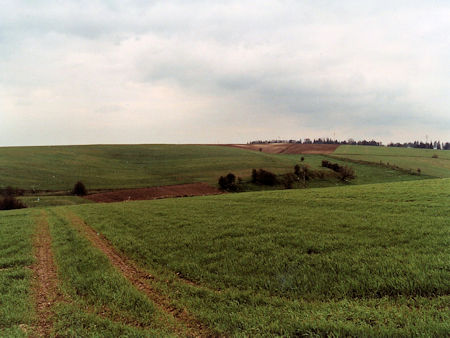
63/DAC arrived on the Somme at Forceville on 23 October 1916 in preparation for the Royal Naval
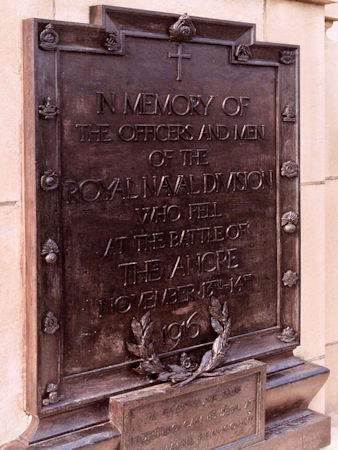
Division's attack at Beaucourt-sur-l'Ancre: the last battle of the Somme campaign fought
between 13-18 November 1916. Forceville was far enough behind the front line to hold an
ammunition dump.
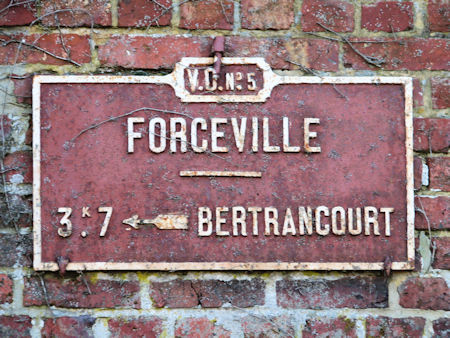
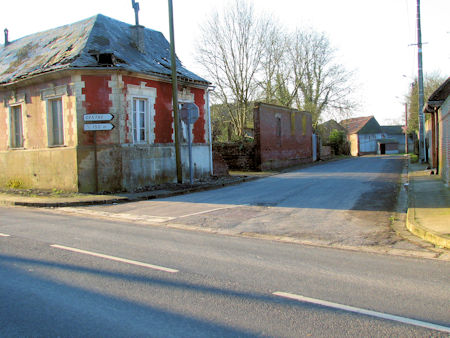
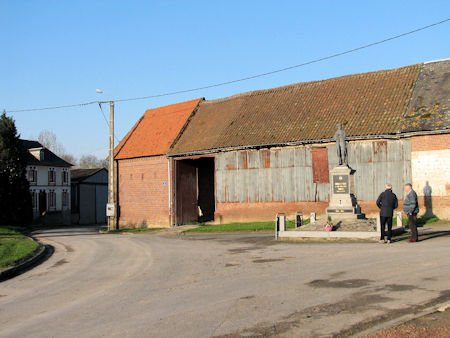
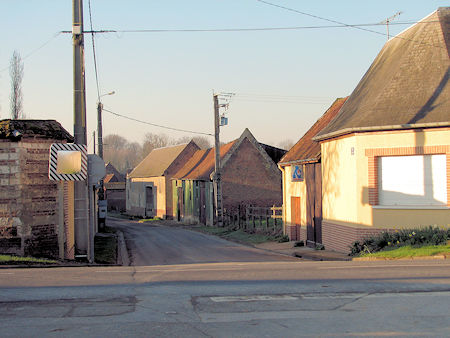
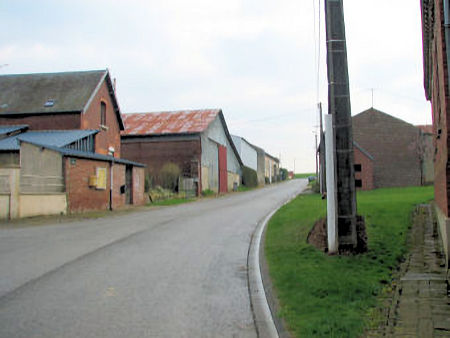
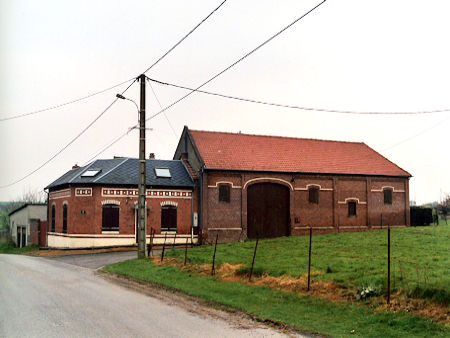
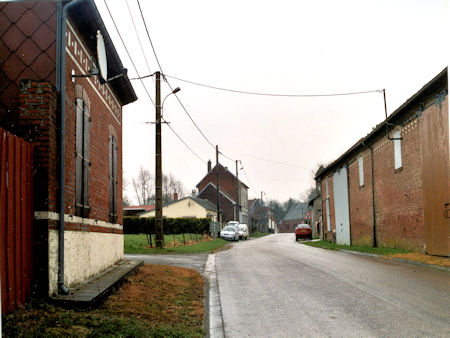
Hoverbox Photo Gallery - Forceville - Author: March 2007
This feature does not function correctly on phones and tablets
1. An old main road sign post 2. From the main road to village
3. War memorial and barn 4. From the main road to village
1
2
3
4
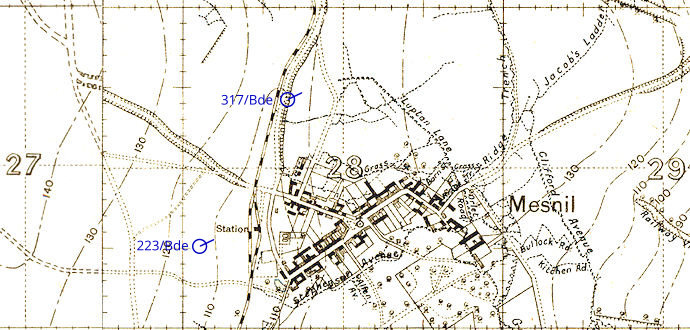
It is known that 63/Division's headquarters was based at Mesnil-Martinsart prior to the
attack. Since this village had a railway station, on a spur from the Albert-Paris line in the
Ancre valley to Mailly-Maillett, it is possible that Harry used this line to move ammunition:
Mailly-Maillett being 5km from Forceville.
Above: A trench map locating Mesnil station and artillery
positions 57D SE42B Oviller and surroundings Trenches correct 11 June 1916
Hoverbox Photo Gallery - Mesnil today - Author: March 2007
This feature does not function correctly on phones and tablets
1. From 10/WRR HQ to village centre 2. Street to 10/WRR battle ground
3. Field once containing 63/Div HQ 4. Field once containing 63/Div HQ
1
2
3
4
1805info3h_2, sheet 7
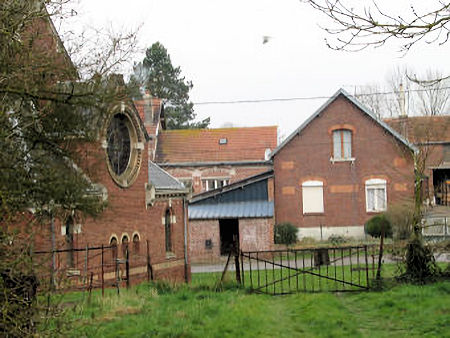
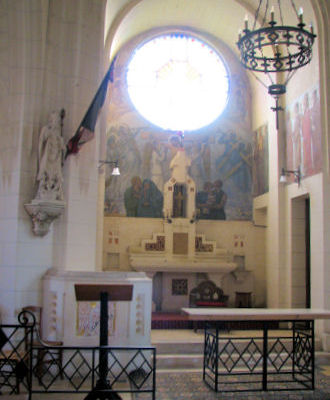
Top left: The interior and east window of Mesnil Church, showing the
cream plaster ashlar stucco work. Top right: A painted image at the south-east corner of the rose window.
Author: March 2007
Hoverbox Photo Gallery - Mesnil and Mailly-Maillet This feature does not function correctly on phones and tablets
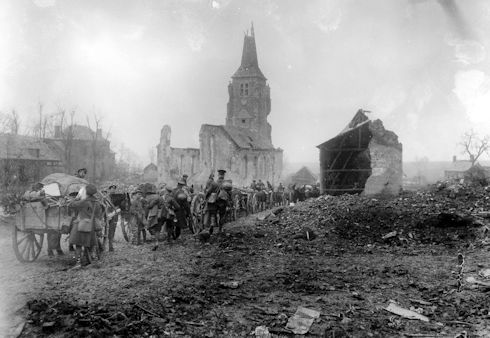
1. British transport passing the ruins of Mesnil church December 1916 IWM Q1747
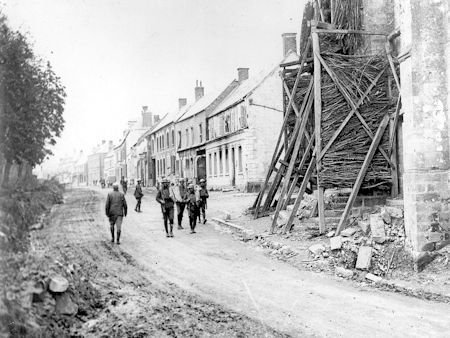
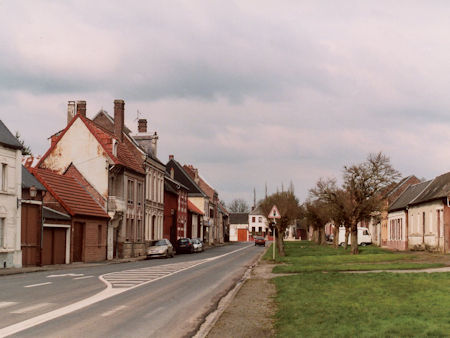
2. rue de l'Eglise Mailly-Maillet - the end of
the railway 20 April 1918 IWM Q61329 3. rue
de l'Eglise Mailly-Maillet March 2007 Courtesy: Roger Dempster
1
2
3
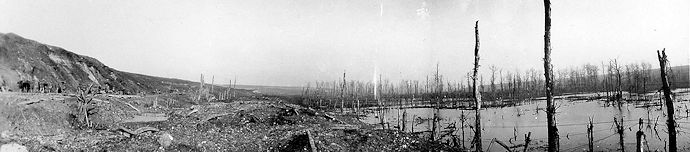
Above: A panoramic view within the flooded Ancre Valley,
taken from near Hamel, looking towards Miraumont in October 1916 Source: IWM
Q.1545
1805info3h_2, sheet 8
Hoverbox Photo Gallery - RND at Beaucourt-sur-l'Ancre Courtesy: Roger Dempster March 2007
This feature does not function correctly on phones and tablets
1. RND Memorial at Beaucourt
2. British Green Line and German rear
trench 3. RND Memorial plaque at Beaucourt
1
2
3
63/Divisional Artillery at Beaucourt 13-18 November 1916
315 Brigade's War Diary is a basic list of sick horses, personnel and movements. On 6
October 1916 the unit arrived in Forceville for four days, followed by a period at Colincamps.
On 18 October the unit moved back to Forceville and then alternated with a location at Mesnil,
until the end of November 1916. On 1 December the unit left the area.
317 Brigade's War Diary movements is similar to those of 315/Brigade being based at
Forceville before moving up to Mesnil on 1 November 1916, with one battery positioned near
Mesnil station. The War Diary then details nightly firing operations, at 20 rounds per gun
per night, before firing supporting barrages on the enemy lines from 13 November 1916. These
appear to be irregularly timed barrages in preparation for the pending attack and were from
dawn for about ten hours with pauses before a second barrage prior to the night shooting.
Counter battery and counter attack firing is mentioned. The War Diary records assisting the
attack of 112 Infantry Brigade on 23 November before withdrawing.
223 Brigade arrived Forceville on 7 October 1916 and followed the same pattern of
location. Activities included wire cutting, supporting a raiding party of 189/Brigade. From 1
November 1916 batteries were based behind Mesnil station. During the month protective
barrages were fired on the enemy front line for several hours, along with regular night
shoots of ten round per hour. Towards the middle of the month the Battery was on standby
before withdrawing to Forceville on 30 November 1916, when unused ammunition was removed to
the dump.
1805info3h_2, sheet 9
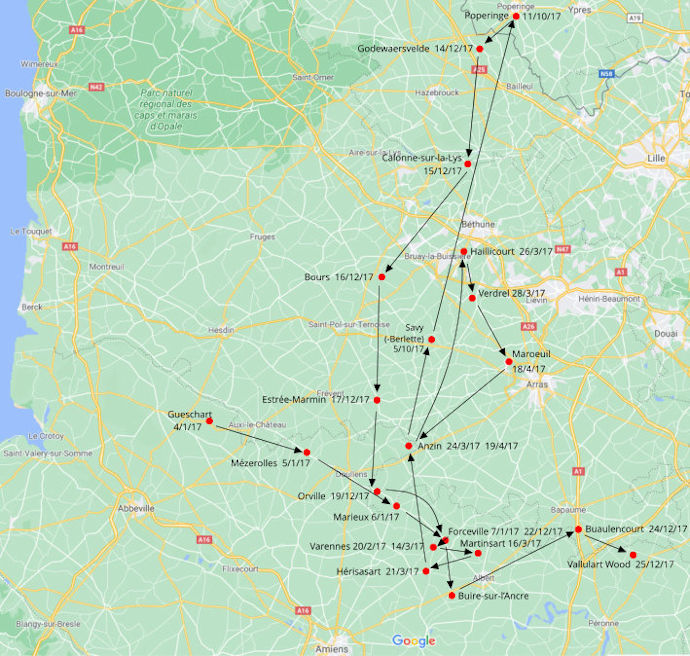
63/DAC's journeys in 1917 and to Passchendaele
Above: The journey of Harry and 63/DAC in 1917 from the
Somme to Passchendaele and back Click on the map to open a scalable pdf map in
a new window
According the 63/DAC War Diary the unit arrived in Poperinghe on 11 October 191. Poperinghe was
the railway town 6.5miles/10.75km east of Ypres. It was in time for the final throws of the Third
Battles of Ypres and Second Passchendaele. A week later the War Diary records a unit move to an
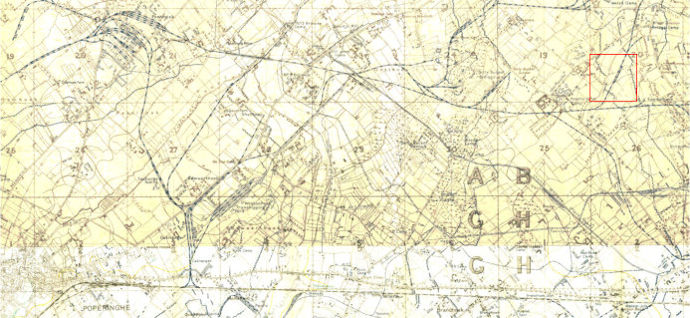
unnamed location northeast of Poperinghe (Grid reference 28NW1 B.20.c), near Hospital Farm Camp.
Although I do not have access to a trench map of that date, the map of 21 July 1918 would be
little changed. Note the numerous railway lines emanating from the Poperinghe area in the
direction of Ypres, able to feed troops and ammunition into the Salient. 63/DAC’s site have a
marked railway siding and presumably storage and loading facilities for ammunition.
1805info3h_2, sheet 10
Above: Trench map 28NW1 Elverdinge trenches correct 21
July 1918. 63/DAC was located in the red square. Poperinge is in the map's
southwest corner. Click on the map to open a scalable pdf map in a new
window
The report on operations for 63rd Royal Naval Division from 24 October to 05 November 1917
3 is not available for download. However, the War Diaries of one component,
188/Brigade 2,
give a flavour of the Divisions action and the reason for Harry’s 63/DAC being there to supply
ammunitions.
On 23 October 1917, 188/Brigade and two battalions of 189/Brigade, of 63/Royal
Naval Division, moved to a forward area east of the Yser Canal, north of Ypres. Leather jerkins
under Greatcoats were ordered. On 24 October 1/Royal Marine Light Infantry (RMLI) and Anson
Battalion moved into the front line, Howe Battalion remainder in support at Chedder Villa
(C.17.c.5.0) and 2/RMLI in reserve at Irish Farm (C.27.a.2.6).
The immediate Battle Narrative is limited. The attack at 5.40am on the 26/27 October,
south-east of Poelcappelle, was preceded by a problematic 48 hours British bombardment, which
contributed to the heavy state of the ground, particularly 300-400 yards from the start. This made
it difficult to rush pillboxes and sniper posts when barrage lifted. Rifles, Lewis Guns, bombs
and rifle grenades clogged with mud and were of little use. There were other problems with the
artillery. The shrapnel barrage was too high so troops went under the barrage to where the high
explosive British shells were falling on the advancing troops. The counter battery work, to
destroy the German artillery, was ineffectual: indeed at Zero+3 minutes a German barrage
fortunately fell behind the attacking troops; the pace of creeping barrage was too fast for the
muddy conditions so the troops lost its protection; the barrage did not focus on the known German
pillboxes and sniper ridden hedgerows. At this moment, no record of the achievements or the battle
casualties have been found. 4
188/Brigade’s War Diary for November 1917 shows, along with daily weather reports, that it was
resting, recuperating and training as it gradually moved back to Poperinghe.
Notes
On 26/1/17 one OR died of exposure.
29/1/17 to 1/2/17 Harry was based at Ammo Dump 2 at Donnets Post - map reference 57dSE4
Ovillers W.12.d.8.2
On 18/10/17 the unit were based at 28B.20.c in Belgium in the loction of Poperinge.
It has not been possible to trace Antremetz - 22/3/17 or Holtje Farm - 5/12/17 though the
spelling suggests Belgium.
1805info3h_2, sheet 11
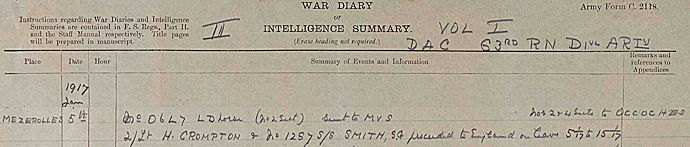
Harry on leave
Above: A composite image of 63/DAC War Diary 05 January
1917 showing Harry' going on leave to England
On this occasion Harry's leave is to England. It seems unusual to have two periods of one
week's leave in a year. So far no leaves have been discovered for 1918.
Above: A composite image of 63/DAC War Diary 23 November
and 9 December 1917 showing Harry' going on leave and returning a day late to
Holtje Farm
1918
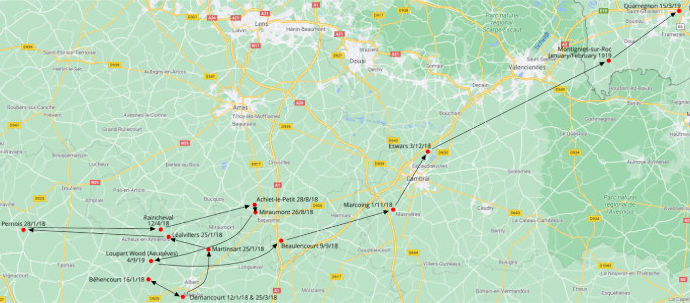
It is difficult to ascribe a particular set of 1918 battles to 63/DAC because of their limited
War Diaries. It would be necessary to consult the War Diaries of 188/Brigade and 189/Brigade.
Their 1918 journey to the Armistice and 1919 is shown on the map below.
Above: The journey of Harry and 63/DAC in 1918 to the
Armistice and early 1919
Click on the map to open a scalable pdf map in a new window
1805info3h_2, sheet 12
In 1918, 63 (Royal Naval) Division saw action at:
The Battle of St Quentin - Operation Michael (21-23 March 1918)
The Battle of Bapaume - Operation Michael (24-25 March 1918)
The Battle of Albert - Second Somme (21-23 August 1918)
The Battle of Drocourt-Queant - breaking the Hindenburg Line (2-3 September 1918)
The Battle of the Canal du Nord (27 September-1 October 1918)
The Battle of Cambrai 1918 (8-9 October 1918)
The passage of the Grand Honelle - a river in Belgium following the Battle of Valenciennes (5-7 November 1918) 5
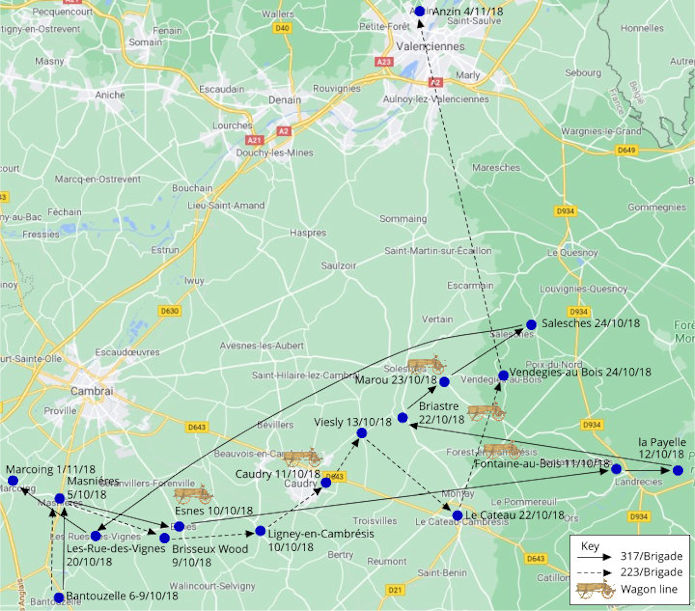
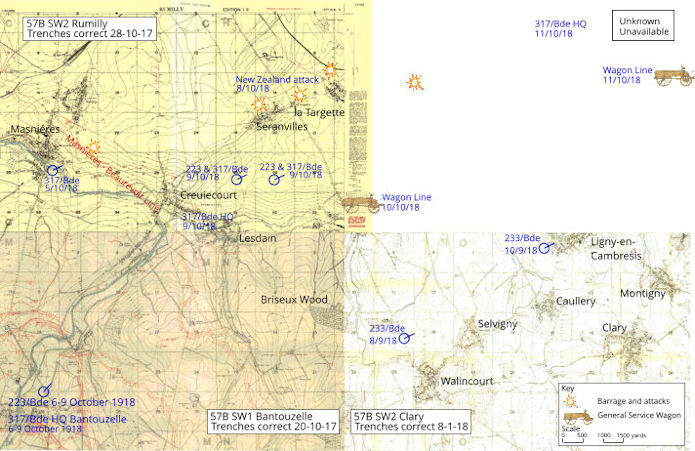
October 1918 have been taken as an example of Harry's hectic activities in a
period of open warfare moving to the Armistice. War Diaries are only available for 223 and
317/Brigades, both of which operated southeast of Cambrai.
Above: Artillery movement of 223/Bde and 317/Bde RFA,
part of Royal Naval Division's artillery October 1918 Click on the map to
open a scalable pdf map in a new window
During the month of October 1918, 317/Brigade was at twelve locations supporting the Second
Battle of Cambrai of 8-9 October 1918. In the rapid progress of open warfare the battery moved
forward to maintain contact with attacks: on one occasions they were in three locations in three
days. On several occasions, the battery moved twice in a day as the attack progressed.
317/Battery’s War Diary records the position of the wagon lines, which would contain the
ammunition for the attacks and it is likely they would be supplied by 63/DAC. It is suggested that
Harry would have been exceedingly busy at this time. Unfortunately, the author does not have
access to the relevant trench maps, which, due to rapid forward movements, were not always kept
up-to-date.
1805info3h_2, sheet 13
Above: A trench map for October 1918 showing movement and
disposition of 233 and 317 Brigade RFA in detail, together with examples of supply
lines. Note the distance for a one day advance and the tasks associated with moving
ammunition.
Click on the map to open a scalable pdf map in a new window
By the end of October both Brigade were withdrawn to refit, recalibrate and for further
training.
Although Harry appears to have served until 10 November 1920, the Royal Naval Division was
demobilised by April 1919. There is no record of whether Harry served with the Army of Occupation
in Germany.
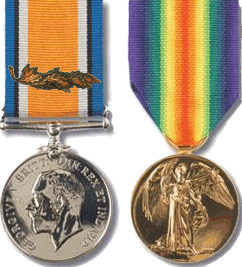
Harry's medals
Right: Harry Crompton's medals: The British War Medal with Mentioned in
Despatches (MiD) oak leaf and Victory Medal
1805info3h_2, sheet 14
Above: A composite image of Harry Crompton gazetted MID
on 23 December 1918, page 15031
1805info3h_2, sheet 15
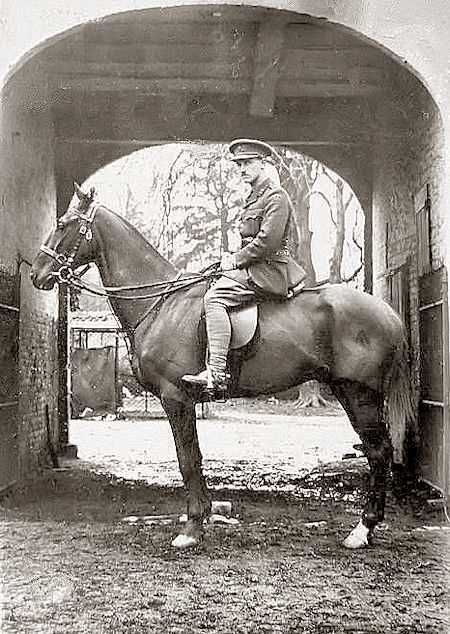
Right: Harry Crompton date and place unknown. The mature face suggests a
person well experienced in war, so perhaps 1918 Courtesy: Sheila Mellstrom
End notes
Army Lists June 1915 to December 1918 National Library of Scotland (Accessed: 25 March 2021)
Also Army Lists, The National Archives, which gave data for 1919 and 1920 (Accessed 04
February 2012). The rank of temporary captain had also been found but this isn't
confirmed by the National Library of Scotland data.
Rob Thompson speaking at a WFA webinar 08 February 2021
The National Archives (TNA) ADM 137/3931
188 Brigade War Diary October 1917 TNA WO 95/3108/3 p.110
63 Divisional Ammunition Column War Diary 01 July 1916-31 March 1919 TNA WO 95/3102/5
223 Brigade Royal Field Artillery War Diary 01 July 1916-31 March 1919 WO TNA WO
95/3102/1
315 Brigade Royal Field Artillery War Diary 01 July 1916-31 December 1916 TNA WO
95/3102/2
316 Brigade Royal Field Artillery War Diary 01 July 1916-30 September 1916 TNA WO
95/3102/3
317 Brigade Royal Field Artillery War Diary 01 July 1916-31 March 1919 WO TNA WO
95/3102/4
1805info3h_2, sheet 16
More information 1
The Affair of Néry
The Affair of Néry was a skirmish fought on 1 September 1914 between the British Army and
the German Army, part of the Great Retreat from Mons during the early stages of the First
World War. Shortly after dawn, a British cavalry brigade preparing to leave their
overnight bivouac were attacked by a German cavalry division of about twice their
strength. Both sides fought dismounted; the British artillery was mostly put out of
action in the first few minutes but a gun of L Battery, Royal Horse Artillery, kept up a
steady fire for two and a half hours, against a full battery of German artillery. British
reinforcements arrived at around 8:00 a.m., counter-attacked the Germans and forced them
to retreat; the German division was routed and did not return to combat for several days.
Three men of L Battery were awarded the Victoria Cross, including Sergeant (later Major)
David Nelson, for their part in the battle. The battery was later awarded the honour
title of "Néry", the only British Army unit to have this as a battle honour.
After the British and German armies first encountered each other at the Battle of Mons on
23 August 1914, the outnumbered British Expeditionary Force had begun an orderly and
disciplined retreat. The two armies clashed again at the Battle of Le Cateau on 26 August,
after which the British again withdrew towards the River Marne. As a result of the
leisurely German pursuit, the bulk of the British Expeditionary Force was able to
withdraw with most engagements being skirmishes between rear guard units and cavalry
patrols.
On 31 August, in warm weather, the fatigued Expeditionary Force continued
falling back to the south-west, crossing the River Aisne between Soissons and
Compiègne, with a rear guard provided by the brigades of the Cavalry Division.
They halted for the night just south of the Aisne leaving a gap of around five
miles between the II and III Corps, which was filled by the 1st Cavalry Brigade
of three regiments, stationed at the village of Néry.
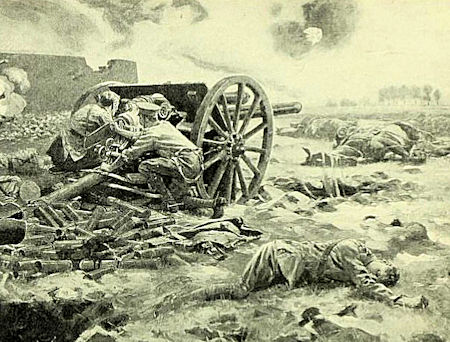
Right: The Néry gun in action
Néry is set in a north-south oriented valley around a small river and is overlooked
from the east and west by high bluffs. The main landmark was a sugar factory, just south
of the village, where L Battery were billeted. At dawn on 1 September a heavy fog lay in
the valley. which delayed the start of the retreat until 0600. The men stood down to rest,
watered the horses and prepare breakfast. The teams for the artillery were left harnessed
to their guns, but with the limbers lowered to take the weight off the horses. At 5.25
am, a patrol from the 11th Hussars encountered a strong force of enemy cavalry and
escaped back to the village taking a dismounted defensive position along the eastern
edge of the village.
At 5.40 am, machine-guns and light artillery began firing from the high bluffs to the
east. The advanced guard of the 4th Cavalry Division was surprised to encounter a
British attack on the village.
Three guns were moved into firing positions, facing twelve German field guns on the ridge
to the east. Two were quickly knocked out, leaving only one gun, under the direction of
Captain Bradbury assisted by Sergeant Nelson and three other men. It kept up a steady
fire, drawing the attention of the German artillery away from the cavalry, until its
ammunition was almost exhausted. Bradbury was hit by a shell whilst trying to fetch more
ammunition, and fatally wounded. The gun continued firing under Nelson and Battery
Sergeant-Major Dorrell, but finally fell silent sometime before 8am, when reinforcements
of the 4th Cavalry Brigade arrived with I Battery RHA and two battalions of infantry from
III Corps. In the clearing mist, I Battery began firing directly on the ...
1805info3h_2, sheet 17
More information 1 cont:
... German guns, as did the machine guns of the 1st Middlesex Regiment. The German horses
took heavy casualties and when the artillery withdrew eight of the guns had to be
abandoned for lack of horses to pull them. A squadron of the 11th Hussars pursued the
retreating Germans for a mile, taking seventy-eight prisoners, from all six regiments of
the German division.
L Battery was almost destroyed as an operational unit, losing all five officers and a
quarter of its men. It was withdrawn to England to reform and did not see active service
again until April 1915 in Gallipoli. Three men of L Battery were awarded the Victoria
Cross for their services at Néry; Captain Edward Bradbury, Battery Sergeant-Major George
Dorrell, and Sergeant David Nelson.
Major David Nelson was killed in action 8 April 1918. Source: Wikipedia
See also: David Nelson VC a biography (Accessed: 01 April 2021)
More information 2
63/RND action at Poelcappelle
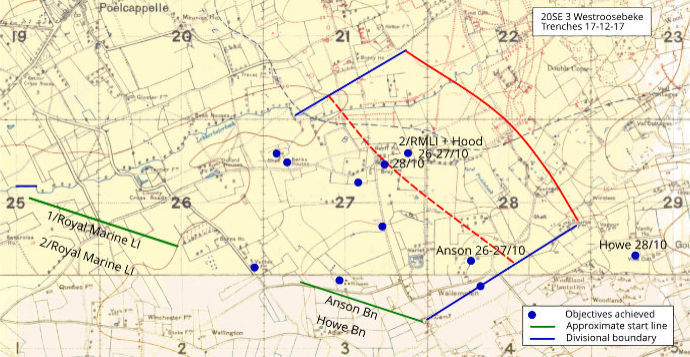
63/DAC would have supplied ammunition for this limited action near Poelcappelle on 26 and
28 October 1917 1. The first objective had two companies Anson Battalion
attacking on the right over a frontage of 600 yards. 1/Royal Marine Light Infantry (RMLI)
had two and half companies in a line of over 900 yards. On the right the second objective
was to be taken by two companies of Howe Battalion attacking over 800 yards. 2
On the left two companies 2/RMLI leap-frogged though 1/RMLI over 800 yards. Hawke
Battalion were in reserve at Irish Farm. The left divisional boundary follows the line of
the stream.
Anson took Varlet Farm at bayonet point. On reaching the first objective, farms were to
be converted into strong points against counter attack. Howe Battalion went beyond the
Red Line outside the divisional boundary. However, the final positions recorded in the
brigadier's report is confusing as the line achieved appears west of the first red
dotted line. There are no obvious casualty figures.
Above: Trench map 20SE3 Westeroosebeke Trenches
correct 17 December 1917 Click on the map to open a scalable pdf map in
a new window
End notes:
Text 188/Brigade Report on Operations of 26 and 27 October 1917 TNA WO 95/3108/3
p.54
There is an unaccountable gap between the divisional boundaries and the allotted
frontage
This page was created by Richard Crompton
and maintained by Chris Glass