 |
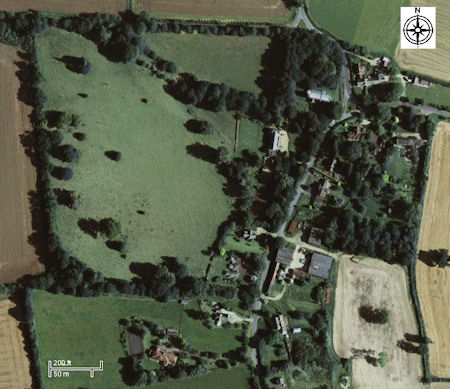
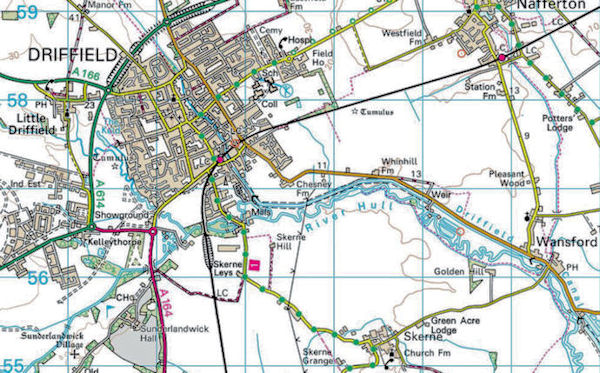
| Above: A modern map of Skerne, showing Skerne Grange, in relationship to Driffield and Sunderlandwick Hall |
1600 Info 5 for the CROMPTONs of the Stuart Period |
Sir John CROMPTON of Skerne and the Inner Temple - 2nd son of Thomas CROMPTON
Prior to being knighted on 25 March 1608, Sir John, second son of Thomas of Bennyington, was easily confused with John CROMPTON (d.1610), his uncle and predecessor, as Steward of Beverley. [7] On 06 March 1592 a John CROMPTON, gentleman, received letters patent appointing him and Thomas as Bailiffs (Ref: East Riding Archives DDBC/19/16) In 1597 he married Frances CROFTS, daughter of Sir John CROFTS 1 of Little Saxham, Suffolk and took the manor of Skerne, south east of Driffield.
|
| Above: A modern map of Skerne, showing Skerne Grange, in relationship to Driffield and Sunderlandwick Hall |
Dugdale's Visitation of Yorkshire, page 420, records Sir John as marrying Frances daughter of Sir Henry CROFTS. However, it is printed 'mar. Frances daughter of Sir Henry (John) CROFTS of little Saxham in coun. Suff.' Given the dates are Sir John CROFTS 1565-1628 and Sir Henry CROFTS 1590-1667 and Sir Henry succeeded his father in 1628 it is more likely that Sir John's father-in-law was Sir John CROFTS. The History of Parliament recorded that Sir John of Skerne married 'Frances (d.1661), da. of Sir John CROFTS of Little Saxham, Suff.,.'
On 13 December 1623, the stewardship of manors of Patrington, Elloughton and Bishop Wilton, which were granted to Sir John CROMPTON, passed to Sir William CONSTABLE. (Source: Hull History Centre U DDHA/18/12)
The Victoria County History for Middlesex and the settlement of East Bedfond, with Hatton records that Sir John CROMPTON had a living there:
'The rectory was held by Hounslow Priory until the suppression of the monasteries, when it was ceded to the Crown. It came to the Bishop of London [...] Bishop Aylmer gave it on lease in 1588 to John Draper of 'Luderworth' and his daughters Margaret and Cecilia, together with the tithes, the parsonage barn, the Strawe House, but saving the right of the vicar in the close known as the Old Vicar's Close. It was to beheld for the term of their lives at a rent of £8 13s. 4d. (£8.66) The rectory has always belonged to the patron of the living, but the tithes of sheaves and grain were granted to various persons at different times. They were conveyed in 1621 by Sir John CROMPTON to Edward Hewlett [...].
Source: From: 'Spelthorne Hundred: East Bedfont with Hatton', A History of the County of Middlesex: Volume 2: General; Ashford, East Bedfont with Hatton, Feltham, Hampton with Hampton Wick, Hanworth, Laleham, Littleton (1911), pp. 309-314 (Accessed 12 March 2020)
NB: East Bentfont is now a suburb of Feltham nestling between the convergence of the A30 and A315, south-east of Heathrow, Terminal 4 stations.
John CROMPTON of The Inner Temple
At about the time of his brother's death, in 1606, John CROMPTON seems to have been made an honorary member of the Inner Temple 2. Certainly his funeral monument in the Temple church describes him as a ‘member of this society’, and there is an entry recording the admission of a ‘John CROMPTON’ that appears to date from this time, although it was subsequently deleted. 9
The Inner Temple Admissions Database records that two children of Sir John CROMPTON, a knight of Skerne, Yorkshire were admitted to the Inn. They were:
His early career
Thomas 'Auditor' CROMPTON was anxious to ensure that his heirs continued to receive the profits of the chirographer’s office after his death, and to that end he procured three reversions in the names of trustees, one of whom was Sir John MORLEY. These came to John CROMPTON on the death of his elder brother, Sir Thomas, in 1606 8. [...] [John] CROMPTON secured a reversion of the chirographer’s office the following year so that he would not lose control of the office after the death of his father’s trustees, and in 1608 he compounded - agreed for a consideration not to be prosecute - for the under-valuations by which his father had acquired Crown land.' 10
In addition Sir John held the following offices:
Sir John CROMPTON’s reversion of the chirographer’s office came to fruition on the death of Sir John MORLEY, the last of his father’s trustees, in December 1622. However, the following month Sir John assigned the position to Edward Wrightington, retaining the profits for himself and agreeing to pay Wrightington £100 p.a. (equivalent to £10550 at Bank of England Retail Price Index 2010 (BERPI)) 18 (Source: John Ferris)
In writing his will, Sir John CROMPTON appears to be making Thomas ‘Auditor’ CROMPTON’s, his grandfather office of Chirographer in the Court of Common Pleas, an hereditary office. Executors were instructed to find each son a prestigious Clerkship within the Office.
Liz Hore, Legal Records Specialist at The National Archives (TNA) writes:
I am not aware of many posts in the courts or government that were hereditary in terms described in Sir John CROMPTON's will. It was, in the periods when nepotism ran fairly freely, not uncommon for offices to pass from father to son, but the son would not have the ' right' to the job if he was deemed 'not up to it'. Sons frequently worked alongside their fathers, either in formal apprenticeships or informal mentoring, where they developed the connections that aided them in being the most suitable candidate when the job became available. Some posts were also bought and sold, with the sale price being an important element of the retirees pension and one can assume this could aid the process of the son following the father.
Thomas 'Auditor' CROMPTON received a substantial income of £2500 (£290472 BERPI) per annum from his office of Chirographer. This situation must have continued as the will declares that all the annuities and lagacies given shalbe paide with such money as is or shalbe raised out of the profitts of my office of C[h]irographer of the common Pleas. There are, however, several statements that monies should be lawful money of England.
Sir John in Parliament
Sir John CROMPTON was MP for:
John Ferris writes:
Returned for Brecon Boroughs in 1614, presumably thanks to the support of the remainder of the former Essex affinity in Wales, Sir John CROMPTON was named to only one committee in the Addled Parliament 3 , on 8 April 1614, for the bill to continue or repeal expiring statutes. He was mentioned on 5 May 1614 by Francis Ashley, who stated that prior to the start of the session Sir Reginald Mohun had told him, in CROMPTON’s presence, that he had heard that there was an undertaking to manage the Parliament, and that this was ‘approved to his face’ by CROMPTON. On 9 May 1614 Sir John CROMPTON made his only recorded speech of the Parliament, although it is ascribed to his dead brother. Responding to the claim of the chancellor of the duchy of Lancaster, Sir Thomas Parry, that the petitioners who had accused Parry of interfering in the Stockbridge election were guilty of ‘sundry misdemeanours’, Sir John CROMPTON demanded that the chancellor name his sources. 11
On 22 February 1621 Sir John CROMPTON was added to the sub-committee that had been appointed the previous day by the committee for courts of justice to receive petitions. 14 In addition he was named to three legislative committees, these being on the explanatory chantries bill (21 March 1621) and measures to nullify forcible evictions (24 March 1621) and prevent vexatious delays by the removal of cases to superior courts (20 April 1621). 15
He was also among those appointed on 26 April 1621 to consider the state of parliamentary business and recommend priorities. [16] His only speech was to propose that the Speaker might keep a table during the summer recess; there is no evidence that his motion was seconded. [17] He played no known part in the second sitting.
In early 1618 [Sir John] was granted a licence to travel abroad for three years, but it is not known if he made use of it. If he did, he was certainly home by the end of 1620, when he was returned for Eye. It is not clear to what influence he owed his election, as his father-in-law lived some distance from Eye, at Bury St. Edmunds. The honour of Eye, like the manor of Beverley, was part of the estates of Charles, Prince of Wales, whose council had reappointed [Sir John] CROMPTON joint steward of Beverley in 1618, but there is no evidence that the council made nominations for Eye in 1620. [13]
The Ghost of Richard the Third
1614 saw the publication of Christopher Brooke’s [4] poem The Ghost of Richard the Third, dedicated to Sir John CROMPTON and his wife Frances. [12]
His death
Sir John CROMPTON drew up his will on 4 December 1623 following, including an annexe detailing his borrowing and lending, which shows him to have been a net debtor to the tune of £1,883 (£269505 BERPI) [18]. He hoped his two eldest sons might be provided for out of the chirographer’s office, and to that end required that his chamber with two studies adjoining the office should be retained, though the whole building was out of repair. Another son was to be bound apprentice ‘to some honest and well-esteemed merchant’, and the remainder were to receive annuities of £50 (£7156 BERPI) each. His will (TNA PROB 11/143) was proved by his brother-in-law, Anthony CROFTS. [18] (Source: Ferris)
Sir John CROMPTON died 8 December 1623 and was buried in the Temple Church, London ( Source:Dugdale's Visitation) Ferris records his death as 07 December 1623. [3] However, his death date is confused by the date of the will where it is recorded that it was written on 5 December in the 21st year reign of King James I (1603+21) of England and in the 57th year of the reign of James VII (sic) of Scotland (1567+57). Both these dates are after The National Archive declared the will was proved on 04 May 1624.
The children of Sir John of Skerne
Sir John's will names his sons as John, his heir, Robert (later Sir Robert), his second son, Henry, Thomas, Charles who received a special mention, Edward, Francis, and Anthony . Sir John’s daughters are named as Elizabeth and Margaret, though there is a hint of other daughters perhaps deceased. None of his descendants sat in Parliament.
John CROMPTON - Sir John's first son was christened in Toddington, Bedford, on 15 July 1610 (Family Search) John, the son of Sir John CROMPTON of Skerne, was admitted to the Inner Temple on 21 May 1613 with the given occupation of 'Armiger'; an 'esquire'. In his father's will of 1624 John is named as his father's heir, but little more is known about him. The Victoria County History for Bedfordshire makes no reference to CROMPTONs living at Toddington.
Elizabeth CROMPTON christened Toddington Bedford in 1613 (IGI)
Sir Robert CROMPTON - Sir John's second son was christened at Toddington on 03 February 1613 (IGI) His father's will of 1624 records Robert as living in the Inner Temple, whose database records his special admission on 16 February 1618. He was a 'gentleman', the son of a 'knight', living in the City of London.
Robert was knighted on 12 March 1641-2.
Sir Robert spent the summer of 1646 in London lodged in Long Aker (sic) (North-east of Leicester Square tube station. Long Acre starting from St. Martin's Lane it runs from west to east just north of Covent Garden piazza, one block north of Floral Street. The street was completed in the early 17th century.). (Source: Seventh report of the Royal Commission on historical manuscripts. Part I. Report and appendix., 1878) On 16 July 1647, the House of Commons Journal (Vol. 5), records that Sir Robert and his brother-in-law Sir John Holland had permission to 'embarque Three little Nags' [into France].
When Sir Robert died, circa 1669, Catherine, his only child, would have inherited. Unfortunately, Catherine died on 23 January 1669 at West Woodley. On Sir Robert's death the estate passed to Sir Henry North of Mildenhall, whom she was on the point of marrying. Source: Dugdale's Visitation page 421
Thomas christened Little Saxham, Suffolk, 27 August 1617 (IGI). In Clay JW, Gentry of Yorkshire at the time of the Civil War, 1915, published by the Yorkshire Archaeological Society, Vol. 23, (Beverley Archives ref: JL/126/23 p.349) two Thomas CROMPTON's are mentioned as Royalist sympathisers. Each was compounded - agreed for a consideration not to be prosecute. One estate was penalised to the amount of £387. This is equivalent, by an income value to £1.675 million in 2018. The other estate was fined £887. This is equivalent, by income value, to £3.84 million in 2018. At this moment it is not know which Thomas was fined which amount. Source: Measuringworth.com (Accessed: 14 July 2019) See also Thomas CROMPTON 1660info2
The 'Cromptons of Crompton Co. Lancashire describes 'a wealthy kinsman Sir Thomas CROMPTON' [...] '[who was a] friend and patron, [of] the great Cecil'. Sir Thomas was further described as 'Auditor of the Exchequer, and agent for nearly all the principal noblemen and statesmen about the Court. He was a great trafficker in Crown lands, and acquired (among other great estates), Houndslow Priory in Middlesex, Skerne Manor in Yorkshire, and Mountgrace Abbey and Bennington Park, Herts.' This is clearly, by occupation and lands owned, Thomas 'Auditor' CROMPTON of Driffield. It is further recorded that 'Mountgrace, an estate in Yorkshire which he [Lord Farnworth] had recently acquired, and which had been the property of Sir Thomas Crompton in the days of Queen Elizabeth, but which had been sold by his descendant in 1642.' [for £24,000]. Perhaps, the sale of Mountgrace, though a reported seven years before the compound, provided the source of revenue to pay the fine. Farnworth also purchase Skerne for £19,480, both to forward his Viscountcy. Source: Cromptons of Crompton Co. Lancashire, author unknown, published in 1902 pp.32, 49, 53 Library of Congress, Washington Mount Grace Priory is at East Harlsey, North Yorkshire .
Charles christened Little Saxham, Suffolk, 08 September 1618 (IGI) and appears to be specially mentioned in his father's will.
Edward christened Little Saxham, Suffolk, 11 June 1620 (IGI)
Francis christened Little Saxham, Suffolk, 28 October 1621 (IGI)
Anthony, christened Little Saxham, 18 July1623 (IGI) is assumed to be the last child as Sir John's died five months after his birth.
Henry is mentioned in the will, but at this moment no other record can be found.
| More information 1 |
 |
Sir John CROFTS, (c.1565-1628), of Bedford and Little Saxham, Suffolk.
John CROFTS married Mary daughter of Sir Thomas Shirely of Wiston, Sussex, circa 1590. Together they had three sons and two daughters. He was educated at St John's Cambridge in 1581; Grey's Inn in 1583; knighted in 1599 and succeeded his father on 13 April 1612. He held the offices of:
Source: Virgoe, Roger History of Parliament (Accessed 12 March 2020) The arrival of the CROFTS at Little Saxham John CROFTS, the grandfather, died in January 1558 and was buried at West Stow, which had remained the CROFTS' hunting lodge ever since the move to Little Saxham in 1531.
|
| More information 1 continued |
|
The arrival of the CROFTS at Little Saxham
John Gage, in his 'History of Thingoe Hundred', written in 1838, provides a dramatic description of the completed edifice of Little Saxham:
|
| More information 1 continued |
|
The arrival of the CROFTS at Little Saxham
Sir John CROFTS came to Little Saxham on the death of his father [Thomas] in 1612. He was 49 at the time and had lived in Bedfordshire for most of his married life. He had been knighted in Dublin in 1599, presumably for active service in Ireland. He lived at Little Saxham until his death in March 1628. He was to entertain royalty on a number of occasions during his 16 years at the Hall. Source: Little Saxham web site (Accessed 12 March 2020)
|
| More information 2 |
|
The Inns of Court
The origins of the Inns of Court remain obscure. However, it is certain that by the mid- fourteenth century lawyers had begun to congregate in the Temple, to the south of Fleet Street, in the City of London, occupying buildings erected there by the Knights Templar and subsequently acquired but not used by the Knights Hospitaller. In due course, two societies of lawyers were formed there, each occupying one of the two halls built by the Templars on the site, and there is evidence that they had adopted the names of the Inner and the Middle Temple by 1388. … It was not until nearly a century later (about 1425) that we find them referred to as the 'inns of court' - inns because they provided accommodation for lawyers and law students, and 'of court' because their members appeared in the king's courts. However, it is clear that, once established, they offered not only residential accommodation and hospitality to their members, but also, more importantly, legal training. Indeed, in the early modern period, the inns of court and chancery became collectively known as 'the third university of England'. The Inns of Court as "finishing schools for gentlemen" Until the 18th century, the majority of students were the sons of country gentry who attended the Inns of Court as "finishing schools" rather than as intending barristers. The Inns provided a form of general education, including the art of dance, as well as legal training and also enabled students to cultivate advantageous contacts. Common law For those destined for the legal profession, the Inns trained students in the common law, employed in the royal law courts, including the Courts of Common Pleas and the King's Bench, rather than the canon/civil law in use in the church courts and Court of Admiralty. Canon, and subsequently civil, law was studied at the universities of Oxford and Cambridge and at Doctors Commons in the City of London. Term-time During the four legal terms of Michaelmas, Hilary, Easter and Trinity, when the Central Law Courts at Westminster were in operation, bar students attended the courts to learn about court procedures and the art of advocacy. In addition, they would attempt to obtain a placement in a set of barristers’ chambers to observe the profession in practice. This form of pupilage was informal and is not recorded in the records. Source: Rider Clare, The Archivist, ‘The Inns of Court and Inns of Chancery and their records’, Inns of Court Archives vol. XXIV no. 101 (1999) published for the British Records Association |
| More information 3 |
|
The Addled Parliament
|
| More information 4 |
|
Christopher Brooke (died 1628)...
... was an English poet, lawyer and politician who sat in the House of Commons between 1604 and 1626. Member of Parliament for York. He was re-elected MP for York in 1614. Brooke held a clerkship under Sir John CROMPTON in his office of Chirographer of the Fines. The Ghost of Richard the Third Expressing himselfe in these three parts: 1, His Character; 2, His Legend; 3, His Tragedie, was published in London in 1614. The unique copy in the Bodleian Library was reprinted by John Payne Collier for the Shakespeare Society in 1844, and by Alexander Balloch Grosart in 1872. It is dedicated to Sir John CROMPTON and his wife Frances. Thomas Rodd, the bookseller, first attributed this work to Brooke at the beginning of the 19th century. The only direct clue lies in 'C. B.', the signature of the dedication. George Chapman, William Browne, 'Fr. Dyune Int. Temp.,' George Wither, Robert Daborne, and Ben Jonson contribute commendatory verses. |
Sources:
Information from Hull University Manuscripts and Archives Database (HUMAD), now
Hull History Centre is referenced: U DDCA3/8/14.
Ferris, John. P.,
'The History of Parliament'
|
 |
||||
| This page was created by Richard Crompton and maintained by Chris Glass |
Version A7 Updated 16 June 2024 |
||||