| Frank CROMPTON, the second child of Whyrill, was born 15 June 1908. |  |
1852 Info 6a for John Harper Crompton |
| Frank CROMPTON, the second child of Whyrill, was born 15 June 1908. | |
1911 Census:      Sun/Mon 2nd April/3rd April 1911
Source:   TNA Ref:        RG14 PN21339
          Reg. Gen. Ref:  RG78 PN443; En.Dist: 15; Sched:
          RegDist:  SubDist:
Dwelling: 15 Napier St
Place:    Hyde, Cheshire
Rooms in dwelling, other than scullery, landing, lobby, closet, bathroom: 4
Years married: 7
Children:      Alive 3, dead none

Name              Rel  Mar  Age  Occupation   Status  Birthplace
Whyrill Crompton  Head  M   30   Bricklayer   Worker  Yorks, Holme on Spalding Moor
Esther Crompton   Wife  M   34                        Shropshire, Tonge
Harper Crompton    Son       5                        Cheshire, Hyde
Frank Crompton     Son       2                        Cheshire, Hyde
Whyrill Crompton   Son   10/12                        Cheshire, Hyde
 |
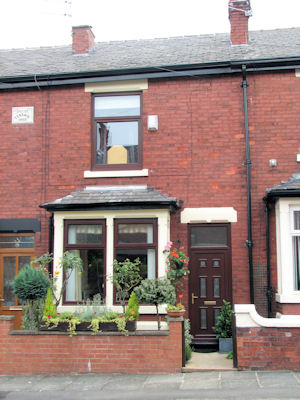 |
| The plaque, on the top left of the photograph, reads 'Napier Terrace
1903'.
Right: 15 Napier Street, Hyde 2009 |
On 27 August 1932 Frank, then living at Silverhill, 46 Stockport Road with his father Whyril (Whyrill), married Ada ENTWISTLE, a cotton cloth weaver of 3 Milk Street, Hyde.
 |
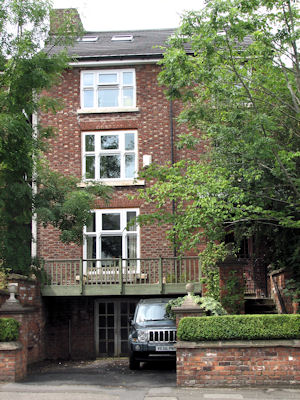 |
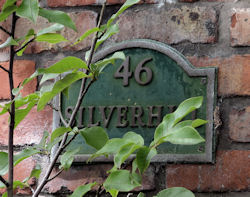
| Above: The name plate for Silverhill, 46 Stockport Road, Hyde
Right: The front view of Silverhill, 46 Stockport Road, Hyde It looks as though the basement floor has been modernised to accommodate large and light French windows. A balcony has been constructed in front of the 'ground-floor' parlour windows. Through access to the builders yard was to the right of the building. |
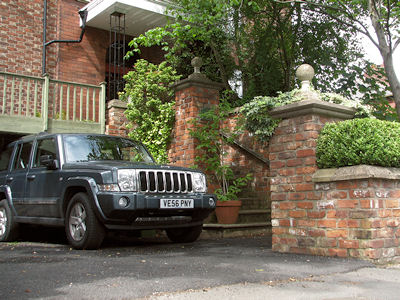 |
Left: The impressive entrance steps to Silverhill, with a modern canopy and
wood and glass door.
Below: An extract from the London Gazette of 17 August 1934, Issue 34079, page 5292 giving notice of that Crompton Bros was closing its stone merchant's business at Edge Hill Quarry |
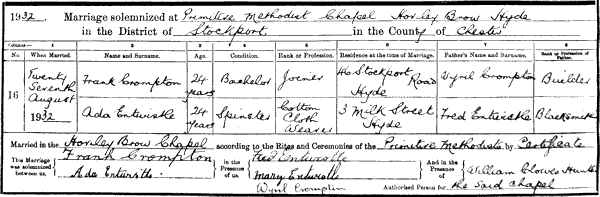 |
| Above: Frank CROMPTON and Ada ENTWISTLE in the Hoviley Brow
Primitive Methodist Chapel's wedding register.
Source: Manchester City Archives: Hoviley Brow Primitive Methodist marriage registers 1909-1953 Ref: C275/522 |
| The GRO entry records ...... |  |
1939 England and Wales Register 29 September 1939
ED Area code:     LFC
ED District code: C
Sched no:         103
Dwelling:         115 Knott Lane
Borough,UD,RD:    Hyde, Cheshire

Names            Sex   D of B   Status  Personal Occupation   Others
Crompton Frank    M   15jun1908    M    Carpenter & Joiner
Crompton Ada      F   17aug1908    M    Unpaid domestic duties
Crompton Mary     F   20jun1933    S    Under school age
The National Identity Number devised from this Registration would have been: Enumeration Area code+Emuneration District code+Schedule number+position in house
Ada ENTWISTLE
Fred ENTWISTLE married Maria Barber in the fourth quarter of 1900 (GRO ref: Stockport 8a 154)
| Ada was born in the third quarter of 1908. |  |
1911 Census:      Sun/Mon 2nd April/3rd April 1911
Source:   TNA Ref:        RG14 PN21335
          Reg. Gen. Ref:  RG78 PN443; En.Dist: 11; Sched:
          RegDist: Stockport SubDist: Hyde
Dwelling: 3 Milk Street
Place:    Hyde, Cheshire
Rooms in dwelling, other than scullery, landing, lobby, closet, bathroom: 4
Years married: 11
Children:       4 Alive , dead none

Name                Rel  Mar  Age  Occupation                 Status  Birthplace
Fred Entwistle     Head   M   33   Blacksmith at Railway Co.  Worker  Cheshire, Hyde
Maria Entwistle    Wife   M   35                                      Cheshire, Hyde
Rose Entwistle      Dau        9                                      Cheshire, Hyde
Hilda Entwistle     Dau        8                                      Cheshire, Hyde
Mildred Entwistle   Dau        6                                      Cheshire, Hyde
Ada Entwistle       Dau        2                                      Cheshire, Hyde
3 Milk Street, once within walking distance of Hyde railway station, now appears to be a car park.
Ada died at 115 Knott Lane on 25 April 1984 (Probate, GRO ref: Tameside 39 1721) leaving 'Not exceeding £40000'.
 |
It is known that John Harper CROMPTON and Crompton Bros built Auburn Avenue, naming it
after his mother's birth
place. Because of similar architectural styles and the identical bricks it is
possible that they also built King George Road and Napier Street.
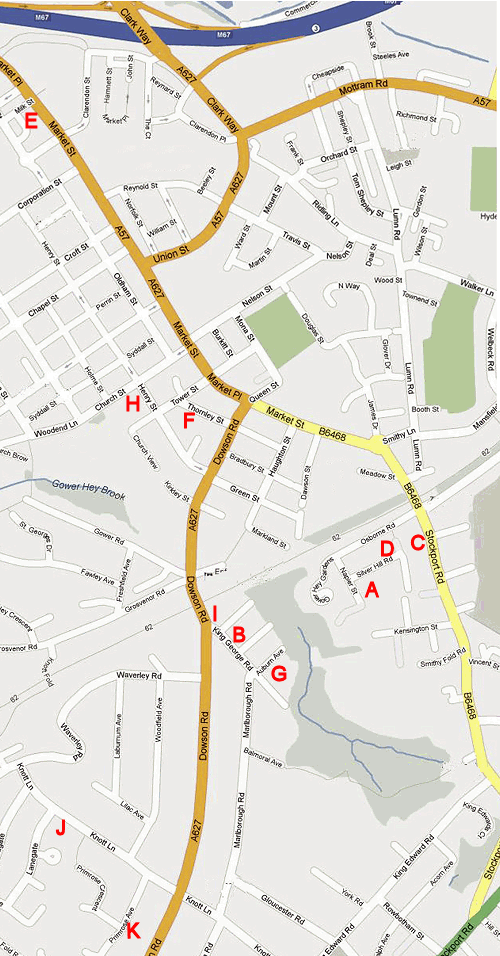
Left: Map locating King George Road, Hyde and others to show the close proximity of the family. Key A=15 Napier Street B=27 King George Road, where Mary was born C=46 Stockport Road (Silverhill) from where Frank was married D=Crompton Bros builder's yard E=Milk Street where Ada lived F=John Harper's home G=Auburn Avenue H=High Henry Street I=5 King George Road, where Lily BIRCHENOUGH, HJ Snr's wife, died J=115 Knott Lane, where Frank died K=17 Primrose Avenue, where HJ Snr. died |
Frank and Ada's children
| Together they had three children who, judging by their birth years of 1933, 1944 and 1946, were separated by Frank's possible war service. |  |
 |
|
 |
Mary, Frank and Ada's first child
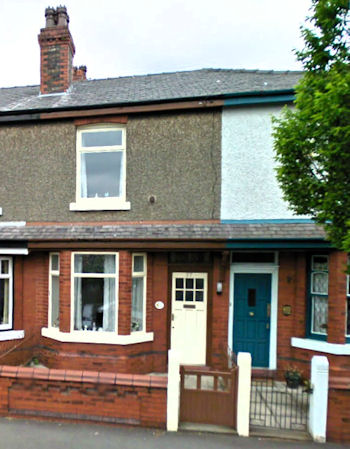
In 1933 Frank, a joiner, and Ada lived at 27 King George Road, Hyde, where Mary their first child was born. This was just round the corner from John Harper's first Auburn Avenue development.
 |
 |
| Above: Mary's baptism in the Hoviley Brow Primitive
Methodist Chapel register.
Source: Manchester City Archives: Hoviley Brow Primitive Methodist Baptism Record - 1909-1953 Ref: Box C22/5 C22/24 (Accessed: 29 February 2020) |
| Right: 27 King George Road, Hyde A similar property, on sale for £109,950 in March 2013, was described as: a two bed, bay fronted, mid terrace property which is located on a desirable road in Gee Cross. The property is close to shops and local transport and would suit first time buyers, down sizers and young couples alike. The property consists of, entrance vestibule, lounge 14'08& (4.27m) x 13' (3.96m), kitchen diner 13'06 (3.96m) x 11' (3.35m), dining area/study 8'11 (2.44m) x 6'04 (1.83m), two bedrooms 13'08 (3.96m) x 12'01 (3.66m) and 11'11 (3.35m) x 9'11 (2.74m), bathroom 8'02 (2.44m) x 5'10 (1.52m) and enclosed rear yard. It is possible that the bathroom was constructed in the third bedroom. |
 |
 |
Mary CROMPTON left home in 1957, aged 24, (Source: Shipman Inquiry) to live in Hampshire, where in the second quarter of 1967 (GRO Ref: Winchester 6b 1494) she married Leslie A MONK, who took Mary and Dean's surname of CROMPTON. This may be Leslie Al[l]an MONK. A Leslie Alan MONK died on 11 March 1993 (Probate GRO ref: ) leaving in excess of £125000.
| Note: The Crompton refers to the grooms surname. |
 |
In her witness statement to the Shipman Inquiry, Mary mentions her son Dean who
| was born in the first quarter of 1960 |  > > |
Dean married Paula KEATES in May 1999 (GRO ref: Droxford 492 504)
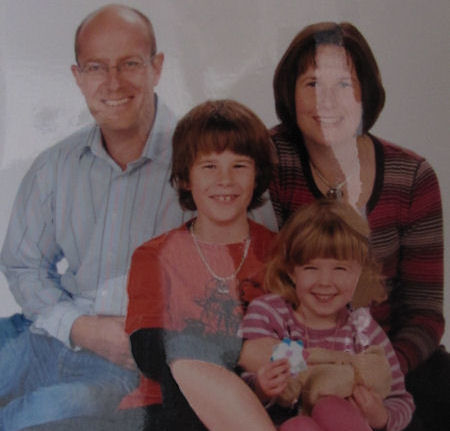
| Right: Dean CROMPTON's family in 2008
Left to right: Dean, Harvey, Polly, Paula Source: Wendy EVANS |
 |
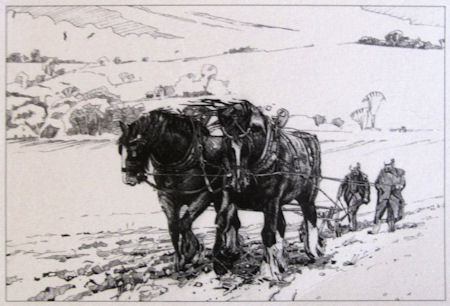 |
Left: An example of Dean CROMPTON's art work
Source: Wendy EVANS |
Whyril Frederick, second child of Frank and Ada
| was born during the first quarter of 1944, and who | |
| married Yvonne Burroughs in the fourth quarter of 1966. |  |
Both of Whyril and Yvonne's children were born in the Wakefield Registration District.
Frank, third child of Frank and Ada
| was born during the second quarter of 1946. He | |
| married Helen HALL in the third quarter of 1965, |  |
| who was born in the third quarter of 1946. |  |
| Both of Frank and Helen's children were born in Hyde.
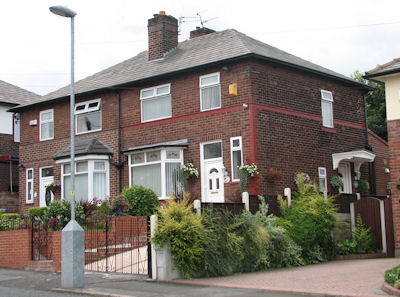
Frank CROMPTON died, age of 86, at his home, 'Franada' 115 Knott Lane, Hyde, where he had lived since 1964. This was next door to the home of his Aunts Cissy and Agnes, who had died in 1953. His death certificate records his trade as 'Joiner (retired)' presumably working for Crompton Bros. Right: 113 Knott Lane, Hyde in 2009, the home of Cissy and Agnes CROMPTON. 115 Knott Lane is to the right |
 |
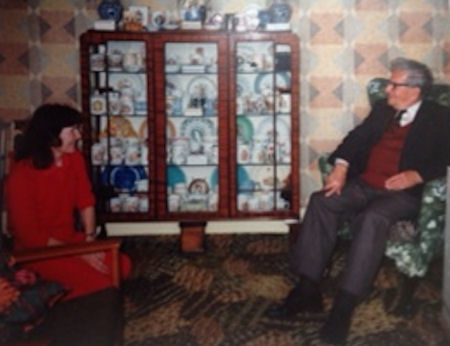 |
Left: Frank Crompton's 'royal' china collection with Val
Crompton in 1990. Frank was very proud of his collection of any china with a royal
connection. It just started and continued, overflowing the especially purchased china
cabinet. Source: Wendy EVANS |
| Left: Nellie, Frank and Charlie CROMPTON taken before Charlie's death
in 1990 Source: Wendy EVANS |
 |
The death of Frank CROMPTON
Ada preceded Frank when she died in April1984 (GRO ref: Tameside 39 1721).
Frank CROMPTON Jnr. died on Friday 24 March 1995 (GRO ref: Tameside B44A 0141B Probate record his death as 26 March 1995) leaving a sum not exceeding £125000. However, Dr. Harold Shipman certified that Frank's death occurred on Sunday, 26th March 1995, although it seems very likely that he died two days earlier.
'Mr Crompton was a widower and lived by himself [being an independent man]. His medical notes and records confirm his family's recollection that he suffered from mild angina. This appears to have been diagnosed in 1984 and seems to have been relieved by use of a glyceryl trinitrate (GTN) spray.'
'In August 1994, Mr Crompton was diagnosed as having carcinoma of the prostate. He responded well to treatment by Cyprostat and, on 2nd February 1995, was noted to be asymptomatic. His treatment was discontinued. ... From early 1995, Shipman made it his practice to visit Mr Crompton at home. Usually, these visits were unsolicited. From time to time, Shipman would take a blood sample. Mr Crompton did not require or receive the ten ampoules of 100mg of diamorphine that Shipman prescribed in his name on or about 28th February 1995. ... Shipman ... talked to him and had persuaded him of the wisdom of keeping a supply on hand [in case the carcinoma of the prostate returned]. Shipman's explanations for writing these two prescriptions were frankly implausible and I [Dame Janet Smith, a High Court Judge and Chair of the Inquiry] am satisfied that Shipman kept the proceeds of both prescriptions for himself.'
Note: After the post-mortem of Shipman's first recognised victim, Superintendant Bernard Postles, the officer in charge of the Shipman case, and his team 'had a probable method of killing - diamorphine. But could they prove that Shipman had access to a large enough amount of what is a controlled drug?' Source: Peters, Carole, 'Harold Shipman, mind set on murder', Seven Oaks, London, 2005, page 34
'There is no evidence that anyone saw or spoke to Mr Crompton on 24th or 25th March.'
'On the afternoon of Sunday, 26th March 1995, Ms [Mary] Crompton tried to contact her father by telephone. ...
[She found] Mr Crompton sitting in his chair, fully clothed, near to the dining table. He looked comfortable and she formed the impression that he had simply fallen asleep after his lunch.' 'The ambulance staff diagnosed the fact of death and recorded that rigor mortis had already set in. ... [Mrs Cooper] noted that shopping was still in bags and recalls that somebody found a receipt with Friday's date on it. Mrs Cooper also told the Inquiry that, on the perpetual calendar that Mr Crompton always kept up to date, the last date showing was Friday, 24th March 1995. [There] was other evidence to suggest that Frank Crompton had died on 24th March.' 'Ms Crompton spoke to Shipman to thank him after her father's death. He indicated that it was probably a blessing that Mr Crompton had died because his cancer was 'becoming rampant'.Right: Frank CROMPTON's death certificate |
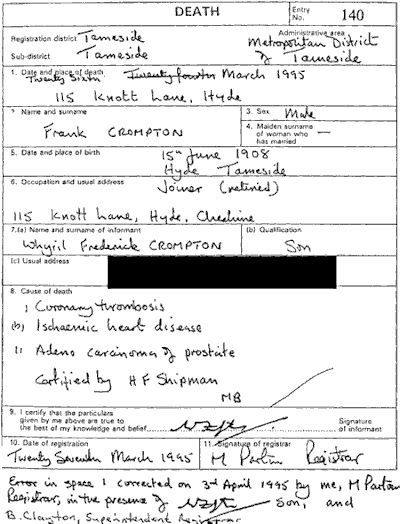 |
'The death certificate reveals that, when the death was originally registered, the date of death was recorded as 24th March 1995. The registrar subsequently corrected this 'error' on 3rd April 1995 in the presence of Mr Crompton's son, Mr Whyril Frederick Crompton, and in the presence of the superintendent registrar, one B. (Brenda) Clayton. Ms Crompton remembers that her brother had originally tried to register the death as having occurred on 24th March, but was told that the death had to be registered as having occurred on the day when the body was discovered.'
Note: An official spelling of Whyril. On his statement his name is spelt ' Wyril and Whyril below his signature
Dame Janet concludes:
'There are some suspicious features of this death but the evidence that Shipman killed Mr Crompton is not at all clear.' ...
'I have come to the conclusion that Shipman probably killed Mr Crompton. The factor which influences me most is that I think it unlikely that this was a death from a heart attack. Mr Crompton's appearance in death was not such as would usually be found following a heart attack. Although a death from a heart attack was possible, there is no other aspect of the evidence to suggest that this was the cause. All the other features of the case are either neutral or else give rise to some suspicion that Shipman was involved. There is nothing which points clearly against his involvement. The evidence falls far short of
that which would be required to convict Shipman of murder. Nonetheless, I have concluded that he probably caused Mr Crompton's death by administering a lethal injection of diamorphine.'
'In January 1995, Shipman killed one patient. In late February and in mid-March, he obtained further supplies of diamorphine, prescribed in the name of Mr Frank Crompton. It has not been possible to discover how much of the drug was administered to Mr Crompton and how much was kept by Shipman. Shipman killed no fewer than nine patients in the month of March and three more in April,'
Mr Crompton had been a patient of Shipman since Shipman's arrival in Hyde in 1977 and had followed him when he moved to the Market Street Surgery. He thought highly of Shipman. Shipman certified that the cause of Mr Crompton's death was coronary thrombosis due to ischaemic heart disease.
'Shipman was not prosecuted for causing the death of Mr Crompton but an inquest was opened and adjourned by the South Manchester Coroner on 18th May 2001.'
'[By 1995] ... Paul Britton [a criminal and forensic psychologist] believes that Shipman had gone through a significant transformation. He was no longer a doctor who wanted to save lives. Instead killing had become a routine.
'Clearly by 1995 the 'buzz' Shipman got from his deaths was diminishing. His crimes were escalating and he killed nine patients in quick succession. ... Killing two patients in one day seemed to sate him for a while as there was then a whole week' s gap between the deaths of Marie Fernley, John Crompton [no relation], Frank Crompton [24/26 March 1995] and Vera Brockhurst.'
Source: Peters, ibid, page 211
Sources:
 |
 |
 |
|
| This page was created by Richard Crompton and maintained by Chris Glass |
Version A6 Updated 29 February 2020 |
||