| Harry CROMPTON was born on 10 July 1916 |  |
1852Info3c: John Harper Crompton |
Henry John CROMPTON Jnr.
| Harry CROMPTON was born on 10 July 1916 | |
| In the fourth quarter of 1942 he married Eileen Daphne WARD at Gee Cross (Hyde, Holy Trinity). |  |
| Above: Henry John CROMPTON Jnr's GRO marriage record 1942 |
| Eileen, whose mother's maiden name was HEANEY, was born on 03 August 1921 in Nottingham. |
 |
| Above: Eileen Ward's GRO birth record for 1921 |
| At the time of his wedding Harry had already been gazetted in to the Royal Engineers. (?) |  |
| Above: A cut-and-paste of the London Gazette 12 May 1942, Issue
35559
recording Harry's promotion |
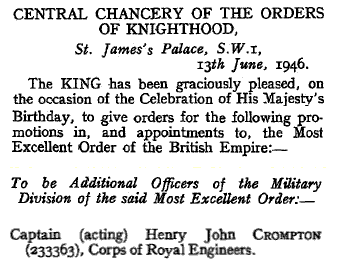
| At the end of the War Harry had been promoted to a temporary
Captain and awarded the Member of the British Empire (MBE) Military. This medal is awarded
to non-combatants.
It is assumed that this is John Harper's grandson. The officers in the two records carry the same serial number. Henry john's experience in the building/construction industry is appropriate for the Corps of Royal Engineers and his experience would allow him to manage military/civil projects. Right: A cut-and-paste of the London Gazette of 04 June 1946, Issue 37598, page 2769-2773 |
 |
|
| Right: The MBE ribbon | 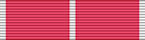 |
|
Crompton Brother's Builders and Contractors
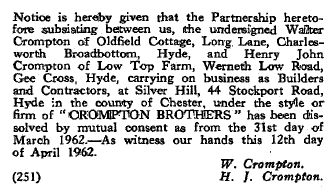
At the age of 46 Harry and his brother Walter, then aged 48, mutually dissolved their partnership, in Crompton Bros, John Harper's business, on 31 March 1962. Source: The London Gazette, 17 April 1962, page 45&
| A local resident of Silver Hill, whose garage was the company office,
told me that the company was taken over and traded under the name of
'someone and Crompton'. Presumably, this was to keep the good will and
reputation established by John Harper and his sons; something confirmed by my informant.
Source: London Gazette 17 April 1962, Issue 42651, page 3229 |
 |
Harry CROMPTON Jnr. followed his father in to the family building business and in to Freemasonry. He is recorded as being a member of:
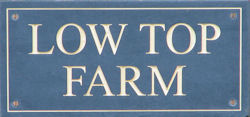
Low Top Farm, Werneth Low
| In the early 1960s, Harry had a 'bit of a
farm' on the top of Werneth Low, above Hyde, at Low Top Farm. He retired and died in
Anglesey.
Source: Alison WARNER from her grandma Maggie BOOTE |
 |
 |
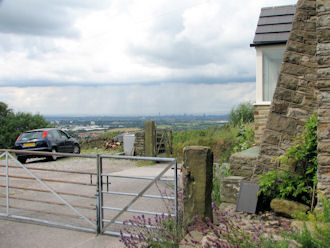 |
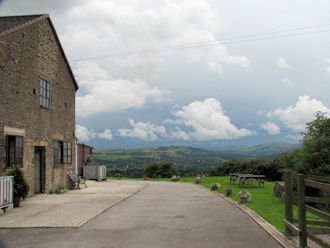
| Below left: The riding school tack room and the view, looking south-east, over the valley of the River Goyt | Below right: The view to the north-west, looking over Bredbury to Manchester on the horizon |
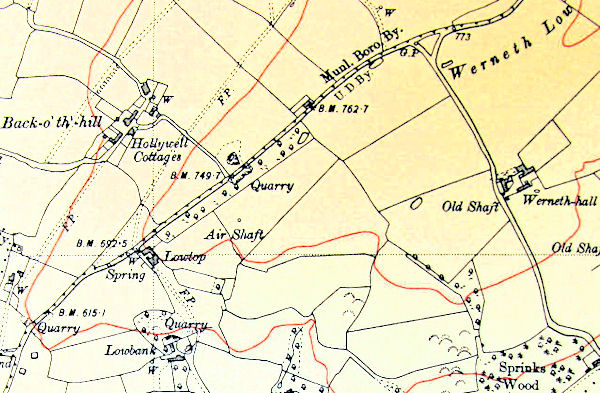 |
| Above: A 1906 map locating 'Lowtop', at the
intersections of the grid lines.
Click on the map to open an 177kB jpg A4 landscape map of the wider area. |
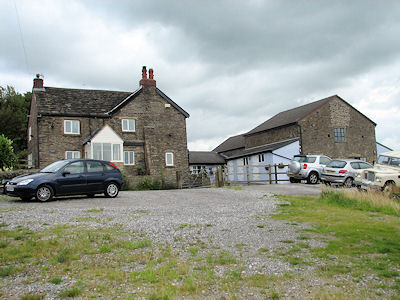
| Low Top farm is perched at 200m on an exposed ridge over looking Gee Cross to the
north, Bredbury to the north-west, Romiley to the south-west and Romiley Golf Club and
the valley of the River Goyt to the south-east.
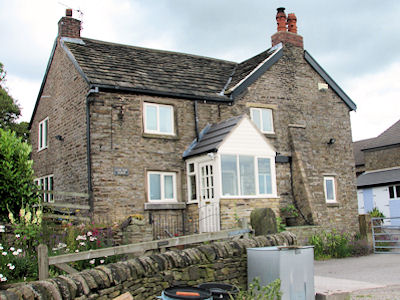
It is approached from Joel Lane, Hyde, on a single track road, which eventually makes a steep bending decent in to Romiley. It is not the place to live in a hard winter and is probably susceptible to strong winds blowing from the Pennines. The farmhouse is substantial, built in solid sandstone and with a flag stone roof. |
 |
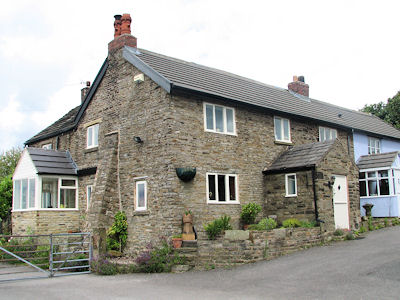 |
Left: Low Top, looking from the side, with the suggestion of a second home
painted blue
Below: Low Top and out buildings It appears that the out-buildings and their modern extensions are now a riding school. |
| 'As to the farm on Werneth Low, we must have walked up there to see them when we
went with Granny (Maggie BOOTE) as she never learnt to drive. They were all prodigious
walkers. Granny walked up the very steep Joel Lane (where Kathleen Grundy lived [It
was the murder of Kathleen Grundy, on 24 June 1998, that instigated the investigation of
Harold Shipman]), with me when she was well on in her eighties; we went up to the top
of Werneth Low and over the back to another village from where we could get a bus
home.'
(Source: Alison WARNER) |
 |
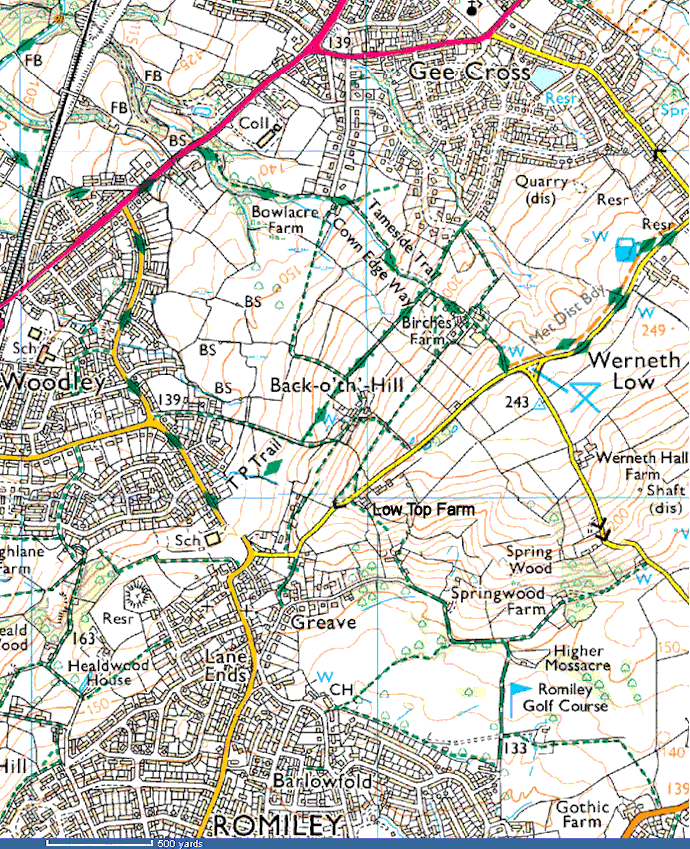 |
| Above: A modern map setting Low Top, at the intersections of the grid lines, in context |
'Gee Cross is one of the oldest parts of Hyde. ... At the top of [Joel] Lane is a cluster of ancient rural cottages; at the bottom are rows of red-brick terraces and 1930 urban semies.' Source: Peters, Carole, 'Harold Shipman, mind set on murder', SevenOaks, London, 2005, page 2
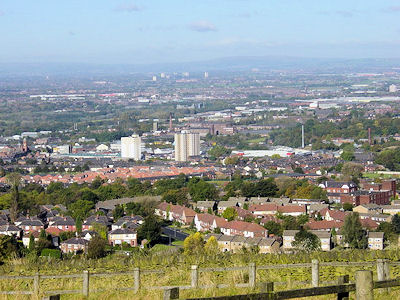
| 'On the hill over looking Hyde's industrial centre is Werneth Low, a ridge of
land that separates the Peak District hills and the Lancashire Moors from the flood plain
of the River Mersey, home of the urban sprawl of Manchester and Liverpool. You descend
into Hyde via the steep narrow Joel Lane. Its journey gives you a potted architectural
history of the industrial revolution.'
Source: Peters ibid, page 2 Right: Hyde looking from Werneth Low, a local recreational area |
 |
Eileen returns to Hyde
Harry died on 08 November 1989 at his home on Anglesey (GRO Death Ynys Mon 25 798) of a
heart attack. Eileen was devastated by the sudden death of her husband, the source of her
strength, and her health deteriorated. Around Christmas 1991 Eileen moved in to accommodation in
Golcar, Huddersfield to be near her son Martyn and there remained as independent as possible.
Having suffered several falls its was recommended that she had 24 hour care. On 14 March 1993 she
reluctantly moved in to her self contained flat in Charnley House Residential Home, on Albert
Road, where her appetite and confidence returned. She was described as a frail but 'lovely
lady'. In the months before her death Eileen deteriorated as her Parkinson's disease
became more pronounced. 'Her death was very sudden and came as a great shock to the staff
of Charnley House.' The funeral took place at Holy Trinity Gee Cross, within a week of
her death after which a cremation took place in Stockport.
Source:
The Shipman Enquiry
| Right: Map locating Albert Road, Hyde, Charnley House and Thornley Streeet | 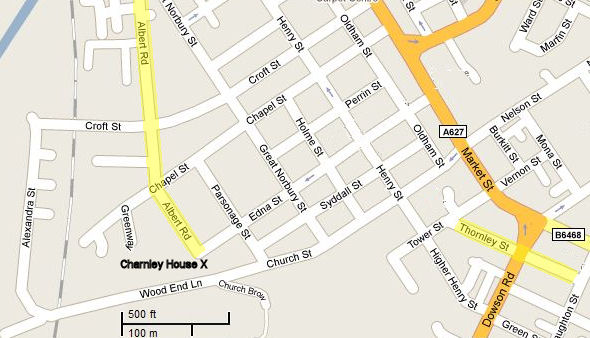 |
 |
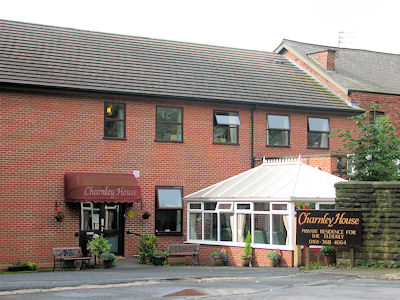 |
| When Eileen CROMPTON had quite severe Parkinson's disease she entered Charnley House. It is here that she died, murdered by Dr Harold Shipman |
Harold Shipman association with the Crompton's of Hyde
On Friday 19 July 2002 Dame Janet Smith's 2000 page, two-year report, into the serial killings of Harold Shipman was published. It answered the painful, heart-wrenching details of who, where and how the Hyde doctor killed 215 of his patients and became the country's most prolific serial killer. Amongst the list published were three Cromptons, two of whom were related to John Harper. They were:
The 'unlawful killing' of Eileen Daphne CROMPTON
The desperate need to kill brought with it a reckless confidence and a volume of deaths that simply could not go unnoticed. And it was during 1997 that the first seeds of suspicion were at last sown in the minds of those around him. But Shipman seemed no longer to care if he risked exposure and at the beginning of 1997 he seems to have deliberately killed a patient in front of a witness.
He had mainly avoided killing patients living in residential or nursing homes. There were too many dangers involved, too many chances of being caught out. However, around lunchtime on January 2, 1997, Dr Shipman visited Charnley House residential home and injected 75-year-old Eileen CROMPTON in front of the home's deputy manager. She was one of only three patients he was confident enough to kill in residential or nursing homes.
He obviously had not planned in advance of his visit to kill Eileen CROMPTON, as he had to go to his car to get a syringe and ampoule. Shipman injected the contents of the ampoule into the back of Eileen CROMPTON's hand, and within a minute she was dead.
Eileen CROMPTON had quite severe Parkinson's disease and the doctor had been called out that morning because, in the words of her carers, Eileen CROMPTON had seemed 'very flushed' and may well have had a cold. But without even examining her, Shipman announced that his patient was in heart failure and that, unless he gave her an injection immediately, to ' kick-start' the heart, he was 'going to lose her'.
Despite the fact his murder had been witnessed and this must have given him some form of adrenalin rush, Shipman showed no emotion, but simply said, 'Oh, dear, this is what I feared would happen.' He certified that the cause of death was bronchopneumonia.
Once back in his surgery, Shipman wrote in Eileen CROMPTON's medical records that he had injcted benzyl penicillin, an appropriate treatment if his patient had a very severe chest infection. But this antibiotic could not 'kick- start' the heart, neither would it have caused the patient's sudden death.
Paul Britton [a criminal and forensic psychologist] believes that 'by this stage even the added excitement of killing in front of someone wasn't enough for him. He simply had to kill more and more frequently. It would expose him to suspicion.'
Source: Peters Carole, ibid pp. 219-220
| At 8am the duty nurse found Eileen to be conscious, flushed and breathless. Shipman,
was called before 10am because Eileen was 'snuffly or chesty', but she
deteriorated during the morning. Shipman's immediate response was 'she is in
heart failure [and he] was undecided as what to do.' He said he would go
to his car to get something. 'Her case notes record 'Doctor came about
lunchtime [1pm]. Eileen collapsed suddenly and died whilst doctor was present at 1.30pm
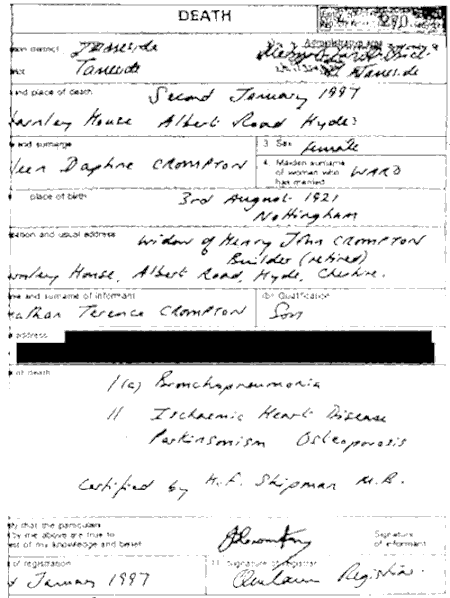
'. Her 'Medical Certificate of Cause of Death', signed by Shipman, gave
the cause of death as Bronchopneumonia though the family had no knowledge of this
condition.
However the Shipman Inquiry concluded 'It may well be that Mrs CROMPTON had not long to live. However, I am sure that, very shortly before her death, Shipman injected her with a strong opiate with the intention of ensuring that she died immediately.' 1 Right: A redacted copy of Eileen CROMPTON's death certificate from the Shipman Inquiry |
 |
 |
'All through her life Mum feared something major going wrong. My
father was a great optimist and used to say 'stop anticipating tragedy'
but I think a tragedy did occur at the end of Mum's life.'
Left: Eileen Crompton's medical certificate of cause of death signed by Harold Shipman Source: The Shipman Enquiry |
Source:
The Shipman Report
| The Shipman Report lists the 215 patients whom Dame Janet
Smith, a High Court judge and Chair of the Inquiry, has definitely established he killed,
between 1974 and 1998, and names another 45 whose deaths he was probably responsible for.
It charts his grisly progress through the quiet Cheshire neighbourhood of Hyde where in
just one street he claimed six lives. It lays bare the coldly meticulous modus operandi
of a man who could administer a lethal dose of diamorphine - pure heroin, to those whose
trust he had won with 'a wonderful bedside manner'.
Nearly all were elderly and living alone. Only three were killed in residential homes. Most were not terminally ill or suffering from any life threatening condition. But the Shipman Inquiry report cannot definitely answer the question why. Dame Janet enlisted the help of leading forensic psychiatrists to sift through the evidence of Shipman's actions. Their insights help to gain a deeper understanding of the macabre nature of - Shipman's world. They chart the descent of a doctor turned drug addict into a murderer whose killing became "a form of addictive behaviour". Dame Janet reluctantly admitted, "We simply do not know why". |
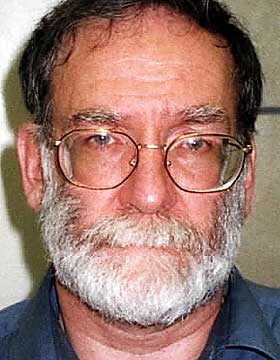 |
| Above: Harold Shipman |
He did not act from sexual motives and his sole physical contact with his victims was the injection which killed them. He did not act, except at the very end, from financial motives and made no sustained effort to pilfer from his victims or secure their worldly goods.
Shipman was capable of a sympathetic beside manner, indeed Dame Janet noted a teasing, friendly, winning approach, particularly towards the elderly, helped him enjoy 'almost celebrity status amongst his patients. The report notes that his 'kind and sympathetic manner' towards fmilies of patients 'disappeared when their relatives had died'.
To the end, Shipman's motivation remains beyond the reaches of our knowledge. As Britain's most prolific serial killer Shipman was convicted of 15 murders and sentenced, at Preston Crown Court in January 2000, to fifteen life terms and four years for the forgery of Kathleen Grundy's [his final victim] will.
Dame Janet Smith commented 'It is hoped that the report brings some feelings of closure to the friends and families of the dead.'
On 3 January 2004, shortly before 6am, Harold Shipman tied his torn bed linen to the bars of his cell window and hanged himself. As a doctor he knew exactly how to make sure his strangulation was quick and painless. It was three years since he had been sentenced to life imprisonment and it was the day of his fifty-eighth birthday.
 |
 |
 |
|
| This page was created by Richard Crompton and maintained by Chris Glass |
Version A14 Updated 29 February 2020 |
||