|
 |
|---|
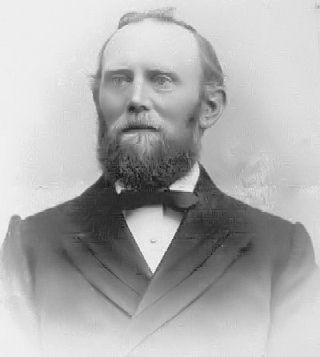
1852 Info 1a: John Harper Crompton |
|
|
|---|
The civil birth registration data records: 07 May 1852
John Harper        Crompton        Boy
  Father-James     Crompton        Labourer of John Street Bridlington
  Mother-Fanny     Crompton        (Formerly Harper)
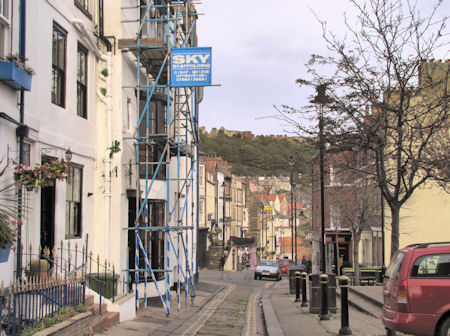
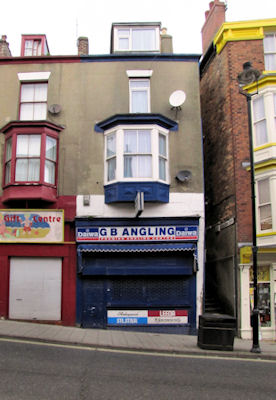
Hoverbox Photo Gallery - 96 Merchants Row, Scarborough - Author:
July 2010
This feature does not function correctly on phones and tablets
| 1. General view of Merchants Row | 2. 96 Merchants Row |
| 1 | 2 |
|---|
|
|
The 1861 census shows the family now living in Low Green, Hutton Cranswick, with John Harper‘s birth place being recorded as Scarborough.
1861 Census Sun/Mon. 7/8th April 1861
Source:           FHL Film  PRO Ref RG09
                  Piece: 3607; Folio: 7; Page: 7; Sched: 42
Dwelling:         Low Green
Place:            Hutton Cranswick, York, England

Name             Rel   Marr  Age  Occupation  Birthplace
James Crompton   Head  Wid   50   Groom       Yorks, Bridlington
Martha Crompton  Dau         14   Scholar     Yorks, Acomb
Mary Crompton    Dau         11   Scholar     Yorks, Scarborough
John Crompton    Son          8   Scholar     Yorks, Scarborough
Sarah Crompton   Dau          7   Scholar     Yorks, Scarborough
| The row of two-up-and-two-down cottages now stands by the level crossing. The
left hand cottage has outbuildings, which could once have been a stable for James
the 'horse doctor'.
Right: Low Green Cottages, Hutton Cranswick Author June 2006 |
 |
In the 1871 census John Harper was already set in the apprenticeship that would take him into his own building business, being employed by Barmby SMITH, a builder in Hutton Cranswick. Robert SMITH was also a builder in the same village. john Harper's father James, at the time of the 1871 census, was a widower working shepherd at Ganstead, separated from his family.
1871 Census Sun/Mon. 2/3rd April 1871
Source:      FHL Film  TNA Ref RG10
             Piece: 4806; Folio: 38; Page: 10; Sched: 43
Dwelling:    Cranswick village
Place:       Hutton Cranswick, York, England

Name             Rel   Mar Age  Occupation  Birthplace
Barmby Smith     Head   M   39  Builder     Yorks, Hutton Cranswick
Ruth Smith       Wife   M   40              Yorks, Pickering
Joseph Smith     Son        15  Scholar     Yorks, Hutton Cranswick
Robert Smith     Son        13  Scholar     Yorks, Hutton Cranswick
James Smith      Dau        10  Scholar     Yorks, Hutton Cranswick
Tom Smith        Son         9  Scholar     Yorks, Hutton Cranswick
Ruth Sarah Smith Dau         2              Yorks, Hutton Cranswick
John Reed        Appr   U   19  Bricklayer  Yorks, Pickering
Lenard Reed      Appr   U   18  Bricklayer  Yorks, Pickering
John H Crompton  Appr   U   18  Bricklayer  Yorks, Burdlington [sic]
Easter Sissons   Serv   U   39  Nurse       Yorks, Hutton Cranswick
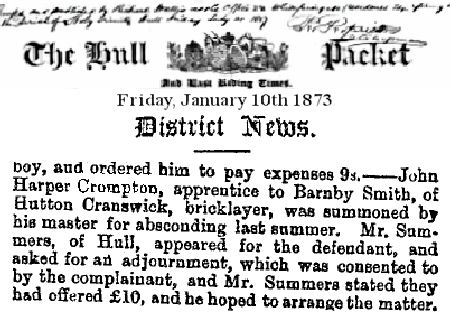
| However, according to the Hull Packet article, not everything in the apprenticeship
was sound. The 'arrangement' of £10 is equivalent to £450 in 2010.
Right: John Harper's appearance in the Hull Packet of 10 January 1873 |
 |
His marriage to Sarah Jane KNEESHAW
| It is possible that John Harper also worked for Richard Tindale KNEESHAW,
a builder of Market Weighton.
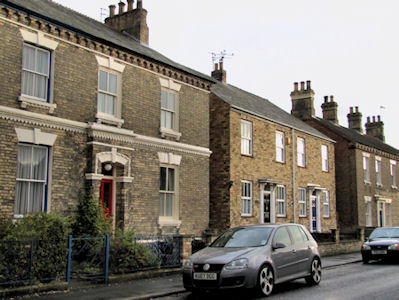
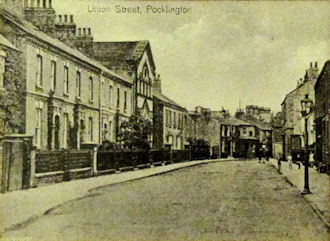
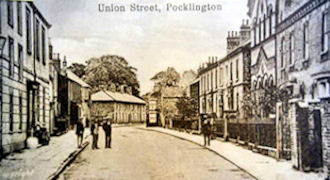
On 27 June 1874 John Harper married his daughter, Sarah Jane KNEESHAW,(GRO ref: Pocklington 9d 166)who was born 3 October 1850(GRO ref: Beverley XIII 13) at North Newbald, in Pocklington Primitive Methodist Chapel, in Union Street. Right: The site of Primitive Methodist Chapel, Union Street, Pocklington 2010. The chapel was demolished and the yellow brick house built. Author |
 |
| Pocklington Primitive Methodist Chapel
Right: On the left with the classical gable looking towards the Market Place Below: second building on the right, from the Market Place end. |
 |
 |
| Registration District Pocklington | |||||||
|---|---|---|---|---|---|---|---|
|
1874 Marriage solemnised at
the Primitive Methodist Chapel, Pocklington
in the District of Pocklington in the County of York |
|||||||
| When married | Name and Surname | Age | Condition | Rank or Profession |
Residence | Father's name |
Father's profession |
| Twenty seventh June 1874 |
John
Harper Crompton |
22 years |
Bachelor | Bricklayer | Market Weighton |
James Crompton |
Labourer |
| No. 145 | Sarah
Jane Kneeshaw |
23 years |
Spinster | Market Weighton |
Richard
Tindall Kneeshaw |
Bricklayer | |
| Married in the
Primitive Methodist Chapel
according to the
Rites
of thePrimitive Methodist
by Certificate The marriage was John Harper Crompton Witness Richard Tindall Kneeshaw by me James Hall, Minister solemnised between us Sarah Jane Kneeshaw Witness Mary Elizabeth Kneeshaw John Ashly, Registrar |
|---|
Their home in Holme upon Spalding Moor
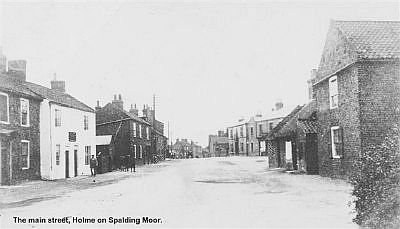
| Their first home was in Mark Weighton where their first child
was born in 1878. One year later the family had moved to Town Street, Holme upon Spalding
Moor.
Right: An undated postcard of Holme on Spalding Moor, showing what is thought to be Town Street, now High Street |
 |
By 1881 John Harper had not only established his own family and successful business, in Holme on Spalding Moor, but also looked after his father, widowed at sometime before the 1861 census.
1881 Census Sun/Mon 2/3rd April 1881
Source:             FHL Film 1342144 PRO  Ref RG11
                    Piece: 4735; Folio: 30; Page: 18; Sched: 95
Dwelling:           Town Street
Place:              Holme On Spalding Moor, York, England

Name                Rel  Mar Age Occupation                Birthplace
John H. Crompton    Head  M  28  Builder employing 4 men   Yorks, Bridlington
Sarah J. Crompton   Wife  M  30  Builder's wife            Yorks, Newbald
Florence Crompton   Dau       3                            Yorks, Mkt. Weighton
Richard H. Crompton Son       2                            Yorks, Holme
Wyrill Crompton     Son       1m                           Yorks, Holme
James Crompton      Fthr  W  74  Former shepherd           Yorks, Bridlington
Sarah Demman        Bord  U  31  Certified school teacher  Yorks, Heuckley
Margaret Agar       Serv  U  15  General servant domestic  Yorks, Holme
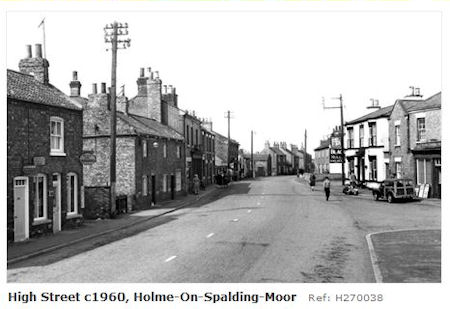
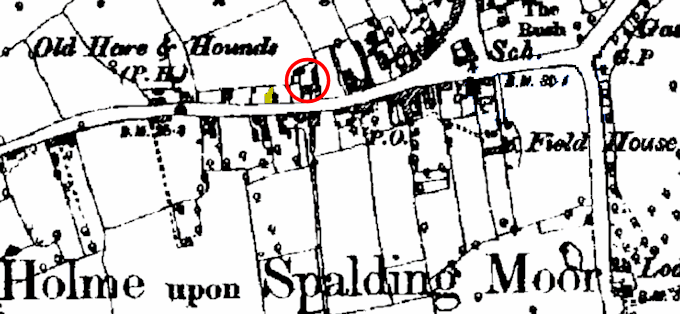
| From 1878 to 1887 the family lived in Town Street, Holme on Spalding Moor. The 1881
census places John Harper's home between an 'ale brewer & publican' and
the blacksmiths. The 1890 map (below) shows the Old Hare and Hounds pub being closest to
the start of the Enumerators route at Runner End. The 1855 map locates the blacksmiths,
positioned within the red circle on the 1890 map. John Harper's assumed home is
marked yellow. The 1960 photograph is taken from the traffic island west of the Sch. John Harpers home would be just around the bend on the right. |
 |
 |
|
| Above: An 1890 map locating John Harper's home in Holme on Spalding Moor in 1890 |
| Right: John Harper's assumed home: it being in the right position, of the right age and having room at the side for a builder's yard. Author | 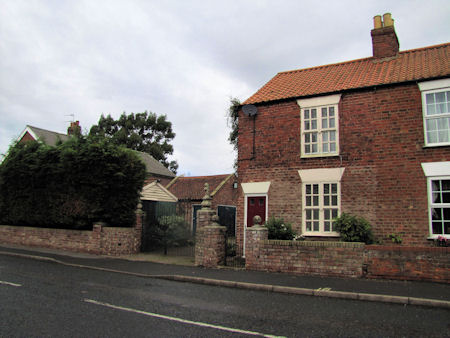 |
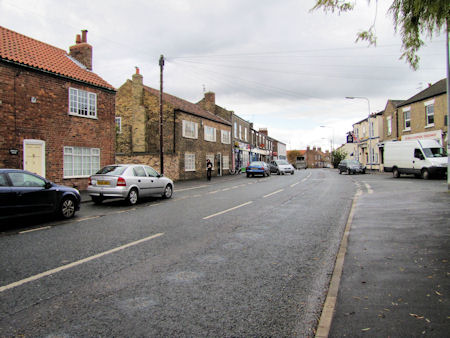 |
Left: High Street, Holme-on-Spalding-Moor in 2010, in the direction of John Harper's assumed home. Author |
An increasing family followed at regular intervals.
Source:  GRO birth records
                         Registration
Name                     District     Folio Page   Date
Crompton William harper  Pocklington   9d    109?  4thQt1875
Crompton Florence        Pocklington   9d    87    2ndQt1877
Crompton Richard Harper  Howden        9d    79    4thQt1878
Crompton Whyrill         Howden        9d    96    3rdQt1880
Crompton Henry john      Howden        9d    89    2ndQt1882
Crompton Francis         Howden        9d    83    1stQt1884
Crompton Fanny           Howden        9d    83    3rdQt1885
Crompton Jessie          Howden        9d    80    4thQt1886
17 Church Street, Hyde
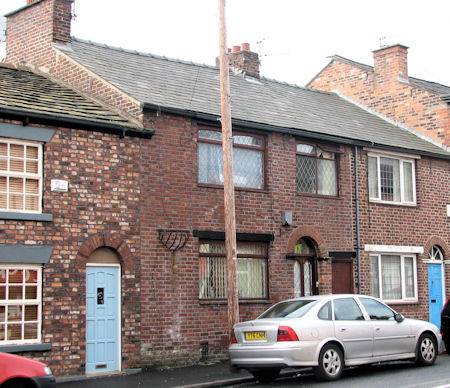
| In 1887 John Harper and his all but complete family moved to Hyde in
Cheshire to begin his building firm. Their first home was in Church Street, just round the
corner from Thornley Street, which was to become the family home for many years. Both
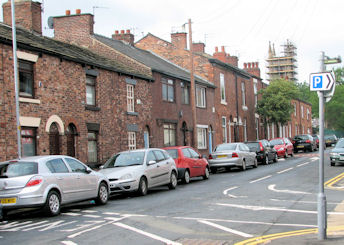
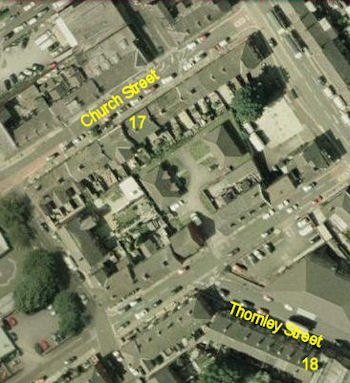
streets are lined with terraced houses, each having small back yards. Aerial photographs
show several examples of modern redevelopment.
Right: The modernised 17 Church Street, Hyde in August 2009. The brown side door gives access to the rear. Author |
 |
The family continued to grow.
Source:  GRO birth records
                         Registration
Name                     District     Folio Page   Date
Crompton Agnes           Stockport     8a    10    1stQt1888
Crompton Lottie          Stockport     8a    14    4thQt1889
Crompton Mary Cecelia    Stockport     8a    14    4thQt1890
Crompton Maggie          Stockport     8a    15    3rdQt1894
1891 Census   Sun/Mon 5/6th April 1891
Source:       FHL Film  TNA Ref RG12
              Piece: 2790; Folio: 49; Page: 42; Sched: 254
Dwelling:     17 Church Street
Place:        Hyde, Cheshire, England

Name               Rel Mar Age Occupation  Status    Birthplace
John H Crompton    Head M  38  Builder     Employer  Yorks, Bridlington
Sarah A Crompton   Wife M  40                        Yorks, Newbald
Florence Crompton  Dau     13                        Yorks, Market Weighton
Richard H Crompton Son     12                        Yorks, Spalding Moor
Whyrill Crompton   Son     10  Scholar               Yorks, Spalding Moor
Henry J Crompton   Son      8  Scholar               Yorks, Spalding Moor
Frances Crompton   Dau      7  Scholar               Yorks, Spalding Moor
Fanny Crompton     Dau      5  Scholar               Yorks, Spalding Moor
Jessie Crompton    Dau      4  Scholar               Yorks, Spalding Moor
Agnes Crompton     Dau      3  Scholar               Cheshire, Hyde
Lottie Crompton    Dau      1                        Cheshire, Hyde
Mary C Crompton    Dau      6mn                      Cheshire, Hyde
James Richardson   Boar    27  Joiner      Worker    Yorks, Market Weighton
John Harper appears to have hired his nieces' husband from Market Weighton.
 |
 |
| Above: A general view of Church Street, Hyde Author: 2009
Right: Aerial photograph of Church Street, Hyde Author: 2009 The modern infill, shown on the aerial photograph, suggests that number 17 had a much larger back garden. |
Possible reasons for John Harper moving to Hyde
| John Harper CROMPTON and his family moved to Hyde in 1887, some five or six
years after the beginning of its expansion as an industrial town.
Hyde Unitarian Chapel and part of the village of Gee Cross started to grow before Hyde. A nonconformist chapel was built here in 1708. Gee Cross was an important early centre of nonconformity (the religious persuasion followed by John Harper), which survived in the area throughout the period of repression following the Restoration. Hyde Chapel and Hyde Hall were in a very picturesque location, just above a weir in the river— "the appearance and noise of this cascade have a romantic effect and the river below for half a mile is made to appear like a lake, forming a fine piece of water well stocked with trout and eels"1. |
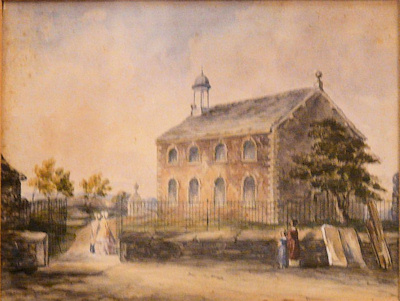 |
| Above: Hyde Chapel 1767. The Chapel was demolished following the completion of the new chapel, but the site can be made out in the present graveyard. Source: Old Hyde (Accessed 29 February 2020) | |
In 1797 a settlement by the name of Hyde did not exist. Although the weir had disappeared, by 1897 Hyde had made enormous growth from the village known as Red Pump Street, which followed the line of Market Street, Hyde. Its growth was inseparable from that of the cotton industry and coal, from the South Lancashire coal field, needed to feed the mill’s steam generating boilers. As new cotton mills were erected, cottages and terraced houses were built for the workers. These hamlets gradually grew together to form Hyde, which soon outstripped Gee Cross.
The most prominent mill owner, who was also involved in the public life of the town, was the Ashton family. Part of a nonconformist paternalist tradition: they made huge fortunes from cotton, but were willing to spend part of their wealth on the town and their workforce. An interesting description of the Ashton empire appeared in 1844:
"The little town of Hyde was, at the commencement of the present century, a little hamlet, of only eight hundred souls, on the summit of a barren hill, the soil of which did not yield sufficient for the inhabitants. The brothers Ashton have peopled and enriched this desert. Ten thousand persons are now established in their five factories. … The houses inhabited by the work-people form long and large streets. Mr Ashton has built three hundred of them, which he lets at three shillings, or three shillings and sixpence, per week. Each house contains upon the ground floor, a sitting room, a kitchen, and a back yard, and above, are two or three bedrooms. The proprietor furnishes, at his own charge, water to the houses, keeps them in good repair, and pays the local rates. ... Everywhere is to be observed a cleanliness which bespeaks order and comfort. The furniture is simple, but sufficient; in some houses, a clock is to be seen; in others, a sofa; and, in others again, a piano-forte. Books are plentiful, but I have seen few Bibles, and this seems to confirm that character for indifference in religious matters, for which the work-people of Mr Ashton are celebrated" 2.
Hyde, including most of Gee Cross, was granted its Charter of Incorporation in 1881 and this led to a spate of public building. The first sign of Hyde's new status was the Town Hall, opened 27 June 1885, after four years of planning. The new council had bought Greenfield House, which stood next to Greenfield Mill, mill and its machinery for just over £13,000. The mill was rented to Horsfield & Co., who also bought the machinery, but the deal reflected Hyde Corporation's concern for future expansion.
By 1897 Hyde had become the second largest town in what is now the Tameside area with a population of 30,670, according to the 1891 census.
The Public Baths in Union Street were opened on 4 May 1889. That "the building is not perhaps so handsome externally as could have been desired" 3 … was said to be a result of the need to keep costs to a minimum and so avoid "elaborate and useless ornamentation". Union Street was also to become the home of the Public Library. In 1894 the Mechanics' Institute, at the corner of Union Street and Market Street, was handed over to Hyde Corporation and became the precursor of the Technical School.
Although industrial concerns, particularly the mills and the railways which helped serve them, dominate Hyde, late Victorian life was marked by increased leisure opportunities for working class people. By 1900 there were over one hundred pubs and beer sellers in Hyde — a ratio of one licensed house for every 300 inhabitants. The Theatre Royal and music-hall, at the corner of Frank Street and Ridling Lane, opened in December 1882 to provide entertainments for working people. It was demolished in 1902 when a new Theatre Royal opened in Corporation Street.
In the late 19th century many leisure activities, from sport to amateur dramatics, were bound up with church life and Hyde was well served by churches of many different denominations — the Unitarian Chapels at Gee Cross (1848) and Flowery Field (1879), St George's (the first Anglican church in Hyde, 1831), Union Street Congregational Chapel (1843) and Hyde Wesleyan Chapel on Norfolk Street (1851) were among the most prominent.
Hyde was therefore providing for the administration, the education and healthy recreation of its inhabitants in typical Victorian style. The wealth, which allowed these buildings and services to exist, was based on the cotton industry and associated trades which generated enormous growth and paid for the public buildings, the churches and the houses — from the mansions of the Ashtons to the tightly-packed working class housing.
Perhaps John Harper CROMPTON saw an opportunity to contribute to the growth of the industrial township of Hyde.
Source: Freely adapted from an article by Alice Lock of Tameside Local Studies
Library, Old Ordnance Survey Maps, Hyde 1897, Alan Godfrey Maps, Consett
Footnotes
(1) Butterworth. James,History and description of the towns and parishes of Stockport, Ashton-
u- Lyne, Mottram-in-Longdendate and Glossop. W.D.Varley,1827, p298-9
(2) Faucher, Leon,Manchester in 1844. Its present condition and future prospects, Cass,
1969. (first published 1844), p105-7.
(3) Middleton, Thomas,The History of Hyde and Its Neighbourhood, Higham Press, 1932, p144.
18 Thornley Street
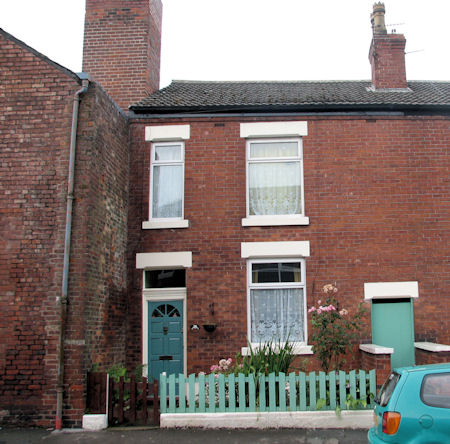
Between the birth of Lottie, in 1889 and Maggie, born in 1894, John Harper and Sarah moved, with their family and building business, to 18 Thornley Street, Hyde. Here was established the Hyde branch of the family.
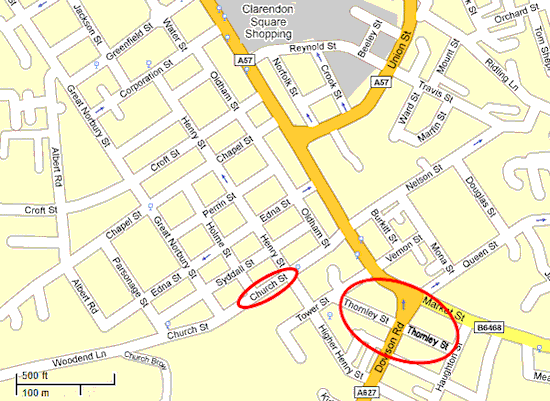 |
| Above: Map locating Church Street, Hyde in relationship to
Thornley Street
Right: 18 Thornley Street, Hyde. Though this looks to be a smaller house than Church Street it had advantages spotted by the builder's eye. Author |
 |
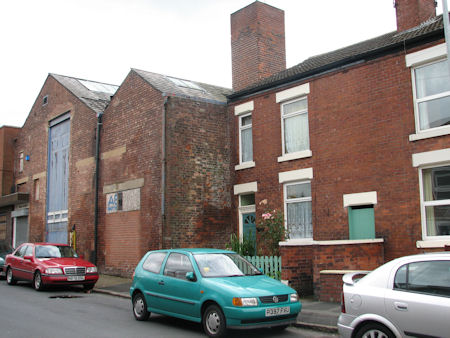 |
Left: 18 Thornley Street, Hyde with the extensive buildings attached. Either
or both of the attached building would have made an excellent 'builder's yard'
for storage of materials and equipment. The lintel, above the bricked-in doorway,
indicates a second entrance. Author Across the road is a new health centre. |
1901 Census   Sun/Mon 31st March/1st April 1901
Source:            FHL Film PRO Ref RG13
                   Piece: 3282; Folio: 2;  Page: 2; Sched: 12
                   Dwelling:          18 Thornley Street
Place:             Hyde, Cheshire

Name               Rel  Mar Age Occupation               Birthplace
John H Crompton    Head  M  48  Builder & contractor     Yorks, Bridlington
Sarah J Crompton   Wife  M  50                           Yorks, Newbald
Florence Crompton  Dau   S  23                           Yorks, Market Weighton
Richard H Crompton Son   S  22  Engineers clerk          Yorks, Holme
Whyrill Crompton   Son   S  20  Apprentice bricklayer    Yorks, Holme
Henry J Crompton   Son   S  19  Apprentice bricklayer    Yorks, Holme
Fanny Crompton     Dau   S  15  Cotton weaver            Yorks, Holme
Jessie Crompton    Dau   S  14  Apprentice confectioner  Yorks, Holme
Agnes Crompton     Dau   S  13                           Cheshire, Hyde
Lottie Crompton    Dau   S  11                           Cheshire, Hyde
Mary C Crompton    Dau   S  10                           Cheshire, Hyde
Maggie Crompton    Dau   S   6                           Cheshire, Hyde
Three of the boys died whilst young and four of the girls remained unmarried, leaving two boys and three girls with known issue.
'Mother went on to say that the Hyde Cromptons would have been at a difficult time as there were all those children and probably only two and a bit incomes. Her younger uncles were sent to the mill as part-timers before they left school properly and worked for their father, the second eldest daughter Fanny went into the mill. By 1901 things must have got less tight as Jessie was apprenticed into a more gentle trade.'Alison Warner
Building two Auburn Avenues
From Thornley Street, John Harper built and named two streets Auburn Street, one in Hyde and one in nearby Bredbury (see maps below). It is said that the streets took their name from Auburn, one of the villages of Holderness lost to coastal erosion, where Fanny, his mother, had been born.Note: This is not the same Auburn in Goldsmith's 'Deserted Village' poem of 1770.Source:< i>Beresford M., 'The Lost Villages of England', Lutterworth, 1965
 |
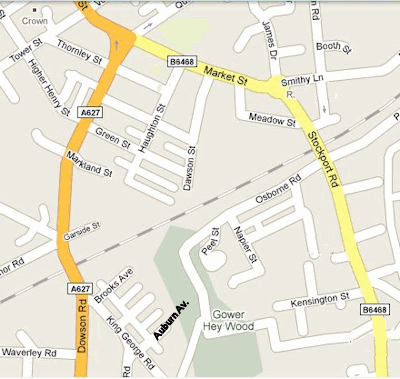 |
| Above: Aerial photograph of Auburn Ave, Hyde 2009
Right: A map locating Auburn Avenue, Hyde |
 |
 |
| Above: The street sign at Auburn Avenue, Hyde 2009
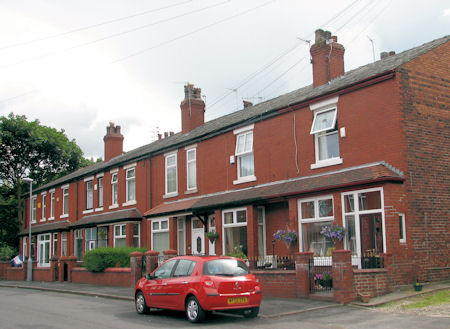
Right: The south-east row of Auburn Avenue, Hyde Author The Avenue ends at Gower Hey Woods which lies on the north-western edge of Gee Cross, Hyde. Covering an area of around 9 hectares, the wood occupies two steep sided valley system which converge halfway through the wood. The majority of the site is secondary woodland mixed with scrub, and although it has some trees of 150 years or more in age, most are more recent. |
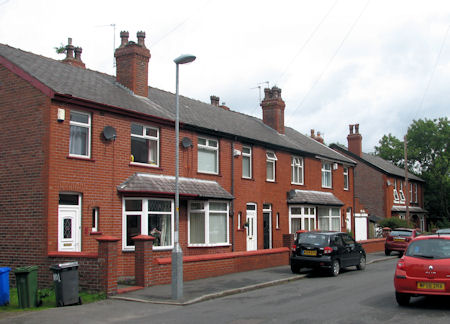 |
Auburn Avenue is a street of thirteen well built three bed-roomed houses, in three
terraces, of facing red engineering bricks and a more 'common' brick to the sides
and rear. The Welsh blue slated roofs are topped by impressive chimney stacks.
Although modernised with uPVC windows and doors the street still gives the impression of homes for a more affluent client: they are fronted by large windows and bays on the ground floor. However, gardens, serviced by a rear car width access, are small and limited to a size similar to those in an industrial terrace. |
| In November 2009 these houses were for sale at about £150 000.
Above: The north-west row of Auburn Avenue, Hyde Author Right: The back of north-west row of Auburn Avenue, Hyde Author |
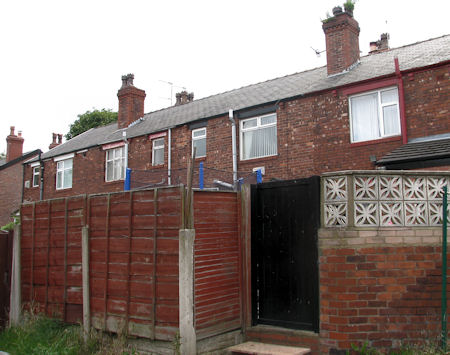 |
John Harper's second development, also called Auburn Avenue, is in Bredbury along the A560 from Hyde. This row of houses isn't as salubrious as the Hyde development. The ten, possibly two bed-roomed terraced houses, faces the wire fenced Bredbury Medical Centre and ends at an industrial complex. However, the back gardens over look an area of rough recreational land leading to an old railway embankment.
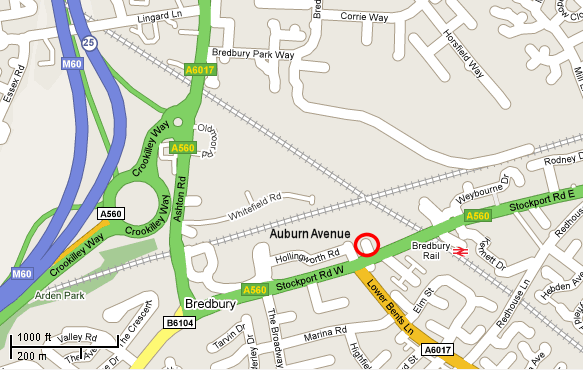 |
| Above: A 2009 map locating Auburn Avenue, Bredbury |
The 1911 map of Bredbury shows that Bents Lane Farm, the location of Auburn Avenue, was a working farm. By 1923 the even numbers of Auburn Avenue had been built. John Harper may have speculated in planning to develop this 'brown field' site, building an estate houses for the industrial workers on the land of the disused colliery. The 'modern' factory, at the end of Auburn Avenue can be seen.
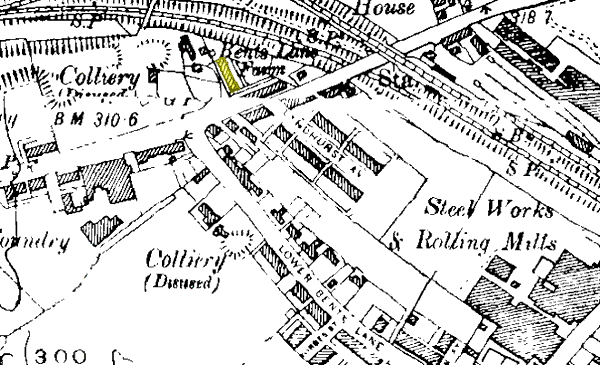 |
| Above: Map of Bredbury in 1923, showing Auburn Avenue in yellow. Scale 1:10,560 |
 |
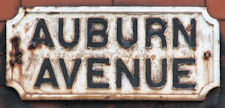 |
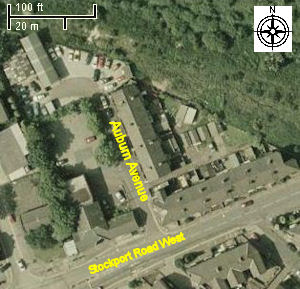
| Above: The street name plate from Bredbury
Left: an aerial view of the eight houses in Auburn Avenue, Bredbury. The avenue leads to a factory area and is opposite Bredbury Medical Centre |
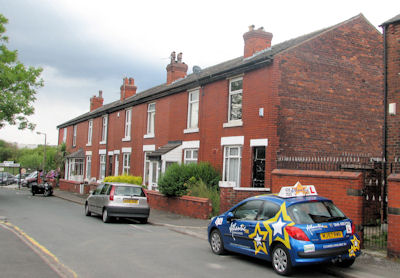
| The houses on the right of Auburn Avenue are all even numbered.
Right: Auburn Avenue, Bredbury looking towards the industrial complex Author Below: Auburn Avenue, Bredbury looking towards Stockport Road West Author |
 |
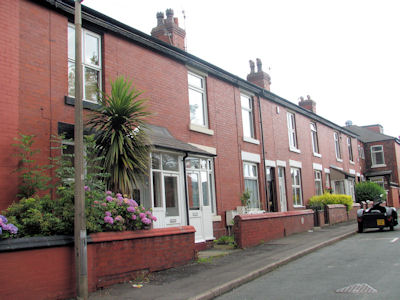 |
Note how similar the terrace construction is to the Hyde development: the same
engineering bricks are used to front the terrace and the same 'common' bricks for
the side.
However, this terrace appears to be of cheaper two bed-roomed houses. In August 2008 number 8 Auburn Avenue, the white door by the convertible car and next door to Fanny and John Nixon's home, sold for £114,950. |
The 1911 census
It is interesting to note that Florence remained without an occupation through to the 1911 census and that Jessie, in her 'gentle trade', was self employed. It is also possible that Agnes employed both Lottie and Cissy (Mary cecelia). A family of enterprise?
1911 Census:           Sun/Mon 2nd April/3rd April 1911
Source:   TNA Ref:        RG14 PN21338
          Reg. Gen. Ref:  RG78 PN1269  En.Dist: 14; Sched: 87
          RegDist: Stockport SubDist: Hyde
Dwelling:              18 Thornley Street
Place:                 Hyde, Cheshire
Rooms in dwelling, other than scullery, landing, lobby, closet, bathroom: 7
Years married:         35
Children:              Alive 9, dead 3

Name                   Rel Age Mar Occupation     Status  Birthplace
John Harper Crompton  Head  58  M  Builder        Employ  Yorks, Bridlington
Sarah Jane Crompton   Wife  60  M                         Yorks, Newbald
Florence Crompton     Dau   33  S                         Yorks, Market Weighton
Henry John Crompton   Son   29  S  Bricklayer     Worker  Yorks, Holme on Spalding Moor
Fanny Crompton        Dau   25  S  Cotton weaver  Worker  Yorks, Holme on Spalding Moor
Jessie Crompton       Dau   24  S  Confectioner   Own a/c Yorks, Holme on Spalding Moor
Agnes Crompton        Dau   23  S  Dressmaker     Employ  Cheshire, Hyde
Lottie Crompton       Dau   21  S  Dressmaker     Worker  Cheshire, Hyde
Mary Cecelia Crompton Dau   20  S  Dressmaker     Worker  Cheshire, Hyde
Maggie Crompton       Dau   16  S                         Cheshire, Hyde
Margaret Radcliffe    Vis   22  S                         Cheshire, Marple
By the time of the 1921 Census John Harper had retired, though still living at 18 Thornley Street.
The 1921 census
1921 Census:      Sun 19th June 1921
Source:   RG15;  Piece: ;
          RegDist number: 443; SubDist: 2; ED 16; Sched: 122;
          Reg District:  Stockport;  Parish: Hyde
Dwelling: 18 Thornley Street
Place:    Hyde, Cheshire
Rooms:    5
Children under sixteen: none

Name                   Rel    Age  Mar  Occupation       Employer  Work place  Birthplace
                            Yrs Mn
John Harper Crompton  Head  69  1   M   Builder Retired  Employer              Yorks, Bridlington
Sarah Jane Crompton   Wife  79  8   M   Home Duties                            Yorks, Newbald
Florence Crompton      Dau  44  1   S   Home Duties                            Yorks, Market Weighton
Lottie Crompton        Dau  31  9   S   Home Duties                            Cheshire, Hyde
May Cecilia Crompton   Dau  30  9   S   Home Duties                            Cheshire, Hyde
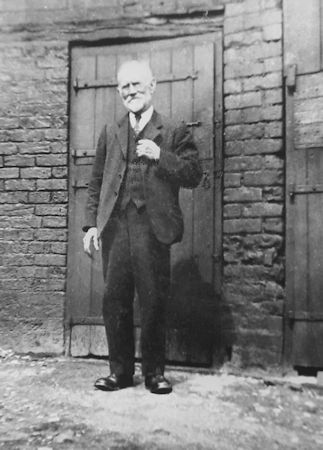
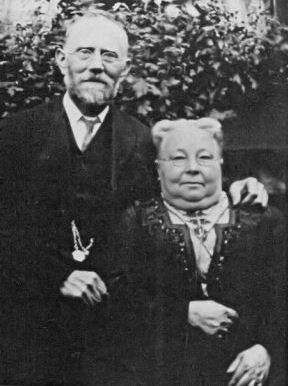
John Harper and Sarah Jane in later life
| Right: John Harper circa 1910 standing in front of an
unknown location Source: Sally Weston |
 |
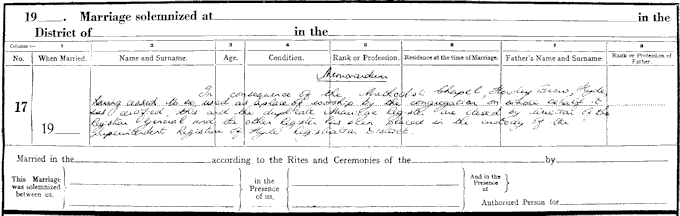
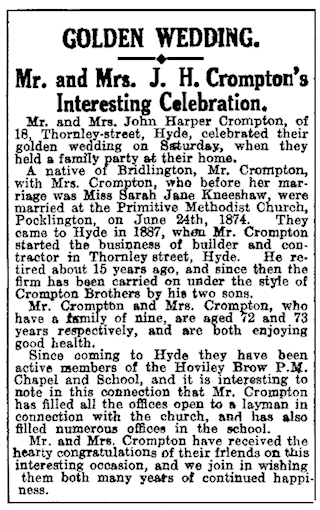
Having been married in Pocklington Primitive Methodist Church, the couple switched their allegiance to the Hoviley Brow Primitive Methodists 1 where they worshipped at the time of their Golden Wedding.
 |
 |
|
Right: John Harper and Sarah Jane, before 1930 Source: Jim KERON, Ontario, Canada Right: A newspaper clipping, from an unknown newspaper, from early July 1924 |
 |
 |
|---|---|
| Above: Sarah Jane KNEESHAW in later
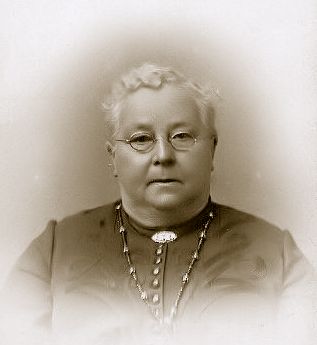
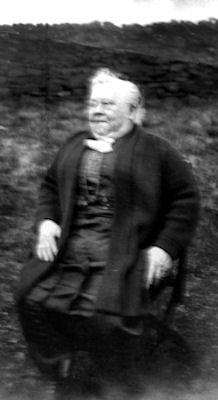
life Source: Jim KERON, Ontario, Canada Right: Sarah Jane Source: Wendy EVANS, |
Sarah Jane's death in 1930
Sarah Jane died about 20 March 1930(GRO ref: Stockport 8a 24). Lottie CROMPTON had already written to her sister Fanny, now Fanny Nixon, living in London, Ontario. John Harper's emotive letter followed later.
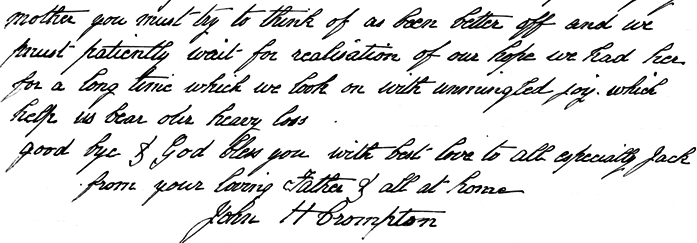 |
| Above: John Harper's letter of 27 March 1930, to Fanny
and Jack Nixon in Canada, announcing Sarah Jane's death.
Double click on the image to open a fuller A4 version.Source: Jim Keron, Ontario, Canada |
Marion KERON, Sarah Jane's grand daughter, retold two stories concerning the death of Sarah Jane.
When they knew Sarah Jane was dying one of her daughters asked her if she was bothered by death or accepted it. Her reply was that "she had trusted Jesus all her life and was't about to quit now." Jim KERON is not certain whether this was handed down verbally or written in a letter. "The day the letter to Fanny arrived Marion was home from school for some reason. She was really grateful when her father showed up at home unexpectedly at noon so he was there to comfort her mother."
John Harper's death in 1935
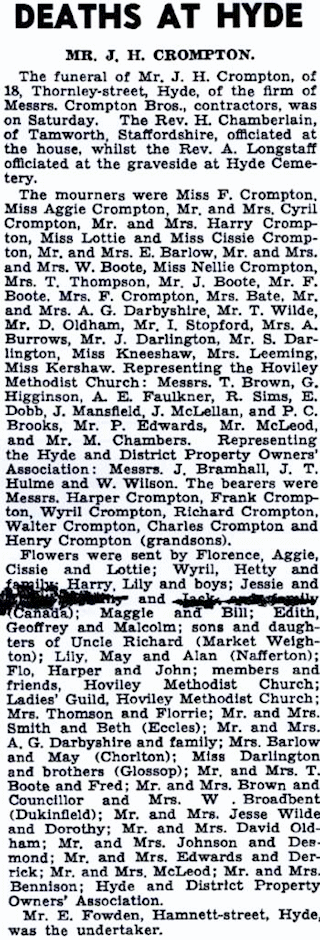
John Harper died in the second quarter of 1935 (GRO ref: Stockport 8a 28).
At his funeral the [possible] mourners were:
Flowers were received from:
Representatives of Hoviley Methodist Church, Hyde and District Property Owners' Association and from a local councillor suggest long-standing and recognised commitments to the community. John Harper also had connections with Eccles, Chorlton, Glossop, Dunkinfield, perhaps through the Primitive Methodist Church. |
 |
| More information 1 |
 |
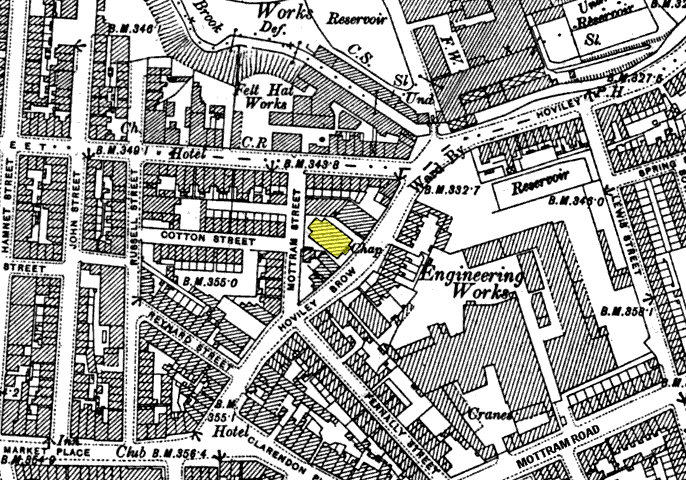
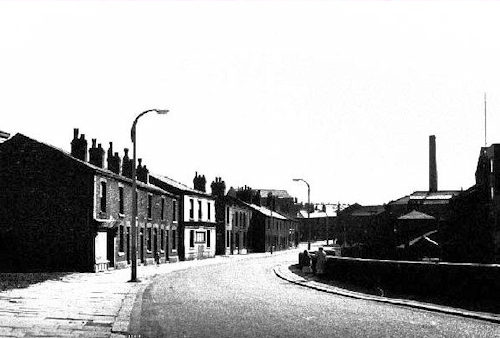
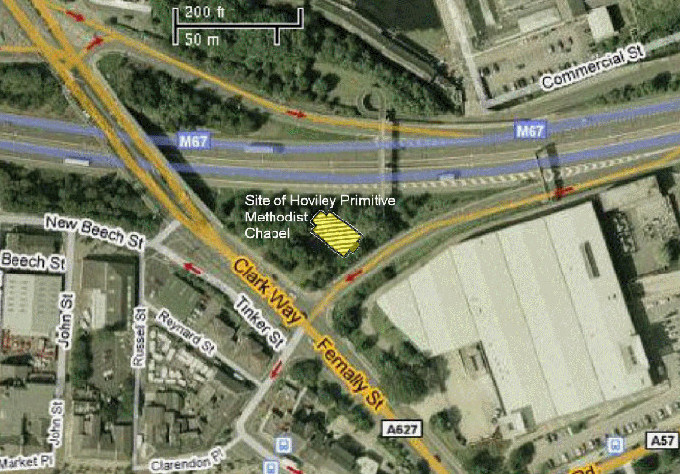
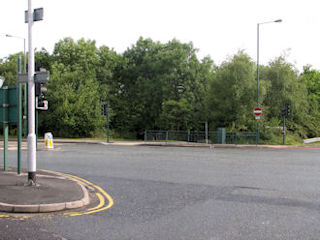
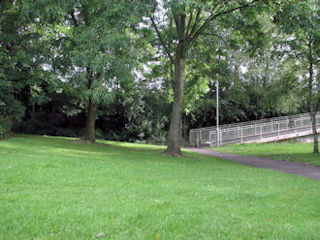
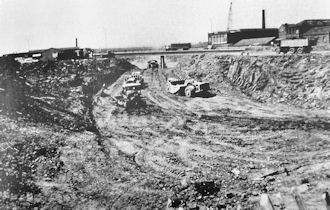
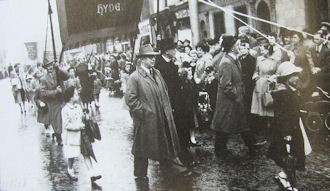
Hoviley Brow Primitive Methodist Church
Hoviley was a district just north-east of Hyde town centre. At one time Hoviley was part of the main route from Hyde to Ashton-under-Lyne. It included:
|
| More information 1 cont:- |
|
|
| More information 1 cont:- |
|
|
| More information 1 cont:- |
|
|
 |
 |
 |
|
| This page was created by Richard Crompton and maintained by Chris Glass |
Version A7 Updated 10 June 2023 |
||
 ohn Harper CROMPTON,