1821 Info 8b: Caleb Crompton
Colin Neil Cox-Crompton, known as "Froggy"
'Good bloke, great sport', 'Dees mourn a hero', 'Demon legend dies'
Neil Crompton, as he was known, died from cancer at the age of 66, on 11 December
2003 at the Cabrini Hospital in Malvern. Immediately several sporting website and
journals recorded a tribute to his sporting life in which he represented Melbourne
Demons, in the VFL (now Aussie Rules), and the Victoria in the Sheffield Shield; one
of the select few to juggle top-level Aussie Rules and cricket careers.
The burley
right back pocket defender, recruited from Ormond Amateurs, played 99 games for
Melbourne during the late 1950s and early 1960s and 45 Sheffield Shield matches. But
for all his sporting prowess he will for ever be remembered for one kick in the epic
1964 VFL Grand Final against Collingwood, when he kicked the winning goal in the
dying minutes of the game in front of a 102,469 crowd: his first goal in eight
seasons erased the disappointment of losing in the 1958 grand final and missing
selection in Melbourne's 1957 and 1960 premiership sides.
Debut: Round 7, 1957 against Richmond at Punt Road
Famed as the man whose won Melbourne their last senior premiership off
his own boot, Colin Neil "Froggy" Crompton was not a noted goal kicker. He had kicked a career
high seven against North Melbourne in Round 11, 1959 but found it hard to win a permanent spot as
a rover.
His most important goal came late in the 1964 Grand Final after he'd
followed his opponent into the forward line. He was 100m out of position, almost a capital crime
in those days, but late in the chaotic game - soon after Hassa Mann had kicked a point to put the
Demons within touch - the ball spilt to him and he threw it onto his boot. It sailed home and the
Demons were in front. It was his first goal for five years and gave the Demons a lead that they
would hold on to for the rest of the match.
He retired two years later, destined to be remembered forever for that
kick. Legend has it that Norm Smith bailed him up after the match and told him off being in the
wrong place, but even the master coach must have enjoyed the fairytale finish no matter how
unorthodox it had been.
Kick that raised a flag just part of Crompton's sporting legacy
By Greg Baum
December 12, 2003
'... Crompton himself had a sanguine point of view about his single mark in time.
Imagine, he said earlier this year, how he would have been remembered if he had missed!
His goal was remarkable in its time, but has gained more significance since. That flag was
Melbourne's sixth in nine years, and it seemed then that more must follow as if by
birthright.
No one would have thought then that the Demons would not win another premiership in
Crompton's lifetime, but now they have come to that pass.
His part in that premiership remains central to the club's mythology. One night in
2000, the Demons took that cup, placed it at half-forward on the spot from where Crompton
had kicked and made a pact about what they would achieve that season. They reached the
grand final, but were soundly beaten.
Crompton, known as "Froggy", was a famously dependable back pocket and
occasional rover, who had been a reserve in two earlier Melbourne grand final teams. He
tried his luck with Glenleg in the SANFL before returning to the Demons in 1962. Such was
his dependability after that he represented the Big V in 1964.
Speaking on 3AW this year, Crompton recalled the drama of the finish. It had begun when
Collingwood ruckman Ray Gabelich kicked what is also one of the most famous grand final goals,
bouncing the ball awkwardly half-a-dozen times before steering it through to put the Magpies in
front. Crompton thought the Demons were done.
He recalled that Hassa Mann kicked a behind, and that in pursuit of his
opponent, Mick Bone, as Collingwood flooded the back line, he found himself in the middle
of the ground.
There were neither time clocks nor runners then, just trainers who waved white towels to
signal that time-on had begun. One gestured to Crompton that he could do nothing where he
was and should get to the play.
The ball spilled his way after a marking contest. The pack was rushing at him, he said, so
he quickly got ball to boot. He said he was never fast, but was a reliable kick. This was
a torpedo punt that sailed unerringly through the posts. It was his first goal for five
years.
"It happened so quickly. I looked at the goals and went bang, kicked it high and
hard, a torpedo punt, and it went through," he recalled recently after posing for a
photo of legends marking the MCG's 150th anniversary.
Crompton remembered the deafening applause as he jogged all the way back to his pocket,
and a muttered exchange between he and the other backmen that they would let nothing else
through now. Melbourne won by four points.
He retired two seasons later after 99 games and 24 goals. ...
Neil Crompton at training in 1964, the year he attained enduring
fame.
... While at the MCG this year [2003], Crompton was given a football and had a shot at goal
from the 1964 spot. It fell a few metres short and bounced sideways. Crompton said that it was
because the ball was flat and that if it had been fully pumped up, he would have made the distance.'
Froggy had a successful coaching career after he retired, including a three-year stint in
charge of Melbourne under-19s.
1821info8b, sheet 3
That immortal match
Then Neil Crompton swooped on a loose ball close to goal and snapped what turned out to be the
winner, even though there was still nearly three minutes left on the clock.
With apologies to Heather Schoffelen, Froggy's third cousin and a long time Collingwood
supporter. Had she only known ....
“Froggy” was just about the most unlikely man in the game to kick such a
goal — or any goal.
He was the designated back-pocket and was in the forward line — against
[Coach] Smith’s instructions — only because his man, rover Mickey Bone, had run the length of the
ground and Crompton decided to go with him.
Although he had once kicked seven goals as a rover against North
Melbourne seven years earlier, this was his first goal for five years and one of only 24 in his
99-match career.
No one was more surprised to see Crompton turn match winner than the
fiery coach, who had given him strict instructions not to stray from the backline.
1821info8b, sheet 4
[...] “I didn’t know whether to abuse him for a lack of discipline or
cry on his shoulder,” Smith said. “I’m glad he did use his initiative. There are times when a
player has to and without him we would not have won.” [However Smith was expected to vent his
feelings towards Crompton for breaking the team rules.]
[Captain Ron] Barassi believes Crompton’s experience at coping with
pressure as a cricketer — he played 45 first class matches as a batsman and superb fieldsman for
Victoria — helped him make the right decision. “He didn’t lapse into panic,” he said.
Left: Melbourne's Neil Crompton signing autographs for young supporters
in the dressing rooms. Source: Herald Sun 08 June 2014
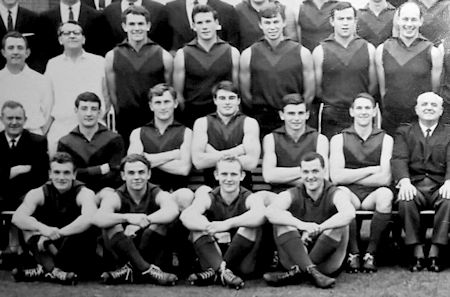
Right: Part of the Melbourne Demons cup winning squad with Neil
Crompton seat on the ground, extreme right
1821info8b, sheet 5
Good bloke, great sport
By Mike Sheahan - Herald Sun
December 12, 2003
IMAGINE the anticipation, the excitement: Neil "Froggy" Crompton was coming to
Werribee to coach the footy club.
It was 1967, just three years after he immortalised his name with what was to become the most
telling kick by a Melbourne footballer in 40 years.
Not only was he the hero of the 1964 premiership, he was just 29 when he came to Werribee after
10 seasons at VFL level. We struggled during our first three years in the VFA, but, in keeping
with the optimism of youth, the younger players embraced Crompton as the saviour, the man to
carry us to glory.
We played Sunshine at Skinner Reserve in Crompton's first appearance as captain-coach, and
he copped a knee to the hip early in the game. It might as well have been a bad knee of his own.
As you would expect of a new coach, he ignored the pain and the medical advice, and continued to
play. That day and the weeks that followed.
The area became infected. It needed to be drained at regular intervals and a player who never
ranked pace among his assets suddenly struggled to run at all. The Frog willed his way through the
season. He was brave and smart, and no one was quicker at getting boot to ball, a trait born of
that lack of pace.
We were a competitive unit under Crompton, making the finals in either his first or second
year. I thought he was a great coach, although my experience was limited. I know he was a good
bloke. He was humble, fair, agreeable. He also possessed that rare quality of appreciating what
sport had brought to his life rather than complain he hadn't earned more from his time at the top.
He came to say hello at halftime during a Melbourne game at
the MCG this year, absolutely thrilled to be a guest of the Melbourne Cricket Club at its
committee lunch, where he saw so many old friends. We reflected happily on where our paths
had taken us in the 35 years since he was a coach and I was a young footballer/journalist,
with much to learn in both fields. He came along at a good time in my life. He was both
hero and mentor. As a Grand Final hero and a Sheffield Shield cricketer, he was the
ultimate in celebrity status for a Werribee boy of 20.
Melbourne FC will celebrate the 40th anniversary of its most recent premiership some time
in the next 12 months. It can't possibly be the event it might have been as a result
of Neil Crompton's passing. No Norm Smith, no Don Williams, no Neil Crompton. They
will be missed.
Good man, the Frog.'
Neil in 2003 with "The Legends of the 'G' "for
the MCG's 150th birthday celebrations
1821info8b, sheet 6
Crompton, the State cricketer
A left-hand batsman, he averaged 32 playing 45 Sheffield Shield matches as an opener for
Victoria, made three centuries and was known as a superb slips and gulley fieldsman. His fellow
opener Dr Allen Aylett remembered Neil as a terrific friend. "While our feats on the cricket
field never entered the record books, we certainly had lots of fun," Dr Aylett said.
Colin Neil Crompton                         Known As: Neil Crompton
Born: 16 August 1937, Dandenong, Victoria   Major Teams: Victoria
Batting Style: Left Hand Bat                Bowling Style: Leg Break

FIRST-CLASS Career Statistics (1957/58 - 1962/63):
                      M    I   NO  Runs   HS   Ave  100  50  Ct  St
Batting / Fielding   45   73    5  2162  124  31.79  3   11  47   0

                      M  Balls  R   W    Ave   BBI   SR   5  10  Ct St
Bowling              45   642  387  8   48.37  2/11 80.2  0   0  44  0
Later, in a 14 year spell with premiership Melbourne Cricket Club, Froggy made 3308 runs, at an
average of 28.03 with six centuries including a highest score of 166. He also took 61 catches. As
a mark of respect the Melbourne Cricket Club wore black armbands during their weekend fixture
against Ringwood.
The death notice posted by the Melbourne Football Club in the Melbourne Herald Sun describes
'Froggy' as a champion clubman and the mastermind of a special moment in football
history. "We salute Neil and remember his crowning moment - the goal that gave us the 1964
premiership, " it says. His death came too late for an obituary in the 2004 edition of Wisden.
Additional sources:
Michael Warner, 'Dees mourn a hero', Herald Sun 'Demons legend
dies', AAP
The Federal Australian Electoral Roll, which started 1903 and is available in Ancestry, shows
1958 6668 Crompton, Colin Neil, 11 Walden rd., SE9, clerk - Carnegie subdivision of
Henty
1958 6669 Crompton, Colin William, 11 Walden rd., SE9, hairdresser