Marriage solemnized in the District of
in the Colony of Victoria
When and where married
Name and Surnames of the Parties
Condition
Birthplace
Rank or Profession
Age
Residence
Parents name
Father's Rank or Profession
448 Queen St Melbourne 4th Nov 1901
John Arthur Cox
Bachelor
Miners Rest
Labourer
29
29 Raglan St Port Melbourne
William Henry Cox Elizabeth Emily Crompton
Farmer
Eliza Maud McCann
Spinster
Tallarook
nil
21
121 Bank St South Melbourne
James McCann Emily Martin
Labourer
I
Joseph Jewell Westwood
, being
duly authorised, do hereby
certify, that I have this day, at
448 Queen St Melbourne,
celebrated the Marriage between
John Arthur Cox Labourer Port Melbourne
and
Elizabeth Maud McCann no occupation South Melbourne
after Notice and Declaration duly made and published and
with the written consent of Dated this
fourth
day of
November
189
1901
Witness: Julia M Cox
Witness: Charles F Cox
1821info5c, sheet 2
John Arthur COX and Elizabeth Maud McCANN were married at
Holt's New Matrimonial Chambers at 448 Queen Street, Melbourne. This seems to have
been as close to a civil ceremony as the times would allow.
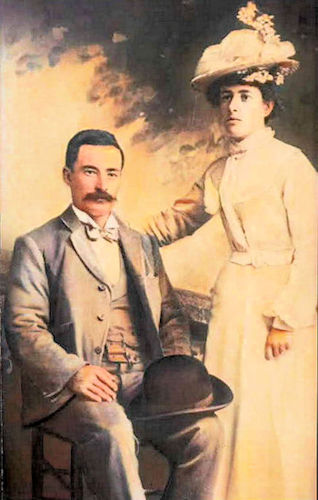
Right: John Arthur Cox and Eliza McCann's
marriage on 04 November 1901
Queen Victoria Market was opened in 1878 on the site of an old
cemetery. Holt's New Matrimonial Agency moved from rented premises in 345 Swanston
Street to 442 Queen Street, hence the term 'new'. Before October 1901 442 was
renumbered 448. It is recorded as being opposite the 'old cemetery': now
opposite Queen Victoria Market.
Right: 448 Queens Street, Melbourne, as it was in November 2009
The advertisement in "The Age" of October 25 1901 shows and gives details of licensed
marriages at 448 Queen Street, Melbourne by Holt's Matrimonial Agency. James Holt's seemed
to be able to supply clergy of quite a number of denominations: he had a group of ministers of
different denominations who were glad to make an extra income and appear to have been available
"on call" though the "Free Christian Church", which does not seem to have had a church of its own
in Melbourne. The address and possibly the witnesses are the only clue to Holt's Agency. An
advertisement on the same day, suggests that the Holt's agency seemed to have been a well-run
organization, giving a complete service, from introductions to marriages.
1821info5c, sheet 3
Marriages at 448 Queen Street are often 'married according to the rites
of'
many different churches.
James Holt and his wife Annie were usually the "witnesses provided". One wonders whether couples who eloped to Queen Street, desired
privacy or had no particular
"Marriages celebrated by ordained clergymen, with due solemnity, in strictest
privacy, at Holt's Matrimonial Agency, 448 Queen Street, Melbourne, opposite the old
cemetery, or elsewhere, from 10 a.m. to 9 p.m. daily, Saturdays included. (no notice
required)
Fee ten shillings and sixpence; or marriage, with guaranteed gold
wedding ring and necessary witnesses provided, £1 one shilling
P.S. - No other charges whatsoever. All sizes, more costly
wedding rings kept in stock if required."
allegiance to a religious denomination. And, as an advertisement the same
day shows, that the well-run service extended to an agency where introductions could be
arranged.
"Ladies, gentlemen, every station in life, contemplating matrimony, immediately
consult proprietors of Holt's New Matrimonial Chambers, 448 Queen Street Melbourne,
opposite the Old Cemetery, specially erected by the proprietors for introductions,
costing £4,000. (Established 1886).
Introductions privately arranged between eligible partners,
either sex, with view to matrimony. Only letter containing stamp for reply answered. All
communications treated confidentially, and managed solely by the proprietors, thereby
ensuring strictest privacy.
Holt's "Matrimonial Gazette" containing particulars
of a number of our available clients, modus operandi, etc., forwarded to any address, in
plain envelope, upon receipt of a two penny stamp."
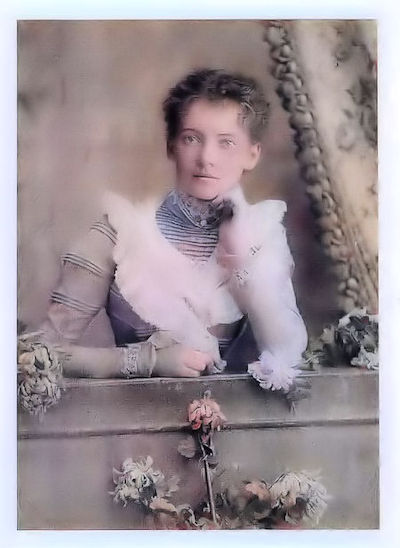
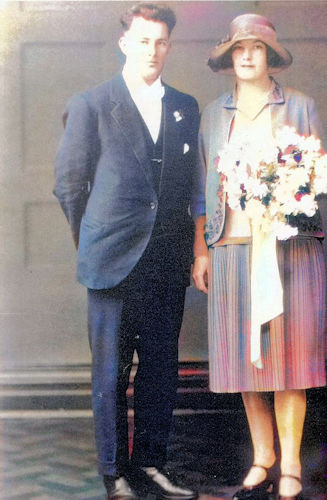
Right: A young Eliza McCann about the time of her marriage
1821info5c, sheet 4
Married life
The couple had seven children and the location of their birth shows how the couple moved around
the State. When William James was born in 1904, the couple lived at Moe in Gippsland.
The Australian Electoral Roll 1903-1977, available on Ancestry, records their homes in
the Gippsland sub-division of Forest between 1922 and 1954 and occupations as:
From 1922-1928:
Cox, Eliza Maud, Wonga, home duties
Cox, John Arthur, Wonga, farmer
and from 1931-1949 at:
Cox, Eliza Maud, Mount Best, Loose Bag, via Foster 1
, home duties
Cox, John Arthur, Mount Best, Loose Bag, via Foster, farmer
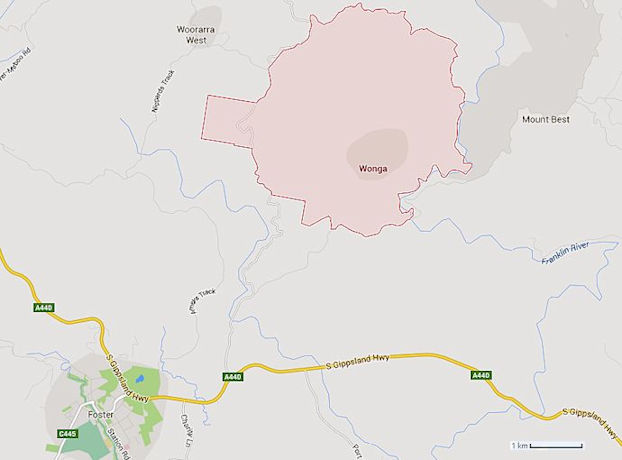
Above: Forest district of Gippsland, showing the close
proximity between Wonga and Mount Best
Between 1934 and 1943 three of their male children were recorded at the same address, though in
1943 a John Arthur COX is recorded but no John Henry.
1934, 543 Cox, Francis Leslie, Mount Best, Loose Bag, via Foster, farm labourer, in Foster
a sub-division of Gippsland
1934, 547 Cox, John Henry, Mount Best, Loose Bag, via Foster, farmer, in Foster a sub-
division of Gippsland
1934, 549 Cox, William James, Mount Best, Loose Bag, via Foster, labourer, in Foster a
sub-division of Gippsland
1943, 553 Cox, Francis Leslie, Mount Best, Loose Bag, via Foster, farm labourer, in Foster
a sub-division of Gippsland
1943, 556 Cox, William James, Mount Best, Loose Bag, via Foster, farmer, in Foster a sub-
division of Gippsland
His son, William James' Attestation papers for 1940 gives his father as next of kin,
living at Wanga Wanga, Mount Best Victoria, which is in Gippsland. 1 This was
later amended to Wangaretta, Mount Best.
1821info5c, sheet 5
THIRD SCHEDULE
DEATH in the District of Foster in
23386
Victoria, Registered by
May E J Phillips
1 No
857
Description -
2 (1) When and where died
(2) Usual place of residence
1st December 1951 Square Top Road Wonga
via Foster Shire of South Gippsland County Buln Buln as above
3 Name and Surname Occupation
John Arthur Cox Farmer
4 Sex and age
Male 81 years
5 (1) Cause of death (2) Duration of last illness (3)
Legally qualified medical practitioner by whom certified and
(4) When he last saw deceased
Cerebral Thrombosis, days
Generalised Arteriosclerosis - 15 yrs Dr Wood. Toora
1st December 1951
6 Name and surname of Father and
Mother (maiden name, if known), with Occupation
William Henry Cox, Farmer
Elizabeth Emily Cox née Crompton
7 Signature, Description and
Residence of Informant
AH Cox
Son
Authorised agent
Amey's Track Foster
8 (1) Signature of Registrar
(2) Date and
(3) Where registered
WJ Phillips 1st December 1951 Foster
If burial registered
9 When and where buried
Undertaker by whom certified
10 Name and Religion of Minister or names of Witnesses of burial
4th December 1951 Foster
HL Phiilips
Rev Ra--ray Church of England
11 Where born and how long in the
Australian States, stating which
Miners Rest 82 years
in Victoria
If deceased was married -
12 (1) Where and
(2) At what age and
(3) To whom
(4) Conjugal Condition at Date of Death
Melbourne 29 years Eliza Maud McCann Married
13 Issue in Order of Birth, the
Name and Ages
Arthur Herbert 48 years,
William James 47 years,
Irene Maud 44 years,
John Henry Dec
Edith Annie 41 years,
Francis Leslie 39 years
1821info5c, sheet 6
At the time of his death in 1951, John Arthur lived at [Wonga] Square Top Road, Wonga (Death
certificate). In 1954, Eliza Maud and Leslie Francis were joined by his wife Maris - mistakenly
recorded as Mavis.
1954 616 Cox, Eliza Maud, Mount Best Loose Bag, via Foster, home duties, in Foster a
sub-division of Gippsland
1954 617 Cox, Francis Leslie, Mount Best Loose Bag, via Foster, farm labourer, in Foster a
sub-division of Gippsland
1954 619 Cox, Mavis, Mount Best, Loose Bag via Foster, home duties, in Foster a sub-
division of Gippsland
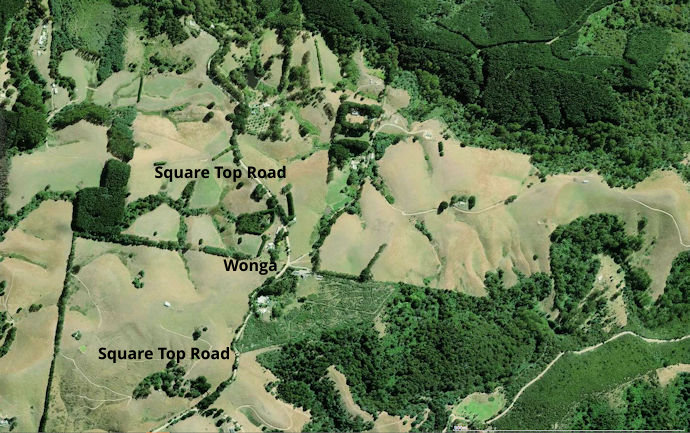
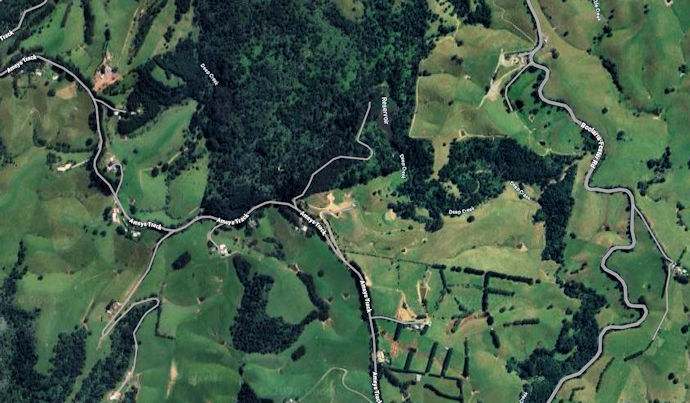
Above: Map locating Wonga and Square Top Road
The last Electoral Roll show Eliza Maud as a widow. Eliza Maud continued to live at Mount Best
until her death in 1955 (Vic BMD 18575/1955).
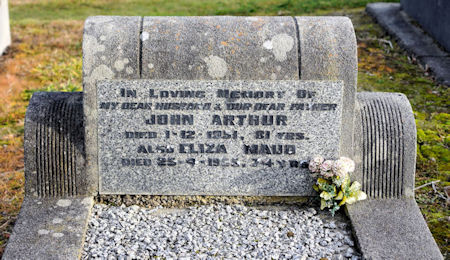
Right: John Arthur and Eliza Maud Cox's headstone in Foster Cemetery
1821info5c, sheet 7
Their children
Arthur Herbert - John Arthur and Eliza Maud's first child
Arthur and Isabel were married in 1927 and spent their life, apart from
war service in Foster, Gippsland.
Between 1934 and 1967, the Australian Electoral Roll 1903-1977, available on Ancestry, records
their homes and occupations as:
1931, 550 Cox, Arthur Herbert, Mount Best, Loose Bag, labourer, in Foster a sub-
division of Gippsland
1931, 535 Cox, Isabel, Mount Best, Loose Bag, Foster, home duties, in Foster a sub-
division of Gippsland
In 1934-35, however, the couple had moved to Rumbug, Loose Bag
1934, 541 Cox, Arthur Herbert, Rum Bug, Loose Bag, Foster, labourer, in Foster a
sub-division of Gippsland
1934, 545 Cox, Isabel, Rum Bug, Loose Bag, Foster, home duties, in Foster a
sub-division of Gippsland
Between 1931-39, the couple lived in Station Road in the town of Foster
1939, 556 Cox, Arthur Herbert, Station-road, Foster, labourer, in Foster a
sub-division of Gippsland
1939, 559 Cox, Isabel, Station-road,, Foster, home duties, in Foster a sub-division
of 1939, Gippsland
Right: Arthur Cox and Isabel Whyte's marriage in 1927
1949, 568, Cox, Arthur Herbert, Amey's Track, Foster, labourer, Foster a sub-
division of Gippsland
1949, 572, Cox, Isabel, Amey's Track, Foster, home duties, in Foster a sub-
division of Gippsland
In 1977, as a widow Isabel remained at Station Road until the 1980 Roll:
1245, Cox, Isabel, 60 Station-road, Foster, home duties, in Foster a sub-division of
Gippsland
In World War II, Arthur Herbert COX enlisted, in Foster, on 12 January 1939 for War Service,
as medically class A1. He served as a married labourer initially in the 2/29 Bn. His record show
him as a fit 5 foot 6½ inches (168cm) high with a weight of 137 pounds (62.14kg) with light
brown hair.
On 01 August 1939, Arthur transferred to the 2/22 Bn as V37139. Despite enlisting in January
1939, his records record 'Called up TTD Bongilla 15/12/41'.
Bonegilla is located on Lake Hume near Wodonga. On 17 May 1944, he was discharged at Royal Park,
Melbourne due to 'personal hardship' with no overseas
service. There is no explanation. His records show his address as Foster, Gippsland with Mrs
Isobel Cox, his wife, as his next of kin.
Arthur was fortunate. The 2/22 Bn were largely captured by the Japanese during the Battle of
Rabaul in 1942. After being captured, the battalion was not re-raised. A large number of its
personnel died in captivity; those that did not were returned to Australia at the end of the war
in 1945.
1821info5c, sheet 8
After the war, the couple moved to Amey's Track where they remained until 1972. Amy's
Track is a winding road through an undulating river valley of eroded grassland north of Foster.
Above: Amey's Track to the left
Arthur died on 04 January 1973 and his remains are in Springvale Botanical Cemetery, Dandenong
Garden 13, Bed 10, P0sition 17..
1821info5c, sheet 9
THIRD SCHEDULE
DEATH IN THE STATE OF VICTORIA
Registered by George
Ronald STANFORD
1 No
No 1225 /73
Description -
2(1) When and where died
(2) Usual place of residence
3 Name and Surname
Occupation
4 Sex and age
4th January, 1973,Foster, Amey's Track, Foster, Arthur Herbert COX Not any Male, 70 years
5(1) Cause of death and duration of last illness (2) Legally qualified
medical practitioner by whom certified and when he last saw deceased
Coronary
seclusions - hours, Atherosclerosis - years, R. Fleming, 29 July, 1972
6 Name and surname of Father and Mother
(maiden name, if known), with Occupation
John Arthur Cox,
Maud Cox
Maiden name McCann Farmer
7 Signature, Description and
Residence of Informant
Certified by
HW Pascoe, Coroner,
Melbourne.
8 (1) Signature of Registration
Officer
(2) Date and
(3) Where registered
Signed
15th January, 1973, Melbourne
If burial registered
9 When and where buried
Undertaker by whom certified
10 Name and Religion of Minister or names of
Witnesses of burial
8th January, 1973 (sic) Cremated at Springvale
Crematorium,
H. Phillips R. Elliot Church of England
11 Where born and how long in the Australian
States, stating which
Melbourne,
Victoria,
70 years in Victoria.
If deceased was married -
12 (1) Where and
(2) At what age and
(3) To whom
(4) Conjugal Condition at Date of Death
13 Issue in order of birth, the name and ages
Melbourne,
Victoria, 25 years, Isabel Whyte, Married,
Arthur John, 44 years, William
George, 43 years, Allan Francis, 42 years, James David, 40 years, Peter Herbert, 39 years,
Geoffrey Owen, 37 years, Brian Edward, 36 years, Betty Margaret, 34 years, Faye Wilma, 29
years, Graham Charles, 26 years,
1821info5c, sheet 10
William James - John Arthur and Eliza Maud's second child
William James was born at Moe in 1904 (Vic BD 12157/1904) and died in Foster in 1985
(Vic BMD 15324/1985). After war service a William James married Ethel Annie EVANS on 21
September 1946 (Vic BMD 12459/1946). Ethel was born in 1904 in Lima South, Victoria
(Vic BMD 14544/1904), 30km north of Mansfield where she died.
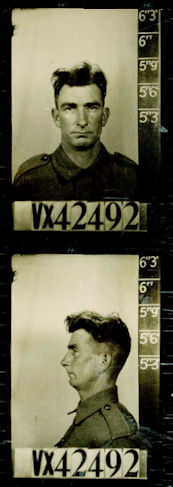
In World War II, William James COX served as VX42492 in the 2/4 Battalion AIF 2
He enlisted at Seymour, Victoria 2 on 14 June 1940, confirming Moe as his
place of birth, his age as 36 years 3 months and that he was a single labourer. There
is no indication of a marriage.
Right: 2/24 Battalion's colour patch 1942-1946: following the change in
design from that of the World War 1 battalion and the T was adopted as a result of
the unit's involvement in the fighting during the Siege of Tobruk, with a grey border
to signify World War 2.
William disembarked in the Middle East on 17 December 1940. On 19 February 1941 he
was admitted to the 1st Australian General Hospital (AGH), Gaga Ridge with dysentery
for fourteen day. There was a further hospital stay in 4/AGH with gastro-enteritis
before rejoining 2/24Bn on 19 November 1941. On 31 October 1942, William was
hospitalised in 7/AGH having been wounded in action with a shoulder wound in his left
shoulder at the Second Battle of El Alamein. After a period of convalescence William
was discharged to 26/Bn on 04 December 1942 before returning to 2/24 on 28 December
1942.
William disembarked in Melbourne on 25 February 1943. 2/24Bn subsequently moved by train
to spend over a year at Kairi on Atherton Tablelands in Far North Queensland where the
battalion underwent a period of intense jungle warfare training. On 04 August 1943 the
battalion was posted to Milne Bay, PNG, taking part in the Battles of Finschhafen and
Sattelburg. The battalion embarked at Finschhafen, near Lae, to disembarked in
Townsville on 02 February 1944 for a battalion rest. On 27 June 1944 there was a
period with 2/1 Australian Casualty Clearing Station (CCS) with an illegible illness,
the 2/2AGH and the 2/1 Australian Convalescent Depot he rejoined his unit on 22 July
1944.
William was eventually discharged at Royal Park, Melbourne on 19 August 1944, before the
Borneo campaign, with a disability 'caused or
aggravated by war' after 1501 days of service, of which 1023 were abroad.
He returned to Foster.
On 12 August 1943 HQ AIF and GOC awarded William a 'commendation card for Gallantry in Action'.
Right: William James Cox 1940
The Electoral Roll shows him living at his parents home in Mount Best until 1943. Given that
he died in Foster suggests he remained in the area for the whole of his life. After the war he marrried:
1949, 304, Cox, Ethel Annie, c/o H. Nankervis via Corryong, home duties, Corryong a sub-
district of Ini
1949, 307, Cox, William James, c/o H. Nankervis via Corryong, farm hand, Corryong a sub-
district of Ini
Until 1980 William was a farm hand at Howes Creek.
1954, 477, Cox, Ethel Annie, Howes Creek, home duties, Mansfield a sub-district of Ini
1954, 480, Cox, William James, Howes Creek, farm hand, Mansfield a sub-district of Ini
Ethel Annie died in 1958 in Mansfield (Vic BMD 25149/1958). The 1980 register shows the
couple had one daughter with whom William James was living in 1980.
1821info5c, sheet 11
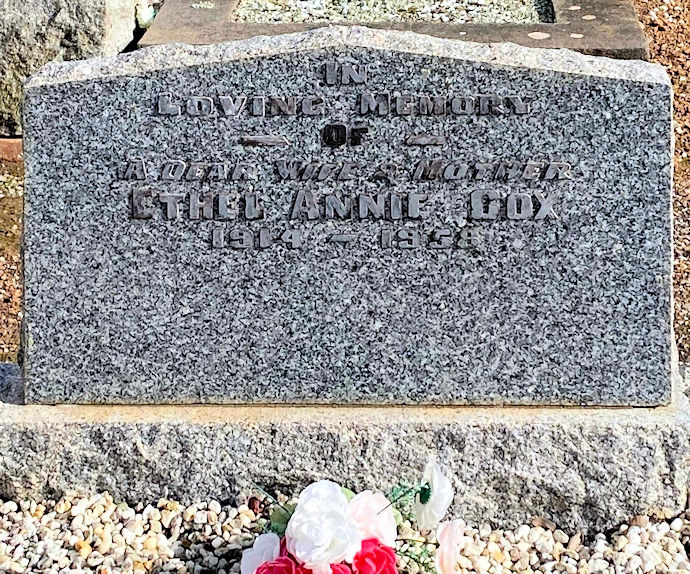
Above: Ethel Annie Cox's headstone
1980, 1834, Cox, William James, 10 Kulnine Ave Mitcham, cleaner, Heatherdale a sub-district
of Deakin
1980, 1835, Cox, Winnifred Mary, 10 Kulnine Ave Mitcham, home duties, Heatherdale a sub-
district of Deakin
1821info5c, sheet 12
Irene Maud - John Arthur and Eliza Maud's third child
Irene Maude was born on 16 August 1905 (Vic BMD 26607/1905) in Panyule. In 1929 she
married Percy Harold GOODING (Vic BMD 9963/1929)
Irene maud Cox ... m......1929 ... Percy harold Goodings
b.16aug1905        |               b...jul1904
d.04jan1954        |               d.25aug1992
       |===========|===========|============|========[|
       Arthur      Herbert     John         William
       harold      james       raymond      daniel
Percy Harold GOODING was born in the third quarter of 1904 in Steying, West Sussex, UK, (GRO ref:
Steying 2b 290).
The Electoral Roll for 1931-34 shows:
7106, Goodings, Irene Maude, home duties at 18 Mayfield st., Coburg a sub-district of
Bourke
7108, Goodings, Percy Harold, a plasterer at 18 Mayfield st., Coburg a sub-district of
Bourke
On 04 January 1954, Percy Harold was widowed when Irene Maude died in Seaford. There is no
obvious Vic BMD record of her death. Two sons were living at home:
1954, 1833, Goodings, Arthur Harold, a fibro plasterer at 54 Fortescue av., Seaford a sub-
district of Flinders
1954, 1834, Goodings, Herbert James, a fibro plasterer at 54 Fortescue av., Seaford a sub-
district of Flinders
1954, 1835, Goodings, Percy Harold, a fibro plasterer at 54 Fortescue av., Seaford a sub-
district of Flinders
In 1967, whilst at the same address another franchised son, John Raymond, an
electrical mechanic, was living at home. In 1963 son George Thomas was living at home.
In 1972, William Daniel was living at home. Percy Harold was at the same address in 1980.
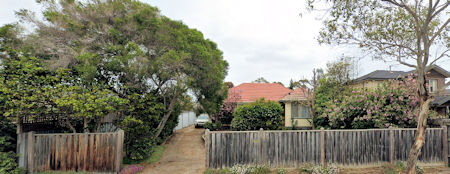
Right: Irene Maud Cox's home at Fortescue Avenue Seaford on the
Morningtown Peninsula
Percy Harold died on 25 August 1992 aged 88 years (Vic BMD 21139/1992). He is interred
in Cheltenham Memorial Cemetery, Bayside.
1821info5c, sheet 13
Olive May - John Arthur and Eliza Maud's fourth child
Olive May was born in Heathcote, Victoria in 1907. (Vic BMD 19412/1907). In 1933 Olive
May married Frank Clark (Vic BMD 11186/1933)
Olive May CLARK appears in the 1943 Electoral Roll for Fawkner, South Yarrow.
In the Electoral Rolls of 1977-80: between 1934-37 the couple lived at:
1936, 994, Clark, Frank, shoe repairer at 33 Carter ave., Toorak a sub-
district of Fawkner
1936, 999, Clark, Olive May, home duties, at 33 Carter ave., Toorak a sub-
district of Fawkner
In between 1941 and 1954, Frank is still a shoe repairer but in 1954 and
1963 he was unemployed. The couple lived at:
1954, 2004, Clark, Frank, no occupation, at 8 Ralston st., South Yarra a sub-
district of Fawkner
1954, 2021, Clark, Olive May, home duties, at 8 Ralston st., South Yarra a sub-
district of Fawkner
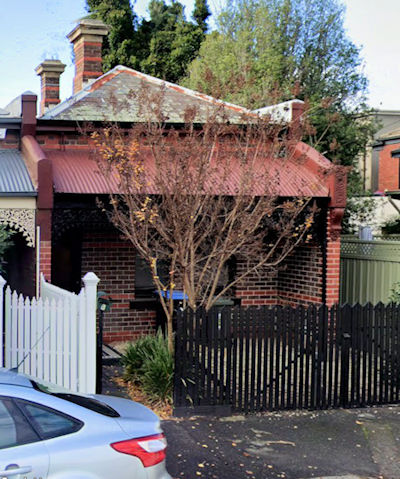
Right: 8 Rolston Road, South Yarra
Between 1967 and 1980 the couple lived at:
1980, 1040, Clark, Frank, shoemaker at 18 Upton Road, Melbourne Ports a sub-
district of Prahran
1980, 10406 Clark, Olive May, home duties at 18 Upton Road, Melbourne Ports a sub-
district of Prahran
Francis Clark died on 26 July 1991 and Olive May died on 23 March 1994. They are both buried in
Lilydale Memorial Park, Yarra Range Shire.
1821info5c, sheet 14
John Henry - John Arthur and Eliza Maud's fifth child
John Henry COX was born in Loch/Woodleigh in 1909 (Vic BDM 12211/1909). In 1940 John
Henry COX married Myrtle Christina HENSHAW (Vic BDM 11842/1940). There is no obvious
record of her birth.
In the Electoral Rolls of 1934-37, John Henry was an unskilled farmer/labourer based on his
parents home.
1931, 537, Cox, John Henry, Mount Best Loose Bag, via Foster, farmer/labourer, in Foster
a sub-division of Gippsland
From 1942 to his death in 1949 (Vic BMD 22786/1949) John Henry COX was a station hand
at Cudgewa Station some 450km north of Foster. This links with a local burial.
1949, 305, Cox, John Henry, Cudgewa Station, Cudgewa, station hand, in Indi a sub-division
of Corryong
1949, 306, Cox, Myrtle Christina, Colac Colac, via Cudgewa, home duties, in Indi a sub-
division of Corryong
John Henry died in Colac Colac in 1949 (Vic BDM 22786/1949) and was buried in Corryong.
From 1954 to 1971 Myrtle is recorded as living at:
1954, 311, Cox, Myrtle Christina, Harris st. Corryon, home duties, in Corryon a sub-
division of Indi
Myrtle died on 21 March 2001. There is no obvious gave.
It has been suggested that John Henry and Myrtle's eldest child, Eunice Myrtle, married Kevin
Anthony WANT. Ancestry's Electoral Role records Eunice Myrtle WANT began her working career as a
nurse in Corryon. This link suggests a feasible relationship between COX and WANT. For an unknown
reason her Sydney born husband is not recorded.
1968, 1820, Want Eunice Myrtle, 216 Hansen st., Corryon, nurse, in Corryon a sub-division
of Indi
1972, 1604, Want Eunice Myrtle, Donald st., Corryon, nurse, in Corryon a sub-division
of Indi
From 1977 to 1980 Eunice lived just in New South Wales:
1977, 8422, Want Eunice Myrtle, 260 Denmar st., Albury 2640, nurse, in Albury a sub-
division of Farrer
However, NSW's BMD shows a Kevin Anthony WANT married Yvonne Jean HUDSON in 1973 in Sydney
(NSW BDM 8406/1973). This couple moved to Mount Lawley, Perth. Yvonne Jean was also a
nurse. Ancestry suggests an alternative husband: Richard FLEET born 06 Sept 1929 and who died in
24 April 1993. His headstone photo, in Newcomb, Geelong, shows he married a Eunice Myrtle, born 28
December 1930 and who died 08 December 1987. This is clearly not Eunice Myrtle COX born 10
November 1941.
John Henry and Myrtle's second child was Dorothy Maud.
A Dorothy Maud COX married Graham Arthur GRENNESS in 1965. (Vic BMD 20944/1965).
From 1967 to 1972 the couple lived at:
1967, 1405, Grenness Dorothy Maud, Hurley ct., Numurkah, home duties, in Numurak a sub-
division of Murray
1967, 1409, Grenness Graham Arthur, Hurley ct., Numurkah, panel beater in Numurak a sub-
division of Murray
In 1977 the couple had moved a distance of 153km:
1980, 4630, Grenness Dorothy Maud, Urana Rd., Jindera, home duties, in Albury North a sub-
division of Farrer, NSW
1967, 4631, Grenness Graham Arthur, Urana Rd., Jindera, panel beater in Albury North a sub-
division of Farrer, NSW
Dorothy Maud died on 05 February 2015 aged 70. Her memorial is in Corryong Cemetery, plot 03
07 33.
1821info5c, sheet 15
Ethel Annie - John Arthur and Eliza Maud's sixth child
Ethel Annie was born in Drouin in 1910 (Vic BMD 326801/1910). In 1928, Ethel married
William Albert BENTLEY (Vic BMD 10679/1928), who was born in Cheddleton, Staffordshire on
25 February 1905. (GRO ref: 3rdQt 1905 Cheadle 6b 355), confirmed by his Attestation
Papers
In World War II, William Albert BENTLEY attested on 31 January 1939 into 13 Light Horse in
Foster. He was a married man, quoting Ethel Annie as his spouse, and farmer by occupation. He
appears to have started 'active service' on 06 January 1941 at a camp in Geelong. On 30 April
1941 he marched into his new camp at Leongatha, Victoria some 40km north-west of Foster. On 14
May 1941, still with the 13/LH, he was promoted to sergeant.
On 19 July 1941 William was transferred to Balcombe [Creek Camp] later
home of the US 1st Marine Division and Mount Martha. Rather than over looking Port
Phillip Bay and so guarding the sea entrance to Melbourne, Mount Martha was part of the
Balcombe training area. In January 1942 William was back at Leongartha for a month before
moving to Dandanong and Heidelberg.
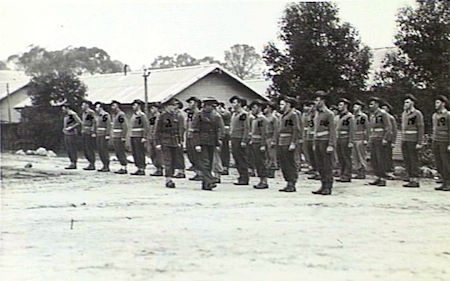
Right: Balcombe Camp parade August 1944 Source: AWM
In April 1942 William is admitted to hospital (B'inder S?) with Colitus Puac [Pucai], which is
a pediatric coitus with symptoms including recurring diarrhoea (often containing blood, mucus, or
pus), frequent and urgent bowel movements, abdominal cramping, and lower tummy pain. Extreme
fatigue, fever, unexplained weight loss, and nausea may also experience. This may have been the
cause of William's hardship discharge on compassionate grounds, from Royal Park, Melbourne, in
August 1942 as medical class B2. He had experienced 114 days of home based active service. His
discharge papers give the date of enlistment as 22 July 1940.
The Australian Electoral Roll 1903-1977, available on Ancestry, records show that between 1926
and 1928 William BENTLEY was living in:
1926, 163, Bentley, William Albert, Foster North, labourer, in Foster a sub-division of
Gippsland
The 1934 Roll shows him as a married man living in Mount Best until the 1954 Roll:
1934, 174, Bentley, Ethel Annie, Mt. Best Loose Bag, Foster, home duties, in Foster a
sub-division of Gippsland
1934, 182, Bentley, William Albert, Mt. Best Loose Bag, Foster, farmer, in Foster a
sub-division of Gippsland
In 1963 the couple had moved
1963, 226, Bentley, Ethel Annie, Winchester St, Foster 3960, home duties, in Foster a
sub-division of Gippsland
1963, 232, Bentley, William Albert, Winchester St, Foster 3960, farmer, in Foster a
sub-division of Gippsland
and Ethel Annie lived there as a widow until her last entry in 1980:
1967, 226, Bentley, Ethel Annie, Winchester St, Foster 3960, home duties, in Foster a
sub-division of Gippsland
William Albert died in Foster in 1981 (Vic BMD 1074/1981). Ethel Annie died in Foster in
1985 (Vic BMD 2352/1985). They are both buried in Foster Cemetery, along with Henry Francis
and Robert Oswald BENTLEY.
1821info5c, sheet 16
Francis Leslie - John Arthur and Eliza Maud's seventh child
Francis Leslie was born in Loch, 70km north-west of Foster, on 21 July 1912 (Vic BMD 31705/1912).
1936, 552, Cox, Francis Leslie, Mt. Best, Loose Bag via Foster, farm labourer, in Foster a
sub-division of Gippsland
Francis, a single farmer, enlisted on 17 January 1939 at Foster as a trooper V23913 in the 13
Light Horse Regiment. He transferred to the Area 22 Reserves on 06 December 1941 at Balcombe. His
records contain no further information. In World War 2, the 13/Light Horse converted to the
13th Armoured Regiment before being disbanded in October 1943.
In 1949, Francis Leslie and his Eliza Maudwere were joined at Mount Best, Loose
Bag by Francis' wife Mavis KELLET, known as Daisy, who he married in 1947 (Vic BMD 9434/1947).
Victoria BMD records her name as Maris. There is no obvious Victoria birth record between
1910 and 1929 for either forename or an appropriate Kellet. NB: The use of Maris appears to be
a typo. A Maris Kellet was born in Batley, UK in the third quarter of 1920 (GRO ref:
Dewsbury 9b 1019), Ancestry makes a link with Maris Cox.
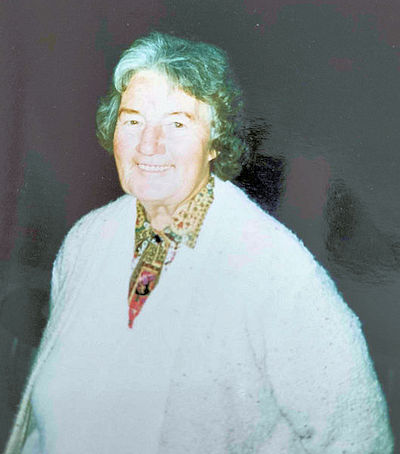
Right: Maris Daisy Kellet
Ancestry's Electoral Roll records a single Maris Cox:
1949, ..., Cox, Maris, 389 Glenferrie Rd., home duties, in Malvern a sub-division o
f Higgins
From 1949 to 1967, the Australian Electoral Roll records:
1949, 570, Cox, Francis Leslie, Mt. Best, Loose Bag via Foster, farm labourer, in Foster a
sub-division of Gippsland
1949, 574, Cox, Francis Mavis (sic), Mt. Best, Loose Bag via Foster, home duties, in
Foster a sub-division of Gippsland
1980, 2192, Cox, Maris, 26 Grubb Ave., Traralgon, home duties, in Traralgon a
sub-division of Gippsland
649, Cox, Francis Leslie, Blackwarry, via Foster, farmer, in Yarram a sub-division of
Gippsland
651, Cox, Mavis (sic), Blackwarry, via Foster, home duties, in Yarram a sub-division of
Gippsland
1821info5c, sheet 17
From 1977 to 1980 a Maris COX is recorded living in Traralgon, 90km
north-east of Foster.
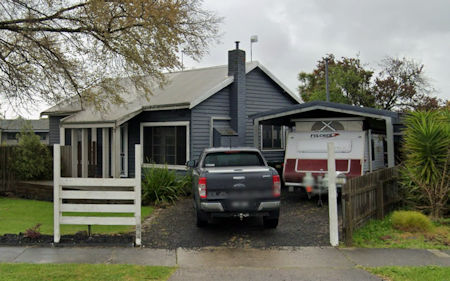
Right: 26 Grubb Avenue, Traralgon
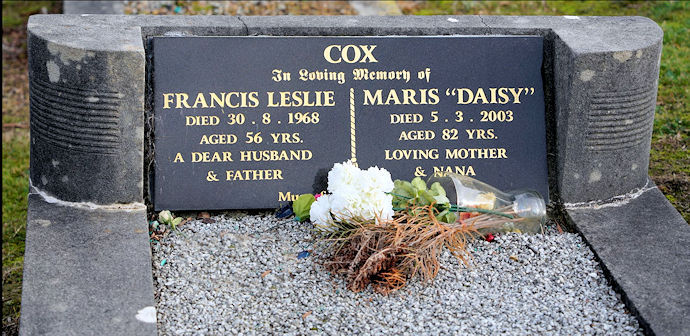
Francis Leslie died in Blackwarry on 30 August 1968 (Vic BMD 21074/1968). Maris died on
05 March 2003.
Above: Francis and Maris Cox's headstone in Foster
Cemetery Photo Sue McC
1821info5c, sheet 18
Some of the ten children of Alan Herbert COX and Isabel
Alan Francis - Alan Herbert and Isabel's third child
In 1954, an unattached Alan Francis COX appears in the Electoral Roll and living in Amey's
Track. This may be the son of Albert Herbert but the name hasn't been linked through Victoria
BMD.
614, Cox, Alan Francis, Amey's Track, Foster, assistant cook, in Foster a sub-
division of Gippsland
In 1963-68:
719, Cox, Alan Francis, Amey's Track, Foster, linesman, in Foster a sub-division
of Gippsland
Brian Edward - Alan Herbert and Isabel's seventh child
Between 1958 and 1967 Brian Edward COX was living in Amey's Track.
721, Cox, Brian Edward, Amey's Track, Foster, public servant, in Foster a sub-
division of Gippsland
In 1977-80 Brian was married to Sheila and there was a change of address:
1242, Cox, Brian Edward, a labourer of 39 Nelson St., Foster 3960, in Foster a sub-
division of Gippsland
1253, Cox, Sheila, home duties in 39 Nelson St., Foster 3960, in Foster a sub-division of
Gippsland
End notes
Moe is in Gippsland, 93km north of Wonga.
Seymour is 29km from Seymour, to the north of Melbourne
1821info5c, sheet 20
More information 1
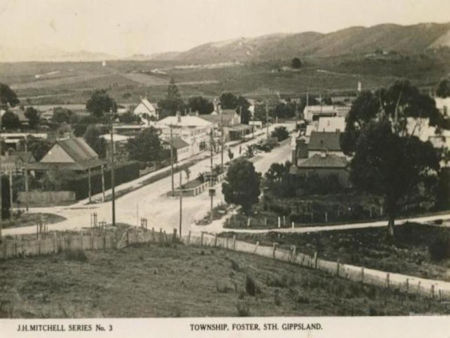
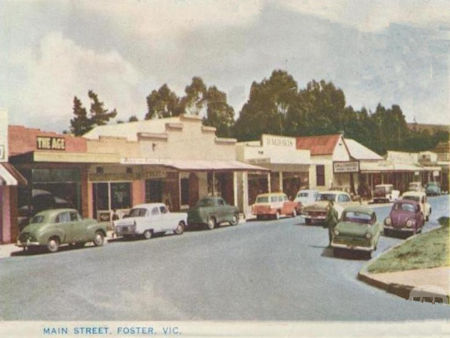
The history of Foster township
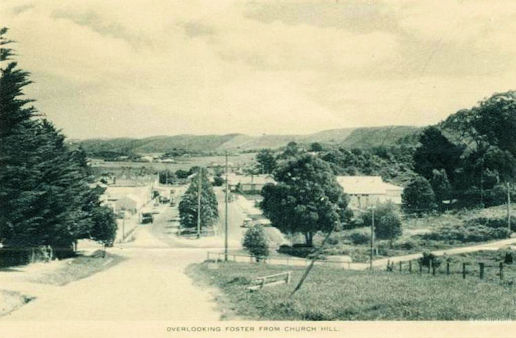
Foster, a rural town, is 150 km south-east of Melbourne. It is on the South Gippsland
Highway and 45 km north of Tidal River, Wilson’s Promontory.
The town is on Stockyard Creek, about 5 km upstream of the creek’s mouth on Corner Inlet. The
creek was used to transport and spell livestock being taken from east Gippsland to the
Western Port district.
In 1869 some timber harvesters at Stockyard Creek discovered alluvial gold there, and by the
middle of the next year about 30 miners were working claims. In early 1871 the number had
grown to about 200. A mining dispute brought the local magistrate and gold warden, William
Foster, from Sale and his successful settlement of the matter resulted in the miners naming
the place after him. By the middle of 1871 tracks were cut from Moe and Rosedale to Foster.
The town’s early token of civilisation, a mechanics’ institute, also opened that year. A post
office and a school opened in 1872 and a Methodist church opened in 1874.
Downstream there was a boat landing for incoming and outgoing mail, where there were one or
two hotels in addition to the several in Foster. In 1872 a telegraph line was connected to
the landing. There were several other gold finds around Foster which kept up activity until
1877 when it was reported that mining became depressed, despite the discovery of a few new
leads. Land seekers were needed in place of gold seekers.
Foster’s hills were moist, fertile and tree covered. Farm selections on the coastal plains
around Welshpool and Hedley were nearly all taken up by the early 1880s, and in 1884
selectors came to Foster, attracted by the moist conditions after a severe Victorian drought
a few years before. Land selection legislation was also more favourable. Within two years
all available farm blocks around Foster were occupied.
In 1892 the Great Southern Gippsland railway was extended from Korumburra to Foster and
Toora. The increasing town and farm populations felt that they were being neglected by
Alberton shire council and successfully agitated for severance. South Gippsland shire,
headquartered at Foster, was formed in 1894.
From the 1950s Foster was firmly established as the district centre. The high school (1952)
and hospital were expanded and a consolidated school established when senior classes moved
to the high school. Buses brought pupils from the surrounding district to the Foster primary
school resulting in the closure of some small district schools. New shire offices and an
arts centre were built in 1960 and 1966. A number of government departments established
offices and depots at Foster.
Many properties in the hill country north of Foster had been abandoned since the mid-1920s,
the farmers defeated by the steep terrain, the mud and the poor roads. From the 1950s large
areas were taken over by the Forests Commission and reforested with softwood and hardwood
plantations.
From the 1970s dairy farms increased in size with amalgamation of properties. But there was
also a proliferation of hobby farms and holiday houses in the hills and near the coast.
Foster is still the service centre for the surrounding agricultural district.
Hoverbox Photo Gallery - Foster, Victoria This feature does not function correctly on phones and tablets
The 2/24th Battalion was an 900 strength, all-volunteer Second Australian Imperial Force
(2nd AIF), formed in Caufield in July 1940 from primarily Victorian volunteers and was
known as "Wangaratta's Own" because of the time the battalion spent in the town during
its formative period prior to deployment overseas. It served in North Africa in
1941–1942 as part of the 26th Brigade. In early 1943, the battalion returned to
Australia and later took part in campaigns against the Japanese in New Guinea in
1943–1944 and Borneo in 1945, before being disbanded in 1946. The 2/24th suffered the
highest number of battle casualties of any 2nd AIF infantry battalion.
The battalion was deployed to the Middle East, departing in November 1940, aboard the
transport ship HMT Strathmore. After completing further training in Cyrenaica, the
battalion subsequently saw action for the first time around Tobruk in April 1941,
remaining there for eight months, occupying various positions around the perimeter before
they were withdrawn by sea in late October 1941. A period of garrison duties followed in
Palestine and Syria before being hastily moved to El Alamein in response to a German
advance through the desert towards Egypt. The 2/24th was subsequently heavily involved in
both the First and Second Battles of El Alamein between July and November 1942. During
the First Battle of El Alamein, the battalion fought to secure Tel el Eisa where they
captured a German intelligence unit; during the second battle the 2/24th advanced from
Tel el Eisa towards the sea, amidst fierce fighting around a position dubbed the "Saucer".
The 2/24th subsequently sailed in early January 1943, landing in Melbourne the following
month. They subsequently moved by train to spend over a year at Kairi on the Atherton
Tablelands in Far North Queensland. For the majority of 1943, the battalion underwent a
period of intense training for the rigours of jungle warfare. In September, the 2/24th
went into action again, taking part in an amphibious landing to advance on Lae, in New
Guinea. The operation was quickly concluded. As the Australians followed up the
retreating Japanese, a further landing was made on the Huon Peninsula in September. The
2/24th subsequently took part in actions around Finschhafen and then the assault on
Sattelberg. They took part in the subsequent advance north to the inland Wareo, during
which they were mainly used to carry stores and ammunition, before being released from
this task and taking part in the fighting around the Christmas Hills. They were
transported back to Australia for rest in early 1944.
In April 1945 they were committed to Operation Oboe, the Allied campaign to retake Borneo
and Java. The plan called for several landings around Borneo and its surrounding areas.
The 26th Brigade's part in the operation was to capture the island of Tarakan. The main
landing came on 1 May, during which the 2/24th formed the brigade's reserve. After the
success of the initial landing, the 2/24th was committed to the fighting to secure the
airfield on 2 May, but heavy fighting ensued as the Japanese defenders fought to hold on
to the strategically important position, and the 2/24th were held up until 5 May.
Following this, the battalion pushed into the rugged terrain inland, fighting a series of
actions to secure the high ground overlooking the township. This fighting lasted up until
20 June, when Hill 90 was finally taken by the 2/24th. Mopping up operations followed as
the battalion worked to clear Japanese stragglers from the oilfields to the north.
Following the end of hostilities in August 1945, the battalion's personnel were slowly
transferred to other units for further service, or repatriated back to Australia for
demobilisation. The remaining cadre sailed back to Australia in December 1945, and the
battalion ceased to exist in early 1946. A total of approximately 3,415 men served in the
battalion throughout its existence. The battalion's casualties throughout the war
amounted to 360 killed and 900 wounded; this was more than any other 2nd AIF infantry
battalion.
This page was created by Richard Crompton
and maintained by Chris Glass