 |
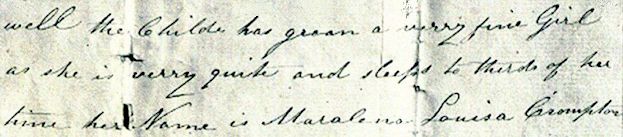
| Above: Caleb's announcement of Maralena Louisa's birth |
1821 Info 2a for Caleb Crompton |
Maralena (aka Madeline Madalena Maraline) Louisa CROMPTON
In 1845 Caleb wrote home to his mother naming his first born as Maralena Louise. Despite many different spellings of her name and the name on her tombstone she is referred to as Maralena throughout.
|
| Above: Caleb's announcement of Maralena Louisa's birth |
However, LINC Tasmania have made a transcription error ...
 |
| Above: A composite image of Maralena Crompton's birth certificate Ref: LINC Tasmania RGD33/1/27 no 612 (Accessed: 15 July 2017) and search for 'Madalena' Click on the image to open a full size A4 image in a new window. Note the pen strike through the 'r' which makes the letter 'd'. LINC Tasmania will not change the index. |
Tasmania's Heritage database (Accessed 07 August 2015) references Caleb and family using the <Name> field.
Maralena Louisa TASP 57295
All other documents and records use the name Madeline, Madalena or Madeline, the name that appears on her headstone and frequently appears in later generations. Known in this text as Maralena.
Source:   Victoria Pioneer Index CB 454306 Ref 1054
  CROMPTON,   Madalena Louisa
  Birth                    Sex:      Female
  Father:     Caleb        Mother:   Lombe Frances Louisa
  Event Date: 06 Jul 1845  Reg Year: 1845
  Reg State:  Tasmania at Spring Dale, Longford, Tasmania
The obituary of Maralena's brother, Charles Walter, describes their journey from Cox's Creek to Ballarat in 1852 bullock cart, known as a bullocky. The average distance travelled each day by a bullock dray fully loaded with supplies or household belongings was approximately 8-10 miles (13 km) a day. (In modern time this is a distance of 594km or 45 days.)
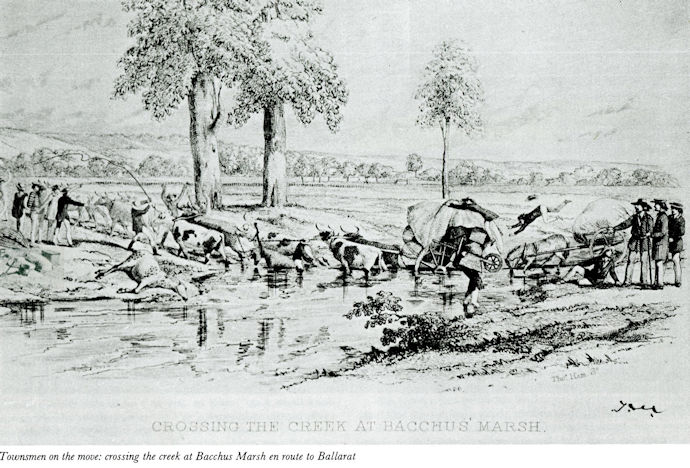 |
| Above: Bullocky team crossing Bacchus Marsh, Ballarat Source: Bate p.10 |
Maralena's obituary describes her arrival at a tented village known, as Ballarat, at the time of the riots. 1
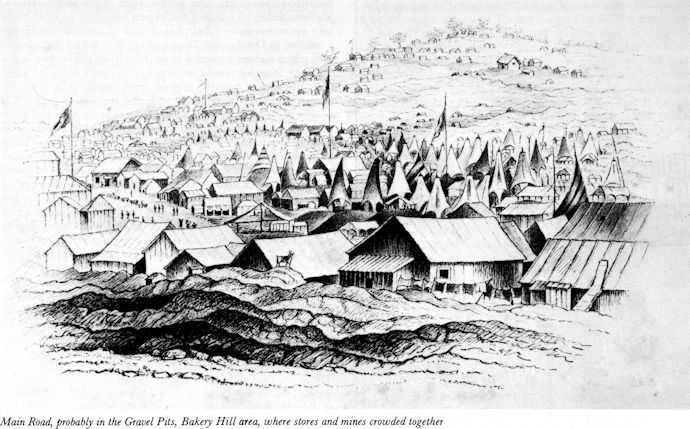 |
| Above: Main Road Ballarat c.1854, probably in the Gravel Pits Source: Bate p.43 |
Her marriage
| In 1865 Maralena married Donald MacDONALD, a secondary school teacher in Bald
Hills, north of Ballarat. (Vic BMD 2020/2865)
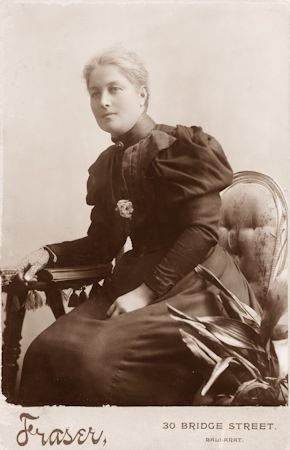
Left: Maralena CROMPTON/MacDONALD Source: Heather Schoffelen - a photograph that I never thought to see |
 |
Donald's obituary (qv) records that he was born in Inverness in 1839 to Alexander McDonald and Ann Frazer (Fraser). The Ancestry 1841 census records 14 Donald Macdonalds born about 1839, all in highland Scotland; the 1851 census records 11. However, it is possible that, since their son Charles William named his house 'Inverness', Donald's origins were in Inverness and not Inverness-shire. Donald home in Sulky was named 'Glenore', however it has not been possible to find this place. If this is so, there were two Donald Macdonalds, born in 1839 listed in the Ancestry census. It may be possible to see when these Donald MacDonald disappeared from the census and if this matches a Victoria immigration. His obituary records him leaving Scotland on 08 September 1862 for the New Zealand/Victoria goldfields.
The best record of Donald MacDonald's early life would now seem to be:
1851 Scotland Census Sun/Mon 30/31st March 1851
Source:     Roll: CSSCT1851;  ED: 2A; Page: 26; Line: 1
Dwelling:   26 Petty Street  [Now Eastgate]
Place:      Inverness, Inverness-shire, Scotland

Name                         Rel   Mar  Age  Occupation     Birthplace
Alexr [Alexander] Macdonald  Head   M   36   Spirit Dealer
Ann MacDonald née Fraser     Wife   M   33
Donald MacDonald              Son       11   Scholar
James MacDonald               Son       10   Scholar
Isabella MacDonald            Dau        8   Scholar
Ann MacDonald                 Dau        5   Scholar(?)
Alexander MacDonald           Son        1
Catherine Fraser             Serv       22
This family has yet to be traced in the 1841 and 1861 census.
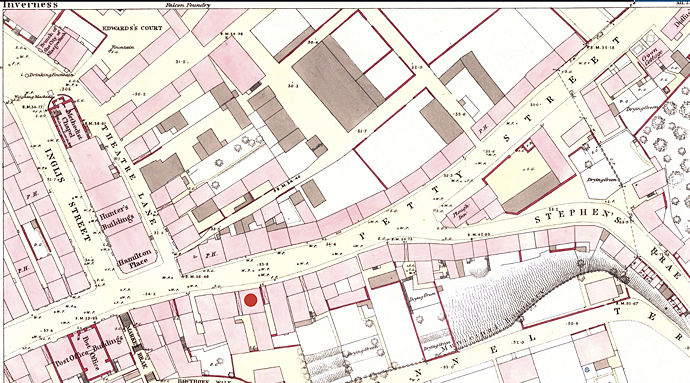 |
| Above: An 1869 map of Petty Street Inverness, now
Eastgate, marked red Source: National Library of Scotland Inverness XII.2 1875 (Accessed: 08 September 2017) |
A Donald MACDONALD of Inverness appears in a seaman's register. He departed Liverpool on 28 September 1866, as a fireman in the crew of the Achilles, with a given age of 29. For the journey, which departed Lpool [Liverpool] he was paid £4 5 shillings (£4.25). This MacDonald was discharged in London.
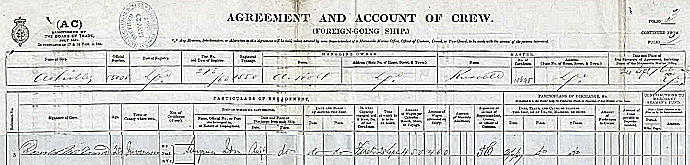 |
| Above: A composite image of Donald MacDonald's emigration record dated 24 September 1866 |
Life in Miners Rest and Ballarat
Maralena's obituary, see below, describes Donald's teaching career recording that he joined the Education Department in 1872 at the inception of free education and was the first teacher at Dowling Forest. Donald's teaching record 1 contradicts this statement. His first assessment at the II Division Dowling Forest School, School No.204, 2 was on 8 January 1866. This records 'H Teacher', which may indicate that Donald was Head Teacher. An additional date of 22 May 1865 is also recorded, suggesting a possible start date as the position of this date corresponds to other starting known dates. Donald resigned on the 31 October 1877 to start at Bald Hill School, School No. 109, the next day as an assistant teacher. However, assessment reports of 6 July 1874 and 7 September 1875 refers to 'his' school, suggesting he was the Head Teacher.
 |
| Above: Donald MacDonald's teaching assessment at Bald Hill |
In general the school was satisfactory under Donald's guidance with good discipline and record keeping, suitable methods were fairly carried out with fair supervision. It was not out outstanding. On 31 January 1878 Donald's teaching assessment records that the school was 'struck off' suggesting it closed. However, on 1 February 1878 Donald was 'Appt. HT from 1 February 1878 at Bald Hill School, now School No. 2027. On the first appraisal of 20 June 1878, it was recorded that Donald was a good teacher in a 'well conducted school'. Donald remained at Bald Hill School until he retired on 31 October 1894, at the age of 55, after 29 years and 163 days service, which will loosely conform to the start date on his state record.
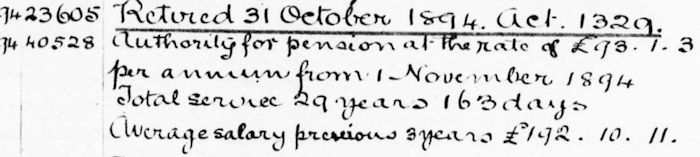 |
| Above: Donald MacDonald's pension assessment at Bald Hill |
In the early years at Bald Hill, between 20 June 1878 and 2 December 1890, Donald's annual appraisals were constant in their comments, though at this time sessions they were not graded with a percentage. Though 'hard working' and 'efficient', phrases such as ' fairly energetic', 'apparently attentive' and 'mechanical teaching' were common.
 |
| Above: Donald MacDonald's teaching assessment at Bald Hill 1890 describing a man 'well up in years' and 'working to capacity' |
The appraisals from 1891 to 31 July 1894 are difficult to transcribe, though Donald scored between a 65% and a 'Very fair 70' with the general comments of an 'Industrious teacher' [...] 'of the old style', 'not particular about the details of school management' giving 'fairly sound' work, though 'Discipline is weak' with 'pupils not very intelligent'.
Following retirement Donald taught at three schools on short term temporary contacts:
On the whole the appraisal comments are not positive. One assessment score rated Donald ' 57 Fair' and a second was with held. Written comments refer to 'old fashioned' with 'weak organisation', though Donald was 'kindly'. His class discipline was described as 'weak' but improving. The penultimate appraisal on 24 July 1902, when Donald was 63 years old, refers to Donald has 'no ability to adopt modern methods' and finally that he 'Should not be offered further employment'.
 |
| Above: Donald MacDonald's final teaching assessment at Diapur 1902 |
The family was long connected with the Presbyterian Church at Miners Rest, perhaps from his Scottish origins, where he acted as secretary and precentor for many years. On retiring from the Education Department, in 1912, the family removed to their Creswick Road home in Ballarat.
 |
| Right: Ballarat Star 01 January 1898 page 1
The Ballarat Star of 01 January 1898 shows that Donald M'DONALD (MacDONALD), Maralena Louisa's husband, was the correspondent to the Miners Rest School Board of Advice. It is assumed they are non-teaching members of the community who support the school with there experience. This confirms the family is living in the Miners Rest school catchment area in 1898. At the age of ten Tom received the third prize at the Miners Rest school prize giving from his uncle Donald. Source: Trove |
 |
Frances Louisa's death certificate, of 15 September 1900, was witnessed by Donald MacDonald, who gave his address at Sulky, 6.5km north-east of Miners Rest. Even in 2015 Sulky gives the appearance of a community of well spread bungalows in their own paddocks.
In November 1901 the MacDonald's would have witnessed the village struck by a sudden and fierce cyclone which caused a lot of destruction. The storm caused widespread damage across the Ballarat district from Sulky to Ballan. Sulky recorded the most damage:
| SULKY GULLY AND
DISTRICT. A SCENE OF DEVASTATION. At Sulky Gully the cyclone was responsible for a large amount of damage. It was about a quarter-past five when the storm started, and it raged for fully half an hour. There were many miraculous escapes from death. The full extent of the storm and the amount of damage caused to crops and tenements will not be ascertained for a day or two. Some pioneers in the district state that they have never seen such a severe storm as that which raged yesterday afternoon. The cyclone came across from the direction of Mount Hollowback, through Sulky. Judging from the track left behind, by the number of houses and trees that were swept away, it must have been a quarter of a mile wide. Redman’s hotel was almost demolished by the severity of the storm. The roof and sides were blown off, and some of the sheets of iron from the roof were to be seen stuck in the trees a distance of nearly half a mile away. Several persons were injured, one man being so badly hurt as to necessitate his removal to the Creswick Hospital. This was accomplished by means of the coach which left Ballarat for Creswick during the afternoon. The other hotel at Sulky, almost opposite Redman’s, known as the Waterloo hotel, was also swept away, and only the walls of one portion of the bar now remain. The roof was carried several yards away, and nearly every piece of furniture was destroyed. The trees in the neighborhood of this hotel were up rooted, and in many instances stripped to such an extent as to leave only the bare trunk. Several cattle were killed along the track of the tornado, and in many instances animals were blown into adjoining paddocks. [...] At the railway station the roof was lifted off the waiting room, and has not yet been found. A high tank, containing water, was blown from its staging at the station and lodged on to the platform. Numerous other buildings and sheds at Sulky were also razed to the ground, and many valuable horses were killed. [...] The Wesleyan Church at Sulky Gully had its roof badly damaged by the storm, and the first gate-house beyond Sulky Gully was stripped of its roof, and its occupants had a narrow escape. Throughout this portion of the district many railway gates were swept away, telegraph poles blown down and splintered into hundreds of pieces, while portions of Redman's building were seen on the hilltop 600 yards away. Bullock’s Waterloo hotel is the property of Mr Walter Bradby, of Ballarat East, and was, together with the adjoining farm properties, to have been sold by public auction on Monday next. The extent of damage to Mr Bradby’s property could not last night be fully estimated. The public house is a certain loss of fully £300 and the same amount can be placed as the result of the damage done at Redman’s hotel. A resident of Ballarat named D. Brown had pulled up with his horse and cart at the Waterloo hotel just as the storm commenced. In a few seconds the verandah and front portion of the hotel swept over Mr Brown and his horse and cart. Assistance was immediately at hand, and Mr Brown fortunately escaped with a few scratches and slight shock to the system. The horse was so encased among the debris that it had to he taken out through the window-sash. Mr Wm. Uren also had a narrow escape. Whilst the storm was at its height he sought shelter in a shed, but the protection was only temporary, for two large trees fell on top of the roof. He managed to scramble out, and rolled him self along a fence, where he lay until the storm had abated. Mr Redman’s horse and dray were standing in his yard whilst the wood it contained was being unloaded. The shaft of the dray penetrated the animal and killed it. Mr Redman possessed several head of poultry, and these were killed by the severity of the storm. The roof from off the Sulky Gully station was deposited at the side of Mr Redman’s hotel, nearly half a mile distant. A large iron post, forming portion of the verandah of one of the hotels, was found nearly a mile off, bent up in all directions. Bricks from chimneys that were an easy prey to the raging storm were carried fully a mile away. When the storm showed such devastation to property, Mr Con. Patten took his wife and another lady with two men into a passage of the Waterloo hotel, and remained there whilst the other portions of the building together with the furniture and contents of a well-kept house, were being gradually cleared off the land. Fortunately for them this passage remained intact, simply through it being shielded by a brick wall. As it was the occupants received a terrible fright which they will ever remember. The small space they occupied was barely sufficient and, strange to say, they were for some time jammed in the passage corner, without means of escape, as two doors were unable to be opened through the falling mass of timber that accumulated there. Mr Redman’s chest of drawers was like the roof, carried from the building with all its contents. Up to a late hour last night it had not been recovered. A coat belonging to the licensee, was picked up half a mile from the hotel. Mr Redman considers he had a most miraculous escape, chiefly through taking shelter under the bagatelle table in the hotel. |
|
Mr Romeo’s house was completely
wrecked, and Mr W. Martin, who was in his hut at the time the storm commenced, was,
with his building and contents, taken in mid-air over a green hedge. Mr Martin
received minor injuries. Many residents, upon being questioned as to the approach
of the storm, state that it came very suddenly. The damage throughout the district
is estimated at several thousands of pounds. Mr Patten was at Nhill during the great storm in that township, and he states that yesterday’s cyclone was in many respects much more severe than the Nhill one. |
The 1912 Ballarat Electoral Register records:
The 1920 and 1922 Electoral Registers give a clue to Donald's occupation as a retired teacher (Record number 2772)
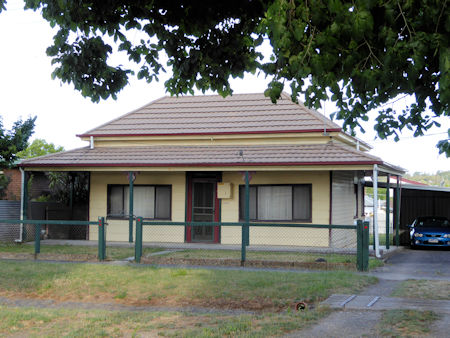 |
Maralena and Donald lived at 'Allowah' 416 Creswick Road, Ballarat, Victoria
directly opposite Ballarat Old Cemetery, where they are buried. Left: 416 Creswick Road, Ballarat in Author: November 2015. |
| Right: A modern map locating 12 Baird Street and 416 Creswick Road, the home of Maralena (Madalena) Louisa (nee CROMPTON) DONALD. Note the close proximity of Ballarat Old Cemetery, where her mother Frances, Caleb's wife, was buried. | 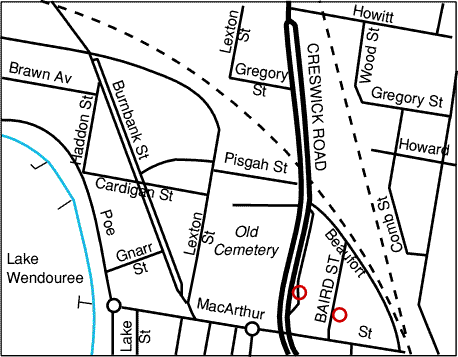 |
Their deaths
Donald's death on 07 October 1922, (Vic BMD 11701/1922) is recorded in The Horsham Times of Tuesday 10 October 1922 and tells a great deal about his life.
| PERSONAL The death has occurred of Mr. Donald McDonald, aged 83 years, a pioneer colonist. Born in Inverness, Scotland, he came to Victoria at an early age. After having spent some time on the goldfields he joined the Education department, and was for many years in the Ballarat (V.) district, having been at the Bald Hills school for 32 years, Mr. McDonald had resided in Ballarat for 16 years. |
| Source:
PERSONAL.
14 October 1922. The Australasian, Melbourne, p.9 (Accessed: 29 August 2017) |
 |
|
Another of the pioneers of the State, Mr. Donald Macdonald, passed, away at his residence in Creswick road, Ballarat, on Friday, at the advanced age of 83. The deceased was born at Inverness, Scotland, in 1839, and was educated for a teacher, but took a position as timekeeper on one of the northern railways. He left Scotland on September 8th, 1862, and spent some time working on the goldfields of New Zealand and Victoria. At the time of his marriage, in 1865, he took the position of teacher of the Dowling Forest school. He joined the Education Department in 1872, at the inception of free education, and was appointed to the Bald Hills State School, where he remained for 32 years until he retired from the service. In his younger days, Mr. Macdonald was of a genial and jovial disposition. He was a great reader, and took a keen interest in a politics. He was closely connected with the Miners' Rest Presbyterian Church for over 40 years, acting as precentor and secretary, and he also took an active part in all local affairs. About ten years ago he went to Ballarat, and settled in Creswick road, where he has resided ever since. He was a member of the local Mechanics' Institute, but owing to a physical defect, he was unable to take part in public affairs. The deceased leaves a widow and three sons and three daughters. Two of the sons, Donald and Charles, are builders and contractors at Murtoa and Horsham; while the eldest son, Alex., is in the Railway department as head of the passes and advertising departments. Miss Macdonald is assistant in the Macarthur street school. Mrs. Gilmore resides in Bexley, Sydney, and Miss Maud Macdonald is at present on a visit there. The death is regretted by a large circle of friends. |
| Source: Obituary, 10 October 1922, The Horsham Times p.5. (Accessed: 29 August 2017) |
Maralena died as Madeline MACDONALD on 07 March 1924 at 410 Creswick Road, Ballarat, the home of her spinster daughter Annie (Vic BMD 220/1924). Though in failing health her death was sudden. The obituary records her birth in Launceston, her move to Adelaide at an early age and the overland travel by bullock cart to Ballarat, which at the time of her arrival, in 1852, was a tented village. This was, according to the obituary, at the time of the gold licence riots which began in 26 August 1851 and continued until 1854. She would have been in Ballarat at the time of the Eureka Rebellion of 03 December 1854.
 |
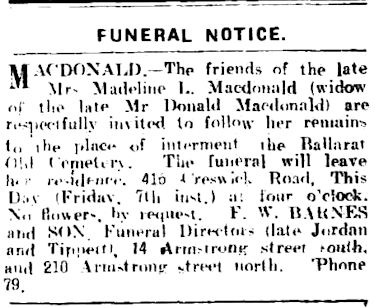
| Late on Wednesday evening the death occurred at 41O Creswick road. Ballarat, of Mrs. Madeline Macdonald, the mother of Mr. Charles Macdonald, of Horsham. Although for some time her health had been failing she was about as usual, and her sudden collapse came as a great shock to her family. The late Mrs. Macdonald was of a kind and genial disposition and since her husband's death, less than two years ago. she had lived with her daughter, Miss Annie Macdonald, of the Macarthur Street State school. Mrs. Macdonald was horn at Launceston in 1845, and at an early age left with her parents for Adelaide. In 1852 the family travelled overland to Ballarat, when it was only a village of tents, and was in business here at the time of the riot. In 1865 she married the late Donald Macdonald, who was the first teacher at Dowling Forest but later at Bald Hills and was for 32 years at Sulky. The family was long connected with the Presbyterian Church at Minersrest, (sic) Mr. Macdonald acting as secretary and precentor for many years. On retiring from the Education Department the family removed to their present home in Creswick road. The family consists of three sons and three daughters. Mr. Alex Macdonald is connected with the Railways, and Messrs Charles and Donald are building contractors at Horsham and Murtoa. One daughter. Mrs. Gilmore, Madeline Laura (Lil) resides at Sydney, Miss Maud in Melbourne, and Miss Annie at home. Two sisters and a brother still survive, viz., Mrs Forsyth, of Bayswater (Elizabeth Emily Milner FORSYTH) ; Mrs. Frederick Sayle, (sic - Caroline Laura SALE) of Sulky and Bald Hills; and Mr. Charles Crompton the well known contractor of Melbourne. The funeral took place on Friday, the Rev. John Walker conducting the service at the house and graveside. The coffin bearers were Messers John Kennedy (Miners Rest) K MacLeod, M McCommiche, G.F. Smith (Sulky Gully), W McLeish and K Good. |
| Source: Horsham Times, Tuesday 11 March 1924, page 4 (Accessed: 07 March 2021) |
 |
|
Left: The Ballarat Star of 07 March 1924 printed two days after Maralena's death on 05 March 1924. |
 |
Their graves
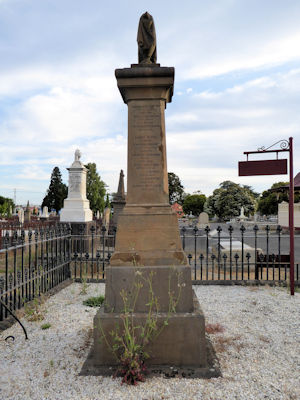
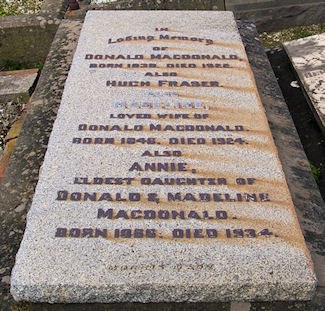
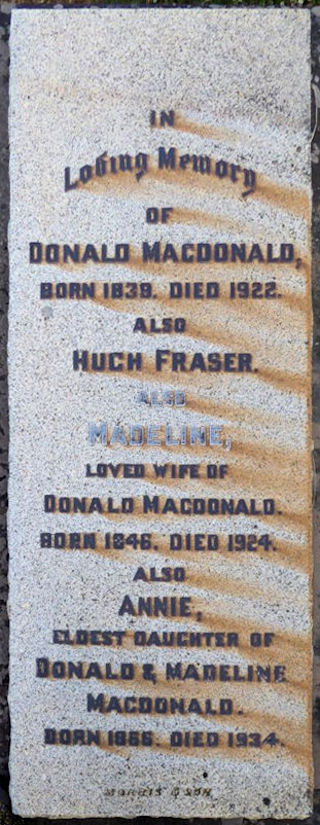
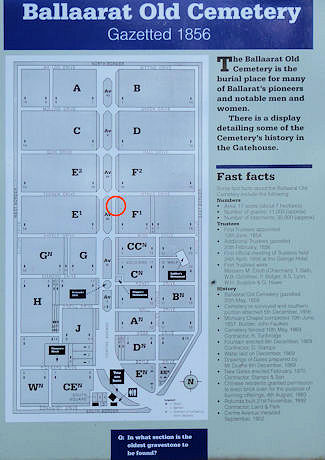
| Maralena, Donald and their daughter Annie Louisa are all buried in plot F1-2-14 of
Ballarat Old Cemetery. Annie, a school teacher, was buried on 07 May 1934 (reference
13775).
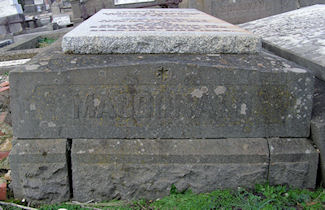
Although this gravestone resolves the spelling of the family surname it adds an additional problem with yet another spelling of Maralena. At this point in time nothing is known about the name of Hugh Fraser. |
 |
 |
 |
|
 |
|
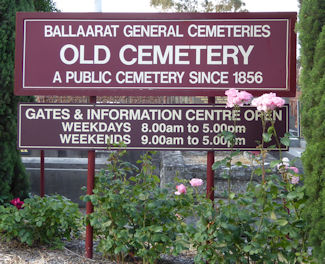
Above: The grave of Maralena, Donald and Annie in Ballarat Old Cemetery. Above left: Entrance to Ballarat Old Cemetery. |
 |
|
|
Left: Cemetery plan marking the grave location All photos Author: November 2015 |
|
| Donald MacDONALD's mother was Ann FRASER. Hugh FRASER died in Ballarat on 04 February 1908 (Vic BMD 218/1908) of unknown parents. Would he have been a nephew/brother/cousin of Donald's mother Ann Frazer? |
End notes
Their children
The Pioneer Index of Victoria 1836 and 1888 uses the spellings of McDonald and MacDonald for their children and records:
Name             Birth place     Birth (Vic BMD Reg. Death place   Death  (Vic BMD Reg.
                                 year     number                   year     number
Annie louisa,    Dowling Forest  1866     16609      Hawthorn      1934
Elizabeth maud   Miners Rest     1867     23559
Alexander        Miners Rest     1869     17484      Camberwell    1948      8473
Charles william  Miners Rest     1869     18309      Horsham       1949
Madaline         Miners Rest     1873     11306
Donald fraser    Miners Rest     1874     24599      East Brighton 1943
Annie Louisa - Maralena and Donald's first child
Annie was a spinster teacher who first appeared in the teachers records in 1883 as a pupil teacher working towards her certificate. 1 (Teacher ID 10080)
Annie's teaching record begins with an entry on 17 August 1876, which records her age as 9 years and 11 months, perhaps recording her as a pupil teacher. On 17 August 1883, Annie was appointed to Bald Hills, School No. 2027, in the Central Highland Region. Between that date and 4 May 1896 Annie was involved in the school based training to obtain her [teaching] certificate. The summons 2 suggests Annie was 'fairly suitable' in November 1883 and 'fairly promising' the following year. From January 1885 Annie was classified as a 3rd Class teacher. However she failed her 2nd Class assessment on 15 December 1885 and did not qualify until a year later. On 15 December 1887 and 18 December 1889, though still 'fairly promising' Annie failed her 1st Class assessments. She was classified 1st Class only on 13 July 1892, back dated to 1 January 1892, despite being assessed as 'Fairy reliable' with assessment scores of 70 and 76, and as someone who 'takes great interest in her work' and gives a 'pretty good lesson' with the class having 'done satisfactory work'.
Emily gained her 1st Class certificate on 13 July 1892 following an assessment score of 65. This was effective from 1 January 1892 with six monthly assessments being 'a pretty good lesson' with the class having 'done satisfactory work' from a teacher who 'takes great interest in her work' and scoring 76 and 70. There followed three temporary contracts before resuming her position on 18 February 1895.The assessment that followed describe Annie as 'diligent energetic and hardworking' with good class control and someone who ' contributes largely to the success of the school'.
There then followed a series of uncertified short term contracts at different schools, suggesting a 'permanent' relief' 'teacher.
|
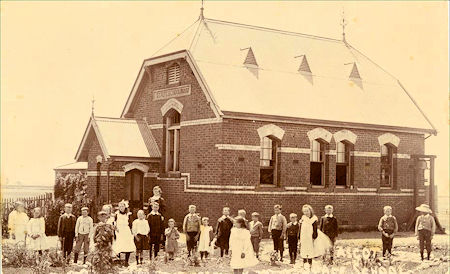 |
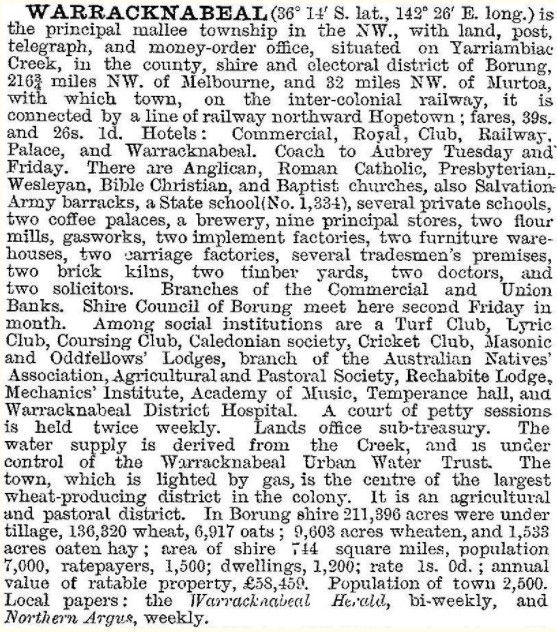
A longer period of time was spent at Warracknabeal with mixed comments and assessment scores. Despite many of the pervious comments and maintaining good discipline 'on the whole', Annie did not stimulate the older pupils so her assessment was 'a fair teacher only', with a score of 63.
| Warracknabeal is 231km north-west of Ballarat and had a population of 131 in 1891.
Right: Warracknabeal described in the Australian handbook of 1903 Victorian Places (Accessed: 27 August 2021) |
 |
Annie was not 'certificated' until 19 June 1915, 32 years after her teaching record started and after she had moved back to Ballarat, where she taught for 13 years.
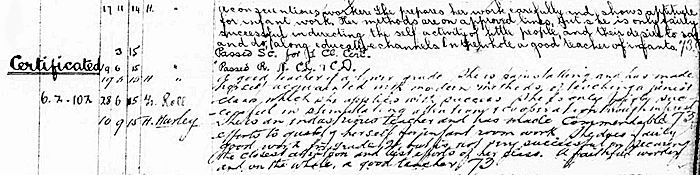 |
| Above: Annie MacDonald teaching record Macarthur Street |
A conscientious worker She prepares her work carefully and shows aptitude for infant work. Her methods are on approved links, but she is only fairly successful instructing the self activity of little people, and their desire to say and do along educative channels. On the whole a good teacher of infants. 73
She is an industrious teacher and has made commendable efforts to qualify herself for infant room work. She does fairly good work with first grade but is not very successful in securing the closest affection and [..]st effort of her class. A faithful worker and on the whole, a good teacher. 73
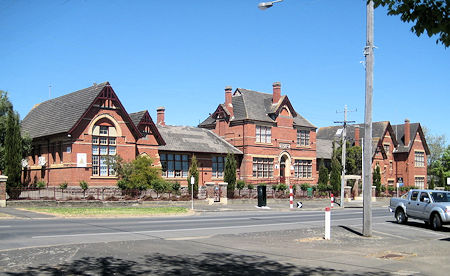
| Macarthur Street School opened 31 May 1878 when it replaced Soldiers Hill School
It re-opened 1916 after being remodelled.
Right: The modern Macarthur Street School |
 |
Annie maintained good comments and an assessment score in the mid to high-seventies at Macarthur until 29 May 1926 when she exchanged with D Doney at Coburg.
She retired from Coburg on 22 August 1926 at the age of 60 and still a spinster.
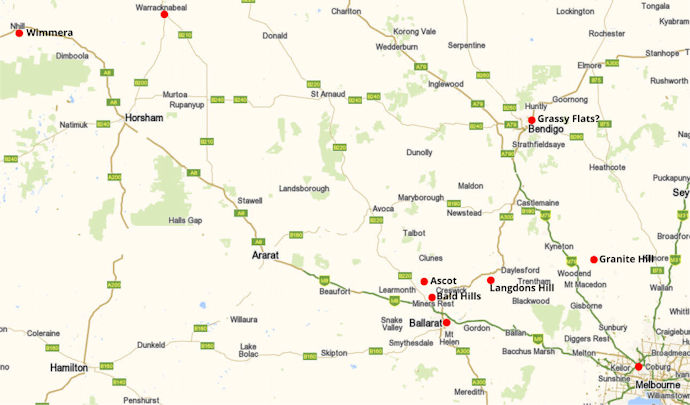 |
| Above: Map locating Annie MacDonald's schools |
The Australian Electoral Rolls, 1903-1980 shows from 1912 to 1924 Annie Louisa lived with her parents
before moving across Ballarat and then to Melbourne.
| AFTER the expiration of
fourteen days from the publication hereof application will be made to the Supreme
Court of the State of Victoria in its Probate Jurisdiction that PROBATE of the WILL
(dated the third day of April 1933, of ANNIE LOUISA MACDONALD late of "Allenby Lodge"
Burwood road, Hawthorn In the said State, spinster deceased may be granted to Donald
Fraser Macdonald, of Hamilton street Murtoa, in the said State retired builder
executor named in and appointed by the said will.
Dated this 28th day of May 1934 D BRUCE TUNNOCK of 443 Little Collins street, Melbourne proctor for the applicant |
| Source: The Argus 28 May 1934 p.16 (Accessed: 19 July 2017) |
End notes
Elizabeth Maud - Maralena and Donald's second child
The Australian Electoral Rolls, 1903-1980 shows from 1912 to 1923 Elizabeth Maud lived with her parents
A StreetView image of the St Kilda Street property, where and Elizabeth Maud MacDonald was registered between 1923 and 1927, would suggest it was beyond the spinster Elizabeth Maud's mean unless house duties inferred.
Elizabeth Maud died in 1942 in East Malvern (Vic BMD 6786/1942)
Alexander - Maralena and Donald's third child
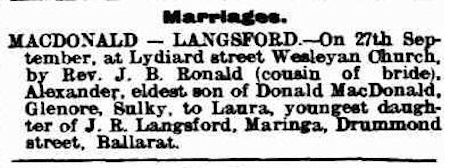 |
Source:
Family
Notices, 01 November 1899, The Ballarat Star, p.2 (Accessed: 24
July 2017) This notice confirms Maralena and Donald's Sulky address in 1899. |
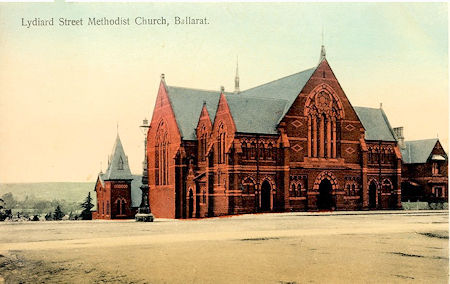
| Right: A Victorian postcard of Lydiard Street Wesleyan Church,
Ballarat The Ballarat Star of Saturday 30 September 1899 confirms that the full choral wedding took place between Alexander MACDONALD, a member of the church choir for many years and of the Railway Department and Laura LANGSFORD at 3.30 at the Wesleyan Church. |
 |
Laura was the youngest daughter of Mr and Mrs J[ohn] R[aynor] LANGSFORD, of 'Maringa', Drummond Street North, Ballarat. One of the Miss MACDONALD acted as bridesmaid and Mr W ASPINALL was best man. 'The wedding party left for the Lyceum Hall, where the wedding tea was nicely laid out'. 'Later in the day Mr and Mrs MacDonald left for Melbourne, en route to Sydney, on their holiday tour'. (No doubt at railway employees discount.) Whist there is a long list of ladies attending; ladies who wore 'handsome' and 'beautiful' attire, and gifts presented. An enjoyable social gathering was held at 'Maringa' on the Wednesday evening, attended by the large number of young folk.'
Source: Trove: WEDDINGS. 30 September 1899, The Ballarat Star, p.6. (Accessed 22 July, 2017)
| Previous to her marriage Miss Laura Langsford (Mrs M'Donald) (sic) gave an afternoon tea to the female inmates of the Benevolent Asylum. She was assisted by Miss E. M’Donald, (sic) and the residents of the institution seemed delighted at having had the opportunity of participating in the joyful occasion. |
Source: Trove:
GOSSIP.
30 September 1899,
The Ballarat Star, p.6
(Accessed 22 July, 2017)
Also
APPROACHING MARRIAGES.
23 September 1899,
The Ballarat Star, p.6. (Accessed 22 July, 2017)
Laura May LANGSFORD was born in Tarnagulla 1873 (Vic BMD 20578/1873) and died in Camberwell in 1964 (Vic BMD 5528/1964) as Mc.
Although the Australian Electoral Rolls, 1903-1980, shows the following entry there is nothing firmly established to the wedding occupation of a railway employee. The generic term <clerk> may cover the 1922 obituary employment in the Railway department as head of the passes and advertising departments.
11 Loch Street, Camberwell North was Alexander and Laura May's home until 1931, when they were joined by Jean, perhaps an unknown daughter or the wife of their son Donald, until 1936.
Their son Donald Leslie MACDONALD was born in Ballarat in 1900 (Vic BMD 16111/1900). In 1933 he married Mary Eileen YOUNG (Vic BMD 12538/1933), who was born in 1904 in Box Hill (Vic BMD 983/1904). Donald Leslie died in 1970 (Vic BMD 6166/1970) and was cremated at Springfield Botanical Cemetery on 23 March 1970. Mary Eileen died in 1979 (Vic BMD 15350/1979) and was cremated at Springfield Botanical Cemetery on 06 July 1979. Her remains were scattered.
The Australian Electoral Rolls, 1903-1980 shows Donald Leslie as a single man living with his brother:
where he remained until the 1936 Roll which shows that he and his wife had their own home
By 1943 the couple had moved two doors in the same street
By 1954 Donald was living 2.4km from Miami Street and 3.2km from his brother
In 1967 they moved 1.3km from Stanhope Grove to a very up-market residence where Donald Leslie retired
and where, after his death, Mary Elieen continued to live
until 1977, two years before her death.
Their second son John Raynor MACDONALD was born in Camberwell in 1902, registered as McDonald (Vic BMD 23706/1902). He died in 1971 at Glen Iris aged 68 with the surname Mac. (Vic BMD 30575/1971).
The Australian Electoral Rolls, 1903-1980 shows that before 1924 John Raynor had married a Laura May and they lived at
where they remained for the rest of their lives until 1934 when the Roll includes their daughter Jean ...
| ...
until 1943 when she was no loner registered. The last record of the couple is in 1949,
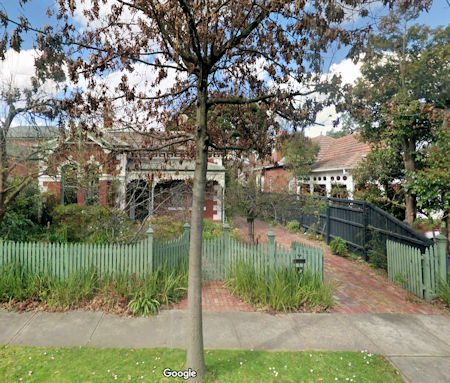
still at 11 Loch Street and still a draftsman. Left: 11 Loch Street Camberwell, John Raynor's home for so long, in 2014 |
 |
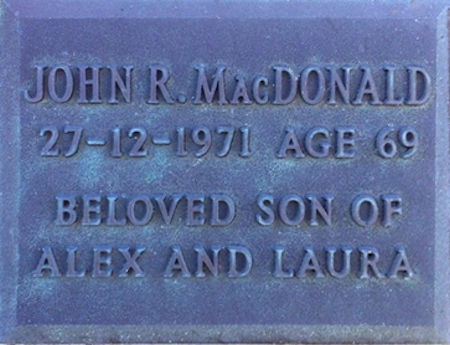 |
John Raynor was cremated at Springvale Botanical Cemetery on 30 December 1971 - Melaleuca, Colonnade 2, Section J, Niche 06. it is interesting that the plaque names his parents, not his wife, who isn't registered at Springvale. |
Charles William - Maralena and Donald's fourth child
Charles William's obituary states that he was born at Dowling Forest 77 years ago (1871/2) and that he had lived in Victoria for 60 of those years. He came to Horsham after residing in Perth, Western Australia for 17 years where two of his children were born. His occupations, on his probate, were listed as a retired builder and formerly Theatre Manager. His mother's obituary of 1924 mentions he and his brother were building contractors. In 1934, under the Transfer of Land Act 1928, an application of foreclosure on the mortgage was made against Donald Fraser MACDONALD of Murota and Charles William MACDONALD of Horsham. This could be redeemed if the land was sold or moneys raised to pay-off the mortgage and expenses incurred. Advertising, 14 May 1934, The Age, Melbourne, p.3 (Accessed: 05 August 2017) Did this precede bankruptcy?
The Australian Electoral Rolls, 1903-1980 shows that Charles William and Mary Hannah lived at
until 1924. In 1927 the resided at
which changed its address name to
which is where Charles died.
| MACDONALD.-On July 25 (suddenly) at his residence, "Inverness," Dooen Road. Horsham. Charles William Macdonald, loved husband of Cissy Tingate, loving father of Hazel (Mrs. G. W. R. Dickinson). Alex, Lorna (Mrs. L. G. Gilbert), and Madeline (Mrs. R. S. K. May). Aged 77 years. At Rest. |
| Source: The Horsham Times, 26 July 1949, p.2 (Accessed: 19 July 2017) |
| OBITUARY MACDONALD.- One of Horsham's most active church and civic workers, Charles William Macdonald, of "Inverness," Dooen Road. died suddenly at his residence yesterday. During his 34 years' residence here the late Mr. Macdonald had been a worthy citizen. He had been particularly interested in the affairs of the Presbyterian Church and was a member of the Board of Management, then an Elder and for some years was also Session Clerk of St. Andrew's. He had resigned from the latter position only a few months ago. He was a past president and secretary of the Horsham Bowling Club and a former club champion and was also a foundation member of the Rotary Club of Horsham. The late Mr. Macdonald was a well known building contractor and for many years gave valuable service to the Horsham Base Hospital as honorary architect, and as member of the Committee of Management. He will also be remembered as man-ager of the Horsham Theatre for some years before the theatre was acquired by Mr. J. Friedman. The late Mr. Macdonald was born at Dowling Forrest, via Ballarat, 77 years ago and had lived in Victoria for 60 years. He came to Horsham after residing in Western Australia for 17 years. He was married at Geelong at the age of 26 years to Miss Mary Hannah Tingate, who survives him. Members of the family are: Hazel (Mrs. G. W. R. Dickinson), Alexander, Lorna (Mrs. L. G. Gilbert) and Madeline (Mrs. R. S. K. May). One son, John, is deceased. The funeral will take place today from his late residence for the Horsham Cemetery after a service commencing at 2 p.m. |
| Source: The Horsham Times, 26 July 1949, p.2 (Accessed: 19 July 2017) |
On 26 July 1942 the Rev. J. Andrew Pawson, of the Presbyterian Church, 'conducted the funeral service at his late residence, "Inverness," Dooen Road, and also officiated at the Horsham Cemetery'. The Horsham Times, 29 July 1949, p.2. (Accessed: 03 August 2017). In his probate Mary Hannah MacDonald, his widow, and Alexander Charles MacDonald, of 24 Glencairn avenue, Hartwell were named as his executors. Advertising, 22 November 1950, The Argus Melbourne p.23 (Accessed: 05 August 2017)
Charles William and Mary's children
Adeline Hazel
...was born on 10 February 1898 in Perth, Western Australia (WA), Registration number 3567, confirming Charles William's time in WA. She died in 1988 at Chadstone (Vic BMD 23175/1988) and was cremated at Springvale Botanical Cemetery (Accessed: 24 July 2017), Clayton, Victoria. In 1927 she (Mc) married Gordon William Rivers DICKENSON (Vic BMD 12456/1927), who was born on 29 November 1901 at "Kemnal", Riversdale Road, Hawthorn and died on 28 February 1991 in Melbourne. He too was cremated at Springvale
 |
 |
| Above: Aledline Dickenson | Above: Gordon William Rivers Dickenson |
| Source: MyHeritage | |
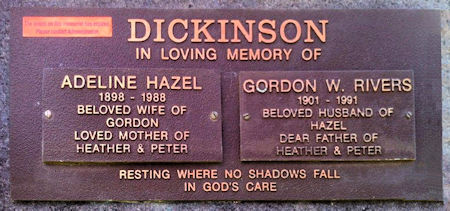 |
Alexander Charles ...
... was born in 1902 in Perth WA, Reg.No.4613.
The Australian Electoral Rolls, 1903-1980 shows that Alexander was a clerk for his life. As a bachelor he moved from his home in Horsham to two properties in Geelong before returning to his parents home.
In 1930, Alexander married Veronica Doreen Mary GLENISTER in the District of Port Adelaide, SA Reg.No. 323/234, who was born in Horsham in 1903 (Vic BMD 11132/1903). Together they lived at
until 1933 after which the couple had a series of houses in Corio, Geelong
Geelong in the 1930s-60s was very busy with Dennys-Lacelles woolstores, Ford and the Shell refinery, with shipping and timber interests. Any of these companies would have employed a 'clerk'. Corio housed many immigrants, e.g. Dutch for work at Shell who worked very hard and prospered. Many of the houses were owned by Shell and there were also many Housing Commission houses for rent. Today, Corio is one of the areas top crime spot unfortunately. Alexander Charles is not registered during the war years, however, there is no obvious service record.
after which they return to Camberwell. In 1949 Charles William's probate described Alexander Charles as a life assurance officer of 34 Glencairn avenue(?)
before moving 600m to their old address
where Alexander died in 1976 Cheltenham, (Vic BMD 14351/1976). In 1977 Veronica was alone.
Veronica died in 1978 in Camberwell (Vic BMD 23353/1978).
| Right: 24 Glencairn Avenue Camberwell 2013 |
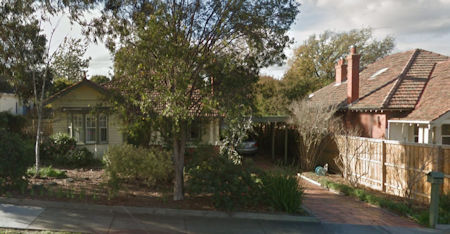 |
| Right: Alexander Charles MACDONALD and Veronica Doreen's plinth in Cheltenham New Cemetery, Cheltenham, Victoria |
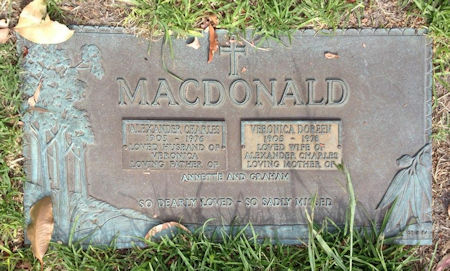 |
Lorna Gill
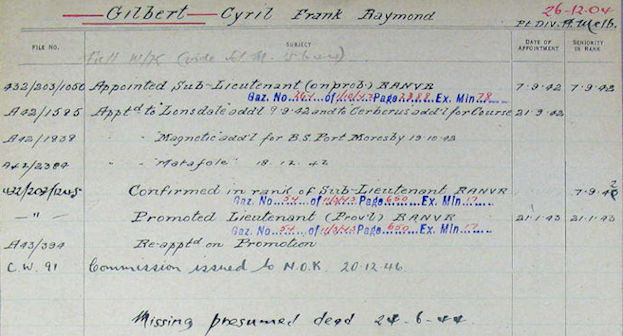
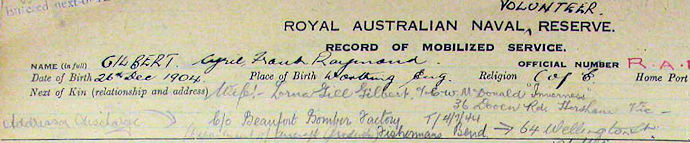
Lorna Gill was born in 1904 in Geelong. In 1936 she married Cyril Frank GILBERT, who was born on 26 December 1904 in Worthing, Sussex and who died on active service 24 June 1944.
1911 Census:      Sun/Mon 2nd April/3rd April 1911
Source:   TNA Ref:        RG14 Piece: 5331
          Reg. Gen. Ref:  RG78 PN  ; En.Dist: 12; Sched: 164
          RegDist: East Preston SubDist: Worthing
Dwelling: 145 Tarring Road
Place:    Worthing, Sussex
Rooms in dwelling, other than scullery, landing, lobby, closet, bathroom: 7
Years married: 10
Children:      Alive 2, dead 1

Name                           Rel Mar Age Occupation       Status   Birthplace
John Charles William Gilbert  Head  M  34  Grocer           Employer Sussex, Staplecross(?)
Annie Gilbert                 Wife  M  38                            Wiltshire, Cricklade
Ronald Charles Gilbert         Son      9  School                    Sussex, Tarring
Cyril Frank Raymond Gilbert    Son      6  School                    Sussex, Tarring
Lily Stella Serell            Serv  S  16  General servant Domestic  Sussex, Burpham
 |
 |
| Above:
Cyril Gilbert's naval record (Accessed: 01
August 2017) Page 2 confirms Cyril's place and date of birth and Lorna Gill 's relationship to CW MacDonald, the correspondence address. It also suggests that Lorna was doing war work at the Beaufort Bomber Factory (Commonwealth Aircraft Corporation) in Fishermans Bend - located south of the Yarra River near the suburb of Port Melbourne. |
| Cyril was reported lost at sea with the sinking of HMAS Matafele (Right). After a short period in Townsville, Qld to repair a fractured bearing in the starboard engine, HMAS Matafele sailed for Milne Bay on 18 June with 215 tons of naval stores. The ship was due to arrive in Milne Bay on the morning of 22 June after transiting the Grafton Passage and China Strait. However, the ship did not arrive on schedule. |
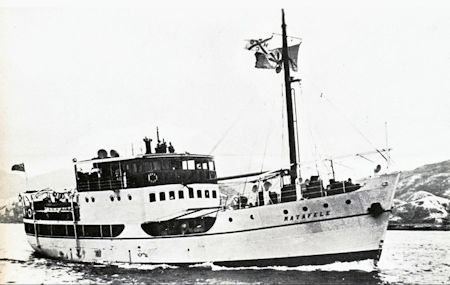 |
On 23 June, a radio request was made for Matafele to report her position. There was no reply, but on 24 June, a Bristol Beaufort over flying the China Strait reported seeing the vessel underway but struggling close to the coast in heavy weather. After no reply was received and the ship still did not arrive, the Naval Officer in Charge New Guinea had a second transmission sent, with orders to break radio silence and report. The lack of reply prompted a search by the Bathurst-class corvettes Townsville, Latrobe, Goulburn, and Geelong, the motor launches 1338 and 1339, and aircraft from Cairns and New Guinea; again with no results. An oar with the ship's name carved into it, along with two damaged boats, were later found off the south coast of Papua.
 |
A Board of Inquiry concluded in October 1944 that Matafele had foundered en route,
likely on 20 June, with all aboard (4 officers, 20 RAN sailors, and 13 Pacific Island
crew) lost. A second inquiry, a few weeks later, rejected the foundering conclusion,
but was unable to determine the cause of the disappearance.
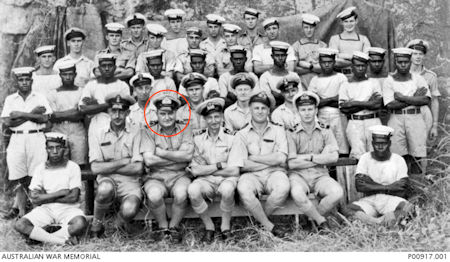
Left: HMAS Matafele's crew, with Cyril Gilbert circled |
The possibility of attack by submarine was considered by a post-war inquiry, which determined that no Japanese submarines were in the area at the time. Source: Wikipedia
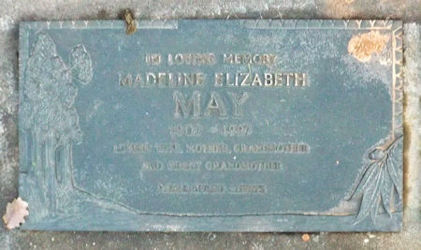
Madeline Elizabeth was born in 1907 in Perth, WA Registration number 1563 and died in 1997. Her ashes were scattered at Bright Cemetery, Victoria. In 1929 she married (Mac) Robert Samuel Keith MAY (Vic BMD 11855/1929) who died in 1977 in Porepunkah (Vic BMD 27902/1977) and whose ashes were also scattered in Bright Cemetery (Accessed: 24 July 2017) Records show Madeline's memorial as Madeline MAY, but the cemetery notes also mentions surname 'Watson' and suggest she married George Watson after 1977.
On 7 January 1944, on page 2, the Horsham Times records, that the Mays of Elwood, Melbourne returned home after spending New Year with her parents at Doonen Road.
The Australian Electoral Rolls, 1903-1980 shows
In 1936, whilst the couple remained at the same address, Keith had become a theatre employee before moving on to war work.
After the war the couple moved frequently, with Keith being first a driver, then taxi driver and later a taxi owner.
In 1954 they were registered in Richmond and Balwyn
In 1963 they were registered in Balwyn and Mentone
before retiring to Frankston, where Donald Jock joined them and then Porepunkh.
| IN LOVING MEMORY/ MADELINE ELIZABETH/MAY 1902 - 1997/ LOVING WIFE, MOTHER, GRANDMOTHER/ REMEMBERED ALWAYS |
 |
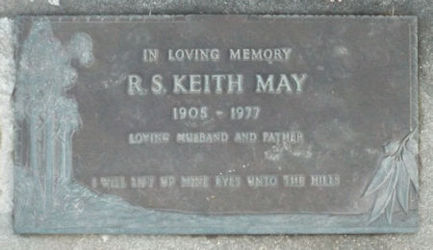 |
IN LOVING MEMORY/ R. S. KEITH MAY/ 1905 - 1977/ LOVING HUSBAND AND FATHER/ I WILL LIFT UP MINE EYES TO THE HILLS |
Bright Cemetery record suggests Madeline and Robert had a son named Donald Jock 1933-1978 and another unnamed son.
The Australian Electoral Rolls, 1903-1980 gives a clue as to Keith's occupation.
Their son Donald Jock MAY born in Horsham, died in Melbourne South in 1978, aged 45 (Vic BMD 4531/1978)
The Australian Electoral Rolls, 1903-1980 shows Donald Jock to be a life-time carpenter
In 1963 he was married to a Shirley Eleanor living at
before they moved to Frankston until Donald Jock's death in 1978 still recorded as a carpenter.
John was born in 1910 at Armadale (Vic BMD 7894/1910) (Mc) and died before his father - see obituary. On his birth certificate his mother is named as Mary Hannah KINGATE; a typo.
Madeline Laura (Lil) - Maralena and Donald's fifth child
When Donald died, Madeline was reported living in Bexley, Sydney as Mrs Gilmore. She married Joseph William GILMORE. There is no Madeline or Joseph Gilmore in an Ancestry Electoral Roll search of <Gilmore in Bexley>.
| WEDDINGS A very pretty, but quiet wedding took place at Allowah, Creswick road. Ballarat, the residence of Mr and Mrs D. Macdonald on Thursday, the 11th of August, when their third, daughter. Madeline Laura (Lil), was married Mr J. W. Gilmore, of Adelaide. The ceremony was performed by the Rev S. Walker, Presbyterian minister, late of Miners' Rest, in the drawing-room, which was, prettily decorated with Cootamundra wattle and violet. The wedding breakfast was served in the dining-room, the table decorations being white narcissus and violets. The bride was, prettily, dressed in a handsomely worked frock of white grass-lawn over white satin charmeues. The travelling dress was a tailor-made coat and skirt of dull moss-green, with black facings and hat to match. Mr and Mrs Gilmore left by the afternoon train for Melbourne en route, for Adelaide. The wedding presents were, numerous and costly. |
| Source: Weddings, 13 August 1910, The Ballarat Star, p.2 (Accessed: 31 July 2017) |
| DEATHS GILMORE.-On September 28. at 33 Clifton street, Malvern, Joseph William, beloved husband of Madeline Laura Gilmore. |
| FUNERAL NOTICES GILMORE.-The Friends of the late Mr. JOSEPH WILLIAM GILMORE, of 33 Clifton street, Malvern [Adelaide]. are respectfully informed that his Remains were peacefully Laid to Rest (Privately in the Mitcham Cemetery on TUESDAY MORNING. The Rev. W. Rex Steadman officiated. ALFRED JAMES & SON (A.F.D.A.), Funeral Directors. 193 Unley road. Unley. U 1129 12, lines. |
| Source:
Family
Notices, 29 September 1942, News, Adelaide, SA, p.4. (Accessed: 26 July 2017) |
Madeline and Joseph were both interred in the Mitcham General Cemetery, Old Belair Road, Mitcham.
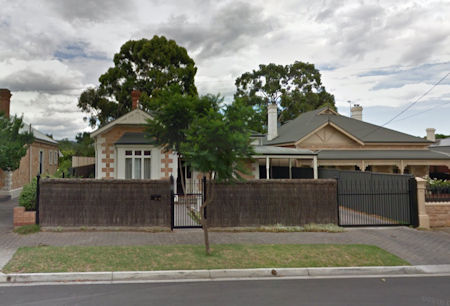 |
Unfortunately, neither Joseph of Madeline have been found in the Electoral Roll
and their death, although listed in the cemetery records, bears no further details.
Left: 33 Clifton Street, Malvern, SA in 2013 |
| DEATHS. GILMORE. On December 19, at Adelaide, Madeline Laura, wife of the late Joseph William Gilmore, late of Jeffcott street, North Adelaide. |
| FUNERAL NOTICES GILMORE. ? THE FRIENDS of the late Mrs. MADELINE LAURA GILMORE, late of Jeffcott street, North Adelaide, are respectfully in-formed that her Remains were peace-fully laid to rest (privately) in the Mitcham Cemetery on WEDNESDAY AFTERNOON. The Rev. Edwin N. Broomhead officiated. ALFRED JAMES & SONS (A.F.D.A.), Funeral Directors, 193 Unley road, Unley, phone UA1129 (2 lines); 100 Henley Beach road, Mile End; phone L4067. GLAZBROOK |
| Source: Family Notices, 21 December 1950, The Advertiser, Adelaide, SA, p.16. (Accessed: 26 July 2017) |
Donald Frazer - Maralena and Donald's sixth child ...
... was born in Miners Rest in 1874 (Vic BMD 24599/1874) as Mc. He died in 1943 in Brighton (Vic BMD 5158/1943) as Mac
He married (Mc) Hilda Ruby ODGERS in 1925 (Vic BMD 2100/1925). Hilda was born in 1886 in Boorst (Vic BMD 8141/1886) and died in 1965 in Glen Iris (Vic BMD 6469/1965). Hilda's parents were William Henry ODGERS and Anna Selina ROSCHELLOR on death certificate and ROSCOLLER on birth Certificate.
His mother's obituary of 1924 mentions he and his brother were building contractors. In 1934, under the Transfer of Land Act 1928, an application of foreclosure on the mortgage was made against Donald Fraser MACDONALD of Murota and Charles William MACDONALD of Horsham. This could be redeemed if the land was sold or moneys raised to pay-off the mortgage and expenses incurred. Advertising, 14 May 1934, The Age, Melbourne, p.3 (Accessed: 05 August 2017)Did this precede bankruptcy?
Australian Electoral Rolls, 1903-1980 show
From 1912 to 1937 Donald Frazer MACDONALD is listed as a contractor in Murtoa as per his father's obituary.
From 1925 to 1937 Hilda Ruby MACDONALD is mentioned living in Murtoa but not at the same address as Donald Frazer. Her surname is spelt MacDonald and not McDonald.
Perhaps one was a home address and the other a business entry?
| LAW NOTICES - DONALD FRASER MACDONALD, Late of 13 Davey Avenue, East Brighton, Retired Builder and Contractor. Deceased. - After 14 clear days Hilda Ruby Macdonald, of 13 Davey avenue, East Brighton, widow, and Donald Leslie Macdonald (In the will called Donald L. Macdonald), of Miami street, Hawthorn, electrical engineer, the executrix and executor appointed by the will of the deceased, dated the 24th day of February, 1943, will APPLY to the Supreme Court of Victoria for a grant of PROBATE of the said WILL. MCINERNEY, WILLIAMS, & CURTAIN, of 90 Queen street, Melbourne, proctors for the applicants. |
| Source:
Advertising, 17 June 1943, The Argus, Melbourne, p.11
(Accessed: 31 July 2017) |
Sources:
| More information 1 |
 |
The Ballarat riots The Ballarat Riots led to the Eureka Stockade Rebellion of 3 December 1854. It is thought that Caleb arrived in the Ballarat area in 1852, the year after the discovery of gold on 12 August 1851. The Governor of Victoria Sir Charles Hotham (1806-1855 pronounce Huthum) was facing protests against his draconian liquor laws and the prohibitive miners licence fees of 30 shillings a month (£164.40/A$188.20 converted to RPI 2019 figures). He was warned that unless there were reforms a slumbering unrest would be aroused which would not be quelled by law. By not taking account of his local advice, Hotham widened the gap between the self-reliant miners, the Goldfield Commission and his autocratic stance on raising money to reduce the Colonies enormous financial crisis, which drained the British exchequer. Police Commissioner Robert Rede explained that his under strength force had difficulty collecting fees from a population containing many who were not miners. With the passing of the Goldfields Act at the end of 1853, licences could be taken out on any day of the month for periods of one, three, six or twelve months, making the collection of fees more complex. Even before the troubled days of September 1854, Rede had requested reinforcements of numbers and quality. The unarmed police not only assaulted civilians and fought amongst themselves but they hard pressed the diggers and storekeepers. Hotham, lacking an understanding of the situation, stepped-up the collection for licence fees by ordering a twice-weekly fee sweep, inspecting and annoying those who generally held a three-month licence. At a time of economic depression, this made the licence fee more objectionable as it hindered production and, it was believed, the taxes were used to maintain the forces against the miners. A spark to the riots was the burning of the elaborate Bentley’s Eureka Hotel valued at £20,000 (£1.891million/A$2.5million converted to RPI 2019 figures) and the murder of James Scobie on 7 October 1854, who it was believed was killed by James Bentley. Ten days later, a large crowd of miners gathered to protest against the acquittal of James Bentley. The crowd was threatening but not very active. Whilst there was tension, there was no cause for alarm at this stage and the Riot Act was not read. The crowd moved behind the mounted police towards the hotel where it began to fling stones. However, reading the Riot Act may have prevented further acts. Then there was a rush of spades, stick and stones, which destroyed the windows and the police horses rushed into the mass of miners. Even though Rede tried to stop the rioters, but hotel was burnt, encouraged by a gale. The military, in Melbourne, was sent for. The day began with a specific grievance but brought forward a wider issue, which the excuse of burning of the hotel could not justify. Rede then had two options: do nothing or arrest everyone. The miners had already shown they would resist when a large crowd gathered to threaten for the release of the three men committed for trial in Geelong. Rede waited for troop reinforcements before making his next move. He allowed those who took part in mass gatherings to create some turbulence, which discredited the whole opposition to Hotham’s law. On Sunday 22 October 1854, after mass in the Catholic Church, it was decided that a deputation would meet with the Commissioner. However, at about two o’clock there was a general move towards Bakery Hill, where a platform had been built in full view of the Government Camp. The Bentley affair stimulated a great deal of tension so that on the 22 October the Camp was threatened and barricaded by the miners, stimulated by the Irish diggers, so that at night the soldiers stood to their post. At this stage, the people were united and the authorities confused. Whilst Police Commissioner MacMahon ordered the arrest of those of the mob on whom charges would stick, he had full knowledge they could be ‘rescued’, MacMahon called on Hotham to end the licensing laws and agreed with the people that the police were tyrants who were imposing military law. This latter act swayed the moderates in favour of the protestors; the deep-seated unrest and Australian independence. On 25 October, the protests, encouraged by the Irish, were at their height: miners demanded their rights to form their own regulations with proposals for juries of miners resolving claims disputes. Henry Seekamp, editor of the Ballarat Times, wrote of injustice, corruption, bribery, personal animosity, private interest and brutality and suggested , unless their demands were met, the forming of local armed mercenaries of miners to enforce the demands. The moderates were bringing together the strands of opposition, though a crowd of moderates could easily be roused. On 1 November 1854, The Ballarat Reform League of miners was formed to challenge the licence hunting, Carey’s grog convictions, the case of Smyth’s servant and Bentley’s trial. They added flagrant cruelty, injustice, bribery and perjury found in the Camp, which imposed God’s people. |
| More information 1 cont: |
|
|
Rede took the Irish agitation seriously and requested reinforcements. Eighty infantry
from Melbourne and 200 cavalry from Geelong, a total force of nine officers and 297 other
ranks, were to arrive by Wednesday 29 November. There was great confusion when they were
attacked along the road from Eureka: either by ambush or they went off track
into the claims. With one drummer-boy killed the miners lost the sympathy of the
military. However, there is debate whether this was a deliberate attack to bring
the conflict into the open.
Held under the newly sewn Southern Cross flag, which signified resistance to British oppression, the Reformers, calling a meeting on 29 November to test the strength of the feeling between constitutionalism and force,. Though a relative quiet meeting, the time for appeasement seemed to have passed, Between twenty and 100 licences were burnt and resistance to the arrest of unlicensed miners grew. Agitation had already been raised to a new level when, on 30 November, the much disliked Inspector/Assistant Commissioner Johnstone lead a licence raid against the Gravel Pits. The party and their reinforcements were pelted with stones. Rede read the Riot Act and called out the troops, who advanced in skirmish order, flanked by cavalry, to maintain the law and collect eight prisoners. Opposition was not serious and casualties were light. However, the crisis developed when Rede, rather winning over the loyal element of the crowd, organised an aggressive licence hunt. It was clear Rede had misjudged public opinion. In Rede’s eyes, as he stood for British law, the whole population was against the Crown. When the mass crowds met on Bakery Hill, under arms, Rede called for martial law, reinforcements and artillery to stamp out disobedience. This divided the alliance of the moral-force and the exponents of direct force. When the League’s leaders failed to appear, the Irish digger Peter Lalor called for the armed men to form companies and to swear under the Southern Cross to defend their rights and liberty. A thousand men marched under the Southern Cross to Eureka with the feeling of being trapped and misunderstood. With the rise of emotion, rather than a tactical plan, the Reform League disintegrated. The rebels met at 4am Friday 1 December on Bakery Hill, were confronted by troops who were impotent because they had large crowd at their back. When The Riot Act was read the moderates withdrew and Rede saw his chance to crush the 500 largely Irish agitators and to restore peace and prosperity to the goldfields. Instead, on Saturday determined agitators began to construct their badly sited palisade, around a weapons producing smithy. It had become the last ditch symbol of protest rather than rebellion. At 2.30am on Sunday 3 December, 176 infantry and 100 cavalry assembled before moving off to cross the creek towards Black Hill.
|
| More information 1 cont: |
|
|
The engagement was brief. Five attackers died and twelve fell seriously wounded.
Thirty diggers died of whom about half were bayoneted after the fortifications had
been over run. A shock wave of opinion in the Victoria press shattered government
complacency. Ballarat was angry but not cowed. On Monday, under arms garrison escort,
the coffins along the Creswick Road to the Old Ballarat Cemetery.
Note: Albert James CROMPTON (1876-1929), the author's great uncle, was chauffeur to John Hotham (1836-1907) the 5th Baron Hotham of Dalton Hall, South Dalton, East Yorkshire. Sir Charles Hotham (1806-1855), then Lieutenant Governor of Victoria, was born in Dennington Suffolk. Whilst there is no direct link between the two families, it is suggested they must be related based on the fifth Baron dying childless. He was succeeded by his first cousin once removed Frederick William Hotham (1863-1923) Source: Bates, Weston, Ballarat Lucky City, The first generation at Ballarat 1851-1901, Melbourne University Press, Carlton, 2003 edition |
 |
 |
 |
|
| This page was created by Richard Crompton and maintained by Chris Glass |
Version A19 Updated 24 March 2023 |
||