 |
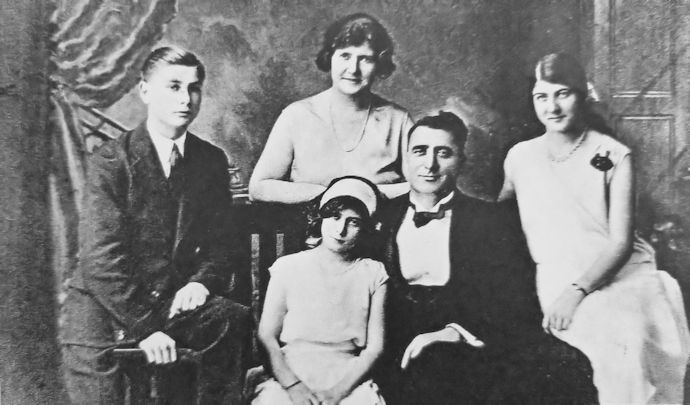
| Above: Nelson Wellington and family c.1928 Left to right: Chip, Ida, 'Mickie', Nelson, Pat Source: 'Regions Caesar Never knew' - NTL Wellington |
1821 Info 13e for Caleb Crompton |
Pat HUTSON, née WELLINGTON, in her Memoirs, wrote extensively about her brother Chip and his difficult life both with his parents and in his married life. Pat’s comments in reporting Chip’s biography up to 1954, are reflected in this paper.
Nelson Thomas Lyle WELLINGTON, was born in Orbost in 1915, 1 where his father Nelson was Shire Secretary and from where he went to war. Whilst waiting for his return, the family moved to Malvern, Melbourne. When Nelson’s repatriation ship docked, Chip was dressed in a 'soldier suit', made by his mother, to meet a father he really did not know. After a family discussion it was decided to take advantage of the Soldier Settlement Scheme and move to a virgin section at Merbein on the Murray River, to extend the grape and citrus industry. Nelson’s father’s family also moved there from Ballarat. It became a hard pioneering life.
In 1923, at the age of eight, Nelson decided to send Chip to be a boarder at Ballarat Church of England Grammar School, his alma mater. ‘[H]is relationship with my parents and sister [Joan, known as Mickie] from that time on was poor and did not improve’. 2 As a schoolboy, Chip won the under 12 years open championship of different classes at the Ballarat Grammar School's athletic competition. 3 He travelled home for the holidays by train with a group of Grammar School boys, who taught him to smoke. At school he missed the family so was ‘mothered’ by Matron, but as soon as he came home, ‘he would continue to quarrel with my sister.’ 4
'At school his name Nelson Thomas Lyle WELLINGTON was a handicap and the boys, astounded that anyone could be called Nelson Wellington, gave him the nickname of Napoleon - Nap for short, which he hated. So he called himself Chip - which was his name at home because he was named after his father and grandfather (from "chip off the old block").' 5
When his sister Pat returned from her boarding school, she found the atmosphere difficult to cope with and looked forward to returning to school. She speculated that Chip’s attitude to many things changed when he was forced to leave St Paul’s and make academic adjustments. This, and puberty, influenced the problems he had in later years.
|
| Above: Nelson Wellington and family c.1928 Left to right: Chip, Ida, 'Mickie', Nelson, Pat Source: 'Regions Caesar Never knew' - NTL Wellington |
Chip had a very nice soprano voice, which the family heard as he sung in the choir at Evensong, which he enjoyed. As his voice matured, he did more solo work. This enabled him to become a member of St Paul’s Cathedral Choir School, Melbourne, where he enjoyed the musical experiences and singing solos At the age of 14, his voice broke and he was transferred to a new school. 6 'The loss of his singing ability made him angry and distressed, particularly when he saw no sign of [...] rejoining the choir later as an adult member. He had difficulty settling in to the school academic pattern. He would not study the subjects he disliked, mainly concentrating on English and rowing and neglecting his other basic subjects like maths and languages. He was very good at English and became involved with the school magazine.' 7 Encouraging Chip to complete his school studies and homework caused his relationship with his parents to deteriorate further. Although Chip completed year 10, the school inconsultation with Nelson and Ida, advised them to abandon the idea of university for him and to follow a career in journalism since he did well in English and contributed to the school’s magazine. In 1932, aged 17 and half way through his final year, Nelson arranged an apprentice as journalist to The Argus of Melbourne.
This did not resolve the tensions at home as issues moved from education to life-style and parental favouritism for Mickie. Pat writes, 'I don't think my brother really understood the effect of World War 1 on our family. We virtually had no Father for four years and when he returned at the end of the war in 1918 he was a total stranger to us. I was five years, my brother nearly four years. Naturally we were closely bonded to our Mother and resented the competition for our Mother's attention. My sister, a post-war baby, premature, and regarded as a "precious miracle", became high priority in the family to the exclusion of family time with numbers one and two. I, being the eldest, was expected to be independent and accepted the mantle, but my brother resented it and felt rejected by his parents. The problem of wartime separation from our Father was reinforced when he returned to his original occupation [of shire secretary] and the demands of the job meant he had very little time for family life—his council duties were all consuming. In addition he resumed his interest in the army and joined the Citizen Military Forces - the reserve army really, which involved him in regular meetings, training, and weekend bivouacs. He later became the CO of the 58th Battalion CMF, with headquarters at Essendon near the town hall.' 8
Despite this, Chip writes; '... I thought my father was the most amazing man I had seen or heard of. [It is only in recent years [to 1980] that I have felt I could understand him and therefore sympathise with him.]' 9
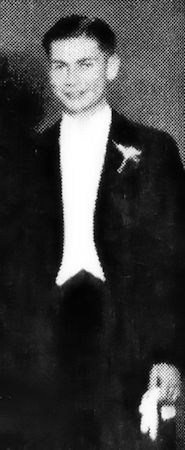
| Right: Chip Wellington at his sister Pat's wedding in 1937 Source:
Memoirs
Pat’s story shifts to 1937 when she was a Junior RMO [Resident Medical Officer?] at Geelong on a salary of £4 a week and full board. Chip had married Pearl Gweneth RAMSDALE in a Fitzroy registry office in 1936 as soon as he turned 21 years, and against his parent’s wishes. His parents argued his career was not yet established and he was financially insecure. They also felt that Pearl, as a partner, would bring future problems with her family. 'He refused to listen to any advice, being anxious to leave home and do his own thing. ' 10 They were living in Ascot Vale, in a spartan flat lacking furniture. At the same time, Chip changed jobs from the daily paper The Argus to the evening paper The Star, 11 which was struggling against Depression difficulties. Her mother asked Pat to contribute half her 1938 12 wages to subsidise Chip and Pearl’s reduced financial situation. She thought that Chip believed the money came from his mother as a contribution to his rent. Pat was never thanked and saw this as an obligation in repaying the funds spent on her university fees. She was also asked to donate all her duplicate wedding presents. Cecil and Rose RAMSDALE were unable to help. |
 |
 |
Pearl’s father was on total disability pension, because of the war.
Pearl’s mother, an attractive and house-proud lady, remained at home. She opposed the
marriage but Mr Ramsdale gave his support thinking marrying into the Wellingtons
would improve his daughter’s position in life. Pearl worked as a secretary to one of
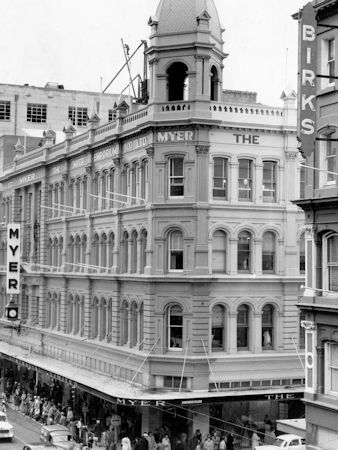
the executives at the Myer Emporium 13 14 and took great pride
in her job. 'My parents felt my
brother's haste to get away from home was not a good basis on which to build a
marriage, but they had no option but to accept the situation and help as best they
could in such difficult economic times.'
15
Chip and Pearl’s situation became worse when The Star, still struggling, closed in 1936 leaving a devastated Chip without a job and limited prospects in the Depression. Although Nelson made several suggestions and found him a job, Chip would not consider it. He had the journalist’s dream of writing a best-seller book in a twelve-month sabbatical, living off Pearl’s income. In order to achieve this aim they moved out of their flat, against all advice, to live with Pearl’s parents in Caulfield. The arrangement did not work and from the beginning Chip’s relationship with his mother-in-law gradually deteriorated. Mrs Ramsdale’s attitude to Chip was one of severe criticism and hostility, which never improved. The book was eventually finished but since Chip was not satisfied with the result, it was burnt. Chip returned to a newspaper job, necessitating readjustment to family life. Lyle WELLINGTON published articles in The Herald between July 1936 and November 1937. |
| Above: Myres Emporium in the late 1950s |
On 21 August 1936, the North-Eastern Advertiser of Scottsdale Tasmania published a single piece by Lyle Wellington. At this moment this is the only article in Trove attributed to Chip in Tasmania. Although this date is likely to be after the closure of The Star, Pat does not make mention of Chip and the family moving to Tasmania and there is only one article. Without further evidence, 16 the author thinks the article on Training Debutants was syndicated. 17
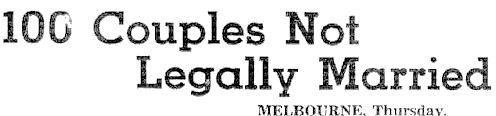
On Friday 1939 the Sydney Dailey Telegraph syndicated a Melbourne report that threw doubts on the legality of Chip's marriage to Pearl. Chip's interview, quoted by the Telegraph appears to me to present a casual attitude to his marriage with concern about the strength of his mother-in-law. A marriage certificate would be interesting.
 |
||
 |
||
| MORE than 100 marriages
performed between 1932 and 1936 by a Fitzroy registrar are invalid. The registrar (Mr. A. C. Dunstan) failed to make couples sign a declaration that they would take each other as man and wife! A signed declaration is unnecessary in a church service, but essential in the civil ceremony, The Marriage Act Amendment Bill, to be passed by the Victorian Parliament in about two weeks, will legalise these marriages. Until then any of the persons married invalidly may marry again without committing bigamy or may separate without recourse to the |
law. "When that bill
goes through we will celebrate our wedding all over again." Did Not Know This is what Mr. Lyle Wellington, of South Yarra, one of the "bridegrooms," thinks about it:— "My wife and I aren't married. The Registrar didn't make us sign the declaration. All our respectable neighbors have treated us as nice people for two years. Any time before Parliament passes the Act that will make our marriage legal. I can walk out. We haven't any children, but there's my mother-in-law". |
|
Source: Trove (Accessed: 20 February 2020)
Trove records Lyle accepting a job in Sydney and living in Frankston before moving to Bondi.
World War II service
In January 1940 Chip was a staff reporter on Sydney’s Daily Telegraph. In about 1943, Nelson persuaded Chip to join the army. Reluctant at first, having a wife and three small children, Chip felt it was an expectation, following his father’s military career. However, when an army journalist opportunity arose, he accepted the challenge and enlisted on 18 August 1942 at Wagga Wagga as service number (NX117584)N225335, as a war correspondent/PR for various New Guinea units.
19 December 1941. Chip enlisted for war service signing his Mobilization Attestation Form, with the number N225335, in Canberra. He quoted Pearl Gwenneth WELLINGTON of Corner Empire Circuit and Davy Crescent Canberra (now appearing to be large expensive houses) as his next of kin. At an unknown date, this address was changed to 113 Arden Street Coogee. In Chip's 1968 application for replacement campaign medals, this was recorded and witnessed by a JP as 119 Arden Street, Coogee suggesting Pearl moved down the street. However, Chip records his permanent address as Press Gallery, Parliament House, Canberra, suggesting he was a prestigious political reporter for his newspaper. No educational qualifications were listed, including entry certificate for entry to Secondary School. However, whilst Chip confirms he can drive a car and lorry, he could not do running repairs. His only other skills were to be able to type and take shorthand.
18 August 1942. Chip signed an Attestation Paper at Wagga, NSW with a new service number of NX117584 into RAE Tng Ctre (Royal Australian Engineers Training Centre), as a L[ance]/Sgt. His next of kin Peare (sic) [Pearl] Gwenneth WELLINGTON was now living at Flat 6, 'Olgita', Dandenong Road, [North Caulfield], Melbourne. This address is too vague to identify. He was certified medically A1 and described as Height: 5ft 10 ins, Weight: 168 lbs, Chest (max): 37½ins., Complexion: Fair, Eyes: Grey, Marks or scars: mole on right buttock. The 'Record of training, schools and courses: (i) training and (ii) range and firing practice' are empty.
 |
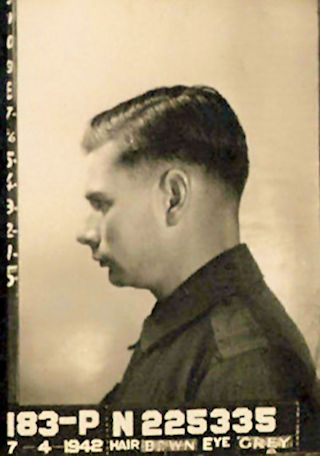 |
| Above: Chip Wellington's photo dated 07 April 1942, from his service record | |
September 1942. Chip was transferred to a headquarters' unit in Melbourne before being sent overseas to New Guinea. It is suggested that the initials SWP stand for South West Pacific.
17 April 1943. Chip was transferred overseas to New Guinea. This includes a period of time in the 1200 bed 2/5 Australian General Hospital, probably at Bootless Bay, in New Guinea. It is suggested that because of the close proximity of Bootless Bay, Chip was based in Port Moresby.
| Right: Troopship Katoomba Built in 1913 the Katoomba operated the Queensland and Western Australia coastal routes before being converted into a troopship in February 1942. | 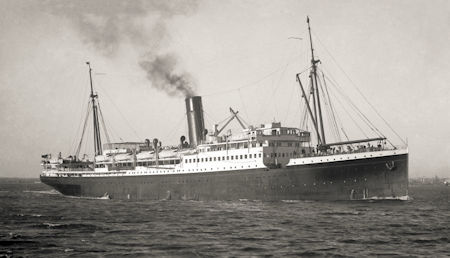 |
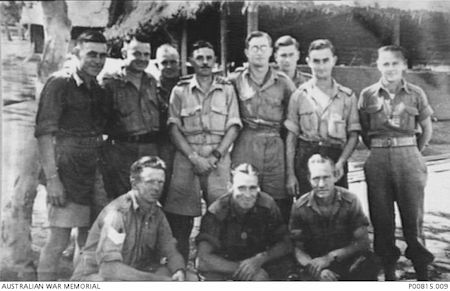 |
Left: Lyle Wellington 6th from left back row, with Headquarters, Intelligence Section, Port Moresby, PNG circa 1944 Source: AWMP00815.009 |
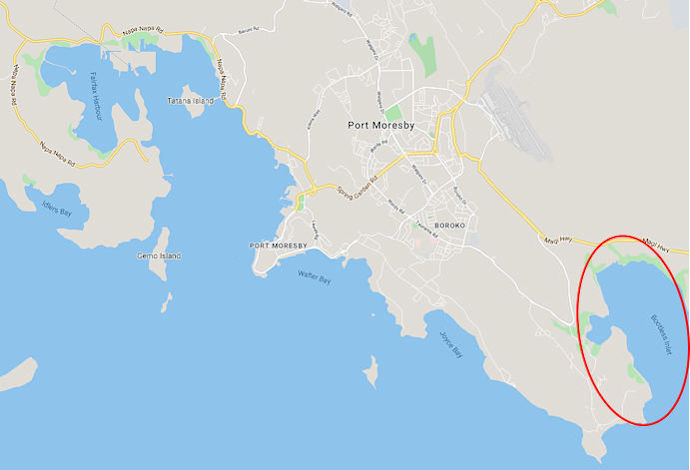 |
| Above: A map locating Port Moresby and Bootless Bay, a distance of 17km |
Whilst in New Guinea, Chip penned three pieces for The Argus in a descriptive style of the BBC From our own correspondent: dense, descriptive, personal narratives of contemporary native life, painting a picture for any Australian family with a son in New Guinea.
On his Christmas 1943 leave, Chip rejoined Pearl and the three boys who were staying with her parents in Ormond, Glen Huntley. Shortly afterwards he got the mumps and was sick for the rest of his leave. In January 1944, shortly after his return from New Guinea, Chip's overseas service ended when he was appointed to the post of public relations officer to the Minister of the Army at Victoria Barracks, Melbourne. 18
His service was summarised as:
| Left: At the time of his discharge Chip and Pearl were living at 17 Queen Street, Ormond, [Glen Huntley] Melbourne, the home of Mrs and Mrs Ramsdale? | 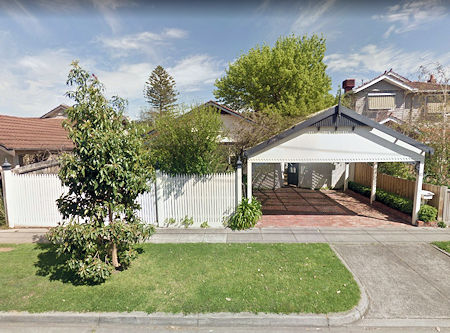 |
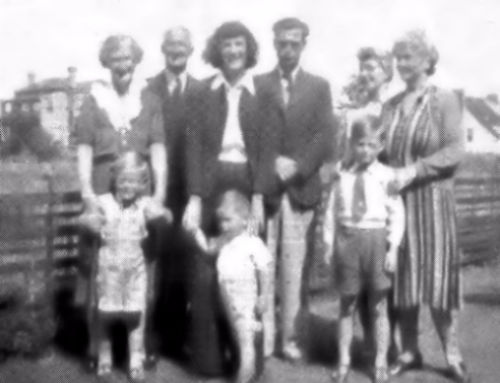 |
Left: Chip Wellington and family May 1945 Rear: Mrs and Mrs Ramsdale, Pearl, Chip, Pat, Ida Wellington Front: Bill, John, Lyle Digby Wellington Source: Memoirs |
On discharged, the family moved to Moorabin, a location not recorded on the Electoral Register. In 1950, Pat discovered Chip and Pearl had serious marital problems. Pat writes, ‘The marriage had always had various ups and downs along the way, but we all hoped that with a house of their own and the opportunity to make a fresh start after the war that they could make the necessary adjustments and improve the situation.' In February 1947, Chip had an article published in The Herald. 'Madeline Rose arrived in November 1948, so they now had four children, and at first it seemed the arrival of a daughter would be a great joy after three boys. Chip got back into the work force but did not settle very well. He wanted to change from daily paper to evening paper and back again, always complaining about the difficulty of the working hours either way.’ 19
In 1950, as with his desire to write a best-seller, Chip had ambitions to further his career by writing for a Fleet Street newspaper in London. Like his book sabbatical, this was impractical, having a responsibility for four children, a responsibility, like his school academic demands, he could not accept. Additionally, Pearl was not in good health. Madeline's birth complicated a kidney complaint that developed when John was born and it persisted afterwards.
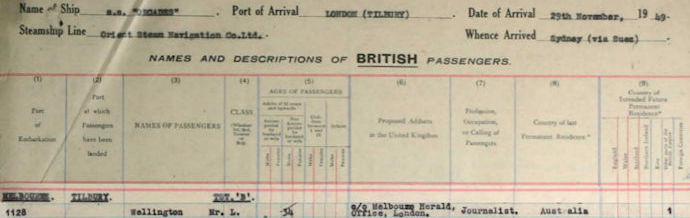 |
| Above: A composite image of Chip Wellington's
passenger list to London in November 1949 Click on the image to open a full size image as a pdf |
| On 29 November 1949, Chip walked out on his family without making any financial
arrangements and went to London Tilbury as a 'non accompanied' traveller on
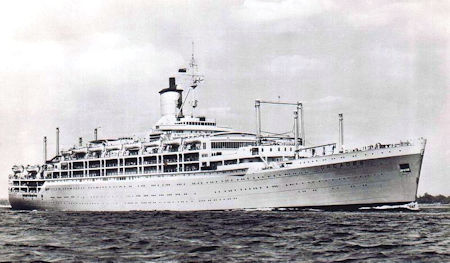
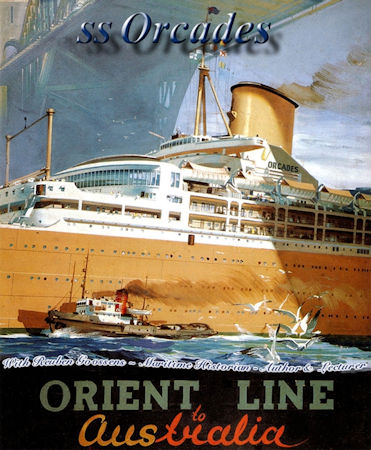
SS Orcades. 20 Leaving Pearl with four children and no money, asked a
shocked, but not surprised, Pat for money to support the family and to help looking
after Madeline when she returned to work. '[Pat] always felt the marriage was at
risk because of Chip's personality and attitudes and the attitudes of his mother-
in-law, which were always negative and unhelpful.
Right: RMS Orcades III |
 |
'[Pat] gave Pearl money for rent and housekeeping and agreed to return with [her husband] Medwyn to discuss her situation further.' 21
When Pat and Medwyn met Pearl the following week, she had 'had received a note from Chip — no address, but stating that he had been unsuccessful in trying to get a job in London, but his girlfriend, who had joined his ship in Perth supposedly to follow him to the UK, had got a job and was supporting them both. He said that he was unable to help his family. Pearl had discovered that the affair had been going on in Melbourne for some time without her knowledge and that Chip hoped to end it by going to London by ship. However, the girlfriend found out and followed and joined the ship just before it left Perth and revealed her presence shortly afterwards.' 22 23
| Left: RMS Orcades poster
The Ramsdales moved in and Pat helped with Madeline allowing Pearl to return to work. However, over the months, Pearl’s health deteriorated and she was hospitalised with kidney trouble, but always returned to work on discharge. She slid into apathy, depression and appeared to give up the struggle. Pat writes, 'We had no knowledge or any detail of her symptoms or case history but privately wondered if she had sought a way out by taking something which had exacerbated her kidney condition. She gradually deteriorated over the following weeks. A big surprise was Chip's return to Melbourne unexpectedly. He was naturally very distressed to find Pearl so ill and in addition he had to cope with the hostility and anger of the Ramsdales. We all hoped that his return might help Pearl but it made little impact on her and her health deteriorated further. She died on 24 November 1950. We were all devastated. Chip was stunned because he was unaware of Pearl's health problems prior to his return.' 24 |
 |
The relationship with his girlfriend ended in London and he returned to Melbourne. Chip easily got a job on one of the Melbourne papers and rented a house in Ringwood and struggled to look after the boys, who were all at school and very distressed by the loss of their mother; Lyle Digby at the age of twelve being, 'understandably, very bruised and brooded becoming very negative and uncooperative with everyone.' 25 'It was a combination of anger towards his father, fuelled by the family situation and hardships, and the hostility expressed by his Ramsdale grandmother, who constantly informed the boys that their father was no good.' 26 The Ramsdales moved to a rented house in Selby and took Madeline with them as a temporary measure. Chip 'was very jealous of [Pat’s] situation and thought "all doctors were wealthy", which was factually wrong, but he harboured this attitude for many years and it clouded our relationship for such a long time.' 27
In 1952, Chip was still struggling with the boys and asked his mother for help. Ida May went over to Ringwood for a few days, which she found extremely difficult. 'The boys were angry and unhappy and missed their mother very much. They refused to do things when my Mother asked them and she found this hard and almost impossible. Her visits got shorter as the task became harder and more complex.' 28 Chip wanted Nelson to visit to help him with the problem, however, Ida May thought that Nelson was not well enough to cope.
The Electoral Roll records the homes of the family:
until
At the time of Nelson's death, Chips was a 'journalist' living at 18 Hillcrest Avenue, Ringwood.
In mid-year 1952, Pat ends her account of Chip’s life.
His marriages to Dorothy Jean WOODS
|
After Pearl died, Chip twice married Dorothy Jean WOODS: first in 1952 and, after a divorce, again in 1955. Between July 1953 and March 1954, Chip was a versatile editorial staff reporter and book reviewer on The Herald's literary staff. The Herald of 08 February 1954 records Lyle's appointment as Melbourne Chamber of Commerce's Public Relations Officer and editor of the Chamber's monthly journal The Record. 'Mr Wellington was formerly a member of The Herald editorial staff. In the mid-1950s Chip was an Estate Agent and living or working in Bayswater. Source: Tom Blackman's Bundoora medical records. Right: Lyle Wellington in 1954 Source: Trove 08 February 1954 |
 |
A Statutory Declaration dated 22 October 1968
In 1968, Chip completed the form to say he had lost his campaign medals. This gives interesting information about his life. At the time
He reported that he had been living alone for nine years in rooming houses and boarding houses in a variety of places in Sydney, Hobart and Launceston and Davenport Tasmania. The medals were missed in March 1968 when he moved from Launceston to Sydney.
On 06 November 1968, the 1939-45 Star, Pacific Star, War Medal and Australia Service Medal were sent to Torch Newspaper and acknowledged on 14 November 1968.
Chip's book
In 1980, according to Victoria State Library, Bellingen of NSW published a 134 page book, with illustrations (some colour) and portraits, by NTL Wellington called ‘Regions Caesar Never Knew’. The State Library classifies it as 'World War 1939-1945, Australian personal narratives'. It is available from the State Library of Victoria referenced: 'Request from onsite storage SLTF 940.541294092 W46W'. It was written whilst Chip lived at Urunga, NSW in April 1980. The first fourteen pages are a family narrative detailing Chip's early life and his father's war record.
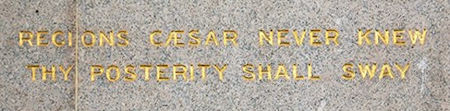 |
Left: Chip's words from Boudica's statue |
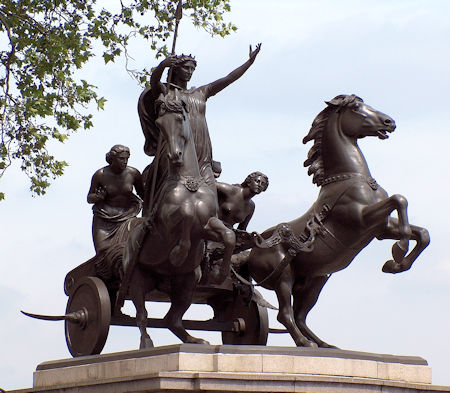
| The title has its origins in the inscription at the base of Thomas
Thornycroft's statue of Boadicea and her Daughters on Westminster Bridge, London,
which declares from William Cowper's poem Boadicea, an Ode where verse
eight of Regions Caesar never knew/Thy prosperity shall sSway and probably
comes from Chip's time in London. Two other books share this title.
William Cowper's 'Boadicea, an Ode'
(Accessed: 11 February 2020)
Right: Boudica's statue with her daughters |
 |
Heather Schoffelen describes it as 'a draft, A4 white paper, plain white cover, printed with the title, 8/10ths completed. Plenty of photos. Some parts are noted as redacted by P.F.H and B.A.H. (Patricia and Bruce) Hutson?'
Bruce Hutson, Chip's nephew writes by email: 'The book was a very rough manuscript and incomplete. It was typed it out in his own words and was written well before the internet and the ability to check information. As you know Les(lie) Blackman was killed on the Western front (Ploegsteert Wood) and not as he stated at Gallipoli. The notes in the book concern some historical facts. We had a few copies printed and sent to his seven children and also to the (State) library as requested in his will. (By email 06 February 2020)
A search of Trove for newspaper articles by Lyle Wellington show no obvious results between 1 January 1930 and 31 December 1941 in ACT or between 1 January 1945 and 31 December 1987 in New South Wales papers. However, Chip's book, recorded that the death of his sister Mickie in 1978, ended her sponsorship of Chip as an immigrant to the USA.
The children of Chip and Pearl
William Frederick, known as Bill - Chip and Pearl's second child
Bill lived at 18 Hillcrest Avenue, Ringwood in the mid-1950s, when he went to visit his great uncle Tom Blackman at Bundoora Psychiatric Repatriation Hospital and drove him to Bendigo. Source: Tom Blackman's Bundoora medical records.
The Australian Electoral Roll 1903-1977 records the homes of Bill Wellington as:
Chip's marriage to Dorothy Woods
After Pearl died, Chip twice married Dorothy Jean WOODS: first in 1952 and, after a divorce, again in 1955.Before her marriage the Electoral Roll records a Dorothy Woods, typist, is recorded at:
It is assumed that being a typist preceded being a more skilled stenographer.
In 1958, Chip returned to Tasmania where he may have been a pre-war journalist. The family of two children with Heather on the way, moved to Sandy Bay, Tasmania, 2km south of Hobart. There they lived in difficult circumstances until Lyle and Dorothy separated when Heather was a few months old. The children had no contact with Chip for most of their lives.
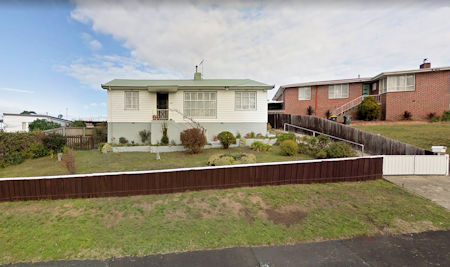 |
Heather lived with her mother and siblings for approximately ten years in public
housing at 24, Pekurn
Crescent, Chigwell, Tasmania, now the northern suburbs of Hobart.
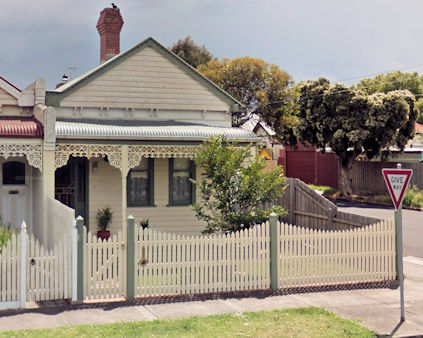
Left: 24 Pekurn Crescent, Chigwell, Tasmania |
| In about 1968, when Heather was in the fourth grade, the family returned to
Brunswick in north Melbourne and then to Coburg. As a single mother, with three
children, Dorothy worked as a typist and stenographer to be able to afford the public
housing or very low quality private rental accommodation.
Left: 6 Victoria Street, Coburg in 2017 |
 |
In the 1960s government policy was that a woman could not purchase a government home unless they had a male partner, despite single parents being in most need. When Dorothy was in her early 50s the state government offered tenants of public housing the chance of buying their homes: a home with power points in every room. Dorothy felt she could manage the A$14,000 asking price for a brand new 1970s house in Broadmeadows. The deal was that the prospective buyer could rent the house for one year, until the paper work was completed. Within a year the state had increased the asking price to a market realistic and impossible A$37,000.
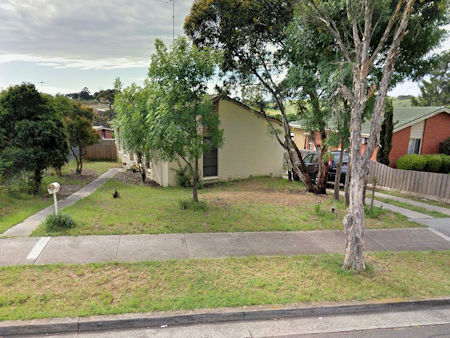 |
Incensed, Dorothy Wellington took action and organised a local community
protest that attracted the interest of The Age newspaper. Heather writes
that she thought 'the minister became involved and eventually the decision was
reversed' and the Broadmeadows house was purchased. This is likely to have
been 9 Heywood Crescent, Broadmeadows 3047, where the family lived in the 1977
Electoral Roll.
Right: Dorothy Wellington's home at 9 Heywood Crescent, Broadmeadows in 2019 |
Whilst separated from Chip, the Electoral Roll records Dorothy as living in:
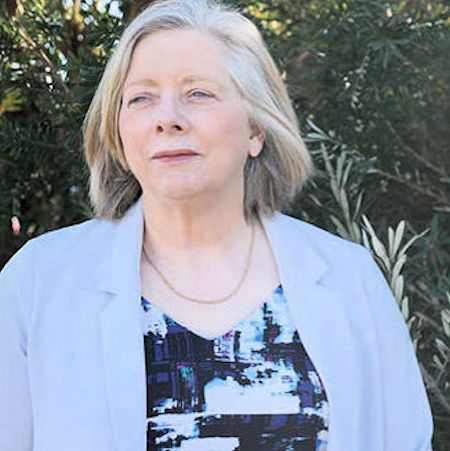 |
Heather described her mother as intelligent and very persistent who did not
have the opportunity to follow a more academic career. Heather and her sister
and brother grew up in quite a bit of poverty and did not have the opportunity
to go to university until Prime Minister Gough Whitlam 29 introduced
free university education: her siblings qualified in law and Heather firstly as
a medical practitioner and later in medical sciences and health administration
and then law.
Left: Heather Wellington c.2019 Source: Surf Coast Times |
Chip's retirement and death
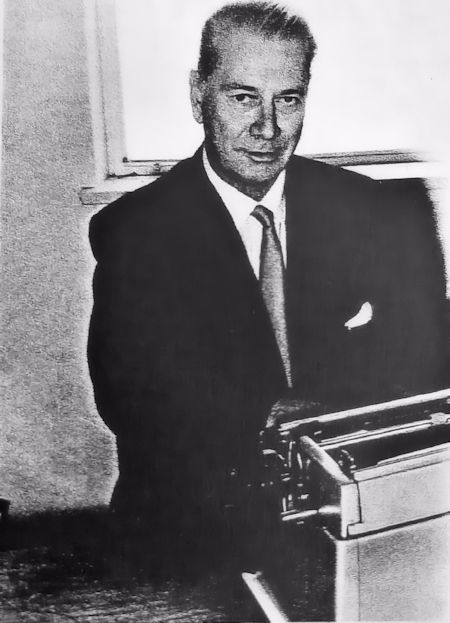
According to the Electoral Roll, Chip moved as a single man, first as a journalist
and then, at the age of 62, having no occupation. Some years before 1980, when Chip
had retired from journalism, he took the time to read '
what I wanted to read', including
histories of World War One to give an understanding of his father's experiences.
|
 |
| Chip died whilst living in a caravan on the property where he lived. Sadly he
died destitute and his three children paid for his burial. Nelson Thomas Lyle
WELLINGTON, died on 14 August 1987 and is buried in Lawn Section, Row D Plot 06 of
Urnga Cemetery NSW. Source: Family and Ancestry's Australian Cemetery
Index
A tin chest containing Chip's worldly goods was collected from Geelong station by Heather Wellington. It contained note books of Chip's 'ramblings'. The trunk remains as Heather's log bin. Right: Chip Wellington's headstone |
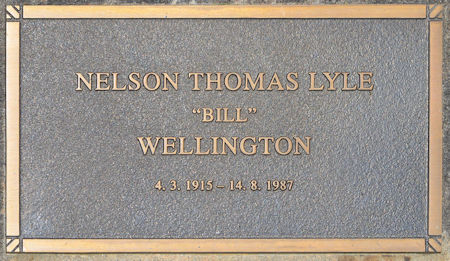 |
Bruce Hutson's email continued, 'When Chip died in 1987 I was the executor of his will and his only relatives at the funeral. Later I had a plaque made for his grave.' Source: By email 13 February 2020
End notes
Source:
 |
 |
 |
|
| This page was created by Richard Crompton and maintained by Chris Glass |
 |
Version A5 Updated 24 April 2024 |
|