1821info11b Caleb Crompton
Leslie Crompton Blackman: His death in World War 1
In Memory of
Leslie Crompton BLACKMAN
Private 3234 'D' Coy, 5th Battalion, AIF
who died on Thursday 29th June 1916.
Age 31.
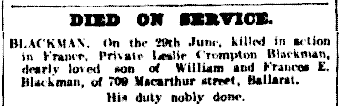
Son of William and Frances Emily BLACKMAN of
12 Baird Street, Ballarat, Victoria.
Buried in row B.16 Berks Cemetery Extension,
Comines-Warneton, Hainaut, Belgium.
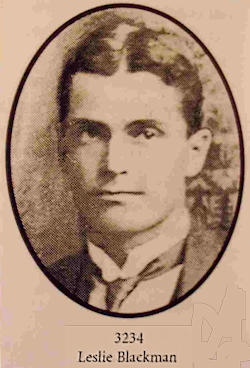
Right: Photograph of 3234 Pte Leslie Crompton BLACKMAN, 5th
Battalion, from Australian Red Cross Society Wounded and Missing Bureau files 1914-
1918 war: ref: 1DLR/0428. Possibly a family photograph, circa 1914, submitted by the
family.
Source: Geoff HUTSON, great nephew of Leslie Crompton BLACKMAN
Cemetery Location:
Berks Cemetery Extension is located 12.5 kilometres south of Ieper [Ypres] town centre on
the N365 leading from Ieper to Mesen, Ploegsteert and on to Armentieres. From Ieper ...
[take the] N336. 3.5 kilometres along the N336 [take] ... the right hand fork leads to the
town of Mesen. The cemetery lies 3 kilometres beyond Mesen on the right hand side of the
N365 and opposite Hyde Park Corner Royal Berks Cemetery.
Historical Information:
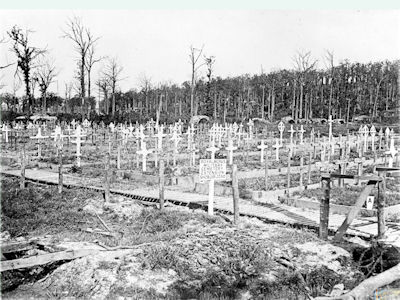
The cemetery is overshadowed on the North-West by Hill 63. It is also close to the
'Catacombs', which were deep shelters, capable of holding two battalions, and used from
November 1916, onwards. Berks Cemetery Extension was begun in June 1916, and used
continuously until September 1917. There are now nearly 900 1914-18 war casualties
commemorated in this site. The cemetery covers an area of 3,125 square metres.
Most were killed in the course of the day-to-day trench warfare which characterised this
part of the line, or in small scale set engagements, usually carried out in support of the
major attacks taking place elsewhere.
Source:
Commonwealth War Graves Commission
Above: Le Rouge et Noir shoulder patch of the 5th Battalion
1821info11b, sheet 2
The Australian Electoral Rolls, 1903-1980 shows ...
... that in 1913 Leslie lived with his married brother William and sister and was
a lamp cleaner.
Right: 6 Finlay Street, Albert Park under modernisation in 2015Source: Author November 2015
1821info11b, sheet 3
Leslie Crompton BLACKMAN's life with the 5th Battalion
1913, 446, Blackman, Daisy, 6 Finley st., hd, Albert Park a sub-division of Fawkner
1913, 447, Blackman, Leslie Crompton, 6 Finley st., lamp cleaner, Albert Park a
sub-division of Fawkner
1913, 448, Blackman, Mabel Frances, 6 Finley st., hd, Albert Park a sub-division of
Fawkner
1913, 449, Blackman, William Henry, 6 Finley st., fitter, Albert Park a sub-division of
Fawkner
Particulars Required for the Roll of Honour of Australia in the
Memorial War Museum
1. Name in full of Fallen Soldier Blackman, Leslie Crompton: 2. Unit and number 5th Battalion No 3234 Pte 3. Town Ballarat DistrictState Victoria 4. What was his birth place? Miners Rest 5. Date of Death.. 29/6/16 6. Place where killed or wounded Near Ploegsteert, on border between France and
Belgium
Particulars Required for the Nation's Histories
1. What was his Calling Blacksmith 2. Age of time of Death 31 3. What was his School Miners Rest 4. What was his other Training Gas fitter and plumber (Melbourne Gas Company) 5. If born in Britain or Abroad, at what age did he come to Australia 6. Has he ever served in any Military or Naval Force before Enlisting No 7. Any other biographical detail to be of interest
He met his death in the performance of specially dangerous work in FRONT LINE (sic), for
which he volunteered. 8. Was he connected with any other Member of the AIF who died or distinguished himself
Brother - Lieut WJT Blackman 2nd Field Ambulance 55th Batt. Enlisted as Pte & gained
commission
Brother - Capt. LA Blackman MC 8th Batt.
Cousin - Capt. JR Blackman MC 8th Batt.
Cousin - Capt. NF Wellington MC 21st Batt.
Brother-in-Law - Capt. FC Sale MC [and Bar] 21st Batt. 9. Name and Address of the Parents or other persons giving this information Name William Blackman Relationship to the Soldier Father Address 12 Baird Street Ballarat
Caleb Crompton would have been proud of his descendants. Note: In fact NF Wellington was
his brother-in-law and FC Sale his cousin.
1821info11b, sheet 4
Enlistment
Leslie Crompton BLACKMAN, once a blacksmith born Miners Rest and now a gas fitter working for
the Melbourne Gas Company on St Kilda Road, signed his attestation papers in Melbourne on 5 July
1915 and reported to the 5th Battalion's 'D' Coy. at their Broadmeadows training camp. In 1915
this was through the northern suburbs, past Fawkner Cemetery and along Sydney Road to a large
paddock [enclosed land] bounded, on the south, by road from Sydney Road to Broadmeadows railway
station and on the east the disused Melbourne to Cambelltown railway, and on the west by fields
dotted with stony outcrops, a description which might aptly describe the cemetery in the S.W.
corner.
Above: A modern map showing the extent of the Broadmeadows
camp in 1998
1821info11b, sheet 5
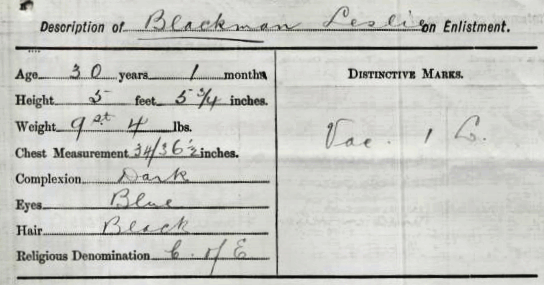
From Leslie Crompton BLACKMAN's enlistment documents.
Source:
National Archives of Australia - Service Records
Click on <Australian Army - World War 1 > Scroll down to < Find and view a
World War I service record online >
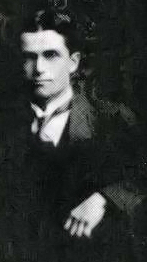
Top right: Leslie Crompton BLACKMAN, taken from the Blackman
family photograph in Ballarat 1914
Source: Geoff Hutson
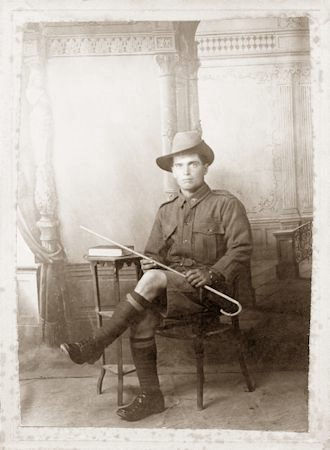
Above: Believed to be Les Blackman c.1916
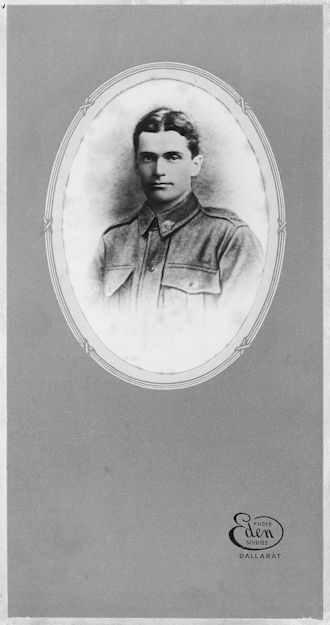
Left: Believed to be Les Blackman on his enlistment. Eden Photo Studios were at
44 Sturt Street, Ballarat. The collection is now held at the Ballarat Mechanics'
Institute. Source: Family photograph
1821info11b, sheet 6
Embarkation
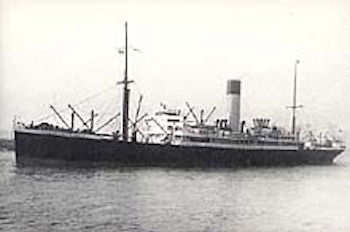
On 11 October 1915 Leslie, now part of the 5th Battalion's 11th
Reinforcements departed Melbourne in A71 HMAT Nestor bound, at 14 knots, for Egypt.
Left: The 14,501 tons SS Nestor of Alfred Holt & Co's Blue Funnel Line of
Liverpool photographed in 1913
Training in Egypt
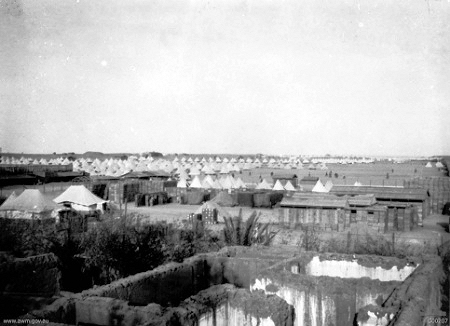
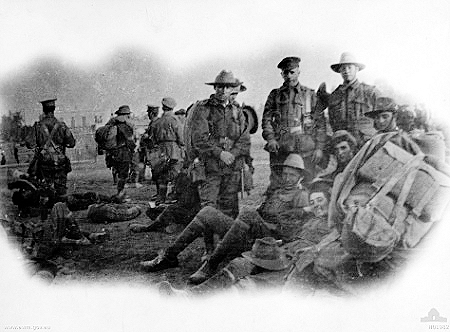
'After the evacuation [from Gallipoli the 5th Battalion]
reassembled in Egypt early in January, 1916, the desert in the vicinity of the famous
Tel-el-Kebir [70 miles/ 110km north-east of Cairo] being selected as the venue for the
infantry; ... the ninth, tenth and eleventh drafts of reinforcements arrived and the old
Battalion settled down to tent life with the ease of veterans.'
On the twenty fourth of January the Battalion moved up to Serapeum, on the banks of
the Suez Canal. ...
Right: Tel-el-Kebir Camp May 1916 Source: Australian War Memorial (AWM)
ref: C00207
On the tenth of February, the Fifth marched across the sands to Serapeum
East, a distance of fourteen miles. With the veterans weakened by their privations, and
the new drafts still raw, this march proved an intensely trying one to all. The sun blazed
fiercely down on the column plodding through the clogging sand, and when the destination
was reached at dusk that evening, tired men were allotted out-post groups, and
reluctantly dug cover for this purpose.
There was still a vague possibility that the Turks might return to the Canal attack,
especially now that their occupation of Gallipoli, so to speak, was gone; ...
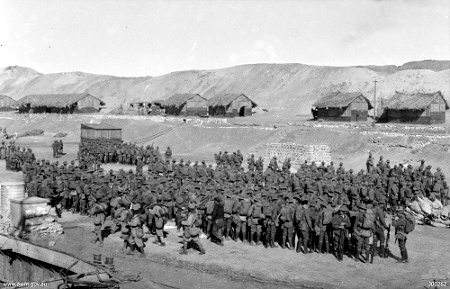
Above: Australian troops prepare to cross the Canal Source: AWM
J00262
1821info11b, sheet 7
[On 17 March 1916 Leslie Crompton BLACKMAN's second cousin, 4161 Pte. William Henry
CALDWELL arrived with the 13th Reinforcements and was taken on the strength of the
Fifth.]
Here until the end of March the Fifth were continuously training into the physical
fitness they needed to face the immanent hard fighting on the Western front ...
... More latitude was allowed in dress, and most of the men wore nothing more than a
singlet and 'shorts' on the body. Sunday, however, brought the 'military maniac' from the
lair ... and in full dress uniform and with meticulously arranged kit, the men suffered
the infliction of inspections ...
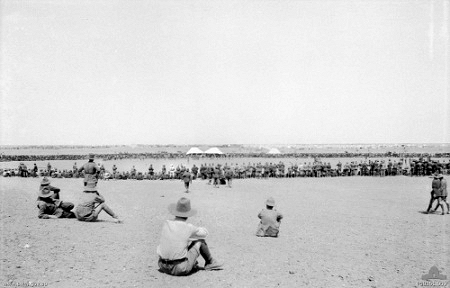
Right: 5th Battalion sports at Tel-el-Kebir 250416 Source:
AWM P00851
The desert was left on March twenty-fifth, the return march to Serapeum
[sic] being reeled off without distress, and entraining here in trucks, the
Battalion went on its jerky way to Alexandria, where it embarked the same day. 1
Right: Members of 1st Division at Serapeum before departing from France in 1916
Source: AWM H01982
On 22 February 1916 Leslie was taken on Battalion's strength. He embarked from
Alexandria, on Egypt's Mediterranean coast, on 25 March 1916 on board HMT Briton bound for
Marseilles, France arriving there on 30 March 1916 and disembarked the following day at
06.00.
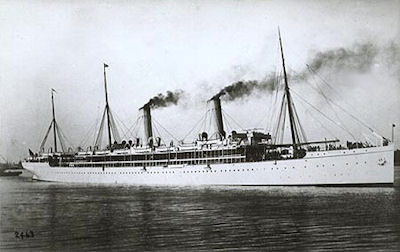
SS Briton remained in commercial service during World War I, but her third class space was
devoted to troops.
Left: Union-Castle liner Briton, (10 248 tons) photographed between 1900 and
1926
1821info11b, sheet 8
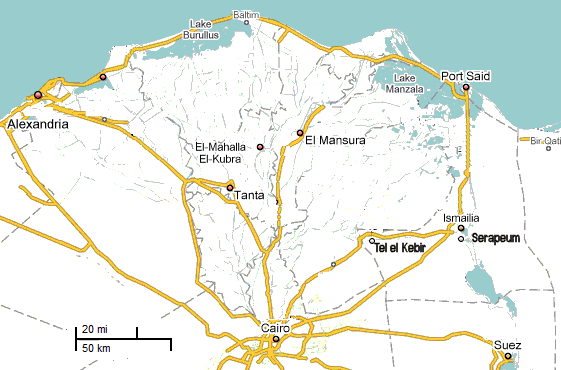
Right: Map locating Tel-el-Kebir and Serapeum in Egypt
1821info11b, sheet 9
Service in France
03 April 1916
At about noon ... the weary, cramped and dirty men detrained at
Godwaertsvelde, a small town, and returned with interest the curious gaze of the
villagers, while the C.O. ascertained the next move. ... [T]hey had been sent here
as to a training ground - since 1914 the quietest sector of the Western Front, and the one
where all the novices were blooded.
Steentje, a small town thirteen miles distant was indicated as the area for the
Fifth, but as, naturally no one knew the road, and no guide was available, the Battalion
bivouacked on the side of the road for the night. Bitterly cold it was ... and all were
glad when the chill dawn broke, with an early breakfast following.
04 April 1916
... it was a tired, out-of-sorts, disjointed column that trod the cobbled
streets and rough country roads through the sweltering air to the little village of
Steentje. ... [T]he men were accommodated in farmhouses and out buildings. ...
Every man will remember the filth of the farmyard, the unavoidable manure-pit; ... the
pigstye [sic] and the stagnant slime-covered pond. Straw bedding was plentiful and the
men, indeed, had never been so comfortable in France as they were here.
A Fortnight was spent here in getting the rough corners knocked of the Battalion.
Cont:-
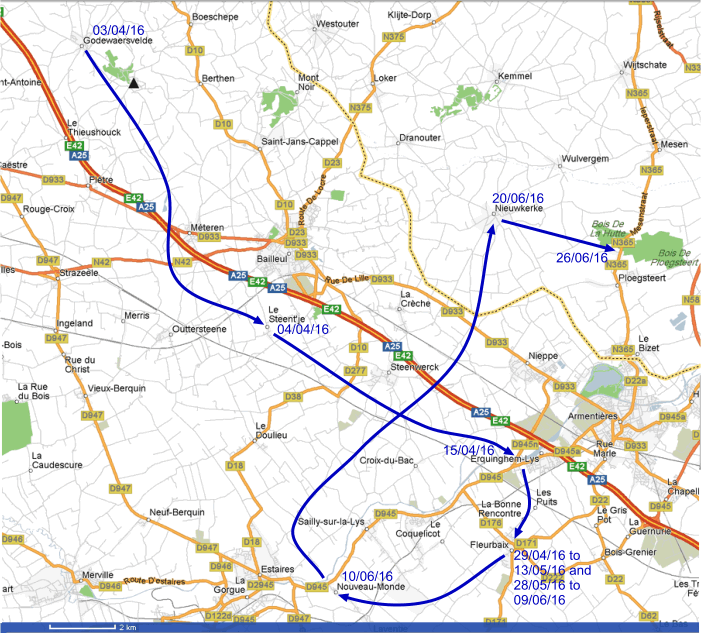
Above: The route taken by 5th Bn. between arriving on the
Western Front and their arrival at Ploegsteert Wood.
1821info11b, sheet 10
04 April 1916 :- cont
The estaminets were patronised freely at night when training was
done, and the euphonious French word quickly superseded 'pub' in the men's vocabulary.
'Vin rouge, vin blanc', generally diluted with grenadine (which is
pomegranate syrup), innocuous beers of the country, were consumed with avidity ...
15 April 1916
... the Battalion left Steentje and marched to Fort Rompu ...
as Erquinghem-Lys was impossible for Australian, the name of the principle street was
chosen. ... Here the Battalion were quartered in wooden Army huts, about sixteen men each.
29 April 1916
... fully equipped, with the newly-issued steel helmet replacing the
beloved slouch felt the Fifth left for Fleurbaix or Fromelles [sic], as it
was rightly called. ... Here raw troops were schooled [to gain experience in the quiet
forward trenches]. NB: this is not THE Fromelles.
13 May 1916
Back to support went the Fifth, finding their resting place to be a ruined
farmhouse at the cross roads (Croix Mar?chal) and in full observation of the not far-
distant enemy.
28 May 1916
Back to the trenches [for ten days of digging and sniping] to relieve the
Seventh.
10 June 1916
... the regiment was relieved and billeted comfortably in farm houses at
Le Nouveau Monde. 2
                                 Headquarters 5th Battn. AIF

                                              12/6/16
                        SECRET OPERATION ORDER NO 20

                      BY MAJOR JOHN WALSTAB, COMMANDING
MOVE       1. The Battalion will move to new Billets in the neighbourhood of NEUVE
ELISE today. Head of Coys. will be at [reference] G.9.c.38 at the following
times, dressed in Marching Order, with unexpired portion of day's rations, one
iron ration, water bottle filled, one blanket and waterproof sheet on the man:-
       C Company        1450       B Company        1455
       A    "           1500       D    "           1505
       M.G.Section      1510
       Specialist Platoons & H'qrs Detail          1515
       Transport        1520
ROUTE      2. From Starting Point G.9.c.38 to G3b.75/A.22.a.18/
STEENWERK ... to NEUVE EGLISE.
COMMAND    3. For the purpose of march discipline, Captain L. LEVY will act as
Battalion 2nd-in-command and move to the rear of the column. Lt. H.A.M. GRAY will
command Intelligence, Raiding and Grenade Platoons, together with the pioneers
and Headquarters' Details, who will move as a Company.
PRECAUTIONS 4. On the appearance enemy aircraft, units will halt and take cover
at the side of the road. Coy. Commanders will ensure that an interval of at least
250 yards is maintained from Coy. in front.
HALTS       5. Halts of ten minutes' duration will be made at 20 minutes past
clock hour.
...
REPORTS    10. Reports to the heads of column en route. The new position of
Battalion H'Qrs will be notified on arrival in new Billeting Area.
                                 (Sgd), H.H.G.O'LOUGHLIN  Lieutenant. Adjutant 3
1821info11b, sheet 11
Plugstreet Wood
Keown [ibid] continues:
20 June 1916
'Orders were received that the Battalion was to proceed to Neuve
Eglise(the modern Flemish town of Nieukerke), and over the Belgium border they
marched to this place, where they were accommodated in small canvas bivouacs. Here the
following three weeks were spent training and the inevitable fatigues. From here they
shifted to the famous Ploegsteert Wood, a forest belonging to the King of Belgium [sic]
and which became world famous under the name Plugstreet. Comfortable huts, sheltered
by the hill, housed them here, and the inevitable fatigues recommenced. The fatigue
parties were introduced to gas cylinders which they carried up to the front line. A heavy
awkward burden for two men, they were laboriously transported and placed under the firing
step in readiness for the attack, which took place a few days later, after the usual
heavy bombardment. Only some few of the Fifth, who had been picked for raiding
parties, were in the front line at this time.'
The actual gas cylinders were around 6 feet (2m) in height and weighed about 150lbs (68kg) and
had to be manhandled to its location by three men.
The woods in front of the Berks Extension Cemetery are Ploegsteert Woods (known as
Plugstreet to the soldiers) and were the south-eastern hinge of the Ypres Salient for the
majority of the war. One of the location of the 1914 Christmas football match and
fraternisation was close by at Le Petit Douve Farm (along Mesenstraat). It was the right
flank for The Battle of Messines (Mesen) in 1917. Until the German push of April 1918, in
the Battle of the Lys (known as Fourth Ypres), this area was known as the 'nursery
trenches', where battalions new to the front received their initiation and training, in
this quiet sector of the trenches. There was no major activity in the area in June 1916.
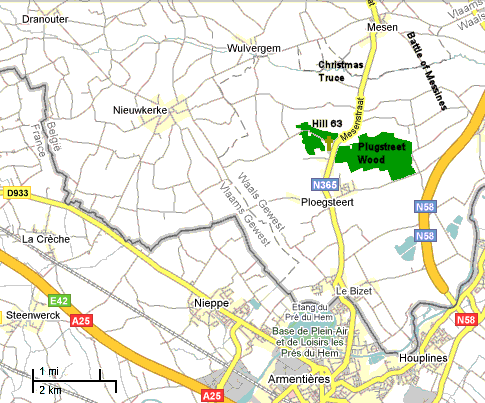
Right: Map locating Plugstreet Wood
1821info11b, sheet 12
Speculation as to Leslie Crompton BLACKMAN's final action
The War Diaries of the 5th Battalion AIF reveal what may have been Leslie's last action.
WAR DIARIES or INTELLIGENT SUMMARY
Date
Place
Time
Summary of Events or Information
June 21st
NEUVE EGLISE
2nd Lt LANGFORD & 8 O Ranks returned from Div Bomb School.
2nd Lt. SMITH & returned from Div Engineering School.
22nd
"
2 NCOs to Physical Training School.
2nd Lt. HM GRIFFITHS and 3 O Ranks returned from Bayonet Fighting School.
23rd
"
Lt TK MALTBY returned from Sniping School.
2nd Lt HA FLEMING and 1 O Rank reinforcement reported for duty.
24th
"
Bn left billeting area NEUVE EGLISE at 21.00 and proceeded to Bn
reserve billet LA GRANDUE MONQUE arriving 2400.
26th
LA GRANDUE MONQUE
Capt BS BAIN and 2nd Lt SAMSON returned from hospital.
28th
"
2nd Lt HA FLEMING and 1 O Rank to Div Engineering School.
2nd Lts DEVERIDGE & KNIGHT and 9 O Ranks returned from Div Bomb School.
Lt HOOPER and 3 O Ranks returned from Div Engineers School
29th
"
2 O Ranks killed and 2 O Ranks wounded
Lt IMRAY and 4 O Ranks to Div Bomb School.
June
LA GRANDUE MONQUE
Since 25th inst Bn has been employed on working parties in
connection with GAS ATTACK and raid by 17th Brigade.
Four officers Lts FITZGERALD, BURKE, CARTER & 2nd Lt STRINGER with 110 O
Ranks Raiding Party for duty with 17th Brigade
HG O'Loughlin Lieut (Adjutant)4
Pte. 3266 J Dillon, of the 5th Battalion, was also killed on the same day and is
buried next to Leslie BLACKMAN.
1821info11b, sheet 13
Headquarters 5th Battn. AIF

				27/6/16
SECRET MEMORANDUM NO 23

                BY Lt Col FW LE MAISTRE DSO COMMANDING
  1. The battalion has been ordered to form Carrying Parties to handle
     Gas Cylinders as per details hereunder.
  2. The Cylinders will be brought up from railhead on nights of 27/28th and
     29/30th June in two Convoys A and B on each night....
  3. Carrying Parties for Convoy[s] will be found by 5th Battn. for
     [both nights as per Appendix A and B.]
  4. Unloading Parties will be furnished by ...
     Parties to report at 2330.
  5. The Routes to the Trenches for the Cylinders brought up by Convoy B
     will be HYDE PARK CORNER, MUD LANE-AND CORNER-PROWSE POINT.
     Squads will return by ONTARIO AVENUE-TRAMLINE-HYDE PARK CORNER.
  6. Guides ....
  7. Poles & trench sticks ...
  8. Reception of cylinders in trenches ...
  9. Action in the event of a puncture ...
  10.Hostile ...
  11.Precautions ...

  APPENDIX 22   CONVOY "B" - FIRST NIGHT
  No of                  Strength   Carried    No. of   No. of     No. of
  Squad   Officer        O.Rank     for        Bay      Cylinder   Trench

  1      Lt. Samson       40        A.Coy      16        12         187
  2      Lt. Smith        40        A.Coy      15        12         ''
  . .......... .. .....   ..        .....      ..        ..         ..

  10     Lt. Chenu        40        D.Coy       2        12         ''

  Total  10 Officers     398 O.R.                       180  5
The Attestation Records of 617 Lance Corporal Wilson, Samuel, 4 Platoon, 8th
Battalion, killed on the same day as Leslie, records that he was buried by Rev. FJ Miles. Source:National Archives of Australia (Accessed: 01 May 2018)
Longmore describes the task of removing gas cylinders in the vicinity of The Catacombs prior to
Messines:
One task set the [49th] Battalion provided them with some strenuous work
in removing about 100 gas cylinders from the front line, where the wind had not been favourable
for their discharge towards Fritz. It had previously been reported to Division that it was
impossible to move these cylinders owing to the state of the trenches and the constant artillery
fire. Hostile shells had even burst and half buried some of these cylinders, and they had to be
dug out by the men working in gas helmets. As each cylinder was a heavy load for two men and the
carrying distance was nearly two miles—what with shell fire, gas, crooked, broken and narrow
trenches—it can be imagined that the Battalion was up against a staff proposition, and that it was
successfully accomplished can only be attributed to the determination of the Diggers themselves.
6
1821info11b, sheet 14
The War Diary of the 7th and 8th Battalion supports the need for gas.
WAR DIARIES or INTELLIGENT SUMMARY
Date
Place
Summary of Events or Information
June 29th
Ploegstreet Sectors - 129, to 133
Our action Six
listening patrols went out in front of the Bn. All reported back safely. Operation Memo
10 re, Gas was issued .... .... Gas was not discharged, owing to unfavourable winds.
(our artillery was very active) Also M.Guns. Enemy action Artillery heavily shelled sectors 130-131-132. Causing a good number
of casualties. ... Casualties No. 2880 Cpl. Robins A, No 2622 Pte.G.P.Didier Killed.
HG O'Loughlin Lieut (Adjutant)
8
WAR DIARIES or INTELLIGENT SUMMARY
Date
Place
Summary of Events or Information
29/6/16
Messines
Sectors
Arrangements for Gas ready but wind unfavourable. Our
trenches heavily shelled by 5.9 and minnewarfers particularly sector 135. Casualties 5
killed 24 wounded
?? Wallis Lt & Adjutant9
WAR DIARIES or INTELLIGENT SUMMARY
Date
Place
Summary of Events or Information
29/6/16 21.00
Petit Mungue
Sheet 28 SW
Enemy shelled locality 1 & wood near MUD LANE with 77s –
tramway slightly damaged. Party from 5th Bn of 3 off, 10 NCOs & 100 O Ranks under LT.
FITZGERALD to discharge smoke from trenches 124 to 126, 130 to 135 both inclusive moved
up to line. Party "K" Coy RE to discharge gas from 127 and 130 also in h---.
JE Borwich Major Brigade Major 2nd Aust Inf Bde
10
It is possible that both the 7th and particularly the 8th, having been heavily shelled,
expected a German attack. The taking forward of gas was a preparatory defensive measure. The 8th
Battalion record that gas was eventually released on 1 July 1916 in a sector to their right. This
was preceded by artillery bombardment and a discharge of smoke. The enemy retaliated with an
ineffective machine gun and artillery.
Keown describes the huts and the raiders at Le Grand Monque Farm.
'A sermon, given by Chaplain Miles to the Fifth whilst in Egypt, dealt
with the doings of a tribe mentioned in Deuteronomy, and called the Zam Zummim, noted for their
huge proportions and strength. It was an interesting discourse, but, as is often the case, the
peculiar name was remembered by the men long after the moral effect of the sermon had been
dissipated.
When the first raiding party was chosen at Ploegsteert Wood, the men
were segregated for the special training necessary, and on the door of the hut they occupied was
chalked in bold letters — "The Zam Zummers," a half-serious allusion to the
sermon heard many months before. Ever afterwards raiders in the Fifth were known as "The Zam
Zummers".' 11
1821info11b, sheet 15
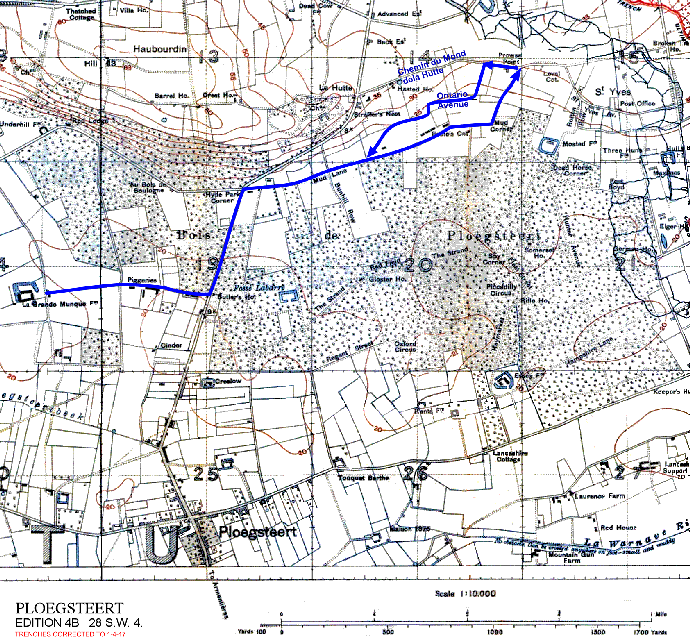
Above: 1917 trench map, correct to 1-4-17, of Plugstreet
Wood showing, in blue, the outward route taken by the 5th Bn. gas carrying party on 29
June 1916. British trenches in blue. German trenches in red.
Source: GH Smith & Son
Ontario Avenue from Barton, Peter, 'The Battlefields of the First World War',
Imperial War Museum, London, 2008
Clicking on the bottom of the map opens a 571kB, A4 landscape image of the map.
The fatigue parties return journey is also described in Cunningham etal:
It is believed that the Chemin du Mond de la Hutte, the modern road from Prowse Point to
Mesen Road was Ontario Avenue.
'Two platoons of the reserve company then proceeded to the Catacombs at Hyde Park Corner,
the rest of the battalion entering the trenches via The Strand, Bunhill Row, Mud Lane
Breastwork and Ontario Avenue. ... Rations were brought up to Campac Dump by transport,
by the Canadian Pacific Light Railway (mule drawn or hand pushed), to Mud Lane Breastwork,
Prowse Point and St. Andrew's Drive.' 12
1821info11b, sheet 16
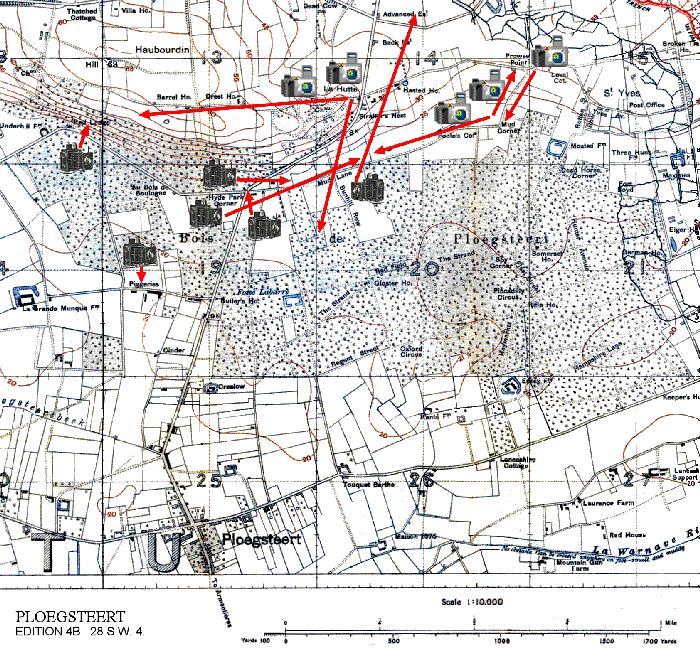
Above: 1917 trench map of Plugstreet Wood showing, in blue, the outward
route taken by the 5th Bn. gas carrying party on 29 June 1916. British trenches in blue.
German trenches in red. Source: GH Smith & Son
- Clicking on the map camera hotspots opens a contemporary jpeg photograph.
- Clicking on the map camera hotspots opens a modern jpeg photograph.
1821info11b, sheet 17
Above: Looking towards Mesen (Messines) from Prowse Point
Military Cemetery, where the track from Mud Corner and the road to La Hutte and Hill 63.
Bairnfather's Christmas Truce took place in the foreground field. Author: July
2008
Anton's Farm is on the left. This was a fortified farm on the British front-line, which
lay roughly on the hedge line. The Germans held the high ground of Mesen church and the
land in the area of the copse. This area was the objective of the gas carrying party. See
map above for more details.
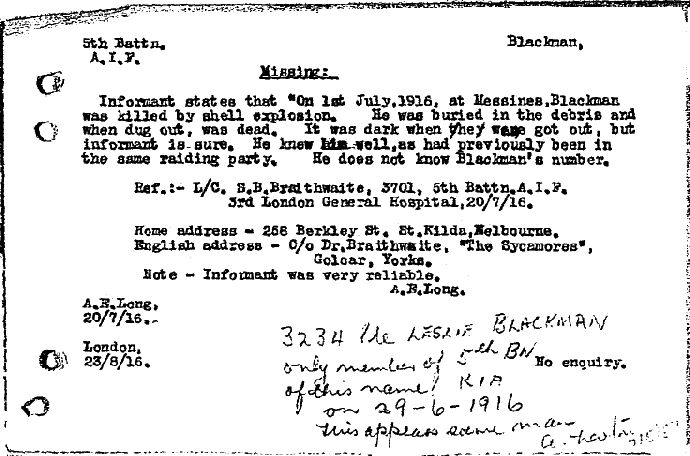
The war diaries do not give a clear cause for Leslie's death. However, a reliable eye witness
account in The Australian Red Cross reports of the missing and wounded 13 does.
1821info11b, sheet 18
It seems likely that he either died in the operations to move the gas cylinders or, as
Ballarat's tribute to those who fought and died in World War 1 suggests, whilst volunteering for
a bombing raid as a 'Zam Zummer'. Both would link to the family record him dying on "
specially dangerous work in the front line".
End notes
Keown pp. 147-150
ibid pp.154-165
5/Bn June War Diary p.10
ibid pp.4-6
ibid pp.12-14
Longmore, p. 67
CWGC
Source unknown. Logged as 5/Bn War Diary and 2nd Infantry Brigade War Diary - can't be
located
8Bn War Diary p.12
2.Bde War Diary June 1916 p.7
Keown p.199
Cunningham Chapter XXI pp.143-4
The Australian Red Cross wounded and missing files
Keown AW, 1921, ‘Forward with the Fifth - The story of Five Years’ War
Service Fifth Battalion, AIF - Chapter XVII, The first Battle of Pozieres’, Naval
and Military Press, Uckfield, Sussex, Reprint 2009
Longmore, Capt. C, “Eggs-a-Cook” The Story of the Forty-Fourth, Naval and Military
Press/Imperial War Museum reprint, 2009
Speed, Brig. FW, Ed, ‘ Esprit de Corps The history of the Victorian Scottish Regiment and
the 5th Infantry Battalion’, Allen and Unwin, Sydney, 1988 0 04 302007 0
1821info11b, sheet 19
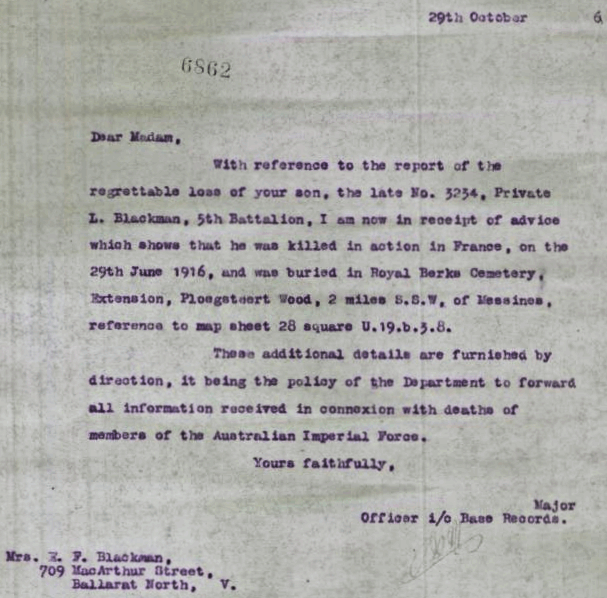
Notification of Leslies death
Above: The official letter confirming the location of LCB's
burial - see below Note: Frances' address in the letter. Source:
National Archives of Australia - Service Records Click on <Australian Army - World War 1> Scroll down to <Find
and view a World War I service record online>
1821info11b, sheet 20
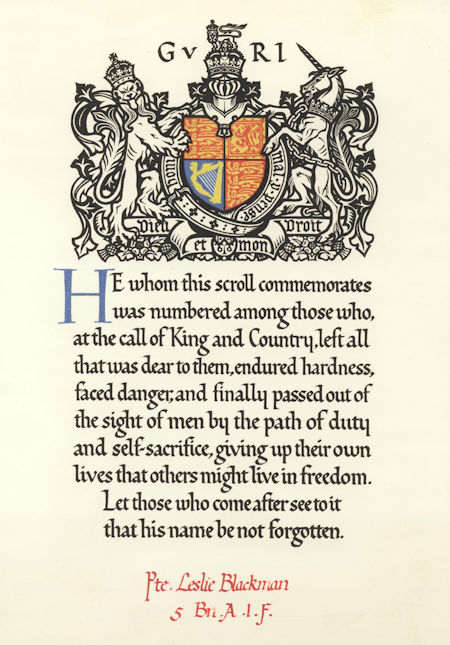
The next of kin of all members of the British and Empire Forces who died in the
First World War were sent a message, a scroll and a plaque, at the State's expense. The
wording on the scroll was drafted by Dr. Montague Rhodes James, Provost of King's
College, Cambridge. The location of King's message and death plaque are not known.
Right: Les Blackman's death scroll Source: Family
1821info11b, sheet 21
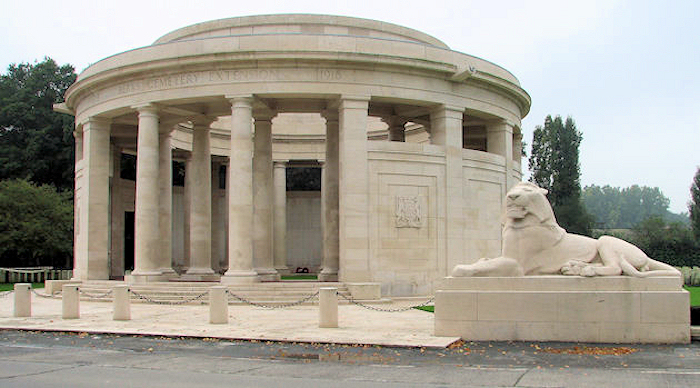
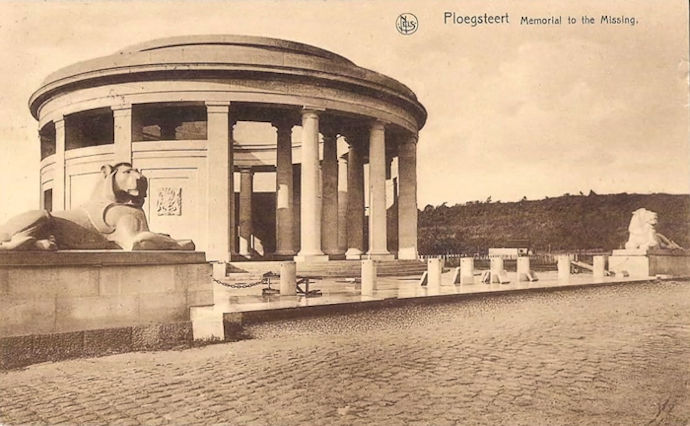
Leslie Crompton BLACKMAN remembered at Royal Berks Extension Cemetery, Ploegsteert, Belgium
The cemetery, cemetery extension and memorial were designed by Harold Chalton
Bradshaw
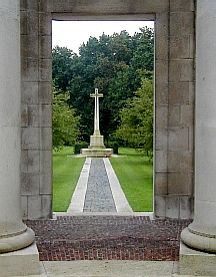
Top: The Ploegsteert Memorial to the Missing, at the position
known during the war as Hyde Park Corner'. It commemorates
11 447 men with no known grave and who fell in the area.
Above left: The Sword of Sacrifice
Above right: The Stone of Remembrance
All author: 04 July 2009
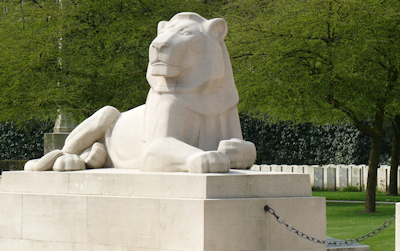
Right: Gilbert Ledward's lion Photo: Matthew Dempster, April 2009
1821info11b, sheet 22
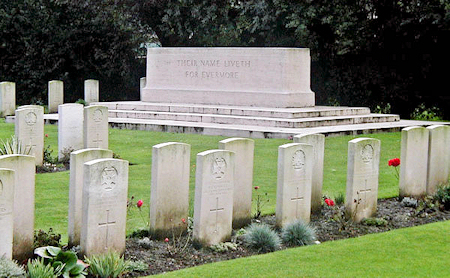
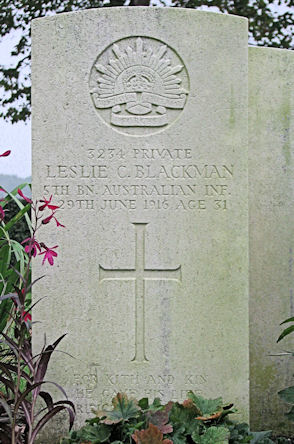
Leslie Crompton BLACKMAN's grave
The Government were responsible for the erection and maintenance of the headstones. In 1929
families were informed, by letter, that they could add personal inscriptions at a maximum of 66
letters and spaces. In 1929 each letter cost 3½d, approximately equivalent to 1.5p or
A$1.12.(2018)
Above: Ploegsteert Memorial to the Missing at the time of
its unveiling in 1931
Clicking on the black and white photograph will open a new A4 portrait
page with four contemporary and dated photographs.
1821info11b, sheet 23
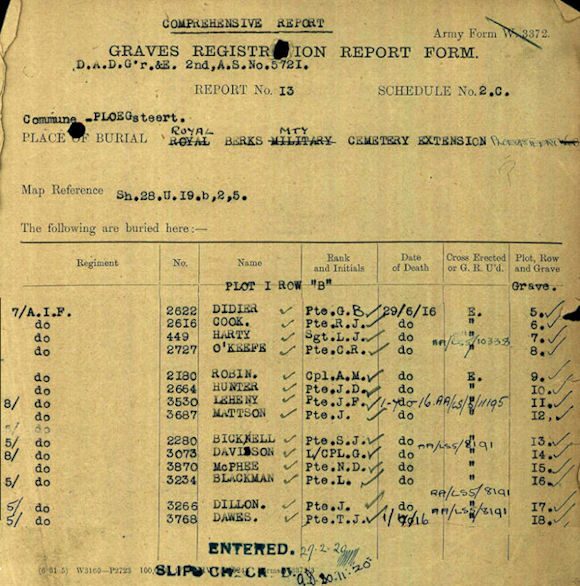
Above: Berks Extension Cemetery record
for the dead of 29 June 1916 - composite image 7
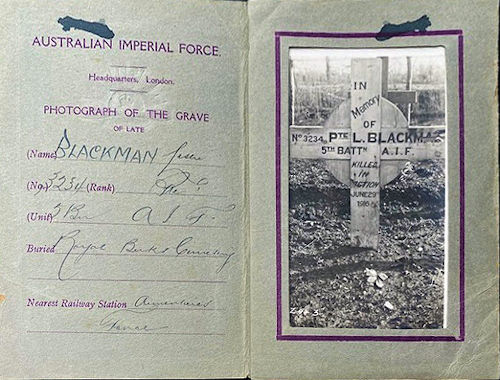
Right: The original headstone cross for Leslie Blackman on its
original card probably sent to the next of kin by the Australian Red Cross
Society's Enquiry Bureau for the Wounded and Missing.
Source: Lyle Blackman's papers in the custody of his grandson James
Coghlan. With thanks to Pam Coghlan
The family words, at the foot of the headstone, read:
'FOR KITH AND KIN
HE GAVE HIS LIFE
A SACRIFICE SUPREME O'ER ALL'
1821info11b, sheet 25
Leslie Crompton BLACKMAN remembered in Ballarat and Melbourne
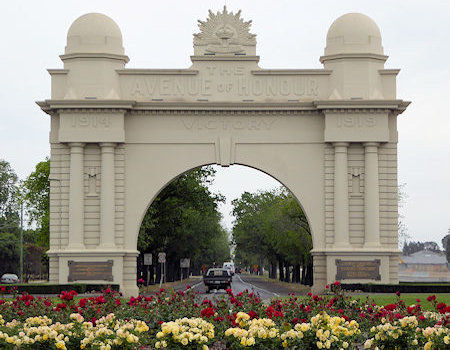
Left: Ballarat's Avenue of Honour (Remembrance Drive), stands
at the western entrance to the city and leads to the tree lined avenue that commemorates
the soldiers of World War 1.
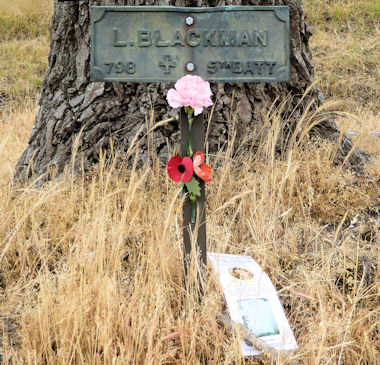
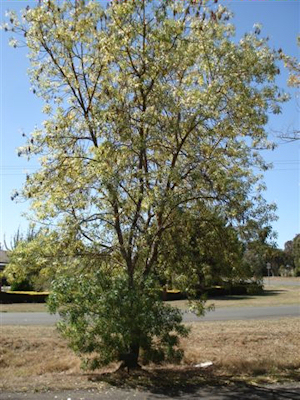
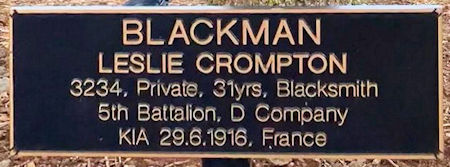
Below right: Tree number 798 is dedicated
to Leslie Crompton BLACKMAN, Below left: The commemorative plaque, replaced for
the Centenary.
Author 25 November 2015
1821info11b, sheet 26
View YouTube video of the one hundredth anniversary commemoration of Ballarat's Victory
Arch and Avenue of Honour
1
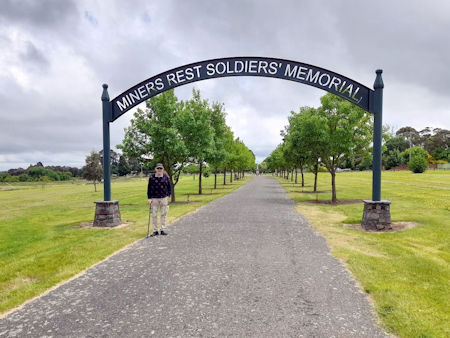
And at Miners Rest
His own community to mark the centenary of the end of World War 1.
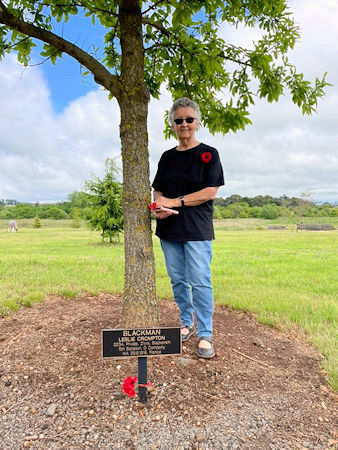
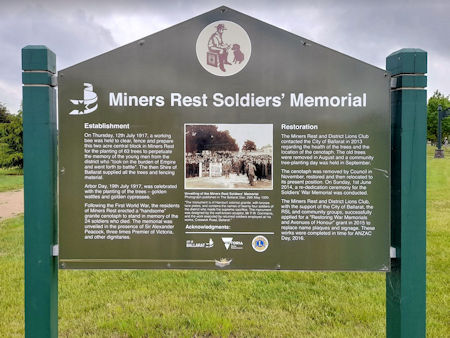
Right: Leslie Crompton Blackman's marker
Hoverbox Photo Gallery - Miners Rest Soldiers
Memorial - Source: All Heather Schoffelen November 2022
This feature does not function correctly on phones and tablets
1. The Memorial's entrance
2. Heather Schoffelen at Leslie
Blackman's Miners Rest tree 3. The Memorial's information board
1
2
3
1821info11b, sheet 27
And finally at the family home
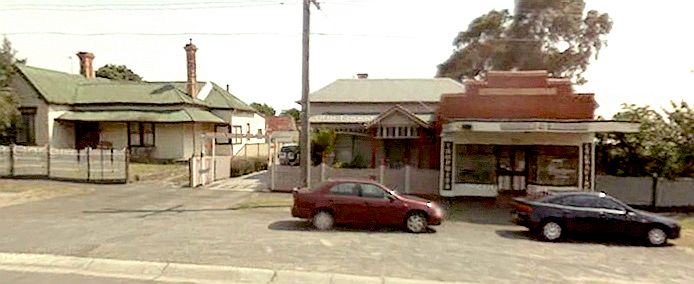
Above: StreetView of 709 MacArthur Street, the BLACKMAN's
home when Leslie enlisted
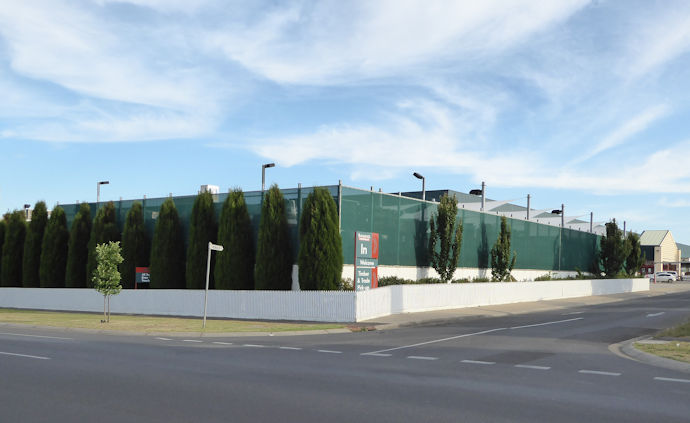
Above: 709 MacArthur Street as it was on 24 November
2015 Author November 2015
1821info11b, sheet 28
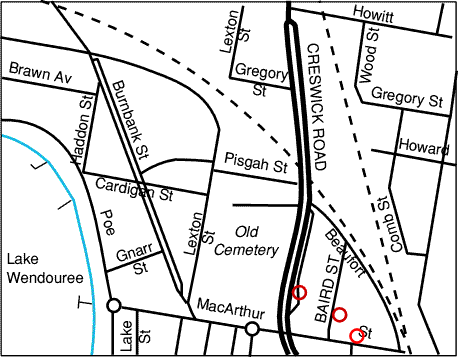
Right: A modern map of Ballarat, Victoria, locating 709 MacArthur Street;
12 Baird Street where the family moved and 416 Creswick Road, the home of Maralena
(Madalena) Louisa DONALD (nee Crompton - Caleb's daughter).
With thanks to Warren Power of Creswick, Victoria for the photograph and map.
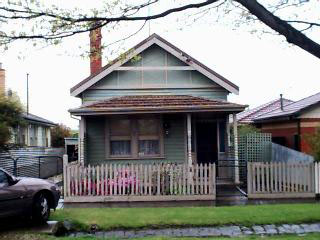
Left: 12 Baird Street, Ballarat, - taken in November
2003 and looking to be little changed from its original Federation style) Photo:
James Crompton
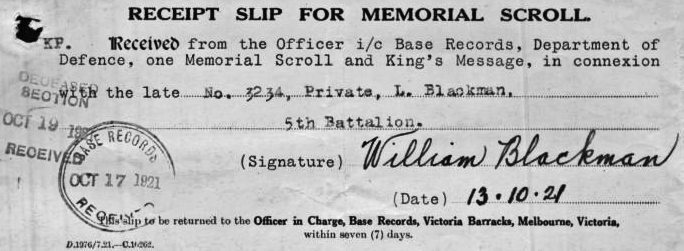
Above: William BLACKMAN's signature on the receipt for the
Memorial Scroll Source:
National Archives of Australia - Service Records
Click on <Australian Army - World War 1> Scroll down to <Find and view
a World War I service record online>
1821info11b, sheet 29
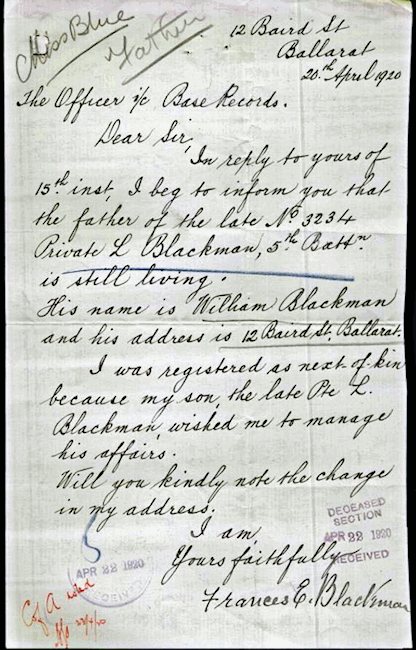
Right: Frances BLACKMAN's letter in reply to an enquiry from the
Base Records Office Melbourne, showing the change of address
1821info11b, sheet 30
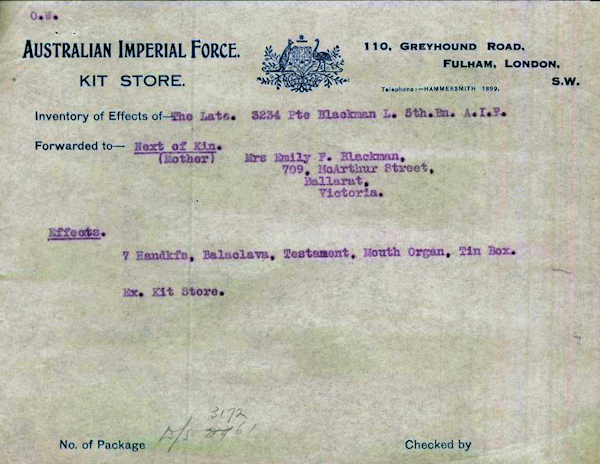
Above: A letter confirming LCB's personal effects
End pieces
On 12 July 1916 the 5th Battalion moved to the Somme and the first battle for
Pozieres. William Henry CALDWELL was killed in action on 25 July 1916 and was buried in front of
the barbed wire protecting the German trench OG1.
During August 2002 we decided to cross the English Channel to shop in Calais, have an evening
meal in Ypres and to attended the Last Post Ceremony at its Menin Gate.
The morning was wet and lorry convoys on the A26 constantly sprayed the window screen. This,
together with driving on 'the wrong side' of an unknown road, meant that we cruised pass our
planned turn to Steenvoorde and Poperinge. The next motorway exit took us to the legendary and
romantic Armentiéres. In the days before SatNavs the car found its way around back streets and
through junctions looking for the N365; a cross-country route to Ypres' back door.
Just across the Belgium boarder, the village sign spelling P-L-O-E-G-S-T-E-E-R-T 1 had no meaning; the wood we passed had no significance.2 At
the end of a long straight, once cobbled road, shafts of sunlight illuminated the dome of a
Portland Stone Rotunda 3of considerable size and importance, but of unknown
relevance. We drove pass it and the headstones of Commonwealth graves lining either side of the
road. 4 It was impressive but of no obvious history, and Ypres beckoned.
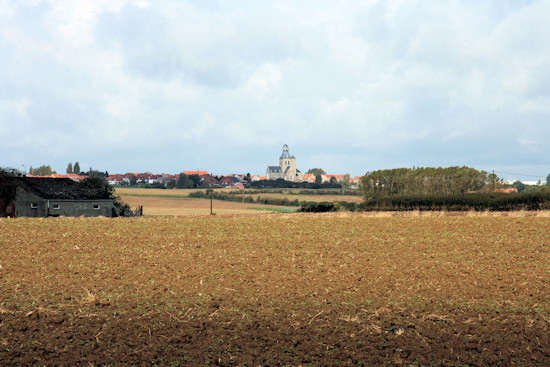
Cresting a ridge a wide plain, that rose to an imperceptible ridge, appeared.5 The road descended to a bridge over a shallow river6and then
climbed towards a church tower,7 which dominated the skyline. This settlement
announced itself as 'Mesen',8 but the map identified it as 'Messines'. A
familiar name suggesting we had driven through the scene of the 1917 battlefield and Allied
victory.
The steak and chips was very Flemish and the Last Post Ceremony moving and memorable.
Several months later that I discovered Leslie Crompton BLACKMAN lay in the cemetery by the
Rotunda, and that the name of John Henry CROMPTON, from Driffield in Yorkshire and of the 42nd
Battalion, was engraved on the Menin Gate.
1821info11b, sheet 31
Until this photograph emerged I thought that I was perhaps the only relative,
distant thought I am, to visit the grave. On my fourth visit to the Royal Berks
Extension Cemetery was in October 2008, I showed friends around Ploegsteert Wood. I
have seen the headstone in three seasons: after the ravages of winter with unkempt
weeds; in early summer when the carefully tended boarders come to life; and in late
summer when the flowers are at their zenith. What ever the season or weather the roar
of the traffic disappears in this tranquil, beautiful and historic setting. My last
visit was as part of a coach party following the 23 April 2018 following the Dawn
Service at Villers-Bretonneux. Two of us stood in the same row of graves, five
headstones apart. Her relative had been killed on the same day as Les, probably on the
same raid.
A fitting place for one who gave his life for what was considered to be 'the home
country' ...
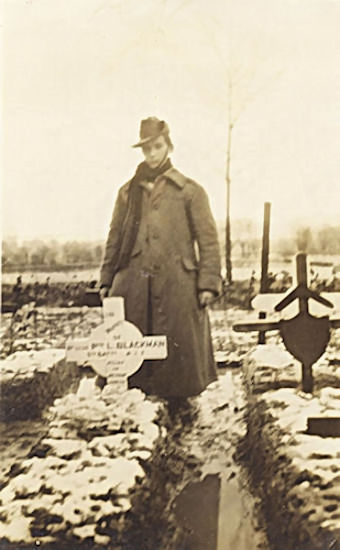
Left: Tom Blackman at his brother's grave in Berks Cemetery Extension
circa February 1917 Source: Heather Schoffelen
End notes:
Troops 'translated' this Flemish spelling to the more familiar Plugstreet.
THE Plugstreet Wood.
The Ploegsteert Memorial to the Missing - see above.
On the left Royal Berks Extension Cemetery, and on the right Hyde Park Corner Cemetery.
The valley of the Lys and the Messines Ridge.
The Douve river, where the Germans were stopped in 1914.
Messines church, in whose crypt the wounded Corporal Adolph Hitler was supposedly treated
for wounds to his arm.
'Mesen' is Flemish and 'Messines' French.
1821info11b, sheet 32
Lieutenant Roland Leighton, 1/7 Battalion Worcestershire Regiment, picked violets from the
top of a dugout along Toronto Avenue. They were sent to Vera Brittain, whose daughter Shirley
Williams documented their love story in her book, A Testament for Youth. On the same day,
25 April 1915, Leighton sent a poem to his mother. Leighton was killed just before Christmas
1915.
Villanelle
Violets from Plug Street Wood,
Sweet, I send you oversea.
(It is strange they should be blue,
Blue, when his soaked blood was red,
For they grew around his head;
It is strange they should be blue.)
Violets from Plug Street Wood-
Think what they have meant to me-
Life and Hope and Love and You
(And you did not see them grow
Where his mangled body lay.
Hiding horror from the day;
Sweetest it was better so.)
Violets from oversea,
To you clear, far, forgetting land
These I send in memory,
Knowing You will understand.
This page was created by Richard Crompton
and maintained by Chris Glass




 State Victoria