| John died in 1908 and is buried at the Lelant Cemetery with his parents
William Glasson and Emma nee Roach.
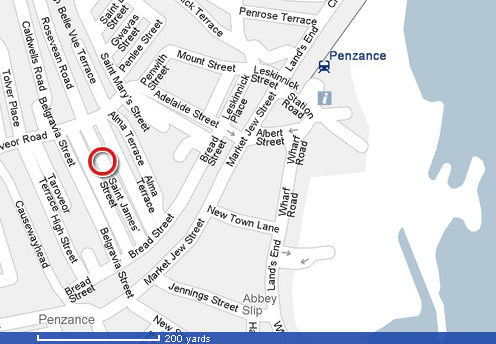
Right: Map locating 11 St James' Street Penzance |
 |
1815 Info 7b for Richardson Crompton |
James Thomas GLASSON
James Thomas GLASSON was born on the 1st August 1884 at Temuka, South Canterbury. He was the son of Paul Roach Glasson (born Cornwall) and Emily Hyde Glasson nee Crompton.
On the 21st December 1887 Paul Glasson, James' father and the local blacksmith, took his two sons on a shooting trip near Toomeys Bridge, Hilton and on the way stopped to talk to a local farmer, Mr Woodley. While the two men were talking the children played around their feet and one of the two children was thought to pull the trigger blowing away half of Paul Glasson's face and resulting in his death soon after. Later Emily GLASSON left for the UK. When she returned to New Zealand in 1890 on the 'Rimutaka' she had only two children with her - six year old William Richardson and two year old Mary Jane. James Thomas remained with his uncle John GLASSON and aunt in Penzance where he was brought up.
1891 Census   Sun/Mon 5/6th April 1891
Source:       FHL Film  TNA Ref RG12
              Piece 1858 Folio 54 Page 30 Sched 196
Dwelling:     21 Tolver Road
Place:        Penzance, Cornwall, England

Name             Rel   Mar Age  Occupation         Status    Birthplace
John Glasson     Head   M   44  Tailor             Employer  Cornwall, Lelant
Mary Glasson     Wife   M   38  (nee Arundel)                Cornwall, Penzance
James T Glasson  Neph        6                               New Zealand, British Subject
John Arundell    F-i-L Wid  64  Shoemaker          Neither   Cornwall, Gulval
Agnes Thomas     S-i-L  M   26                               Cornwall, Penzance
It is possible that James Thomas visited his mother in New Zealand, for a particular reason, sometime after 1891.
1901 Census   Sun/Mon 31st March/1st April 1901
Source:       FHL Film  TNA Ref RG13
              Piece 2254 Folio 5 Page 4 Sched 11
Dwelling:     11 St James Street
Place:        Penzance, Cornwall, England

Name                  Rel  Mar Age  Occupation               Status       Birthplace
John Glasson	     Head  Wid  53  Tailor                   Own account  Cornwall, Lelant
James thomas Glasson  Son   S   15  Potato Merchants Assit.  Worker       New Zealand,
                                                                 Christchurch (Temuka area)
| John died in 1908 and is buried at the Lelant Cemetery with his parents
William Glasson and Emma nee Roach.
Right: Map locating 11 St James' Street Penzance |
|
Aged 18 years, James Thomas GLASSON (300562) joined the Royal Navy on 24 May 1902 for a 12 year term as a steward. He was described as 5' 3½" (161cm) with brown hair, hazel eyes and with a fair complexion. James Thomas served as a second class steward on the iron screwed yacht HMS Vivid, which served as the Devonport base ship and yacht for the port admiral.
 |
He was posted first to HMS Wallaroo and then to HMS Phoebe, both cruisers
launched in 1890, for service as part of the Australia Squadron.
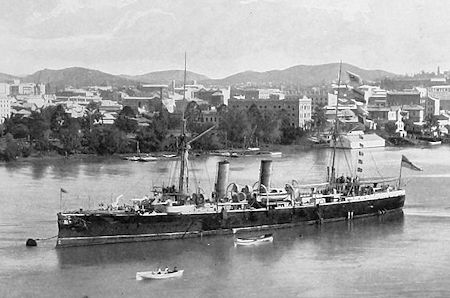
On the 29th December 1902, while tied up at Port Chalmers, New Zealand, James ran from the ship. He was "recovered" and sentenced to 90 days detention. Between 17 June 1903 and 08 July 1903 he was in 'Cells 14 days' for an unknown crime. Left: HMS Wallaroo c.1902 in Brisbane class cruiser, 2575 tons, ex. " Persian" Aux. Squadron Australian and New Zealand Stations 1891-1906 |
Prior to this James had his character recorded as VG - (very good).
| Then on the 23rd July 1903 he was posted to HMS Phoebe, (a Pearl 3rd
Class Cruiser similar to HMS Philomel), and three days later given 90 days punishment for
insubordination. On the 18th December 1903, James faced a court martial for wilful
disobedience. His conduct, as a result of a punishment of 9 months hard labour, was
described as 'Bad'.
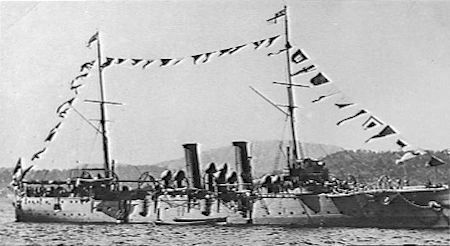
Source: The National Archives (TNA) ADM 188/488/300562 Right: HMS Phoebe, in Hobart in 1903 when James Thomas GLASSON may have been on board |
 |
His service record finishes at this point so it is not clear how or when he was discharged. Could he have been discharged and made his way to New Zealand?
National Explosive Works, Hayle
| Prior to enlisting he was a Fitter Labourer at the Cordite
Process House, National Explosives Works, Hayle.
In 1888 the National Explosive works were established on Upton Towans (also known as "Dynamite Towans"). Originally built to supply the local mining industry it soon grew to supply the military, and during the First World War employed over 1500 people. The remote location on the Towans proved a wise move as there were a number of accidents resulting in explosions. Source: Walking West Cornwall (Accessed: 22 June 2020) |
 |
| Above: The remains of the National Explosives works at Dynamite Towans |
 |
| Above: in the foreground are the remains of the National Explosives factory at Upton Towans in Hayle, known as 'Dynamite Towns'. The 10th Duke of Cornwall's Light Infantry (10/DCLI) were billeted in the holiday camp, which can be seen in the distance. Source: Johns p.26 |
First World War service
James Thomas GLASSON enlisted at "The Drill Hall" in Hayle on the 13th April 1915 as 20982 Glasson of the 10th Duke of Cornwall Light Infantry (10/DCLI), a Pioneer battalion, from Hayle, Cornwall to serve during Wold War One. His birthplace was given as New Zealand, his current address as Market Street in Hayle. Aged 30 years and 8 months, he was employed as a fitter's labourer, was 5 feet five inches tall, and weighed 143 pounds. He remained in the UK until the 9th October 1915 when he joined the BEF in France. He was in France for 30 days before he returned to England on the 8th November 1915. By this time he had been promoted to Lance Corporal in the May of 1915 and Corporal in July of 1915 and had transferred to the Royal Engineers.
His record show he transferred as:
132266 Corporal James Glasson, 251st Tunnelling Company, Royal Engineers as a "tunnellers mate".
He returned to France on the 12th February 1916 and stayed in France for 267 days before returning home again on the 5th November 1916. During this time he was admitted to a number of hospitals so it was clear that he had a medical problem. In fact he was diagnosed with Pulmonary Tuberculosis which finally led to his discharge. His forwarding address was Market Street, Copperhouse in Hayle. He stated that his intended vocation was a return to the National Explosive Works at Hayle, in particular the Cordite House.
| France | 09.10.15 to 07.11.15 | |
| England | 08.11.15 to 11.11.15 | when he was hospitalised |
| France | 12.02.16 to 04.11.16 | |
| Essex County Hospital | 04.11.16 to 19.12.16 | where his medical record shows he was being treated for TB right lung |
| When the 251st Tunnelling Company was formed at Rouen, it took
over from 170th in the Loos area in October 1915, around Cuinchy-Cambrin-Auchy,
where it remained for a considerable time. It blew the last mine fired by the British in
the Great War, near Givenchy, on 10th August 1917.
A history of 251st Tunnelling Company will appear later. Source: The Long, Long Trail - Tunnelling Companies RE (Accessed 22 June 2020) Right: A map locating position of 251st Tunnelling Company RE On 15 December 1916 James Thomas GLASSON was discharged as 'No longer fit for service' to Market Street, Copperhouse, Hayle 1 Cornwall. and his service became non-effective the following day on the 16th December 1916. Soon after, on 24th February 1917, he married Evelyn Mary MARTIN (GRO ref: Redruth 5c 267), who was born in the fourth quarter of 1897 (GRO ref: Redruth 5c 190), in the Register Office, Redruth, Cornwall. |
 |
| Right: James Thomas GLASSON's medal cluster, including the 1914-1915 Star for those who served in any theatre of the War between 5 August 1914 and 31 December 1915. The Silver War Badge was issued to service personnel who had been honourably discharged due to wounds or sickness during World War I. The badge, sometimes known as the Discharge Badge, Wound Badge or Services Rendered Badge, was first issued in September 1916, along with an official certificate of entitlement. | 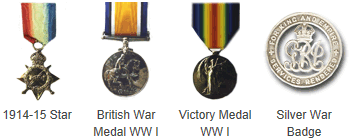 |
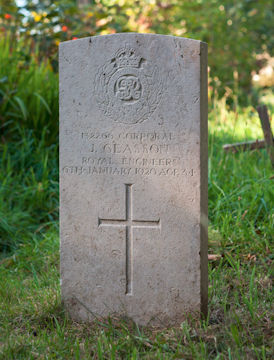
| He died on 06 January 1920 aged 36, (GRO ref: Redruth 5c 238) presumably
as a result of TB contracted from working in the Cordite Process House and in the
tunnels of Picardy, and is buried in Redruth (St Uny) Churchyard Extension. His
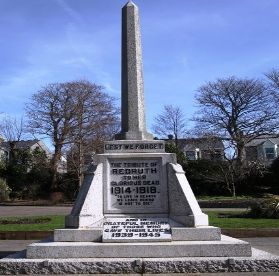
death is recorded on Redruth War Memorial.
Right: James Thomas Glasson's headstone in Redruth (St. Uny) Churchyard Extension. As the date of his death was within the period of the official war years his headstone remains under the care of the Commonwealth War Graves Commission. |
 |
 |
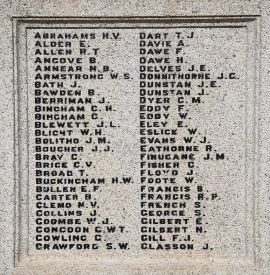 |
| Above: Redruth War Memorial | Above: Redruth War Memorial with the Glasson name |
Evelyn Mary Martin - his wife
Evelyn Mary MARTIN was born in the fourth quarter of 1897 (GRO: Redruth 5c 190), in the village of Carn Brea, Cornwall, some 11km from Hayle and across the A30 from Illogan. She married James Thomas GLASSON on 24 February 1917 (GRO: Redruth 5c 267) a year after his discharge.
Evelyn's marriage certificate, below, names her father as Thomas Henry MARTIN and her mother as Elizabeth PEARCE. Between 1866 and 1870 the birth of five Thomas Henry MARTINS and six Elizabeth PEARCE were recorded. There is no obvious record of their marriage.
Evelyn returns home
| Evelyn and the three boys left their home at 1 Barnoose Place, Illogen
near Redruth. On 29 June 1922 they boarded the Shaw Savill & Albion steamship '
Athenic' at Southampton, bound for Wellington, via Panama. The family move to Eyerton,
near Oxford, New Zealand, probably to stay with Emily, the boys grandmother. In 1922
Evelyn married Mr GEBBIE.
Right: A contemporary postcard of S.S. & A.Co 'Athenic' of 7592 tons, carrying 489 passengers on direct sailing to Wellington |
 |
 |
| Above: The names of Evelyn Glasson and her family as they
appear on the embarkation register.
Source: BT 27 The Nation Archives, Kew, London |
There is an Evelyn Mary Glasson on the 1908 Maori Freehold Land register who had 0.00529
absolute shares in Block ID: 21805 in the District of Te Waipounamu. This is off Highway 96 in an
area between Gore and Matura near Invercargill.
Source:
Māori Land
Online (Accessed: 07 November 2014)
It is unlikely that Kenneth was the son of James Thomas Glasson however. Mary had been living at Barncross Place near Illogan prior to her emigration. Mary married John Gebbie in Kaiapoi in 1922.
On 01 November 1922 Evelyn married John Gebbie at Kaiapoi Registry Office.
| NEW ZEALAND | |||||||||
|---|---|---|---|---|---|---|---|---|---|
| COPY OF MARRIAGE BY REGISTRAR | |||||||||
| 1922 Marriage in the District of Kaiapoi 9191 |
| No |
When and where married. (Date, Description of Building, and Locality) |
Name and Surname of the Parties | Age | Rank or Profession | Conditions of Parties | Birthplace. | Residence. 1.Present 2.Usual |
PARENTS | |
|---|---|---|---|---|---|---|---|---|---|
| (1)Father's Name
and Surname (2)His Rank or Profession. |
(1)Mother's Name (2)Her Maiden Surname |
||||||||
| 2 | 1922 November 1st Registrar's Office Kairpoi |
John Gebbie | 42 | Shepherd | Bachelor | Lyttelton |
1.Eyreton 2.Eyreton |
1.David Gebbie 2.Farmer |
1.Agnes Gebbie 2.Smith |
|---|---|---|---|---|---|---|---|---|---|
| Evelyn Mary Glasson | 24 |
Domestic duties |
Widow January 5th 1920 |
Carn Brea Village Cornwall England |
1.Eyreton 2.Eyreton |
1.Thomas Henry Martins 2.Foundry Clipper |
1.Elizabeth Martins 2.Pearce |
Between 1928 Evelyn and John lived in Eyretron, Kaiapoi, where John worked as a shepherd until his retirement was recorded in the New Zealand Electoral Rolls of 1946. During retirement the couple lived in Woodend, north of Kaiapoi, where Evelyn died after the 1957 registration.
Percy Lorraine Glasson was born in Hayle in the Redruth district in the last quarter of 1917, and Victor James in the September quarter of 1919. Percy married Daphne Cotton in 1945 at Addington (divorced in 1950) and is buried at Kaiapoi. Victor never married and died in 1966 of heart failure and was cremated at Johns Road in Christchurch. Victor was said to be from " Red roofs (Redruth)". Victor thought his father was a glass worker, Percy thought his father was a boot maker.
With thanks to Sally Weston, Emily Hyde CROMPTON's first cousin four times removed, for her evening work.
| More information 1 - Copperhouse, Hayle |
|
|
 |
|
| More information 1 - cont: |
|
|
Sources:
Copperhouse Foundry, Hayle, Cornwall (Accessed 22 June 2020)
Cornish Mining World Heritage - Harvey's and Copperhouse
(Accessed 22 June 2020)
Cornish Mining World Heritage - Hayle
(Accessed 22 June 2020)
Cornwall's War History Remembered - Redruth Memorial
(Accessed 22 June 2020)
Genuki - Hayle, St Elwyn
(Accessed 22 June 2020)
New Zealand War Grave Project (Accessed: 01 October 2022)
Pictures of Hayle - vintage photographs - no longer online
 |
 |
 |
|
| This page was created by Richard Crompton and maintained by Chris Glass |
 |
Version A10 Updated 01 October 2022 |
|


