1815 Info 4a for Richardson Crompton
The death of Caleb Crompton, born 1851
Caleb's early life
Caleb birth was registered in the third quarter of 1851 (GRO index: Bridlington 23 19).
In the 1861 census he was living with his aunt and uncle KINGSTONs at a lodging house in
Bridlington Quay as a scholar. This may have been a simple matter of there being no appropriate
school for a farmer's son in Flamborough. However, the choice of a KINGSTON as '
guardian' is significant. Though recorded as 'nephew' there is no known family
connection to Sarah KINGSTON, born 1800, being a CROMPTON. Liz Vine (Huddleston research)
suggests the enumerator should have recorded 'great nephew'. That he was recorded as a
'nephew' suggests that either James or Sarah was related to a CROMPTON or PICKERING. This
would suggest he is related to Sarah. A mystery to be resolved as the KINGSTONs feature in other
situations related to the CROMPTONs.
1861 Census Sun/Mon. 7/8th April 1861
Source:     FHL Film  TNA Ref RG09
            Piece: 3613; Folio: 41; Page: 37; Sched: 239
Dwelling:   Sea Breezes
Place:      Bridlington Quay, York ER, England

Name               Rel   Mar  Age  Occupation             Birthplace
James Kingston     Head   M   63   Lodging House Keeper   Yorks, Strensall
Sarah Kingston     Wife   M   61   Lodging House Keeper   Yorks, Hull
Caleb Crompton 	   Neph        8   Scholar                Yorks, Flamborough
Ann Hilerby 	   Serv   U   24   Cook                   Yorks, Lowthorpe
Fanny Wiles 	   Serv   U   19   House servant          Yorks, North Frodingham
William W Ringrose Board  U   45   Gentleman              Yorks, Cottngham
Robert Donkin 	   Board  U   20   Coachman               Yorks, Bridlington
There is no obvious record of Caleb in the 1871 census or as an
immigrant in the National Archives of Australia, Ancestry's immigration/assisted passenger lists
or New South Wales assisted passenger lists.
His life in Orange, New South Wales
In November 2015, I spent three days in Orange without appreciating its historical
significance when it was an unknown settlement 168 miles from Sydney
in the isolation of the New South Wales prairies. It appeared to be miles from anywhere, rather
than the centre of a thriving district. The reason for the visit was to find the grave of and pay
respects to Caleb Crompton, son of Richardson Crompton of Flamborough. Caleb Crompton, born in the
first quarter of 1851, is recorded as a residence of Lucknow in the years 1889-90 and of Orange
in 1903-4 and 1913 until his death there on 08 March 1915.
It was also to try to find the reason why Caleb should chose to emigrate to this isolated
community. Part of the answer to this question lays in the general description of the thriving
settlement in context of its physical environment.
Located west-north-west of Sydney and over the Blue Mountain
escarpment, the city is the gateway to the west. Settled in the early years of
nineteenth century it is now the major settlement on the agricultural lands of Western
Plains. Its growth was stimulated by the discovery of gold. Once it was suggested as the
new capital of Australia. Orange has a temperate oceanic climate, with warm summers
(with cool mornings) and cool winters with frequent morning frosts and a regular light to
moderate and sometimes heavy snowfalls.
1815info4a, sheet 2
It has to be assumed that Caleb took the 168 mile train journey from Sydney to Orange rather
than by bullock cart trundling through the dirt roads of the Blue Mountains or on the more
progressive Cobb and Co. coaches. In 1877 the railway that crossed the Blue Mountains had reached
Orange before the construction of the 150km/100 miles extension to Dubbo and eventually crossing
the ‘bad lands’ to Perth.
Lucknow
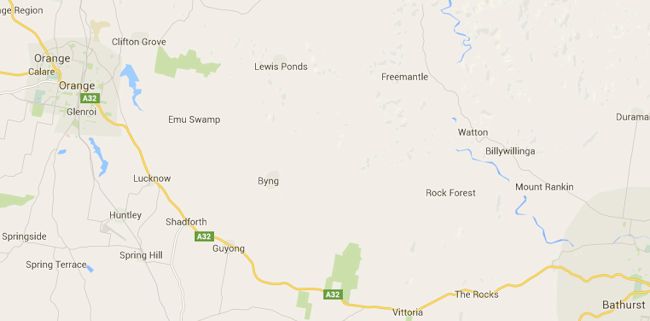
Lucknow is one of those 'now you see it, now you don't' towns. It is located
on the Mitchell Highway 9 km south-east of Orange and 245 km north-west of Sydney. Travellers,
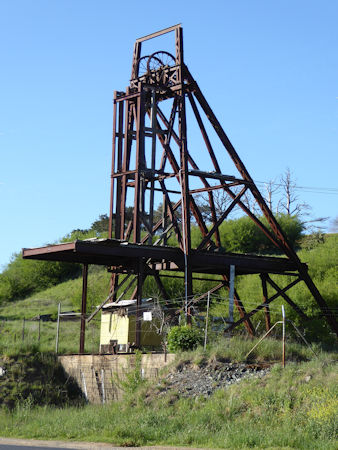
journeying between Bathurst and Orange, rush through the town, notice a strange piece of
machinery beside the road (it is a poppet head - see below) and keep driving on the highway
believing that this group of buildings has little to offer. Instead it was the site of
Australia's first gold strike.
Above: Lucknow in relationship to Orange and Bathurst
Caleb arrived in Lucknow in or before 1889. Ancestry's New South Wales, Government
Gazettes 1853-1899 lists
1891 July August 670, Crompton C., Orange (2)
The Australian Electoral Roll 1903-1977, available on Ancestry, records:
1889-90 Crompton Caleb - residence - Lucknow
It is thought possible that Caleb was attracted by the
Lucknow gold rush. In 1851, William Charles Wentworth's estate, the
present Lucknow, became the site of Australia's second gold discovery. In the 1890s there was a
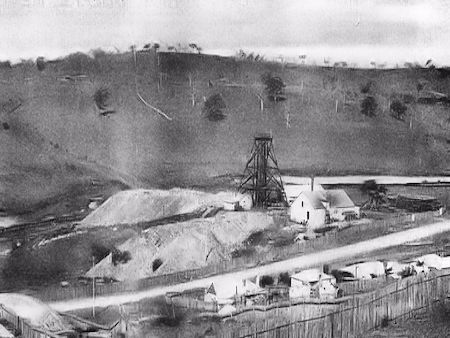
mining boom at Lucknow. By 1894, Wentworth Proprietary was employing 232 men and had lowered the
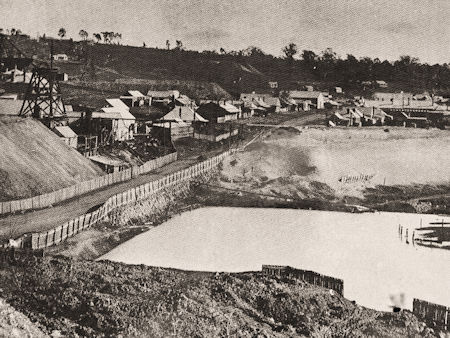
New Reform shaft to a depth of 160 metres. In 1898, the village and mines of Lucknow was alive
with activity. The four shafts now operated by Wentworth Proprietary brought employment to more
than 500 men.
Hoverbox Photo Gallery - Lucknow NSW - Author 26 October 2015
This feature does not function correctly on phones and tablets
1. Lucknow mine 1895 2. Lucknow, a thriving gold mining town around 1900
3. Lucknow poppet from 1935 4. Lucknow bungalow on Mitchell Highway
1
2
3
4
1815info4a, sheet 3
Orange
The facsimile Orange and District Illustrated 1928, written 13 years after Caleb’s
death forms the basis of the description of a location known to Caleb. It records an article from
the Sydney Morning Herald of 17 February 1906, well within Caleb’s time in the
municipality, which describes an overview of Orange’s environment and views Caleb would have
witnessed.
Orange is one of the rare places that you visit, after hearing much
about, and are not disappointed, the author [LG] writes. "My first sight of it was from the
Sydney mail train, when we stopped for a few minutes. The station and town were covered with a
mantle of snow. I next saw it, when I came for a few weeks' change from the heat and monotony
on the banks of the Bogan, 150 miles distant. Certainly the experience was pleasant, and
exhilarating in the extreme, and I learned to love Orange and its surroundings. The climate was
splendid, with its warm days and deliciously cool nights, but the crowning charm of Orange was
the wonderful Canobolas range of mountains. They stood sentinel over the town, and their
commanding presence completely satisfied the artistic sense. The best thing I can say in praise
of the Orange climate is that in the middle of summer I was able to walk to the Canobolas
[Mountains a distance of 8.1 miles/13km and maximum elevation of 4560’/1390m] and back, not only
with comfort, but with very real pleasure.
Orange is 2846ft [867.5m] above sea level, and its climate marks it as
the natural sanatorium of the heat stricken country beyond it. The days in the summer are fairly
warm, but rarely 100deg. in the shade, but the nights are almost invariably cool.
The author then goes on to describe the municipality of Orange with opportunities for Caleb
being employed as an agricultural labourer.
The road out was through a very fine orchard district, the undulating
country on either side being covered with cherry and apple trees, with here and there a vineyard,
or field of wheat, to give diversity to the scene. The farm where I stayed the night was hemmed
in with hills, at the back of which rose the Canobolas […]. There was a delightful old-fashioned
orchard and garden, partly run riot, in which raspberries and apple trees grew in profusion. When
the moon rose over the hills, the scene was one of quiet beauty. […] Trickling from the side of
the mountain came a little stream of water, icy cold, and as clear as crystal.
This supply of water and the temperate climate set Orange aside from the dry lands further
west, but hindered its ultimate progress.
In 1927 and 1928 the municipality entered and won the competition for New South Wales’ most
beautiful town with a population exceeding 4000. Although 13 years after Caleb’s death the judges’
comments must have had a foundation in the town Caleb walked through and buildings he saw.
Mr. Weekes said that, in Orange, there was a preservation, or creation,
of public buildings, with tree-planted environs, consistent design and splendid construction of
homes, and private buildings. It had a conveniently zoned and constructive policy of highways,
with wide streets, ornamental trees, paving of footways, a higher standard of parks than he had
seen elsewhere, and the preservation of trees, and floral treatment, were not overdone. The
removal of restrictive fences and railings, making reserves available as playgrounds, was also
commended. The lighting and gas plants were exceptionally efficient.
Mr. Davidson said that Orange evidenced the embodiment of civic pride
and achievement.
Mr. Davidson expressed the opinion that Orange had a most progressive
people, making wonderful efforts to create a beautiful town. It was holding its own natural
setting far more intimately than was its older neighbour, Bathurst.
The awarding of the laurels to the Capital of the West was no surprise to
the people of Orange, who were more than confident, and justifiably so. The glorious panoramas
spread before the admiring eyes of judges who were keen critics, from the Pinnacle and [Canobolas]
hills around the townships, elicited their keenest admiration.
1815info4a, sheet 4
Caleb would have witnessed …
The greatest rejoicing in the history of the town was in 1910, on January
26, when the conclusion of the first 50 years of municipal life was celebrated. It was a day when
Orange looked its best. In the warm sunshine, green fields provided the setting for the jewel
city, and, in the distance, the stately Canobolas loomed blue through the mist. The town itself
was bedecked with colour. In Lord's Place and Summer Street, [where Caleb lived] rows of flags and
gaily coloured streamers canopied the streets where the people thronged, meeting old friends from
the back country, and making new friendships, it was a day of carnival, and the township seemed to
be the home of happiness and goodwill.
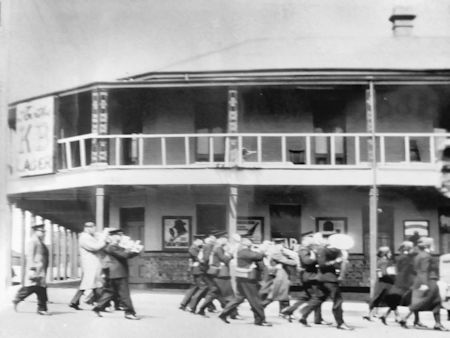
There were many ceremonies to be performed. One of the events of the day
was the procession through the town, which marched to Wade Park, which was formally opened for the
first time as a sports arena.
Or, perhaps, he used the celebration as an excuse to drink.
Greyhound Hotel, Summer Street
The Australian Electoral Roll 1903-1977, available on Ancestry, records:
1903-4 2037 Crompton, Caleb, labourer, Summer Street, East Orange a sub division of
Orange
1913 666 Crompton, Caleb, groom, Summer Street,
Orange a sub division of Orange
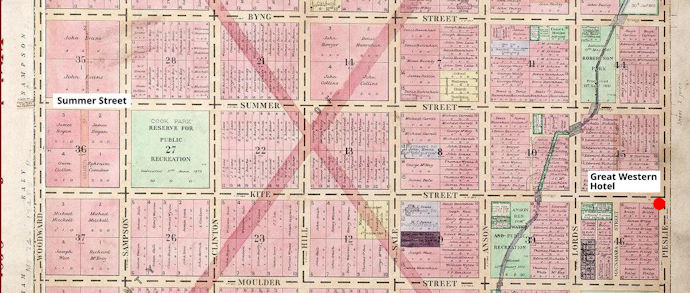
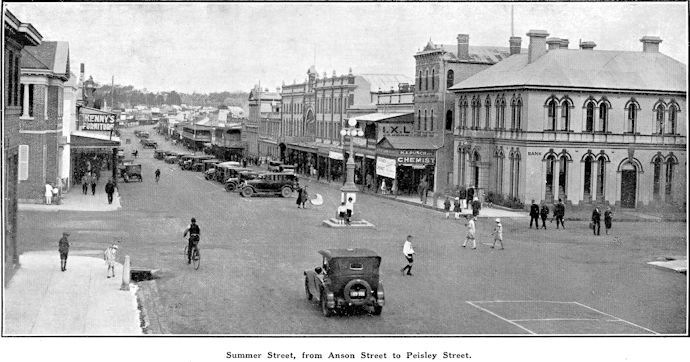
Before the dominance of Byng Street, Summer Street was Orange's main street. Trove traces
the history of the Greyhound during Caleb's employment.
06/1893 George Star was the licensee of the Greyhound, one of 34 named hotels in
Orange
01/1897 Starr's Greyhound Hotel was the meeting place for several
town organisations
10/1897 George Starr died of an affection of theheart.
05/1904 The Greyhound's licensee was Francis (Frank) Quinn who purchased a mare
valued at over £175
06/1907 M. Darley of the Greyhound Hotel, Orange was seeking a competent groom
07/1907 A fire at the rear of the Greyhound partially destroyed two loose boxes,
which would have affected Caleb's work
07/1908 Darley was one of nine licensees who lost their licence
09/1908 It was announced the Greyhound was being converted into two shops.
Undated Caleb was for many years a trusted employee of Mr. Frank Quinn, at
the old Greyhound Hotel in Summer Street
Above: 1915 map of Summer Street Orange where Caleb lived
and worked at an unknown location
1815info4a, sheet 5
Above: Summer Street, Orange circa 1925 showing the
street where the Greyhound Hotel would have been located 1
Great Western Hotel
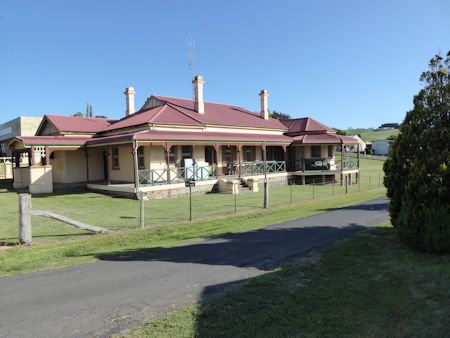
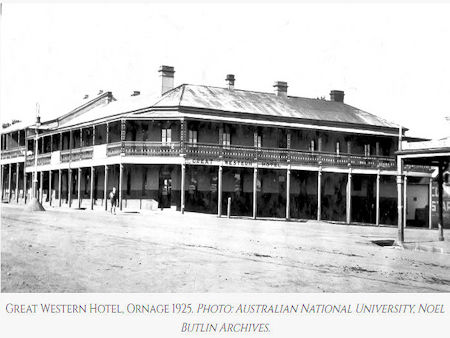
After the Greyhound closed, Caleb moved to the Great Western Hotel where his services were
retained by Mr. Sloane and where he worked as a groom at the time of his death.
02/1903 The Government Inspector of Mines was staying at Wright's Great Western
03/1904 F Wright advertising for a housemaid and waitress
02/1905 Frederick Wright licensee of the Great Western declared bankrupt with
liabilities of £1922 and assets of £1
04/1905 Robbery
04/1905 William Robinson licensee was in court as witness of a theft, to the
value of £89 13 shillings 6 pence (A$11,714 in terms of real wealth in 2018) from his home,
the Great Western. On discovery of the night time theft Robinson called his groom. Later
alleged to be Paddy McMahon
05/1905 Mr F Wright wrote to the Leader from the Great Western
06/1905 William Robinson granted twelve month license - one of 22 hotels in Orange
10/1905 Mrs Moore sold her novelties at her sample rooms in the Great Western
06/1906 Frank Quinn had his licence renewed - annual value £312, license fee £40 -
one of 32 hotels in Orange
10/1908 Thomas Haybell wrote to the Leader from the Great Western
09/1909 Frank Quinn of the Great Western lost a saddle
12/1911 Frank Quinn licensee had transferred from the Greyhound
10/1914 Thomas Sloane reported living at the Great Western in their father
John's obituary. The Sloanes are a large Orange family.
10/1916 Thomas Sloane still licensee
It is clear from the many adverts that the Great Western was the location for many sales
pitches.
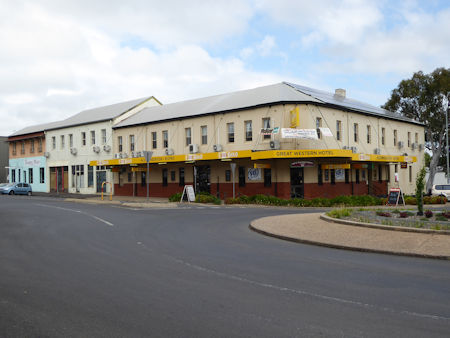
The Great Western Hotel has traded for over 140 years, and continues a popular pub at Orange.
The pub’s opening coincided with the extension of the western railway line from Blayney to Orange
in 1877. To cater for rail travellers the hotel was built opposite the railway station on the
corner of Peisley and Kite Streets, for an Irishman, Patrick Kenna. He was one of the early
pioneers of the district, and for many years one of its most prominent and progressive citizens
as an alderman of the Orange Municipal Council and was Mayor during the 1870s and in 1884 and
1885. In 1915 the property was owned by James Briley, who owned the hotel corner plot, the
adjacent stable block on Kite Street and the next two through properties on Pieslie (sic) Street.
The 30 bed roomed Great Western freehold was up for auction in Sydney 17 August 2017 2
and sold for an undisclosed amount. 3
1815info4a, sheet 6
Hoverbox Photo Gallery - Great Western Hotel, Orange - Author 26 October 2015
This feature does not function correctly on phones and tablets
1. Grand Western Hotel 1925 2. Grand Western and Salvation Army undated
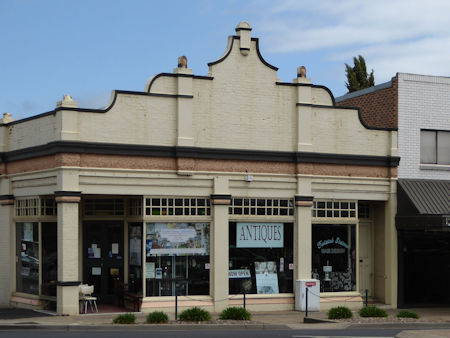
3. Grand Western Hotel in 2015. The demolished stables were to the right 4. Period property on Peisley Street
1
2
3
4
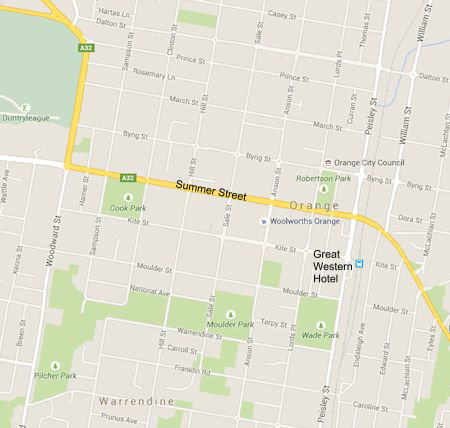
Left: Map locating Caleb Crompton residences in Orange. The Great Western
Hotel is situated at the roundabout.
1815info4a, sheet 7
Caleb's death
The sad story of Richardson and Hannah's children continues with the report of the death
of their fourth child Caleb, in the town of Orange, New South Wales, at the age of 63. The
newspaper reports, in the Orange Leader, of his death would suggest that Caleb was a solitary man,
a bachelor rather than a widower. It was 'servants of the household' who searched
for him, rather than family; no one could really confirm his age or place of birth. On 8 March
1915, Caleb died on the
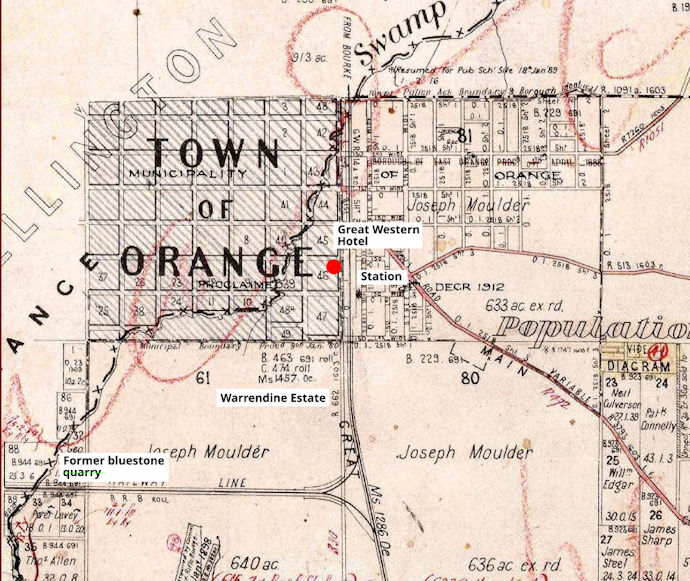
Warrendine Estate in a culvert at the quarry on the common. 4 The former
bluestone quarry is a 37 minute walk along the 2020 routes.
Above: Orange in 1912, which shows the Warrendine estate
that was sold by lots in 1911
1815info4a, sheet 8
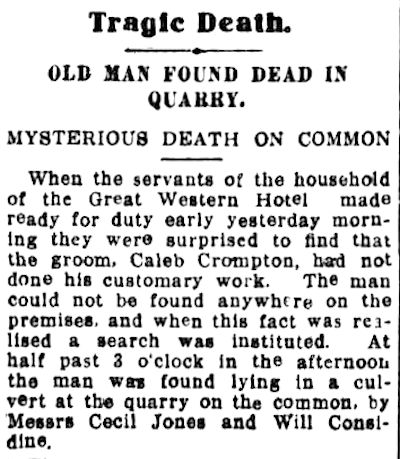
The circumstances of Caleb's death were reported in the 'Orange Leader' of
Wednesday 10 March 1915:
The report continues ...
There are some unexplained
circumstances in the case. Crompton was at the hotel till about 8 o‘clock on the previous
night. It is stated that he was afterwards seen going away from the premises in company
with two other men. When found at the quarry the right side of his head was resting on a
stone. There was a wound in the head, and the stone was bloodstained. The man had his
boots off. It is expected that the police will have secured sufficient evidence to
explain the case at the Court House this morning when an inquest will be held by Mr.
Gates P.M.
The body now lies at the morgue. Crompton, who was about 70, was a good
natured, honest man and for all the years he had been in Orange his friends were many,
and enemies few - if he had any at all. He was for many years a trusted employee of Mr.
Frank Quinn, at the old Greyhound Hotel in Summer street and afterwards at the Great
Western Hotel where his services were maintained by Mr. Sloane ...
On Thursday 11 March 1915, the 'Leader' had a burial notice for Caleb:
'The burial will take place in the C/E Cemetery today of the late Caleb
Crompton.
Caleb was buried in the Church of England section of Orange Cemetery, Section B 168 on
11/3/1915 in an unmarked Grave. His age is recorded as 70 years.
1815info4a, sheet 9
A further account of the incident appeared in the 'Leader' on Saturday 13 March 1915:
AN OLD MAN‘S DEATH
BODY FOUND IN A QUARRY
Acting in his capacity as Coroner, Mr. Gates P.M. yesterday conducted
an inquiry into the cause of the death of Caleb Crompton whose body was found in a quarry on
Warrendine Estate on Tuesday evening. The proceedings were conducted by Constable Perkins who
deposed that at 7 pm on the 9th instant that he went with Constable Walsh? and a man named Cecil
Jones to a paddock situated on Warrendine estate, about half a mile south of the town. About 100
yards from the boundary fence he came across the body of Crompton. It was five or six yards from
a large quarry, amongst some briar bushes. Deceased was dressed except for boots and hat, which
were near the body. There was a gaping wound on the forehead evidently caused through a fall on
to a stone (produced). Blood had flown freely from the wound. Death must have occurred some hours
before the body was found. There were no marks of a struggle about. The only property found on
deceased was a key, knife, and a penny. Crompton had been a resident of Orange for a number of
years, and was employed as a hotel groom. He was very quiet in his ways, and slightly addicted
to drink.
Thomas Sloane, licensee of the Great Western Hotel, deposed that
deceased had been in his employ for the last 10 months, as a groom. His age was 64 years,
but witness could not say where he was born. He had no property of any description.
Witness last saw him alive at about 6.45 on Monday night. He spoke to him about his
having had a few drinks during the day, and when asked then as to how he was he said he
was alright. Deceased was not drunk, but was so far under the influence of liquor that
witness refused to let him have any more during the day. Whenever he got a few shillings
he spent them in drink. There was about 6 pound 10 shillings coming to him in wages.
Right: Great Western Hotel, est. 1852
Dr C. B. Howse deposed that he made a post-mortem examination of the body of deceased
on Wednesday afternoon. There were a number of scratches and bruises over the arms and legs and
chest, and a cut on the forehead, besides a deep dent in the skull, at the side of the cut. The
edge of the stone already produced fitted into the dent, and there was blood on the stone as
well. He thought death was caused by haemorrhage and a fractured skull.
John Kallmer, employed by Mr. E.T. McNeilly, deposed that he saw the deceased going in the
direction of the quarry on Warrendine on Monday evening. Crompton appeared to be under the
influence of liquor. Later on witness saw him in the quarry reserve, sitting down and holding
his head in his hands. There was no other person about at the time. The fence through which
deceased had gone had barbed wire in it, and there were a lot of briars about.
Cecil Jones, engine driver, deposed that on Tuesday he, in company with other, found
the body of Crompton. They were out looking for him. Deceased was lying on the left shoulder, and
his forehead was resting on a stone. There were no signs of a struggle about.
The Coroner returned a verdict of accidental death, caused through falling on a stone.
Cash or property possessed by deceased 6 pounds 10 shillings (£6.50 or A$13 equivalent to £511.60
or A$611 in 2018 by CPI index)
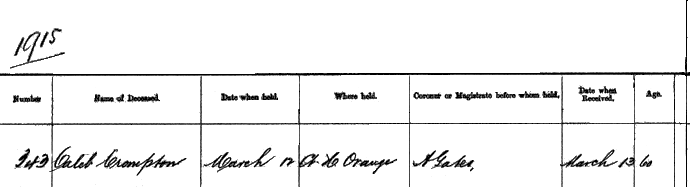
Source: NSW State Records - Coroners Inquest index: Reel 2765 - Caleb Crompton -
Held 12/3/1915 - Orange Court House - Magistrate or Coroner A. Gates
1815info4a, sheet 10
NEW SOUTH WALES
REGISTRATION NUMBER:
1915/002921
DEATH CERTIFICATE
Date and place of
death
Name and occupation
Sex and age
Cause of Death
Duration of illness; medial attendant; when last seen
Name and occupation
of father Name and maiden name of mother
Informant
1915
8th or 9th March
Warrendine Orange
Caleb Crompton
Groom
Male 60 years
Injuries accidentally received
through
falling on head
Findings at inquest held at Orange on 12th March
1915 A Gates
Coroner
(1)Not known
(2)Not
known
(3)Not known
Certified by A Gates
Coroner
Orange
Particulars of
registration
When and where
buried;
name of undertaker
Name and religion of Minister
and names of witnesses of burial
Where born and how
long in the Australasian Colonies or States
Place of marriage,
age, and to whom
Children of
marriage
1915
8th or 9th March
Warrendine Orange
11th March 1915
C of E Cemetery Orange MH Ford Acting
Not known
Not known
Not known
Not known
Above: Left hand columns which records the date of the
inquest as 12 March 1915. Caleb must have been a private person as his exact
age or place of birth was unknown.
1815info4a, sheet 11
Above; Right hand columns which records a verdict of
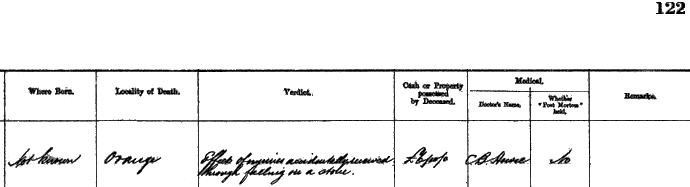
'Effect of injuries accidentally received through falling on a stone'
with cash or property of £6/10/0 Source: New South Wales, Registers of Coroners' Inquest 1914-1920 at
ancestry.co.uk
According to the Coroner's report he left £6/10/0 or £6.50.
Like his brother Stephen Clubley, Caleb appears to have died without property or possessions
apart from his key, his knife, the penny in his pocket and the 6 pounds 10 shillings owed to him in
wages. Like his uncle and name sake this Caleb appears to have died in a drink related incident.
Orange cemetery
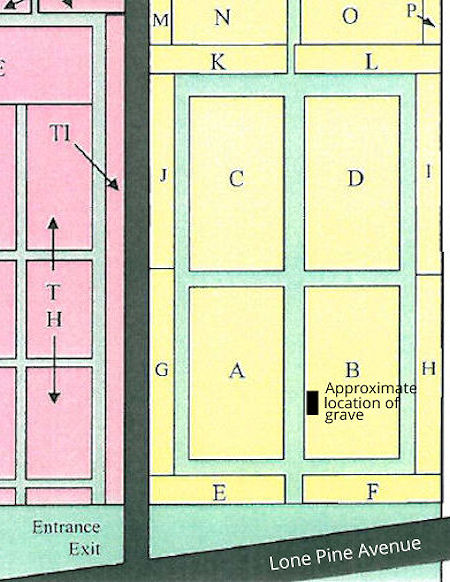
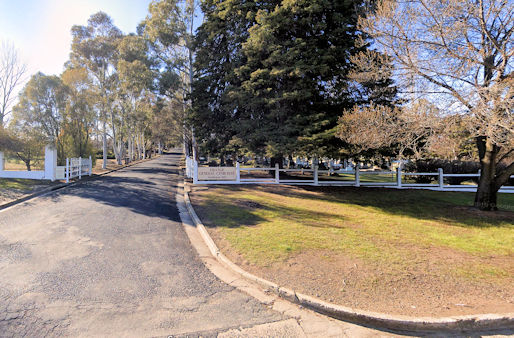
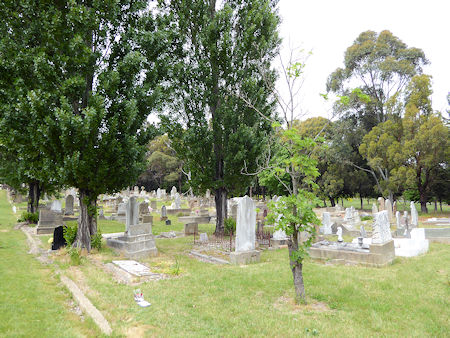
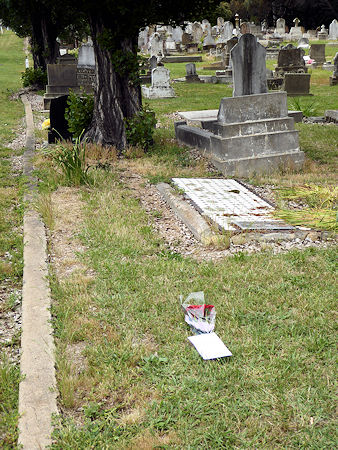
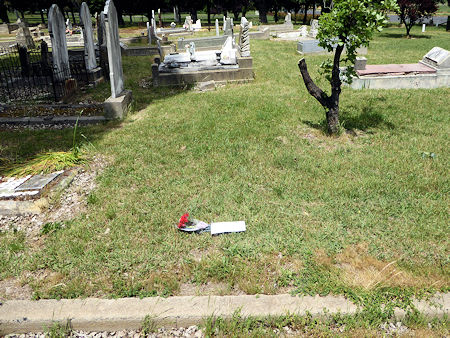
Caleb was buried in the Orange town cemetery on Lone Pine Avenue in an unmarked
grave in Church of England section, grave B 168. The cemetery custodian had no
problems locating or taking us to the grave. We were perhaps the first family to visit.
Right: Plan of Orange Cemetery marking Caleb's grave
1815info4a, sheet 12
Hoverbox Photo Gallery - Caleb Crompton's
unmarked grave Orange Cemetery NSW Author 27 October 2015
This feature does not function correctly on phones and tablets
The bluestone quarry, marked on the map, provided building stone for Orange until 1977 and
then became a spring-fed water recreation area until 2004. In September 2019 it was developed
as the eighteen block million dollar plus Bluestone Lake housing area with the lake now
stocked with stocked with Murray Cod, Silver and Golden Birch.
Source:
1928 Orange & District Illustrated, Historical, Statistical & Descriptive,
Orange City Council, reprint 1989, p.19
1815info41, sheet 13
More information 1
Lucknow gold
From experience gained in California, Edward Hammond Hargraves, along with John Hardman,
Australia Lister, James Tom and William Tom, found the first gold on 12 February 1851
at Ophir, about 23km north of Lucknow and 17km from Orange. Hargreaves explained
"to Lister and William and James Tom how to prospect and make and use a miner's
cradle, and they found payable gold between the 07 and 12 April, 1851."
A proclamation followed, officially announcing the first discovery of payable gold
in Australia, […] leading to the rush into the west of gold-diggers, and the embarking
from England of men who hoped that success would attend their efforts in that direction
in the colony. […] It was the final assurance of the future success of Orange, which
commenced to grow steadily in the flow of new settlers, and with the spending in its
precincts of the gold values won from the hills close by. 1
In the year 1851, over 2000 miners' licenses were issued. In the same year, after
the discovery of gold at Ophir, came the electrifying news of gold on land known as
The Wentworth, being the property of Mr. W. C. Wentworth. This was the origin of Lucknow,
a richer field than Ophir. 2 After the discovery of gold, the population of
the district rapidly increased, and, among the scattered shacks of the early dwellers,
there commenced to spring up better and bigger buildings. The town had begun to take
shape. 3
William Charles Wentworth's estate became the site of Australia's second gold
discovery. Two local farmers on a hill behind what is now the village discovered the gold
but, as the land was owned by Wentworth, he demanded they pay monthly royalties. In April,
1852 Wentworth sold his estate to the Wentworth Gold Field Company, the first short-lived
gold mining company in Australia, which went into liquidation in 1860. Two years later
the land was opened to the public on monthly leases.
When the post office opened on 1 July 1863, the area was officially called Lucknow.
Between April 1862 and February 1867, the Bank of New South Wales and the Commercial Bank
purchased 1,962 kg of gold. The largest nugget weighed 76 kg. 4 Henry Newman,
who purchased the mine and reopened it in 1878, made a fortune and then lost it all.
Lucknow was run by private mining companies until 1913 when the land was subdivided into
smaller parcels. One of the peaks of production was between 1892 and 1899, Caleb’s time.
The Wentworth Main Gold Mine, at the eastern end of the town, is still marked by its
prominent ‘poppet’ head, which still has part of the winding gear attached (See photo
above). Relating to the 1890s and 1930s mining booms, the poppet head was built in 1935
to bail water 24 hours a day, seven days a week, from the mine workings into the creek.
The problem with rising water continued to plague the mines which are now all flooded.
The mine’s main income came from the cyanide vats where gold and other ores were extracted
from the old tailings dump. The corrugated iron buildings near the poppet head were built
early in the twentieth century.
Above: Lucknow map 1865-1940 Click on the map to open a scalable pdf map in a new window
The Reform Mine has been described as the richest small gold field of its type in the
world. Its deep vein, known as the Uncle Tom, are at a depth of 387 feet (125 metres).
Mining began here in the 1870s or earlier and prospered until the late 1890s. At the
height of the gold rush the whole hillside beyond the Reform site was a hive of
activity, including a battery to beat the rock, foundry and grand two-storey mine office,
along with houses, stables and numerous shafts and tunnels.
1815info4a, sheet 14
More information 1 cont:-
Lucknow gold
Where and how Caleb heard of the Lucknow strike is unknown, as is whether he went to
Lucknow to seek his fortune underground or in a service industry.
Sources:
Orange & District Illustrates, 1928 Historical Statistical &
Descriptive, Facsimile Orange City Council, 1989
The value of gold in 1915 was US$493.55 per ounce (oz). 78kg equals 2680oz, 1962kg
equals 69207.52oz. Very approximately, the 2018 equivalent value by CPI inde,x for the
76kg nugget was £278,720 or A$28,760,000 and for 1962kg of gold is £7,197,581
or A$742,800,000. Source:
Measuring Worth (Accessed: 19 June 2020)
More information 2
The Warrendine Estate
On 4 May the Orange Leader reports that WJ Murray, of Warrendine Quarry, had a dray horse
for sale.
Messrs JS Leeds and Co announced a sale, on 21 February 1911, of the Warrendine sub-
divisions on Thursday 06 April 1911. The areas, ranging from ½ acre to 10 acreson the
town frontage, were suitable for comfortable residential homes, gardening, dairies and
orcharding purposes as there is nothing better round Orange. The estate abutted on
to the southern boundary of the town, and has the Orange water supply main right along
its boundary. The terms of the purchase was a 5% deposit and the balance in ten yearly
instalments at 5% interest. The most distant lot was half a mile from town.
The sale took place on 07 March 1911, when Messrs JS Leeds and Co. undertook the auction
of the Warrendine Estate and expected sales to be brisk and at fair prices being
accepted. In addition Mr Moulder’s property the handsome house, a roomy modern
structure of eight rooms and numerous outbuildings, situated on a big block with
frontages to Lord's Place and Warrendine Street was to be sold with the rest of
the property. There was a large attendance and the bidding was brisk. However, a
further continuation sale was held in May 1911, as the time in the original sale did not
permit all blocks to be auctioned. Since reserves were not met, no sales were effected
on this occasion. The Orange Leader advertised the Warrendine blocks as a place for first
class residences as a smiling suburb of Orange, as there is little unoccupied land in
the town proper. Purchases were seen to be an investment as in the future values were
expected to increase.
The Leader reported on 26 May 1911 that the sale raised £8000 (Equivalent to A$6,544,
000.00 of relative income in 2018)
The sale of land had been preceded on 29 March 1909 by the sale of Mr WJ Moulder’s
machinery, tools, horses and cattle and walnut household furniture.