1815 Info 1c for Richardson Crompton
The emigration of Richardson Crompton's children
Hypothesis
The UK 1851 census shows the family farming the 124 acre South Sea Farm, Flamborough, having
enough productivity to employ one man. According to the 1861 census, following Richardson‘s death
on 24 August 1859, Hannah, ran the 130 acre North Moor Farm, Flamborough. Since her children were
recorded as "farmer‘s children" and since she employed two "farm servant" a
degree of wealth is suggested.
However in 1863 Hannah married Richard HUDDLESTON and four of her children emigrated to the
Christchurch area. They are not listed as passengers on assisted passages.
Why the children left a potentially affluent environment is a question to be asked. It would be
reasonable to expect the farm to pass to Hannah‘s eldest child Stephen Clubley CROMPTON and for
the younger members of the family to disperse. Stephen‘s emigration and the fact that Hannah was
buried in Richardson‘s grave suggest that life with Richard Huddleston was not a bed of roses.
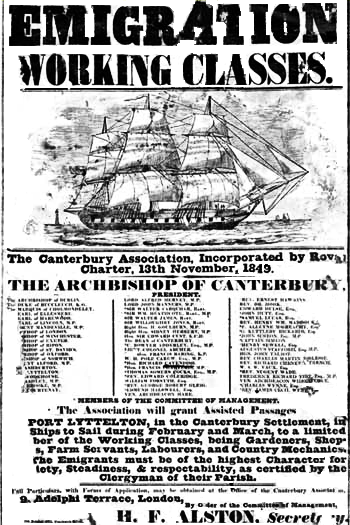
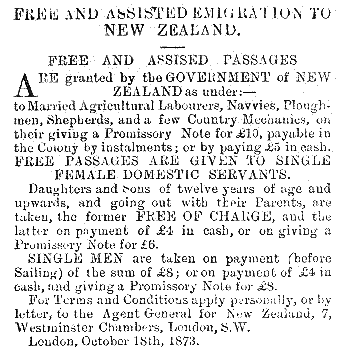
An enticement to emigrate?
Throughout the second half of the 19th century enticing advertisements appeared to attract
'labourers' throughout the United Kingdom to the 'promised land' of New Zealand.
At a time of agricultural uncertainty and pending rural poverty and when the Colonies
were expanding, agents for the various Government land agencies travelled the country
enticing the 'Working classes' to emigrate. The example below illustrates
the temptations for inhabitants of Lincolnshire to start a new life in the Auckland area.
Lincoln, Rutland and Stamford
Mercury
27 May 1859
EMIGRATION to NEW ZEALAND
PARADISE - Free Gift of a Forty Acre Farm; Mr J. Jun, agent to the provincial Govt. of
Auckland is authorised to give the following notice: Every industrious Man or Woman of
good character and not through age, infirmity or other cause, unlikely to form a useful
colonist, will, on approval, receive a Free Gift of Forty Acres of Good Land in the
province of Auckland New Zealand, together with Forty Acres more for each person above 18
years, and Twenty Acres for each child above and under 18 yrs of age, who he may take
with him to the Colony.
The advert went on to say that emigrants had to pay their own passage and that female
domestic servants and agricultural labourers were especially eligible. Further down the
same page the cost of passage was advertised, being then (1859): 1st class cabin from 50
gns (guineas) and 2nd class cabins from 30 gns. It took over 80 days to get to New
Zealand.
1815info1c, sheet 2
It is with some certainty that, even after the sailing of the first four
ships in in late 1850, agents for the Canterbury Association visited parishes of the
Yorkshire Wolds to recruit, or entice emigration immigrants for Canterbury. It is possible
that Stephen Clubley CROMPTON, following the remarriage of his mother to Richard
Huddleston, was attracted by this new life.
Both advertisements call for trades within his agricultural experience: labourer,
ploughman, shepherd.
One 'Agent' was Mr. White, who encouraged people to leave Lincolnshire for the
Tarnanki area New Zealand in 1875. He describes not only the standards and requirements
for the potential emigrants but also the social status of the villagers, his methods of
enticement and the resentment of local landowners who saw a potential drain on their
labour. See highlights below.
MR BURTON IN LINCOLNSHIRE
To the Editor of the Taranaki Herald.
Sir, - Having seen in a recent issue of your contemporary, The Budget, some strictures
and criticisms on your emigration agent and his work while in England, and knowing how
uninformed on the subject the writer must have been, having myself been witness to the
diligent, discriminating, and unremitting toil with which Mr Burton has spread information,
selected suitable emigrants, and the remarkable success which has met his meriting labours,
I feel I cannot do less than send a short note of information ...
Some twelve months ago I was honoured by appointment of Dr Featherston with commission
for emigration work, and had the pleasure of holding meetings and co-operating with Mr
Duncan, from the Canterbury Province, in his tour through North Lincolnshire. ... It so
happened that the Agent-General mentioned North Lincolnshire in connection with my name
to
MR BURTON
who first ascertaining that the men were of the right stamp, and that there was probability
of ultimate success in the locality, went to work in good earnest until his name and Mrs
Burton's are household words through the whole district. ... First in
SPREADING INFORMATION
... advertisements are practically useless so far as the farm labourer is concerned, for
as a rule he does not read. The same class rarely assemble, as they have no political
voice or social standing, and there are few rooms available for any meeting on their
account.
1815info1c, sheet 3
Then their knowledge is so limited that
they can hardly be persuaded of the truth concerning the Colony, and their means so small
that it is almost an impossibility to raise clothing for the voyage, let alone ship kits
and railway fares to the ship. ... Again in months of our winter, November
to March, it is impossible to get them to move; so that coping with these difficulties
and others I will point out it speaks volumes for Mr Burton's energy and discretion
that 500 souls have left Lincolnshire for
Taranaki in April, May and June. Another difficulty and great one lies in the stern
opposition to emigration by the bulk of our influential dwellers in the rural districts.
... An incident occurring not two days ago in connection with
THIS WEEK'S LECTURE TOUR
will best illustrate some of the difficulties under which the Emigration Agents labour ... .
Leaving Laceby, (the centre of our operations), a four mile dusty drive to Grimsby, brought
Mr Burton and myself to Grimsby, where taking train, we booked to Barton-on-Humber. Reaching
this place by twenty miles rail-travel, we walked after tea some four miles to a secluded
village further inland, also on the river bank, called South Ferriby. Here lay our
night's work -
A PUBLIC MEETING
duly advertised by the Labour League, to which many of the men of the district belong. The
place of the meeting was to be of necessity out of doors. No school-room was obtained and
our advent was evidently an audacious thing. Announced to be taken at half-past seven, the
chair, and being the only seat, well called the chair, was vacant till eight, no resident
daring to occupy it. By this time the tardy gathering counted some one hundred and fifty
squatted on the green bank of a retired highway leading from the village. The arrival of
a brave spirit, locally well known, was the signal for his immediate votal to the chair by
more timid villages. Giving a brief speech he
called upon myself to address the motley and moving group. This I did referring to the
numbers gone to New Zealand - the news of arriving to a good reception and prospects on
arrival - contrasting this with the helpless and hopeless condition of those before me, and
giving good reason why they should copy the example so bravely set by those who had already
gone. Mr Burton followed me, outlining
THE GOVERNMENT SCHEME OF FREE PASSAGES,
detailing its conditions, meeting English objections ad explaining the reason of the
difference of remuneration here and with you to the farm labourer was suddenly
interrupted in an unexpected fashion, as I will now relate. To my own eye, as witnessed.
THE SCENE WAS MOST LUDICROUS,
and even now, in recalling, I am terribly amused with the event. The chairman and speaker
were on one side of the narrow roadway, with some dozen or two aside and behind them. The
way itself was clear. The slope opposite was dotted some 20 or 30 yards along, and five
or six yards deep, with the then tolerably attentive listeners.
From the up the hill I saw coming, with somewhat martial bearing and very measured tread,
as if the comer meant something, a man I judged to be a farmer [who] ... cut quite an
imposing figure. The eyes of the audience glanced uneasily towards him, as if they
turning round, rudely faced the speaker, blurting out in a threatening attitude: "I
authorise you to move off this ground at once." ... Let me say that
MR BURTON'S LABOURS HAVE BEEN INCESSANT.
Long walks, and protracted meetings, repeated interviews, and tedious and multiplied
letter writing, besides a number of nameless yet necessary duties, have filled up his
time as none in the Colony can understand; nor
will the worth of his work be known till the physical, social, and moral value of the
emigrants he has selected is shown in a prosperous community, an increased revenue and
the national consolidation which will, I feel sure, ensure, and be owning to the
conscience which your agent has put into his work. ... Hoping some of my own late
neighbours and friends are amongst you ere this arrives, and that you will treat them
well, as being good men they deserve to be treated, - I am, &c., JOHN H. WHITE, The
North Lincolnshire N.Z. Emigration Agent. Laceby, near Grimsby, 8th July, 1875.
It is not difficult to imagine, when considering the death of his father, his mother's
remarriage and the possible loss of his inheritance, his will and occupation at death, that
Stephen Clubley CROMPTON was one of these 'poor souls' who attended such a meeting, not
too far away from Grimsby, and who sought a new life in New Zealand.
The experiences of John HILLARY, reflected in his diary describing his emigration to New Zealand
on the "Westland", and of his attempt to settle in the Christchurch area must have
mirrored those of Emily Hyde. Apart from hearing news of New Zealand from her brothers it is
possible that she listened to the same Rev. J BERRY on his preaching circuit, as the East Riding
isn't far from Hillary's Durham home of Tow Law.
"In the year 1879 there was touring this country the Rev. J. Berry
who would seem to have been an agent for the New Zealand Government. He extolled the virtues of
that country and advised people to emigrate to New Zealand and there make their fortunes. John
Hillary, a shopkeeper in the small north eastern town of Tow Law, being a deeply religious man,
listened to the blandishments of the reverend gentleman and being sure that only truth could come
from such a source, decided that as New Zealand must be "the promised land" he would act
upon the advice given."
In order to be accepted as an immigrant to New Zealand occupations were often given as the much
needed agricultural labourers, for the expanding farmland, and domestic servants, for those people
who have established themselves in their new country. Emily changed from "farmer's
daughter" of the 1871 census to "domestic servant" on her wedding certificate and
it is possible that Paul Roach Glasson possibly changed his Cornish occupation from blacksmith to
farm labourer.
However Hillary and Emily Hyde CROMPTON had arrived at the wrong time. The Otago gold rush, which
had brought more riches than Alaska, was now ended. The Canterbury area was experiencing a drought,
which had reduced the crop yield, and the wool price had fallen heavily on the world market. Being a
new country much was imported creating a balance of payment deficit and reduced employment and
wages. Highly paid men in good positions in the UK and earning 50/- per week now earned 21/-.
"Having read Agent General‘s Hand Book and Rev. J. Berry‘s
Pamphlet, I expected statements therein made as to abundance of work, high wages etc and general
prosperity of New Zealand to be true. What was our surprise on landing to find hundreds walking
the streets who could not get a day‘s work. Prospect beingso dark we saw the necessity of moving
very cautiously ....
.... Much indignation is freely expressed, several of the more
conscientious tradesmen joining, and the newspapers publishing letters and leaders charging home
upon the Government the inconsistency of inveighling people away from their comfortable English
homes by means of exaggerated and one sided lectures and pamphlets, to sorrow, untold suffering,
disappointment and almost despair.
A clerk, a new chum, nor not able to get work took to book hawking and
the day he called upon us he said that from that day week, he had not taken a penny. Another clerk
called about the same time who having been out 15 months and got nothing, was trying to sell
vinegar at a small commission. Another, Mr. W. Raine, had only a few hours carrying for the mason
and returned with Mr Williams on the SS Cotopax.
Met a family of father, mother and two sons who paid their passage and
came out from Bradford shortly after us. They were printers to trade and had been in one of the
best establishments in England at a good salary, had read the pamphlets and were persuaded. It was
pitiful to hear their regrets. Could not get a day‘s work and took to hawking tea, but found this
a played-out game and next door to begging. The older son, who was a widower, with much emotion
and tears, told me they would never settle and be happy until they were home again, and if friends
in Bradford only knew their position they would subscribe to pay their passage back. Mother was
out at work and at harvest time the three men would go up country harvesting, work hard and save
every penny until they could raise passage money."
Abstract from: Hillary JH, 1979, Westland Journal of John Hillary, emigrant to New
Zealand 1879, Acorn, Norfolk ISBN 0 906554 01 2
1815info1c, sheet 5
Our arrival in this far-off land, after a passage of 104
days, having sailed on the 12th September 1849, and landed at Port Chalmers on Christmas-
day. Since that period I have been knocking about all over the country, have examined the
whole of the Company's block from end to end. Port Chalmers, the only present-seaport
of the settlement, is most beautifully situate in a small bay. It is distant from Dunedin
about nine miles, the country being all forest, or what is here called "bush."
The sail up the arm of the sea, here called a river, is certainly very beautiful, until
you come within sight of Dunedin, when one of the coldest, bleakest, and most wretched
looking counties opens out upon you that you could well behold. The site of Dunedin
itself is actually pitched upon a mass of hills, having such big gullies between them,
that nothing save an earthquake coming to level them could ever make it suitable for the
site of a town; early jobbing or ignorance and mismanagement, gained the day, and the
poor settlers are now reaping the consequences. "The theory of concentration and
contiguity," so urgently upheld by the leaders in this settlement, by inducing the
early comers to take up their abode near the town, has proved, and will continue to prove,
eminently ruinous to the colony, so long as such fatal counsel is allowed to bear
paramount away. The generality of the most
respectable emigrants who came out are supposed to bring with them from £150 to £250 in
cash. Of this sum £100 go to pay the heavy expenses of living in the town with their
families until they can get a house upon their suburban section; next comes the expense
of transport of their goods and chattels over a country where roads are promised, but
where none exist; erecting their house where all the timber has to be brought from a
distance, and with a multitude of other outlays, all of which when subtracted from his
reduced capital, must evidently leave him but a very small sum to commence his
cultivation of the poorest land on the whole block. Where, now, are his means for
purchase of a few cows to breed stock from, the principal return you can expect to get
for your money in this country. But let us take the more fortunate instances, where the
settlers have, perhaps, either had a larger capital, or, having managed more
economically, have succeed in buying a few head of cattle. The result has been, that
some half-a-dozen of these individuals have, by overstocking the suburban districts with
their cattle, been compelled, with their diminished means, to move inland, in order that
their beasts should not stave in winter. ....
The climate is not nearly so hot as represented, but from what I have seen, superior by
far to our own at home. The Taieri plain, and Tokomairiro also, no doubt contain much
good pasturage on the ranges surrounding the, but the plains themselves are too wet for
any immediate use, and could only be brought into cultivation, after an expense far
beyond the means of a young colony...
The Mollineux district, is bounded on the north by the Matau river, and on the south by
a high range of hills which are suppose to run as far as the west coast;...
All we want down here are roads, and emigrants to stock the country, and then we are
sure to go ahead. If a man can begin with 400
or 500 sheep, his fortune is made in five or six years as certainly as the ground
exists on which he stands. ...
1815info1c, sheet 6
The previous extract from page 4 of the Otago Witness, although south of Christchurch, also gives
a flavour of what life may have been like for the early settlers to the north and may account for
the hard life experienced by Richardson's emigrant children.
Source:
Papers Past, Otago Witness Extract from a letter, dated Mollineux, New Zealand, March
1850 (Accessed 20 June 2020)
It was in to this economic climate that certainly Emily Hyde CROMPTON landed and Stephen Clubley
CROMPTON and Thomas Richardson CROMPTON found themselves. One wonders whether Stephen‘s lowly
position of ploughman resulted from the economic depression of the late 1870s and early 1880s. It
wasn‘t until ten years later that refrigeration revitalised the meat and diary product trade to the
UK and New Zealand's prosperity increased.
The Spyglasses, that follow, describe the life of Richardson's four children in New Zealand.
This page was created by Richard Crompton
and maintained by Chris Glass