| Right: Map locating Stawell, the birth place of JR BLACKMAN and many of his family. | 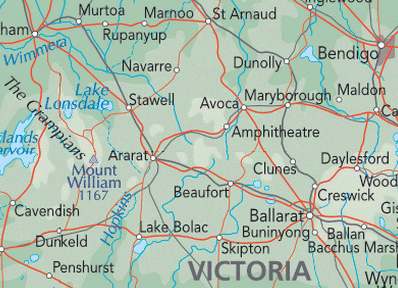 |
|---|
Blackman Info 2k: John Reginald Blackman (Jack) |
                                 George Blackman ... m.25dec1868 ... Mary jane Cox
                                 b.2ndQt1846                         b......1852
                                 c.12jul1846
                                 d.30may1936                         d.18jan1908
                                 |
                                 |       12th of 14 children
                                 |=======|=======|=========||
Oliver john                                      John reginald (Jack)
Looney DCM                                       Blackman
b.30oct1886  Amphitheatre, Victoria              b.16aug1888  Stawell, Victoria
d.18sep1954  Maryborough, Victoria               d.24apr1975  Adelaide, SA
|                                                |
m.12jun1919  Cleator Moor, Cumberland            m.29oct1919  St Andrew's, Ararat, Vic
|                                                |
Margaret florence                                Marianne
Pearson                                          Edmonds
b.07aug1888  Cleator Moor, UK                    b.19sep1893  Serviceton, Vic.
d.03jun1964                                      d.19sep1971  Ararat, Victoria
|                                                |
|                                   |============|=============|============|========||
|                                   Joan         Beth          Lola         Gwenda
|                                   b.22mar1922  b......1920   b......1923  b......1926
|                                   d......2017  d......1982   d.           d......2020
|                                   |            |             |            |
|                                   m......1947  m......1953   m.           m.
|                                   |            |             |            |
|                                   |                          Alfred       Vincent
|                                   |            Bourke        parker       patrick
|                                   |            |             McLean       Murphy
|                                   |            |                          |
|===========|===========|===========|            |========|=======|======|| |
Jack        Betty       Nancy       Oliver james Barbara  Maggie  Leonie    |
kingsley                            pearson (Jim)|        |       |         |
                                    Looney of    |        |       |         |
                                    Warnamboo    |        |       |         |
b.17may1920 b......1925 b.12jun1930 b.09jul1922  b.       b.                b.~1918
d.          d.          d.          d.10dec2013  d.       d.                d..2002
|           |           |           |            |                          |
m.          m......1960 m.19oct1953              m.                         m.
|           |           |                        |                          |
Edna        William e   Stanley                  Alan
            Ross        Bartlett                 Leary
b.          b.          b.                                                  b.
d.          d......2008 d.                                                  d.
                                                                            |=====||
                                                                            Deborah
The great nephew of Oliver John Looney was my friend and colleague for many years until his death in 2012. We taught some five miles apart, shared our family history and visits to Oliver's Passchendaele battlefield.
His early life
John Reginald was born on 16 August 1888 at Stawell (Vic BMD 24950/1888). On 29 October 1919 he married Marianne EDMONDS at St Andrew's, Ararat (Vic BMD 9883/1919) who was born on 19 September 1893 at Serviceton and is recorded as Mary Ann EDMONDS (Vic BMD 26391/1893). Marianne died on 19 September 1971 at Ararat. She is recorded as Mary Ann BLACKMAN (Vic BMD 23374/1971)
Heather Schoffelen write: 'I was looking at the Ararat (Aussie Rules) Football Clubs and J.R. played 8 games from 1911 until 1914, all Premier level. I don't know how many games were played every day. The last J.R. played was in 1914 in the Wimmera District Football League Premiers, and had a cord keeping his socks together. Ararat played at Horsham, Stawell and Wimmera so moved around for competition.' (By email 19 July 2023).
He was a grocer by trade.
| Right: Map locating Stawell, the birth place of JR BLACKMAN and many of his family. | |
|---|
John Reginald's war record
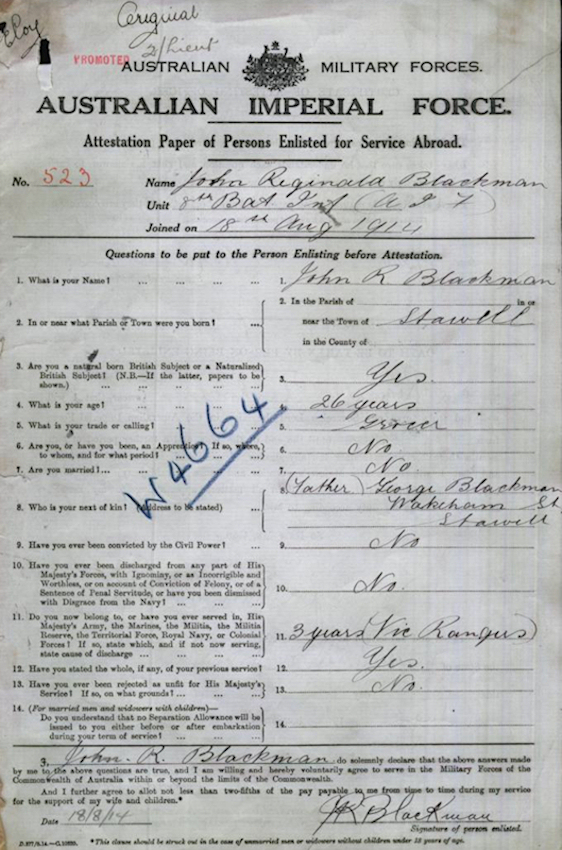
John Reginald BLACKMAN was the 523rd person to enlisted in E Company of the
Victorian 8th Battalion on 18 August 1914 in Ararat/Stawell, after spending three
years in the pre-war Victoria Rangers.
He enlisted with his cousin.
Right: 8th Battalion colour patch |
 |
His enlistment details
At the time of enlistment he was described as:
|
|
|
| Record of Service in the Field, also Reference to Decorations etc, and Dates | ||
| Date | Event | Place |
| 18/8/14 25/4/15 28/4/15 -/1/16 7/1/16 20/2/16 24/5/16 31/5/16 27/7/16 13/11/16 23/11/16 5/1/17 3/4/17 14/10/17 10/11/17 27/10/17 17/6/18 28/6/18 29/6/18 30/6/18 15/7/18 7/8/18 9/9/18 25/9/18 10/10/18 14/10/18 17/2/19 17/2/19 18/4/19 26/4/20 17/9/20 5/12/21 24/4/22 27/11/34 16/8/38 23/12/39 |
Enlisted Appointed E Company 8th Battalion at
Broadmeadows Served on Gallipoli as Corporal Promoted Sgt Evacuated Gallipoli Disembarked Empress of Britain Promoted 2/Lieut On leave Disembarked Marseilles Promoted Lieut. Mentioned in Sir Douglas Haig's dispatched London Gazette Second Supplement 2/1/17 No 2980 Attached 1st Aust Inf. Bde. Hqrs Awarded the Montenegrin Decoration (Silver Medal) for Bravery London Gazette 9/3/17 No.29977 Ceased to be attached 1st Aust Inf. Bde. Hqrs Discharged Devenport Mil. Hosp. Bronchitis Awarded Military Cross On leave MC announced in London Gazette Second Supplement No.303 Appointed temp. 2nd Lieutenant in Regular Force (acting Lieutenant) Wounded in Action. Placed on seconded list Adm Line of Communication from FM (wounded) Adm 8th Red Cross Hosp Boulogne GSW Shoulder sever Adm 3rd London Gen Hosp GSW shoulder Transferred to Cobham Hall Hospital Promoted Captain Appt Hon Capt RSO 3 MD Medical Board No.1 Convalescent Hospital Medical Board Returned to Australia hospital ship "Berrima" Reached Melbourne Recommended discharge due to being medically unfit Awarded 1914-15 Star Received Mentioned in Dispatches oak leaves Awarded British War Medal Awarded Victory Medal Transferred to R of O Placed on 8/Bn Reserve List Appt. Area Officer Area 8B |
Ararat, Victoria Gallipoli Alexandria France England France Ararat Ararat Ararat 1 |
To war
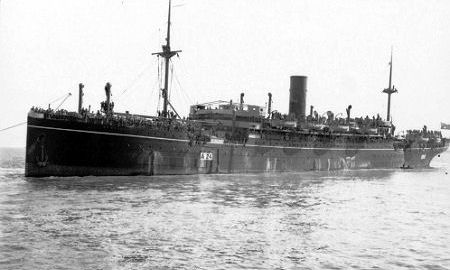
HMAT A24 Benalla departed Melbourne, on 29 October 1914, arrive Alexandria on 08 December 1914.
| In theory the voyage should have been a trip of
some luxury. The 11,118 tons, 14 knot Benalla had been delivered to Pand O,
for UK/Australian emigration via The Cape, in February 1913. She had been requisitioned
as the Australian Transport A24 in September 1914.
Interestingly, in 1927, the Benalla took the first load of steel for the construction of Sydney Harbour Bridge. Right: HMAT A24 Benalla Source: AWM Ref: PB0246 |
 |
The 8th Battalion was among the first infantry units raised for the AIF during the First World War. Like the 5th, 6th and 7th Battalions, it was recruited from Victoria and, together with these battalions, formed the 2nd Brigade. The battalion was raised in rural Victoria by Lieutenant Colonel William Bolton in the third week of August 1914 and embarked just two months later. After a brief stop in Albany, Western Australia, the battalion proceeded to Egypt, arriving on 2 December.
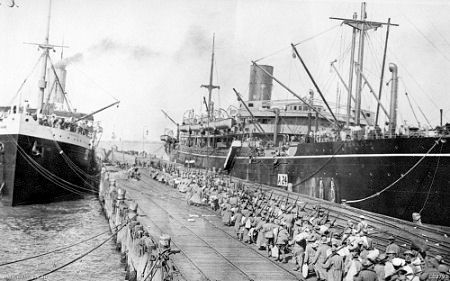 |
Left: Men of the 2nd Australian Infantry Brigade walking down the Port
Melbourne pier to embark on HMAT Benalla (A24) (right), and HMAT Hororata (A20) (left),
for service overseas.
Source: Australian War Memorial (AWM) Ref: C02793 |
Egypt
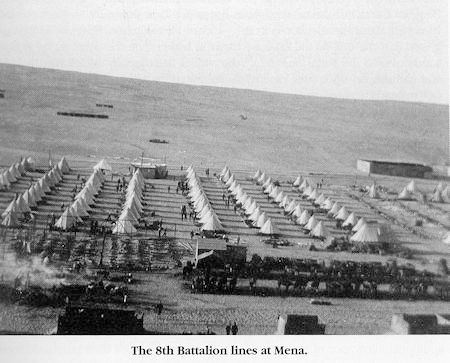
| The Benalla berthed at Alexandria wharf on 8 December 1914. The 8/Bn
disembarked and immediately boarded special troop train on the 100 mile (160km) journey
across the Nile delta to Cairo. The train arrived at 2030 hours amidst heavy rain and to
an evening meal of a cheese bun and a cup of cocoa. The battalion had to wait several
hours before being crammed into trams for the 12 mile (20km) journey to the sandy and
inhospitable Mena Camp, arriving in the early hours. From the 8/Bn lines could be seen a
100 foot (33m) cliff some 200m to the east, above which were pointed the tops of three
pyramids. Within a couple of days the training routine of drill, musketry, tactical
training and route marches, began.
Right: 8/Bn at Mena Camp Source: Austin |
 |
| By the end of January 1915, the troops were well practiced in advanced guard formation and attacks. In January 1915, a large Turkish force threatened the Canal and Cairo. On 4 February 1915, the 8/Bn were selected to be the Ismailia reinforcements with the excitement of moving up to the Canal. Operation Orders, later aborted, were received detailing half the battalion to be the advanced guard of a flying column to pursue the Turks across the western Sinai Desert. February was spent undergoing route marches, trench digging, attack and defence exercises. From these experiences, the 8/Bn cherished the belief that they had originated the famous nickname 'Digger Soldiers'. On 24 February 1915, the whole battalion was granted a holiday and Cairo was subjected to an invasion as the men had 'the best of times'. | 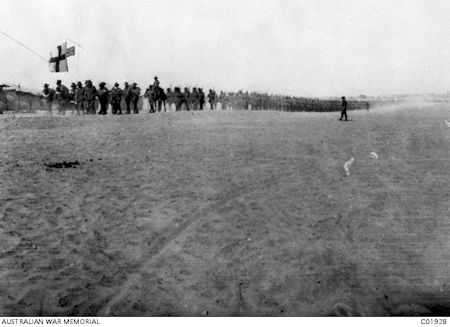 |
| Above: 8/Bn return to Mena Camp from their detachment to the Canal Source: AWM C01928 |
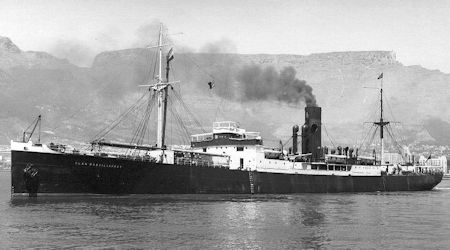
After the special Good Friday church service many of the men were granted leave to go into Cairo. This large influx of soldiers into the brothel streets of Haret el Wasser brought about the infamous First Battle of Wozzer' between the Australians and the Egyptians. On 2 April 1915 the festering bitterness regarding the activities of the liquor traders erupted into violence. However, it had already been decided to transfer the Australians to Lemnos as part of Hamilton's Mediterranean Expeditionary Force. On 4 April 1915, the 8/Bn struck camp at 2000 hours and marched into Cairo. The first troops reach Alexandria at 0800 on 5 April, where they were transferred to the small and dirty troop ship Clan Macgillivary. The ship sailed at 1700 hours on 8 April.A summary of John Reginald's war record reads:
To Gallipoli
On 05 April 1915 8th Battalion embarked to join MEF in the Gallipoli Campaign in MV Clan Macgillivary from Alexandria. Two days later, after experiencing a rolling ship in heavy seas, land was sighted and the Clan Macgillivary anchored in Mudros harbour. 4 JR was promoted to sergeant and served on Gallipoli from 25 April 1915 to the Evacuation. On 25 April 1915 he landed from the Clan Macgillivary and took part in the second wave ANZAC landings.
[...] the 8th Battalion which was on board the Clan Macgillivray, had been aroused at about 3.30 am, and commenced their breakfast of hot bully beef stew a half an hour later. The order to "Fall in on deck" soon had soldiers scurrying everywhere, particularly as some of the men were still eating their stew. 5Left: The 6447 ton Clan Macgillivary built in 1911 |
 |
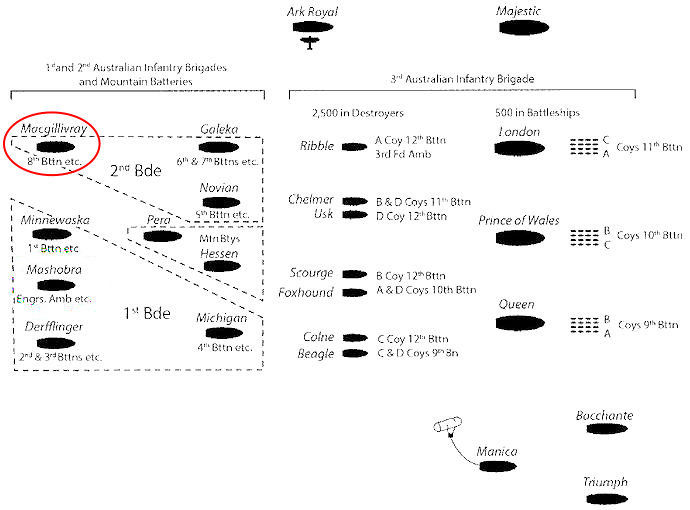 |
| Above: The Clan MacGillivary at the Gallipoli landings |
The original plan was for the 2nd Infantry Brigade to come ashore, immediately after the 3rd Brigade had safely landed. Colonel McCay's [Later Lt. General Sir James McCay commanding 5th Division at Fromelles] battalions were to quickly move into position on the left of the 3rd Brigade from Baby 700 feature to Hill 971, with the role of protecting the left flank as far north as Fisherman's Hut.
The companies quickly lined up on the deck and waited for further orders. The shelling from the accompanying battleships and the zing of stray enemy bullets passing overhead, reminded the men, now so strangely silent, that their war was about to begin in earnest. A British destroyer came alongside and the battalion climbed down the swaying rope ladders and filed onto her waiting decks. As the destroyer steamed closer to the shore, the men could see the scrubby hills in front of them. The destroyer stopped and the troops then climbed down into several barges being towed by a rowing boat commanded by a young Royal Navy midshipman. The tiny convoy was then towed over the glass-like water by a steam pinnace. 6
The 8th Battalion landed in three groups, the final companies landing at 10am. McCay ordered them to defend Bolton's Ridge, named after Lt. Col WK Bolton CO 8th Battalion, against a southern counter attack. Bolton's Ridge lead to the 400 Plateau, on which stood the Lone Pine. The 8/Bn were in position around 9am by which time 6th Battalion were advancing towards the third ridge objective. Despite the confusion of battle, two companies of the 8/Bn advanced and reached the shoulder to the south-east of Lone Pine and moved, in isolation, beyond Owen's Gully. The scrub gullies and spurs broke the troops into small parties, preventing the formation of an Australian line. In the late afternoon the scattered Battalion was withdrawn to Bolton's Ridge.
The men of B Company had "followed the Turk back inland for almost a mile over very hilly country - hills and dales covered with low prickly bushes." There was great confusion as the 8th Battalion tried to form a firing line while under enemy fire [...] ready to repel any counter attacks. 7
| By 1.30pm Col. McCay was seeking reinforcements to hold onto 400 Plateau and Lone Pine in the face of any major counter attack. However, reinforcements were not available. The scattered units on Knife Edge, were under shrapnel fire and begun to deepen their trenches. On several occasions the Australian moved their straggly line forward only to have to retire. At 4pm, McCay ordered the 8th Battalion to extend their line onto 400 Plateau itself to plug a gap in the brigade's position. Reinforcements arrived just before dusk to bolster the precarious position. The proposal to withdraw was rejected by General Hamilton. The 8th Battalion was told to 'dig' and defend the western part of 400 Plateau and the rear edge of the Wheatfield to the sea. Three attacks across the Wheatfield were made before dawn: the first was countered by rifle and machine gun fire, the second by a bayonet charge and the third by withering fire. The next morning the 8/Bn continued its consolidation, interrupted only by sniper fire. | 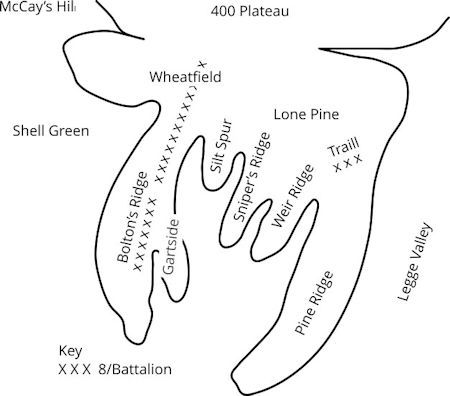 |
| Right: Map locating 8/Bn's positions on 400 Plateau |
Had Colonel Mustafa Kemel launched a major counter attack, the Australians were in danger of being thrown back into the sea.
On Monday 26 April 1915, despite snipping and shelling, the 8/Bn continued to consolidate their line aided by the arrival of three 18 pounders of 7th Field Artillery on Bolton's Ridge. On the night of 27 April 1915 the shrapnel fire from these guns cut swaths through the Turks attacking through the Wheatfields. On the night of the 29th, whilst the other battalions were relieved by the Royal Marines, the 8/Bn, being well organised, maintained their position being well supplied with wither, food and ammunition. The 8/Bn were relieved by the 11th at 09.30am the next day, moving to the reserve position on the beach in time for a swim. After a spell of fatigues, digging and swimming, the Battalion returned to the front, to the left of their previous position on the 30th.
During the five days of the landing the 8/Bn had lost 3 officers and 21 Other ranks (OR) killed, 8 officers and 136 OR wounded and 1 officer and 50 OR missing. 8
Second Krithia
Ten days after the landing, on 5th May, the 2nd Brigade was transferred from ANZAC to Cape Helles to help in the attack on the village of Krithia. The attack captured little ground but cost the brigade almost a third of its strength.
Ten days after the landing, on 5th May, the 2nd Brigade was transferred from ANZAC to Cape Helles to help in the attack on the village of Krithia. The attack captured little ground but cost the brigade almost a third of its strength. The Victorian battalions returned to ANZAC to help defend the beachhead, and in August the 2nd Brigade fought at the battle of Lone Pine. The battalion served at ANZAC until the evacuation in December.
The British landings around Cape Helles had also failed to achieve their objectives. Accordingly, 8/Bn Battalion received hurried orders to move by sea on the torpedo-boat destroyer Bulldog to land at Helles against the River Clyde at 0700 on 06 May and then digging in at Sedd el Bahr. From their vantage point, over looking lush rolling hills reminiscent of Victoria, the 8/Bn in reserve, watched both attacks of 07 May fail with considerable casualties. However, at 0900 on 08 May McCay ordered the 2nd Brigade to move forward equipped with extra ammunition.
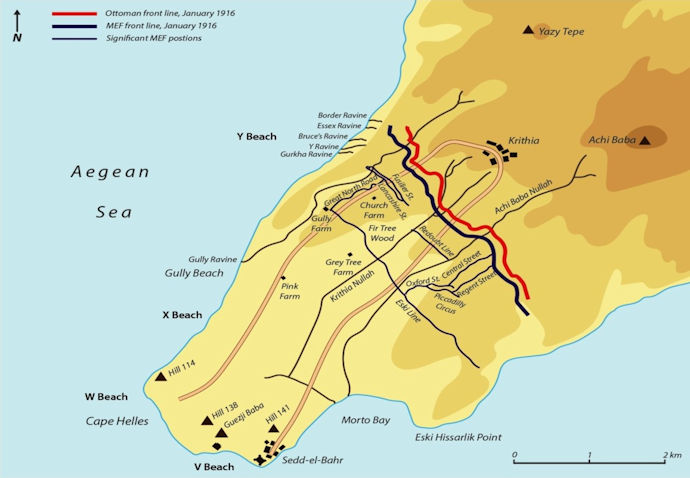 |
| Above: Helles Peninsular Source: Bean |
 |
Left: Location of Krithia
Key Dere - stream Nullah = dry stream bed ADS and CCS positions are approximate Based on: The New Zealanders at Gallipoli Chapter IX, The Battle of Krithia, Fred Waite 1919 (Accessed: 15 October 2019) |
The 8th Battalion, accompanied by the stretcher bearers of 2nd Field Ambulance, dug a defensive position in the rear of the brigade to the west of Krithia Nullah creek bed. Along with JR, the brothers Lyle and Tom were together. Following fruitless attacks, General Hamilton used precious reserves and ordered 2nd Brigade to make and unprepared attack at 1730 on the right flank and capture Krithia and Achi Baba, with the 8/Bn in reserve. Shortly after 1730 'A' Coy of the 8/Bn advanced in single file in support of the 6th. In the confused advance the other part of 'A' Coy and 'B' Coy found themselves in the centre of the brigade advance. By 1830 the attacked, which had, at 600 yards (550m), the furthest gain of the afternoon, had failed and by 1900 the troops were back in their trenches. During the night trenches were deepened in anticipation of a Turkish counter attack that never materialised. The aftermath of the charge left dozens of wounded men exposed to Turkisk rifle fire and searchlights. During the night 2nd Field Ambulance were busy bringing in wounded from No-Mans-Land and carrying them 6000 yards (5.5km) to the Advanced Dressing Station (ADS) and then on to Casualty Clearing Station (CCS) at Cape Helles. During the night of 11 May the 8/Bn Battalion was relieved by the Lancashire Fusiliers was completed at 0500 the next morning. The unit War Diary 0f 24 May 1915 (Accessed: 23 July 2017) records that Second Krithia coast 8th Battalion Killed 5 Officers 53 OR, Wounded 11 Officer 240 OR, Missing 1 Officer 73 OR, Total 17 Officers 371 OR, or 45.6% of the roughly 850 strong battalion.
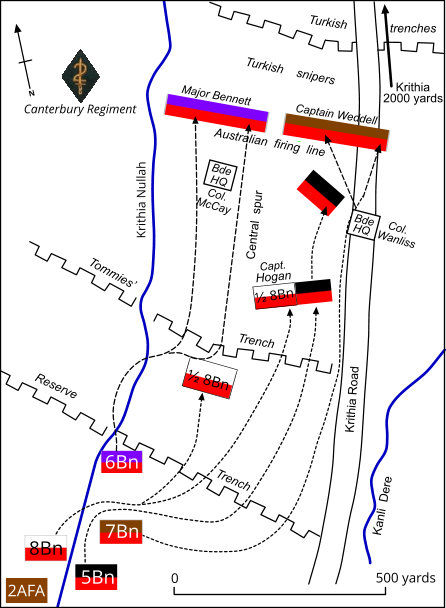 |
Left: Second Krithia - sketch of disposition of 2nd Brigade troops
along the central spur 08 May 1915
Adapted from Austin, The White Gurkhas The map shows the close proximity between the disposition of 8/Bn and cousin Tom's2/ Australian Field Ambulance. The period of reorganisation ended on 16 May when 2nd Brigade was ordered to return to Anzac on the Ionian. ...it should be acknowledged that the performance of 8th Battalion during the advance on Krithia was less than brilliant. There was great confusion as to where the companies would go, and this confusion was exacerbated by as series of vague orders issued during the battle. A quarter-master sergeant of a sister battalion observed about 100 men of the Eighth who remained under shelter during the entire battle, an action which badly tarnished the reputation of the 8th Battalion within the 2nd Brigade. 9 |
Back to Anzac
The Victorian battalions returned to ANZAC to help defend the beachhead.
The return of the 8th Battalion to the deadly hills of Anzac, provided little opportunity for rest. As soon as the men disembarked they were directed to a bivouac in White Gully. That evening the threatened Turkish attack required the entire battalion to ' stand to' several times during the night , following a heavy artillery bombardment by the Turks at 5pm. The Turkish attack on much of the Australian firing line commenced at 3am on 19th May, but the only successful incursion was at Courtney's Post. 10 The sound of continuous rifle fire which had the men on edge, abated an hour or so, and by 5am it was clear that the enemy attack had failed, and that 8th Battalion would not be required for any counter attack. 11
On 21 May an armistice was arrange for both Turks and Australian to bury their dead. The next day Lt. Vol. Charles Bond DSO assumed command. In between lightly trench digging in Shrapnel Gully and moving stores the Battalion acted as relief for those units at the front. It was a rota of two days at the front and two days on working parties based on their White's Gully bivouac. Steel's Post was one position garrisoned. It was there that the Battalion was inspected by Generals Birdwood and Walker on 15 June. The following day the Battalion took heavy shelling that damaged trenches and endured constant and accurate sniping that accounted for four dead and nine wounded. August the 2nd Brigade fought at the battle of Lone Pine.
The battalion served at ANZAC until the evacuation in December.
Lt JR BLACKMAN distinguished himself at Pozieres on 23 July 1916
'The HQ of the 7th and 8th Battalions was sited in the Gibraltar strong point, but even that concrete structure succumbed to the shelling, and two signallers were killed when part of the roof caved in. The constant shelling was now seriously affecting the fighting capacity of the troops in the forward trenches.' ... The terror of Pozieres is dramatically captured in a letter written to his parents by Reg Johanesen:
We lay in shell holes all night and as soon as dawn came they started to shell, and all hell let loose. They shelled us all day without a break and men we getting skittled everywhere. I shall never forget the cries of the wounded for Stretcher Bearers. We never had a moments spell from them until the time we were relieved. I could hear the cries for Stretcher Bearers in my sleep for weeks after. We were four days in that hell.
The officers and men of the 8th Battalion emerged with flying colours from what was their first real experience of war on the Western Front. The continual pounding of artillery was a far cry from the pitiful bombardments that had been the norm at Gallipoli. Some of the battalion members who distinguished themselves during the first attack on Pozieres included: … Lieutenant John BLACKMAN … The casualty lists emerging from Pozieres were cast a pall of gloom over Australian community, as the home front at last fully realised the high price of victory demanded.' 2
|
W6378/M755 500m 9/16 G S M.369 Army Form W.3121. 2nd AUST INF Brigade 1ST AUST Division 1st ANZAC Corps Date of recommendation 8.10.1916 |
|||||
|---|---|---|---|---|---|
| Unit | Reg. No | Rank and name | Action for which commended | Recommended by | Honour or Reward |
| 8thBatn | Lieutenant JOHN ROBERT BLACKMAN | Lieut. John Robert Blackman, a platoon Commander
of "D" Coy, who led the attack through Pozieres on 25/7/16. His coolness and
courage at a critical moment was a big factor in the success of this attack. He is
utterly regardless of danger and his example had a splendid moral effect on his men. He
led a party forward from our new line N. of Cemetary [sic] and established a Strong Post.
This was done under heavy fire.
A splendid young Officer who rose to great heights. He joined the Battalion in Aug. 1914 and has shown consistent good work ever since. He has not been away from the unit since its inception. |
Lt-Col. G. Coulter | Awarded Silver Medal for Bravery |
|
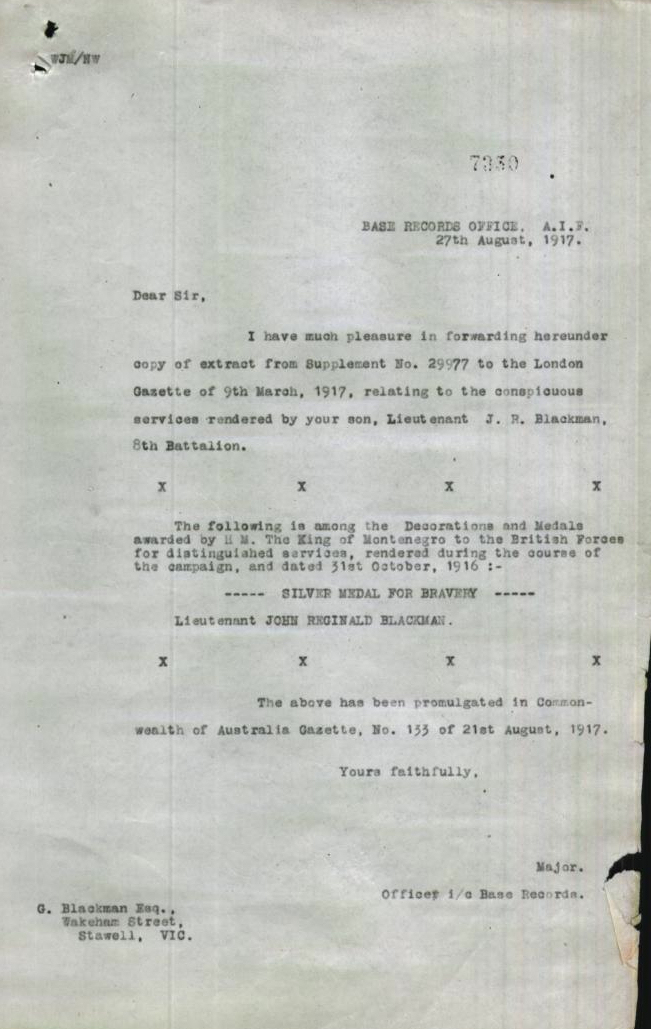 |
Clicking on the icon will open a full page A4 Records of Service citation sent to G
BLACKMAN in Stawell
Source: National Archives of Australia - Defence Service Records |
For this action Lt. Col. G Coulter, O.C. 8/Bn recommended John Robert [sic] for the Military Cross. However, this recommendation was amended to the 'Silver Medal'.
| This, a Serbian bravery medal, commonly known as "Milos Obilic
Medal for Bravery", was founded on 12 July 1913 by King Peter I, and awarded for
acts of great personal courage, or for personal bravery in the field. During the Great
War both Serbian national and allied military personnel received the award. The Bravery
Medal was worn suspended from the red ribbon. There was also a gold medal.
Since the Serbs fought on the Allies side their officers were officially decorated. It was
more a "honorary/diplomatic" decoration. 3
Note: Was the incorrect second name - a secretarial error? The nominal roll of the 8/Bn and of the AIF shows only one JR BLACKMAN. |
 |
|---|
|
SUPPLEMENT TO THE LONDON GAZETTE, 9 MARCH 1917, 2449 |
|
|
Decorations and Medals conferred by H.M. THE KING OF MONTENEGRO Silver Medal for Bravery |
| 2nd Lieutenant John Reginald Blackman, Australian Infantry. |
Above: A composite image of the London Gazette
A letter diary of Lieut. Pitt 8/Bn AIF - see Battalion photograph below
42nd Instalment Friday August 18th [1916]
Reveille 6 o/c. Moved out each man carrying a tin of water, to reserve trench in sausage gully. Relieved some of the 7th battalion. The shelling has been pretty severe this morning although they have left us alone. Our regimental MO and his orderly were burned by a bursting shell in the line today and both had to go away. We have a new Doc now and miss the old fellow who is very popular, being absolutely fearless. Rumours of a hop out tonight. Things here have altered considerably since we were here last. The line has now been pushed forward considerably and places which were very lively previously are now comparatively peaceful. Arrived at reserve trench about 5.30 and were sent with 100 extra rounds of SAA [small arms ammunition], 2 sandbags and 2 bombs and then made our way up a very much battered communication trench to battalion HQ, and remained near by until close on 9 o/c. Previous to this however Mr Blackman had got all the NCO’s together and told them that A "&" C company’s were hopping out. We moved and occupied the hop out trench they left and upon being assured that they had taken their objection we are to dig accommodation trench towards them for our lines. Our artillery opened up a heavy kettledrum fire about 9 o/c and we hopped out to occupy the trench A and C company’s had left, but when we got half way we were blocked and whilst waiting got the full benefit of the Hun barrage, no cover. Twice our boys went at their objection and twice failed to get it. All available men were then got lined for a third attempt, D coy, however still being kept in reserve and incidentally getting badly blown about but it was no good. Our officers did some splendid work especially Captain Lodge, Lt Mummery and Lt Bordwin?. Our casualties were very severe. Captain Hardy and Lt’s O’Kelly, Dabb and Rodda missing, Lt Doolen killed, Captain Lodge, Lts Beck, Tickle, Fox wounded and a large number of NCO’s and men killed and wounded. God knows to what the failure can be attributed, but machine gun fire seemed to come from totally unexpected quarters. The 7th battalion attempted assembly movement on our left with the same result. My platoon sergeant Sgt Whitfield was very badly wounded and I had to take over his duties. Sorry not much tonight as it took ages to work out the text and now my eyes are killing me.
Night all Regards 4
Mentioned in Dispatches - 21 January 1917
Mentioned in Dispatches (MID) is a military award for gallantry or otherwise commendable service. The award is relatively common, does not confer a medal and is relatively low in the order of precedence. It is a dispatch in a report from a senior commander, usually of an army, to his superiors, detailing the conduct of military operations. This report is published in the London Gazette. If a subordinate officer or soldier performs a noteworthy action included in the report, he is said to have been "mentioned in dispatches". In JR's case the Dispatch was from Sir Douglas Haig, GCB, Commander-in-Chief of the British Armies in France, perhaps to General Sir William Robertson, 1st Bt, GCB, GCMG, GCVO, DSO, Chief of the Imperial General Staff.
In the AIF, soldiers mentioned in dispatches received a certificate and were entitled to wear a bronze oak leaf on the ribbon of the campaign medal - JR's 1914-15 Star.
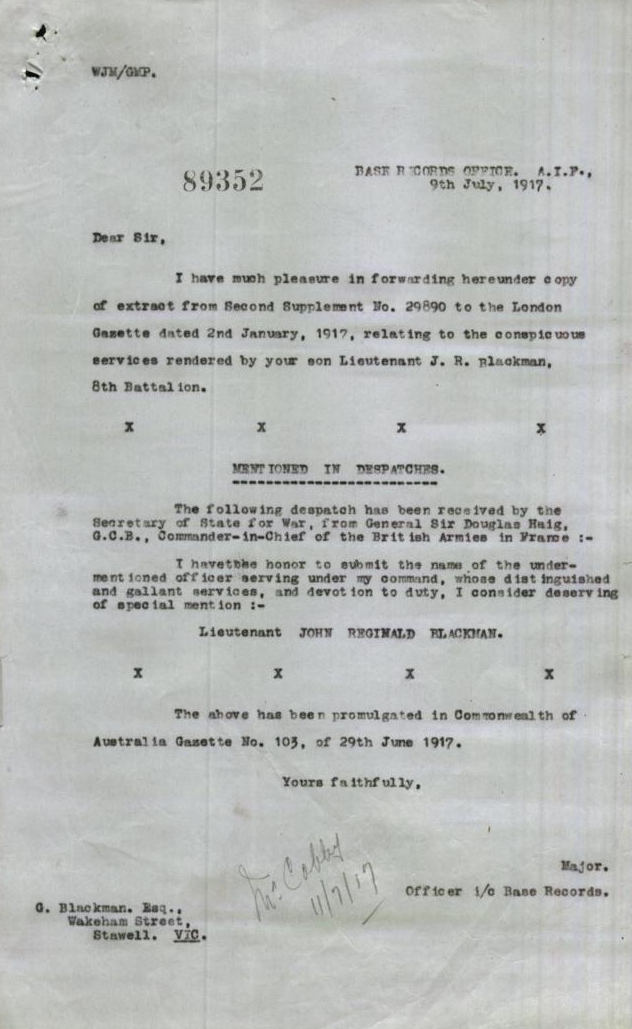 |
Clicking on the icon will open a full page A4 Records of Service citation sent to G
BLACKMAN in Stawell Source: National Archives of Australia - Defence Service Records |
Excerpt from London Gazette Supplement dated 26 October 1917 gives no details of why John Reginald won his Military Cross, which was Gazetted on 18 March 1918.
|
11110 SUPPLEMENT TO THE LONDON GAZETTE, 26 OCTOBER, 1917. |
|
| AWARDED THE MILITARY CROSS. | |
| AUSTRALIAN IMPERIAL FORCE. | |
| Lt. John Reginald Blackman, Infy. | |
The action at Polygon Wood - 20 September 1917
Bean's Official History makes a general references to the 8/Bn action when JR BLACKMAN won his Military Cross.
'The 8th Battalion, on far right, advance to the Green Line occupied in most parts only a few minutes. Everyone expected resistance at the points from which fire had been coming during the pause, and, if the Germans there had now been ready to come into the open, taking all risks, they could have caused great trouble. But the renewed impact of the overwhelming barrage had dissipated any such tendency. As the line advanced the enemy appeared glad to surrender.
From the row of pillboxes north of the Reutelbeek, Germans came running to give themselves up to the 8th Battalion.Right: Map location action of 8/Bn 20 September 1917 in the Battle of the Menin Road |
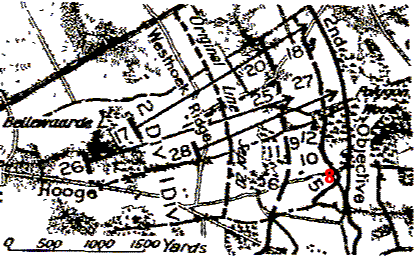 |
|---|
 |
This icon opens a Word document, adapted from Bean. It gives more information about the Battle of the Menin Road and mentions the part played by the 8th Battalion. |
|
|
This icon opens a Word document. The 8th, along with the 5th , 6th and 7th Battalions formed the Second Brigade of the First Division. This account, describing the part played by the 5th Battalion in the Battle of Polygon Wood and gives a flavour of what the 8th would have experienced. |
From the 12 September 1917, the Battalion moved up to the front in preparation for the attack.
| WAR DIARIES or INTELLIGENT SUMMARY | |||
|---|---|---|---|
| Date | Place | Time | Summary of Events or Information |
| September 12 |
LE DOULIEU | Battalion marched to VIEUX BERQUIM | |
| 13 | Battalion moved to REINGHELST | ||
| 14 | In camp at REINGHELST | ||
| 15 | / |
Moved to CHATEAU SEGARD } BUND DUG OUT } Narrative IN ACTION } Appendix |
|
| 22 | Battalion moved by Motor Vehicle to STEENVOORDE Bn HQ | ||
J.W. Mitchell Lieut. Col Commanding 8th Battalion AIF |
|||
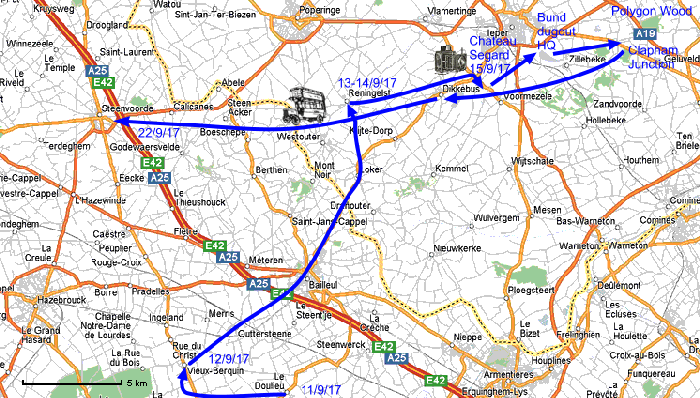 |
| Above: A map showing the approach march of 8/Bn toward Polygon Wood. Today Carlisle Farm (below) is just to the north of the A19 motorway, south of Polygon Wood map ref: 28NE3 J.15.b.2.3 - approximately under the 9 |
Hoverbox Photo Gallery - Cafe Belge and Chateau Segard
This feature does not function correctly on phones and tablets
|
| 1 | 2 | 3 | 4 |
|---|
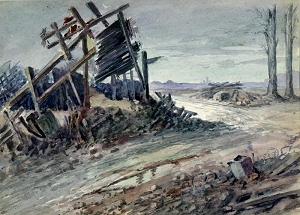
|
|
|
|
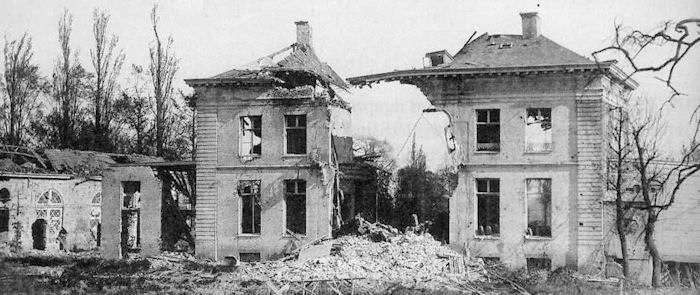 |
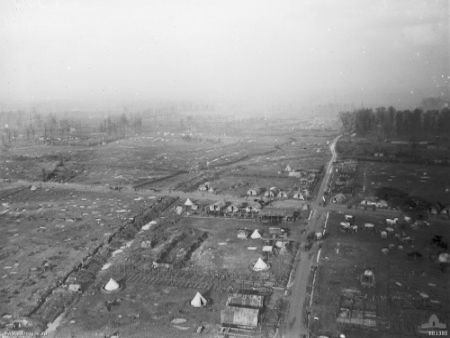
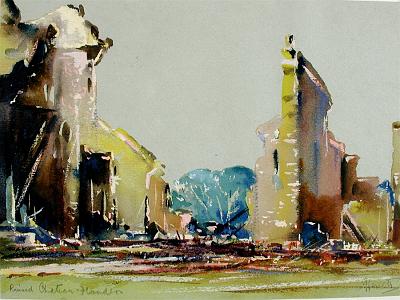
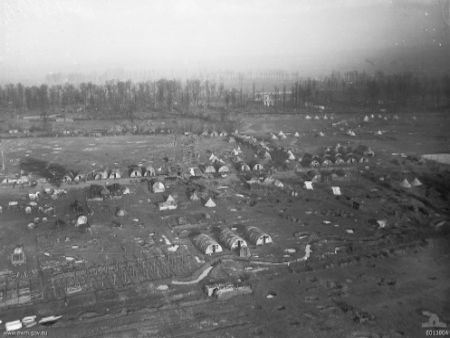
| Above: Chateau Segard, the HQ for many formations which fought
at Polygon Wood. It was severely damaged in the fighting of April 1918. 6 |
 |
| Above: A map, of unknown date, locating Chateau Segard and Cafe Belge - highlighted 7 |
The 8/Bn's War Diary and the medal citation gives more detail of Jack's Military Cross action. The Battalion's Battle Narrative records JR BLACKMAN's action, as the '1 Officer'.
| APPENDIX | |
| 8th Battalion A. I. F. | 19/22nd September 1917. |
| -:-:-:-:-:-:-:-:-| SUMMARY OF OPERATIONS |-:-:-:-:-:-:-:-:- | |
| 20/9/17. | ... At Zero Hour 3-1/2 Coy's had cleared CLAPHAM JUNCTION and 3 Coys were on the Tape Line. The whole Battalion moved when the Brigade moved forward but owing to the heavy casualties and delay caused by Troops not being quite into position direction was not too well kept up to the FIRST OBJECTIVE and touch was lost with the Battalion on our right; this, however, was gained before reaching Sec nd [sic] Objective and maintained throughout the Operation. At CARLISLE FARM 1 Officer and 4 men attacked and captured a Strong Point from which they had been subjected to Machine Gun Fire. In this Post they secured as prisoners 4 Officers and roughly 30 Other Ranks, together with 3 XXXXXXXXXXXX Machine Guns. ... |
| 23/9/17 | RIFLE STRENGTH -
CASUALTIES - RIFLE STRENGTH - |
19/9/1917.
21 Officers 740 Other Ranks. Killed 4 " 40 " " Wounded 8 " 160 " " Missing 13 " " D. of W. 6 " " 22/9/17 11 Officers 521 Other Ranks. 8 |
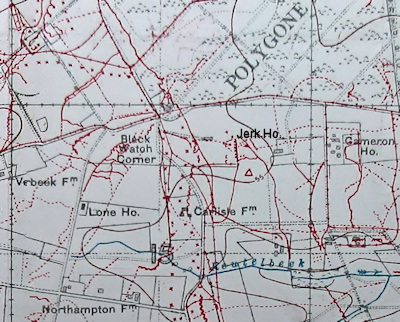
| 2nd Brigade Preliminary Orders, Appendix XC, recognised Carlisle Farm at J.15.d.3.9,
as a strong point on the Green Line.
It was to be captured and converted into an Australian strong point.
Right: Trench map of Carlisle Farm - German trenches in red Source: Gheluvelt 28 NE3 of 30-6-17, WO297/738, TNA, Kew, London Click on the image to open an A4 landscape map of the wider area showing movements and positions 9 |
 |
| Appendix XCIV
Headquarters 2nd Aust. Inf. Bde. 23rd September 17. |
| Narrative of operations from 19th to 21st September 17. ------------------------- |
| -:-:-:-:-:-:-:-:-| SUMMARY OF OPERATIONS |-:-:-:-:-:-:-:-:- |
| 20th Septr. 21st Septr. |
0540 0642 0816 0835 0910 0930 1100 1226 1620 1646 1707 1900- 2400 |
Zero hour, our BARRAGE opened punctually quite
dark. 6th Bn. reported RED Line captured. 6ht Bn. HQ at L. Farm RED Line consolidated 8th Bn. reports progressing with our rear BLUE Line - casualties slight - prisoners good number - one battery 18 pndr. shooting short - Lift barrage 200 yards. RSM 2nd Aust. Div. reported their men consolidating on BLUE Line, Left Bde [inc. 8th] reports troops for attack on GREEN Line ready on BLUE Line. Left Bde. in touch on both flanks - Casualties slight 8th Bn. report lift whole barrage 500 yards, will have to retire if not done soon - in touch with YORKS on right. 8th Bn. report consolidating GREEN Line, estimated casualties 4 Off. 100 O'Ranks F.L.O. report enemy massing at J.10.C and J.16.A.5.6 [Cameron House] F.L.O. report enemy removing guns at J.16.A.10.65 [Cameron House] Artillery informed 8th Bn. report Patrol ascertained that flares were sent up in forward position by not by them 8th Bn. report having taken S[trong] P[oint] J.15.B.8.1. move barrage to JUT FARM Relief by 1st Aust. Inf. Bde 7th and 8th Bn and Brigade Hqrs to DICKEBUSCH report 8th Bn. / having sent up S.O.S. 1910. As there was considerable movement of hostile troops in sections in artillery formation in front of sector - S.O.S. had previously been sent up by Bde. on left - Artillery broke up what certainly appeared to be an organised counter attack. |
| Above: A compilation of 2nd Brigades Battle Narrative War Diary Appendix XCIV 10 |
Despite JR's efforts on 20 September, when the German counter attacked at Carlisle Farm on 25 September, the British 98th Brigade line was thrown into considerable turmoil causing a retirement to a line through Verbeek Farm.
This see-saw of events failed to disturb Plumer's stage-by-stage advance on Passchendaele and Broodseinde ridges. 11
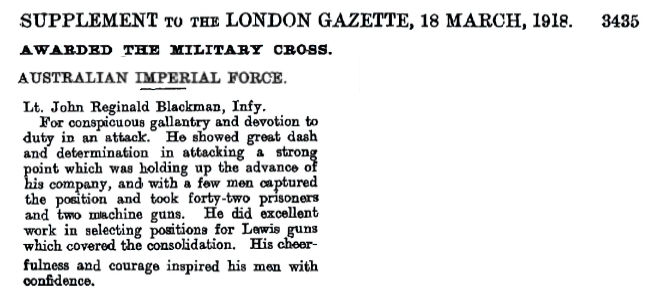 |
| Above: A composite image of the London Gazette |
| The Age (Melbourne, Vic.), Saturday, 25 May 1918, Page 17 |
|---|
|
DEEDS OF GALLANTRY. |
| The Ararat Advertiser , Tuesday 09 July 1918, Page 2 |
|---|
| LOCAL AND GENERAL NEWS George Blackman, of Stawell, received word from the Defence Department that his son had been wounded, and that he would be advised later of particulars. Yesterday morning Mr Blackman, senr., received a cablegram from his son, stating that he had been wounded in the shoulder (not serious), and was in the Bologne (sic) Hospital. |
Page 3 of The Ararat Advertiser and Chronicle for the Stawell and Wimmera Districts on Saturday 15 December 1917 gave a broad account of JR Blackman's life and the action leading to the award of the Military Cross.
 |
| CAPTAIN J. R. BLACKMAN.
AWARDED MILITARY CROSS.
The many Ararat friends of
Captain J. R. Blackman, who was in the employ of Messrs Cust and Scholes, of Ararat,
when he enlisted, will be pleased to learn that he has been awarded further honors,
he having received the Military Cross. Previously he had received the award of the
Montenegrin medal. Sir William Birdwood in command of the Australian troops, forwarded
him the following congratulatory letter:- "1st Anzac Corps, 8th
October, 1917. Dear Blackman, - This is a line to congratulate you most heartily upon
the award to you of the Military Cross, which you have fully deserved for your good
work in the attack on Polygon Wood on the 20th September. I well know what
dash and gallantry you displayed in attacking a 'pill box,' which was holding
up your company's advance, and which you captured, together with 42 prisoners and
two machine guns. Later you showed good judgment in the selection of positions for
your Lewis guns, which covered the consolidation of your final objective. With good
wishes for the future, yours sincerely, W. Birdwood." |
captured numerous
prisoners, machine guns and a battery of field guns. This is the first time we have
taken any big gun, so you can guess the old battalion is very proud of itself. The
weather is rather wet and cold and winter appears to be setting in, and I can tell
you we don't relish the idea of it after our experience of the last one. I expect
to be going on leave to Paris for four days. Yesterday I received word that I had
been awarded the Military Cross for the fight on 20th September, also a letter of
congratulation from our chief. |
Out of the line
| On the morning of 29 January 1918 the Battalion marched to new billets at
Doncaster Camp, Locre. Despite the weather being cold and the ration being supplemented by
'bully beef' the Battalion football team won the brigade championship.
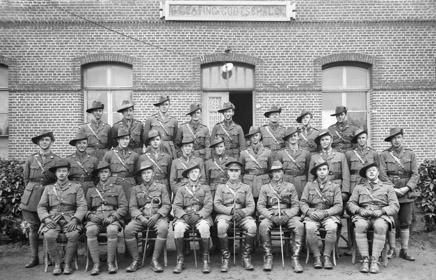
It provided a restful break for the battalion, with the major event being the provision of 373 pairs of socks. A series of group portrait of the officers of the 8th Battalion, photographed 20.2.1918 at the Locre Hospice. Source: Austin R, ibid, page 176-179 |
 |
|---|
| Left to right, back row: Lieutenant (Lt) A. W. Finlayson MC; Lt S. W.
Young MC MM; Lt J. G. Pitt; Lt F. W. Tickle MC; Lt R. W. Dowling MC; Lt R. Woodhouse. Middle row: Lt J.G. Evans MC; Lt T. Anderson MC DCM; Lt R.V. Andrewartha; Lt J. Bourke; Lt P.A. Waters MC; Lt P.G. Perkin; Lt J.L. Foott; Lt W. D. Joynt VC; Lt R.G. Hutson; unidentified; Lt W. D. N. Hooper; Lt S. Young; Lt H. G. Whitton; Lt W.G.M. Claridge. Front row: Captain A.G. Campbell DSO; Lt J.R. Blackman MC; Lt H.Fenton; Major J.H.P. Eller DSO; Lieutenant Colonel J.W. Mitchell DSO; Maj. later Lt Col) J.C.M. Traill DSO MC; Lt A.D. Temple MC; Honorary Capt E. Freeman MC. Photo source: AWM EO1811 |
Raiding party
'At midnight on 1st April [1918], a large raiding party led by Lieutenant [JR] Blackman, with Lieutenants Tickle, Murdoch, Davis and 54 men left the lines and attacked Whiz Farm [Wytschaete, Belgium]. The raid achieved total surprise and resulted in six enemy who were captured and the death of about 40 Germans. Blackman's party attacked a pill box containing 23 enemy, of who 20 were killed, and three captured. ... The patrol's casualties were not light, with five men wounded, three of whom died of their wounds and the Intelligence Officer, Lieutenant Davis, missing. Once Blackman ascertained that Davis was missing, he immediately took out another patrol across No Man's Land to the enemy position, in a fruitless search for his fellow officer. Blackman searched along the wire until close to day break when he was forced to return to the battalion position.' 12
The follow extracts from the War Diaries of 8th Battalion, relating to the months of March to October 1918 illustrate JR BLACKMAN's activities.
| WAR DIARIES or INTELLIGENT SUMMARY 8th Battalion |
|||
|---|---|---|---|
| Date | Place | Time | Summary of Events or Information |
| 17/3/18 | Dezon Camp | Lt LA Blackman appointed to command 'C' Coy during the temporary absence of Capt. Fox. | |
| 29/3/18 | RIDGEWOOD WHIZ FARM Wytschaete [Belgium] | 12am | Lt JR Blackman MC and Lt JG Murdock left No 3 post south to patrol of 10 OR and ------ forward to reconnoitre WHIZ FARM. Patrol some what hampered by enemy MG fire but succeeded in going v. close to enemy's advanced post. The Farm appeared to be very strongly garrisoned. On returning patrol appeared followed by hostile patrol. Lt. Blackman promptly arranged an ambush fire, sending Lt Murdock back to his own lines with half the patrol so as to draw the enemy. |
JCM Traill Major [D.S.O., M.C.] 2/IC 8th B n. |
|||
Wounded in action
At this time Lieut. JR BLACKMAN MC was officer commanding 'B' Coy. The Battalion was preparing to move from Sercus is west-south-west of Hazelbrouck to the Forward Area at Merris, east of Hazelbrouck.
| SECRET OPERATION ORDER No.32
Ref Maps Sheets 36a and 27 SE 1/200008th Battalion |
APPENDIX 9 Headquarters 8th Battalion |
| 1. 2. 3. |
On 27th inst. [June] 8th Battalion to move to relieve 3rd
Battn in Forward Area. Coys will be fallen in ready to move at 7.30a.m. passing starting point at C.5.C.2.4 at 8.40 a.m. Order of march will be Battn. H.Q. A, B, C, & D Coys Transport |
On 27 April 1918 Joynt records the location of JR Blackman being in the line into the support trenches at an unspecified place near Borre just east of Hazebrouck presumably in defence of the railway junction. After a week in the reserve unit - which was an organised Company with Major Traill in Command, Blackman as Second-in-Command, two other officers and myself as platoon commanders.
From midnight 28 June 1918 Lt. Col. JW Mitchell D.S.O., Commanding Officer 8th Battalion, sent out two Officer patrols to assess his new front. In general the wire was secure and satisfactory and an unused enemy listening post was discovered. One patrol was fired on by enemy machineguns and two men were wounded. 13
| WAR DIARIES or INTELLIGENT SUMMARY 8th Battalion |
|||
|---|---|---|---|
| Date | Place | Time | Summary of Events or Information |
| 24/6/18 | Sercus | Captain Fox returned. | |
| 28/6/18 | Merris W.22.D.9.7 |
Battn H.Q. and R.A.P. located at W.22.D.9.7 Dispositions of Coys is as follows:- 'A' Coy - Line Right From F.1.A.3.6 to X.25.C.4.1 'B' " - Line Left " X.25.C.6.2 to X.25.D.9.9 'B' " - Support [sic] 'C' " - Reserve Attached to Battn. H.Q. are 1 Officer and 10 O.R. of the American Army |
|
| 28/6/18 | Merris W.22.D.9.7 |
6am | Our artillery, trench mortars and machine guns opened fire to give support in
operation which was being carried out on our right. Enemy artillery replies putting a
barrage about our front line. A few men wounded, including 1 Officer. Enemy appears very
alert - his machine guns and snipers being very active during the night. Lieut. JR
Blackman MC and 4 OR evacuated wounded. Morning - very dull and rain fell at intervals. 14 |
JCM Traill Major [D.S.O., M.C.] 2/C 8th Bn. |
|||
Joynt continued his history of 8/Bn by recounting the Battle of Chuignes Valley, where he won his Victoria Cross, on 23 August 1918. Chuignes is a village south of the Somme opposite Cappy. He includes a nominal roll of officers involved in the battle, and JR was not included. It is assumed he was still on hospital leave. 15
Lt.Col. Mitchell was so concerned by his position that, on 29 June 1918, he sent a signal to Division saying that 'unless [they] wire otherwise' he would advance his right and centre-right line at midnight, about 250 yards, to deny the enemy the high ground overlooking his position. Perhaps this highland was the position of the snipers.
It is difficult to know whether this attack took place:
Admitted 3rd London General Hospital
JR BLACKMAN's service record records he was admitted to a Lines of Communications Hospital on 29 June 1918 before being transferred, on 30 June 1918, to the 8th Red Cross Hospital which, from January 1918, was based at Boulogne.,16 suffering from a severe gun shot wound to the left shoulder. Was he snipped? And if so, he was very lucky that it was not a heart shot. He transferred to the 3rd London General Hospital on 15 July 1918. On 14 August JR's next of kin were informed that he was convalescing.
| Soon after War broke out No.3 London General was mobilised at the Royal Patriotic School, Wandsworth Common. 17 The CO Bruce Porter agreed to take on a group of men as RAMC orderlies, all members of the Chelsea Arts Club, who were either too old, or unfit for other military service. Thus, he accumulated a wonderful collection of artists, sculptors, writers and poets, and laid the foundations for a hospital journal 'The Gazette.' This magnificent building has been restored and converted into residential and commercial accommodation and is now known as the Royal Victoria Patriotic Building. | 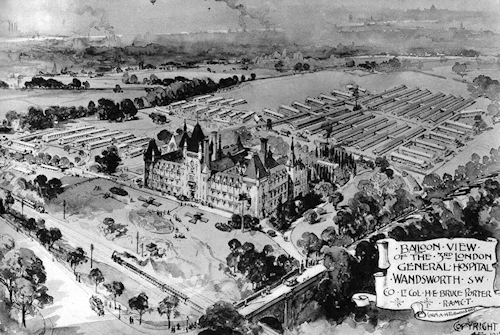 |
| Above: 3rd London General Hospital in 1916 |
Convalescing at Cobham Hall
JR was transferred to convalesce at Cobham Hall on 07 August 1918.
 |
| Above: Map locating Cobham Hall, Kent where JR spent time
convalescing. Note its close proximity to Wilmington, his father's birth place.
Debbie Roberts writes: 'I do know that he convalesced at Cobham Hall in Kent, and rumour has it that he finally got in touch with some of his family from Kent, as later in our family history, a lady arrived in Australia and presented a photo of JR and [cousin] Lyle that had been taken in England. No one seems to know who this person was, or how they fit in.' |
Cobham Hall is steeped in history. It dates back to the 12th century, when the manor house was granted by Henry II to a French knight.
| Elizabeth I visited on two occasions and Charles I spent a night of his honeymoon at Cobham. Charles Dickens often passed through the park on his way from his home at Gads Hill to partake of the ale at the Leather Bottle Inn in Cobham village, frequently stopping to visit his friend, the Earl of Darnley. Joshua Reynolds and Gainsborough were regular visitors, and the Duke of Wellington once famously lost his hat during a shooting party in the grounds. | 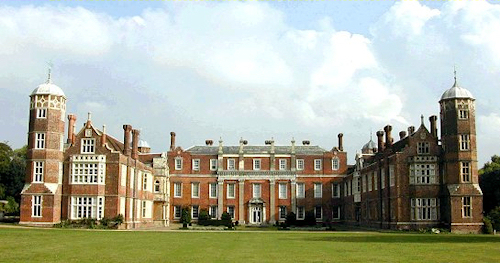 |
| Above: Cobham Hall, Kent |
The Hall has been home to a priceless collection of old masters, to recuperating Australian servicemen in the First World War, and to the Ashes, which were originally a gift to the 8th Earl and stood on the Library mantelpiece until his death.
Captain JR BLACKMAN MC, returned to Australia on 17 February 1919
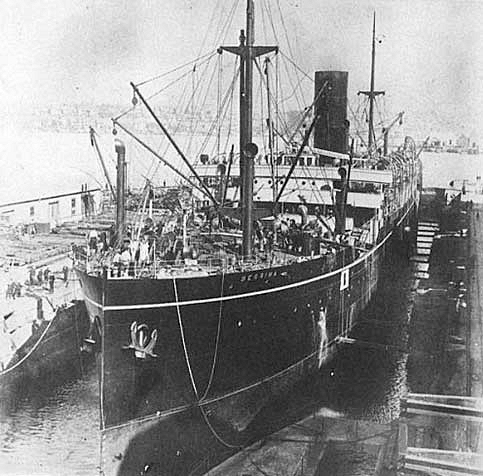
| On 02 January 1919 JR left England for return to Australia per the Hospital
Transport Berrima arriving in Melbourne on 17 February JR's HMAT A35
Berrima docked in Melbourne on 17 February 1919, with returning Australian troops
and the wounded Captain JR BLACKMAN. His service termination occurred on 18 April
1919 being medically unfit for active service.. 18
Right: HMAS Berrmina |
 |
| In August 1914 the P.O. Berrima became an armed merchant cruiser but, after the Rabul campaign, she was paid off in October and converted to a troop transport. Berrima continued to work under the liner requisition scheme until 18 February 1917, when she struck a mine in the English Channel off Portland and was beached and later repaired. Berrima was returned to commercial service 24 March 1920, and was sold to Japanese ship breakers in September, 1939. Right: HMAT Berrmina as a troopship. Date unknown |
 |
On 26 February 1919 George BLACKMAN wrote to RP Touhcher(?) MLA, at State Parliament House, Melbourne seeking a refund for two first class rail tickets purchased 'in order to proceed to Melbourne to meet Captain J.R. BLACKMAN MC. In the reply of 3 March 1917, his letter was forwarded to another department.
Discharge
On discharge he was entitled to the Military Cross, the Montegnegrin Silver Medal and,. the 14-15 Star with MID cluster, the British War Medal and the Victory Medal.
His post war life
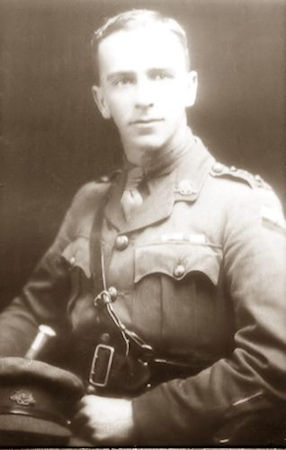
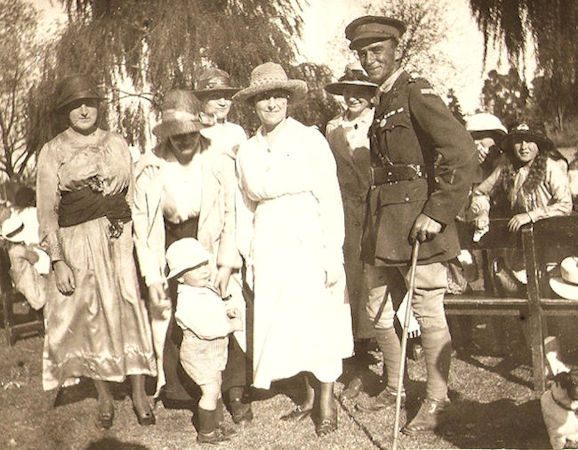
JR and Marianne lived in a house in Collings Street, Ararat with the train line opposite. (It is likely that this is now Birdwood Avenue - General Sir William Birdwood first GOC Australian Corps, preced. JR's occupation was listed as grocer, return in to his pre-war occupation at the local variety store known as Cust and Scholes. He worked there before the war and returned after the war. His brother Joseph BLACKMAN had a shop in Ararat of his own. He was also a grocer.Right: Post war studio portrait of JR BLACKMAN 19 Below: Capt. JR BLACKMAN's return to Ararat: dated between his return to Melbourne on 17 February 1919 and his demob on 14 April 1919. A wound stripe is visible on the left sleeve. 20 |
 |
 |
On 11 August 1931 at Ararat at the annual meeting: of the Ararat Legacy Club, Mr; J. R. Blackman was appointed president, Messrs. J. M. Lyle and C. McKay vice-presidents, Mr. C, C Murray secretary. Mr P. J. Sullivan treasurer, Mr. J. Dunnachie sergeant at arms, Mr Bethell Liaison Officer, Mr. R. Fairnie editor of the bulletin. During the evening the ex-president, Mr. Roy Stewart, was the recipient of a gold badge and a past-president's certificate.
Footnote
The town of Ballarat published a book outlining the war service of its soldiers who appear to be linked to the trees of Ballarat's Avenue of Honour (Remembrance Drive). Trees in the Avenue of Honour were planted by the Lucas Ladies (Lucas Clothing Factory) in honour of all the men from Ballarat and district who fought in the Great War. Not just the ones who died. ( Source: Karen Walsh) The following entry, an addition stapled in to the book, is attributed to Lyle A. BLACKMAN Tree No 114. However, errors suggest that this entry could refer to Captain James R BLACKMAN, along with the photograph (see below) attributed to Private Leslie Crompton BLACKMAN.
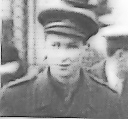 |
The record details: 'Lyle A BLACKMAN, born at Miners Rest, was a captain in
the 8th Battalion. In the War he served in Egypt, Gallipoli, England and France.
He was wounded on 28 March 1918 and admitted to 3rd London General Hospital, returned to duty and was wounded on a second occasion at Pozieres and admitted to the Le Treport Hospital, then again to the 3rd London General Hospital. Captain BLACKMAN was awarded the Military Cross for gallantry and devotion to duty, at Buckingham Palace in August 1918.' Quite what can be attributed to whom remains to be decided. |
|---|---|
| Above: JR BLACKMAN |
Electoral Rolls
Before the War, The Australian Electoral Roll 1903-1977, available on Ancestry, recorded Jack's homes and occupations in the 1912-14 Roll as:
During his War service, Jack was registered at the same address.
In the 1919 Roll, after returning from the War, JR was recorded:
In the 1921-1931 Rolls, Jack had married and changed his address but had returned to his trade as grocer:
The 1934-39 Rolls have a change of address:
In the 1943 Roll, though at the same address, Beth had joined them:
In the 1949 Roll, Beth had left home and Lola was recorded, though crossed through on 09 March 1950:
In 1954 the couple were recorded at their Collings Street address.
By the 1967-68 Rolls Jack had retired:
In the 1972 Roll Marianne had died and Jack was living alone:
In the 1972, the last available Roll, Marianne had died and Jack was living alone:
His death
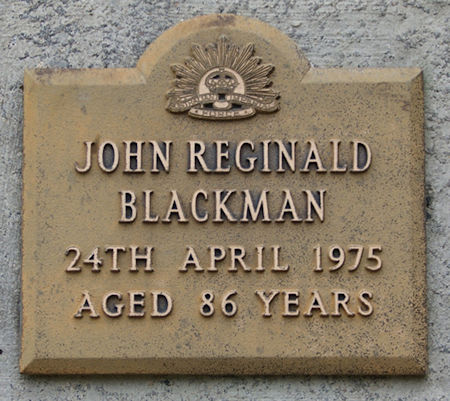
| Jack died in Glenelg South, on Adelaide's coast, on 24 April 1975, perhaps at
the home of his daughter Mrs A. McLean (Lola) and was cremated on 28 April 1974
at Centennial Park Cemetery, Mitcham City, SA.,
Right: JR Blackman's grave marker |
 |
On 27 June 1975 the Ararat Legacy commemorated the life of Captain John Reginald Blackman MC. It gave an account of his war both on Gallipoli and in Flanders. The obituary describes his return to his former occupation as a grocer, his active part in the Returned Servicemans League and being the a founder member and third president. of the Ararat branch of the Ballarat Legacy Club. He served The Legacy, in many guises, through the depression with self-sacrificing devotion being an inspiration and example to fellow members. The survivors of his 8th Battalion voted him the best officer they had served under during those four war time years. Sympathy was expressed to his four daughters and their family. Formed on 28 September 1929, Legacy’s role, as it was in 1929 is the same today; the care, guidance and encouragement of the families of those servicemen and servicewomen, who through death because of their service, are no longer there to give those benefits. Ararat Legacy today has twenty four active legatees from the areas of Ararat, Avoca, Beaufort, Stawell and Willaura, looking after over 100 war widows.
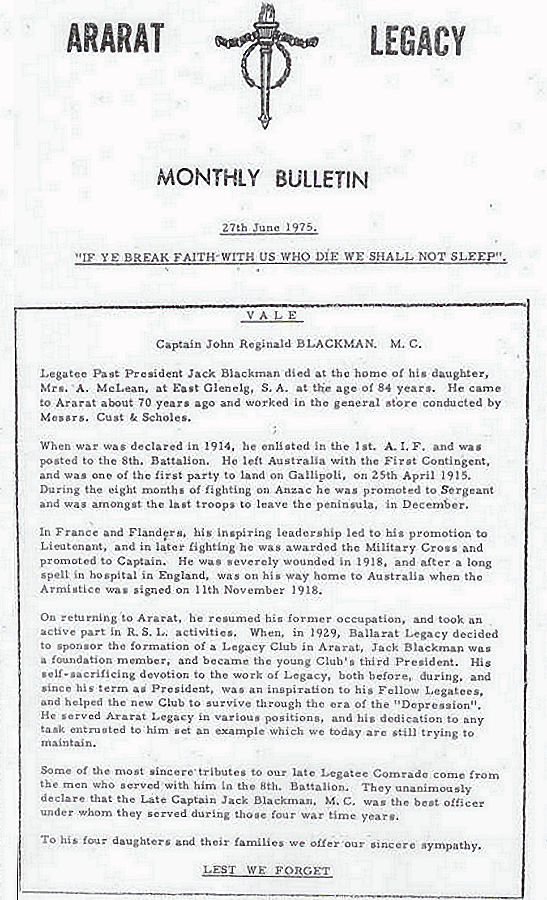 |
| Above: JR Blackman's obituary The Ararat Legacy |
John Reginald's third child, Lola
His daughter Lola was born in 1923. In 1953 she married Alfred Parker McLEAN in Strathalbyn, SA. It seems that the McLean's were quite well known as early wheat farmers. Jack's brother-in-law, Alfred Henry MOULDEN was born in Strathalbyn.
End notes
Source:
With special thanks to the Shileds/Bugden Public Members Tree
 |
 |
 |
|
| This page was created by Richard Crompton and maintained by Chris Glass |
 |
Version A2 Updated 30 September 2023 |
|